Tag: India

  • Exclusive: Prabha Parameswaran is Group President, Colgate-Palmolive

    By  A Correspondent

    Prabha Parameswaran
    Prabha Parameswaran

    There has been much reason to sport a Colgate smile this Ganesh Chaturthi with the news coming in that Prabha Parameswaran has been appointed Group President, Global Innovation Group & Africa-Eurasia. She assumed the role in August after having been President, Colgate Europe since 2016.

    Parameswaran joined Colgate-Palmolive in 1995 in India and progressed through a series of marketing positions in India, the global oral care and toothbrush divisions in Asia and Mexico. She next led Colgate’s business in India as Vice President & General Manager starting in 2012 and, in 2014, became President, Colgate Africa/Eurasia. Parameswaran has worked in advertising in India at HTA (later J Walter Thompson and now Wunderman Thompson) and Lintas India (now Lowe Lintas).


  • Reliving ‘Mauka Mauka’ as the stage sets for the Cup!


    By Sanjeev Kotnala


    Mauka Mauka’ was an iconic communication engaging and entertaining cricket lovers 2015  to 2018. So, it is natural for the reference to come up in May 2019.


    On May 23, as I was  the 2019 election results on TV, the seat swing with BJP winning was unprecedented. Someone teased the Congress supporters in the family with ‘Mauka Mauka’. It said it all.


    I know it is a bit early.  India only plays Pakistan https://www.icc-cricket.com/teams/men/20/pakistan/overview on Sunday, June 16. A date most of us have marked in our calendar. As it is early


    In the discussion, Star Sports’  current ICC #WorldCup2019 communication was compared with ‘Mauka Mauka’. And one can say  the cricket enthusiast in me wants another ‘MAUKA MAUKA’. However, the professional me knows in spite of intense rivalry, a serialised communication like ‘Mauka Mauka’ is simply not possible.


    One remembers the launch TVC. The full song #Won’tgiveitback.


    https://youtu.be/K-nNFWdBtB8


    In the last video, the Pakistan supporter with his arsenal of crackers lands at the Star Sports studio. It continued in many forms in Champion’s trophy, T20 World Cup 2017 with a lot of consumer generated spoofs and somewhere died finally with the Asia Cup. The CGS is already on like this SAPHIRA and films by Seven Pictures.


    And when you are at it:  watch this too. Spoofs are far more entertaining and touch a chord.


    The current World Cup has 10 teams. It’s an open tournament with a team playing all the other teams. The Top 4 qualify for the semi-final spot. And the chase is on.

    The current communication ‘Cricket Ka Crown Hum Le Jayenge’ by Star Sports is entertaining and exciting.


    The extension ‘Tum Suro Karo Hum Aate Hai’ promises that the broadcaster is not going to leave any Mauka of engaging the audience. And there is my hunch that ‘mauka-mauka’ will make an appearance sometime at least in the social media.  Meanwhile, the rivalry intensifies at every level


    I am really waiting for this ICC World Cup 2019 communication from Star World to take some twist and keep entertaining.

    …………………………


    It is cricket time. I must mention that I am enjoying the simple yet very celebratory communication from ”DREAM 11′. Dhobhighat, Bush and  Keys, all of them one relates too.


    And when it is cricket- the AMAZON campaign Chonkpur Cheetahs will always be remembered.  I missed them. I always feel that there was a lot ,more potential to this series than what we have seen.


    https://youtu.be/mM16sepxvZo


    Sanjeev Kotnala is a senior marketer, strategy consultant and educator. He writes weekly for MxMIndia. The views here are personal


  • Achche Din…! Zenith forecasts 15% AdEx growth in 2019


    By A Correspondent [to be updated by 9.30am]

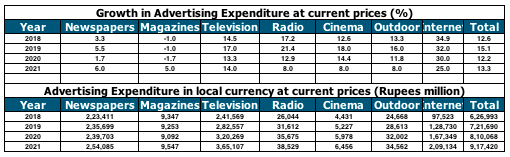
    Media agency network Zenith forecasts that adspends for India in year 2018 will close at Rs 62,699 crore. And the total AdEx for India will see an increase of 15% and climb up to Rs 72,169 crore in 2019.

    India remains one of the fastest growing economies, with strong GDP growth of over 7%, led by reforms in sectors such as retail, infrastructure, manufacturing and services, notes a Zenith communique, adding: “Given that a significant part of the population is below 30 years of age, there is likely to be continued consumption-led growth with less reliance on export-led momentum.  This should give a boost to businesses across the board, ad investments and government initiatives.”


    Furthermore, the release adds: “However, 2018 has also seen the depreciation of the rupee and oil price volatility. The overall expectation is that oil prices will stabilise, giving Indian consumers more disposable income. Indian consumer confidence continues to remain relatively high. “

    According to Tanmay Mohanty, Group CEO at Zenith, many parts of India were experiencing digital transformation, led by mobile. This will accelerate categories such as banking, financial services, healthcare, entertainment and sports, travel and lifestyle. “2019 is the year of the Indian General Elections. These and the State Elections will boost marketing spends.  Additionally, the Cricket World Cup and the Indian Premier League will drive growth.” Mohanty said.

    “Digital will continue to accelerate both in reach and consumption.  Television – linear and catch-up will be on an upward curve. The expectation for radio is that it will digitise aggressively in response to streaming services while both cinema and out of home (OOH) will innovate and increase reach-led investments. Print will thrive on regionalisation.” Mohanty added.

    According to a similar report released last year (Dec 4, 2017), total AdEx for India was estimated to climb up to Rs 58,422 crore, growing  at 8.4% in 2018, led by television. This estimated has been bettered by the figure of Rs 62,699 crore as quoted earlier for adspends in 2018.

    Meanwhile, online video and paid search are driving the growth in global adspend, as advertisers focus on personalised and targeted communications, according to Zenith’s Advertising Expenditure Forecasts, published today (December 3).

    This is what the rest of the summary, as provided to the media, notes:

    With advertisers now able to use these channels to target with pinpoint accuracy and serve personalised messages, they are increasing both the efficiency and effectiveness of campaigns. Between 2018 and 2021, online video advertising will grow at an average of 18% a year, twice as fast as other forms of internet display advertising and well ahead of any other channel.

    Paid search is not growing as quickly in percentage terms – it will grow at an average of 7% a year over this period – but in dollar terms will contribute even more to global growth than online video. The application of AI techniques, better location targeting, integration with commerce and the rise of ‘in the moment’ search are all making search more effective for advertisers. We forecast that between 2018 and 2021, online video advertising will grow by US$20bn, while paid search will grow by US$22bn. Between them these two channels will account for 60% of the extra ad dollars added to the market over this time.

    Online video and television are more important to brand-building than ever

    Advertisers commonly use online video together with traditional television, combining television’s broad reach and immersive experience with online video’s ability to target and optimise frequency. Taken together, these two media are becoming more important to advertisers’ brand-building campaigns. Their combined share of adspend in ‘display’ media (i.e. all media except paid search and classified advertising) has risen from 46.2% in 2012 to 48.4% this year. By 2021 we expect television and video to have a combined 48.8% share of global ‘display’ – a higher share than television ever achieved on its own. Taken together, television and online video are working harder for advertisers than ever before.

    Global e-commerce advertising starts to accelerate

    E-commerce advertising – advertising that sits alongside and within search results and product listings on e-commerce sites – is well established in China, but is only just starting to get going globally. Zenith believes it has the potential to transform the way brands convert customers online, and add about US$100bn of new money into the global advertising market.

    E-commerce advertising has risen from 0.8% of all adspend in China in 2009 to an estimated 18.2% this year, driven by investment by companies like Alibaba in turning e-commerce into advertising revenue. Until recently, e-commerce platforms outside China have largely focused on direct sales to consumers at the expense of advertising, but that is now changing. Amazon generated nearly US$5bn in advertising revenue in 2017 as a whole, and in Q3 2018 its ad revenues grew by 122% year on year. Other shopping platforms are following suit by investing in their own advertising activities.

    Globally, e-commerce advertising is about as advanced as it was in China at the end of the last decade. Amazon accounted for 0.8% of global adspend in 2017, the same proportion that Chinese e-commerce occupied in 2009. If e-commerce follows a similar path globally to the one it followed in China, it could account for 18% of global adspend by 2027. That’s equivalent to over US$100bn in today’s ad market, representing a huge revenue opportunity for the platforms, and a whole new way for brands to reach customers at the point of purchase. This money typically comes from brands’ commercial teams rather than their marketing teams, from budgets set aside for negotiating with retailers. It is therefore new money to advertising, and should expand the market without cannibalising money spent elsewhere.

    Steady growth in global adspend to continue

    We estimate that global advertising expenditure will grow 4.5% by the end of this year, boosted by the Winter Olympics, FIFA World Cup and US mid-term elections. Growth will then remain steady and positive for the rest of our forecast period to 2021, at 4.0% in 2019, 4.2% in 2020 and 4.1% in 2021.

    Central & Eastern Europe will be the fastest-growing region, with average growth of 6.3% a year between 2018 and 2021, driven by continued strength in Russia, which is growing at 6.8% a year and accounts for 39% of the regional total. Asia Pacific is next, growing at an average of 4.9% a year, or 5.7% a year excluding Japan. India is the stand-out growth market here, growing at 13.5% a year from US$9.7bn in 2018 to US$14.2bn in 2021, when it will become the world’s eighth largest advertising market, entering the top ten for the first time. India has huge potential for further growth, with advertising taking up just 0.3% of GDP, less than half the Asia Pacific average of 0.7%

    Young advertising markets like India are playing an ever-more-important role in driving global growth in adspend. ‘Mature’ markets – by which we mean North America, Western Europe and Japan – account for 62% of global adspend this year, down from 75% ten years ago. ‘Rising’ markets – by which we mean all markets apart from the ‘Mature’ ones – will contribute 54% of the growth in global adspend between 2018 and 2021, increasing their share of global expenditure from 38% to 40%.

    “E-commerce advertising is poised to transform the advertising market in much the same way that paid search did in the last decade,” said Jonathan Barnard, Zenith’s Head of Forecasting and Director of Global Intelligence. “It could bring US$100bn in new money into the market over the next ten years.”

    “Brands are transforming their businesses to take advantages of the new digital opportunities available to them,” said Vittorio Bonori, Zenith’s Global Brand President. “Better segmentation and targeting, personalised creative and direct transactional relationship with consumers are combining to drive brand growth.”


  • Havas Media retains integrated media mandate for Kohler

    By A Correspondent


    Havas Media India has successfully retained Kohler’s integrated media business following a multi-agency pitch. The agency has also been entrusted with some of its PR duties. The account will continue to be handled out of Gurgaon office.


    Anita Nayyar

    Speaking on retaining the business, Anita Nayyar, CEO, Havas Media Group, India and South Asia said: “It is a matter of pride that Kohler has once again chosen Havas Media. The pitch has further entrenched our relationship with Kohler. It has been a great association so far and we will ensure we provide more integrated and meaningful solutions for the brand in the coming year.”


    Sandeep Singh, Director Marketing, Kohler India commented, “We are happy to partner with Havas Media yet again. We have been working with them over the last few years. We feel that they understand the market and will continue to be an effective partner in the years to come.”


    Mohit Joshi

    “Kohler is a dynamic brand which thrives on style and innovation. We are confident that we will keep up the great work that we have been doing over the years for the brand. We eagerly look forward to innovate together and drive the brand forward,” added Mohit Joshi, Managing Director, Havas Media Group, India.


  • Sony BBC Earth to launch on March 6

    By A Correspondent


    N P Singh, CEO, Sony Pictures Network, India, Paul Dempsey President, Global Markets, BBC Worldwide, Saurabh Yagnik, EVP and Business Head, Sony English Cluster

    The Sony BBC Earth channel will go live on March 6, 2017 at 8pm.The premium factual entertainment channel is being launched by MSM Worldwide Factual Media, a joint venture between Sony Pictures Networks India (SPN) and BBC Worldwide.


    The channel will bring award-winning, premium factual content from the BBC and will feature acclaimed film-makers and storytellers like Sir David Attenborough, Steve Backshall, Ben Fogle and Gordon Buchanan.  It will be available in both SD and HD in English, Hindi, Tamil and Telugu.


    As a run-up to the launch, the channel has created a brand film with its ‘Feel Alive’ Ambassador Kareena Kapoor Khan Said NP Singh, Chief Executive Officer, Sony Pictures Networks India on the launch: “Sony Pictures Networks is known to create compelling and differentiated brands across all genres that it operates in. Nurtured as a JV partnership, Sony BBC Earth, combines the strengths of both partners; including fascinating content, estimable brand equity and superior sales and distribution prowess.This gives Sony BBC Earth a distinct positioning and watchability. I am confident that this channel will be amajor player in its category.”


    Added Paul Dempsey, President Global Markets, BBC Worldwide:“Our relationship with Sony has been a long one, built in the first instance on our production business, and one that has since grown across all key areas of BBC Worldwide’s operations.  We partner with them to bring top programmes like Sherlock, Orphan Black and Top Gear on AXN to our fans in India, and now, this joint venture which is a pioneering model for us. By working with a respected local partner of the caliber of Sony Pictures Networks, we look forward to bringing BBC Earth’s world class content to a new audience who we know has a huge appetite for premium factual programming.”


    Said Saurabh Yagnik, EVP and Business Head, English Cluster, Sony Pictures Networks India, while expressing his bullishness on the channel: “SPN’s philosophy is to create brands based on deep consumer understanding. We have worked extensively with viewers to sharpen our insights into what they want and have synergised this understanding with our compelling content and storytelling. Our brand positioning of ‘Feel Alive’ captures the emotion of subliminal happiness which viewers experience when they consume our content. This has been brought to life through a clutter-breaking film featuring our ‘Feel Alive’ ambassador, Kareena Kapoor Khan – whose persona embodies positivity, happiness and full of life demeanour that naturally blends with what our channel and its content stands for.”


  • Vizeum wins media AoR for Warner Bros Pictures India

    By A Correspondent


    Vizeum has been appointed as the media AoR for Warner Bros Pictures, India. The agency won the account following a multi-agency pitch that was carried out over a period of six months.


    Following the win, the first movie from the Warner Bros slate that Vizeum worked on was The Conjuring 2, which did decent box-office collections in its genre.


    Shripad Kulkarni

    Commenting on the win, Shripad Kulkarni, Managing Director, Vizeum India said, “We are delighted with this win. We look forward to our partnership with Warner Bros Pictures. We are confident that we will add tremendous value to the theatrical marketing of their movies.”


    He further added, “Vizeum’s philosophy of focusing on ‘simple strategy to address client’s business objective, activating it brilliantly’ guided our audience connection approach. Our media solutions will singularly aim at delivering box office success, by seamlessly integrating offline and online efforts around one PR-able idea.”


  • Concept PR wins multiple new biz mandates

    By A Correspondent


    Concept PR is on a high growth path and has signed up a series of new clients and has started ramping up operations.


    The agency’s new client acquisitions, in the face of multi-agency pitches, include the sports portfolio of IDBI Federal Life Insurance, spanning cricket, grassroots football and distance running, realty giants, K Raheja Corp, Sheth Corp and Century Real Estate, India’s first e-ticketing company Kyazoonga, telecom major Matrix Cellular that provides telecom solutions for Indian travellers going abroad, and MedGenome & Manipal Hospital in the healthcare sector.


    “We are happy that our teams have been doing well and winning businesses across verticals, from genomics, e-commerce, telecom to healthcare to sports and BFSI. These wins underline the core strength of our consultancy, which is to craft strategies that enhance a client’s desired image while delivering quantifiable benchmarks. We are on road to aggressive growth and are ramping up our teams across cities,” said Ashish Jalan, Director and CEO, Concept PR.


    Some other companies who signed up contracts with Concept PR in the recent past include ThatsPersonal.com – India’s leading adult health and wellness e-commerce site, Groupe SEB – world leader in small household equipment, Tookitaki – a decision support system (DSS) company head-quartered in Singapore, and SciGenom Research Foundation, a not-for-profit organization working to promote science in India through research and education.


    Concept PR, with 10 owned offices and effective service network covering the length and breadth of the country, services clients across verticals such as BFSI, Infrastructure, Real Estate, Healthcare and Pharma, Sports and Lifestyle, IT, Telecom, Legal and Tax, apart from handling pre-IPO build up, IPOs and road shows.


  • Achche din aagaye hain, Consumer confidence rises in India: Nielsen study


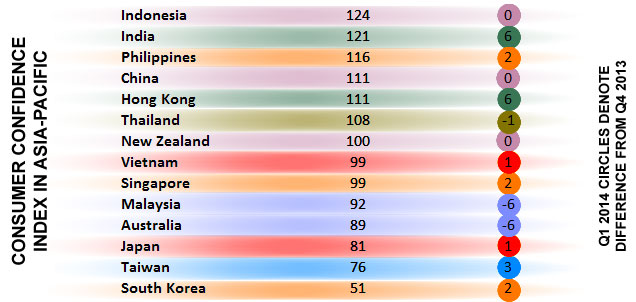
    It appears the ‘achche din’ have already arrived in India. Consumer confidence in Asia-Pacific increased in eight of 14 markets in the first quarter even as it was flat in three and declined in three markets. The region’s biggest quarterly index increase was six points, in both India (121) and Hong Kong (111). India’s index rise returns the score to a fourth-quarter 2012 level after several quarters of declining performance.


    Consumer confidence in the Philippines (116) and Thailand (108), as well as Indonesia (124) and China (111), were among the highest index scores of the 60 countries measured.


    “In India, the overall perception about the economy has achieved a steady state as many believe that things cannot get worse and that investments will pick up as the Indian fiscal year-ends and most households expect the positive impact of year-end bonuses,” said Piyush Mathur, president, Nielsen India. “However, inflation continues to be a challenge, and there is a sense of cautious anticipation about the outcomes of the world’s largest democratic election. Despite these factors, discretionary spending intentions are slightly more buoyant than previous quarters, as is typical at the end of the financial year, and in good time for the summer holiday season.”


    “In China, we see stronger confidence among respondents in Tier 2 and Tier 3 cities, compared with those in Tier 1,” said Yan Xuan, president of Nielsen Greater China. “In these lower tier locations, consumers have higher average salaries than their counterparts in lower tier locations, and they have less work and life pressures than those living in Tier 1 cities. Consumers in the middle tier cities also demonstrate a greater willingness to purchase more premium products. The continued rise of the Chinese middle-class throughout the country bodes very well for China’s goal to grow its GDP through more domestic consumption, rather than solely rely on infrastructure investment and export.”


    Discretionary saving and spending intentions in the Asia-Pacific region increased across all categories measured. The region boasted the most prolific savers, with 67 percent putting spare cash into savings accounts-an increase of 7 percentage points compared to fourth-quarter 2013. Investing in shares of stocks and mutual funds (38%) was also up 7 percentage points in the first quarter. Spending intentions increased for new clothes (+6 percentage points), home improvement projects (+6pp), holidays/vacations (+4pp), out-of-home entertainment (+3pp) and new technology (+3pp), compared to fourth-quarter 2013.


    Meanwhile, global consumer confidence returned to a pre-recession level with an index score of 96 in the first quarter-the highest score since first-quarter 2007, according to consumer confidence findings from Nielsen, a leading global provider of information and insights into what consumers watch and buy.


    The global index score represents a two-point increase from fourth-quarter 2013 and a three-point increase from a year ago (Q1 2013). The Nielsen consumer confidence index measures perceptions of local job prospects, personal finances and immediate spending intentions. Consumer confidence levels above and below a baseline of 100 indicate degrees of optimism and pessimism, respectively.


    Regional consumer confidence was highest in Asia-Pacific with an index score of 106, a one-point increase from the previous quarter (Q4 2013) and a three-point increase from a year ago (Q1 2013). North America posted the largest quarterly increase of five points to reach the optimism baseline of 100-the highest level since 2007. The Middle East/Africa region increased four points to 94, and Europe rose two points to 75, compared to fourth-quarter 2013. Latin America reported the only quarterly regional consumer confidence decline, falling one point to 93.


    In the world’s biggest economies, consumer confidence increased six points in the U.S. (100), remained flat in China (111), increased one point in Japan (81), increased four points in Germany (99), increased eight points in France (59) and increased three points in the U.K. (87).


    “With global consumer confidence at a seven-year high, it marks a significant milestone for the longest recession since the Great Depression,” said Dr. Venkatesh Bala, chief economist at The Cambridge Group, a part of Nielsen. “A global sentiment moves to one of cautious stability. As recovery continues, signs of optimism are increasing.”


    The Nielsen Global Survey of Consumer Confidence and Spending Intentions, established in 2005, measures consumer confidence, major concerns and spending intentions among more than 30,000 respondents with Internet access, in 60 countries.


    In the latest round of the survey, conducted Feb. 17 – March 7, 2014, consumer confidence increased in 60 percent of markets measured by Nielsen-up from 43 percent the previous quarter (Q4 2013). Indonesia (124) reported the highest consumer confidence index score for the fifth consecutive quarter, which was flat compared to fourth-quarter 2013. Croatia and Italy each reported the lowest consumer confidence scores (45), an increase of one point each compared to the previous quarter. Egypt (87) and Switzerland (104) reported the largest quarter-on-quarter increases of 11 and 10 points, respectively. Ukraine (56) reported the biggest quarterly decline of seven points.


    Text of the report is based largely on the Nielsen Global Consumer Confidence report  that MxMIndia sourced from Nielsen India


  • @India, living in China: Burson-Marsteller finds out

    By A Correspondent


    When everything else, or so it seems, is “Made in China”, why should India’s Twitter handle not originate from there? The fact that it has not happened by design is – or should be – a source of embarrassment for the Incredible India peddlers, for this is a strange fact unearthed by Burson-Marsteller – that the @India account is owned by an Indian person living in Guangzhou, China.


    The public relations and communications firm has released the second part of its “Twiplomacy” study (http://twiplomacy.com), looking specifically at country branding on Twitter. The study shows that only 9 governments out of 193 UN member states own their country name Twitter handle.


    In the case of @India, the account owner shares pictures from his daily life and has made it clear that his Twitter handle is not for sale. With respect to other social media channels, India is one of just 19 YouTube channels owned by the tourism office.


    The accounts of @GreatBritain, @Israel, and @Sweden are the most significant examples of country promotion on Twitter. @GreatBritain is part of the ‘Britain is Great’ campaign launched in March 2012 to highlight everything that is great about the United Kingdom.


    @Israel is the country’s official Twitter channel, maintained by the Foreign Ministry’s Digital Diplomacy Team. The account is one of the most followed country accounts with more than 66,000 followers and serves as the focal point for Israel’s government Twitter activity.


    The Twitter accounts of @AntiguaBarbuda, @Barbados, @Lithuania, the @Maldives, @SouthAfrica, and @Spain are run by their respective official tourism organisations to promote tourism in each country.


    However, three out of five country accounts are either protected, dormant, inactive, or suspended and almost half of the 71 remaining active accounts are tweeting an automated news feed broadcasting news about the country.


    “Looking at the findings it becomes clear that few governments and tourism organisations have understood the power of country branding and marketing on Twitter,” said Matthias Lüfkens, head of the Burson-Marsteller EMEA Digital Practice. “There is a huge opportunity for countries to use Twitter as part of their communications to engage with a large and growing audience.”


    Data used was taken in November 2012 looking at the Twiter handles of the 193 UN member countries. Burson-Marsteller used Twitonomy (http://twitonomy.com) to analyze tweeting patterns and the Twitter history of each account.


    To access the complete analysis of these findings, visit: http://twiplomacy.com/country-promotion.


  • Anchor: 6 reasons why networking sites appeal to Indians

    By Adam Sachs


    1. India is a very young country. It has one of the youngest proportioned demographics in the world, even of the BRIC nations.


    2. There are over 500 million young people in India and all are looking at an opportunity to interact and know others.


    3. More Indian women are going to college and are more educated than ever before. The literacy rates have increased from less than 10 per cent to more than 50 per cent today. With education, comes freedom and the desire to make personal choices for themselves, one of these being who they are going to spend their time with.


    4. The Indian population is one of the fastest growing Internet populations in the world. According to Mckinsey, youngsters in aspiring countries drives the adoption of online services, and the level of their engagement with online activities such as social networking. In fact their online activities often exceed that of their developed country counterparts.


    5. The socio-cultural dynamics around relationships and marriage in India are changing very rapidly. This change is resulting in Indians seeking out solutions which can help them meet like-minded individuals, have fun experiences, and form real-life relationships. They are ready to experiment and meet prospective people outside their community and family circles


    6. Indians are getting married later. There are fewer arranged marriages and far more love marriages. Young adults in India are now interested in having relationships with multiple people before getting married. According to our survey, on average, Indian young adults have 5-6 relationships BEFORE getting married.


    Adam Sachs is CEO, Step Out


  • Havas Media launches Meaningful Brands study

    By A Correspondent


    Havas Media has come out with findings of its research that suggests that 20 per cent of brands have a notable positive impact on our sense of well-being and quality of life. Some of the findings also suggest that majority of consumers are willing to pay 10 per cent more for socially and environmentally responsible goods in India and China and 95 per cent and 85 per cent say they trust companies with a responsible or social profile more than those without in China and India respectively.


    This is the fourth yearly study done by Havas Media, which started initially with a study on sustainability and has evolved further to studying Meaningful Brands.


    What is intriguing is that for the second year running, Havas Media found that most people would not care if 70 per cent of the brands ceased to exist. Further, it argues, that the existing approaches to building and measuring brand value are out of date. As a direct response, Havas Media has launched ‘Meaningful Brands’, a global framework that offers a new index, analysis and proprietary tools to measure and build brand value in the context of today’s demanding environment.


    This innovative global undertaking that covers India and China in Asia Pacific enables, for the first time, to connect brands with our quality of life and well-being. It does this by measuring the perceived impact of brands on our personal wellbeing – their influence on factors such as our health, fitness, happiness, values, social relationships, financial security, lifestyles and habits – and our collective well-being, that is, how brands help to improve communities, societies and the environment.


    Speaking to MxMIndia, Vishnu Mohan, CEO of Havas Media Asia Pacific, said: “The findings suggest that the brands in the emerging markets like Asia have a much more positive impact and score higher on trust as compared to western market. It would have been believed that vice versa would be true but this study shows that the future of brands is higher in emerging markets like India. My interpretation is that valued brands are those that have values too. Hence those brands that are considered meaningful also have been performing well on the stock index.”


    The research was carried out from March to June 2011 across 14 markets – France, Spain, UK, Germany, Italy, USA, Mexico, Brazil, Colombia, Chile, Argentina, China, Japan and India. The research took into account the views of 50,000 consumers via online panels. Mr Mohan explained that the plan is to include more markets and consumers to make it more robust.


    The findings of Meaningful Brands analysis are especially relevant for marketers in Asia. It clearly shows the seriousness with which consumers in Asia look at the social, ethical and environmental aspects of a brand. As a region, which is growing at a rapid pace, the findings provide us a huge opportunity to create the context that promotes the growth of meaningful brands. Companies and brands operating in our region can play a big role in transforming the lives of millions of people and contribute to the progress of their societies.


    Some of the key consumer trends in China and India include:


    • 74 per cent and 62 per cent say they would pay 10 per cent more for socially and environmentally responsible goods in China and India (highest globally, aside from Chile).
    • Information and expense are the main barriers to socially responsible consumption, with credibility being another key issue in both markets.
    • 84 per cent in China feel it’s the responsibility of companies rather than the government to solve social and environmental issues (compared with 64 per cent in 2009) and 76 per cent in India, with a similar increase, since 2009.
    • 95 per cent and 85 per cent say they trust companies with a responsible or social profile more than those without in China and India respectively.
    • Empowerment is down in China: 64 per cent feel that they can make a difference to how companies behave and this is static in India at 71 per cent.
    • But so is cynicism: 71 per cent feel that most companies are only trying to be responsible to improve their image and only 12 per cent trust what companies say in this area.


    The analysis suggests that the next generation of brands will come from emerging economies. People in fast growing economies, such as Asian and Latin American markets, record a stronger and healthier relationship with brands. The proportion of brands making a notable positive contribution to our lives increases to around 57 per cent in China, 30 per cent in Latin America, compared to 8 per cent in


    European markets, where people tend to be more skeptical and less engaged with brands. In the US, it’s 5 per cent. By contrast, the situation in developed economies is the opposite. Brands in these regions are no longer seen to improve people’s quality of life.


    Meaningful Brands helps us to develop this type of relationship by understanding exactly what people expect from brands. It also helps us track how successful companies are responding to these needs by understanding how these companies are contributing to our wellbeing, both as citizens and individuals, and how they communicate these values to us. It also shows us that there’s a big business opportunity for brands which are able to satisfy consumers by creating wellbeing in the context of their new values, expectations and local market realities.


  • Advertising on multi-channel TV can double reach

    By A Correspondent


    CASBAA, the association for digital multi-channel TV, content, platforms, advertising and video delivery acrossAsia, has released a first-of-its-kind reach and frequency analysis of the definable returns on media investment in multi-channel TV advertising.


    Commissioned by CASBAA and executed by global media agency Universal McCann, the study measures the benefits of allocating variable percentages of a US$1.75m TV budget on multi-channel TV and Free-to-Air (FTA) in seven key Asia-Pacific markets:Australia, Hong Kong, thePhilippines,India,Malaysia,SingaporeandTaiwan.


    “The clear advantage of advertising on multi-channel TV becomes evident when simulating real-life budgeting scenarios via robust Peoplemeter data. The numbers demonstrate that multi-channel TV makes undeniable fiscal sense when reach and return on investment are optimized,” said Simon Twiston Davies, CEO, CASBAA.


    “This powerful new look at TV data allows us to better understand that for a regional campaign, switching a portion of the budget onto regional multi-channel TV channels means we can deliver higher reach at a lower cost-per-thousand for our clients,” said Chris Skinner, Managing Director, Universal McCann Hong Kong.


    Highlights from the study (audience: 4+):


    In the seven markets measured, a 100 per cent allocation of a $1.75m budget to FTA results in a campaign viewed by just 33 per cent of the TV population.


    Campaign reach increases from 33 per cent to 56 per cent when half of the TV budget is redistributed to multi-channel TV from FTA only TV allocation.


    A 50/50 combination of FTA and multichannel TV sees total impressions (gross number of times a commercial is viewed) multiplied by 2.5 times from an FTA only schedule: increasing from 537 million to 1.4 billion.


    Using multichannel TV lowers cost per thousand (CPT) by up to 60 per cent in a 50/50 multichannel TV/FTA combination versus an FTA only schedule.


    “Campaigns that allocate part of their terrestrial TV budget to multi-channel TV reap the rewards,” added Twiston Davies. “The research tells us that you can effectively double your reach, increase the viewing frequency of ads, and lower your CPT – all with no extra investment.”


    A similar trend was also monitored when the demographics data was analyzed to reflect key age, gender and socio-economic groups.


    In the coming months CASBAA will release more data from two other global media agencies supporting the case for multi-channel TV advertising.


    The complete study is available at http://www.casbaa.com/atac/features.


    Established in 1991, CASBAA is the Association for digital multichannel TV, content, platforms, advertising and video delivery acrossAsiafor the past two decades. Spanning 17 geographic markets, CASBAA and its Members reach over 420 million connections through a footprint ranging fromChinatoAustralasia,JapantoPakistan.