
Tag: India Today TV

  • What Ails English News Channels in India? – A Marketing Perspective


    By Ashoke Agarrwal


    Ashoke AgarrwalI am not a media critic. MxMIndia has a trenchant one in Ranjona Banerji, whose twice-weekly column makes for exciting reading whether or not you agree with her.

    However, as a brand and marketing strategist, it is clear that English News Channels in India is a declining product category.

    Both in terms of share of attention and advertising. What gives?

    The product category’s essential advantage is that it potentially addresses an affluent target audience of the educated professional class.

    The crucial factor ailing the product category is that it is steadily losing its core audience. I have only anecdotal evidence to support the assertion, but a reliable poll will prove it as a fact.

    The core reason educated professionals these days shun the gaggle of English news channels is that they find them irrelevant. The tragedy is that despite this quickening decline, their anchors and management do nothing to address the issue.

    Is it because the overweening odour of self-importance prevents them from smelling the coffee? Or are they deer caught in the headlights of impending doom?

    Going by the content they put out daily, it is a sad mix of self-importance and fear.

    At the core of this morass is their focus on politics at the expense of everything else. Further, they practice political news primarily as a debate between second-rate “experts” and political spokespersons from two distinctly opposing camps moderated by an anchor whose bias clearly shows. Night after night, prime time after time, these debates on the minor issues of the day devolve into shouting matches that would embarrass any right-thinking individual. Once in a while, they latch on an “exclusive” – usually a leaked video or document on a minor issue whose authenticity they assert they have not verified but push all day and into that night’s debate!

    Is it any wonder any national aspirationally-positioned brand that values its credibility is reluctant to advertise on these channels? So, it is no surprise that they fight for a shrinking pie of advertising from second-rate brands and rah-rah ads paid through Government coffers. And even this fight is embarrassing as they put out conflicting numbers about viewership, with every channel claiming to be number one.

    From a marketing perspective, the solution for English news channels to become relevant in India is to look hard at the core potential market of educated professionals and entrepreneurs and work towards a better market-product fit.

    At the outset, the channels need to go easy on domestic politics. While their core audience might lean one way or the other regarding domestic politics, most are not rabid enough to even remotely enjoy the kind of nightly debate and slanted news coverage the channels indulge in. They should also realise that the politicians and the powers that be do not care what the English news channels put out.

    The politicians know that the audience for English news is too niche to matter in electoral politics and also the kind that is not swayed by rabid anchors or dueling talking heads. Instead, the politicians focus on regional language channels that deliver pliable audiences by droves. So, the management of English news channels must put aside the notion of currying favour or fearing disfavour based on what they cover on their channels. They can do this by leaving hard-core politics to their regional languages brethren.

    Instead, each channel should focus on building a unique non-political position for themselves. Wion has done so by focusing on international news from an Indian point of view. With better funding, more correspondents and camera teams worldwide and a couple of name-brand anchors, that position is viable, especially as India gains traction as a player on the international stage.

    The other positioning that a channel could build substantial and lasting market share on as a genuinely pan-Indian reporting entity with solid reportage from all, not just Delhi or Mumbai but from all State Capitals as well as the other critical metros anchored by on-the-ground, well-trained, well-spoken reporters. NDTV, during the heydays of Prannoy Roy, delivered on this. But over the past few years, it lost its way as it looked to fight a political headwind by pissing into it. Will the current ownership recognise the strength of the brand DNA and restore it? I will be pleasantly surprised if it does.

    The other positioning is investigative journalism. At one time, the newspapers were the champions of investigative journalism. Alas, they are these days just broadsheet rags fluttering weakly in a digital storm.

    With the India Today DNA, one would have thought that India Today TV would have been the one to fly the investigative journalism flag. Alas, even the mother brand, let alone the TV off-shoot, has sacrificed investigation (except the occasional. mood-of-the-nation or sex survey poll) at the altar of convenience and cost-cutting. If India Today is to reposition the magazine and India Today TV on real investigative journalism, it could regain its lost sheen of being India’s public square where the well-read and the well-intentioned gather to take stock.

    There are nuances in investigative journalism that allow multiple channels to find a unique position under its broad umbrella. For example, one channel could focus on stories with a societal and human angle, investigating developments in cultural mores, health, education, crime, etc.

    Another channel could investigate stories in hard-edged areas like business, management, science and technology. The one English news channel that does well is CNBC because it focuses on a specific area of interest to the educated professional or entrepreneur. This other channel would have a broader focus than CNBC and go beyond the stock market and financial results to developments driving trends and changes.

    Yet another channel could focus on personalities from across cultural, business, scientific and technical fields with bio-documentaries and skillfully conducted long-form interviews.

    The above examples illustrate that there are viable positioning options for English News channels that will take them out of the swamp of politics and regain their core audience. This audience will pay reasonable subscription fees and attract brands with deep advertising pockets.

    The repositioning will take work – it will require substantial capital investments and hiring and retraining people. The alternative, however, is for all the brands in the category to continue on a demeaning race to the bottom.


    Ashoke Agarrwal writes on MxMIndia every other Thursday. He focuses on the intersection of technology, marketing and communications, but sometimes like this time around, he dwells on other issues as well. His views here are personal.


  • India Today group feels vindicated with Bombay HC order

    The India Today group has said it feels vindicated with the Bombay High Court order on the BARC disciplinary committee order.

    It has released a statement that says:

    “Accepting the plea of the India Today Group, the Bombay High Court has set aside the order of the Disciplinary Committee of the Broadcast Audience Research Council (BARC) against India Today TV. The Bombay High Court has asked for the Rs 5 lakh deposited with the court registrar to be returned to the India Today Group in full.

    Over 45 years, we have painstakingly built on the principle of credible journalism. Story by story. Edition by edition. Platform by platform. We have created a deep legacy of credibility, excellence, trust, and bipartisanship. We are widely recognised as the Gold Standard of Journalism in the country. In a landscape marked by shrill polarities, we have only one political alignment: the Indian Constitution. And we follow it without fear or favour.”

  • Aaj Tak maxes in lockdown. India Today shines too in megacities

    By A Correspondent


    Only the fittest thrive in times of duress. Similarly, only those news channels that are strong on content and distribution, come out on tops on big news days. As they did in the lockdown period – Week 12 of the BARC measurement period. Aaj Tak came out tops across all channels aired in India. Now this isn’t the first time it has happened. In the past, around the time of the surgical strike and the Abhinandan Varthaman return, viewership for 2+ all-India – the same yardstick chosen for general entertainment channels, the gross impression was 55.5 crore and for the Janata Curfew and Lockdown the weekly gross impressions generated was 66.3 crore. In #2 position in the 2+ segment has been ABP News and in #3 is Republic Bharat. The movie channels follow thereafter, but News18, Zee News and India TV are come thereafter – and all are part of the Top 10. Interesting, the first English news channel is at #240 and the next two are at #350 and #385.

    Amongst English news channels in Week 12, while Republic TV is  #1 in megacities, India Today TV is #2 (22+ M AB). In the three days of the lockdown, while the pecking order at an all-India level saw Republic TV followed by Times Now and then India Today TV, in megacities, India Today is ahead of Times Now. Meanwhile, according to numbers available to us, for a full-day period of Week 1-12 in 2020, India Today TV has been #1 – ahead of Times Now and Republic TV (15+ M, Wk 1-12). In the NCCCS A higher socioeconomic strata, India Today has ranked ahead of Times Now (22+ M A, 07-24 HRS)


  • Rajdeep Sardesai presented Prem Bhatia Award for political reporting

    By A Correspondent


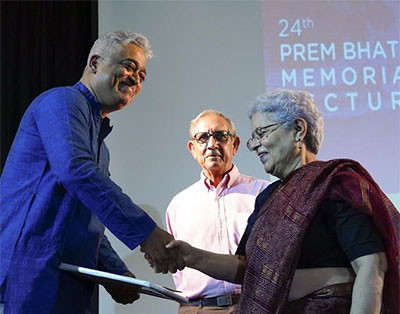
    Senior journalist and India Today TV Consulting Editor Rajdeep Sardesai has been awarded the 2019 Prem Bhatia Award for Outstanding Political Reporting, in an event held in New Delhi on Sunday, August 11.
     

    The annual award, which carries a prize of Rs 2 lakh, was established in the memory of veteran journalist Prem Bhatia, who was well-known for his political reporting and far sightedness. Every year, two awards are given to distinguished journalists in the fields of political and environmental reporting.


    Sardesai has been the recipient of many awards in the past, including the Padma Shri (2008), the Ramnath Goenka award for Journalist of the Year (2007) and the International Broadcasters’ Award for his coverage of the 2002 Gujarat riots and many more.


    On winning the award, Sardesai said: “I am delighted to receive an award which is for, of, and by journalists and is widely regarded as one of the most credible awards in Indian journalism. The award is a recognition of not just an individual but of a wonderful team at India Today which worked tirelessly while offering the best election coverage of the 2019 general elections”.


  • In run-up to 2019, India Today TV launches Political Stock Exchange

    By A Correspondent


    With 2019 general elections looming, India Today TV has launched Political Stock Exchange, a show hosted by its leading anchors and editors Rajdeep Sardesai and Rahul Kanwal. Notes a communique: “The show is a next generation innovation that will revolutionise election analysis,” adding: “Political Stock Exchange will air every week, with Rajdeep and Rahul cracking the political divide, tracking the political worth of each party and evaluating their leadership.”


  • India Today TV overtakes Times Now, as per BARC data

    By A Correspondent


    India Today TV has put up good ratings in the megacities as per the latest BARC ratings in week 29. The channel takes the lead from Times Now with a market share of 29.5 per cent (Source: BARC, Mega cities, 15+ M NCCS All, Wk 29’ 16, 02:00 -26:00, Share per cent calculated based on 5 English News Channels). India Today TV also leads in the TG with coverage of 617 cov’000 and 121Gross Impressions’000.


  • Media & 2 Years of Modi Rajya


    By Ranjona Banerji


    Two years ago, the Bharatiya Janata Party won the Lok Sabha in historic fashion. After decades of coalition rule, one single party won with a huge majority. The victory was attributed to a campaign that ran on the promise of one person: current Prime Minister Narendra Modi. “The Modi Wave” the media called it and indeed it was a tsunami in some areas.


    Most of the media immediately went into adulatory mode – that is, those who had not already become Modi cheerleaders during the campaign itself. One of the finest examples of the media’s Modi Media Fan Club at work was seen during the prime minister’s first US trip. The event at New York’s Madison Square Garden for non-resident Indians saw the Indian media calling him a “rock star” (was it Barkha Dutt who started it?) and getting brainwashed by such immense popularity.


    Most cynics know that such a honeymoon cannot last. It might be fair to say that in Modi’s case, the honeymoon lasted a little longer than most. Years ago, India Today (the magazine) had a cover on how cartoon depictions and caricatures of Rajiv Gandhi had changed in a year as he went from Mr Clean (after the Congress won with a massive majority following Indira Gandhi’s assassination) who promised youth and change to the same old same old. Made worse of course by Bofors.


    With Modi, the shift from “rah rah” to “ha ha” has been more subtle and incremental. Television and social media have changed the discourse and the news cycle. And the left-right-centre divide of Indian society has become more pronounced. Therefore, we still have news channels that are overtly pro-government, we have prominent journalists who are pro-government and we have websites pretending to be news websites that are almost government spokespersons.


    Let’s take a look at columnist Tavleen Singh who has a popular column in the Indian Express on Sunday. She promised her readers that Modi’s victory would bring a massive and wonderful change to India, as the nation needed to be rescued from the evil Congress and the even more diabolical Sonia Gandhi. But as time has changed, her column has made certain shifts. As the Modi government did not deliver on the promises she made, she started by blaming everyone around him.


    First, the Congress was to blame for its legacy. Then bureaucrats were to blame. Then other ministers were to blame. Then extreme Hindutva organisations were to blame. But now, two years in, now and then Singh finds that Modi himself is to blame. For a fan like Singh, is that a reality check or her fine journalistic prowess from the past re-asserting itself?


    The Times of India has declared itself a “federal” state. This means the newspapers say one thing, often critical of the government, and Arnab Goswami, ruler of Bennett Coleman’s news channels (Times Now, ET Now) says something quite else – hyper nationalism and a tendency to hold the Congress to account for this government’s failures.


    The Indian Express sticks to the old journalistic principle of holding a government in power to account. So does The Hindu. The Telegraph has perfected the fine art of holding a government in power to extreme ridicule, whether at the Centre or the state.


    Our other news channels walk their confused path. NDTV is accused of being anti-Modi and pro-Congress but often that just means that the channel tries to be balanced. The new avatar of CNN-News18 is far more balanced than it has been for three years – all the fears of Mukesh Ambani being only pro-Modi have not come quite true. With R Jagannathan leaving firstpost.com for Swarajya, the flagship website is also less tilted to the right. In fact, one might say Raghav Behl’s Network 18 was far more pro-Modi than the Ambani one. CNN-News18’s choice of “resident commentators” might give one a clue: Swapan Dasgupta (pro-BJP), Vir Sanghvi (not pro-BJP), Ajoy Bose (not pro-BJP) and Ayaz Memon (balanced).


    India Today TV remains the most everywhere. The cartoon series So Sorrry lampoons everyone equally. Rahul Kanwal and Gaurav Sawant are the best pro-Modi pro-BJP pro-nationalist and Super Patriotic TV journalists – my due apologies to Goswami for saying this – with Sawant having a slight edge over Kanwal. These two are balanced by the acerbic and sharp Karan Thapar and the even tone of Rajdeep Sardesai. So depending on time of day, you get a different India Today TV.


    News18 remains in a constant race to become Times Now with Rahul Shivshankar emulating his former boss Arnab Goswami as best he can. Which is not good enough by a long shot.


    May 19 and elections results of five states will be announced. Let’s see how many jump various ships then.


  • ‘We want India Today TV to be #1 in Viewers’ Faith’


    The India Today group has in the recent past been working hard on having all its media brands work in sync with each other. Last Saturday, at 6pm on May 23 to be precise, Headlines Today, the group’s English-language news channel, was rechristened India Today Television, named after the flagship news magazine. In this interview with MxMIndia, Ashish Bagga, Group CEO, India Today talks about the rebranding and how more than ratings, the objective is to make the channel numero uno in viewers’ faith.


    Over the last few months, ever since Karan Thapar and Rajdeep Sardesai have come on board, Headlines Today has seen a steady rise in popularity (though I am sure your marketing team will say that rise started even before they came on board). So why change the name?

    The brand equity of a 40 year legacy is incomparable to any product of today. The attributes the new channel will stand for, like Zero bias, Credibility, Neutrality, Depth are best communicated in two words ‘India Today’ – the brand that has defined the national agenda  – A brand that is in itself an institution of purest form of journalism. At a time when this viewer is yearning for meaningful journalism, what better way to deliver it than with a name that’s stood for it and stands for it. Ushering and nurturing top editorial talent was part of the strategy for the launch of INDIA TODAY TELEVISION.


    The Hindi edition of India Today magazine (the printed avatar) has the same name as the English one. Will you consider changing the name of Aaj Tak (the TV Channel) to India Today? Why?

    Aaj Tak has been an undisputed leader for 14 years since inception and has lately achieved a continuous 100 week nonstop leadership streak. It is a symbol of unshakeable trust and the nation turns to only one news channel when it really matters…. Trust is built with a lot of hard work and sincerity over many many years… A question to rename, therefore definitely does not arise.. India Today and Aaj Tak are both mega brands and playing their roles very very well in respective spaces.


    We see the aggressiveness in English news channels really hard to beat – quite like it took a long, long time to get over the ‘angry young man’ image of Amitabh Bachchan era of the 1970s and early 80s. In the Hindi genre too, we have seen that the dumbing down has played rich dividends? Do you think a serious news channel will ever work in terms of ratings?

    News consumption habits have evolved considerably with people consuming news content across media and platforms. TV news is still linear and gives only one story at a time leading to lot of missed news and viewer disconnect. What this space awaits is revolutionising the delivery and integrating with digital. An involvement level of the consumer needs to be built in. If you’ve got these elements right, there is definitely not just space but a very strong opportunity for a serious news channel. On Hindi, I disagree with dumbing down. Talking the people’s language and dumbing down are two very different things. I think all the channels in leading position are taking their news and content very seriously.


    Running an English channel obviously requires huge investments of monies. Is it really worthwhile making such huge investments at a time when the environment is uncertain and the ‘achche din’ haven’t really arrived?

    We’ve had an increasing rate of return on the investments made on the English channel. If the product is drawing quality audience, revenue will follow. Yes, costs are high, but they also bring along disproportionate returns if the strategy is right and the brand is strong. More so in the English news space than any other.


    Given the current scenario in English news television, do you think the one-upmanship which typically exists in the space can also mar the image of India Today, which has a 40-year-old legacy, brand dominance and is much trusted?

    The purpose of India Today Television’s entry is to try and move the genre away from one-upmanship. The only person who should be one up, should be the new news consumer. A consumer who has options, a consumer who sees through the claims, a consumer who prefers depth over breaking news, a consumer who doesn’t want forced opinions. If we keep our consumer ahead, we believe we keep ourselves ahead


    As per information that we’ve got from the market, the ad rates of Headlines Today were much, much lesser than those of a Times Now. Will all of that change?

    The feedback has been very positive. While we wouldn’t like to disclose our commercial rates or to enter a comparison, we are surely seeing an upward tick even before the launch


    The India Today group also has some other English products in the general news space – Mail Today and Daily O. Will see a rechristening there too?

    No plans


    Any targets of by when do you hope to see yourself as the #1 All-India?

    The space in TRP terms is very small and rankings change week by week. Therefore, our attempt is to first become No.1 in the viewer’s faith – his/her reliability on our news. To become the destination channel when it matters to him/her. To stand out as a news channel that makes sense. The rankings will follow… is a matter of time. What is more important is to become the viewer’s knowledge source and not an entertainment hangout.