Tag: IMRB

  • Luxury market takes a hit but likely to regain its bling next year: CII-IMRB report

    By Vijaya Rathore


    The Indian luxury market is expected to post a slight revival and grow about 17% next calendar year even as the industry faces serious growth challenges in the country, says a new report.


    ‘The Changing Face of Luxury in India’ report by industry chamber Confederation of Indian Industry (CII) and market research firm IMRB International pegs the luxury industry in the country at $7.58 billion, or about Rs 47,127 crore, in 2012.


    The luxury market has grown at a compounded annual growth rate of nearly 15% in the last three years, powered mainly by luxury cars and other products that grew faster than luxury services and assets.


    The report says that the economic slowdown has impacted the luxury market to a certain extent this year. “The industry, which until 2010 was poised to take off in a big way, has paused in its tracks to relook at financials, strategies and plan the way forward,” it says.


    The luxury market had grown 20% year-on-year in 2010 before slowing down due to an overall dip in the consumer and market sentiment. Currently, returns for luxury brands are trickling in slower than anticipated and they face serious growth challenges. “There are multiple factors which are stunting growth of the market; government regulations, ambiguity in the FDI policy, lack of quality infrastructure, etc, often come up as some of the important contributors, but a key factor is perhaps the Indian consumers themselves,” the report says.


    It expects mid-2014 to be a crucial period for the luxury market in the country owing to the general elections being held in the country. Factors such as high quality infrastructure, surge in luxury real estate space and renewed investor and consumer confidence will be key determinants of success.


    Luxury real estate, which is currently stagnant, is expected to revive by the second half of 2014.


    PRODUCTS OUTPACE SERVICES, ASSETS

    IMRB research shows that over the last three years, the luxury products segment has grown faster than both services and assets segments with a CAGR of 21.8%, thanks to the entry of leading labels across categories, increase in their geographic footprint and rising aspirations among consumers not impacted by the market slowdown.


    Products, including the ‘recession-proof’ categories such as apparel, accessories, personal care, wines & spirits, electronics, watches and home decor, are expected to account for 45% of the overall luxury pie by 2014, it says.


    While luxury services grew at a CAGR of 15% in the past three yeas due to increase in inbound tourists availing luxury hotel services and upsurge in number of standalone high-end restaurants, assets have grown at a slower CAGR of 9.4%. “Primary contribution to the growth has come from the luxury cars segment. Luxury real estate segment is currently stagnant owing to weak investor sentiment, but is expected to revive during the second half of the 2014,” the report says.


    EMERGENCE OF ‘CLOSET CONSUMERS’

    What makes India a market with tremendous potential for luxury is that a new segment – ‘closet consumers’ – that does not typically fit into the boardroom definition of luxury consumers is staking claims to luxury products, brands and services.


    But these closet consumers come into the market on their own terms as they are caught between rising incomes and traditional middle-class distaste for unabashed luxury.


    “This inner conflict between a middle-class mindset and the globally rich income level, between conspicuous consumption and a level of luxury which is a reward for hard work, shapes what we call the closet consumer,” says the report.


    These are consumers who may well have the capacity to spend on luxury in terms of income levels but due to an inherent conflict between their values and those that luxury brands are seen as espousing, their consumption of luxury is restricted or at a much lower level than potential.


    “It is not the ability to afford that shapes their buying behaviour, but their values and their belief system towards money and luxury,” the report says. So besides infrastructure and government regulations, one of the biggest challenges for luxury players in the country is to change middle-class perception about luxury and bring ‘closet consumers’ out of the closet.


    Source:The Economic Times

    Copyright © 2013, Bennett, Coleman & Co. Ltd. All Rights Reserved

    Licensed to republish
     

  • Social media campaigns can swing 3-4% of votes: IAMAI-IMRB

    By A Correspondent


    This is a report that political parties and their campaign managers will make a rush for. According to the report ‘Social Media in India – 2013’ by the Internet and Mobile Association Of India (IAMAI) and IMRB, released on Tuesday (Oct 8), the number of social media users in urban India would reach 86 million this month and 91 million by end-2013.


    Social media users in urban India are expected to grow by 19% between June and December this year. The report further found that 19.8 million users use mobile phones to access social media platforms in urban India.


    Based on the number of eligible voters, data of actual voter turnout from the Election Commission of India and field interviews, the report estimates that there could be a vote swing of 3-4% in 24 states – states where the internet users are sizeable. The vote swingers can be pre-dominantly young men and non-working women whose affiliation towards social media is high.


    Talking to representatives of major political parties in India, the report also found that parties have earmarked around 2-5% of their election budgets for social media. While political parties are gradually investing in social media, corporate have long realized the importance of the medium. Corporates are spending nearly 13% of their digital advertising budget on social media in FY2012-2013, according to the report. It was only 10% in FY2011-12.


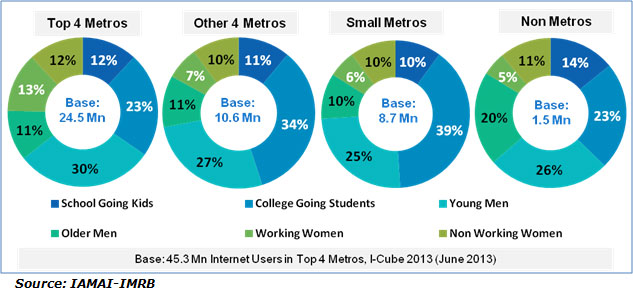
    Predictably, the report finds that the highest proportion of social media usage in the Top 4 metros and the non-metros was among the demographic segment “Young Men” with 30% and 26% penetration levels respectively.


    Interestingly, the report finds that younger women are increasingly using social media, whereas, in the other metros and small metros, “College-going Students” show the highest proportion of social media usage. “Working Women” demographic segment is observed as having the lowest proportion of social media usage in other, small and non-metros whereas they show a moderate proportion of social media usage in the Top 4 metros.


  • Online matrimonials ads leapfrog 124% since Jan ’13: IAMAI-IMRB

    By A Correspondent


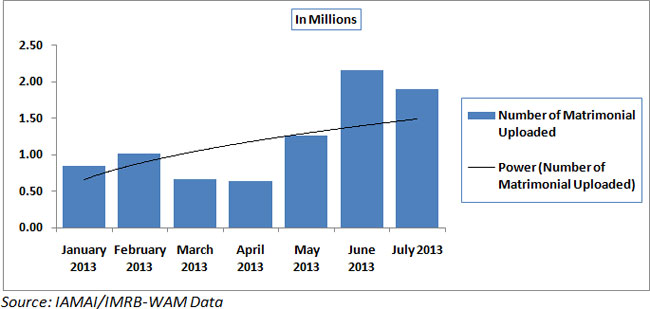
    Uploading of profiles on matrimonial portals has registered a quantum jump since January 2013, registering a growth of 124%. According to the Internet Economy Watch data by IAMAI & IMRB, in January, the number of matrimonial profile uploads were 0.85 million, while in July, it recorded 1.91 million uploads.


    Uploading of matrimonials was lowest in the month of April with 0.64 million uploads. The month of June saw the maximum profile uploads with 2.16 million.


    Commenting on the upward trend, Gourav Rakshit, COO and Business Head, Shaadi.com said: “The Shaadi.com TV campaign launched during the IPL 2013 Finals in May and ran through until the end of July.  The ‘Love, Arranged by Shaadi.com’ TVC featuring Chetan Bhagat” captured the imagination of parents and individuals alike, resulting in a new segment of prospective match seekers entering the online matrimonials category.


  • Social media users in urban India to reach 66mn by June

    By A Correspondent


    The number of social media users in Urban India reached 62 Million (Mn) by December 2012, and it is estimated to reach 66 million by June 2013, according to a report on Social Media in India, by the Internet and Mobile Association of India (IAMAI) and IMRB. According to the report, about 74 percent of all Active Internet users in Urban India use social media.


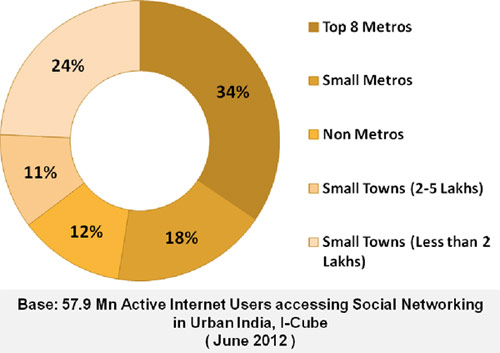
    The report also finds that of the social media users, 34 percent are from the top 8 metros while 35 percent of the total users are from small towns of population up to 5 lakh.


    Figure 1 – Social Networking Profile by Town Class


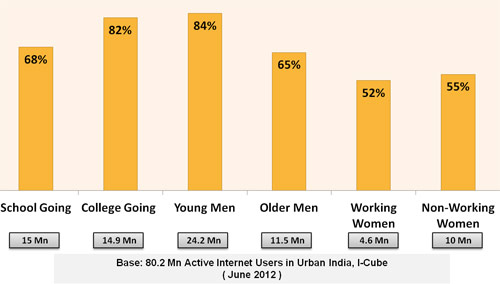
    The report further finds that the highest proportion of social media usage was observed among the demographic segments of “Young Men” and “College Going Students”, with 84 percent and 82 percent penetration levels respectively.


    Figure 2- Social Networking Profile by Demographic Segments (Proportions)


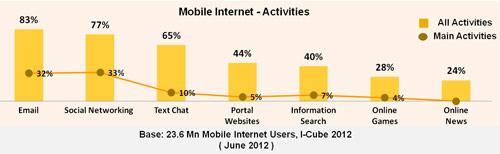
    Social media usage is also fast catching up with mobile internet users. According to the report, 77 percent of the users use mobile for social media. Email, social media, search, app store and chat / IM are used everyday by those accessing internet through mobile.


    Figure 3 – Activities Done by Mobile Internet Users (Top 35 Indian Cities)


  • I-Cube Report: Mobile crucial for rural India to access Net

    By A Correspondent


    There are about 38 million claimed internet users in rural India today. The penetration of claimed internet users in rural India has grown from 2.6 per cent in 2010 to 4.6 per cent in 2012, a CAGR of 73 per cent. On the other hand the penetration of active internet users has grown from 2.13 percent in 2010 to 3.7 percent in 2012. These are some of the findings from the latest I-Cube Report on ‘Internet in Rural India’ which was released by the Internet and Mobile Association of India (IAMAI) and IMRB.


    According to the report, the number of claimed internet users in rural India is expected to reach 45 million by December 2012. The report further states that mobile phones are fast emerging as an important point of internet access in rural India. As of June 2012, there were 3.6 Mn Mobile Internet Users in India, a growth of 7.2 times from 0.5 million in 2010.


    In a prepared statement, Dr Subho Ray, President of IAMAI stated, “This is just the tip of the iceberg, in the next two years, a combination of affordable smart phones, optic fibre backbone and local language content is likely to change the beat all projections of internet growth in rural areas.”


    Anurag Gupta, Founder and MD, DGM India explained the possible impact of a growing rural internet usage on digital advertising. He was also of the view that local language contents, hyper local information etc will lead to higher internet usage in rural India. “Internet penetration is growing in the urban areas and now it is percolating to the rural areas, this is very good news as it bridges the digital divide across the country and empowers dual India with a level playing field of knowledge and information. There will be a growth in digital spends as the users grow, so for the digital advertising industry this is a very heartening sign.”


    Usage of Indian language or local language content is also said to be on the rise. According to the report, the availability of content in local language encourages the rural user to go online and although 79 per cent of the users access content in English, 32 per cent of the users access content in Hindi.


    A whopping 42 per cent of the respondents said they were not aware of internet. This is also one of the reasons for the non-usage of the internet. As more and more people begin to use the internet, infrastructure facilities is also bound to grow. While more initiatives are certainly needed to build the internet infrastructure, evangalising of the medium to the rural masses is equally the need of the hour for further growth of the medium. In addition to this, local language content is also said to play a critical role in order to fuel the growth of internet usage in India.


    Point of Access:

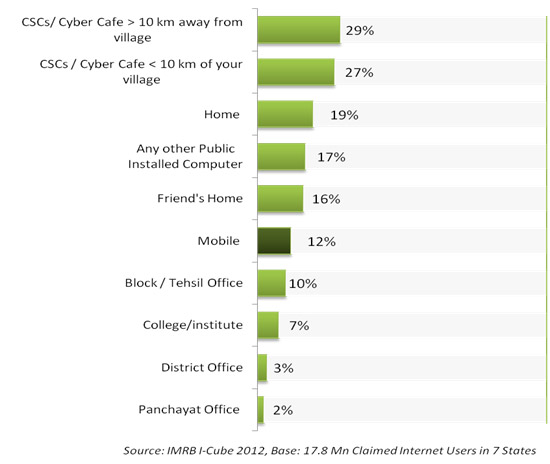
    One of the reasons for the increase in rural internet usage is probably because of the availability of cyber cafes and community service centres. Interestingly, majority of internet users in rural India (i.e. 57 per cent) have access to internet via cyber cafes and community service centres, only 19 per cent are said to have internet access at home and 12 per cent of the internet users access internet through their mobile phones.


    Purpose of Internet Access:

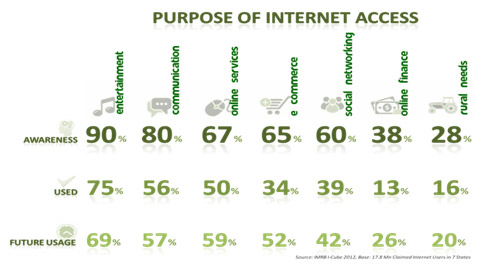
    Entertainment is the primary driver of internet use in rural India. 75 percent of rural users use internet for entertainment while 56 percent use it for communications Users like to access Music, Videos and Photos for entertainment.


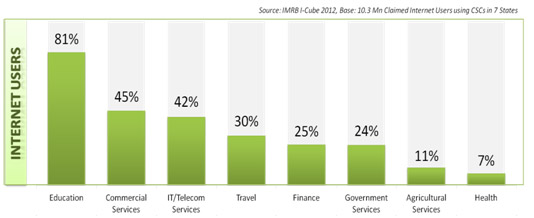
    There is a growing interest amongst the rural constituents seeking information on education. 81 percent of claimed internet users seek information pertaining to school / university and exam centres.


    Primary research is said to have been conducted in line with ‘I-Cube’ reports, an annual syndication of eTechnology Group, IMRB International. The syndicated research is based upon a primary research survey that interviewed about 15000 people from various age groups, across SECs and genders from the states of Assam, Maharashtra, Orissa, Tamil Nadu, Andhra Pradesh, Rajasthan and Uttar Pradesh.


    The Internet and Mobile Association of India (IAMAI) is an association which is said to be representing the entire gamut of digital businesses in India. It was established in 2004 by the leading online publishers. IAMAI is also said to be the only professional industry body representing the online and mobile VAS industry in India.


  • FMCG biggies HUL, Godrej, Dabur report higher sales growth numbers than estimated by Nielsen

    By Sagar Malviya & Ratna Bhushan


    Market research firm Nielsen and India’s consumer goods companies are in sharp disagreement over growth rates in the sector. In the April-June quarter of 2012, sales growth in value terms of some of India’s biggest fast-moving consumer goods companies is higher than Nielsen’s growth estimate for the overall FMCG market, raising concerns over the world’s largest research firm’s accuracy in India.


    Seven listed domestic companies, which control over 70 per cent of the FMCG market, have posted an average value sales growth of 19.28 per cent in the first quarter of fiscal 2013. A Nielsen spokesperson says their figure for this period is 17.6 per cent. Even in categories such as soaps, juices, oral care and hair oils, leading players, which contribute between 60 per cent and 75 per cent to each segment, have posted much higher volume growth than what Nielsen’s data suggests. When contacted, Nielsen did not validate the numbers that ET has obtained from the research firm’s FMCG clients.


    For instance, Godrej Consumer Products Ltd saw a 24 per cent spurt in soap volumes even as Nielsen estimates growth for the overall segment at a sombre 5 per cent in the April-June quarter. “There is a bit of under-reporting by Nielsen. The issue lies with its statistical method,” said Adi Godrej, chairman of Godrej Group.


    “We generally use Nielsen’s data for market share as there isn’t any other option for us. However, for category growth, we rely on our sales numbers and listed companies’ performance,” said Vineet Agrawal, president at Wipro Consumer Care & Lighting, which saw a 15 per cent jump in volume growth in soaps in the first quarter of the fiscal year.


    It’s a similar story in toothpastes, a category that grew 9 per cent in volumes according to Nielsen; however, this doesn’t tally with internal sales data of Colgate and Hindustan Unilever Ltd (HUL), which together command roughly 80 per cent of the market. Colgate saw a 13 per cent rise in volume growth. For HUL also it was higher, said CFO R Sridhar at a recent financial results’ presentation.


    In packaged juices, Nielsen says the category grew 18-19 per cent in the April-June quarter in value terms and that Dabur grew 24 per cent. But Dabur’s quarterly sales numbers show its juice business grew 34 per cent. Dabur leads the packaged juices market with the Real brand, which accounts for more than half of all juices sold.


    Dabur CEO Sunil Duggal said: “Our quarterly growth numbers are generally ahead of what Nielsen reports. So we prefer to study Nielsen numbers as a longer-term trend – over a 12-month period – because that evens out errors.”


    Nielsen counters that the retail audit cannot be compared with sales numbers that companies report. A Nielsen spokesperson said: “The retail audit is focused on sales offtake through a sample of retail stores that tracks sales to the end consumer. It is technically incorrect to compare it to the financial results of companies, which report sales to distribution channels.” The research firm also said sales reported by companies may include those beyond retail stores from institutions such as army canteens, restaurants and transport hubs, which are outside the scope of its retail audit.


    An FMCG analyst points out on condition of anonymity that ignoring the Canteen Services Department (CSD), which caters to the Indian defence services, may be one explanation for the discrepancies.


    After all, CSD can easily qualify as India’s largest retailer with some 3,500 outlets across the country. Nielsen is no stranger to controversy on the market share front. In May 2009, HUL disputed the researcher’s data that showed a steady fall in the company’s market share across segments, saying it contradicted internal estimates as well as data from household research firm IMRB. The issue snowballed into a crisis when Dabur, Godrej and Marico echoed similar doubts over Nielsen data. Dabur and Perfetti Van Melle even went so far as to cancel Nielsen’s subscriptions in categories such as hair oils, juices, candies and confectionery.


    A year ago, Unilever CEO Paul Polman questioned the accuracy of Nielsen’s data for India, underlining that the country’s largest consumer product maker was still unhappy with the market researcher two years after first raising the issue. “I know you all like to write about it. But they (Nielsen) are not very accurate with what their numbers are,” Mr Polman had said while commenting on the performance of Unilever’s Indian arm.


    Nielsen has increased its sampling size to 22,000 outlets from 16,000 over the past three years, included more modern trade outlets and uncovered channels in rural markets, prompting some companies to be optimistic about the research firm’s data. “We are worried, but the fact remains that at least it is not deteriorating. They have been changing panels and we have to pick up points where there are issues and work with them on it,” said Saugata Gupta, CEO of Marico, which saw its hair oil business grow over 15 per cent in volumes while Nielsen’s data shows a growth of 4.7 per cent for the category.


    Also, companies are now slightly at ease after Nielsen decided not to share data with market analysts and investors who depend on the data to track the performance of consumer product companies and rate the stock accordingly. “While we are glad that analysts can’t access the data easily, even we have stopped taking the research seriously and rely on it just for trends. Nielsen’s numbers is not a bible to us,” said a CEO of a leading homegrown consumer firm who didn’t wish to be identified.


    Source: The Economic Times

    Copyright © 2012, Bennett, Coleman & Co. Ltd. All Rights Reserved


  • Aaj Tak Care Awards to be announced tomorrow

    From the MxM Infodesk


    Leading Hindi news channel Aaj Tak will host the Aaj Tak Care Awards on June 6 at Hotel Taj Palace, New Delhi. Finance Minister Pranab Mukherjee will be chief guest at the awards which will honour leading companies in the corporate sector who have contributed towards inclusive and sustainable development keeping in mind the society as the focal point


    Aaj Tak Care Awards will be given in five different categories: Education, Empowerment, Environment, Health & Livelihood. IMRB and FICCI partnered the event.


    Commenting on the awards Joy Chakraborthy, CEO, TV Today Network said, “It is a matter of great pride for all of us to honour the real champions of corporate India who have positively impacted the society. We looked at companies who have gone beyond their corporate objectives of growth & profitability and have put a society centered approach at the centre of everything they do.”