Tag: IMRB

  • Kantar unveils new corporate identity & management structure

    By A Correspondent


    WPP-owned data, insights and consultancy network Kantar has announced the launch of a new corporate identity- for the parent brand and its 12-strong family of operating brands- designed to create a unified look-and-feel across the whole business. Operating brands not previously Kantar-branded will now take a Kantar prefix and a new, common typeface.  For example: Millward Brown, IMRB, and TNS will now become Kantar Millward Brown, Kantar IMRB, and Kantar TNS.


    Kantar’s new identity reflects and externalises an on-going change programme that started in January. The programme includes greater collaboration between operating brands and the creation of a new insights group through much closer alignment of the company’s custom brands. In addition, global operations capabilities have been brought together into a single entity and the company is moving towards more aligned shared services in HR, finance and IT. The company will shortly be adding to the portfolio of expert brands with the launch of Kantar Public, uniting its global expertise in governmental and public policy work; and Kantar Consulting, which will draw expertise from several of our brands to provide a full and broader range of marketing and sales consulting solutions and capabilities to our clients.


    Commented Kantar CEO Eric Salama: “The rebranding is a tangible, visible expression of our desire to present clients with more easily-navigable and connected solutions that bring together the best of Kantar’s expertise,” adding: “We believe our clients and partners have started to experience the benefit of this approach – in more rounded, detailed and holistic research and recommendations. And it is helpful that for the first time we really look like a single family of brands serving a common purpose.”


    Along with the rebranding, Kantar is introducing a new tagline, “Inspiration for an extraordinary world”, drawn from its new corporate purpose statement, “To inspire our clients, our people and society to create and flourish in an extraordinary world.”


    Said Preeti Reddy, CEO, South Asia – Insights, on the rebranding: “Clients have consistently asked us to be more collaborative in the way we work with them; faster and more agile at a local and global level. They want the ‘best of Kantar’ on a consistent basis, not just on occasions. Earlier this year, we put in place a whole new way of working to remove siloed thinking and barriers between the Kantar companies to collaboration for client benefits. In South Asia, we will be able to bring together the thought leadership of three powerful brands and harness the power for our clients. This combination brings with it an ability to converge thoughts when required to solve a problem as well as an ability to diverge solutions when clients need choice. That is a unique mix and in, my view, will make Kantar an even more dominant force in South Asia.


    The new identity, developed by WPP branding firm The Partners, will be rolled out across all external and internal communications channels in the coming months.

  • It’s all about the consumer for IMRB


    By Anuka Roy


    The weather was very unpredictable in Mumbai. But the interesting conference by IMRB International did not let it affect the moods of the people who attended it. K Ramakrishnan or Ramki as he is popularly known,General Manager and Country Head – Household Panel at IMRB Kantar World Panel and the host for the day, welcomed the audience to ‘Consumer Connections 2016’.


    To explain the agenda in brief and to give the audiences a head start about what to expect from the conference this year, Ramakrishnan invited on stage Preeti Reddy, ‎CEO at Kantar Consumer Insights, South Asia, Kantar and Josep Montserrat, Global CEO at Kantar Worldpanel. They explained how useful this research will be for brands to reach out to consumers in a better way. Montserrat also focused on the work they have done and the potential that India has. For making the session a little fun, the host subjected the two experts to a quick round of rapid questions, which both answered quite rapidly as well as wittily. An example, when Reddy was asked what comes to her mind when she hears about research in India? Pat came her reply, “Over worked and under paid.”


    This was followed by the presentations about consumer trends to look forward to. Rashmi Nair, Group Business Director, IMRB Kantar Worldpanel presented about ‘What lies ahead for urban India in 2016’. Her presenting was engaging from the word go and she very intelligently incorporated many popular Bollywood movie dialogues to explain her topic. She gave example of Patanjali- the brand which doubled its sales in just one year. This shows the trend of demand for local brands. She also explained how more focus is now given on the aspirations and lifestyle of the rural people.


    Next presenter Prafull Babar, Group Business Director, IMRB Kantar Worldpanel was an instant hit with the audience because he gave chocolates as a prize whoever gave a close enough answer to his questions. His topic was ‘Penetration Rules’. He explained the five key principles of buying behaviour, which were as follows:

    :: Brands grow fastest by attracting more buyers, not by getting buyers to buy more often

    :: Plenty of penetration headroom, no matter how big you are already

    :: Most of your buyers only buy you once in a year

    :: Your buyer base is in constant churn – over a third will not buy next year

    :: When buyers come, frequency will follow – no need to chase


    ‘New products Benchmarks’ was explained by VinayKhamkar, Business Director, IMRB Kantar Worldpanel. He explained that one key way to gain newer buyers is launching new products. The fact that consumers can set norms for successful launch of products was clear through his presentation. One of the key learning from this presentation was that new variants do better than new brands. He further explained about how the norms have been calculated and the research that has gone behind this study.


    Consumer Mix Model (CMM) evaluates how consumers respond to different media campaigns by analysing their impact on purchasing behaviour. This was presented by Devika Satam, Insights Director, IMRB Kantar Worldpanel. She explained that the consumer is at the heart of every marketing strategy. CMM evaluates the impact of media. It helps brands to understand the consumers’ response, optimize the media mix for better returns and calculate ROI (Return On Investment) based on actual purchase behaviour.


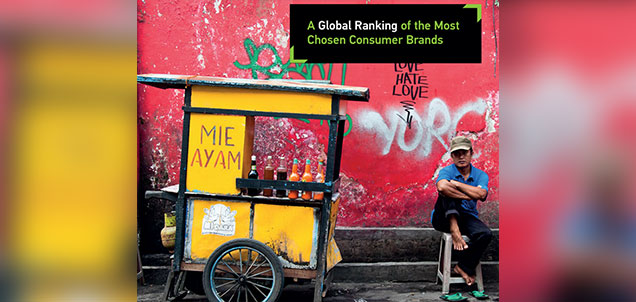
    Andy Parkinson, Global Markets Director, Kantar Worldpanel spoke about the book Brand Footprint on global ranking of the most chosen consumer brands by Kantar Worldpanel. Parkinson said Coca Cola remains the number one chosen brand of 2016 and the rise of Sunsilk has been consistent and very surprising. He also explained the entry of Indomie noodles, an Indonesian noodle brand in the global list. The reason behind local brands succeeding was the main focus of his presentation and one of the key reasons was identified as the affordability of the brand. On the other hand, Henry Swann, Global Solutions Director, Kantar Worldpanel gave an overview of the World Panel Online. It is an online data and analysis tool which gives global access to insights anytime and anywhere.


    Hemant Mehta, Senior VP, Media and Retail, IMRB concluded the conference by giving a summary of the presentations. He also gave an insight of what they are working on currently, which were Data Management Platform (DMP), data integration and behaviour based segmentation to power activation.


  • Taproot announces senior level appointments

    By A Correspondent


    Ayesha Ghosh

    Taproot has appointed two senior resources into its fold. Ayesha Ghosh joins Taproot as the General Manager while Ninad Umargekar has joined Taproot as the Head of Strategic Planning.


    Having studied Economics and Advertising in Delhi, Ayesha spent most of her working years in Mumbai. In her previous assignment, she was heading the Mumbai office of Contract where she spent 14 good years. At Contract Ayesha was involved with the integrated communication planning on brands like Shoppers Stop, Asian Paints, Cadbury and Star Plus among others. She also worked closely with the Design, Digital and Core Consulting divisions of Contract. A voracious reader and foodie, Ayesha is also a fitness enthusiast.


    Ninad Umargekar

    After studying Mathematics and doing an MBA, Ninad worked with IMRB in quantitative research followed by six years at Lowe. At Lowe he started with channel planning and then moved to brand planning working on a wide variety of brands like Lifebuoy, Hit, BookmyShow, Finolex among many others.


    Agnello Dias

    Commenting on Ninad’s appointment, Agnello Dias said: “Strategic planning is a key discipline that we are focusing on and Ninad’s arrival helps us take a significant step forward in that respect. He has a sharp mind and the ability to be precise with people observations. A trait we respect and admire as that is what has seen us produce some really powerful work in the past.”


    Umesh Srikhande, CEO, Taproot said, “At Taproot, the endeavour is keep adding value to the brands entrusted to us. Strengthening our relationships, growing our talented people, adding sharpness to our counsel and overall adding more depth to everything we do. And that is where hiring senior talent like Ayesha Ghosh becomes important. Her high levels of maturity, cross category experience, her strong people-team skills and her bias for good ideas will mean a happy and meaningful addition to our bandwidth.”


  • E-commerce traffic during Diwali surged 75.5%

    By A Correspondent


    UCWeb, India’s leading mobile browser with an over 54% market share, said e-commerce traffic during the Diwali shopping season surged a whopping 75.5% this year.


    “The number of users who visited e-commerce sites Flipkart, Amazon and Snapdeal via UC Browser in the month leading to Diwali 2015, increased over 75% compared to last year,” Kenny Ye, Managing Director of UCWeb India, said Thursday.


    Parent UCWeb Inc, which is a leading provider of mobile internet software and services, is a business within Alibaba Group’s mobile division.


    “Indians are increasingly embracing shopping on-the-go, splashing out on various items through mobile shopping during festive sales. There’s no doubt m-commerce is prospering,” he added.


    A big portion of users eventually placed orders on Amazon via UC Browser through the campaign, the company said in a media statement.


    Popular items including lifestyle products such as electronics, ethnic and fashion apparel as well as household products that received most visits contributed to the vast majority of total page views.


    According to UCWeb India, the traffic upsurge reflected the public perception of Diwali in the age of e-commerce. “As e-tailer giants rolled out sales promotions to usher in the festive season, UC Browser and Amazon India also joined hands distributing coupons and vouchers to users through a #HarGharUCDiwali campaign launched exclusively on UC Browser,” the company said.


    The two-week long shopping carnival eventually saw over 17 million users coming on board trying their luck for coupons and vouchers.


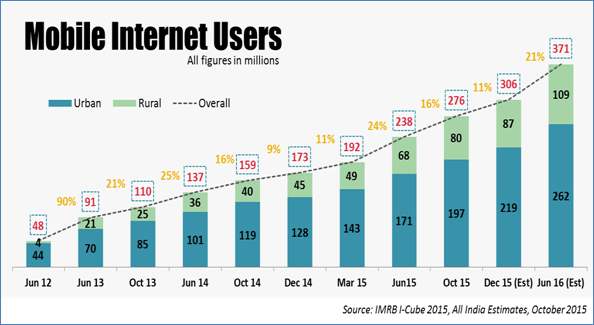
    According to latest reports by IAMAI and IMRB, mobile Internet users in India are roughly at 306 million, up from 276 million in October this year. The number of mobile users who shop via their smartphones has also seen a steady rise, with 75% increase in e-commerce traffic throughout Diwali shopping season.


  • Internet user base to zoom past 400 mn by Dec’15, notes study

    By A Correspondent


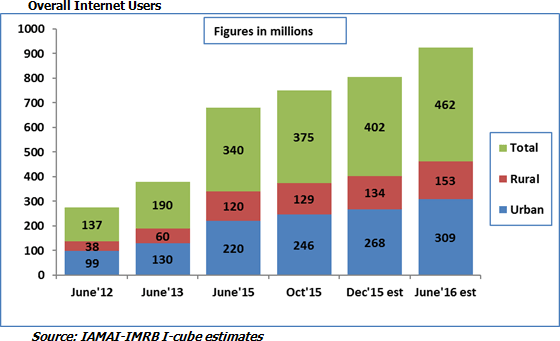
    The number of Internet users in India is expected to reach 402 million by December 2015, registering a growth of 49 per cent over last year, according to a report ‘Internet in India 2015’, jointly published by the Internet and Mobile Association of India (IAMAI) and IMRB International. While Internet in India took more than a decade to move from 10 million to 100 million and 3 years from 100 to 200 million, it took only a year to move from 300 to 400 million users. Clearly, Internet is main stream in India today. And the large internet users base is definitely a good news for the overall growth of the digital industry.


    In October 2015, there were 375 million internet users in India. Currently, India has the third largest internet users’ base in the word but it is estimated that by December, India will overtake the US as the second largest Internet users’ base in the world. China currently leads with more than 600 million internet users. This makes India the second largest internet user’s base in the world behind China, but is ranked first as the largest internet users in a free market democratic setup.


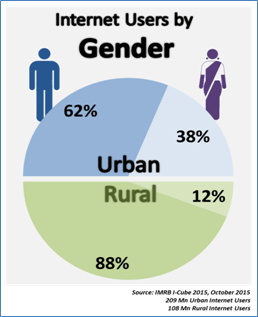
    According to the report, 71 per cent male and 29 per cent female are Internet users in India. The Internet usage among males has been growing at a rate of 50 per cent while it is growing at 46 per cent for female users. However, in Urban India, the ratio between male to female Internet users is 62:38. Significantly, Internet users among females are growing at a rate of 39 compared to 28 per cent among males.


    Among the Rural Internet users, 88 per cent are males. The Internet users among females are growing at 61 and 79 per cent among males. 75 per cent of the rural internet users belong to the age group of 18-30 years. Another 11 per cent are in the age group of <18 years, while 8 per cent belong to 31-45 years age group.


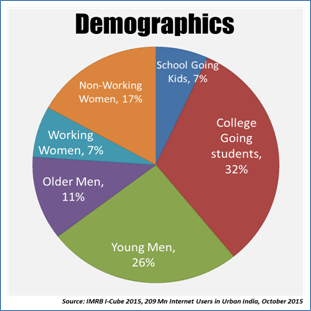
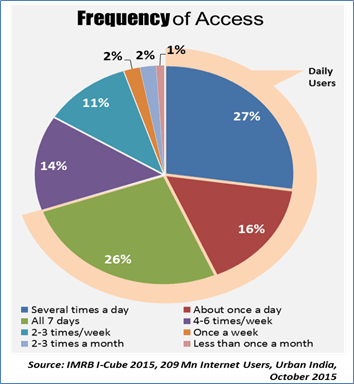
    Significantly, there has been a huge spurt in the number of people accessing internet on a daily basis in Urban India. As on October 2015, 69% of Users are using Internet on a daily basis. This daily user base has gone up by 60% from last year. However, the high frequency usage is not restricted to only the youth and the College going students; this habit of accessing the Internet daily can be seen among other demographic segments as well including Older Men and Non-Working Women. 75% of the Working Women access Internet daily. 37% of the male internet users are daily users whereas only 23% of the female internet users are accessing internet daily. 75% of internet users among both genders access internet at least once a week.


    The findings of the report further reveal that in Urban India, Mobile Internet user base has grown at a rate of 65% over last year to reach 197 million in October 2015. The Mobile Internet Users have surged to 80 million by October 2015 growing at 99% over last year. The user base of Mobile Internet users in Rural India is expected to reach 87 million by December 2015 and 109 million by June 2016.


    Interestingly, the report also reveals that out of all the Internet non-users surveyed in the 35 cities as part of this study, 11.4 million Non-Users are willing to access the Internet in the next one year and over 2/3rd of them intend to do so through mobile phones.


  • Mags 2x more engaging than Radio & TV


    By A Correspondent


    The Association of Indian Magazines (AIM), the apex body of magazine publishers in India, commissioned leading market research firm IMRB in 2010 to conduct a large survey, covering a sample size of 3,600 over 10 cities. The study released at the Indian Magazine Congress held in Chennai on February 23 and 24, has shown high engagement scores for magazines on all key parameters like ad avoidance, information seeking, purchase intent and such.


    Mitrajit Bhattacharya

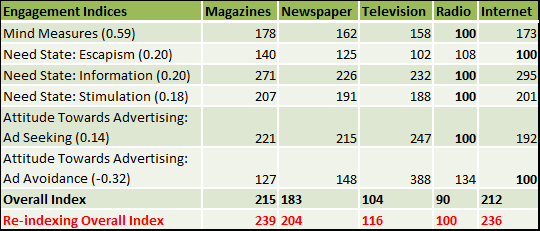
    Industry leaders urged AIM to take these findings forward and create an index as a composite score, which would clearly demonstrate the extent to which magazines are engaging, vis-a-vis other media. “That’s exactly what we did,” says AIM President Mitrajit Bhattacharya, adding: “We ran a regression analysis on the same data and came out with weights for individual indices like Mind Measures (weight .59), Ad Avoidance (-.32) etc. and then we created a Composite Index.”


    A two-step process was followed to create the Engagement Index. The first step entailed running a regression on a key dependent variable and evaluating the hierarchy of each of the partial engagement indices. The second step required evaluating each medium on the partial engagement indices and arriving at a final Engagement Index.


    The study demonstrates that magazines are twice as engaging as television and radio (239 indexed to 100 of Radio).


    The Engagement Index Findings


    Statements which constitute Mind Measures (Weight: 0.59):This medium matches my personal interests/ personality

    This medium shows how I can approach problems

    This medium is trustworthy and reliable

    This medium helps me stand out and create an impression

    This medium is like an undemanding companion


    Statements which constitute Escapism (Weight: 0.20):

    This medium is relaxing and a good escape

    I can consume this medium anywhere and at any time


    Statements which constitute Information (Weight: 0.20):

    I am always discovering something new with this medium

    This medium keeps me updated with latest styles and trends

    This medium helps me in expanding my knowledge 


    Statements which constitute Stimulation (Weight: 0.18):

    This medium helps me understand the opinions of others

    This medium touches and inspires me

    This medium helps in better social interaction 


    Statements which constitute Ad Seeking (Weight: 0.14): 

    Ads provide useful information new products/ services

    Ads add to the experience of consuming the medium

    Pay more attention to ads as I find them more useful


    Statements which constitute Ad Avoidance (Weight: -0.32): 

    Ads appear at inconvenient moments in this medium

    Ads in this medium should be eliminated


  • Preeti Reddy to succeed Thomas Puliyel as president at IMRB

    By A Correspondent


    WPP-owned Kantar has announced a change of leadership at IMRB International which will see Preeti Reddy take over from long-serving president Thomas Puliyel when he retires in August this year.
     

    Ms Reddy, currently senior vice-president, will work alongside Mr Puliyel during the next few months as the transition takes effect. Once president, she will report to Kantar president Wayne Levings.


    Ms Reddy has close to three decades of experience in research and consulting, working with leading Indian and multinational companies. She joined the IMRB group in 2009 when she was appointed CEO of LMRB in Sri Lanka. She has previously worked in consumer consulting at Technopak, was senior vice-president at TNS India and has worked with the BAT group in India.


    In other management changes, effective February 1, Jasojit Mookerjea, currently senior vice-president responsible for the International Business Unit and joint head of IMRB One will take on full responsibility for IMRB One as well as heading change management and managing the key account directors within the company.


    Sreeram Sreenivasan, currently BAT global account director and vice-president, IBU, will take overall charge as senior vice-president, IBU, based in London. Diptya Mukherjee will continue in his role as vice-president, IBU, based in Calcutta. The management team at IBU is being further strengthened under the leadership of Sreenivasan and Mukherjee and the proposed changes will be communicated in due course.


    Vivek Gupta, senior vice-president, will head the Auto, BFSI and Telecom sectors, while the Brand Science business will be merged into IMRB One.


    Mr Puliyel joined IMRB in 1981 as manager, overseas projects and remained with the company until 1992 before moving to set up Research International India as country manager. He returned to IMRB as president in 2000. The company has been named research agency of the year eight times since 2005 and Mr Puliyel has twice served as president of the Market Research Society of India.


    Mr Levings commented: “Thomas has made an outstanding contribution to IMRB and the broader Indian research market throughout his long and distinguished career. Under his leadership, IMRB has continued to improve and innovate around its offering, expanded into new markets and sectors and has been consistently recognised as the leading research agency in India. He leaves with our thanks and best wishes for his retirement.


    “In Preeti, we have an excellent new leader of IMRB. She brings a combination of strong client leadership, general management and consulting capabilities. With the very strong leadership team she has around her, IMRB will continue to build on its world-class foundations.”


    Ms Reddy said: “I’m delighted to be leading such a diversified and vibrant business which continues to define research in the region. We have a great team of experienced and highly competent managers to head our different businesses and I look forward to working with them to build IMRB into an even bigger and better business.”


    Mr Puliyel added: “IMRB is a wonderful place to work in. The open, empowered work environment is a great magnet for the best research talent. The freedom that the company provides makes it a great place to learn and realize one’s potential.”


    Kantar is the data investment management arm of WPP and is the holding company of IMRB. Established in 1971, IMRB’s footprint extends across 53 offices in 18 countries. In India, IMRB International has five full-service offices and sixteen field offices.


  • India’s e-Commerce growth to be driven by digital payments

    By A Correspondent


    The Indian e-Commerce market as of December 2013 stood at INR 62,697 crore though only 25 million of over 231 million internet users transact online. And, security still emerges as the major issue for online transactions.


    As per IAMAI, PCI & IMRB report the digital payments industry is expected to grow at a rate of 40 per cent to reach INR 120,120 crore by December 2014.


    According to Asit Oberoi, Sr. President & COO – Yes Bank, “Though security is a concern for many, it is imperative to point out that the evolving and tech savvy customer today, is more confident transacting online. The digital payments industry is witnessing a steady growth and that goes on to show the acceptance of online transaction.” While global online utility bill payment hovers around 18 per cent, in India it is around 10 per cent.


    Speaking at the 6th IAMAI National Conference on Digital Commerce, Ravi Sundarajan, Chief operating Officer – Webaroo said that China is set to be the world leader in e-Commerce in the next 18 months. “With over 240 million online shoppers, China is set to be the new leader in e-Commerce. In China 6 per cent of retail sales accounts for online shopping and has been growing at an exponential rate in the last ten years and compared to that only 1 per cent of retail sales accounts for online shopping in India.” According to him, “If India has to become a world leader in e-Commerce, mobile apps; sms marketing has to evolve.”


    Speaking about engaging internet users in online retail, Nitin Bawankule, Director – e-Commerce & Online Classifieds, Google India, said, “When Google started GOSF in 2012, 50 per cent of the shoppers were first time buyers. In 2013 GOSF, 55 houses and 285 cars were sold with 40 per cent of the shoppers being women. This clearly shows how consumers are increasing spend on through the internet, though India is way behind when compared to other countries.”


    In the US, there are 245 million internet users and 156 million online buyers, while China has 538 million internet users with 270 million online buyers. Closer home, Sri Lanka, with 3.2 million internet users, has 2 million online buyers and Australia, which is a similar economy to India, has 20 million internet users with 11 million online buyers. Unfortunately, India, with over 231 million internet users, has mere 25 million online buyers.


  • Online railway ticket booking witnesses a spurt

    By A Correspondent


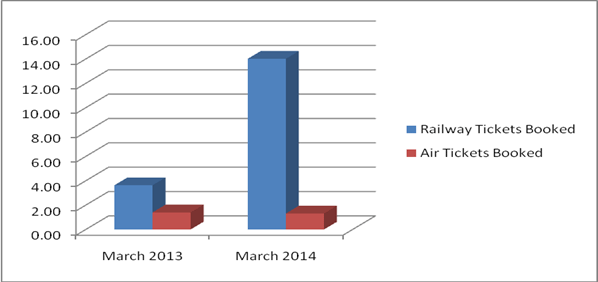
    According to the latest Internet Economy Watch, published jointly by the Internet and Mobile Association of India (IAMAI) and IMRB, the online booking of railway tickets increased from 3.63 million in March 2013 to 14.02 million in March 2014 registering a y-o-y growth of 286 per cent. While online booking of railway tickets grew phenomenally, the air tickets booked online in March 2014 were 1.31 million as compared to 1.40 million in corresponding month last year.


    Source: IAMAI/ WAM Data March 2013-14


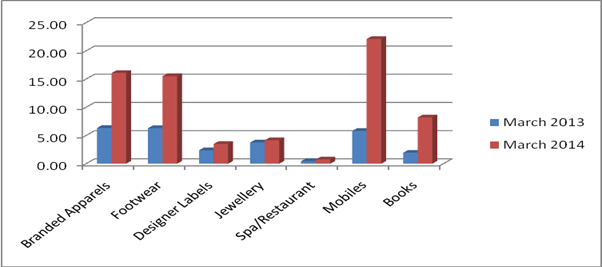
    The monthly tracker also finds a y-o-y growth of 154 per cent in online user visits to branded apparel category. While branded apparels witnessed 16.08 million online user visits in March 2014 as compared to 6.34 million user visits in March 2013, the footwear segment registered 15.51 million online user hits in March 2014 as compared to 6.30 million user hits in March 2013.


    Source: IAMAI/ WAM Data March 2013-14


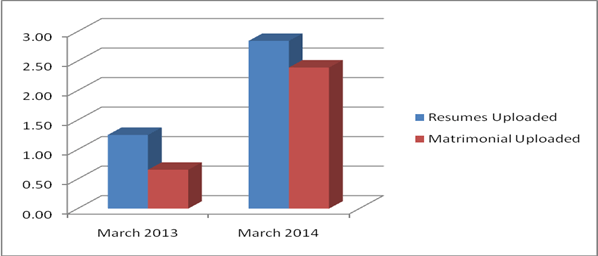
    According to the data captured from major matrimonial sites in the monthly tracker, the number of profile uploads in March 2014 were 2.39 million as compared to 0.66 million in the corresponding month last year. The number of resume uploads increased to 2.84 million in March 2014 from 1.25 million in March 2013.


    Source: IAMAI/ WAM Data March 2013-14


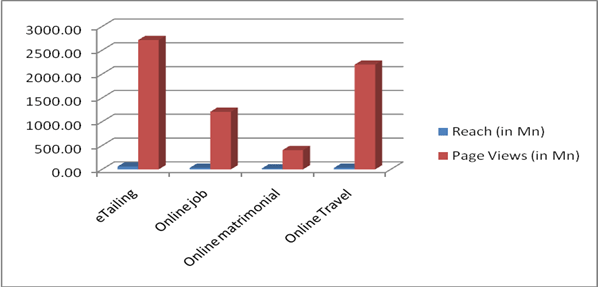
    The monthly tracker further indicates 59.48 million people accessed various e-tailing sites. There were 2714.28 million page views in the category. The user reach for job and matrimonial websites is 31.18 million and 19.86 million respectively with 1209.48 million and 403.20 million respective page views. Online travel segment has reach with 32.13 million reach and 2198.801 million page views.


    Source: IAMAI/ WAM Data March 2013-14


    Sourced from all India active internet data, the monthly internet tracker is based on WAM data captured from various relevant sites, and encapsulates online usage for e-tailing, online travel and vertical classifieds.


  • FMCG product launches dry up in a tough market

    By Ratna Bhushan & Sagar Malviya


    Consumer product companies drastically cut down on product launches in 2013 to avoid additional cost pressures in a year when sales growth slipped to a decade low. Growth in product launches in the fast moving consumer products (FMCG) segment dropped to just 5 per cent last year from 35 per cent in 2012, according to data shared by research firm IMRB. Consumer product companies confirmed the slowdown in product launches and said they will bring out new variants and products once overall market improves.


    “This is not the best time to launch new products. We are waiting for consumer sentiment to improve, which we believe will be in the second quarter of the next financial year,” Sunil Duggal, chief executive officer at Dabur India, said. Dabur restricted its new products, Real drinking yogurt and premium chyawanprash Ratanprash, to select markets instead of a national rollout.


    Companies want to keep their expenses low even as they increase ad spends to protect existing brands and roll out higher promotional offers or price cuts to mop up volume growth. “Any FMCG company will have to take into consideration the high expense of taking a new launch national. The second half last year was bad in terms of cost perspective,” said Anil Chugh, senior VP at Wipro Consumer Care and Lighting.


    Consumer product companies have been facing relentless rise in the prices of raw materials such as crude and palm oil that went up by 19 per cent and 32 per cent, respectively, in the last 12 months. Consistent demand pressures weakening margins also resulted in the BSE FMCG Index underperforming Sensex by 10 per cent in the past six months. Some experts, however, feel marketers are making a mistake by not exciting a dull market with new launches. “It’s an irony that marketers take upon themselves to open consumers’ purse strings while they themselves tighten theirs,” Devendra Chawla, CEO at Future Group’s Food Bazaar, said. He said companies that continue to invest and innovate in a slowdown will benefit once the economy rebounds.


    According to IMRB’s group business director Manoj Menon, categories such as tea, breakfast cereals, hair, washing powders and noodles drove the slowdown last year while skincare and oralcare products saw higher launches.


    Several product launches in the past three years have been in the premium category – a space which slowed down the most as consumers cut back on discretionary spends.


    Some companies said the slowdown in product launches is temporary and it will pick up in the coming months as raw material prices stabilise and food-inflation is controlled. That’s already happening in some cases. L’Oreal has introduced a hair care range called 6 Oil Nourish, ITC has launched Sunfeast Farmlite and Procter & Gamble has rolled out a shampoo for men -Head & Shoulders Men. A recent Goldman Sachs report said marketers expect things to improve after the general elections. “Most companies pinned hopes on improved consumer sentiment post elections,” it said.


    Source:The Economic Times

    Copyright © 2014, Bennett, Coleman & Co. Ltd. All Rights Reserved

    Licensed to republish


  • Online user visit for mobile phones witnessed 162% growth: IAMAI

    By A Correspondent


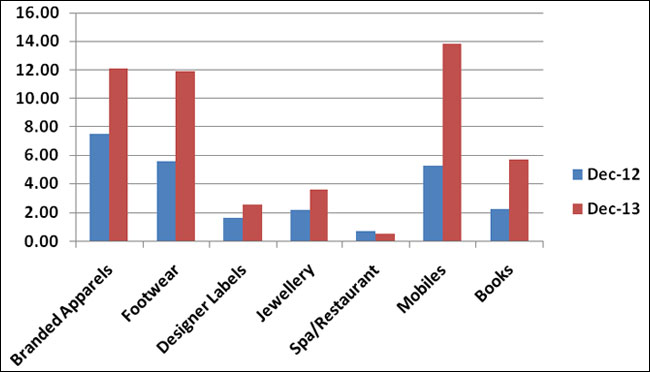
    According to the latest Internet Economy Watch, published jointly by the Internet and Mobile Association of India (IAMAI) and IMRB, the user visit to various websites to look for mobile phones has gone up from 5.26 million in December 2012 to 13.79 million in December 2013 registering a year-on-year growth of 162 percent. While branded apparels witnessed 12.09 million online user visits in December 2013 as compared to 7.45 million user visits in December 2012, the footwear segment registered 113% y-o-y growth in December 2013 when compared with user visits in December 2012.


    Fig: 1

    Source: IAMAI/ WAM Data December 2013


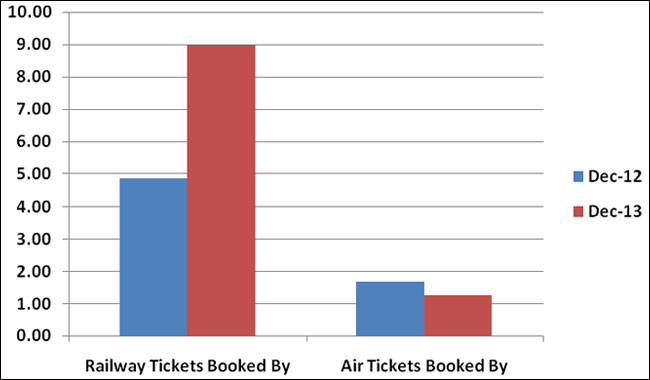
    The monthly tracker also finds a y-o-y growth of 85% in online booking of railway tickets when compared with the numbers of corresponding month last year. Railway tickets booked online in December 2013 were 8.97 million as compared to 4.84 million in December 2012. The online bookings of air tickets witnessed a decrease from 1.68 million in December 2012 to 1.26 million in December 2013.


    Fig: 2

    Source: IAMAI/ WAM Data December 2013


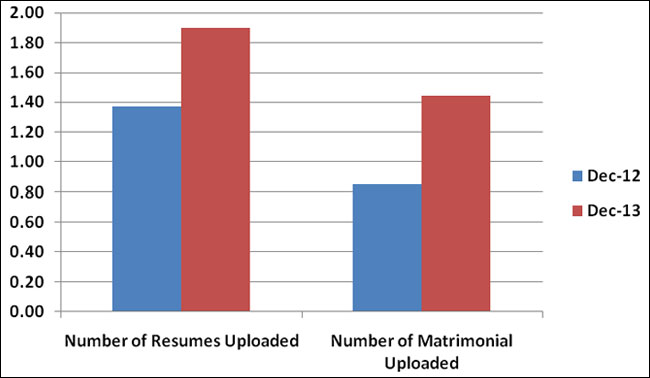
    According to the data captured from major matrimonial sites in the monthly tracker, the number of profile uploads in December 2013 were 1.44 million as compared to 0.85 million in the corresponding month last year. The number of resume uploads increased to 1.90 million in December 2013 from 1.37 million in December 2012.


    Fig: 3


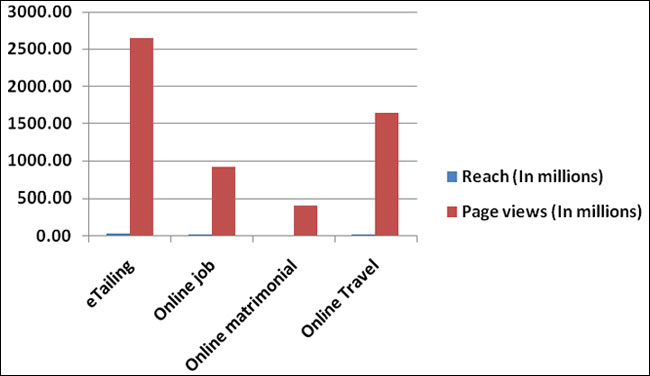
    The monthly tracker further indicates 39.73 million people accessed various e-tailing sites. There were 2648.57million page views in the category. The user reach for job and matrimonial websites is 20.76 million and 15.27 million respectively with 917.01 million and 417.19 million respective page views. Online travel segment has reach with 23.11 million reach and 1650.813 million page views.


    Fig: 4


    Sourced from all India active internet data, the monthly internet tracker is based on WAM data captured from various relevant sites, and encapsulates online usage for E-tailing, Online Travel and Vertical Classifieds.


  • Online visit for looking up mobile phones registers 126% year-on-year growth: IAMAI

    By A Correspondent


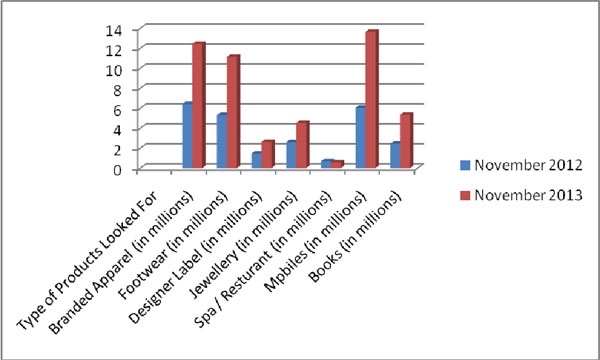
    According to the latest Internet Economy Watch, published jointly by the Internet and Mobile Association of India (IAMAI) and IMRB, the user visit to various websites to look for mobile phones has gone up from 6.05 million in November 2012 to 13.65 million in November 2013 registering a year-on-year growth of 126%. While branded apparels witnessed 12.45 million online user visits in November 2013 as compared to 6.42 million user visits in November 2012, the footwear segment registered 110% y-o-y growth in November 2013 when compared with user visits in November 2012. The online users visit to spa and restaurant segment decreased from 0.70 million in November 2012 to 0.58 million in November 2013.


    Fig: 1
    Source: IAMAI/ WAM Data November 2013


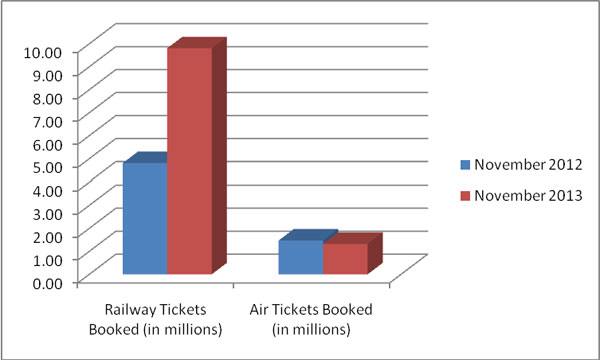
    The monthly tracker also found a y-o-y growth of 104% in online booking of railway tickets when compared with the numbers of corresponding month last year. Railway tickets booked online in November 2013 were 9.81 million as compared to 4.81 million in November 2012. The online bookings of air tickets witnessed a decrease from 1.47 million in November 2012 to 1.33 million in November 2013.


    Fig: 2
    Source: IAMAI/ WAM Data November 2013


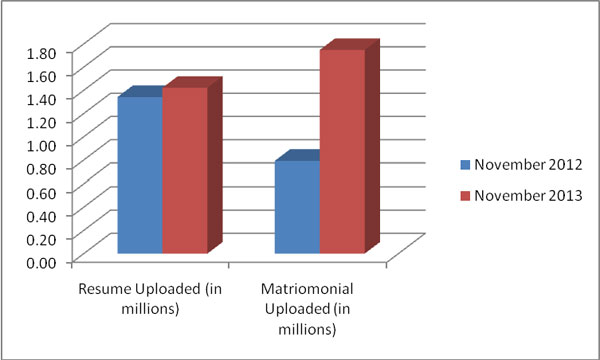
    According to the data captured from major matrimonial sites in the monthly tracker, the number of profile uploads in November 2013 were 1.75 million as compared to 0.79 million in the corresponding month last year. The number of resume uploads increased to 1.42 million in November 2013 from 1.34 million in November 2012.


    Fig: 3
    Source: IAMAI/ WAM Data November 2013


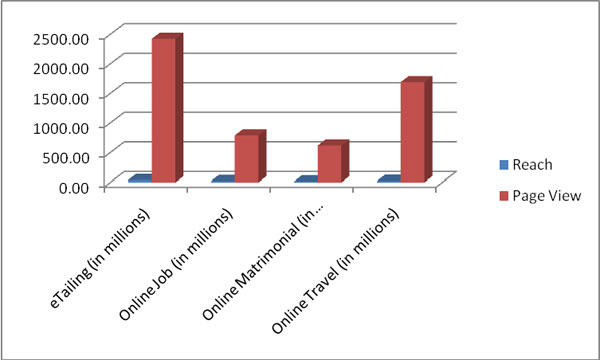
    The monthly tracker further indicates 40.02 million people accessed various e-tailing sites. There were 2425.43 million page views in the category. The user reach for job and matrimonial websites is 23.00 million and 16.15 million respectively with 789.28 million and 618.87 million respective page views. Online travel segment has reach with 24.91 million reach and 1691.479 million page views.


    Fig: 4
    Source: IAMAI/ WAM Data November 2013


    Sourced from all India active internet data, the monthly internet tracker is based on WAM data captured from various relevant sites, and encapsulates online usage for E-tailing, Online Travel and Vertical Classifieds.