Tag: IAA World Congress

  • Srinivasan Swamy presented with IAA Golden Compass Award

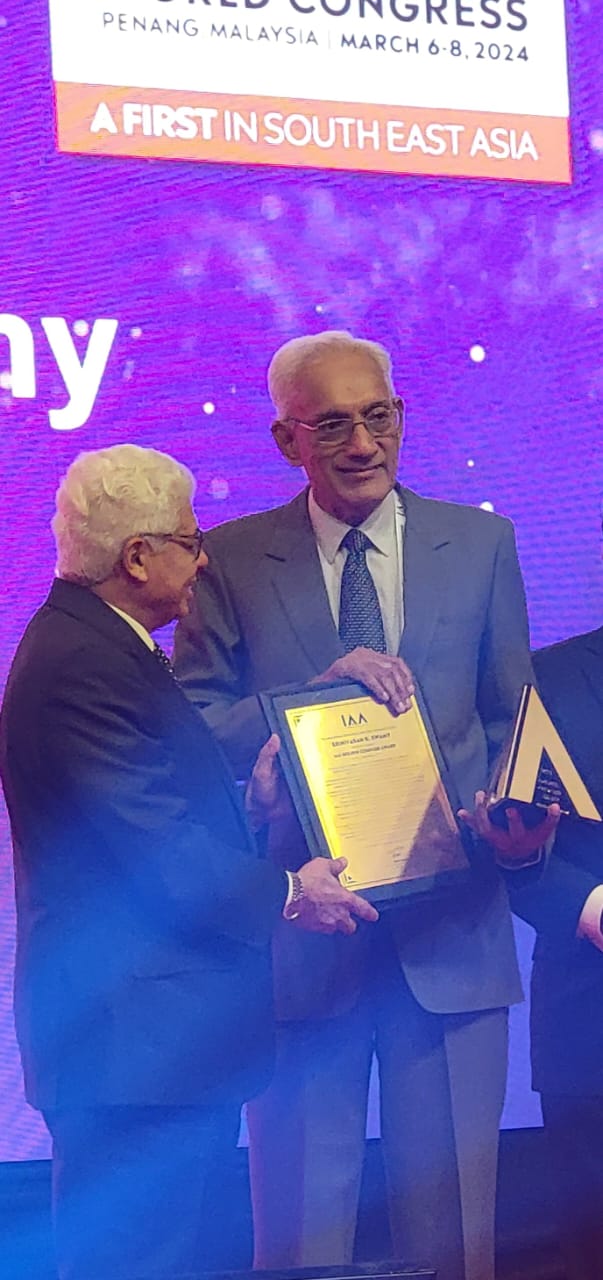
    Mr. Srinivasan Swamy receiving award from Governor of Penang, Malaysia
    Mr. Srinivasan Swamy receiving award from Governor of Penang, Malaysia

    At the 45th IAA World Congress held in Penang, Malaysia, Penang Governor Tun Ahmad Fuzi Abdul Razak presented veteran industryperson Srinivasan Swamy with IAA’s most coveted IAA Golden Compass Award. The award honours legends who have significantly contributed to the world stage in the field of marketing, advertising and media industries. This is the first time that this award is being bestowed upon an Indian industry leader. Earlier recipients of this Award include Shelly Lazarus (Chairman Emeritus, Ogilvy and Mather), Paul Polman (CEO, Unilever), Paul Rossi (President, Economist Group), Marc Pritchard (Chief Brand Officer, Procter & Gamble), Andrew Robertson (President & CEO, BBDO Worldwide), etc.

    Srinivasan ‘Sundar’ Swamy, is Chairman & Managing Director of R K Swamy, the only recently listed integrated marketing services company. He currently holds the position of Chairman for The Asian Federation of Advertising Associations (AFAA) and The Audit Bureau of Circulations (ABC).

    Acknowledging the award received, Swamy said: “I am happy to receive this most coveted award on behalf of all the professionals in my company as well as the industry who have supported me at work and in my various initiatives over the years. I want to dedicate this award to my father, the late Mr. R.K.Swamy, who once said to me that no amount of time given to the industry is wasted time, since that is the hand that feeds us!”

    Added advertising veteran Ramesh Narayan, who has worked with Swamy for several years on various industry projects: “Sundar is a leader on steroids. His ability to set tall targets and get things done when the odds are stacked against him is inspiring. His leadership style is inclusive, but he will not brook any slackness from his teammates. It amazes me that he finds quality time for everything despite running a large diverse business. I wish him continued good health and energy as his group embarks on a new journey as a publicly listed entity.”

  • IAA 45th World Congress in Penang from March 6 to 8

    By Our Staff


    The International Advertising Association (IAA) has unveiled the forthcoming 45th IAA World Congress, to be held in Penang, Malaysia, from March 6 to 8, 2024.


    Said John Chacko, President, IAA Malaysia and Chairman of the 45th IAA World Congress, Penang: “The convergence of social, economic and climate issues, along with rapid technological advancements has created a new reality for businesses to navigate. Equally, social issues such as inequality, diversity and inclusion have gained significant attention with customers and the workforce demanding more ethical practices all around. All these issues would be discussed and debated by senior global experts in Penang. And Penang itself is a wonderful confluence of diversity, heritage, and culture.”


    Added Pradeep Dwivedi, Group CEO, Eros Media World PLC and IAA Global Vice President & Area Director, APAC Region: “The Indian media, advertising and marketing talents are making big waves globally in creative excellence, impact, and effectiveness. The IAA World Congress 2024 in Penang, Malaysia offers Indian delegates with the perfect blend of learning and sharing same with the worldwide community of professionals. I am confident of its wide appeal and benchmark level of participation from India, coming on the back of phenomenally successful IAA World Congress previously held in Kochi, India. I am especially delighted to share that my good friend and an esteemed industry colleague, Avinash Pandey, CEO, ABP Network has been chosen as the leader of the Indian Delegation to IAA World Congress at Penang and looking forward to it. With Indians not needing visas to come to Malaysia the path has been made even easier for a good participation from India.”


    Said Pandey: “The 45th IAA World Congress marks a pivotal gathering, echoing the success of our 2019 Congress. It serves as a hub for innovative ideas and transformative discussions, shaping the future of our industry. We eagerly anticipate a robust Indian delegation, expecting invaluable insights and collaborations.”


  • IAA gets set for World Congress in in Penang

    By Our Staff


    The International Advertising Association (IAA) has announced the dates for its World Congress. it will be held from March 6-8, 2024 in Penang, Malaysia.


    Said John D Chacko, veteran marketer and corporate captain based in Malaysia and Chairman of the IAA World Congress: ”The convergence of social, economic and climate issues, along with rapid technological advancements has created a new reality for businesses to navigate. Equally, social issues such as inequality, diversity and inclusion have gained significant attention with customers and the workforce demanding more ethical practices all around. Technological advancements like AI continue to disrupt industries, bringing both opportunities and challenges. All these issues would be discussed and debated by senior global experts in Penang. And Penang itself is a wonderful confluence of diversity, heritage and culture. With Indians not needing visas to come to Malaysia the path has been made even easier for a good participation from India.”


    Added Avinash Pandey President IAA India Chapter,” The India Chapter has been a very special part of the global IAA firmament. It has even contributed a World President in the form of Srinivasan Swamy. The Chapter itself is arguably the most active industry association of its kind with initiatives that cover sustainability, technology and excellence in Marketing and Creativity. The IAA World Congress Kochi in 2019, of course set a benchmark for others to emulate.  We are happy to welcome John Chacko and plan out the route ahead.”


  • Remembering Pradeep Guha


    Ramesh Narayan: My friend, Pradeep


    Pradeep proved to me that you could violently disagree with someone and still be friends, writes Ramesh Narayan


    Ramesh Narayan

    By Ramesh Narayan


    Sometime in the early nineties I signed on for a tour of Spain organised by the India Chapter of the International Advertising Association (IAA). I was a rookie in the advertising industry and I looked in awe at veterans like Mukul Upadhyaya, Amol Bose, Pheroza Bilimoria, Mohini Bhullar and Pradeep Guha. Yes, his reputation preceded him even then.


    He was the man who was building up the Times of India Group into this formidable money-making machine.


    In a couple of years, we were travelling to Cancun for a World Congress of the IAA. This time, I knew Pradeep slightly better. At London, where we checked in again for the second half of our flight, he sauntered up to the Business Class queue where I was (he was travelling first class) and cautioned me to ensure my bags had been loaded. I did, and when we landed in Cancun, my bags were there, but his weren’t. And so we spent half a day shopping for some basics for him.


    And that was the beginning of dozens of flights and trips we did together for a host of reasons. We were the most unlikely friends. He loved shopping, I never shopped. He was an extroverted partygoer, I preferred to be in bed by 11pm.


    But it was sometime in the late nineties when India (to be read as Pradeep Guha and Goutan Rakshit) decided to make a bid to bring AdAsia to India that we really became a threesome.


    Flashes of incidents come back to me.


    I excitedly told him that I had managed to wrest a 15-minute slot at the IAA World Congress in Beirut to pitch the AdAsia. He looked at me and said: “You really think those guys want to see you and me on stage? Let’s get Miss World to invite them instead”. And so Pradeep, Priyanka Chopra, the reigning Miss World and I flew to Beirut. I made the presentation and then Priyanka in her gown and wearing the crown and sash came on to invite the audience to India, promising to meet them there as well.


    During the build-up to the AdAsia I was at the Times of India office every day from 2 to 7pm for about six months. The security assumed I was some senior employee and saluted me all the way to Pradeep’s well-designed room. Here, he poured every minute detail that could make this a memorable Congress. From the bus routes to the venue to the staff who would clean the toilets, no detail was too small for him.

    And thanks to his personal goodwill, Mukesh Ambani, Kumarmangalam Birla, Amitabh Bachchan, Priyanka Chopra and Shah Rukh Khan all graced the AdAsia. And his name never appeared in the media. He made me the face of the AdAsia with a sardonic: “I will not allow the TOI to carry my picture. And the other newspapers won’t carry it in any case. So you have to do the honours”.


    In 2008, a call from him brought me back from organic farming to my second innings with the advertising industry. He was taking over as President of the IAA and he insisted I be at least a mancom member with him.


    In 2011, after the completion of the AdAsia in Delhi, we were driving to an after-party hosted by a friend. I told him of an ethical problem I was facing in accepting a large company which was faced with pollution charges as our sponsor for the fledgling Olive Crown Awards. He listened and quietly said: “I’ll do it”. And for three years after that 9XM sponsored the Awards.


    In my year as President of the Rotary Club I asked for speakers, a star Chief Guest for a function at a Municipal school and TV time. He never said no to me.


    Even in 2014 when we were organising the silver jubilee Summit of the IAA, I called him and said he should somehow get Shah Rukh Khan to come for the opening session of the conference in Kochi. He just said, “You deliver a jet. I’ll deliver SRK”. And that was it.


    On the work front, as President of the AAAI, I was able to recover many longstanding dues from errant clients for our members simply because as regional Chairman of the INS he was happy to arm me with a letter that would place an embargo on the advertising of those clients if they didn’t pay up.


    Pradeep had the dubious distinction of being the author of the Page 3 culture. He also helped birth the Bombay Times and though he didn’t personally usher in the era of paid news, he half-heartedly oversaw it. He knew how to make anything into a huge spectacle. The Filmfare awards, the Miss India pageants, even the Bombay Times party. It was the only party people lusted to get invited to. However, through all this he never took his eye off the ball. All these efforts were aimed at brand-building for the various publications of the Times of India group.


    Here was a large-hearted man. Sure we had our differences, including one bitter exchange of hot words at KL airport over the theme of the 2019 IAA World Congress. But when the Congress was over and it turned out so well, we were back to our old relationship. Pradeep proved to me that you could violently disagree with someone and still be friends.


    Ambi Parameswaran, as President of Advertising Club honoured Goutam, Pradeep and me on stage and called us the Three Musketeers of the advertising industry.

    We lost Goutam last year. Pradeep a couple of days ago, and I stand bereft.


    Ramesh Narayan is a veteran and awardwinning industryperson and headed various media industry associations


    Partho Dasgupta: Live like a King again, Boss


    The outpouring of love, respect, devotion as well as a sense of despair and loss – in words and pictures – in newspapers, and social media posts though don’t do justice to the Man himself, writes Partho Dasgupta


    Partho DasguptaBy Partho Dasgupta


    It’s amazing to see the various social media posts on PG (The Boss) pouring in through the weekend. So many, just so many have remembered him with their memories of the man who shines today as one of the brightest stars of the media and advertising world out there. The outpouring of love, respect, devotion as well as a sense of despair and loss – in words and pictures – in newspapers, and social media posts though don’t do justice to the Man himself. He is (yes, not using the past tense still) a man who is bigger than all this.


    He was a towering personality in the Old lady of Boribunder (Times – VT building) whose presence in every review meeting or otherwise meant one learnt something that day. I still remember presenting The Economic Times  efforts in franchising the brand into regional languages by providing a page of the top news in the local language but with English ET masthead. He taught me never to use the term Vernacular – since it meant the language of the Vernas i.e the slaves. I have always learnt from him how to think strategically, thinking big and to encourage people instead of pulling them up for their mistakes.


    The way he gave the Indian event industry a new scale, stature, and glamour, was unprecedented. He was a man who always thought way ahead of his time, encouraged people to perform and partied hard to get amazing results. I still remember the way he organised the Abbys with SRK and stars performing on stage as the President, The Advertising Club. From there on the AdAsia at Jaipur to the recent IAA World Congress at Kochi – he brought the world to recognise and witness the Indian advertising industry at its best. I doubt anyone else could do that.


    He was the life of every party. His Diwali do every year was a sought after one and one where most erstwhile colleagues and senior people would meet. A man with excellent relationships, across industries and across levels, he loved to entertain. And lastly the managers he helped groom, the startups he advised, are there across the industry successfully managing their businesses – is the big legacy he left. I doubt we will see another PG again.


    Live like a King again, Boss.


    Partho Dasgupta, former CEO of BARC India, is Management Strategy Consultant and worked with The Times of India for many years

  • Anant Goenka bags IAA 2020 Young Leader Compass Award

    By A Correspondent


    The International Advertising Association (IAA) has named Anant Goenka Executive Director- The Indian Express Group, and Mancom Member IAA India Chapter as ecipient of its 2020 “Young Leader Compass Award”.


    Says Punit Goenka, President of the IAA India Chapter: “It is a matter of pride for us in the India Chapter and in the Marcom industry in India that our member has been selected for this signal honor. I wish Anant all the best”.


    The award was to be presented at the IAA World Congress St.Petersburg, but since that has been postponed, the presentation details will be communicated soon.


  • IAA World Cong at St Petersburg on May 27-29

    By A Correspondent


    Around this time last year, the 44th edition of the IAA World Congress was held last year. Now the leading global platform to discuss a development strategy of the marketing communications industry, returns for its 45th edition from May 27 to 29, 2020 in St Petersburg, Russia.


    “Power to People” is the theme of the 2020 World Congress.

    The Congress will also grant a great chance for young professionals and students within educational program, which will involve briefings, master classes and lectures of key congress speakers. Details about the IAA Congress can be found out on www.iaaworldcongress.org/en. The India Chapter of the IAA and The Advertising Club are planning to mobilise a large delegation to the St Petersburg Congress. For registrations, please contact: Soumen Santara at execseciaa@gmail.com or Bipin Pandit at bipin@theadclub.in


  • Future Shock or Fixed?


    By Sanjeev Kotnala


    Sanjeev Kotnala

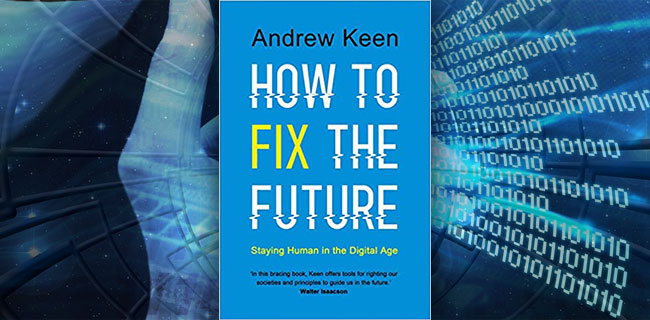
    I knew all along, there was something drastically wrong with the way the future is unveiling itself. I was on the lookout for a debate on ‘How to fix the future’. Andrew Keen’s session at the IAA World Congress held at Kochi, India in February this year probably opened new spaces for the discussion.

    We are under constant surveillance. Our behaviour is slowly being nudged towards what the dominant biggies Google, Amazon, Facebook of the business want. It is the new era of ‘Winner-takes-it-all’ business that is creating polarisation of wealth rather than distributing it.

    We are ignorantly working towards bettering their algorithms. We believe we are getting all this free. Not realising there is nothing free.

    The internet is a boon, but may be the price we are paying for its services outweigh the benefits.  Internet is the new morphine. Like many of us, I feel trapped in the system. I am addicted to it. I am unable to withdraw or detox.

    After having read ‘Internet is not the only thing’ by Andrew Keen, and having an equally polarised view of the internet, it was logical for me to pick his next book ‘How to Fix The Future: Staying Human in the Digital Age’.

    And if this is the trailer, what profound changes Artificial and Alternate Intelligence can unleash on mankind, unless we pre-plan to control the damage. History is witness to the fact that we are blinded by our vision of advantages and rarely humans have thought of the future repercussion while it adopted a new regime of services and products.

    Talking of the influence of internet-based services and addiction, I find it amusing and true. A potential threat humans failed to appreciate at the initial stage. “In the 1960s, we swam through the waters with only a few hooks: cigarettes, alcohol and drugs that were expensive and generally inaccessible… “In the 2010s, those same water are littered with hooks. There’s the Facebook hook, Instagram hook. The porn hook. The email hook. The online shopping hook. And so on. The list is long –far longer than it’s ever been in human history, and we’re only just learning the power of these hooks.”

    On the other side, humankind has always been smart enough to get out of the damage path by intense social pressure, tweaking of the technology and bringing new guidelines and reforms to control the damage.  Half of us would believe that we would once again succeed in doing so with the Internet and AI.

    In his book, Keen makes a very pertinent point: ‘The computer is the “Brain Outside ourselves” our “Second Brain”. From an evolutionary point of view, there we have taken an exponential leap. The new brain has outpaced our heart, our morality and beliefs. We are so preoccupied looking down at the second brains, that we forget how to look smartly at ourselves. As these devices get faster and faster, we appear to be standing still, as they produce more and more data about us, we are getting any more intelligent: as the devices become more powerful, we might lose control of our own lives. Instead of the singularity, we actually be on the brink of antithesis- let’s call it the “duality” –  an ever-deepening chasm between humans and smart machines and also between tech companies and the rest of humanity.

    He adds what I call a real possibility:  ‘In the future, we may no longer be in charge of our own creation… Our technology might be developing a mind of its own, thereby excluding and disempowering, and enslaving us. The existential threat of self-conscious algorithms is very real. They might be our final invention.’

    May be the answer lies in genuinely finding ‘What the Humans are good at’ and will always be a wee bit better than the machines. The current answer is ‘Nothing’. And we in our quest of making machines equally smart and emotive with a better power to process and take decisions are clearly on the path to wipe out any difference. I have my doubts. I am part of the small subset that believes; we are on the way to hastening the end of mankind. And one of the reasons I like reading Andrew Keen.

    Most of us are intellectually challenged to understand the enormity of the technology revolution, the amplified inequalities, the creation of parallel power centres feeding on our data and the race to harnessing Alternate intelligence.

    No doubt, Keen is open and transparent in stating: ‘This is a maybe book, based on the belief that the digital revolution can, like the industrial revolution, be mostly successfully tamed, managed and reformed. It hopes that the best feature of this transformation – increased innovation, transparency, creativity, even a dose of healthy disruption – might make the world a better place.”

    The book title ‘How to fix the future’ is misleading. There are no solutions. There can’t be.

    Keen presents a strong argument in favour of his belief that “No, not even the smartest technology can solve technological problems. Only people can”. I agree with him as he shares a few example and stories of how people are solving the thorniest problem in the digital age.

    Though there are directional paths from education to governance, to fixing it well in time. The example quoted in the book of Governance in Estonia and the always-on technology for betterment in Singapore shows some promise. The concept of ‘Universal Basic Income’, paid to everyone for ‘Not Doing Anything’ is also explored but be warned that can never be the solution. The only good part is that Andrew Keen is raising the issue. He at least presents a possible solution around competitive innovation, government regulation, consumer choice, social responsibility by business leaders, and education. It is up for healthy discussion.

    What I disliked was the constant reference to the 1516 work of Thomas More’s Utopia. It comes across as a framework of an idealistic world-inspiring Keen. But that is hardly the way life is expected to turn. Though it was interesting to note that if seen from a perspective More’s Utopia Map resembles a skull. May be there is a cryptic message in the map design that we are missing.

    Go read this interesting book that may sound fiction to many followers and admirers of internet-led ease in life.


  • India can be proud of staging IAA World Congress: Srinivasan K Swamy


    Impossible is not a word that you’ll ever find in the books of Srinivasan K Swamy, Chairman and World President of the International Advertising Association (IAA). Hardly had the IAA World Congress at Kochi got over, he was busy working on plans for the next few projects. And of course achieving his dreams for IAA across the world.

    The Chairman of the RK Swamy Hansa Group, Swamy took on the global charge in October. A quick chat with

    Srinivasan K Swamy on the success of the IAA World Congress and what’s next on the IAA calendar. A slightly shorter variant of this interview appeared as part of a pull-out published with Business Standard today, March 12. Compiled by MxMIndia. Published and conceived by The Resource 24×7


    You had set yourself near-impossible targets for the IAA World Congress. Now that the Congress is over, and the feedback received indicates that it was very successful, what are your own thoughts? Are you happy with what you set out to achieve?

    Frankly, during the last few days prior to the Congress, it all came together. Of course the speakers were done and dusted well in advance. A few cancellations in speakers were always expected and we had some options that we exercised, without compromising on what we set out to do. The only reason we settled for Grand Hyatt Lulu Convention Centre in Kochi was because only this venue could host a capacity of 2500 delegates in India, that too in style. Our target for participation at the Congress was set at 2500, the full capacity, and we exceeded that too thanks to the enormous support we received from Kerala delegates.  We also felt the evenings is what would make the event memorable and these were executed to perfection. All our international delegates were overawed by the scale and the grandeur of the event, and India can certainly be proud of staging this spectacular international event in India.


    And we now hear that the next IAA World Congress is in St Petersburg, Russia next year. How will you better the really high benchmark that you’ve set with Kochi?

    St Petersburg is a beautiful city with many palaces and historical monuments. It  starts off with that advantage straightaway. The event is going to be conducted in late May 2020, when the sun never sets. It will be a new experience for many delegates during these ‘white nights’. Further, it will be more easily accessible from many European cities, so more international delegates will be a natural consequence. And last but not the least, the Governor of St Petersburg, the City Administration and the Federal Russian Government are fully backing the Congress and are very keen to ensure that the event will be a world-beater in both content and entertainment. We have already formed a committee of experienced people to finalise all details and I am sure the St Petersburg Congress will in no way fall short of the benchmark we have set for ourselves in Kochi.


    Pre-event, you had mentioned that the real work on the Congress happened only in the last six-odd months. Given that all of you amongst the key organisers have other businesses to look into, what were the challenges that you faced?

    The actual work for the Congress started well over 18 months ago. Many of the speakers were finalised well in advance. As is always the case, the momentum builds in the last few months when strong marketing efforts are put in for delegates to sign up. When we are organising an important event like the World Congress, our business demands do take the backseat. And fortunately, none of the core committee members complained in this regard and tirelessly plugged along.


    The IAA World Congress in India is just a one-off event. Do you have plans to harness the momentum that the IAA franchise gained in India over the next few months?

    We have many good global events coming up. We will have the Africa Rising conference taking place in May 2019 at Accra, Ghana. In June, we will be in Cannes, France having our own leadership sessions. In October, we plan on our third edition of the IAA Global Conference in Bucharest on Creativity4Better. There are couple of other things on the anvil which will be announced once the plans/dates are finalised. Events apart, we are putting enormous emphasis on Education. We have already accredited 44 institutions on marketing/ advertising courses and we want to provide active support to them, apart from expanding our accredited institutions base to twice that large over the next two years.


    The IAA is of course a lot more than the World Congress, and in your presentation at the opening ceremony, you spoke about the work that you intend undertaking in the field of digital privacy? It’s a huge ask given the extent of intrusion that has taken place. What are your specific plans?

    Privacy in the digital world is a matter of concern for everyone. No wonder the governments of various countries are stepping in to protect their Citizens. IAA believes that over-regulation may not necessarily be in the interest of the consumer, because it could impair on the efficacy of well-targeted communication. As a strong promoter and defender of advertising self-regulation, IAA is of the view that a strong data privacy regulation would actually act against the interest of the consumers. Advertising after all is a major source for economic growth. It promotes competition, thereby innovation, improves product quality, promotes choice, reduces prices. Excessive privacy laws would make targeted advertising difficult making the cost of advertising very high impacting on all the benefits of advertising listed.  With 43% of the global advertising budget going to digital, regressive privacy laws will change the business of advertising as we know it. IAA is therefore trying to speak to all the stakeholders – advertisers, agencies, media, digital companies, technology companies etc – to hopefully arrive at a self-regulation code we all can subscribe to and also develop a mechanism to oversee this. The response from the people I have reached out to has been overwhelming and I am sure many of what we need to do, will be based on further consultation with multiple stakeholders. As they say, watch this space!


    The India chapter has been super-active ever since you helmed it. Do we see you inspire other country chapters to also become as active as the India chapter?

    IAA Chapters are only as active as the leaders leading them. And another ingredient that is needed for this is the quantity of members. Our focus at IAA will be on both these fronts. We have already made some changes in our by-laws which will aid in membership-building. We have put in place some guidelines to check the health of the Chapters. And we do want to get Chapters to adopt certain common events from the vast repertoire of events we have in many of our Chapters. We have some distance to cover in this but I can say the journey has begun!


    A slightly shorter variant of this interview appeared as part of a pull-out published with Business Standard today, March 12. Compiled by MxMIndia. Published and conceived by The Resource 24×7


  • Been bullish on India for years…


    Former WPP CEO Sir Martin Sorrell has always been bullish on India. And he continues to be that as Executive Chairman of S4 Capital, which is building a new age, new era, digital advertising and marketing services platform for clients.

    Sorrell was CEO of WPP for 33 years, building it from a £1 million “shell” company in 1985 into the world’s largest advertising and marketing services company. Prior to that, Sir Martin was the Group Financial Director of Saatchi & Saatchi Company PLC for 9 years. S4 Capital PLC recently merged with MediaMonks and MightyHive, and is listed at the London Stock Exchange under SFOR.

    We had a quick chat with Sir Sorrell on the sidelines of Day 1 of the IAA World Congress (Feb 20)


    So you’ve been making frequent trips to India in the recent past.

    They are no different to normal.

    Earlier the normal was different…

    But I would say that no dissimilar frequency. I wouldn’t differentiate particularly.

    And the million dollar question is—

    Only a million?

    Well, billion actually, given the acquisitions that you’ve made globally. But are you looking at furthering your business interests with S4 in India?

    Organically, quickly and by acquisition as quick as we can… so we’d be doing both in India.


    Any clues on your wishlist?

    No, I’ve got a wishlist but I mean whether in term vision reality is other question and whether what people tell you and what is there is another question as well.

    Is old friend Sam Balsara’s Madison still on your radar?

    Our operation, you must remember, is focused purely on digital.


    Right, but when you launched you were looking at digital content, data, media planning and buying?

    No, not media planning. First party data and informing digital content and digital media planning which is programmatic.

    The traditional media agency doesn’t come under your radar?

    Well as defined by that, no.

    But at the end of the day it’s all about relationship with clients, right?

    Yes, but that’s a very old-fashioned way of looking at the business. I mean I would turn the question around you and ask you, is it? I mean it may well be that faster, better, cheaper is becoming more important. It may be that people are looking at doing things in a more transparent way. It may be the clients felt that they want to take back control of some of these things. So may well be that they are worried about the height of the gardens in, the height of the walls in the old garden.

    You say that things are not transparent in the traditional media agency model that you created?

    Well I would say that the Indian market tends to be less transparent than other markets.

    It’s often said the media agency business is not all that transparent because of what’s happening?

    Yes, I think, sometimes there’s been a perception of that and sometimes clients or associations of clients you know have been pushing that line unfairly. Sometimes I don’t know they obviously have come across situations, one hopes given by what they said. They come across situations which they didn’t think were fair. But what I would say you can compare India to other markets, I think there is scope for a more transparent model.

    Back to acquisitions. So are these around digital agencies? But there aren’t too many options out there, right?

    No they are small.

    Small?

    Yes because we are at the beginning of the journey. So they are growing bigger.

    But no many of them are doing really all that well, right?

    That broad, sweeping generalisation is probably unfair. There are some that are doing ok. Yes, the ones I’ve seen are doing ok.

    Is there a timeframe for these acquisitions?

    We’ve never had a timeframe…

    Given that you know you are coming here often enough. You are meeting people.

    The cheapest way of doing things is organically.

    But time to get to the market is longer?

    Yes, it takes longer time.

    Have the organic operations started?

    Yes, in the process of starting.

    Any people you’ve hired already?

    Yes.

    Could you reveal the name?

    No.

    You bought Media Monks last July, Mighty Hive in December. What next?

    Well we started in Tokyo and Japan. We are going to start shortly in India. So the one other market we’ve identified is Germany. I would like to do something in Germany and may be France, Spain and Italy at some point in time. But I think that geographically for the moment we know that India would be I think our 15th country.

     But the biggest market place is US?

    Yes I mean US, by and large US is about a third of worldwide advertising. But don’t undersell India.

    Of course.

    Yes, we will the most populous country in the world. Bigger than China, may be not the wealthiest on a per capita basis or absolute basis. But it is growing and I got more faith, probably more faith than you that it is going to grow more faster.

    And you’ve fairly very close to the Indian market, you know the, clients, you know the business?

    I’ve been bullish on India for years.

    Since you are so bullish about India, could you give an indicator of what you’d think would India be as part of your foot print in percentage terms?  

    It’s impossible to say. I mean it depends, if we get traction from a model. The data-driven content and media model could be very significant. Because the other thing that happens here is, you got lot of BPO, back-office type work being done here and so the nuance to the  Indian operation, it’s not just sort of a front office operation, back office operations as well. And the people are so talented. I mean if you said to me, what is the attraction of India? I would say scale and quality of people. Despite the scale, which usually the bigger you are, the more average you get. Despite the quality of the people here is outstanding. Look at the quality of the WPP people – Srini and his colleagues I mean they are superb, yes superb.

    You miss them?

    Listen, I always miss talented people. And as I have said pretty much every time I have come here, if we had the same quality of people outside India that we have in India, I could have retired a long time ago.

    The retirement question keeps coming up.

    Well, I will retire on the job.

    Since you are betting so big on digital, people like P&G’s Mark Pritchard have cast aspersions on the transparency in digital?

    Our operation includes one significant P&G brand, P&G Braun. Our operation plays exactly to what Mark Pritchard has been saying. The willingness to experiment, try different models, faster better cheaper, unitary structure, focus on digital. It plays exactly to what he wants.

    You had mentioned last year, in fact on the day when you announced S4, that you want S4 to be run the way consulting firms work. Given their access to CEO, the Board. Is S4’s operations like them?

    Well I’d love S4 to have a relationship. We want the consulting practices   which gave us that sort of fourth dimension. So you’ve got data driving  content and media making for the three dimensions. The fourth one would be that access. Yes, we do have access to the C-Suite. We do. We can get in there, we do get in there but you know, do clients I mean, this would apply to the Big 6, but do clients really takes seriously our ability to digital transformation or digital disruption? I think the honest answer is no.

    But the consultants have access to the C-Suite

    Having access to the C-Suite and being able to execute is two different things.

    They are buying agencies, right?

    But they are buying small, they are buying bits of pieces and if you got the 100 billion or 40 billion dollar company buying a two or three million dollar company and buying four of them, compounds the felony four times. You know it’s eight times more difficult to integrate four, two or three million dollar operations or even a 100 million dollar operations.

    You were bullish on the way a firm like Accenture was doing. Now you are more critical

    I don’t think I was bullish

    You had said the advertising industry needs to align like the?

    I think I am saying the same thing. They do have that access and I think we have the access as well. But, clients don’t believe that we can put together digital transmission jobs. I mean the claims Publicis, for example, make around digital transformation are unrealistic. If you and I were CEOs of a big business which had a transformation issue or disruption issue in digital and we saw presentations  from Publicis  or from Accenture, I don’t think we would choose Publicis or Deloitte. I don’t think we’d choose Publicis. Likewise I think if we were competing Publicis, we were competing  against Accenture for the implementation of digital marketing job. I don’t think there would be a pro Accenture. So they are all complementary strengths. All I am saying is the way the consultancies can get those complementary strengths is not by tinkering with a dozen small acquisitions. You won’t move the needle.


  • What made the IAA World Congress a Grand Success


    By Sanjeev Kotnala


    The IAA World Congress held at Lulu Bolgatty International Convention Centre (LBICC), Kochi from February 20 to 22 was a grand success.  Most of the delegates I met were satisfied with the sessions, set-up and infrastructure.

    Time to congratulate Srinivasan Swamy, Ramesh Narayan, Pradeep Guha, and the extended team of IAA India, sponsors, delegates and speakers.

    The event will most probably be remembered for Sophia, Andre Agassi, may be Amitabh Bachchan and the grand parties in the evening. But, the session ‘Tech Without Affect is the Death of Advertising’ by Havas’s Jacques Seguela will be remembered the most. Seguela, also author of “Don’t tell my mother I’m in Advertising, She thinks I’m pianist in a Brothel”, spoke on Day Two and received a genuine standing ovation. It was a class in presentation, idea delivery, stage coverage, voice modulation and connecting with the audience. Though it was tough following the Frenchman’s English, there was no communication gap. In brief, remember your advertising should not be Brain-to-Heart or Heart-to-Brain, or Brain/heart –to-wallet but Heart-to-Heart. Have the idea and then leverage it with technology and not necessarily the other way around.


    FINDING FAULTS IS ALWAYS EASY.

    A Congress of this size with around 2000-plus delegates from a diverse sphere of the industry is like an Indian wedding. No matter what you do, there is always Dal Mein Namak Kum. Delays and minor issues over dramatised. Now, look at the positive side. You may forget the bride and bridegroom. However, such incidents become memory hubs.

    It is natural for IAA World Congress not to meet everyone’s expectations. Remember our ads and strategies also cater to the majority.  IAA World Congress ticked almost all boxes. Knowledge sessions followed the bell curve, so you got a spectrum covering the good, the bad and the ugly. Speaker sessions did not majorly overrun the allotted time.  The evening parties gave ample networking opportunities. The IAA World Congress app was helpful.  The area for question-answer and to jotting down your notes was appreciated. The three evening parties were engaging enough. There were hardly any technology glitches. The buses more or less maintained departure schedule from designated hotels.  The PR agency took good care of media in their movement, schedule, interviews and inputs. However, there was a visible absence of Marketers and brand owners.


    FEEDBACK HELPS.

    In case you attended the Congress, do share the experience. Constructive feedback will always help to narrow the gap between reality, and the myth perfection is.

    Before you say I am biased, let me be clear, there were moments when you wondered what was happening. But, then, they are bound to happen in a three-day event and Indian Barat.


    OVERALL IMPRESSION

    Day One was slow, and even Amitabh Bachchan’s speech did not help. The Congress warmed up on Day Two and finished on a high note with the Andre Agassi – Vijay Amritraj double volley and the Bollywood night. I am purposely avoiding any mention of the Deepika Padukone session which was the last session on Day Three, as it was going nowhere. I walked off the session, and so it is not first-hand experience. However, whoever, I met has the same expression.

    There were two sessions where the speakers got a standing ovation. It was proof that the delegates were willing to appreciate when they were served something really fantastic. I do not include Piyush Pandey’s session in it, as the ovation was more of respect for the perfect brand ambassador of Indian creativity and the creatives shown as part of his presentation…

    The Andre Agassi- Vijay Amritraj session was a class on how to engage the audience, pace the conversation and to face the camera. Agassi was very transparent, open and emotional in his answers and it helped the cause. He was not hesitant to add tadka-wala statements that resonated with the audience.


    SOME SUGGESTIONS.

    I think that panel discussions could very well be done away with. Or we must be willing to give more time for the sessions. That reminds me: this Ted Talk-inspired 30-minuts sessions do not do justice to the speaker or the audience. Time to experiment with 45 minutes or even a 60-minute session.

    I was surprised with few speakers (even in such global event) crib about the shortage of time as an excuse of them not being able to complete the session. It speaks more about the speaker than the organisers. And if something could be done to avoid blatant plugs by a few speakers, the audience will definitely appreciate.

    Loved the media seating. They were provided table seating to help them in filing stories. However, non-media delegates occupied a few of the media seats. It required better monitoring and control.

    As always, we could have done with more bar counters. That reminds me to add: with such a large gathering the number of live counters during evening parties were too few, adding to the wait.

    I loved the small act of lucky draw for the audience who returned from breaks on time. May be a higher valued price would have done the trick.


    IMPORTANT SHIFT.

    IAA World Congress also shifted the focus from digital that was becoming a cacophony in every event to Artificial Intelligence, which is where the future lies. Maybe, it is easy to predict that we are going to hear a lot more about AI and IOT this year.

    …………………………………………………….

    PASSING THOUGHTS:

    1. Since the IAA World Congress happened just 50 days before Goafest, will registrations there get impacted?

    2. Surprised that most people I spoke with advised wait-and-watch the situation, before taking a call on attending or boycotting AdAsia 2019, that is scheduled to be held from December 2 to 5  in Lahore.  WHAT DO YOU THINK? DO SHARE YOUR VIEWS ON THIS at editor@mxmindia.comwith the subject AdAsia2019.

  • Biz with Purpose on Day 2 @ IAA-WC


    By A Correspondent


    The second day of the 44th edition of the IAA World Congress organised by the International Advertising Association (IAA) saw several star speakers addressing a packed audience of professionals, practitioners, academics and students. The joint themes of ‘Brand Dharma’ and ‘Tech for Good’ were what everyone spoke on or discussed.


    It was also time for felicitations and awards. Yusuf Ali, Chairman and Owner, Lulu Group, was felicitated by Srinivasan Swamy, Chairman & World President, International Advertising Association. In his speech, keeping with the theme of the conference, Ali reiterated to all the marketing and communications stakeholders to act responsibly towards the society and stay true to their business values.


    The IAA Golden Compass Awards were conferred to Marc Pritchard, Chief Brand Officer, Procter & Gamble and Andrew Robertson, President & CEO, BBDO Worldwide. The IAA Inspire Champion Awards was conferred to Raj Nayak, senior media professional and former Chief Operating Officer at Viacom18. The IAA Inspire Honorary Life Member Award was conferred to Ranil De Silva from Sri Lanka.


    In the first session of the day, Paul Polman, President of the ICC, Chairman of the B-Team and Vice-Chair of the UN Global Compact. CEO Unilever made a passionate plea to companies to run their businesses by heart, because he felt that businesses can’t succeed in a society that fails.


    Polman stated that value and trust are two important elements for a company. However, currently, trust is low in the industry because of fake news, frauds, unethical employment practices, sexual harassment etc, he said.


    As advertisers, we should look and hear from a consumer’s viewpoint since consumers judge us by what we do, not by what we say, Polman said, adding: “You cannot run business with freedom without responsibility. If we don’t protect it, we won’t have a future.  Partnership is important to work on sustainable growth. A partnership, which is for a common good. Putting other’s interests before ours is very important because although we have the resources to help the society, all we are missing is human will power. Tech has connected us better with people, but has also given us loneliness.” He ended his speech by urging the audience: “If you belong to 2% of population, think about 98% population and live responsibly.”


    Next up was Simon Kahn of Google APAC on the Future of Digital Immersion. According to Kahn, the next wave of technology will assist us, augment our experience and will help us accelerate things we need to get done.


    The digital tech has started to help us in all practical areas, most progress which we have seen is in the area of speech recognition. We are now up to near human quality in speech recognition.  In India recently, we worked with Flipkart when wanted to add the experience of haggling for the big billion day sales and it the result was many millions interaction with the tool with average time of engagement for min 6 minutes. Communication is also about gesture and nonverbal cues, hence we are training computers to replicate the same hence breaking down physical world barriers


    This was followed by a panel discussion. Tom Doctoroff, Business Leader and Global Brand Builder on Derisk the future in conversation with Michael McQueen, Trend forecaster and Author and Tim Reid, Comedy Writer and Innovation Expert. Said Reid: “Best ideas come as jokes make your thinking as funny as possible. What makes is laugh are two things, first is the truth (as it is relatable) and the second is surprise, we experience, when something doesn’t quite fit in in the normal trend. Truth with the twist is the biggest thing that make us laugh. In an idea session, if we can get people to say something which has point of truth with an element of surprise and you will probably see a genius idea there somewhere and hence there is a science behind it creativity works better with humour.


    Mcqueen, who has done a lot of work with millennials on what are they thinking and what are they looking at, shared his insights on decoding the millennial mindset and how one can bridge gaps. There are 34% millennial population in India, which is very important numerically and economically as they will enter spending peak by 2026. McQueen advised the marketers to market their products through them and not to them.


    There was much anticipation for the session of Marc Pritchard, Chief Brand Officer, Procter & Gamble. After screening the latest ad campaign from his company in India, Pritchard started the conversation with the proposition of ‘What if brand could be force for good and a force growth’. He emphasised on living the brand’s purpose and not just talk about it. He stressed on the need of brands to align themselves with a purpose. He covered three major problems faced in the business diaspora; Gender Equality, Sustainability and Technology.


    People expect more from brands, he said. They want the brand to take a stand on the social issues. 9 out of 10 consumers want brands to live with their values, they want brands to take stand. In sustainability there is a difference between what people say and do. 67% of the population talks about sustainability but only 30% of them actually act on it. Sustainable goals are equally good for the growth of the brands, he sai. He spoke about how P&G is doing its bit by using technology is work on a product that can eliminate need of water in cleaning,


    “I urge to reduce renew and recycle water, energy and waste. It will be nice if all brands can come together.”


    Later, Chris Tung , CMO, Alibaba, spoke about the Alibaba model and how it has built for itself an ecosystem for brand-builiding. Mark D’Arcy, VP of Global Business Marketing and Chief Creative Officer, Facebook was in conversation with Hungama founder and digital pioneer Neeraj Roy. India is the second-largest market for Facebook. D’Arcy asked mainstream brands to be always being interesting and relevant in reference to content marketing. The journey from attention to action is interesting, he said. All touchpoints in the journey should be engaging and seemless. FB is deeply committed to innovation too. We have curiosity of constantly learning as an organisation is important. It helps in growing the business and help improve the culture.


    The following session had Rahul Welde, EVP Digital Transformation, Unilever and Lindsay Pattison, Chief Client Officer, WPP in a chat with Ralph Simon.


    The biggest change in marketing and technology sector is speed, Welde said. The results are quick which enables faster changes meeting the needs. Apart from technology, the most important assets in marketing are skills and talent. To make a greater impact, one needs to have a skilful leadership and talent pool in the organisation.


    Said Pattison: Disruption is affecting everybody and every brand. India has a 14% ad spent growth which is highest in the world, making it the most potential market for the advertisers.


    After some serious business truths, the audience witnessed an extremely engaging session by Jacques Seguela, Co-Founder of RSCG & Vice President of Havas Media where Seguela underscored the need for storytelling and emotions to not get disconnected in our pursuit of technology.Seguela, who was celebrating his 85th birthday on Thursday, receive a standing ovation. His session was followed by that of Ed Pank of Warc who spoke on ‘Tech for Good, Innovating for Social Impact’.


    The final session of the day was by Ogilvy Chief Creative Officer and celebrate adperson Piyush Pandey offered a perspective on ‘Brand Dharma’ that made people sit up and take notice. “A lot of people spoke about sustainability, climate change and everything. I would like to draw your attention to sustainability of human emotions that are under threat in the digital world… Sustainability in environment is to make life longer but sustainability in relationships is to love and enjoy life.”


    The evening entertainment for the day was interestingly titled ‘Fashion & Flavours of India’. After a day packed with high energy session, the winding down was well-deserved.


  • Thumbs up for Congress in Kochi


    By A Correspondent


    The weather was typical of what one can expect from Kochi in February: warm and sweaty. But all that was left behind as one entered the Lulu Bolgatty Convention Centre which played host to the 44th IAA World Congress.


    Around 2000-odd attendees from 25 countries were present, set to witness the 40-odd speakers and partake in the entertainment cultural nights.


    The inauguration was marked by the lighting of the ceremonial lamp, albeit digitally. Reliance Industries CMD and Chairperson of the World Congress Mukesh Ambani couldn’t make it due to some other pressing engagement, but ensuring a packed house was the presence of actor Amitabh Bachchan and spiritual guru Sri Sri Ravi Shankar. Bachchan spoke at length and Sri Sri got the audience to meditate. Also present at the inaug were:. Srinivasan Swamy Chairman & World President, International Advertising Association, Punit Goenka , MD & CEO, Zee Entertainment Enterprises Limited, IAA India President and Kaushik Roy , Vice President/Area Director, Asia Pacific, IAA Global and MV Shreyams Kumar, Joint MD of the Mathrubhumi group and Global VP of IAA were present for the inauguration ceremony.


    In his opening address, Goenka stressed on the ‘Brand Dharma’ theme of the World Congress, as the basic principle a brand should follow, to connect with its customers and society at large. “what matters at the end of the day is the deep connect a brand establishes with the audience and the language, dialects in which the brand speaks with the audience,” he said, adding: “Also, how purely and honestly does the brand believe in the culture and value system of the audience.”


    Bachchan spoke passionately on the topic of Brand Dharma. He mentioned that “Customer’s hard-earned money is Dharma, and a brand should sell their products accordingly, that should become brand’s Dharma.  He internalised the theme and said that “My face is present on over 24 product’s packaging. Not endorsing tobacco and alcohol products, that’s my Dharma.”


    Sri Sr Ravi Shankar said that If you believe in your product’s quality, it is Dharma. He spoke about the dangers of the virtual world that had resulted in personality disorders in young children. “Video games per say encourages violence in children. Too much of screen exposure to kids impacts their central nervous system and hence the screen usage shall be controlled,” Shankar said.


    One of the star sessions was that of Nandan Nilekeni, former Chairman, UIDAI and co-founder and Non-executive chairman Infosys. In the session titled “How India uses Digital Technology”, Nilekani spoke about how Aadhar has been essential to provide everyone a digital ID.  He also asserted Aadhar was not a data gathering instrument and rather uses minimal data to fulfil two key requirements of providing a basic and unique identity document as well as to ensure welfare benefits reach the right person.


    In other sessions, Hans Paul Burkner, Chairman BCG spoke on the topic ‘Tech for Good’ and how personalisation is possible and doable and is absolute must for most companies as new consumers are really expecting personalisation of information and now companies have the tech to make it work. He indicated the fact that in today’s society, privacy is dead but security is a big issue and both these are interlinked as there is need of respecting privacy and security needs of the customers. “There is an issue of collecting data stealthily and utilising for the benefit of select enterprise,” he said.


    Penny Baldwin, Senior VP and CMO, Qualcomm Technologies spoke about how Mobile is the world’s largest tech platform in the history of mankind and how Brand Dharma of Qualcomm is innovation.   According to Baldwin, mobile is the largest technology platform with 8 BN connections all over world and There’s a huge opportunity for marketers and advertisers to reach their audience even in remotest areas with the rise in data consumption.


    D Shivakumar, Group Executive President-Strategy & Business Development, Aditya Birla Group, introduced the audience to the DUCA (Digitally Unacceptable Content and Attitude) World. He mentioned that digital has become mainstream and in the digital world, consumers are more aware and more cynical and more distrusting. “In a digital world it is society not your stakeholder and not your board that matters. If you need to build trust you need to build that trust in society,” he said.


    Jonas Kjellberg, Lecturer, author, venture investor who was also associated with Skype, talked about three key gears building game changing companies and deploying capital. He spoke about customer acquisition, customer delight and zero cost innovation. Said Kjellberg: “what a customer loved before, today it has become commodity so there is need to spend time and energy on tomorrow ‘s delight through innovation and not only about today’s efficiency and functionality. Innovation in business model should be zero/ no cost innovation like Airbnb, Uber and Alibaba  as these businesses gained from innovating and not imitating.”


    Also part of the Congress Day 1 was a chat that PayTM’s Madhur Deora had with journalist-anchor Mini Menon and Boris Eremin, President, IAA Russia Chapter welcomed delegates to St Petersburg, Russia for the 45th IAA World Congress in 2020.


    The highlight of the second half was a fireside chat with media strongman, yet-again-entrepreneur with S4 Capital and former WPP CEO Martin Sorrell conducted by journalist Anant Rangaswami. “Transparency in data is important in India,” Sorrell said, adding: “


    The position of the media industry is much better than what it was 10 years back and it’s a good business to get into. Our biggest clients are tech. Our recruits are really excited about technology. We are more attractive to population than ever before.”


    The evening ended with a window to the local culture and cuisine curated and sponsored by the Mathrubhumi Group.