Tag: Hero MotoCorp

  • Hero MotoCorp salutes real heroes of the nation in latest film


    Hero MotoCorp has unveiled the third edition of its #HeroSalutes campaign. The campaign has been conceptualised by Law & Kenneth Saatchi & Saatchi.


    Said Rahul Nangia, Joint National Creative Director, Law & Kenneth Saatchi & Saatchi: “How does a child, whose parent is away serving in the armed forces make sense of their absence? That’s heroism too!”


    While the film peaked on-air on August 15, and screened in theatres, the campaign also had full page print ads in leading national dailies on I-Day as well and was supported with digital engagement on social media with unprecedented views and likes.


  • Hero celebrates joy of togetherness with ‘Dilon ki Diwali’

    By A Correspondent


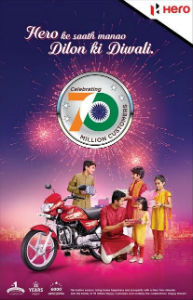
    Hero MotoCorp has rolled out its latest brand campaign #DilonKiDiwali.  The 360-degree campaign conceptualised by Law & Kenneth Saatchi & Saatchi went on air on October 24 with five television ads. Full-page print ads, radio commercials and the digital campaign have also gone live subsequently. The campaign celebrates the two-wheeler company’s historic milestone of crossing 70 million two-wheelers sold, and the millions of lives they have touched, while capturing the festive sentiment and spirit of Diwali. The films have been directed by Pradeep Sarkar and Kshitij Ravi Prasad.


    Said Rahul Nangia, Joint National Creative Director, Law & Kenneth Saatchi & Saatchi: “The campaign celebrates Hero’s role in bringing people together with simple and real stories”. Added Debarjyo Nandi, Senior Vice-President, Law &Kenneth Saatchi & Saatchi: “Hero is a nation brand with 70 million customers. When it’s the nation’s biggest festival, they are responsible for bringing so many families and friends together and touching millions of lives, celebrating the true spirit of Diwali with heart.”


  • Rahul Nangia made NCD at L&K Saatchi & Saatchi

    By A Correspondent


    L&K Saatchi & Saatchi has widened its creative leadership and elevated Rahul Nangia to the position of Joint National Creative Director, alongside Charles Victor.


    Rahul has been credited with the creation of the iconic ‘Hum Mein Hain Hero ‘for the launch of Hero MotoCorp that helped the brand catapult from being Hero Honda.


    He has been in the forefront of driving highly effective and memorable campaigns  for L&K Saatchi & Saatchi which has now sharpened it’s focus on establishing creative leadership and to live up to its global iconic reputation.


    Rahul joined Law & Kenneth 7 years ago and has played a pivotal role in some of its highly acclaimed work especially Jockey, Thomas Cook, VIP Skybags and of late, the creation of pepperfry.com.


    Commenting on the elevation, Praveen Kenneth, Co-Owner, Chairman and Managing Director, L&K Saatchi & Saatchi said “Our focus over the last decade has been to build a strong business foundation and strong client partnerships. We have a great reputation of being thought leaders and it is but natural for us to establish a strong creative reputation to maximize our ability to make the IMPOSSIBLE POSSIBLE for our client partners.


    Rahul is a fine creative leader who has worked closely with me. He will now join the creative leadership team along with Charles to move the game to the next level. This is in line with our plan to have creative leaders drive the future of our business”.


    Rahul will report to Mr. Anil Nair, Managing Partner & CEO.


  • More ads go digital as ICC World Cup action shifts to sites, apps

    By Vijaya Rathore & Ravi Teja Sharma


    The morning and working hour timings of matches in the ongoing cricket World Cup have made millions of sport lovers follow the action on dedicated websites, apps and social media, prompting several big and small brands to latch on to digital advertising like never before.


    Brands across industries, including Lufthansa, Accenture, Tissot and Hero are looking to catch the on-the-move consumer on a variety of platforms including official broadcaster Star India’s starsports.com, social media sites, cricket portals and apps such as Hotstar.


    “Some of our clients have looked at digital very seriously. Hero, for instance, has bet heavily on digital and it is really doing well for the brand,” said Praseed Prasad, national director for digital trading at media buying firm GroupM India. Another client of his, Pepsi Lays, has chosen to do more on the digital side and only advertise on television during select matches in the World Cup this year.


    A spokesperson for Star India says they have seen an exponential growth in consumption online. This World Cup, Star has got around 35-40 advertisers, including Lufthansa, Accenture, CarTrade, Tissot and Hero for its online platforms, with about 20% of those exclusively on the digital medium. “Revenues from digital will be significant this time,” the person said.


    Hero is the co-presenting sponsor of the World Cup 2015 digital. “The medium has seen exponential growth in terms of traffic,” a Hero MotoCorp spokesperson said. It is the lead sponsor on the property with branding/inventory in terms of video inventory, logo presence, banner ads, special sections such as replay and match insights, and has also launched a dedicated app, Hero Super Skipper, the spokesperson said. “This association is a strategic move, owing to a perceptible shift in viewership patterns in favour of digital medium.” The India-Pakistan match at the beginning of the tournament, for example, got over 25 million views on Star’s digital platforms, the highest in the world for a single game.


    Firms such as DishTV have created fresh campaigns around the World Cup. “Most digital campaigns are either in the form of graphics or extension of TV campaigns but we created one especially for the digital medium and that has helped us reach the young consumers, the millennials,” said Salil Kapoor, COO of DishTV.


    He said the interactive nature of the digital space helps consumers to make purchases by routing them to the firm’s call centres if they wish to. Also, a television ad campaign costs at least 3-4 times more than a digital campaign, Kapoor said. DishTV has shot a campaign with brand ambassador Shah Rukh Khan to promote their HD channels during this world cup.


    Digital adoption by brands is on the rise with large companies now allocating significant spends to this medium. “From about 2-3% of a large company’s marketing budget, digital is now in double digits,” says Ahmed Naqvi, CEO at digital and social media agency Gozoop.


    Source:The Economic Times

    Copyright © 2015, Bennett, Coleman & Co. Ltd.

    All Rights Reserved, Licensed to republish


  • Hero signs up Tiger Woods as brand ambassador at Rs 200cr

    By Chanchal Pal Chauhan


    Hero MotoCorp, the world’s No 1 two-wheeler manufacturer by volumes, has roped in Tiger Woods as its brand ambassador in a four-year deal pegged at Rs 200 crore, making it the most expensive celebrity endorsement yet for an Indian company.


    “Tiger Woods is one of the biggest global icons and not just a sports celebrity. His appeal cuts across geographies, nationalities, age and gender and therefore, he is the best brand fit to be our ‘Global Corporate Partner’ as we go global,” Pawan Munjal, Hero chief told ET in an exclusive chat on Tuesday. “We have lined up exciting campaigns to build on the core values of Hero in our global markets and Tiger is going to play an integral role in these initiatives. Our campaign with him will be on multiple platforms – print, electronic, digital, social and outdoor.”


    The company did not share the financial details of the deal, but analysts pegged it at about Rs 200 crore.


    While Hero MotoCorp has always had popular Indian stars from the fields of sports and cinema as its brand ambassadors, this is the first time the company has signed up a top global sporting icon, a move that fits well with the company’s global expansion plans.


    Woods, who has won 14 major golf championships, said, “It allows me to be involved with the world of two-wheelers and the vision of Pawan and Hero MotoCorp. We have a shared vision… for me, any collaboration and partnership has to be something that’s important to me. I greatly appreciate Hero sponsoring the Hero World Challenge that benefits my foundation, and my new role will greatly expand our worldwide relationship.”


    In mid-September, Hero had announced a separate four-year deal with the Tiger Woods Foundation to become the title sponsor of the Hero World Challenge, a PGA Tour event. This year’s event starts on Thursday at the Isleworth Golf & Country Club in Orlando, Florida, with 18 top golfers competing in the $3.5 million event.


    It was at Mr Munjal’s invitation that Woods first came to India in February this year. Hero also supports its brand ambassadors and top golfers Anirban Lahiri, Shiv Kapur, Gaganjeet Bhullar, Daniel Chopra and Sharmila Nicollet.


    Mr Munjal, a sports enthusiast, is responsible for the company’s association with various sports for more than two decades. A keen golfer, he is the past chairman of the Asian PGA Tour Board of Directors and the past president of Professional Golfers Association of India (PGAI). The company also hosts the annual Hero Indian Open Golf tournament, which sees participation from international marquee players.


    Outside India, Hero’s products sell in Sri Lanka, Nepal, Bangladesh, Turkey, Egypt, Peru, Ecuador, Nicaragua, Guatemala, Honduras, El Salvador, Kenya, Mozambique, Tanzania, Uganda, Burkina Faso, Ivory Coast, Congo and Angola.


    Last week, the company commenced retail sales of its bikes in Colombia, which is among the three top two-wheeler markets in Latin America. Hero is also building a manufacturing plant in Villa Ricca in the Cauca province near Cali.


    Hero is also building a manufacturing plant in Bangladesh through a joint venture partnership with the Nitol Niloy group. Through its local distributor partners, Hero has also established assembly units in Kenya, Tanzania & Uganda that would go on-stream in next few months.


    Source:The Economic Times

    Copyright © 2014, Bennett, Coleman & Co. Ltd. All Rights Reserved

    Licensed to republish


  • L&K Saatchi & Saatchi unveils new campaign for Hero

    By A Correspondent


    L&K Saatchi & Saatchi has unveiled its latest campaign for two-wheeler brand Hero. The brief shared by the client was to build the technology credentials and establish Hero as an innovative company that is ahead of the technology curve.


    The agency stumbled upon the insight that it’s the people behind the technology who make the technology come alive. And for breakthrough and futuristic technology, the people need to have a passion for technology that’s beyond the ordinary.


    The campaign details how technology is prevalent from the smallest component like a nut to the designer who conceives futuristic bike concepts and shows how this spirit of zidd makes each of these elements significant. The TVC is a narrative about this zidd for each of these elements – the nut’s zidd to be unshakable, the engine’s zidd to amaze the world, the wheel which will shorten distances, the rider who will not be deterred with challenges, the engineer who will never give up and the designer who will design the unthinkable. Hero’s world doesn’t depend on hope, but on zidd, the obsession with technology which is making the future at Hero MotoCorp, a reality today.


    Sanjeev Shukla, General Manager and Head – National Marketing, Hero MotoCorp said: “This campaign is the manifestation of Zidd – a spirit deeply integral to Hero. Zidd personifies the Hero in each one of us – the relentless pursuit of excellence and tireless striving towards perfection. Zidd is not a new concept nor is it a new discovery for us; it is inherent in every Hero and perpetually keeps our wheels in motion, and ahead of time. For us, Future indeed is Now.”


    Rahul Nangia, Chief Creative Officer, L&K Saatchi & Saatchi commented, “The challenge was that even though this was meant to be a technology driven film, it couldn’t be cold and futurist. It had to be a Hero MotoCorp film. It had to have the Hero ethic, which is never emotionless.”


  • FCB Ulka conceptualises new TVC for Hero Pleasure

    Hero MotoCorp has unveiled its latest TV commercial for Pleasure, the 100cc, light and zippy scooter. The commercial has been conceptualized by FCB Ulka, and features new sensation Alia Bhatt.


    Hero had led the way a few years back to establish the scooter category for women with Pleasure and it has managed to carry forward its strength consistently through thought provoking advertising over the years.


    The ‘Why should boys have all the fun’ platform with this new campaign takes a leap further where the scooter is not just a commute or enabler of fun but it is the fun. The television comes from the thought when it comes to enjoying the thrill of riding, why should boys have all the fun.


    Alia Bhatt is the new face of the brand and the TVC portrays her in her fun loving, confident, adventurous avatar which matches with the personality of the scooter as well. The TVC shows her enjoying her time with her partner, the pleasure scooter in the lovely locales of Kulu Manali.


    Vasudha Misra, Senior Creative Director, FCB Ulka Delhi, said, “Hero Pleasure is all about putting girls on an even keel with boys. From being a vehicle that helps women ‘go places’ we wanted to evolve it into a vehicle of pleasure. Hence, the idea of why should guys be the only ones to ride purely for the fun of it. Also, the role of music was extremely important in the concept. Indian rap has, fairly or unfairly, got a misogynistic image. So we purposely used rap, and a light-hearted banter between a guy and girl, to drive home to message.”


    Sharad Mathur, Vice President, FCB Ulka Delhi, said, “The TVC is aimed at breaking the stereotypes in the Indian society about girls not able to go out and live life as boys do. The communication showcases the protagonist enjoying the thrill of riding the all the new Hero Pleasure, lending credence to the brand philosophy that the young girl of today can go out and have fun just the way she wants and how she wants. Hero Pleasure is the scooter of the young confident girl of today who believes in fun, mischief and independence. And Alia Bhatt, the youth icon, captures this attitude perfectly. Her charm, vibrancy and naughty but nice image brings alive the proposition of the brand – Why should boys have all the fun?”


  • Yes Bank inks multi-yr deal as Assoc Sponsor of Hockey India League

    By A Correspondent


    The private sector Yes Bank has inked a multi-year deal with the Hockey India League (HIL) commencing with the 2014 season.


    Announcing the deal, HIL Chairman, Dr Narinder Batra, said: “HIL had a terrific start last year and we are certain with YES BANK on board, it will benefit both the League and our millions of followers around the world.” The other brand partners that HIL has are Hero MotoCorp and Airtel.


    Said Rana Kapoor, Managing Director & CEO, Yes Bankj: “We are extremely pleased to associate with the Hockey India League. Through our dedicated sports banking proposition, we are also committed to provide a robust financial infrastructure to support sports through customised banking solutions for various hockey associations, teams as well as players.”


    In the inaugural season, 70 top domestic players including the Indian national side as well as 50 international players who are part of the national squads of Australia, New Zealand, South Africa, Netherlands, Germany, Malaysia, Spain, and Argentina played for the five franchise teams.


  • Ranjona Banerji: When ads hit a miss

    By Ranjona Banerji


    This time I think Airtel has hit a miss: the “what’s mine is yours or what’s yours is mine or what’s mine is mine song” makes you reach for the mute button on your remote. I suppose all good things have to come to an end and Airtel did pretty well with its earlier songs about friendship and sharing. It is testament to good advertising that while I do not actually remember the songs, I do remember them as being listenable.


    The grouchy old man as in Ranbir Kapoor for Tata Docomo has outrun its usefulness and is starting to grate. Sooner rather than later, their own customers are going to start thinking about how they’ve kept waiting on the phone, how the service slows down at the wrong time usually and the difficulty of trying to get a human on the line when you have a complaint…


    Most people are now feeling the same way about Anushka Sharma, especially her of the Reliance 3G ad. Most feel that she’s too nasty. I feel the worst she can be accused of is grossly exaggerating Reliance’s service. I know it’s a script but perhaps Reliance (or its ad agency) might remember that people are not quite that stupid all the time. Speaking of which, why doesn’t that boyfriend just switch to the same service and end her smart-aleckyness? Maybe he likes her just the way she is? He seems to be a tolerant chap with a sense of humour. Or perhaps his service doesn’t have goons masquerading as bill collectors?


    Car buyers although must be quite silly because the “caaaaaaaaar” ad is back. Nissan Sunny is it? I have only one question: whhhhhhyyyyyy? But then I remember the brand so maybe the brand has won but then if I ever buy a car it won’t be this one for sure because I don’t want to sound like a prime twit as I say, “Driver, caaaaaaaaaar le ke aana” to a lift full of strangers. At the very least, I would know the name of my own driver.


    If I had to buy a car, it would be a Renault Fluence not because I like it or I know anything about cars but just so I could shut up my show-offy upstart host with his horrible American accent and his skin-crawl-worthy bragging about his things.


    The winner of the ads I don’t understand category came in this morning papers (and not on television oddly enough) with Blackberry saying an asterisk had something to do with action. I’m not a Blackberry boy (or girl) and I have some other idea about the usefulness of asterisks, so I was at a complete loss. The ad ran over two pages but more space does not always aid comprehension.


    Finally, I now firmly believe that the most irritating song of all is the inspirational one from Hero MotoCorp. All this hysterical urging of India to go has led to all the Indians coming back empty-handed from the Olympics. Trying to make money and tempting fate at the same time? All that you get is bad Karma!


  • Corporate Voice|Weber Shandwick wins highest number of accolades at e4m PR awards

    By A Correspondent


    Corporate Voice | Weber Shandwick (CVWS), India’s most awarded PR consultancy, took home more awards than any other consultancy or corporation at the exchange4media group’s Indian PR and Corporate Communications Awards again this year.


    The awards, organised by exchange4media, are the most extensive awards to recognise the contribution and success of the PR industry inIndia. CVWS shared recognition with clients for the following campaigns:


    • Hero MotoCorp Launch – Hum Main Hai Hero, Best Use of Public Relations by Private Sector Entity (Agency)
    • Gillette ShaveIndiaMovement, Best Continuous PR Campaign
    • Honda Brio Launch ‘Made forIndia,’ Best Use of Media/Marketing/Consumer Data for PR Planning/Strategy


    Additionally, Atul Ahluwalia, president, CVWS was named PR Professional of the Year (Agency). Tim Sutton, chairman, Weber Shandwick, Asia Pacific, delivered the keynote address to a large audience representing leading corporates and public relations consultancies in India.


    Speaking on the occasion, Shiv Reddy, CEO, CVWS, said: “Another year of recognition and accolades from our peers and clients in the industry leaves us proud, humbled and determined to innovate and succeed. We are grateful to the jury, our clients and the CVWS team.”


    Atul Ahluwalia, president, CVWS, added: “For seven consecutive years now, CVWS has established itself as the most awarded consultancy of the country. This continued success is wholly attributed to our ability to consistently re-invent and innovate as well as to the long-standing relationships with our clients.”


    Corporate Voice | Weber Shandwick (CVWS) is a  joint venture company owned by Weber Shandwick, a unit of The Interpublic Group of Companies, headquartered in New York, USA, and MAA Group Holdings headquartered in Bangalore, India. Incepted in 1992, the firm has grown to become one of the largest and the most awarded consultancies in the country. CVWS is a founder member of the Public Relations Consultants Association of India (PRCAI).


  • Life beyond cricket: 5 new leagues in 1.5yrs

    By Bhanu Pande


    If Pepsi’s latest commercial, ‘change the game’, prods people to switch from cricket to football, it hints at a fundamental shift in the way the cola major plans to use sports as a brand-building platform. It feeds off – and feeds into – a fundamental change happening in the Indian sporting landscape.


    Inspired by the success of the Indian Premier League (IPL) in cricket, almost every sport with some following in India is launching a city-based, professional league. Five new professional leagues have been announced in the last 18 months and, word is, two others are being revived. “The Indian sports consumer is looking for entertainment, diversion, passion and emotion,” said Shailendra Singh, joint managing director, Percept India, which is behind the Indian Boxing League (IBL). “League sport will ensure that.”


    But for leagues to become a permanent fixture, something only the IPL has managed so far, paramount is drawing sponsors and advertisers. If the initial response is any indication, sponsors of many hues are warming to them. Hero Motocorp is making big investments in hockey, the Mahindra Group in basketball, and the ongoing World Series Hockey (WSH) has Bridgestone and Vodafone among its sponsors.


    “Those chasing cricket will have to move to a life beyond it,” said Sanjay Sharma, head of JK Motorsport. “The canvas has to enlarge for brand marketers as cricket won’t continue to enjoy the status it does.” Besides cricket fatigue and the gathering momentum of other sports, there are three reasons why marketers and sponsors are gravitating towards these new leagues.


    Low-risk investment

    The new leagues offer a low-cost proposition. Unlike cricket, they don’t have to put a lot at stake. CVL Srinivas, chairman of Starcom MediaVest India, a global communication & media services group, said while sports is a good medium for brands to connect to the youth, the most popular of them, cricket, poses an entry barrier for many advertisers. “Many advertisers today see cricket as overpriced,” he said. “Emerging new leagues could give them an opportunity to enter sports in some way at a much lower cost.”


    Four years ago, when Bridgestone considered IPL as a medium for brand communication, it was put off by the price tags for premium rights. For example, DLF pays 40 crore per year to be the title sponsor of IPL. So, Bridgestone made a modest entry into cricket as a co-sponsor of IPL team Mumbai Indians. The decision to become the title sponsor for the ongoing World Series Hockey (WSH) came easy.


    The investment was low: Bridgestone is paying 2 crore per year in a three-year deal. And it gives the tyre company an opportunity to target North India, a market where hockey is popular and where Bridgestone was weak. “South India has always been our strong market and our association with Mumbai Indians is good enough to deliver there,” explained Vaibhav Saraf, GM (sales & marketing), Bridgestone India.


    Similarly, a 10-second spot on IPL cost 4-5 lakh, but just one-tenth on WSH. “Returns in non-cricket sports would be much lower,” Mr Srinivas qualified. Even then, the cost value equation works just fine for Bridgestone. “Even if our return on investment (RoI) from WSH is 10 crore worth of media mileage, we are happy,” said Mr Saraf.


    Besides Bridgestone, the other principal sponsors of WSH are Vodafone and Imperial Blue (Pernod Ricard India). “We evaluate all sponsorship proposals on a cost per reach and level of consumer engagement possible,” said Anuradha Aggarwal, senior vice-president-consumer insights & communications, Vodafone. “The WSH was efficient on both.” The early days of WSH have seen modest to half-filled stadiums.


    “Hockey is still not a proven sport, we are building it,” said Yannick Colaco, chief operating officer of Nimbus Sports, the promoter of WSH. “Some leagues in the past haven’t delivered, which is likely to make sponsors and advertiser sceptical for any new league.” Mr Colaco claimed the league has booked 15 brands on-air in the first week.


    He expects this number to increase to 40-50 by the time the tournament ends on April 2, yielding 50-60 crore from sponsorship and advertising revenues. “WSH is not here to topple cricket, but we hope to make it a strong number two property before we enter the second season,” he said, adding that marketers will have to have “realistic expectations” during early days and come in with a “long-term vision.”


    Proof of Concept

    One factor that gives the new leagues a greater chance is how they are structured. They follow the IPL model, which is city-based and essentially pays for itself by riding on a big TV rights sale. “IPL has proven that city loyalties exist, which has prepared the ground for other professional sporting leagues to take off,” said Darshan M, CEO of Machdar Motorsports, promoters of i1Super Car Race Series.


    In Premier League Soccer, Uro Infra Realty, a Kolkata-based real estate company, was the highest bidder for a franchise – 25 crore for Team Barasat over 10 years, or a franchisee fee of 2.5 crore per year. Each team can spend up to Rs 12.5 crore on players, which means Barasat (Uno Infra) will spend a total of 15 crore a year.


    Now, 50 per cent of the central revenues – essentially, the sale of TV rights and central sponsorships – would be equally divided among the six franchisees. In return, each team gets 2.5 crore as match rights fee for its five home matches. Then, each team can have eight sponsors, apart from ticketing and hospitality rights in home matches. “Considering the league will be broadcast in 50 countries other than India, it won’t be a problem for franchisees to recover their investment,” predicted Bhaswar Goswami, executive director, CMG, the promoter of PLS.


    The new leagues have learnt from the failure of the past. For example, the Indian Cricket League (ICL), promoted by Zee, died because it did not have a buy in from the Indian board that runs cricket in India and so could not draw the best of the current players. The new leagues are either taking the boards of their respective sports along (soccer, boxing and basketball) or are working towards it (hockey).


    Another learning is spreading it out. Premier Hockey League (PHL) – India’s first sporting league event launched in 2005 and WSH’s predecessor – was discontinued in 2008. “Any successful league the world over has had two fundamental elements: multiple ownership and multiple match locations,” said Mr Colaco of Nimbus. “PHL ignored both.” PHL teams were all owned by ESPN and all matches were held in Chandigarh. By comparison, WSH has eight franchisee teams playing in eight cities.


    When Fragmentation Works

    Sports promoters and marketers say sports like soccer and wrestling have a significant regional following, and brands can tap that. “For instance, a brand that wants to target audience in soccer-crazy West Bengal may want to ride the PLS,” said Indranil Das Blah, chief operating officer, Kwan Entertainment & Sport Solutions.


    Mr Aggarwal of Vodafone sees a fragmented market as more of an opportunity rather than a threat. “Marketing investments are fixed and need to deliver maximum RoI,” she said. “If local fragmentation delivers a higher RoI, marketers like us will not have any problem going regional.”


    Similarly, Mr Colaco points to how motor sports can target auto brands, be it cars, tyres, lubes or accessories. However, eventually, feels Mr Srinivas, leagues will have to make a national impact. “To sustain, they’ll have to become pan-India properties,” he said.


    Source: The Economic Times

    Copyright © 2012, Bennett, Coleman & Co. Ltd. All Rights Reserved
     

  • Has IPL become too expensive for advertisers?

    By Rishi Vora


    After Rahul Dravid announced his retirement from international cricket on March 9, senior journalists, fellow cricketers and fans pondered over the future ofIndiaas far as test cricket was concerned. While that’s an issue selectors for the Indian cricket team have to sort out soon, officials from IPL and Multi Screen Pvt Ltd have to come up with real quick ideas to woo key advertisers, so that they remain invested in the property, especially after the 10 per cent hike in the ad rates for Season 5.


    The 10 per cent hike in ad rates means that advertisers will have to pay upwards of Rs5 lakh per 10 second spot. Last year, afterIndia’s fabulous performance in the World Cup, MSM hiked ad rates by about 25 per cent.  The season delivered an average rating of 3.91, lowest ever in four seasons.


    So season 5 was always going to be a challenge considering the slowdown andIndia’s continued poor run inAustralia. However, despite these challenges, MSM has managed to rope in a few sponsors already. Pepsi, Vodafone, Tata Photon and Idea have been signed on as sponsors and, furthermore, the broadcast partner is in process of finalising a few more deals.


    But, as a matter of fact, there are a few advertisers who have raised concerns over low returns against large investments on IPL and two amongst those – LG Electronics India and Godrej that have been sponsors from the start of the tournament have decided to pull out this year. They don’t think it’s worth the money anymore.


    LG Electronics India’s Chief Marketing Officer, L K Gupta told MxMIndia: “It is true that we’ve opted out of IPL this year. While it is the single largest property on TV, the fact of the matter is that there is only a certain level to commit marketing funds and the return we get in terms of TRPs does not really justify the high level of spending. Last year we felt the pinch, so we decided to stay out this year.”


    Godrej too is said to have opted out on similar grounds.


    Maruti Suzuki, which as a policy spends about 23 per cent on sports every year, of which cricket commands a reasonable share, has always restrained from being associated with IPL. Shashank Srivastava, Chief Marketing Officer explained his stance: “We invested in the World Cup last year. We don’t invest in IPL because for a company like ours, one needs to put in a lot of spike. IPL gives you good reach. In terms of viewership, it gives you good returns for 5-6 weeks which is something ideal for new launches or new product offering. So the money which goes in on buying IPL, and in return what you get for a brand like Maruti is not much.”


    A senior media professional who requested anonymity said that India’s richest league commands nothing less than Rs65 crore for presenting rights and Rs45 crore for being an associate sponsor. He said: “This is serious money you’re talking about. They (MSM) have increased by 10 per cent on ad rates, and they are under tremendous pressure to cut down further.”


    Nitin Jain, Co-Founder, DoMor Communications said the broadcast partner will eventually have to come down to last year’s price which was around Rs4.5 to 4.75 lakh per 10-second spot. “I’m sure the broadcaster is in talks with many clients, but from what I understand, it is going to be a game of who blinks first.”


    Buying his point is Nimbus sports COO Yannick Colaco who said: “I think advertisers are just waiting to see if the rates can be brought down. It’s pretty usual for advertisers to do this as a practice to get better deals out of the broadcaster.  IPL is a big tournament and advertisers will eventually look to advertise on a property of that scale, so I think it’s just a matter of time before they (MSM) sell out and a formal announcement is made.”


    It is learnt that MSM has initiated talks with Cadbury, but it is not entirely clear if the chocolate brand has signed the deal officially. On-ground sponsors for season 5 are DLF, Hero Motocorp, Karbonn Mobiles and Volkswagen.


    Set Max officials could not be reached but it is said that this year the attempt is also to sell smaller packages of 20-25 matches to cash in on advertisers with limited budgets. Also, it is not leaving any stone unturned in promoting the mega event. It is believed that a whopping Rs45 crore is being spent to bring the IPL fever back among viewers.


    It will be interesting to see how things turn out to be for all stakeholders of the mega property.