Tag: GroupM

  • Mash Up & Blazar get Kapil Sharma to launch new Honda Mobilio

    By A Correspondent


    Honda India is all set to launch their new premium 7-seater, the Honda Mobilio in July. Before the launch of its TVC, the car is generating a lot of buzz around the web with a series of four videos with India’s favourite comedian – Kapil Sharma. The concept and execution of this web series has been done by Mash Up, a part of GroupM India. The digital campaign is being executed by Blazar, the digital marketing agency of GroupM India.


    This is the first time Honda has taken the route of a celebrity association and branded original content to launch a car. The videos are not product videos, but are designed to announce the launch of the car, touch upon its features and give the audiences a dose of entertainment. Kapil plays a Honda car salesman in the web series.


    GroupM released the campaign on YouTube on June 24th 2014 at 6pm. Since then the video has garnered over three lakh organic views and over 1.5 lakh likes. This is also the first time Kapil Sharma has associated with any brand. GroupM specifically chose Kapil, keeping in mind his popularity across digital media and his fan engagement on social media.


    Shakeel Anjum, Head – Brand Communications, Honda said, “Unlike the traditional advertising, digital is a pull medium. And we for sure wanted to leverage the medium to its best. All the four Honda Mobilio films are buzz worthy content. The first film has already gained social chatter and consumer engagement organically, within just hours of launch. Kapil Sharma is definitely the new benchmark of Family Entertainment. His humour cuts across genres and age groups. Kapil is one of the most searched celebrities on digital with a massive fan following on social media. We believed he was the best fit to launch this Family car on digital media”


    Kumar Deb Sinha, head, Digital Content, Mash Up said, “We are extremely thrilled to take Blazar’s long standing partnership with Honda Motors to next level by creating a brand association with Kapil Sharma. The objective is to unleash the full value of digital media and branded content to engage consumers, inducing high sharability amongst users.


  • GroupM elevates Sidharth Parashar & Jai Lala

    By A Correspondent


    Jai Lala

    GroupM has announced the promotion of two of their senior executives of the Central Trading Group (CTG). The company elevates Sidharth Parashar, as Head, Pricing & Investments, and Jai Lala, as Head, Trading & Partnerships. Both will report in to Prasanth Kumar, Managing Partner, CTG, South Asia.


    Prior to his promotion, Mr Parashar was the Agency Buying Head for Maxus, for over five years, where he was a valued member of the leadership team, working on media mandates for brands such as Google, Nokia, Vodafone to name a few. In his new role, Mr Parashar will be responsible to facilitate and execute GroupM investment mandates across media. His key focus will be on the GroupM trading products that should continue to offer the edge to our clients. All the GroupM Agency Trading Heads and cluster heads will now report in to Sidharth.


    Prior to Mr Lala’s elevation, he was the Agency Trading Head for Mindshare, where he worked on media mandates for clients such as Pepsi, GlaxoSmithkline, ICICI, Aditya Birla Group and Nike. Going forward Jai will be managing all trading mandates at GroupM. He will also be heading a team of all the heads across verticals: Proprietary media, DTH, Xaxis, Syndication, GME and Special projects and maximize value for our clients. He will also work closely with Sidharth and the agency trading heads on delivering the maximum ROI on media investments.


    Speaking on the new structure, Prasanth Kumar said: “As we move into a growth phase largely driven by converging synergies across the group and driving client satisfaction it has become critical that we create more focus, especially in the area of media investment. With the development of new concepts of integrated media, merging traditional and digital media, we are also looking at reforming the way we plan our investments as a central hub. This new structure in our core function will deliver unparalleled client delight and value.”


  • Freeze! Media agencies put on hold IPL-7 buys given uncertainty over tourney

    By A Correspondent


    Media-buying firms have frozen all ad sales of the Indian Premier League for the next 48 hours as they await clarity on the future of the tournament, two top officials of leading media buying firms said.


    They said advertisers are considering either re-negotiating ad rates for the IPL, or considering pulling out of the twenty20 tournament and putting their money on elections instead, after the Supreme Court on Thursday recommended suspension of two teams – Chennai Super Kings and Rajasthan Royals.


    Gautam Kiyawat

    Gautam Kiyawat, CEO at media buying firm Madison Media group, said the development will hit the sentiments of marketers. “There was a bit of scepticism from the beginning with some matches being moved out of the country and now with the potential disappearance of two star teams, advertiser sentiments are going to tank even further,” he said. Media buyers, which represent some of the country’s biggest advertisers, are of the opinion that if 20-30 per cent of the IPL matches are scrapped, it would bring down the overall revenues of the popular twenty20 tournament by half.


    Multi Screen Media-run Sony Entertainment, which holds broadcasts rights for the tournament, would also face a similar quantum of losses because advertising airtime would also shrink with less number of matches, said the CEO of a top media buying firm.


    Multi Screen Media (MSM), which is charging Rs4.5-5 lakh for 10 seconds, was expected to better its last year’s IPL earnings of around Rs900 crore that was helped by 30 per cent – 40 per cent jump in advertising revenues. Rohit Gupta, president at MSM, said: “Since the final order has not come yet, it is too early for us to comment on the matter. Let the order come.”


    If Chennai Super Kings and Rajasthan Royals are banned, then it would have a direct negative rub-off on advertisers. Title sponsor PepsiCo, which had has committedRs400 crore for five years, stands to lose the most, as it has hinged its entire annual plans on the tournament that falls in peak summer season for the soft drinks sector. PepsiCo declined comment on the matter.


    CVL Srinivas

    CVL Srinivas, CEO at GroupM, the country’s largest media conglomerate that also represents PepsiCo, said, “It is too early to take any decision (on whether or not we should advice our clients to stay away from the IPL) as we don’t know which way the scenario will pan out. We will get more clarity in days to come and then we will weigh the options for our clients.”


    Some matches of the IPL will be played in the UAE, which is not a market for many brands, and with the Supreme Court banning two teams, advertisers stand to accrue huge losses if the tournament is scrapped. Navin Khemka, managing partner at media buying firm ZenithOptimedia, said absence of two key teams will bring down the value of IPL as a property.


    IPL’s brand value grew 4per cent, from $2.92 billion in 2012 to $3.03 billion in 2013. The total brand value of the nine franchises last year reached $325.8 million from $321.12 million in 2012, according to consulting firm Brand Finance.


    Nandini Dias

    Mr Khemka said that big advertisers may choose to be on elections over IPL, while likely lower ad rates may open IPL doors to smaller companies. “The sense is that overall ad rates could come down in the IPL. The flip side is that many small advertisers, who otherwise were not able to afford IPL as the entry costs were very high, may get a chance to be a part of it this time,” he said. Nandini Dias, CEO at media-buying firm Lodestar UM, said the agency was not advising clients to pull out of the tournament.


    “Controversies in cricket seem to have become a regular occurrence. Advertisers like PepsiCo have paid unprecedented amount of money despite all the controversies and uncertainties,” she said. “There are enough clients who want to ride on the higher viewership likely due to controversies. In fact, there are clients who change their media plans and skew their media plans to news channels when the channel is breaking news regarding controversies and scams.” The hospitality industry too could take a hit if some matches are cancelled.


    Source:The Economic Times

    Copyright © 2014, Bennett, Coleman & Co. Ltd. All Rights Reserved

    Licensed to republish


  • Changing talent scene in media agencies: Gaurav Hirey, Chief Talent Officer, GroupM


    An alert: this is a long, long interview. Possibly as long as the ones of business heads of huge broadcast networks. But, then, the hat that Gaurav Hirey wears is that of Chief Talent Officer South Asia. And as the media services conglomerate of the WPP group in India braces itself for the new digital order, Hirey has his life (read KRAs) cut out for him. Part of GroupM since 2008 and with a few stints in media and one in outsourcing, Hirey is based in the Mumbai headquarters of GroupM South Asia. He returned in December after a stint in Singapore as Group HR Director – APAC at GroupM.


    Excerpts from an interview over lunch and Diet Coke:


    So how has been the return for you so far?

    It has been both interesting and exciting. Like I keep telling everyone, it is homeground so obviously the day you walk in you are supposed to know it all and I have come back with a very different perspective, a much better one.


    Apart from some obvious developments, what’s the one thing you would say has changed in the last two years since you were away?

    I think from a scale perspective we have exploded more. We now have a diverse offering; we have a diverse talent pool now within GroupM. I see new types of people from technology, mobile etc joining us and I think the whole challenge is now much more than what it was maybe two years ago when I was here.


    Has it changed significantly? What would it be in percentage terms?

    From a diverse talent pool, I think we have changed remarkably. Close to 50-60 per cent of our pool is now diverse. So it’s not just media planning and buying… we have got people who do activations, we have got people who understand technology, we have people who understand brands and marketing much more, we have content specialists. The whole spread is remarkable.


    Is this happening across the GroupM network or only in India?

    I think it’s happening across the Group M network simply because of the way the industry is shaping up, but the pace at which it is happening in India is definitely faster than others as it’s become important for us reinvent and do new things and this market is doing it just right. We just seem to be making the right moves.


    How would you compare India’s performance compared to Singapore, Korea and other South East Asian markets?

    I think the pace is very high; it’s much faster, we are much more agile and in terms of opportunities there is a plethora of opportunities…


    Here in India?

    Yes.


    Would you say the same about India when compared to markets like China and Malaysia?

    China again is very similar to India and that is something that has stuck with me. I remember when I landed in China the first thing that I said was ‘Oh my God, this place looks so much like home’. The same pace, the same activity. The only difference being that the Chinese traditionally are a bit quieter whereas Indians have a tendency to speak and express ourselves much more clearly. Otherwise from a market perspective both are very alike.


    If you were to analyse your annual adspend reports that come out every year, what you are saying does not reflect very well through the numbers that have been released?

    We may be behind in adspends but we seem to be having a very healthy business model here as compared to other countries. India is ranked at No 2 or 3 most of the time in APAC in terms of business and the numbers so to speak, so it’s one of our critical markets. In fact China, India and Australia are considered as the most critical markets within APAC…


    Yes, the forecast indicates that by 2017-18 India will be among the top 10 markets in the world. But going back to comparisons between South East Asia and India, how do you compare the talent there to the people over here?

    I think one great thing that I have found outside India is the way they package things, the way they sell, the way they tell a story…and they really do a good job. So whether it’s in Singapore, China, Australia or the UK, the whole thing is phenomenally far better than what we do. What we do well is in the area of content, data; the kind of insights that we have and the kind of skills that we have today. Today you will find Indians everywhere; within APAC and also the GroupM network, I don’t think there is any country where you will not have an Indian representation. There is some Indian or the other in those markets as well.


    We know India has what it takes to deliver results in the digital domain but is it the same when it comes to their capabilities in sales and other functions in the organization?

    I see a lot of Indians in the role of client leaders…so they are actually facing clients and handling business development aspects of the trade. And it’s not just that, I do think that once somebody gets exposed to international experience one understands that this is one area that they need to be working on. So I do see a lot of Indians occupying frontlines roles.


    GroupM is possibly the only media agency network which has seen people moving on from India to occupy South Asian and other global roles. This is not observed as much across other networks. Do you think this is an advantage for the exposure that you gain and for the business on a whole?

    Absolutely, in fact I remember telling Vikram Sakhuja that if there is something that we should do is try and get our people to spend a year or two outside India and then get them back. This will give them a very different perspective. There are so many learnings, there is such a diverse group of people there…you have people from the UK, the Americans, Australians, Asians, Koreans… everyone is there and when you are working in that environment the way you work, the way you manage people, the way you communicate…


    Is it part of your plan then to have some kind of exchange programme to ensure a certain number of people go out and experience outside work culture?

    Talent mobility is one of our important focus areas and under that a lot of our agencies are preparing initiatives which will help people within the agencies to move to other countries depending on the skillsets that they have and the rules prevailing over there. I see this getting more and more formalized in the coming years. So if you are asking whether we have anything formal at this point, it is no. Whether it happens, yes, it does happen. India is probably one of the biggest exporters of talents including for GroupM India. What we are also realizing is that the new kind or type of people joining us now, they also seek international exposure…so if we do not give them the opportunities, they will find it someplace else. So it’s better that we do it.


    One aspect that a lot of publications or TV channels bring up is that the exposure by media agencies to affairs in rural India is not as widescale as it ought to be. What’s your emphasis on exposing your team to the countryside or middle India so that they can make more informed business decisions?

    In fact these are the markets where our focus areas are centered around. We are focusing on the B and C cities where we have got special initiatives; we have a team focusing on the growth that would come from these areas. We believe that the growth is now going to come from B and C cities. So we have already started an initiative which is targeted at getting people down and on the ground in such places. We already have units like our activations unit which already operates in B and c cities…then there is also the rural marketing unit which is functional there.


    Also, our focus this year is to open offices in B and C cities. We have already got satellite offices in areas like Trichur and would be launching in Ahmedabad very soon. So we see growth coming from B and C cities and our focus is there. We don’t have formal modules to expose people to those cities as such but I see next year being more about introducing them to what’s really happening in middle India and making them more aware so that they are able to service clients better. Even if you look at our client spends, a lot of it is coming from B and C cities. So it’s an area of focus and it’s also something that formally I think we need to start getting people to be more aware of.


    What are the challenges that typically give Gaurav Hirey sleepless nights?

    That is pretty easy at this point. What’s really happening is that the youngsters of today are not as aware of the industry as they should be…they are not aware of the opportunities of this industry and even those who join us… in fact today, we are facing a situation where 40-50 per cent of the young guys who join us, leave us. When I look at at the next 5-6 years, what gives me sleepless nights is thinking about who will I have with me; on whose shoulders the future of this organization would be built because if these young guys won’t join and stay with us and grow with us, then the organization of tomorrow is going to be quite handicapped.


    One of the reasons could be that they are not being paid enough…

    That’s not true.


    How much is the percentage of new hires in your company? Where do you typically hire new talent from?

    They come from all across. We have got a huge chunk of people say about 20-25 per cent who actually leave us and join us back. Then we have got another 20-25 per cent who are freshers…people who are fresh into the industry, just out of colleges etc. Currently, we have started hiring people from IIMs, ISB, MDI … We have a leadership training programme that we have introduced where we actually go to campuses and hire people from there.


    Typically how many of them come from IIM and ISB?

    This year we are looking at hiring about 14-16 people from that group. We are also looking at hiring another 30-40 from MBA institutes. So overall, a batch of about 60.


    Do you hire about 30-40 people from the top 10 MBA institutes?

    Not necessarily. We actually go to those places where we have had great experiences. So it could be from a college in Coimbatore where we keep on visiting or the SIBM, SIMC in Pune…it doesn’t have to be only the top institutes.


    Many clients aren’t too happy about the talent in media agencies vis-à-vis their own.

    So that is why we have introduced the Leadership Training scheme. What we are trying to do is to bridge that gap too. We can understand that. There are some clients to look at that and then there are many clients of ours who appreciate the kind of quality we are bringing to the table and they don’t really look at the pedigree at that point. A lot of our top clients today have client leaders who are not necessarily from IIMs or ISBs. They are extremely satisfied with the kind of services they are getting but yes, we hear this often and that’s why we said that even from a future perspective, we need to look at improving the quality of fresh talent that is coming. So we have just introduced the Leadership Training scheme about a year ago and this is the second year that we will be hiring from the ISBs and IIMs and we are hoping that at one point we will be able to cover that gap completely.


    In percentage terms, what’s your staff cost vis-à-vis your various other costs?

    Sorry, I can’t say that.


    But is it significant?

    Yes, it is.


    Say more than 50 per cent?

    Like typical service companies, yes.


    But media agencies are already working under tremendous pressure in terms of earnings and one reason that agencies often give for not hiring enough talent from the premium B-schools is because they hardly make money. Do you think there will be pressure now on the bottomline giving the hiring from the ISBs, IIMs etc?

    No. This is a conscious call, so we obviously have budgeted for this and we know what we are getting into. So when it was only traditional media I would totally buy this point but today the way the landscape has changed, we definitely think this talent is important and critical for the future of the organization. Secondly, with the new core that is coming in which is digital media, activation, data analytics etc these are not bound by the old rules of engagement. These are all project-based work; more interesting, there is more variety in the type of work too. This is also the kind of work that the new talent likes. So we are able to train and engage these young guys and I don’t think it will cause pressure on the bottomline eventually.


    If we were to assess talent across the top tier in agencies some of the names like CVL Srinivasan or Vikram Sakhuja or Shashi Sinha  are alumni from BITS Pillani, the IITs, IIM etc. That layer is all there. But somewhere after that, I think, media agencies have stopped hiring from the premium schools. Why?

    I think it was a factor of the numbers but today we see it as a combination. It is also about clients saying that we need to get different or new talent into the industry. We also feel the same way and it is not that we are hiring all 200 or 400 people every year from the IIMs; we are just hiring 10, 14 or 15. So that won’t put much pressure on the bottomline


    Is that number good enough given the fact that you have such a huge client base?

    At this moment, I think it’s a good start. I see this number increasing, I definitely see these people growing in numbers across the organization and not just at the entry level. So even when today we are hiring, we are hiring people from the client side as well. And they are people with pedigree.


    Earlier a typical media agency comprised media buying, selling and business development folk. Now, with agencies going full-service and digital taking centrestage, there are people working on activations, you have creative and art directors. Does this impact the equilibrium within the organization?

    Not in a big way, but it does because then we have to also make our people sensitive about the changing landscape. So the change we have undergone is about flexibility at the workplace. I think the next change is about bringing sensitivity to the fact that there is diverse talent now and that the way you manage this talent is going to be different from how we have traditionally managed it. So a creative guy, he will have his moment of inspiration and you’ve got to give him/her that space, give the flexibility, give him/her the environment where he/she can think that way and give you something creative rather than tell him, ok, you be here at 9.30am and you have to work till 5.30pm. So I think we moved away from that and we understand that we need to be flexible. Like you said equilibrium, it affects a bit because there are different sets of people and some of our managers have never managed such kind of people. So we are working on programmes which will sensitize them to the fact that these people need to be managed a bit different than how they were earlier managed.


    From the talent point of view, what is it that will make people stay on in an organization like a media agency?

    I think it is the experience that we provide. If a person has a great experience working with us and learning and growing with us, then the person will stay back. I don’t think anybody is going to join us and retire here. We are now borrowers of talent. So if there is good talent out there, you know that you can have that talent but it’s not going to be a permanent thing. Those days have gone when somebody would join us and just grow old with the organization. You just borrow talent for some time and after that you just see where it goes.


    At GroupM we have five different agencies, each with its own unique identity…


    Do you have separate HR functions in the agencies?

    No. So what we are working towards is getting an HR business partner embedded in every agency. Right now we have one in Mediacom, we have one for our digital businesses, MindShare had one till last year and we are now in the process of hiring one more now. Maxus is looking at appointing one more business partner. The idea of having a HR business partner within agencies is that they will drive the agency agenda and GroupM will anchor them.


     

  • MEC gets Sidhraj Shah to head Brand Activation unit

    By A Correspondent


    MEC has announced the appointment of Sidhraj Shah as Head of Brand Activation. His mandate will be to deliver innovative consumer experiences and to expand MEC’s brand engagement and implementation services.

    Mr Shah’s last assignment was at Wizcraft as Deputy General Manager. An MBA from Bombay University, Mr Shah will report to T Gangadhar, MD, MEC and to Dalveer Singh, Head Experiential Marketing, APAC, GroupM’s experiential marketing unit.


    With prior stints at O&M, SSC&B Lintas and Bates 141, Mr Shah has conceived and executed ground-breaking campaigns for clients such as McDonald’s, Standard Chartered, Virgin Mobile, Siemens, MTV and MiD-Day.


  • Chief Digital Officer: A fancy meaningless designation or a crying need of the hour?

    By Amit Bapna


    A recent Gartner study in the US predicted that by 2015, 25 per cent of organisations will have a CDO and that the chief digital officer may be the most exciting strategic role in the decade ahead. While such statistics are often swept aside by Indian head honchos as a US reality, the wave may reach Indian shores faster than expected.


    Though a relative late starter, digital has made swift inroads into the Indian marketplace. Brands are upping the ante on digital allocations. No Indian marketing head can have a conversation without talking about how serious they are about digital. They’ve even moved to saying “It’s not the wave of the future but what’s happening right now!” which is an improvement.


    But where are all the CDOs then? Globally, organisations as diverse as Starbucks, Metropolitan Museum of Art, BBC Worldwide, Amnesty International are known to be already deploying the services of a CDO. While the title is yet to gain vogue, some companies are making a few non-cosmetic changes.


    PepisCo tweaked its structure to make digital a strategic vertical reporting in directly to the head of marketing. Earlier, it resided with individual brands. Deepika Warrier, vice president – Po1 (Power of 1) marketing, PepsiCo India, is clear that digital needs to be incubated by the CMO as it requires focused mentoring to build interactions with other business functions. Their team is led by Rishi Dogra, who along with the digital mandate is involved with a unique concept called Pepsi Labs. He works with co-creators incubating, experimenting and testing new content ideas. PepsiCo claims to have doubled its digital budget from last year.


    SBI Life has a business vertical to tap the potential of online sales of life insurance policies. Shares Chandramohan Mehra – country head – digital business, SBI Life Insurance, “Through the channel, it distributes products exclusively developed for online business, and has gained leadership position in direct-to-consumer sales.” He was formerly the VP and head of brand at SBI Life Insurance.


    Jasmin Sohrabji

    Jasmin Sohrabji, CEO India and South East Asia, OmnicomMediaGroup is convinced about the case for a CDO. The reason it hasn’t happened thus far is due to scale and scope. Even among the more digital aware, spends hover at about 10 per cent, offering little or less than threshold scale. As focus (and spends) move to digital platforms, the relevance for a CDO will come into play, she feels.


    Adds Rishad Tobaccowala, Chairman, DigitasLbi and Razorfish, “CDOs should be the evangelist for ensuring the company remains relevant to changing behaviour. His role is important in the early years of digital to ensure a voice for tomorrow.” The case for a CDO becomes even stronger in a backdrop where digital budgets are increasing but cutting edge case studies are few and far between.


    Most conversations hover around aggregating fans and likes on Facebook as also prerolls of campaigns on YouTube. But has the market reached a stage where the advent of a CDO is imminent? Or is this yet another instance of India leapfrogging a few stages of development, to create its own delivery-mechanisms?


    At L’Oreal India, where the digital spends have been ramped by nearly 125 per cent over the last year, the function is embedded within respective brands. Satyaki Ghosh, director, consumer products division, L’Oreal India avers that they could eventually have a CDO, but he would service the entire company as against just the Consumer Product division.


    The CDO role needs to have a larger platform to build the digital capability of the entire organisation and the digital business, according to Arjun Srivastava, consumer practice leader – India, Egon Zehnder.


    Marico too is currently embracing a decentralised structure. Sameer Satpathy, EVP and business head, Marico India says, “The medium gives enormous flexibility in terms of engagement, creativity and speed.” All their brand managers are being trained and certified on using digital, in order to have an enabling ecosystem.


    CVL Srinivas

    Which is as it should be says CVL Srinivas, CEO (South Asia), GroupM: “CMOs need to drive digital as part of their core job. Most advertisers still look at digital as a silo and struggle to integrate it into their mainstream plans.” However digital specialist Harshil Karia, cofounder, Foxy-Moron makes a case for digital having grown too big for a CMO’s mandate.


    He says, “CMOs haven’t naturally taken to ‘digital thinking’ and ‘digital as an ecosystem’. It is difficult in a world where maintaining Share of Voice, pleasing brand ambassadors, coordinating to get the best out of various agencies and reporting to management and sales teams is a priority.”


    A private sector bank claims that only 5 per cent of its business is coming from branches. The rest is from other channels that include digital: mobile and internet as well as telebanking. In such a scenario the medium is no more just for marketing or brand building but has a huge business implication as well. The biggest need for CMOs today is to adapt or otherwise provide for the digital landscape since it will emerge as a key component of marketing strategies.


    Kent Wertime, COO, Ogilvy Asia Pacific, and co-author of DigiMarketing, believes “The CMO has to determine today how to integrate traditional means of marketing/channels with digital channels, the capture and use of data, and build new relationships with big digital media players/platforms.”


    Digital gives insight in real time through social media and its endless streams of conversations and insights. Increasingly, it will be about harnessing this information. For instance, Dell has a chief listening officer, who “listens” to what consumers are saying and feeds these insights to the CMO. So whether as an adjunct to the CMO or his equal, a company serious about the future would do well to consider the CDO.


    Source:The Economic Times

    Copyright © 2014, Bennett, Coleman & Co. Ltd. All Rights Reserved

    Licensed to republish


  • A lot of change in world & media landscape is thanks to digital: CVL Srinivas

    The GroupM CEO South Asia in conversation with Rishi Vora on growth areas for digital and how digital is at the centre of all business verticals. Excerpts:


    How would you look at Group M’s focus on digital media? Where does digital stand in Group M’s priority list?

    Last year we got together as a team and we created a new vision for ourselves. The vision was to have digital at the heart of everything we do, to create a digital culture and to provide digital solutions to clients with new ideas, new approaches. We decided to do more of the new and less of the old.


    We created a three-year programme called the ‘New Me’. For GroupM, New Me is a repositioning in terms of how we approach business practices across the GroupM verticals. We want each and every member of the Group M community to take notice that the world is changing and that the rules of the game are also constantly changing.


    As a media agency brand we are No 1 but there is no guarantee we will continue to be No 1 if we continue to have the same approach we did for many years. The world is changing, the media landscape is changing and a lot of that change is happening due to digital. It is with this thought we came up with the New Me approach.


    So the agency has evolved from its core of being a media agency and that it is adding a lot many layers to it?

    Absolutely! Earlier the media planning and buying was the core business. But now we have changed the definition of Core. We have seen the growth happening in non-core areas, and we are in fact calling these non-core businesses the new core.


    At the industry level, what are the various initiatives GroupM is taking on the digital front?

    Last year we partnered with Social Media Week, an event which came to Mumbai for the first time. The Mobile Marketing Association (MMA) is another industry event which we are associated with. We, in fact, are setting up MMA in India this year to evangelise mobile as a medium to help rest of the industry and the ecosystem.


    Digital Rendezvous was another initiative, but that is more internal. Maybe at some stage we will take it to the industry.


    So everything is flowing in from the New Me philosophy which we have adopted. Even the tools that we have created and launched.


    As an industry we need to take notice of the changes happening and manage the transition from practices of the old world to the practices of the new world effectively. It means investments in new tools, knowledge, skill sets etc.


    Talking about the rapid growth of digital as is estimated in the report, what are the implications on advertisers?

    Advertisers will be keen on investing in digital as consumers have got many options in the digital space – be it social platforms or mobile apps. We are going to see a rise in the user generated content. So all these aspects will have a positive impact on the advertisers’ mind.


    A lot of advertising will come from the entertainment sector for the mobile industry as smaller towns and cities – the mobile device is also seen as an entertainment device given lack of infrastructure.


    How do you see 2014 pan out for social media as a business?

    In 2014, we will see the emergence of new platforms. While platforms such as Facebook will continue to do well, we will see a lot of brands moving towards, Instagram, Pinterest etc.


    Are we going to see a rise in M-commerce in 2014? What are the implications on the industry on that front?

    Yes, there will be a growth in the M-Commerce space as well. Research online (from a PC) and pay offline. The thing is shifting to research on mobile and pay offline. If operators can connect consumers with payment gateways on the mobile phones, there will be a huge growth in M-Commerce where consumers will start buying products and services from their mobile phones.


    To mention a few clients – Nokia, Vodafone, Perfetti, Pepsi – they all have taken mobile as a serious platform and they have kind of experimented with it. 2014 definitely see a lot of initiatives on the mobile advertising front.


    Overall digital pie is at 35 per cent, what is the share of mobile in that?

    Last year the size of mobile advertising was about Rs 350 crore. By the end of 2014, we should see that increasing to Rs 450 to 470 crore.


  • GroupM estimates: TV degrows, Digital, print grow


    By Rishi Vora


    At the launch of GroupM’s This Year Next Year (TYNY) Report  2014,  chief executive officer CVL Srinivas, while presenting the report to a media gathering in Mumbai, stressed on the media agency’s renewed focus on digital, and the need for a change in approach and mindset in order to be relevant with the changing business scenario.


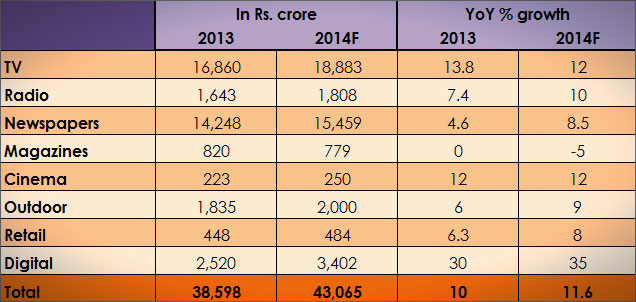
    Mr Srinivas, of course, stated that in the context of GroupM’s advertising expenditure (AdEx) 2014 where digital is the fastest growing medium with a 35 per cent growth rate, followed by TV with an estimated growth rate of 12 per cent. It may be noted that TV’s growth has reduced from 13.6 per cent in 2013 to 12 per cent in 2014.


    Sector – wise growth


    Elections

    With general elections and 5 state elections on the anvil, government spending and political party election spending adding significantly to the AdEx of all media. It is estimated that the government spending will lead a 2.5 per cent growth in the industry.


    FMCG

    FMCG will continue to be an important sector for the industry as it accounts a 29 per cent share in total ad spends this year due to the following factors:

    [] Volume growth back for FMCG companies on the back of good monsoon and hence good rural income


    [] Raw material prices benign and hence more flexibility with advertisers


    [] Ad spends of most FMCG companies on the rise to ride on the back of higher disposable income due to election spending


    Retail

    The retail industry will experience growth from the entry of new players into the food and beverage segment, growth in E-commerce, and regional retailers  expanding their reach across markets in India.


    Auto

    Despite slowdown in the  four-wheeler segment, there is growth for entry level cars, sports and multi utility vehicles.  Two-wheelers to continue the focus on small town and rural India.


    Competition is likely to intensify  on the back of recent market developments leading to more launches by existing players, which subsequently mean higher ad spends.


    Telecom

    Smartphones penetration  is on the rise, however, stiff competition in the segment will continue. Phablets  and connected devices will gain popularity in 2014.


    Cellular phone service providers too will witness growth in revenue.  Service providers will bring down the price points for 3G, therefore completion is more likely to intensity.


    Banking, Financial Services & Insurance

    For the Banking and Financial Services and Insurance industry, year 2014 will see a revival happening with a likely reduction of interest rates. IPOs to pick up pre-election owning to better market sentiments.


    Recent RBI policies will result into a more favourable business environment and new bank licenses will push advertising expenditures of the category.


    The report estimates  that print will grow at  8.5 per cent in 2014 as against the 2013 estimate of 4.6 per cent, thanks to the growth in vernacular print publications across the country. The report also states that while newspapers  are to grow by 8.5 per cent, magazines will witness a negative growth of 5 per cent.  Outdoor will grow at 9 per cent, Cinema 12 per cent and Retail 8 per cent, states the report.


    If one looks at the sector-wise break up of spends, FMCG constitutes a majority share (29 per cent) followed by Consumer Durables (22 per cent)  and retail (12 per cent).


    CVL Srinivas

    Commenting on the growth prospects for the industry in 2014, Mr Srinivas said: “It’s going to be an okayish year for the media industry. I’m saying this because the 11.6 per cent growth estimate also accounts for the 2.5 per cent growth that will come from advertisements from political parties as the elections are around the corner. If you take elections out, which is a one-off event, the growth in 2014 is about 9 per cent.”


    He further noted that the growth of the industry will also depend on how things are panned out on the measurement front, on IPL’s success or failure and the outcome of the elections, which will have an impact on government policies.


    In his final remarks, Mr Srinivas said that the year 2014 will be remembered for two reasons — one being the fast growth of digital at 35 per cent as is estimated, and also the fact that the industry will cross the Rs 40,000 crore mark in 2014 from its current size of Rs 38,000 crore.


  • Maxus elevates Sanchayeeta Verma to Managing Partner


    Sanchayeeta Verma
    Sanchayeeta Verma

    By A Correspondent 

    Media services major Maxus announced the elevation of Sanchayeeta Verma as Managing Partner, Maxus South India & South Asia.

    Ms Verma, who was has been with GroupM for over 10 years, moved from Mindshare to Maxus in 2009  as head of the Bangalore office. Over the years she has managed the agency’s Bangalore operations and also established the Kerala set-up.

    Speaking on her appointment, Kartik Sharma, Managing Director, Maxus South Asia said, “Sanchayeeta is one of our star Maxusites.  A team player to the core, her sharp strategic thinking and keen sense of innovation keeps her and her team at the cutting edge of media investments and planning. We wish her all the best for her future endeavors at Maxus.”

    Upon her appointment, Ms Verma said, “The future of media is about choreographing convergence between traditional, digital and experiential media, content & data being the epicenter of it all. Maxus is best poised to lean into change towards this exciting new future and I look forward to it!”


  • The term ‘media agency’ is a bit outdated: CVL Srinivas


    When CVL Srinivas’s name was announced as successor to Vikram Sakhuja as CEO of GroupM South Asia, not many were surprised. Srini, as he’s known in the industry, had worked in GroupM before and had established himself as a seasoned media agency captain. While his tenure required him to ensure GroupM business was as usual, he took measures to steadily get the media services group to reinvent itself, without disturbing the status quo.

    In a free-wheeling chat with Pradyuman Maheshwari of MxMIndia, Mr Srinivas talks of his year at the helm of GroupM South Asia , how 2013 was for the business, his plans for 2014 and how he misses being a media planner/buyer in the digital age.

    Excerpts from the interview:


    As you look back at 2013 which has just passed us, how would you describe it? Annus Horribilis, as Queen Elizabeth had termed the year 1992 in a speech? Was it a good year, or a year that could’ve been worse?

    It was the year of the perfect storm. On the one hand there were structural and policy-level changes especially in the broadcast sector. On the other hand, we had a bit of a yo-yo year in terms of ad spends, up in the first six months, a slowdown post-July and a minor blip towards the year-end. Having said that, it could have been far worse. Given the fundamental strengths of the economy, advertisers continue to invest in brands and media organizations continue to innovate and diversify.  Things continue to keep happening in India, no matter what the economic or political scenario is. I am just back from a long overseas trip and I can definitely say that the most exciting market to be in today, at least from a media industry perspective is India.


    It’s also been a year for you as head of GroupM. How has it been for you, personally?

    Its been a satisfying year for me personally. All our agency brands and specialist units did extremely well in a challenging year. We won several new businesses, retained all our key clients who came up for a review and continued to innovate in terms of our offerings.  We launched a few interesting tools in 2013 to help our agencies manage the transition from offline to online and for sharper planning in smaller towns. GroupM agencies and specialist units continued to dominate all industry awards. We won the coveted Porter Prize for leveraging unique activities, the first for any media or ad agency. Its also been a year where we launched several initiatives on the Talent front. Including Y-co, our Youth Executive Committee. We’ve had our lowest attrition compared to earlier years. None of this could have happened without great team work – GroupM is a fantastic example of how team work can deliver great value.


    The digital media agency has become a full-service business. Are you also offering that at GroupM?

    GroupM has been an early mover in the digital space and we have scaled up our practice over the years. So while most of our competitors are acquiring digital agencies to build scale, we are taking our digital practice to the next level by integrating it a lot more with our core product and moving to the next level of sophistication in content, analytics and  activation, thereby providing a lot more value to our clients.


    You mentioned that digital is the centre of everything you do and if indeed digital will become the centre of most advertising, does it worry you that you will also have various players also doing media kind of work – including those from agencies within the WPP network?

    The ecosystem is extremely fragmented. Increasingly we get this feeling from our clients that they are looking for  integrated solutions. Clients are looking for ideas that can explode across multiple touch points with scale and  measurability . Ultimately it boils down to a deep consumer understanding and therefore the need to analyse data which is going to sit at the heart of the advertising product. I believe media agencies have an even greater role to play going forward. In fact with so much of expertise built in areas like consumer understanding, data management, analytics, experiential marketing, digital and content, I think the term ‘media agency’ is a bit outdated.


    But, digital continues to be a low-spending sector.

    Relative to TV and print, digital is still small, but it has been growing at 30-40% year after year. We have just crossed 200 million internet consumers in India and by end of next year could be hitting double that number. With improvement in digital infrastructure and growth of video advertising on the internet, we are bound to see digital hitting a double digit contribution of the AdEx very soon. Also, digital as we have known it (internet and mobile) is expanding into many more platforms including TV with convergence technologies.


    As someone who’s seen the business for a long time, do you think the reason for this is that the best creative work is not done in digital? And what fuels creative agencies is TV commercials which are more expensive to make and hence generate more commissions.

    That was a problem some years ago, but I think it’s changing. We have a whole new generation of fresh young creative minds who are born in the digital era. GroupM is attracting talent in this area and we have done good creative work for some of our clients.


    One of the key highlights that everyone’s made a note has been the creation of the Y-Co. How’s it doing? But, first, tell us how it happened?

    While working on our ‘New Me’ vision, one of the things that came out very clearly was in a digital era, if knowledge is equal to power, most of the power rests with the younger lot in the agency. So we felt that the ExCo (Executive Committee), which is the senior leadership team at GroupM, needed to have a closer connect with what’s happening on ground and needed to have better insights and better input when it came to areas like digital. That actually led to the creation of Y-Co: we got 15 of our brightest stars who’re all in their 20s to get together and form this body to actually complement the ExCo.Y-Co worked on several strategic initiatives through the year, in the areas of digital, talent retention, profiling, etc.


    Looking back, any key learnings for you from Year 1?  Any key differences that you’ve managed to bring in to the successful structure you inherited?

    Having worked in smaller outfits, including start ups, I realise the need to be constantly restless about the future, no matter how big or strong you are, in order to stay relevant for our clients. A key learning from last year was the need to bring in a lot of focus starting with a clear articulation of where the organization needs to be three years from now. And then aligning everything to this vision, the organization structure, talent, investment priorities, day-to-day processes, etc


    At the start of the year, GroupM senior leadership along with several of our key team members worked on creating a ‘New Me’ vision and a roadmap for the next three years, given the opportunities and challenges in the market place. We did an organization-wide cascade of ‘New Me’ that has helped bring focus and purpose into everyone’s day job. We simplified our organisation structure, embedded more specialist resources (digital, content, data experts) into agencies and built several partnerships, all tying in with our ‘New Me’ vision.


    On a very personal level, has it been a fulfilling experience?

    Yes, indeed.


    You were of course very familiar with the GroupM structure and the people…

    The best part about my job is that I work with a fantastic team. I have great support from our global and regional leadership. Having been a part of GroupM India during its formative years I am quite aware of the system and that really helps.


    From whatever one has seen of you, you’ve been exceedingly hands-on everything yourself… including receiving the media communiqués directly from you… until you had a full-time person heading that function. Do you prefer a federal structure where you have individual business heads doing their own thing or a more hands-on approach for yourself?

    I obviously got a lot more involved in some of the activities which I thought I had to personally drive last year like digital initiatives, talent, internal and external communications. At the same time, I don’t interfere in the day-to-day running of any of our agencies or specialist units.


    Do you miss getting your hands dirty with client acquisitions, servicing and all of that?

    I really miss being a media planner/buyer (laughs). Especially in the digital age, when there are so many fascinating opportunities you have in front of you and you’re sitting and working on a media plan… In fact, just the other day I was trying to strike a deal with one of my media planner colleagues to see if we can swap seats for a day. And I’m seriously planning to do that soon.


    You’re joking, aren’t you?!

    No, I am not.


    As you look at 2014, other than the routine things, could you tell us of a few key activities you plan to undertake this year?

    At a GroupM level, the focus on digital and the new core is going to continue in 2014. We could see a few more partnerships happening across areas of the new core, be it in digital, content and analytics. We’ll continue to focus on talent. In fact, on the talent front, we’ve started broad basing our profile and today we attract talent from different streams. For example, we are hiring a lot of people who have expertise in content, technology, data management etc


    More partnerships lead to more acquisitions?

    We’re not into acquiring for scale because that’s something we already have. We’re more into acquiring to be able to give our clients a more relevant and solid product.


    If you had to play soothsayer, is there any one new thing you think will happen this year?

    I think it’s going to be the year for digital video. We’ve seen a fair amount of traction last year especially from large FMCG players who are very heavy on television. A lot of them are moving up the learning curve and it’s only a matter of time before it gains a larger share of the media pie.


    And is there one thing that you wish had happened in 2013 which did not happen?

    I wish as an industry we could have better handled the regulatory and structural changes that happened last year.


    Any other pan-industry issues which you think should be tackled this year…

    We need to work a lot more closely across all industry bodies to be able to grow the industry. I think we’ve spent a lot of time trying to manage environmental issues and we hardly have time for constructive discussion in terms of what we should be doing as an industry, how do we ride the digital wave, how do we bring in more accountability and so on.

    I think a lot more of that needs to happen and I wish 2014 is the year when some of that starts happening.


  • Impact of tech & techcos on consumer & advertiser behaviour: GroupM report


    Presenting extracts from GroupM’s observations of the impact of technology and technology companies on consumer and advertiser behaviour. This is a preview of the final report, which, complete with media investment data from around the world, will be published in the early part of 2014:


    This year twenty five years have passed since March 1989 when Sir Tim Berners-Lee, a Fellow at CERN, wrote a paper that proposed connecting ‘…the hypertext idea and connecting it to the transmission control protocol and domain name system ideas…’ The quote finishes ‘…ta da.’


    The ‘ta da’ became the World Wide Web. The rest, as they say, is history.To be clear the web created at CERN is not the web of today. For the first time tablet sales exceed PC sales and the sales of smartphones exceed both comfortably. Few of the next billion online users will use a PC-like object as the principal method of access. Additionally much of today’s digital experience is driven by the app universe in which the wire frame of the web is largely invisible. To paraphrase an Oldsmobile commercial of similar vintage, ‘This is not your father’s internet’.


    By some means of access or another it is estimated that one third of the world’s population is online. In August Mark Zuckerberg announced the foundation of Internet.org, a partnership between Facebook, Nokia, Samsung, Qualcomm, Ericsson, Opera and MediaTek to close that gap at a faster rate than the current annual growth rate of 9%.


    AdvertIsIng Was Broadcast

    Advertising as we understood it in 1989, and for at least another decade, was a function of the broadcast age. From the mid-1950s and the mass penetration of television and peaks in print circulation to the middle of the last decade when broadband became pervasive first to the PC and now to mobile devices advertisers had a reliable supply of large and mostly attentive audiences. Screen based entertainment with the exception of video games, was, in broad terms, a passive activity that became a key driver of popular culture and conversation. In this environment,marketers had few challenges in capturing the attention of audiences, which is not to say their efforts always provoked the desired action.


    In the broadcast age the short history of marketing from packaged goods to politicians was characterized by applying maximum pressure to as many people that funds and optimization allow, and pursuing share of voice which is hoped to translate over time to share of mind, wallet and,  ultimately, loyalty. The targeting of advertising used context, day-parts and geography as proxies for audiences, that everyone knew to be only modestly accurate.


    Advertisers have always built reach through the aggregation of audiences from multiple channels but this is far harder to do amid the precipitous decline in the reach of non-live individual units.


    The challenge is magnified by extreme fragmentation, ad avoidance (albeit often overstated); adblindness (often understated); time shifting; multi-tasking; active screen time and the increasing adoption of over-the-top and often ad-free or ad-light media.


    Less attention, fragmented audiences and even more fragmented channels create financial pressure on advertisers to deliver effectively in more places and on more platforms with little additional available resource.


    They are doing this by:

    # Aggregating ever more fractured audiences in an effort to recreate simultaneous and time-specific reach by matching time spent with media with the funds allocated


    # Leveraging more engagement from the premium reach they do invest in by activating against media properties in ways similar to sponsorship – this may not save money in the short term but might hedge against diminishing effectiveness


    # Rebalancing investments to increase the volume and value of owned assets (content and utilities) earning an organic dividend by successfully executing in the new stream or feed based marketing forms like Facebook and Twitter


    # Redefining audiences and realigning their planning around revenue events or proxies for them by applying better, faster, data to increase the precision of targeting and the value of outcomes


    All these strategies have two things in common. All require expertise in digital marketing and require deep data skills and both the ability and desire to leverage the creative application of technology to increase audience engagement. They also require proof that engagement pays as well as the old-fashioned, less surgical approach to advertising.


    Aggregation of audiences and Allocation of Budgets

    Mary Meeker, a partner at Kleiner Perkins Caulfield & Byers, has long been a leading commentator on the digital economy. She has been a consistent and persistent observer of the apparent disconnect between time spent with media and the allocation of marketing investment by channel.Her expectation is that eventually the eyeballs and the advertiser dollars reach parity. To a degree Ms Meeker’s view is coming true: the usage-to-spend ratio on online display, desktop and mobile, is increasingly proportionate to user time allocation. The falsehood inherent in this is that time spent is not an accurate proxy for utility nor the allocation of advertising dollars. Search is the highest utility activity but hardly the greatest consumer of time. Further, much online time is spent on activities in which advertising is either not permitted or is simply inappropriate.


    Ms Meeker also believes technology to be a catalyst of wholesale industrial disruption. This is certainly true of media. Around the world broadcast audiences are not so much in decline: rather, they are fragmenting at speed. Hours spent with traditional broadcast channels are in decline, yet linear TV hours as a whole are stable and total video consumption is rising. Last year we discussed in some detail the redistribution of long-form programing via full episode players and over-the-top TV including Netflix, Hulu and Amazon Prime, and the rise of YouTube and its global analogs. The growth of these channels continues and accelerates as the penetration of tablets, which outsold PCs in 2013, and video-capable smartphones become favored video consumption devices. 25% of YouTube’s views are to mobile devices, yet the idea of the  best available screen persists.


    As last year however a comparison with television offers useful perspective. According to Nielsen’s September US Q3 2013 Cross Platform Report 7% of all viewing is now online; the top quintile of internet video and streaming video users consume 25% of their video minutes online; and the second quintile 13%. These quintiles represent 23% of the US population. Incidentally the top quintile of all TV users is also the heaviest-consuming group of online video. The lean-back TV experience is very much alive, and often enhanced by a second screen, as we explored in this report last year. We now spend over a third of our waking time interacting with screens.


    Video usage is geographically inconsistent. Television supply is restricted in many markets and as we commented last year we expect to see viewing minutes by screen and by delivery mechanism vary significantly by market. Share of online tends to be higher where one finds ample bandwidth,device penetration and sensible ad loadings.


    The search for practical metrics between and across channels continues. Thus far, despite the progress made on viewability and cross-channel rating currencies the industry remains far from aligned. Nielsen OCR is a huge step forward but it requires all the owners of inventory to agree on the metric as a common and comparable currency.


    Click here to download complete report


  • GroupM elevates Gaurav Hirey to Chief Talent Officer, South Asia

    By A Correspondent


    Gaurav Hirey

    GroupM has announced the appointment of Gaurav Hirey as Chief Talent Officer South Asia. Part of GroupM since 2008 and currently Regional HR Director, APAC, Mr Hirey will relocate to Mumbai with effect from January 1, 2014.


    Mr Hirey will be responsible for driving the agenda on people, culture and values at GroupM which will include employee acquisition, training, development, retention and growth for India, Pakistan, Bangladesh and Sri Lanka. He will be a part of the GroupM South Asia Executive Committee and will report to CVL Srinivas, CEO, GroupM South Asia and Angela Ryan, Global CTO, GroupM.


    CVL Srinivas

    Speaking on the appointment, CVL Srinivas, CEO GroupM, South Asia said, “As we move to the next stage of the People Transformation journey, I am pleased to welcome Gaurav Hirey back as our Chief Talent Officer (CTO) – South Asia. Gaurav has a successful track record of making things happen and is the best person to lead our people agenda. We look forward to having him back with us.”


    Said Mr Hirey: ” Mumbai is home ground and so always a pleasure to be back! I am very excited about the new leadership and the new vision at GroupM South Asia and look forward to leveraging the last two years of my international exposure and the network to help and impact business results.”