Tag: GroupM

  • Embracing the New Consumer


    By Shruti Pushkarna


    The Advertising Club’s popular annual event, Media Review 2014 was held at the DLF City Club, Gurgaon on Thursday (Dec 18) evening. In its 60th year, the Advertising Club decided to tweak the format of the media review in its latest edition. Unlike the previous editions, there were three eminent speakers speaking on varied topics. CVL Srinivas, CEO South Asia, GroupM spoke on ‘Redefining the role of media agencies in a borderless world’. HT Media CEO, Rajiv Verma also spoke on similar lines, differing only in restricting his topic to redefining the role of ‘print’ media. The third speaker, Shashi Sinha, CEO, IPG Mediabrands spoke on, ‘Separate and Together: The future is about being specialist and holistic’.


    There was a lot of talk of redefining and reinventing the roles of media agencies in the new digital era and what to expect of the future trends but Mr Sinha, summed it up in a most appropriate way when he said, “We have to manage our present in order to reinvent our future”. He emphasised on the need to tell stories in a way that they evolve and reinvent the future automatically.


    As in any other forum that takes place today, there was talk of integration, the need to align different cultures and different mediums to effectively send out a message. There was also anxiety expressed on whether older mediums like Print will hold value in the growing digital world. But the concluding remarks hit the notes of optimism that rode on the back of realigning and in assimilation of various models present today, to arrive at that ‘magic model’ of communication.


    Redefining the role of media agencies in a borderless world

    CVL Srinivas, CEO South Asia, GroupM opened his session speaking about the evolution of the media agency and trying to define a ‘borderless world’.


    He compared the evolution of man with the evolution of media agency, which he said was presently in its fifth stage. The first stage of media evolution, according to Mr Srinivas, happened in the mid 1990s when media buying shops were being set up in India. The next stage came when media planning business moved out of the creative agencies. After which most media agencies started to diversify, setting up allied businesses, beit outdoor or digital, in order toprovide what they called, 360-degree solutions.


    He said, “We started off as a little chimp who is standing right in the back, as being the backroom office and I was one of the chimps when I’d joined the industry in the early 90s, following the client servicing guys wherever they went, hoping to get my five minutes to present my 80-odd slides. From then to now, it’s been quite a journey. But where we are today is at a very interesting stage. Whatever changes have happened in the last four to five years have forced media agencies to take on an entirely new avatar.”


    Trying to define a borderless world, Mr Srinivas cited the example of a Facebook map which stands for a connected world. Since the world we live in has all the customers connected and well informed, there is an urgent need for brands to not just stay relevant but also remain meaningful. Mr Srinivas said he sees an opportunity for agencies in this newly connected world, He said, “Today it’s not enough to be a trusted adviser of clients. Agencies can move up the value chain by moving from advising clients to leading clients.”


    In the digital era, added Mr Srinivas, a lot of disruption is taking place because of exceedingly available data and technology. He also mentioned some disruptive trends that agencies can take advantage of by designing content strategies around them. One of them was multi-screen viewing, which as a study by Milward Brown on ‘ad reaction in India’ states, is a growing trend in the Indian market. More and more Indian consumers are involved in multi-screen viewing. Milward Brown notes that by 2020, it’s estimated that about 50 to 60% of mobile owning population of India will have smartphones. Mr Srinivas added, “If you put that alongside with the kind of decreasing involvement in TV viewership, the whole ball game completely changes.”


    Another disrupter is e-commerce or m-commerce as some would like to call it. Mr Srinivas observed that because now consumers are using a digital gadget to close the loop, agencies have an opportunity to interact with the consumer up to the last mile.


    Brands are also getting into publishing and that is turning out to be a disrupter too. They are standing for functional benefits. The more content a brand can keep sending out, the more they can interact with the consumers. “Brands realize that it’s important to become a franchise of content because then a consumer interacts with the brand in so many more ways”, said Mr Srinivas.


    Talking of new trends in audience planning, CVL Srinivas said, “We have to move from contextual planning to audience planning with the help of data and the digital. Manual processes will give way to automated processes. We also need to build different communities within the organization.”


    CVL Srinivas concluded his session by once again emphasising the importance of reinventing and redefining the role of media agencies and the need to take advantage of every new point where you can touch the consumer directly.


    Redefining the role of print media in a borderless world

    HT Media CEO Rajiv Verma started his session on a similar note as Mr Srinivas. He also started by talking oh the history of media and how it has shaped up through the centuries. He divided it into three eras, Pre Media, Mass Media and Infinite media. He confessed that all this talk of the ‘cool digital world’ has had him worried about the future of print but since the infinite media we live in is younger than our kids, he still had some hope. He said, “Infinite media is younger than our kids so it’s not even a blink of an eye in the entire chronologue of media evolution. Therefore it’s just the beginning.  And there’s scope for all mediums to coexist.”


    He talked about how reporting has changed over the years and yet the essence remains the same, finding out accurate information and putting it out there. “From one half-hour news bulletin in a day to the days of embedded journalism that began with the Iraq war to today’s day and age where the model of reporting has shifted from ‘one to many’ to ‘many to many’, we have come a long way,” he said.


    In a borderless world, media is no longer acting as a filter. It has become more ubiquitous.  He reiterated Mr Srinivas’ point of massive amount of disruption that is taking place today, which presents huge opportunities for business.


    But Mr Verma wasn’t all that optimistic as Mr Srinivas as he stated that the digital has its own problems. He said, “In the age of digital reporting, before the truth gets known, the virality takes over. The lines between blogs, tweets, photos are blurring; becoming a mish mash of data and information. The war for ad $s is leading more to noise rather than to news. And the pressure of ad $s is leading to trivialization of news.”


    He emphasized on the unique characteristics of print media, like, the written word is still the most trusted word. He said print can go beyond straight facts, presenting a range of views and building a sense of community among its readers.


    He concluded on an optimistic note stating that print will coexist along with other media given its unique characteristics. He said, “While all these disruptive forces are at play, the real question that comes to mind is that print media will have to go back to basics in figuring out its comparative advantages, what is exactly is the audience it’s trying to serve and try to go more hyper local in serving that audience because that’s the only unique characteristic of print media which differentiates it from others.”


    Separate and Together: The future is about being specialist and holistic

    The last session saw Shashi Sinha, CEO, IPG Mediabrands, reiterating the points made in the previous two sessions, adding a few new ones.


    Shashi Sinha, CEO, IPG Mediabrands, started the session with the word ‘Integration’. He talked of his own career where he started off with advertising and what integration meant in those days, and then talked of the need to integrate not just ideas and processes, but to integrate, mindsets, culture and philosophies, in order to remain relevant.


    He also emphasized on the need to embrace the new consumer. He said: “Consumer wants to be the protagonist, he/she wants to be at the center of communication. He/she doesn’t want to be bored with information. Just tell them how it impacts them and how can they participate.So there’s a need for consumers to be constantly engaged and constantly touched.”


    He added that what’s important in today’s ever-changing media environment is the need to tell a powerful story. He said, “The success of any model depends on the story and its storyteller. You have to play it together to tell a story. We have to manage the present and as we manage the present, the stories will evolve for us to reinvent the future. And keep your stories simple.”


    He concluded by saying that while we live in an increasingly specialist world, without integration we will not be able to remain relevant to the new age consumer. He said, “In this specialist world, where you have Starbucks, Café Coffee Day and Barista, I still have my coffee from the baker.”


     

  • Global adspend growth down to 3.9% in 2014. Forecast for 2015: 4.9%


    By A Correspondent


    Global advertising will rise 3.9 percent in 2014 to $513 billion, GroupM has announced, revising its midyear forecast for 2014 global measured media spend downward from 4.5 percent growth.


    The revised forecast, published in the company’s biannual worldwide media and marketing forecast report, This Year, Next Year, also projects 4.9 percent growth in global ad spend in 2015, bringing measured global ad investment to $538 billion. The detailed India numbers are not yet available.


    This Year, Next Year, is part of GroupM’s media and marketing forecasting series drawn from data supplied by holding company WPP’s worldwide resources in advertising, public relations, market research, and specialist communications


    In the United States, 2014 growth is fractionally revised down from 3.4 percent in the company’s midyear forecast to 3.1 percent, for a total $170 billion in 2014. GroupM is looking for ad growth in the U.S. to accelerate to 3.9 percent in 2015, to $177 billion, with digital again making the dominant contribution and turning in expected growth of 17% percent.


    “The world remains short of demand and uncomfortably short of inflation. However, two stabilising forces are the falling price of oil, which transfers spending power to the world’s consumers, and shrinking trade surpluses, especially China’s,” noted Adam Smith, GroupM Future’s Director and report editor of This Year, Next Year. “Smaller surpluses help aggregate demand. The Eurozone’s large surplus now makes it the biggest drag on world demand, and it remains the main headwind to ad growth”.


    “As it relates to media,” commented Irwin Gotlieb, Global Chairman, GroupM, “the proliferation of choice is steadily increasing media consumption (and consequently supply) around the world. The effect of increased supply is a mitigation of media inflation for clients – they can achieve their objectives with minimal increases in spend, thus holding down demand. In conjunction with our improved attribution analytics, these trends are improving return on investment for our clients.”


    “While growth has slowed, we see advertisers pushing for unprecedented levels of innovation that is both impactful and scalable. We believe this increase in demand for new uses of media substantially elevates the available level of learning and creativity, and will benefit the entire marketplace in the long-term,” said Dominic Proctor, President of GroupM Global.


    Less Dependence on Faster-Growth Markets

    One of the more striking features of this new forecast is the falling dependence on ‘faster-growth’ markets. Comprising around 44 percent of the world’s economy in 2014, they are still certainly punching above their weight, and are slated to contribute 55 percent of net new ad dollars this year, and 57 percent next year – but this is down from rates in the 70s for the period 2010-2013, peaking at just under 80 percent in 2013.


    The five main countries impacting ad growth in 2014, in order, are:

    :: China, where the forecast slows from 10 percent to eight percent and ad growth is presently trailing nominal GDP;
    :: Brazil, where a big World Cup and election year was a little less big than expected;
    :: Israel, for what we assess are geopolitical reasons;
    :: Nigeria, reflecting World Cup disappointment and a late start to election campaigning; and
    :: Russia, likely due to political reasons as well.


  • Why the $$$s are finally going beyond Cricket


    Once upon a time there were the seasons for sports. But now with the various leagues in play, we have them all year round – be it the summer, winter or the rains. The formatting and packaging have led to even sports like kabaddi attract revenues and viewers.


    We asked Vinik Karnik, National Director, Sports and Live Events- GroupM ESP, to give us his views on why and how non-cricketing sports are attracting sponsorship money. Here goes:


    By Vinit Karnik

    1. Increase in awareness about sports

    New Age India consumes multiple sports and is exposed to world class leagues and formats. Real-time broadcast and analytics have ensured high degree of interest within the younger audience to watch and follow sports they like. This is leading to an increase in fans following sports on television.


    2. Multiple language broadcast

    Sports being promoted and broadcasted through multiple platforms and languages is the next big thing. This will increase the reach of sports in a big way. For instance, IPL 2014 reached a total audience of 191 million, Pro Kabbadi league reached 128 million. Expect ISL to create new benchmarks in terms of reach because of its broadcast strategy


    3. Digital is the new Traditional

    An increase in digital penetration has helped the sports business substantially. The live streaming of most sporting leagues helps fans to catch live action on their mobile phones or tablets while on the move. The world of apps help the fan with statistical data and trivia which they love to share on social media.


    4. Improved performance by Indians at the highest stage in the World of Sports

    The likes of Saina Nehwal, Mary Kom,Yogeshwar Dutt etc and the Indian hockey team have helped respective sports other than cricket stay relevant and aspirational


    5. Mushrooming sporting leagues provide for more career opportunities for budding sportspersons pushing the performance envelope higher

    Sporting leagues have generated a new ecosystem which develops high interest in the catchment areas. Grassroot development programmes ensure penetration of sports in rural areas. Very soon we will see young India take to sports as a profession. Talent and support functions both will be seen as professional careers


    6. Sports is Entertainment

    In a land where movies and cricket rules the roost, sports is slowing becoming an avenue of entertainment. Film stars investing in sporting franchise and sport stars premiering on TV or in some cases movies comes as a culmination of the two biggest passion points of India.


    7. Multiple sports like Football, Badminton, Kabaddi and Hockey vying for No 2 spot makes for competitive pricing and lucrative deals

    Sporting leagues are actively investing to make their sport the No 2 ensures a well-balanced on-air + on-ground entitlements packaging. Marketers will look at sports to involve and engage their target audience through their passion points. Sports will become one of the most effective and efficient way of engaging the target audience


    With the sports industry on a high, advertisers have more options and opportunities to consider. Sports sponsorship helps and advertisers drive the communication in the most engaging manner. While advertisers chase eyeballs, sports is garnering more followers which translates into eyeballs. It’s a win-win situation for both and hence sponsorship in sports as an ecosystem is growing leaps and bound and will continue to challenge the status quo and create new benchmarks.


    This article first appeared in ‘dna of brands’ in October 2014.

  • Sanchit Sanga promoted to Head of Digital Services, APAC at Mindshare

    By A Correspondent


    Sanchit Sanga

    Mindshare APAC, the global media agency network part of WPP has appointed Sanchit Sanga to the role of Head of Digital Services for Asia Pacific to be based in Singapore.


    Sanchit takes on the role after two years as Digital leader for South Asia & South East Asia. In his new role as Head of Digital APAC, Sanchit will focus on the continued development and delivery of Mindshare’s digital services to marketers, working closely with the regional in-market digital leads and global teams.


    Mindshare continues to focus on expanding their digital services from digital performance product integration, to working with GroupM partners like Vocanic to offer innovative Social solutions, to building an in-house Mobile Marketing practice – partnering with innovative start ups like Footmarks. As part of the drive to continually raise the quality of the digital product, Mindshare has increasingly focused on aspects such as precise audience targeting and multi-screen planning, working with partners like Crayon Data, Xaxis and the Mindshare Trading hubs.


    Ashutosh Srivastava, Chairman, Asia Pacific & CEO, Global Growth Markets, Mindshare Worldwide, commented on the appointment: “We are privileged to have highly talented people like Sanchit in the Mindshare family. Over the years, Sanchit has developed trusted relationships with our clients, which continually assists us to lead the industry in digital thinking. It is an exciting time to be in our business, where our understanding of media, technology and effective data usage is becoming more and more central to brand success.”


  • Leaning into change: Lindsay Pattison


    When we met her in Mumbai a few weeks back, a senior GroupM official had alerted us that she was the Global CEO-in-waiting.  Lindsay Pattison has been successfully leading Maxus in the UK for five years, taking it in that time from a ranking of 14 to a No 7 position, and from 30 people to now over 250. She has also held the global Chief Strategy Officer role for the last two years, overseeing product, planning, marketing, new business and effectiveness.


    And now Pattison replaces Sakhuja as Global CEO of Maxus. She will co-locate between London and New York and will report to GroupM Global President Dominic Proctor. “I am thrilled to step up into this role,” she said in the communique announcing her appointment. “I love the energy of Maxus and I relish opportunity that comes from our unique and fortunate position as the challenger brand within GroupM.”


    Pattison, who will be succeeded in the UK CEO role by Nick Baughan, currently the MD, joined Maxus in October 2009 in the newly created position of CEO to drive the agency brand to a new level, both in the UK and as part of the global management team. In August 2012, she was named as the new Global Chief Strategy Officer for Maxus, working alongside her duties in the UK. She would take direct responsibility for global planning, data and insights, digital, marketing and new business functions.


    In between her travel from London to New York, Pattison took time off to respond to the questions from Pradyuman Maheshwari


    Having seen Maxus grow from a small, smart media agency to one of the world’s brightest, your sentiments as you take charge as CEO of the agency?

    To reiterate my quote before I am thrilled to step up into this role. I love the energy of Maxus and I relish the opportunity that comes from our unique and fortunate position as the challenger brand within GroupM. I am most energised by our people; we have people with PACE; passionate, agile, collaborative and entrepreneurial and we take those values and behaviour very seriously. It all comes from having brilliant colleagues, solving client challenges At Maxus we have a mantra to lean into change. In fact it’s really to lead change for our clients, navigating the complexity and embracing the possibilities offered in a digitalised, mobile, always-on media landscape. It’s an incredibly exciting time to lead a media agency.


    You have been Chief Strategy Officer since the last few years and hence have been shaping the course of the agency’s business for a bit. Is there something that you would like to see happen over the next few months and years?

    We still need Growth - in our people as they broaden their skillsets and help our clients business navigate the multifarious opportunities in today’s media landscape. We want a win-win in the success of our clients’ businesses as without them we are nothing. And of course more growth for Maxus globally as the smallest and fastest growing media agency worldwide outright, and of course the fastest growing agency within GroupM.


    You were in India just a fortnight back. Any thoughts on Maxus Team India?

    Maxus India is a shining star in our global network. As the dominant agency in the Indian media scene, we’re in a tremendous position because of the incredible passion and energy of Kartik (Sharma) and his team in all our offices. I was delighted to see our teams in action as we met with several of our key clients. I could see the mutual respect and the strategic value our clients get from Maxus. And there is a palpable entrepreneurial zeal in our team in India - whether that is developing world leading commumications platforms such as the ‘Power of 49’ for Tata or developing fascinating partnerships with academia, Moribus. There is a restlessness to keep striving for better that is a real delight to see.


    Is the new digital, programmatic order scary for media agency businesses such as yours?

    Digital, and programmatic buying as a subset, is all about opportunity. I know it can be somewhat overwhelming for some clients - but our role at Maxus is to be a trusted advisor in this space and work with our clients to make the most of the opportunities on offer, to help them lean into change rather than be fearful of change. With programmatic specifically in mind, there is a huge benefit to clients working with Maxus and GroupM, where I see amazing talent and deeply impressive tech supporting our clients in their business goals.


    While new clients and great work are fine, eventually it’s the bottomline that shareholders are looking at. Any immediate thoughts on how you are looking at pushing profitability in your tenure?

    Well I think the answer to continued profitability is to focus on your clients’ needs and ensure you are delivering great work with great people - it’s a virtuous cycle. That’s how we’ve grown Maxus faster than any other media agency network over the past 5 years, and that’s what we will continue to do.


    And lastly, as he makes way for you, a word on Vikram Sakhuja as Global CEO?

    Vikram has been a breath of fresh air to Maxus, bringing an entrepreneurial zeal to our agency and in his own words, brought ‘systems to scale, whilst retaining the soul of a start-up’. I am looking forward to working with him closely in the future.


    First appeared on dna of brands dated October 21, 2014


  • Product fails when commercial imperatives get in way of editorial integrity: Proctor


    By Pradyuman Maheshwari


    Dominic Proctor took on the role of President of GroupM Global in January 2012. Prior to that, he spent a decade-and-a-half years as CEO of Mindshare Worldwide, the GroupM agency he had founded in 1997. With billings of over a 100 billion dollars that constitutes around 30 percent of all global media, GroupM is the holding company for all of WPP’s media agencies – notably Mindshare, Maxus, MEC and MediaCom amongst others.

    Excerpts from an interview with Dominic Proctor while he was in Mumbai around a fortnight back.


    This is your third visit this year. What brings the GroupM CEO to India so often?

    I think it’s rather patronizing to speak about India as a market for the future. It’s a massive market now, and for us it’s a very significant part of our global company. It’s obviously going to get bigger and better as the economy and the population develops but we come to the present as well as the future.


    You’ve been coming here for over a decade-and-a-half. What do you see as the significant difference between then and now?

    Much more open-minded. I think those days were characterized by fairly closed minds in the marketing services industry. The status quo was everybody’s friend and therefore it took longer than most countries to get business going here. The thing about a closed economy or a closed mind is that you don’t get the fresh oxygen of ideas as in other markets.


    The disadvantages of a closed economy is there isn’t much business, but when you have an open environment, the competition also gets stiffer, right?

    That’s capitalism… that’s cool, that’s fine.


    How do you see the digital business in India vis-à-vis the rest of the world?

    The rise of digital platforms has been of fundamental importance to media and marketing and our business in India. It may have started rather slowly, but the important thing is it’s changing in the same way as the global, digital economy is. Each country starts in a different place and has a different speed. The direction is more or less the same.


    But the spends here are not as much as in the rest of the world.

    That’s exactly my point. They will catch up.


    Is it because the best creative brains don’t work for digital here? They work for television commercials instead?

    That’s not the reason at all. The reason for varying speed is the differential uptake of digital media by consumers. In the end, rupees follow the eyeballs.


    Could the spend be getting distracted by the many offerings in digital- search, social media, conventional banner ads etc?

    It’s a sign of growing up. It’s a sign of a platform maturing and moving in different directions to its usual requirements.


    If you were to self-assess, what would be your own assessment of GroupM in digital given that Unilever, one of your biggest clients, is not with you?

    I’d give ourselves a 7 on 10 and wouldn’t give anybody else much more than that, because I think there’s a lot of headroom to grow. Some of our direct competitors have been rather quick to assume the way of solving the problem is primarily through acquisitions. We’ve made some acquisitions and we’ll make some more. Acquisitions alone aren’t the main driver. The main driver is the fact that the whole world is becoming digital and therefore our business needs to become digital.


    In digital, both media and creative agencies have turned full-service. Would you hence say your competition is not necessarily media agencies like yourselves but also an Ogilvy, JWT, Leo Burnett…

    I think it goes way beyond that. Our competition for client attention, demand and revenue is not just from other agencies and other types but also from consultants, specialists and clients themselves who do things inhouse. Our competitive set is very broad indeed. That’s a sign of our business growing up and fighting on a lot of fronts. That’s good.


    Is there a need to reinvent yourselves given the way businesses are growing? Is there any one thing you’d like to do in terms of reinventing?

    We reinvent ourselves constantly. The most challenging thing in reinventing is of course training and development of talent. I’m very happy to say that our talent retention record in India is very good compared to other markets.


    Are you able to attract the top talent given the very high remuneration levels at B-Schools? Especially since your clients have them…

    That’s a challenge for us. I’ve been on platforms talking about the fact that we need to continue to move up hierarchy of partners to clients, because we need to earn the revenue that will pay for the A-list talent. There’s no doubt that other competitors for talent, example, Google, can have deeper pockets than us. I think people join us not just for that reason. A lot of them join us for varied life and varied training. It’s the environment. This year, we won the Porter prize for best places to work. To me that’s just as important, if not more, than our ability to pay a few more dollars to a few more people. People come here not just for that. They come here for the working environment, training, grounding in business. It’s really important to not forget that when you’re working in a media agency, you have the privilege of looking at a lot of different clients across a lot of different marketing platforms in media. That gives you tremendously good grounding for a business career.


    What happens is people use your organisation as a jumping board to move elsewhere

    That’s fine. I don’t mind that. That’s why I’m pleased our people aren’t jumping ship.


    Talking of higher remuneration, if a GroupM can’t achieve that, who can? You are a market leader, and have a longstanding relationship with clients.

    We can and we do. Our income rate and clients are increasing. We’re of increasing value to our clients. The more value we are to clients, the more revenue we can make, the more we can attract talent. It’s a virtuous circle.


    GroupM today is a lot more than just a media agency in India and the rest of the world. How much of your focus is on businesses such as Dialogue Factory and your association with sporting events and other BTL activity?

    A lot of it. One thing common to all countries is that the bedrock of our business is media planning and buying. It’s always been clear to me that unless we can get that fundamental activity right and be efficient and effective for our clients, then we have no ability and no permission to expand our service offering. We absolutely have the ambition to broaden what we do in our agencies. Sports marketing, digital consultancy, data analysis, we could go on. It’s becoming more and more broad because the clients demand is for agencies to have more and more specialist insight into the opportunities, to make sure that the specialist insights are integrated.


    In the current scenario where digital has overtaken print media spends, what is your view of the future for spends in print versus the rest?

    If your print business stays fresh, relevant and interesting, that’s where the eyeballs will go. The challenge simply isn’t just to abandon all traditional media platforms and just follow the digital dollar, the strength of a print brand, the attractiveness of its editorial, the freshness of its presentation are critical. If you lose those things, you lose your audience not just from print, but digital as well. Your brand suffers.


    One of the peeves of print publishers is that the advertisers forever want innovations. Like in the papers you have these jackets, one or two or more pages of advertising over the front page, taking away the interest of the reader?

    It does if it’s boring and it irritates people. So, the balance between the editorial and marketing judgment has to be more even. You just look at any country in the world,  where commercial imperatives get in the way of editorial integrity, the product fails. Media entities are brands. If you mess around too much with the brand, it becomes confusing to the consumer.


    Over the last couple of years, GroupM in India has seen a fair amount of changes. One is the embracing of digital has leapfrogged. We’ve had the Y-Co, a kind-of youth ‘Shadow Board’. How many processes of GroupM India have you followed elsewhere in the world?

    Y-Co is an Indian idea born here. I was at the launch myself, a year ago, and it has now been taken up in other markets. So, India is both an exporter and importer of ideas. Y-Co is an Indian export idea, made in India. Your current Prime Minister has been talking about Brand India. It’s also an importer of ideas. So, a lot of the initiatives happening here were born elsewhere. It’s an import-export business.


    Anything you’d like to see here in GroupM in future?

    We encourage our teams to continue to be open-minded. We encourage them to be more focused around the digital developments. As brand or market leaders in India, we’d want to be at the forefront of these and rather than wait for a market to form and join in, we’d like to form a market.


    Over the last year, India has seen a lot happening in the field of audience and viewership measurements. We are all set to get a new measurement regime in television and we have had an uproar over a print survey. Since you are a key stakeholder in the business, how do you advise your clients when questions are raised about the veracity of data?

    We have specialists who are able to give very special advice in very important areas. Measurement is a very important part of what we do. Return on investment is a very acute measure of our performance and return can be linked to the performance of leadership or viewership. of course, it’s fundamentally important to get it right. To me, it’s symptomatic of change. As media landscapes change, the way we measure them changes too. We intend on being a very important part of stewarding that change so that it’s fair and accurate. If it isn’t, we’re going to be rejected.


    A variant of this interview first appeared in ‘dna of brands’ as part of the dna issue dated October 6, 2014


  • GroupM, Google join hands to launch online shopping fest for Diwali

    By Pritha Mitra Dasgupta


    They are now in talks to rope in a top e-commerce company to partner the event and provide logistics support, officials of the two firms said. While GroupM will bring in the brands that will sell their products on the website, Google will help with the technology for the shopping festival that will run for three weeks starting October 1.


    CVL Srinivas

    “Grand Diwali Mela is taking offline festive experiences online,” CVL Srinivas, chief executive officer at GroupM South Asia, said. “It will allow users to window shop, browse merchandise and, in some cases, sample products as well, just like your local mela,” he added. Rajan Anandan, country head at Google India, said people can join the festival through their mobile phones. “This will be first of its kind initiative to kick off the festive season in India. Our teams are very excited about this and we are sponsoring the effort that will be accessible across all kinds of devices, including mobile phones,” he said.


    The festival site will have all kinds of categories including real estate, automobiles, consumer durables, electronics, FMCG products, music and entertainment. A number of FMCG brands will sample their new food and beverage products through the website, officials said.


    The real estate segment will provide information on new properties including layout plans and facilitate site visits. Similarly, people interested in cars and bikes can get details of different models and schedule test drives on the site. GroupM and Google are in the process of signing on brands – including those that Group M does not handle – to participate in the event. “Through this initiative we are trying to help brands graduate to the virtual world,” GroupM’s Mr Srinivas said.


    GroupM has already ideated and created an advertising campaign to promote the Grand Diwali Mela across different media platforms including TV, radio, print, internet and social media. Officials said that if the Diwali festival proves a success, than they will host similar events around other major festivals and occasions.


    Source:The Economic Times

    Copyright © 2014, Bennett, Coleman & Co. Ltd. All Rights Reserved

    Licensed to republish

  • Luxe vendors reach new moneywallahs at cinemas, DTH etc

    By Vijaya Rathore


    It is unusual for a top jewellery brand, which sells super expensive items such as a Rs 50-crore necklace through auctions, to put out advertisements in cinema halls for the popcorn-munching audience. But designer Nirav Modi’s namesake jewellery label does exactly that recently.


    “Be it someone who earns Rs 5,000 or Rs 5 crore a month, everyone watches films in India. It is a great way to reach out to a larger set of potential buyers,” the designer reasons. “But what you show and where has to be chosen wisely.”


    Mr Modi is one of the numerous luxury players who have started using mass media including TV, cinema, DTH and mainstream newspapers to reach out to a larger set of audience and open new areas of growth, rather than limiting themselves to the glossy sheets of lifestyle magazines and airport billboards. A host of luxury brands across categories such as luxury clothing, jewellery, automobile, watches and cosmetics, including Jaguar, Bentley and Rado, have started advertising through cinema halls and televisions.


    The Collective, a multi-brand retail store chain that sells premium and luxury merchandise from a 100 brands in India, is contemplating tying up with DTH services providers to put out ads through the digital video recorders, while cosmetics brand Forest Essentials that markets itself as luxury ayurveda has launched television commercials.


    “It is just a thought at the moment, but would be an interesting way to target the consumer who is not aware about the brand,” said Amit Pandey, marketing head for The Collective. He is of the view that experimenting with mediums new to luxury brands was an investment for the future. “The view is that a lot of wastage happens on mass media, but with so much new money in India, there is a huge opportunity to tap the new consumers,” he said.


    CVL Srinivas

    The luxury market in India is still minuscule and so is adspend by luxury brands. Estimates suggest that in China, luxury brands contribute 10% to the media spending, while in India it is 0.5%. That seems to be changing. “Ad spends by luxury brands in India is minuscule compared to global markets,” said CVL Srinivas, South Asia CEO of media conglomerate GroupM.


    Source:The Economic Times

    Copyright © 2014, Bennett, Coleman & Co. Ltd. All Rights Reserved

    Licensed to republish


  • HDFC Bank is India’s Most Valuable Brand


    By A Correspondent


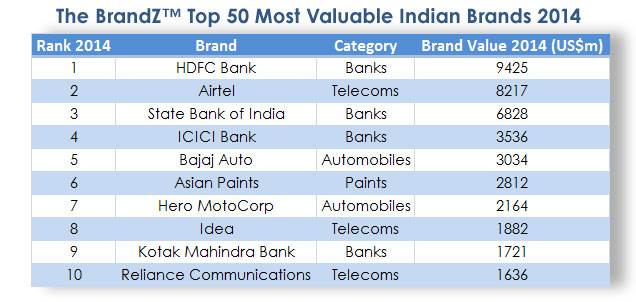
    The combined Brand Value of all the brands in the inaugural BrandZ Top 50 Most Valuable Indian Brands ranking is almost $70bn BrandZ. HDFC Bank is India’s most valuable brand with a value of $9.4bn. Carried out by marketing and brand consultancy Millward Brown in conjunction with WPP, the valuation is the only one in India that takes into account consumers’ opinion of brands to calculate the contribution that product brands make to business success.


    The BrandZâ„¢ India study shows that India’s unrestricted ‘right to play’ for businesses has nurtured great diversity amongst brands in the ranking. The Top 50 come from 13 different categories. Seventeen are multinational corporations (MNCs), 26 are private Indian brands and seven are state-owned brands. This indicates that India is an open, fertile market for building valuable brands, irrespective of age, origin, structure, category, ownership or even price range.


    HDFC Bank, the No 1 brand, has a network in more than 2,100 cities. It is popular with its 28 million customers for launching mobile apps designed to make banking easier, and running literacy, education and skills training programmes in rural areas. The No 2 brand, Airtel, is the fourth largest mobile operator in the world with nearly 300 million customers, while India’s largest commercial bank, State Bank of India, is at No 3 in the ranking.


    Services businesses (Banking, Telecoms and Insurance), which are the nerve centre of today’s Indian economy, are prominent in the ranking. Seven of the Top 10 brands, and 30% of the Top 50 brands, come from the service sector. Financial services stand out, with the 12 banks and insurers in the ranking holding the largest proportion (37%) of total Brand Value. Analysis shows these brands have built value by successfully achieving scale – both in geographical reach and the diversity of their offerings. Telecoms, Personal Care, and the Food and Dairy sectors also feature strongly in the Top 50. The data shows that these brands – along with the other FMCG brands in the ranking – excel at connecting with Indian consumers.


    The average Brand Contribution (a measure of the impact brand alone has on value) of the Top 5 brands is far higher than the overall average of the Top 50, illustrating the positive impact that building a strong brand has on the financial valuation of the brand. These brands create powerful connections by being meaningful to consumers, and differentiating themselves from others.


    Key findings highlighted in the BrandZ Top 50 Most Valuable Indian Brands include:

    :: Being meaningful and different builds value – India’s most valuable brands are highly relevant to consumers and differentiate themselves through service, new offerings and brand experiences. One such example is personal care brand Colgate (No 28) – even after 70 years in India the brand has successfully remained relevant and continues to differentiate itself from the competition.


    :: India has evolved into a brand powerhouse – India’s Top 50 most valuable brands have as much Brand Power (consumers’ predisposition to choose that brand over another) as the global Top 50, and are ahead of the other emerging economies.


    :: Private sector players and multinational corporations dominate – together these contribute around 85% of total brand value. They have succeeded by nurturing a strong relationship with Indian consumers.


    :: Megabrands lead the game – like other fast growing economies, India is dominated by a handful of big brands or companies that own stables of brands: the Top 5 account for 45% of the ranking’s total value. Their tremendous scale and ability to cater to a wide spectrum of the population has translated into financial gains.


    :: ‘Balanced brands’ is the mantra – brands that are able to build both strong connections with consumers and business scale that leads to the creation of financial value are contenders for entering or rising up the BrandZ ranking. Three out of the Top 5 Indian brands demonstrate this balance.


    :: Consumer technology is ‘the category waiting to happen’ – there are currently no homegrown consumer technology brands in the Top 50, but this category is on the verge of emergence. The presence of Indians working in the sector globally is high, and consumer-facing technology brands founded by young entrepreneurs have already started to gain ground.


    :: ‘Indianizing’ products and services is important – the many successful international brands in the ranking have taken the time to understand Indian needs and tastes and adapt to them. Noodles, food seasoning, soup and sauce brand Maggi (No.18), personal care brand Colgate (No.28) and beverage brand Horlicks (No.20) are masters at this – and are thought of as Indian brands by most consumers as a result.


    :: Old and new sit side by side – living with one foot in the ancient world and one in the modern makes consumers equally receptive to heritage brands (Bajaj Auto, No.5, established 1945) and new brands (Airtel, No. 2, established 1995). More than a quarter of the Top 50 brands were created after the economic liberalization in 1991 while Dabur, No.22, was established 130 years ago.


    Said Prasun Basu, Millward Brown’s Managing Director – South Asia: The stronger the relationship a brand can build with consumers in its category, and the more it can leverage that to build scale, the more sustainable and profitable it becomes. All of the Top 50 brands are reputable, successful engines of growth for the future of India. Any global manufacturer that makes the effort to understand the diversity of the Indian consumer’s needs, tastes and aspirations, and which can build a proposition that is both meaningful and appropriately differentiated, will succeed in building a strong brand.”


    Added David Roth, CEO of The Store, WPP: “With the second highest number of social networking users in the world, and the third highest number of users of mobile devices, developing an e-commerce strategy that focuses on social and mobile platforms is essential for brands in this region.”


    Said CVL Srinivas, CEO GroupM – South Asia, “We are already seeing the impact of the purchasing power of the internet and mobile users in India, with the exponential growth of e-commerce companies in the space of travel, e-tailing, ticketing and many main line brands increasing their brand building budgets to digital media in multiples.”


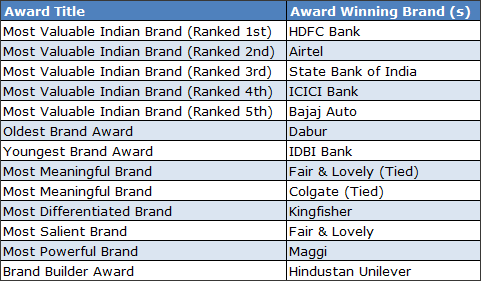
    In addition to the rankings, special awards were also presented to brands among the Top 50 under the following categories.


    Millward Brown BrandZ India Awards 2014

    A copy of the BrandZ™ Top 50 Most Valuable Indian Brands 2014 report can be downloaded at www.brandz.com


  • Achche Din Aane Waale Hain: GroupM revises adspend growth to 12.5% from earlier 11.6%

    By A Correspondent


    If leading media services conglomerate GroupM revised annual advertising expenditure (AdEx) estimates for 2014 are to be believed, the ‘achche din’ are surely set to come. The AdEx estimate is revised to 12.5% from 11.6% released earlier this year. The AdEx revision is part of the global report called the This Year, Next Year (TYNY) 2014. GroupM globally also released its revised estimates, India, Brazil and Russia remain among the faster-growing ad markets.


    Speaking about the industry sectors contributing to the revised growth, CVL Srinivas, CEO, GroupM South Asia said, “After a cautious start to the year, the overall sentiment in the country is positive following the general elections and a new stable government. One of the sectors that is adding to the growth story in India is retail. Specifically e-commerce players that are investing heavily in above the line advertising along with digital media. Industries like FMCG, auto, telecom and BFSI are expected to increase spends given competitive pressures and clear policies.”


    Medium-wise, television spending is set to grow to 14.8% as against the previously predicted 12%. Digital media continues to show the maximum growth with 35%. In the print medium, regional publications and local advertisers are projected to lead the growth for dailies. Government spending and retail will continue to increase spending in print.


    This Year, Next Year, is part of GroupM’s media and marketing forecasting series drawn from data supplied by holding company WPP’s worldwide resources in advertising, public relations, market research, and specialist communications.


  • SMW 2014 to deliberate on Social Media for Social Change

    By A Correspondent


    The second edition of the Mumbai leg of Social Media Week (SMW) has been announced. The five-day event to be held from September 22-26, 2014 will bring together influencers, practitioners, academic thinkers and international experts, who will provide a blend of information and ideas through panel discussions, debates, workshops, and more. SMW 2014 is set to happen simultaneously in 12 cities- Berlin, Chicago, Johannesburg, London, Los Angeles, Miami, Mumbai, Rome, Rotterdam, São Paulo, Sydney, and Toronto.


    SMW 2014 aims to reach new realms of connectivity and knowledge through social media platforms by creating an ecosystem for influencers, practitioner, brand managers, entrepreneurs, students and social communities. The theme for SMW Mumbai 2014 is Social media for Social Change, with multiple sessions through the week will explore the dynamic ways of how social media has become the greatest marketing tool to the loudest voice of the people. This international festival was founded in New York by Crowdcentric Media LLC and is hosted twice a year, in India, by R SQUARE Consulting, an integrated marketing services agency.


    “Dynamism in social media makes social media week really interesting. New technology, platform, insights, usage, there is so much to know hence social media week plays a very important role for the whole community and industry,” said, Rohit Varma, Founder and Managing Partner at R SQUARE Consulting.


    SMW’s unique format explores the social, cultural and economic impact of social media, and gives a platform to instil ideas and empower the social world. With a mission to help people and organizations connect through collaboration, learning and sharing of ideas, it garnered an overall reach of 19 million in Mumbai, last year.Globally, 27,000 people came together to be a part of this mega event which was held simultaneously in eight cities. With 1745 speakers and more than 1000 events, the festival reached out to 555 million people in 2013. This edition of SMW Mumbai to have 100+ events with a league of eminent speakers both national and international joining. Attendee registration will begin on August 20, 2014.


    SMW has partnered with the leading media and integrated communication agencies GroupM, OgilvyOne, Step Up (inspired by Genesis Burson-Marsteller), Germin8, Chlorophyll, Avid Learning, Page Traffic buzz, MxM India, TiE Mumbai, Construckt Festival and The Indian Networker together to organize the event in India.


  • MEC elevates Rahul Jadhav to National Trading Head

    By A Correspondent


    MEC has announced the promotion of Rahul Jadhav to National Trading Head. In his new role, he will be responsible for media investments across platforms and will report to T Gangadhar, Managing Director, MEC, Sidharth Parashar, Head – Pricing and Investments, GroupM and to Michael Beecroft, Trading Head – MEC Asia Pacific.


    In his previous role, Jadhav was head of media buying on Colgate Palmolive. He has been with MEC since 2010 and will continue to be based in Mumbai.


    Announcing the development, T. Gangadhar, MD, MEC India said, “Trading is a massive differentiator for us and Rahul has the smarts to lead this critical function. He has an astute understanding of the media landscape and enjoys excellent relationships with our business partners. I wish him the very best in his new role”.


    Jadhav is a Bachelor in Engineering and holds an MBA degree from the University of Pune. Prior to joining MEC, he was Product Manager at Tata Motors. His career also includes a stint at Bajaj Tempo. He is an avid car enthusiast and a cricket fanatic.