Tag: GroupM

  • GroupM wins media mandate of Malaysia Airlines

    By A Correspondent


    GroupM, along with Mindshare and m/SIX, has been appointed in Malaysia as the media agency for Malaysia Airlines, the country’s national carrier and a member of the Oneworld airline alliance. GroupM won the account following a competitive pitch, which included incumbent IPG, Starcom, Havas, and Zenith. The appointment is effective May 1, 2016, and covers Global Channel Planning, Media Buying and Optimisation, and Search Engine Marketing and Re-marketing. The entire global digital buying will be done by the Malaysia office.


  • GroupM wins media mandate of Malaysia Airlines

    By A Correspondent


    GroupM along with Mindshare and m/SIX, has been appointed in Malaysia as the media agency for Malaysia Airlines. Malaysia Airlines is the national flag carrier of Malaysia and a member of the oneworld airline alliance.


    GroupM won the account following a competitive pitch, which included the incumbent IPG, Starcom, Havas, and Zenith. The appointment is effective May 1st 2016, and covers Global Channel Planning, Media Buying and Optimization, and Search Engine Marketing and Re-marketing. The entire global digital buying will be done by the Malaysia office.


    The win came on the back of Mindshare and m/SIX pitching a proprietary framework “AIR” to Malaysia Airlines, that provides the client with dynamic audience segmentation and targeting capabilities.


    Girish Menon, CEO of GroupM Malaysia said: “Malaysia Airlines is the most prestigious global Malaysian brand. We are excited to be their business partner. This appointment is a testament of the teams’ understanding of the dynamic consumer journey, and applying the insights through effective use of real time data and technology. With our proprietary planning framework of Adaptive Marketing, the team helped in sharing breakthrough ideas to the client.”


    Grace Chan, Head of Group Branding and Communication, Malaysia Airlines added: “We are excited and looking forward to working with GroupM, who has clearly demonstrated adaptive strategic thinking using their proprietary framework and capabilities. We will be working with the best of the resources from the group as Team MH.”


  • Up, Close & Personal: Vikram Sakhuja


    Six months ago, Vikram Sakhuja quit GroupM to join Madison Media as Group CEO, Madison Media and OOH and Equity Partner, working closely with his former professional rival Sam Balsara. Bursting with ideas on how to take both Madison and its business forward, Sakhuja opens up to Pradyuman Maheshwari about his move out of the global role at GroupM and into Madison, his regard for Balsara and his plans for the agency network. Excerpts from the interview


    Six months at Madison last week. How has the journey been so far?

    In a word, fantastic. It’s everything I expected it to be, and perhaps a little more. But this is the long haul. So when one is entering into this thing, it’s with a Test match mentality, and not with the sensibility that things are broken and I have to fix them. If Sam [Balsara] has found a role for me to join him in leadership, it is probably to help with the next stage of evolution at Madison.


    So I think that’s the way I have approached it, and though I have been slow about it, purposely, it’s because I have been trying to drive a few agendas. In this interview I don’t think you will get too many silver bullets. You won’t even get any bombastic statements. But there will be a flow of thought, and you will see a process unfolding.


    You were familiar with the scene in India and at Madison having been out of the country for just a few years. Was it different from what you had expected it to be when you came in?

    Not at all. I had a fantastic time running GroupM’s South Asia operations for six years, and Mindshare before that. I have loved every bit of my WPP tenure in India. It was interesting because I was doing South Asia and then I was a part of the Asia Pacific management team but based in this part of the world. So after that, to suddenly do a global thing, a few things struck me.


    The GroupM role was more of an organisational enabling role. While we were building GroupM’s superstructure, a large part of it was to make the agency stronger — whether it was buying and trading, or putting in place; whether it was digital infrastructure or talent. A large part of that was about still enabling clients. But I had started noticing, in my early years at GroupM, that my client contact had gone down even though there was a lot of other exciting stuff happening. When you get to a global role, it becomes even more rarefied. Maxus, at that point of time, had more local than global clients. When you have local clients doing their job, you don’t want to get in the way. You have the standard ceremony and meeting clients and stuff, but you’re not adding tangible value. So the way you add value at a global agency leadership level is to set direction, drive P&L, drive the product and those kind of things. It is very internal.


    So you missed getting your hands dirty?

    Absolutely. At GroupM in India I wasn’t missing that because it was familiar turf. Even though I was not involved in client work per se, a lot of clients were old friends. So I have always had that steady contact and a relationship with clients at some level. That became a bit removed in the global Maxus setup, and even more when I was doing global strategy for GroupM.


    There was a sentiment that your leaving Maxus was very abrupt…

    It probably was. It was my boss who felt it would be better if I got out of the role and got into a strategy role, since they were doing something in the area of digital, data and stuff, and wanted me there. Even I felt it was abrupt.


    Even at GroupM, there was a fair amount of shock about your sudden exit from the Maxus top job.

    Yes, it was abrupt, and made me revaluate what I should really do. I had a feeling the global GroupM strategy role would frustrate me. The vision was interesting but the implementation would have been too slow for a person like me.


    And then this whole thing happened with Madison. How did you think of joining Sam because – even though he has been a friend and you have had some collaboration — at the end of the day, he is somebody whom you have fought so much against in the media agency battlefield. It’s almost like sleeping with the enemy…

    Actually way before we were competitors, we had a seven- or eight-year partnership. I was the one who started the practice of AORs in India when I was in P&G. I was in research and media at P&G when I heard the word AOR. When I asked my then-boss Vivek Bali about it, he suggested that instead of working with various agencies, we consolidate our media efforts. We organised a pitch and the [duties] were awarded to Sam. Then I moved to Coke, we got a pitch on there too. There were two pitches in that four-year period I was there, and Madison defended both.


    So I would say that my respect and affection for Sam has been there right from the beginning, even before I was a competitor. And it’s not only with Sam. We are blessed that in our industry, we have a mutual respect for other agency heads. Many of them are very good friends of mine, but we have no problem separating the professional from the personal.


    What are the things you are trying to bring in, at Madison?

    There are three things on the agenda. First, is this entire thing of outcomes. Then there is a piece about agency management, which is the way we want our people to conduct themselves and build teams. The outcomes piece, simply put, is that in the last 25 years, media has been about efficiency over effectiveness. Everybody coasts on impact, and the science of intelligently spending your marketing money to grow business, has become weaker. Today, you are able to not only measure output but also, to some degree, behavioural outcomes. So this is something I am hoping you will see a bit more of, in the coming months. I can’t announce it today but we have identified a chief strategy officer who will join us and I am very excited to have him. There is also a large outcomes-based thing I am trying to do since I have always believed that organisational culture is a total of all the conversations that happen in our workplace. So if I can get conversations going in corridors about what we are doing to grow the business of the client, I think it will make a qualitative and profound difference.


    For me, the biggest joy has been that I have come back and now almost 70 per cent of my 14-hour day involves client work, as against my earlier setup where it was less than 10 per cent of a 12-hour day.


    Are new businesses a part of your agenda?

    Yes, and we have won eight or nine [accounts] since October. Last April- May we won Snapdeal, which comes with Freecharge, and fills up a very large hole. The BJP remains an active client, and with all the Assembly elections, not insignificant.


    Is there a pressure on new business?

    Who is there to put pressure? Sam and I have to put pressure on ourselves. We watch the space; there are some categories in which we want to have some businesses. We would love to get a good car client or a telco…


    Was it expected of you, or did you think you could pull some clients from GroupM? Or was that not a part of your agenda?

    We all have certain non-poaching clauses relating to good clients and people in our contracts, so I was mindful of that. As per my contract, I was not allowed to work for six months, which I didn’t, and a few months after that, I was not allowed to poach people and clients.


    One has seen you interact with your former colleagues from GroupM at forums like Goafest. You are still very friendly and comfortable with each other…

    I have had a very close relationship with them and I am very fond of them. Some of them are like extended family. But you separate professional and personal relations. Firstly, they have to have a place in Madison. And second, everyone takes a professional call and I am not just going to [hire them] because they are friends. But if they feel that the way I lead or the way I am going to envision things can attract people then I don’t mind. Just because we are good friends will never be the reason.


    In your six months [at Madison], especially in your early days, did you feel that things were better here, or there [at GroupM]?

    Things are definitely better here. I was getting very frustrated in the global setup, by the lack of delivery that I had to show for. I had a good time at Maxus where I was driving a few agendas. Fortunately, in the two years that I led, Maxus saw fantastic growth.


    When you were at GroupM, especially in India, you were the boss and reporting to the Board etc. Here, Sam has a larger-than-life role in the organisation. Does that affect your day-to-day working?

    In the last six months, I have had no reason to feel constrained. Sam has given me all the space, but I also realise the kind of power that Sam brings to a party, is enormous. At GroupM, I was taking all the calls and it ended with me. Here, the responsibility is divided and it’s a very comfortable zone of working. He gives me all the space, and is very patient and receptive to what I have to say. So from that standpoint, he is my Martin Sorrell.


    You are comparing Sam to Sir Martin Sorrell?

    I am serious. In terms of capability, both are on par. Sam has a very well-honed sense of intuition that comes with having done something many times. He can break down complex issues and get to the heart of the problem. Martin Sorrell is also like that. He also gets to the heart of a complex problem and solves it…


    So you have the space? And you don’t feel stifled in any way?

    Yes, the space is there. I have a mentor to look up to. I have a boss that I can go up to and gets things validated. So I think it is very good. No, I am not feeling stifled in any way. Not at all.


    Everybody wants to know if and when Madison is going to sell out. You are still something of an outsider, so what is your view on this? Do you think Madison should be aligned with an international network?

    Because I have run a global agency, I have seen how difficult it is for global to impact local. I don’t believe any extra value can be added, apart from in the structure [in aligning with an international partner]. Even if I have quality talent, I will never be able to replicate the talent of a local agency. At the risk of sounding immodest, I believe that if an agency had to have pedigreed leadership, like with Sam and me, can that be replicated?


    But then it happened with Mondelez moving to Dentsu Aegis because of an international alignment…

    Yes, these are very frustrating, and for that reason alone, I think we should consider it. But that said, I don’t think there is a tearing hurry. It’s got to be the right value, the right partner. And frankly, it’s not a question you should be asking me. You should be putting it to Sam. But my view is exactly that: If there is the right value and the right partner, then why not?


    So what are you looking at over the next six months?

    I had mentioned the three agendas which I want to drive, like outcomes, One Madison [which is about integration] and internal agency management. Our ability to holistically look at clients’ requirements and present integrated solutions, makes for outcome-based thinking. On the consolidation side, buying is the obvious piece. I am trying to put a central buying unit in place which is going to drive a few agendas, and I would not like to talk about them right now. Automation is the third thing. These are all things that come under [an entity called] Madison Next.


    In terms of size, is there something you are looking at? Do you want Madison to be the same, or 1x, 1.5x or 2x bigger?

    I am definitely looking at pretty aggressive growth. At this point of time, we are the second-largest standalone agency after Mindshare, so we would definitely like to retain our position. We have to do whatever it takes to drive growth in the market.


    The part about agency management is, according to me, one of those critical values I can bring into this place. It has been run very entrepreneurially, and I would love it if we can get the spirit of entrepreneurship one or two levels down, so our divisional heads could become mini Sams. Then nobody will be able to stop us. But this is an HR piece and requires a talent game that you need to play. It starts with aggressive growth targets and comes down to a business plan, on the back of a [good] team that will deliver it. The part I think most agencies struggle with, is the empowerment of people who are the managers of managers. So there are two areas where empowerment is required: One is running the agency and the ability to take calls that a head of an agency does at an office level. And second is to be managers of managers so that when a junior person comes to you with a problem, plan, buy or whatever, you don’t just do the job but actually mentor and help the guy do the job.


    So in my next six months I’m going to put into place performance management in a very profound manner by setting up a training club programme in the agency which is going to develop people in a number of areas. And I will personally oversee one or two of them. Another part of Madison which would be a bit of both outcomes and bit of talent focuses on people. I am pleased we had Deboo Mohanty join us from the Asia Pacific for ITC. I am going to bring in a CSO who is going to be a gamechanger, so hopefully when we announce it, the market will also see that. A digital piece is something I’m doing now where I have restructured it and broken it up into two parts within Madison, with two people handling different parts which I oversee to gauge how that can be developed as a clear focus on digital. So I have given targets of what percentage of our billing needs to be going into digital because I just feel that we need to be more aggressive than we are right now and in the last six months, that has moved up considerably.


    Is there anything that is causing you an anxiety about the business?

    Staff turnover always causes me anxiety, especially at the junior levels. Even though that is normal in the industry, it causes me anxiety. I am a firm believer in something called an employee value proposition. I believe employees like to work for an organisation that stands for something good, with leadership you can look up to. They want to do good work, want to see growth and of course, want to be rewarded. You need a place where the culture is in sync with them. So the culture part we have to work on backwards, and I am fixing that by trying to figure the kind of conversations you want to have at the workplace and drive those.


    If you talk about leadership, I think we are blessed with people like Sam who is an icon. Madison is an agency people look up to. But I think all of this needs to be dialed up. So whether it is on the awards front, or whether it is a new business front people like to be associated with or just recognising and rewarding good work, those are the kind of things that we are trying to do to build a great organisation. Our systems are not bad, but we are putting in place things which will help develop performance, management, training plans, career plans and such. The minute an organisation is able to recognise and reward merit, respect for that organisation builds. So that’s a huge play for me.


    This interview first appeared in dna of brands on April 25, 2016
     

  • Sports sponsorship grows 12.3%


    Sports sponsorship grew by 12.3% in 2015 to Rs 51,854 million in India. This number is 10.4% of the total Indian AdEx in 2015 as reported by GroupM’s ‘This Year, Next Year’ report.  This was revealed in a report sponsorship in the country presented by ESP Properties, the Entertainment and Sports arm of GroupM and leading sports news portal Sportz Power.


    Into its third edition now, the report on the Indian sports sponsorship market discusses the success of non-cricket leagues, fan engagement and how brands can maximise value from association from sports.


    Emphasising how sports can be harnessed as a successful communication medium by brands, Vinit Karnik- Business Head, ESP Properties said: “There is definitely a cultivated sense of understanding between corporate sponsors, sports teams and federations. A symbiotic marketing relationship has emerged within the sporting ecosystem in India. 2015 saw Sports accounting for 10.4% of the total media spend, which is a 12.3% increase from the previous calendar year. 2016 will be fantastic for not only players and federations, but also for brands and spectators, with a deeper engagement with sporting properties.”


    “Sports other than cricket have successfully established themselves in terms of revenue and fandom within the Indian sporting firmament,” added Thomas Abraham, Co-Founder, SportzPower. He added, “Sports like Kabaddi and Football have massively increased sponsorship revenues in 2015 and we saw return editions of sports like Tennis and Hockey as well. The successful launch of the Pro Wrestling League bodes well for 2016, which will see the advent of more franchise based leagues. We expect 2016 to be a good year for Cricket as well as Other Sports, generating ad spends and clocking in corporate investments at an exponential pace.”


    2016 is a big year for the sporting community, including emerging talent, federations, broadcasters and fans, adds the report. As the Indian market opens up to new sporting leagues and new forms of exhibition, there is great interest in sports such as Football, Tennis, and Running, to name a few. Brands that have made investments in sporting events early on are seeing greater returns on their investment over the last two years. With the advent of non-cricketing sports taking a share of the sponsorship pie, emerging talent is exposed to international players, better coaching techniques and greater interesting in their chosen game. With this kind of exposure, the next three to five years will also see heightened attention from broadcasters, as they look at newer platforms to increase advertising engagement, the report adds.


    Executive Summary of ESP Properties-SportzPower Report 2016

    Key Observations

    > Sports Sponsorship in India increased by 12.3% in 2015, compared to the previous year. This accounted for 10.4% of the total Indian AdEx


    > While cricket took a majority share of the sponsorship pie, non-cricketing sports were the growth driver in 2015


    > Pro Kabaddi League’s resounding success paved the way for it being slotted as a biannual event from 2016 onwards


    > Change in the landscape of Indian sports with the successful launch of the Pro Wrestling League. Pro Kabaddi League and the Indian Soccer League have successfully deepened their respective engagements with fans


    > The build-up to the FIFA Under-17 World Cup in India will provide encouragement to emerging talent and investment in the sport locally, with world class infrastructure and facilities being provided in six cities


    > International Premier Tennis League and The Champions Tennis League delivered second editions


    > Hockey India League announced three new franchises to kick-start its third edition of which Ranchi Rays and Dabangg Mumbai continue to be a part of the six team league in 2016


    On Ground

    > On ground sponsorship for cricket in a year when IPL was the only big bang cricketing event grew a path-breaking 30% from Rs. 7,948 Mn. to Rs. 10,305 Mn.


    > Despite the bad publicity and the shadow of the Supreme Court looming over the BCCI, IPL viewership and engagement was unaffected. The property grew by a solid 13.9% in 2015, to Rs. 5295 Mn


    > Key brands that drove the cricketing upswing were Paytm, CEAT Tyres and MRF Tyres with a combined inflow of around Rs. 1,078 Mn. per year, increases the cricket spends by 14%


    > Football clocked in a whopping 91.6% growth in ground sponsorships from Rs. 595 Mn. in 2014 to Rs. 1140 Mn. in 2015


    > Hero Moto Corp for ISL at Rs. 180 Mn. as the title sponsor is the behemoth among the 17 (up from 10 in 2014) sponsors who collectively contributed Rs. 1000 Mn. + as sponsorship amounts


    > A 32% rise in sponsorships at Rs. 470 Mn. was seen by Tennis in 2015. While Champions Tennis League added brands like Kotak Mahindra Bank, Gatorade and Grey Goose, title sponsor for IPTL – Coca Cola – renewed its sponsorship while also becoming a 10% stakeholder


    > A massive 300% rise YOY, PKL revenue soared to Rs. 480 Mn. in 2015, that too without a title sponsor


    > With Distance Running at 53.5% YOY revenue increase, PWL and HIL also drove On Ground Sponsorship from Other Sports to close at a healthy Rs. 2230 Mn. for 2015


    Team Sponsorship & Franchise Fees

    > Cricket Team Sponsorship saw a marginal 1.9% drop from Rs. 3,478 Mn. in 2014 to Rs. 3,412 Mn. in 2015. Drop has come on the back of less number of matches Indian team played


    > 2015 also saw an increase of 48.8% in Non Cricket Sports, driving the market (despite the drop in Cricket) up by 13% to Rs. 2,170 Mn


    > Football by itself registered a 67% increase YOY, to close at Rs. 603 mn


    > PKL was the principal driver of increased Team Sponsorships in Other Sports, which saw an overall 38% upside from Rs. 855 Mn. In 2014 to Rs. 1,180 Mn. In 2015


    > Closing at Rs. 240 Mn, PWL made up for its chaotic, unorganised debut by claiming hearts and fans


    Endorsements

    > The biggest endorsement deal of 2015 was delivered by Tata Motors, which signed its first brand ambassador in global football superstar Lionel Messi onto a two-year deal at Rs. 600 Mn per year


    > If the triumvirate of M S Dhoni, Sachin Tendulkar and Virat Kohli remain perched atop the Indian endorsement pyramid, among female sporting stars, Saina Nehwal, Sania Mirza and MC Mary Kom continue to be the Big Three in 2015 as well


    > Virat Kohli stepped into the elite Rs. 1,000 Mn. endorsement club that Tendulkar and Dhoni already belong to.


    > Endorsements from other sports rose a spectacular 90% from Rs. 221 Mn to Rs. 420 Mn in 2015, with Saina Nehwal, Sania Mirza and Mary Kom accounting for 40% of the endorsements pulled in by Non Cricket Sports


    On Air

    > Despite the challenges of time zone differences, the ICC World Cup managed to garner Rs. 5000 Mn in ad revenues in 2015.


    > On Air Sponsorship increased by 6.8% YOY from Rs. 25,180 Mn. in 2014 to Rs. 26,900 Mn.


    > Longer live content duration with league sports. Wider reach, consistent performance metrics of non-cricket sports help in garnering future spends


    Mobile & Social Media

    > 70% fans bring their mobile devices to share in stadia experiences


    > 46% mobile internet users search for sporting events and news


    > In IPL, CSK could not generate much online conversation despite a strong fan base, while in social media top three drivers are KKR, RCB and MI.


    > With six digit Facebook bases, ISL teams are more talked about than the league itself, thus highlighting a clear divergence between team buzz v/s league buzz


    > Likewise, PKL teams also cumulatively generate 500 times more buzz than the parent league


    > IPTL, HIL and PWL need to focus on building more traction on their social media assets to be able to up their social and search numbers


    > Sachin Ramesh Tendulkar still rules the social media with fans on Twitter and Facebook surpassing any other sports player numbers


    Year 2016


    > Sports teams and federations have developed a better understanding of marketing themselves and are in an evolving state of sync with corporate sponsors to ensure a symbiotic commercial relationship


    > Sports needs a mobile amplification – the ways and means to harness mobile as a direct communication medium with the sports fan demographic are limitless, progressive and extremely penetrative


    > IPL templated leagues for sports such as Table Tennis, Cue Sports and Volleyball are readying for their respective coming out parades


  • GroupM launches ‘Live Panel’ for targeted media plans

    By A Correspondent

    Media services conglomerate Group M has announced the launch of Live Panel, a new consumer and media insight solution enabling its agencies to more efficiently develop precise and targeted media plans so advertisers can more effectively reach their audiences, measure outcomes and seize competitive advantage.

    With seamless access to a global panel of more than 5.5 million consumers in 30 markets, the solution will offer actionable insights needed to inform media decisions for both global and local campaigns. The new platform connects with multiple data sources across WPP group firm Kantar Media’s data and research assets and integrates with the planning tools of GroupM’s media agencies (Mindshare, MEC, MediaCom, Maxus and Motivator) to accelerate insights to planning to implementation. In India, Live Panel is spearheaded by Tushar Vyas, Chief Strategy Office, GroupM South Asia.

    “In an era of continually evolving consumer behaviours and media preferences across a wider array of channels, marketers who have the most intelligenceare at a distinct advantage, and our unique knowledge of audiences worldwide sets us apart in the industry,” said Irwin Gotlieb, Chairman, GroupM Global. “Leveraging WPP’s data and analytics investments, we know more about media use and consumption behaviors than anyone else. Live Panel operationalises this knowledge to turn consumers into audiences and audiences into customers more nimbly and efficiently for our clients’ advantage.”

    “GroupM’s use of our global Lightspeed consumer panels and the integration of a number of our unique data sources – BrandZ, TGI, Connected Life and Kantar Worldpanel ComTech – into Love Panel fully realises the power of Kantar’s insights capabilities by embedding them into agencies’ media investment management tools,” said Eric Salama, CEO of Kantar.  “This continues Kantar’s strategy of combining survey, panel and census data for the benefit of marketers by connecting us to the client rosters of the world’s largest media investment group.” Kantar incidentally also runs IMRB in India as well as a jv with Nielsen in TAM.

    Live Panel is launching with an extensive global hub survey generating media knowledge on 30 media and 40 touchpoints including consumers in Argentina, Australia, Brazil, Canada, France, Germany, India, Singapore, the United Kingdom and the United States.


  • GroupM predicts adspends to grow 15.5% in 2016…


    By A Correspondent


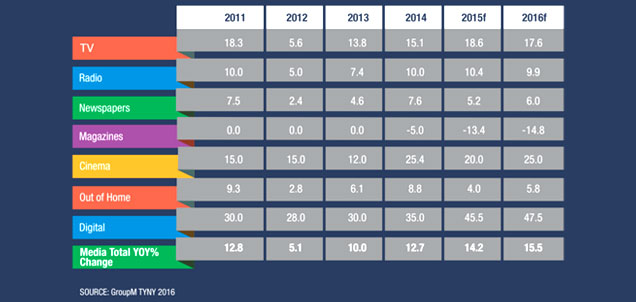
    Marketing services conglomerate GroupM says India’s adspends will grow 15.5 per cent in the year 2016. The media agency network also reported that adspends grew 14.2 per cent in 2015 over the similar period 2014.


    Said CVL Srinivas, CEO, GroupM South Asia said, “India is the fastest growing ad market among all the major markets of the world. 2015 was the best year for ad spend growth we’ve had in the last five years. While global headwinds are building up in the new year, there are a number of positive factors that will help the Indian ad sector grow at higher levels in 2016. While FMCG, Auto and Ecommerce which have been the top sectors contributing to ad growth in 2015 will continue to invest, Telecom, BFSI and the Government sector will see a ramp up. Events like the T20 World Cup, IPL and many state assembly elections will give a further impetus to ad spends. India is one of the few large markets where all traditional media platforms will show positive growth.”


    FMCG remains the most dominant sector with a 28 per cent share of the AdEx. In 2016, e-commerce adspends are expected to be high on the back of increasing competition, market expansion and newer players entering the space. Many leading traditional retailers will be expanding their e-commerce presence in 2016 even as consolidation continues in the sector. Another exciting development is the opening up of e-commerce as a platform for advertising, which will see further traction in 2016.


    With the advent of 4G services in India, telecom service providers are expected to roll out extensive marketing campaigns across media. According to GroupM, another big contributor to the Indian AdEx this year will be the auto sector, on the back of multiple launches across both 4-wheelers and 2-wheelers.


    GroupM’s biannual advertising expenditure (AdEx) estimate report This Year Next Year (TYNY) has forecast India’s advertising investment to reach an estimated Rs 57,486 crore in 2016.  The last calendar year saw ad expenditure  closing at Rs 49,758 crore.


    Added Lakshmi Narashimhan, Chief Growth Officer, GroupM South Asia: “With a significant number of users accessing internet primarily from a mobile device, adspends on mobile will become as large as the digital AdEx from two years ago. With digital media achieving audience reach numbers that are next only to Television, multiscreen planning is the order of the day. We have seen focused targeting of digital and native advertising with programmatic buying over the last two years, and this momentum will continue in 2016, as automation increases”.


    GroupM estimates the Digital AdEx to grow by 47.5% in 2016 to Rs. 7,300 crore from the earlier Rs. 4,950 crores. A significant part of this growth is on the back of higher investments in cross-screen campaigns. The digital AdEx is estimated to take a 12.7% share of the total AdEx in 2016.


    The year 2016 is estimated to be a better year for newspapers than 2015, the report notes. The increase in adspends expected from print heavy sectors like Auto, BFSI and the government sector augurs well for newspapers. Regional advertising of telecom and FMCG brands will benefit language dailies. While print as a medium is facing a lot of pressure from digital there is still headroom for growth in certain pockets and amongst certain audience clusters.


    While radio is expected to grow at a little over 10%, there is scope for the medium to pick up towards end 2016 when most of the new stations (set up after Phase III licenses, round 1 were issued) are fully operational. Digital audio platforms are gaining in popularity, opening up a new format for radio.


  • Motivator motivates Mohandas to move in as Client Leader

    By A Correspondent


    Amol Mohandas

    Motivator, a media agency from the house of GroupM, has appointed Amol Mohandas as the Client Leader on all businesses. He will be based in Mumbai and will oversee all businesses of Motivator in the city.


    With over 15 years of experience, Amol joins Motivator from Percept Media where he was responsible for heading the west region business and identifying and acquiring leads for new business developments. He was also successful in initiating and acquiring the ISO 9001-2008 Certification, a first for a media AOR in the country.


    Prior to joining Percept Media, Amol established his own venture, Weave Through Communications. The company provided multi-platform communication solutions to its clients. He has also been a part of Mediacom as the General Manager for the UAE region, Starcom MediaVest Group as the associate Media Director and Mindshare.


    Commenting on the new addition to the team, Trishul Bhumkar, General Manager, Motivator said, “All our clients have had a fantastic 2015 and the momentum is only going to increase. We are getting ready to deliver on their business ambitions going forward. To do this we found the right senior leader in Amol. With a deep understanding of communication planning and having been an entrepreneur himself, Amol will be able to deliver on our client’s business results. Under him, Motivator’s Mumbai client leadership team is fully strengthened.”


    On his new assignment, Mohandas said, “It is a happy feeling to be a part of an organisation where the objectives – the individual and the organisation – match! Looking forward to a long and exciting journey ahead where I can leverage my 360-degree experience across diverse work environments and contribute to the success of our client’s businesses.”


  • Crayon Data enters Indian market in alliance with GroupM / Mindshare

    By A Correspondent


    Mindshare, along with GroupM, announced that they will bring their global alliance with Crayon Data, among the most innovative global big data start-ups, to Indian enterprises.


    This comes hot on the heels of the announcement last week, of Ratan Tata’s investment in Crayon Data. Together, GroupM, Mindshare and Crayon Data aim to map the taste of millions of Indian consumers, which will allow enterprises to target consumers more precisely.


    “GroupM is changing the way marketers approach the business of media. Together with the WPP data alliance, bringing the Crayon Data proposition to India reflects our ambition to know more deeply than anyone else the tastes of Indian consumers and use that to help our clients target them better,” says CVL Srinivas, India CEO of GroupM.


    Commenting on this, Prasanth Kumar, CEO of Mindshare South Asia said, “Through this alliance, Mindshare’s proprietary data and research are further enriched with Crayon Data’s analytics. This will help us bring in both agility and adaptive solutions for our clients. Understanding the tastes and mind-set of consumers is extremely important and will be a great advantage for us especially since there is a strong focus on digital. In our journey to understand our consumers even better, this will be a great advantage.”


    Suresh Shankar, founder of Crayon Data, said, “As life goes digital, and choices proliferate in every aspect of our life, we will move to a world centred around personalisation, where companies understand tastes and preferences at an individual level, and use that to make choices simple and relevant for their consumers”.


    In India, the GroupM and Mindshare partnership with Crayon Data, will create a unique data coalition across media agencies and media owners, to deliver the vision of offering personalised choices to millions of Indian consumers.


  • Indian adspend to grow 15%: GroupM

    By A Correspondent


    GroupM forecasts adspends in India in 2016 to grow 15 percent. In February this year, GroupM had predicted Indian adspends would grow 12.6 percent. Like ZenithOptimedia and Magna Global, GroupM, has also issued its bi-annual global advertising expenditure forecast which predicts ad investment growth of 3.4 percent ($17bn incremental) in 2015 and 4.5 percent in 2016 ($22bn incremental).  These are slight downgrades from GroupM’s predictions at mid-year for 2015 and 2016 which were 4.0 percent and 4.8 percent respectively.  The detailed India numbers are set to be released by GroupM around end-January 2016.


    The forecast is published in GroupM’s biannual worldwide media and marketing forecast report, This Year, Next Year, available at www.groupmpublications.com. The intelligence is drawn from data supplied by WPP’s worldwide resources in advertising, public relations, market research and specialist communications by GroupM’s Futures Director, Adam Smith, who commented, “The outlook remains tough.  Marketers’ constrained pricing power in a deflationary world, a macro trend, prompts ongoing focus on cost control versus investment and this colors our outlook. Continued strength across the majority of the BRIC and Next 11 countries, notably mainland China, is a highlight of the forecast, but the Eurozone is still struggling to find traction.  While our outlook is overall positive, we recognize the downside risks of financial pressures in faster growth markets and the changing profile of China’s external demand.”


    Brazil, Russia China and India, GroupM believes will represent 23 percent of measured global ad investment in 2016, a proportion which has grown every year since they began measuring it in 2000, and GroupM continues adding a point a year for the BRICs in its modelled forecast through to 2020.


    Mainland China remains the largest contributor to global advertising growth, but GroupM has revised downward its 2015 forecast from 8.7 percent to 7.8 percent, and the 2016 forecast is also slightly reduced from 9.6 percent to 9.1 percent.  GroupM has observed that Chinese consumer demand remains strong, supported by wage growth, urbanisation, property wealth and supportive governmental policy. However, on the external side, less demand for primary resources, less foreign direct investment (FDI), less local tourism, and the impact of domestic goods and services replacing imports are among the top reasons for ad market slowdowns in Taiwan and Hong Kong.


    Elsewhere among the BRICS, GroupM predicts that India will be the fastest-growing economy in 2016, and the 2016 forecast is raised by two points to 15 percent.  India is a beneficiary of cheaper oil, as is neighbour Pakistan, which GroupM also upgraded in the forecast. Russia is at risk of another step down in the oil price, but absent another shock, a soft rouble and room to ease rates could assist quick recovery. GroupM expects a short, sharp ad recession of 13 percent in 2015 followed by 2 percent growth in 2016. And despite the Olympic summer, GroupM has revised Brazil’s 2016 down from 9 percent to 7 percent.  There, household spending continues to shrink as unemployment potentially reaches a ten-year high.


    The Eurozone now accounts for only 11 percent of global advertising, and Eurozone consumer price inflation remains near-zero; monetary policy is set to ease just as that of the US may tighten. Zero ad growth is forecast in France in 2016, and German and Italian annual ad growth for 2016 is anticipated to fall only between 1 and 2 percent.  Spain shows the Eurozone’s strongest recovery, but advertising investment in Spain will still be 55 percent smaller in real terms relative to its 2007 peak. In Europe, outside the Eurozone, high employment and other very positive trends make the United Kingdom the fastest-growing mature ad market in the world and the number three contributor to global ad growth in 2016 behind China and the U.S.


    In terms of investments across media types, the shift of advertiser investment to digital, of course, remains the biggest trend.  GroupM hasmaintained its midyear forecast and anticipates digital growth of 14 percent in 2016, commanding 31 percent of global ad budgets. This is a deceleration from the 17 percent growth predicted for 2015. The slower but ongoing strength of digital springs from many sources including organic take-up, technical innovation, advances in value, viewability and validation, automation and efficiency, better creative work, and the mastery of data.


    “Facebook is addressable and targeted at scale with requisite tools and automation that make it easy for advertisers to understand and use; so it is reaping advertising growth of 50 percent globally, including Instagram.  Organic Google website revenue is growing remarkably fast too at 25.5 percent, and they have streamlined YouTube into a complement to broadcaster VOD, even if it is not yet a real challenger on price or quality,” said Dominic Proctor, Global President, GroupM.  “We see that digital’s data and automation capabilities are inspiring the evolution of all media — in all markets across the globe — but digital will continue its powerful growth and market share gains.  This is despite the challenges in the digital space such as viewability, fraud, measurement and currency, all of which we expect to be solved by market forces.”


    According to a communique, GroupM believes 2015 will be the first year that absolute spend in traditional media went backwards in the ‘new world’ (Latin America, Central & Eastern Europe, and Southeast Asia). Only a half-point fall is predicted, but this marks rapid deceleration from the 17 percent growth recorded as recently as 2010. New world newspaper advertising first went negative for growth in 2012, followed by magazines in 2013. China’s advertiser exodus from TV to digital gave the extra push required to make 2015 a negative for traditional media in the new world. These trends are anticipated to ease slightly in 2016.


    Globally, print media’s share of advertising will stand at 18 percent in 2016, according to GroupM.  Print’s long-standing run-rate of annual loss is slowing from two points of share to one, but GroupM notes it is too soon to call it a stabilisation. The medium is embracing digital distribution, but only the strongest franchises are replicating their eminence in the digital domain. Common obstacles include fragmentation, chronic loss of reach, and lack of common standards in audience measurement and trading.


    Traditional TV continues to stand up well.  TV accounted for nearly 44 percent of global ad investment at its peak in 2012; since then it has shed about a point a year. China is responsible for most of this loss because TV advertising became more rationed and regulated while the digital ecosystem grew by leaps and bounds. The USA by contrast is perhaps the least-regulated and most competitive TV ad market, and its TV ad revenue share loss is less than the global average. It would look even healthier if its digital gains were properly consolidated with its traditional linear top line.


    “TV’s share is rising in almost as many countries as it is falling and contributors to the forecast identified three themes of untapped potential: relaxing regulation, improving the quantity and quality of VOD ad inventory, and format innovation. But every medium is in the midst of transformation; some to accelerate growth, others to decelerate share losses; and GroupM, as ever, plays a central role with the voice of the advertising customer to help shape the market to the advantage of our clients,” added Proctor.


    Most of the segment-specific forecast is global. The India numbers are set to be released by GroupM around end-January 2016.


  • CVL Srinivas appointed Chairman of RSCI

    By A Correspondent


    CVL Srinivas

    Readership Studies Council of India (RSCI) announced that CVL Srinivas, CEO, GroupM South Asia has been nominated as Chairman for a period of two years with immediate effect. Srini takes over from Hormusji Cama who was Chairman of RSCI for the past two years.


    RSCI was set up when the Audit Bureau of Circulations (ABC) and the Media Research Users Council (MRUC) agreed to undertake joint readership studies as equal partners. The RSCI is governed by a 20 member Managing Committee consisting of Publishers representing the print media, Advertising Agencies’ representatives and Advertisers. The managing committee of RSCI sets up the Technical Committee to work on the IRS. In a recent development N.P. Satyamurthy was made the head of the Technical Committee to work on the new IRS.


    Shashi Sinha

    Shashi Sinha Chairman of ABC said “From an ABC standpoint we are delighted that Srini has taken over as Chairman RSCI, as there can’t be better person with this stature to guide RSCI especially as we kickoff IRS 2016.”


    Commenting on this development, I. Venkat Chairman MRUC said, “Srini brings over two decades of rich and varied experience in media planning and buying having worked in some of the best known agencies. I am confident that Srini, ably assisted by N.P. Satyamurthy who has recently taken charge of the Technical Committee will help us bring out an improved IRS 2016 with a 3,30,000 sample the largest such study anywhere in the world.”


    Srini was till recently the Chairman MRUC, stepping in to complete the term of his colleague Ravi Rao who moved to Dubai in May 2015.


  • GroupM brings back online Diwali mela with Google

    By A Correspondent


    Following the success of the 2014 edition, GroupM along with Google is bringing back India’s largest online Diwali celebration. This year, the online festival initiative has a new title sponsor in Askmebazaar.com. The other brands to come on board are Lakme, Horlicks, Kurkure and Hungama.com renewing their partnership with the Grand Diwali Mela and new partners Eno and Godrej Securities.


    Last year, the Grand Diwali Mela received over 5.5 million visitors in a course of 30 days. Over 150,000 samples were shipped across India, with 70 percent sample orders going to Tier 2 and Tier 3 towns. The samples ranged from make-up, skincare and household products.


    On the second season of the Grand Diwali Mela, CVL Srinivas, CEO, GroupM South Asia said, “After the success of the ‘Grand Diwali Mela in year one, we are excited to bring the online festival back again this year. With a clear focus on taking the festival to not just metros, but also Tier 2 and 3 towns, where the mobile phone is their window to the world, GroupM and our partners are integrating traditional print, TV and radio with mobile and digital marketing.”


    Said Punitha Arumugam, Director Agency Business, Google SEA & India: “As more and more consumer products companies embrace the internet to drive sampling and consumer engagement, we’re delighted to partner Group M to scale this initiative further and help brands make the most of the opportunity online.”


  • How Emvies Case Studies Rule for Young Pros


    By Shephali Bhatt


    The Ad Club is celebrating ’15 Glorious Years of Emvies’ this year. Emvies doesn’t just award excellence in media planning, it celebrates the business of communication. It sees expats tweaking flight schedules to make sure they’re present to cheer their network. The energy, in all these years, has been infectious to say the least. But do the case study presentations, get the same love? Let’s find out: Just a day before the presentations, we saw this tweet on our timeline: https://twitter.com/S_kotnala/status/637942894318485504


    We agree time is a luxury not many media professionals have but INTRADIA consulting’s Kotnala, an ex-media man himself, makes a valid point. The case study presentations were spread over five days this year with at least 30 cases presented everyday. That’s great wealth of information for agencies (and their competition.) Or as Punitha Arumugam, agency director of media business at Google India and chief organiser of Emvies puts it, “Attending Emvies case study presentation is like going to a classroom.” Now, the choice between sitting in a classroom and attending a party is easy. But making a difficult choice might ensure a better reason to party next year, no?


    The participation has only improved over the years, says Arumugam, adding that most attendants are perhaps busy rehearsing for their presentations which is why you see lesser people in the room sometimes. But that’s a sign of how seriously they take their job at the dais. “We have to devise ways to get all of them back in the room though,” she admits.


    Come One, Come All

    Shekhar Banerjee, SVP and head – media at Madison Media Infinity and Pinnacle, observed a poor turnout on Day 1 but attributed it to inertia. “You always have a full house for prestige categories like Strategy and Integrated,” he points out. Perhaps the categories can be better arranged, he suggests, so that not all important ones fall on the same day. He also suggests that 24 Frames Digital – the live webcasting platform for the event – should employ two cameras instead of one, so the viewer sitting in his office can get a better sense of what’s happening. But as long as you can, try and attend the presentation event. More than anything, it allows for interactions with jury members and a sense of what’s being appreciated in real time.


    The Jury Has Spoken
    The teams’ presentation skills have been the jury’s pet peeve. It’s not so much about accent and intonation as it is about content and confidence. Says Aditya Save, CMO of Shaadi.com and one of the jurors, “The teams indulge in a kind of jingoism that doesn’t help. They should remember who they’re finally presenting to – the judges.”


    (We) Can Do Better
    Nikhil Mayne, senior director of branded content at GroupM was one of the presenters this time. He admitted a lot of presentations could be guilty of taking a page out of a dated soap opera script. And then there were those loaded with numbers corroborating the belief: If you can’t convince them, confuse them. “I think we tend to get lost in parameters like ‘reach’ and other numbers when mediums like digital go way beyond that. They are about being able to talk to the right user without causing spillage,” he admits.


    Even the analytics data category was marred by similar issues which led to it having a slightly soporific effect on some audience members. “For a data-driven industry, it’s ironic how poor our understanding of using data is,” he adds. Mayne points to an IBM case study they were hoping would win in the data category which fetched a shortlist in ‘social media’ instead. In the next four years, he hopes data will become the most sought after category.
    For all that, the Emvie presentations are unique: perhaps the only opportunity for young media folk to hone skills that will certainly be useful during pitches or even workaday presentations. They may create a next generation of media folk who are a lot more confident and articulate than their creative peers – considering the Effies have scrapped live presentations after trying them out for a year.


    Between the occasionally lame gags, jokes and inter-agency sniping, there’s often an undeniable youthful exuberance. The best presentations – which may or may not coincide with the most compelling cases – allow young media folk to actually practice one of the most abused words in the business – storytelling.


    Pick from the shorlisted case studies

    Colgate Palmolive: ‘Sugar Receipt’

    Agency: MEC

    Category: Best Media Innovation – Events/Experiential Marketing and Best Media Innovation – Direct Marketing

    To catch the attention of customers who actually bother to check their bill, Colgate seeded sugar receipts along with grocery bills at select malls. This was to highlight the danger of cavity owing to the extra sugar in their grocery items. Based on the sugar content, consumers were given adequate discounts on Colgate maximum cavity protection toothpaste. The presentation showed a Bengali couple fighting over extra sugar in their bill which was thoroughly entertaining. On day two, the couple was accompanied by a rat on stage but that didn’t deter their enthralling performance. As they say, the show must go on!


    Lenskart: Eye for an Eye

    Agency: DDB Mudra Group
    Category: Best Media Innovation – Events/Experiential

    Lenskart organised an eye donation camp specifically inviting transgenders, right after the Supreme Court awarded them equal status as the male and female community. The presentation centered around the thought – ‘Those who can’t see being helped by those who can’t be seen.’


    Ariel: Share the load

    Agency: Mediacom
    Category: Best Integrated Campaign – Consumer Products and Best Media Innovation – Branded Content

    Ariel’s claim to have removed the stain of inequality in one wash with ‘Share the load’ was well received by the audience. Bonus points for not dishing out the same presentation on different days given it was nominated in multiple categories. And it’s not just the presentation that shone through, the product sales went up by 60 per cent, they claim.


    Lenovo: By Gamers for Gamers

    Agency: Mindshare
    Category: Best Media Innovation – Digital – Video

    Lenovo got top gamers to influence the gaming ecosystem about Lenovo products that have a good processor, illuminated keyboard, high-res display, better sound – all necessary armoury for a dedicated gamer. Where most entries in the digital category spoke about reach, this one made a strong case of using the medium to talk to the right set of people to avoid spillage. The result? Lenovo experienced an 80 per cent increase in traffic on its online store.


    Zee News: The Misunderstood Scoreboard

    Agency: DDB Mudra Group
    Category: Best Media Innovation – Out of Home

    15th Feb: India against Pakistan, ICC World Cup. Zee News installed four billboards, one each in J&K, New Delhi, Lahore and Karachi. They looked like manual scoreboards. Only instead of showing the runs each team made, they ended up clocking the total number of lives lost in all the India-Pak battles since 1947. The message: When lives are lost, no one wins. The activity garnered half a million views.


    Source:The Economic Times

    Copyright © 2015, Bennett, Coleman & Co. Ltd. All Rights Reserved

    Licensed to republish