Tag: Group M

  • Counting on digital to be M&E’s trailblazer


    @FF12: Day 1: Digital attracts ‘desirable’ status
    on Day1
    @FF12: Day 2: Seamless blending with traditional mediums – a big want!
    @FF12: Day 3: Industry expects thoughts to lead to pertinent actions
    @FF12: Takeaways: Digitization rules the roost @FICCI Frames 2012

    By A Correspondent


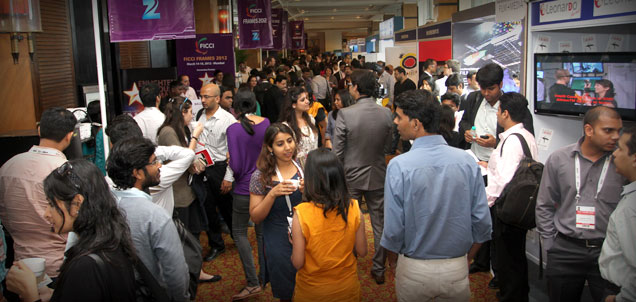
    Those familiar with the going-ons at FICCI Frames would testify how an infatuation gets displayed by delegates at the event each year so as to summarise the mood of the convention even before it broadly takes off across the three days that it is entitled to. But probably, the setting was a bit different this time around when the delegates – joined in unison by the media – were running ballroom to ballroom trying to ingest giveaways that were being thrown up abundantly across several sessions. May be, it was a year where each day had something new to offer to the delegates that kept them at tenterhooks throughout the 3-day event. And going by the loud decibels that were being emanated across every nook and corner of the venue, it was evidently clear that there was some motivating factor that was driving the gathering to go on an overdrive spree.


    The organisers of FICCI Frames 2012 have every right to take credit for coming up with a theme around a medium that attracted the attention of one and all. Having kept it on the sidelines till last year, digital was finally given its due at the convention as experts, authorities and enthusiastic youngsters came face to face to deliberate and come up with outcomes that would redefine the way the consumers consume the medium. From television to print to films and even radio, digitisation and the benefits and effects it would cast on these sectors were discussed in length at the venue. In fact Star India CEO Uday Shankar in his keynote address didn’t hesitate in thanking the FICCI committee for putting across a theme that would go on to redefine the way the industry functions in the future.


    What was apparently clear through the various sessions at the convention is that with the nearing of date for total digitisation across key metros by June 30 2012, and then across the country by 2014, broadcasters had to relook their distribution and content provision models so as to keep the consumer at the heart of every shift that will transpire in the future. Emphasising on the current digitisation scenario in the country, Mr Shankar said, “Most of the discussions that I have participated in are still around whether digitization will happen and if it indeed were to go through, how chaotic it would be. But all these are meaningless discussions triggered by a bunch of retrograde interests who are living in denial.” According to Mr Shankar, digitisation of distribution is a big reality and the 40-45 million homes that have bought DTH boxes at some point or the other are a conclusive evidence of that.


    Shooting back at critics who had doubted whether the makeover to digital would ever be a reality, Mr Shankar said, “To the critics and the cynics who are still wondering whether digitization would happen, my answer is: Look around, it is already happening and the rest of it is bound to happen because even in this country it would be difficult to undo such a momentous shift. To those who wonder how chaotic it would be, my response is that there would be some chaos, but chaos is not necessarily bad if the alternative is status quo or regression. When a transition at such a scale is happening that affects the illegitimate but strong vested interest in certain pockets, then there is an incentive to put up with chaos in the interest of the larger social objectives.”


    A broader outlook was provided by a few panellists who said that digitization will come in as a relief for broadcasters who will be benefitted from additional subscription revenue, relaxation on paying heavy carriage fees, and of course providing viewers with a superior content experience – MSOs and cable operators have to quickly respond to the digitization mandate by investing in set-top boxes – the cost that is only possible to recover after four years.


    Sounding off the challenges that digitisation would present for the broadcast sector, Tarun Katial, CEO of Reliance Broadcast Network Ltd said that, “For television, it will be a combination of content as well as marketing. The old model which was a combination of carriage and product, as it stands today, won’t work. The business plan which currently has a very high rate of carriage will obviously see the content taking precedence.” And as for content, it will be niche content that will call the shots for broadcasters as according to experts at the convention, niche isn’t niche any more as all niche channels put together command a share that is equivalent to the share of Hindi GECs and the mass channels, so to say.


    Perhaps the many advantages that digitisation will have on several mediums was rounded off by Vikram Sakhuja, CEO, South Asia, Group M who said, “The inherent power that digital brings along with it is interactivity and its ability to link multiple devices. Also the ability to enhance real-time consumption of content; linked to that is the entire thing about going mobile.” On the roadmap for the industry, Mr Sakhuja said, “I think integrated media is the best way forward. Today when people think of multimedia planning, they do a separate TV plan, print plan, radio plan, internet plan and so on. I believe that if you actually look at media agnostically and at common metrics of each cost per thousand impressions, these are the ways in which you can construct a media agnostic plan. What it does is, it suddenly gets more money into digital, and when more money can come into digital, that’s when focus is going to come in.”


    While digitisation was the mainstay of every discussion, the all-important issue of regulation too was taken up by panellists who chose to have the government respond to the many queries surrounding the topic. Uday K Varma, I&B Secretary, said that “if people at large seem to be happy with self regulation, I think the government would have no problem in legitimizing them. But I think the self regulation mechanism which has been set up by both the news broadcasters and the entertainment broadcasters, they’ll have to really prove it, not to the government but to the people at large.” He was joined in his cause by Prithviraj Chavan, Chief Minister ofMaharashtrawho said that the challenge would be to adopt the regulatory framework to new technology and ensure that over regulation doesn’t kill a good thing. The Chief Minister emphasised on the need for regulation and suggested that instead of the state regulating the media, the medium should look at regulating itself.


    The other important announcements that came up at the venue included the soon-to-be-passed Copyright Amendment Bill, the roll-out of the imminent phase 3 radio policy that would steer the growth of the medium and increased government aid for the film & entertainment sector.


    New ventures @ FICCI


    BARC takes wings

    In between the many promises and hopes that were being doled out at the sessions came the news of the Indian Broadcasting Foundation (IBF), the Indian Society of Advertisers (ISA) and Advertising Agencies Association of India (AAAI) announcing the official formation of a nationwide audience research joint body — Broadcast Audience Research Council (BARC).

    While IBF will have 60 per cent stake in BARC, ISA and AAAI will each hold 20 per cent stake. The Board of the council will have 10 members, six members from the IBF and two members each from the ISA and AAAI.


    Discovery Kids to flag off ops in April

    Another important announcement was made by President & CEO of Discovery Networks International, Mark Hollinger who announced the launch of its new network for children inIndia, ‘Discovery Kids’. Mr Hollinger said, “Launching in April, the network will initially be available in three languages – Hindi, English and Tamil. The channel will offer children a fun and entertaining way to satisfy their natural curiosity with stimulating and imaginative programming,” he said. The company plans to roll out the channel inPhilippinesandIndonesialater this year.


    Ten Golf tees off

    Taj Television India Pvt Ltd announced the launch of Ten Golf, a dedicated 24-hour golf channel. Ten Golf is the fifth channel from Taj Television India Pvt Ltd and began transmission on March 15, 2012. The dedicated golf channel will showcase a mix of live, non-live and feature programming. The channel will also broadcast live, high quality Golf action from around the world.

    Ten Golf has acquired rights for European Tour and Asian Tour till 2016, and has also entered into partnership with PGTI for three years to telecast the Indian Tour. Further, Ten Golf will be telecasting 400 hrs of golf programming in association with NBC.

     

  • @FF12: Integrated media best way fwd: Vikram Sakhuja

    Video and Text by Shruti Pushkarna


    On the fundamental powers of digital:

    In digital there are few things that are exciting. One is that digital has the potential to burst from a sampling kind of mindset into a census kind of a mindset. By that I mean that a lot of measurement we do in marketing today is very sample based and digital, whether it is through set-top boxes, or through online behaviour, it is possible now to get the data at a granular level. So that leads to targeting a million, one at a time kind of thing, which is exciting. The other inherent power of digital is interactivity. The third area is the ability to link multiple devices. Last is the real time query, whether it’s query or the consumption of content. Linked to that is the entire thing about being mobile. So these four or five inherent powers of digital are game changers for marketers.


    How to engage in an increasingly digital world?

    [youtube width=”400″ height=”250″]http://www.youtube.com/watch?v=sIj_VeYzlPo[/youtube]

    The engagement part comes from the kind of content you put up and the entire viral or social nature which comes up. The framework we talk about is paid, owned and earned media. An example of paid media is when Mindshare got Dhanush to sing an anthem for Sachin Tendulkar, post Kolaveri Di. Within four days we got ten million views, and the anthem, in turn, got a viral life of its own. So I think the way in which you can use content is how it becomes engaging.


    What is the way forward?

    I think integrated media is the best way forward. Today when people think of multimedia planning, they do a separate TV plan, print plan, radio plan, internet plan and so on. I believe that if you actually look at media agnostically and at common metrics of each cost per thousand impressions, these are the ways in which you can construct a media agnostic plan. What it does is, it suddenly gets more money into digital, and when more money can come into digital, that’s when focus is going to come in.


  • How the WPP and Interpublic Group fared in 2011

    By A Correspondent


    WPP reported record profits of more than $1.45 billion for 2011, up a whopping 43 per cent from the year prior, and the holding company expects to see continued momentum in 2012 due to increased ad spending for the US presidential election and this summer’s Olympic games, according to Ad Age.


    Reported revenue for WPP, the biggest ad holding company in the world and home to creative agencies such as Ogilvy, JWT and media-buying behemoth Group M, was up 11.4 per cent year-over-year to $16.05 billion. However, WPP’s CEO-Executive Director Martin Sorrell is less optimistic about 2013, as there are no big events to bolster ad spend, and political ad dollars will drop off following the election.


    “We think 2012 looks similar to 2011, maybe at a slightly reduced level,” said Mr Sorrell. “But the one big cloud on the horizon we feel the need to address in 2013 is deficit reduction after the US election.”


    WPP said North America performed well, and in Europe the debt crisis is impacting growth, but overall the company said it still fared well in the region thanks to strong growth in the UK and acquisitions in Western Continental Europe.


    The company reported that Austria, Germany, Switzerland and Turkey, all showed strong like-for-like growth for the year, but France and especially Greece, Portugal and Spain remained affected by the Eurozone debt crisis. In 2011, nearly 30 per cent of WPP’s revenue came from Asia Pacific, Latin America, Africa and the Middle East and Central and Eastern Europe.


    The company said that emerging markets in Asia, Latin America, Africa and Eastern Europe represent the highest growth regions for WPP. The company plans to spend between $470 million and $630 million on acquisitions this year, Mr Sorrell said. The focus will remain on small and medium-sized agencies, particularly those in new markets or specialising in digital work, data analytics and technology.


    The past year saw a number digital agency acquisitions, including: F. biz and Gringo in Brazil; Rockfish and Lunchbox in the US; Who Digital in Vietnam; Promo in Russia and A4A in China. The company made a total of 38 acquisitions and 10 investments in 2011.


    The Interpublic Report-Card 2011

    US-based ad holding company Interpublic Group of Cos has reported that it nearly doubled its net income for 2011, up 96 per cent to $551.5 million, up from $281.2 in 2010, according to Ad Age. The company’s annual revenue was up 7.8 per cent, to about $7 billion.


    “Building on a very good 2010 result, we continue to show organic revenue growth that is at or near the top of our peer group,” said Interpublic CEO Michael Roth. “This performance keeps us on track to deliver on our goal of fully competitive profitability in 2014.” Mr Roth added all of the company’s regions grew in terms of organic growth in 2011, except for Europe, which is in the midst of a debt crisis.


    For the full year, continental Europe was down 0.1 per cent. The best region for organic growth last year was Latin America, which was up 17.8 per cent. For the fourth quarter, US organic growth was up 2.2 per cent, Latin American was up 30.4 per cent and Europe was down 3.2 per cent. Interpublic’s digital agencies, MRM, part of the McCann network, Huge and R/GA, significantly contributed to the company’s growth.


    In 2012, the company is targeting 3 per cent organic growth, noting “significant macro uncertainty on the global level.” Interpublic agency networks McCann Erickson and DraftFCB both saw major accounts defect in 2011. McCann Erickson lost Nescafe and other accounts, while DraftFCB lost SC Johnson and is now having to share Miller Lite with Publicis Groupe’s Saatchi & Saatchi.


    Source: The Economic Times

    Copyright © 2012, Bennett, Coleman & Co. Ltd. All Rights Reserved


  • Chinese Madhouse looks to wow India


    By Johnson Napier


    Countless comparisons could be drawn on how two of the biggest and most admired economies are driving brands from all across the world to be a part of a growth story that is unparelled. Or how the APAC region is all about just these two economies today, putting the other developed nations in the region in a state of oblivion. Having wowed the world with growth stories that defy market odds, China and India today command attention from business stalwarts and entrepreneurs like no other, especially entrepreneurs from emerging mediums like Digital and Mobile that are shaping the way the world goes about doing its business. But despite the huge buzz around these two economies, there is very little that transpires when it comes to the two economies trying to venture into each other’s territory to gain mileage and expand base – especially in the digital space.


    But all that could change with the advent of the largest mobile solutions and advertising network firm from China- Madhouse. Launched in 2006, the company enjoys the reputation of being tagged as the most intellectual and largest mobile ad solutions company in China. In India, Madhouse will work towards providing brands, advertising and media agencies and marketers with a host of comprehensive mobile marketing solutions. It has already tied up with a host of strategic partners including WPP, Vivaki, Omnicom, Aegis and so on from the media agency side of the business and would work towards providing them holistic mobile marketing and advertising network solutions.


    The Madhouse India team would be headed by Vinod Thadani, who until now was handling mobile responsibilities for Group M India andSouth Asia. Given that the two countries share market complexities that are similar in nature and have a population base that is very high, it seemed like a natural extension for Madhouse to step in to India, making it the first such venture into foreign territory in APAC.


    Throwing light on how the APAC market compares to the other regions and reacting on his choice of targeting India as the hub for launching the venture, Joshua Maa, Founder & CEO, Madhouse Inc. said: “Today APAC occupies ad spends growth to the tune of 32 per cent, making it the largest in the world. These are led by the economies of China , India and Indonesia that are the key drivers of this growth in APAC. To gain success in a market like India requires the ability to manage complexity, and this is an area where we excel.”


    Hoping to leverage the opportunity of using mobile as a mass media device, Maa went on to elaborate the business module by stating: “If you compare the mobile markets of India and China, they are almost identical. While China has a mobile user base of 960 million, India’s number stands at 894 million. But where mobile internet users are concerned, China has 356 million users while India’s number stands at 150 million. Therefore, we foresee a huge growth in India and decided to make this our first market to launch in APAC.”


    In India, the agency’s focus would be centred around disciplines of mobile ad serving, mobile ad network and mobile marketing solutions. Having wowed clients in China like HP, KFC, Unilever, Intel, Coke, and others, Maa hopes to emulate a similar example here by getting important brands to align with the network: “Being the only full-service provider in the market and having a skilled and experienced team in place, we hope to attract a lot of clients in the days to come.”


    Emphasising on the partnership, Vinod Thadani, COO, Madhouse said: “Madhouse will offer mobile marketing solutions created and carried out for advertisers by a team of experienced media professionals that understand this medium. On a technical level, mobile advertising can now achieve accurate intelligent targeting and provide real-time reporting – a very convincing proposition for advertisers.” According to Thadani, the need of the hour is to unlock the potential of the mobile medium and they are therefore determined to grow the Indian Digital Media market from Rs125 crores to Rs1,000 crores in the next 3 years. “The need of the hour is to understand the medium thoroughly and this would be possible by partnering with the right partners and going back with the right solutions to clients.”


    Perhaps the best reason for elation among mobile clients in India was provided by Ranjan Kapur, Country Manager, WPP, who began by discussing how India, as an advertising market, was highly undervalued. “Despite India boasting such a good growth in economy, the advertising spends in China stand at US $55 billion while for India it is at US $6 billion, this shows that we are still an under-advertised and under-branded market.” Citing the reason for China leapfrogging ahead of India, Kapur said that the single biggest factor for India’s dismal record in getting more ad spends was because it jumped on to the services bandwagon and chose to ignore the manufacturing sector. “While the Services sector contributes about 55 per cent to the GDP growth, it is still very shy on spending on marketing and promotional activities. And this is an area where Manufacturing excels. But all that is changing and the Services industry is opening up and spending more.”


    On the ad spends growth in India, Kapur said that while there is a 15-20 per cent growth, it is digital that is intriguing the advertisers the most. “Digital ad spends recorded a growth of 30 per cent.Mobile, specifically, is a Rs125 crore industry today and given that there are 300 million internet users predicted by 2015, mobile advertising is expected to account for about one-fourth of conventional traditional advertising. So it can be said that a revolution in digital in India is beginning to happen now.” This growth will be boosted further by the Government’s efforts to spread mobile and internet usage in rural areas for which it has promised 2,50,000 nodes for broadband in the next four years. “So mobile marketing in the rural areas will be a mass phenomenon, once this plan gains momentum.”


    Another interesting addition to the venture would be Rovio Entertainment that is more popular for its Angry Birds concept around the world. “Madhouse is a valuable partner for us in China , and we are excited about the opportunity to extend our collaboration to India as well,” said Bijay Gurung, Key Account Director, Rovio Entertainment Ltd. “With India being the second largest Facebook market, it opens the door for us to entertain even more fans as we are aiming for one billion downloads by the end of the year.” The current number stands at 700 million. Apart from that, Rovio would also focus on pushing itself as a publishing firm, a large-scale animations firm and further look to enhance its merchandise business.


    In an era where it is becoming difficult to lead lives without smartphones, iPads and other such mobile gizmos and with a lot left to be accomplished in the Data, Voice and Text domain and lack of established tools and systems that makes it difficult to answer the question of how this medium can be leveraged by advertisers to reach out to their consumers, probably an established Chinese mobile dragon could well show Indian mobile companies the way this medium could be harnessed to its full potential.


  • AdAsia: Brand-building in a trust deficit world

    By Akash Raha

    With a plethora of brands in the market and a cacophony of declarations from each, the result is a trust famine in the mind of the consumer.

    In such a trust deficit world, the protocols of brand-building could be a lot more complex but highly rewarding. The panel members in the session named ‘Building brands in a trust deficit world’ helped navigate through the fog of distrust and threw light on a brand becomes trustworthy.

    The panel members in this session were Robin Wight, President, Engine and WCRS; Vikram Sakhuja, GroupM, Chief Executive Officer, South Asia; Michael Boneham, President & Managing Director, Ford India; Deepa Prahalad, Author & Business Strategist and Sandeep Ghosh, CEO, Bharti AXA Life Insurance. Ms Prahalad began the discussion by asking the rhetoric question, how can a brand build trust in a trust deficit world? Trust is very important and it is not dead, but fewer brands are trusted these days. Some brands are struggling to build trust not because they are not trustworthy, but because trust is so hard to gauge and build.

    Trust is not only about what is the brand giving in terms of quality of product and services but quality of a brands conduct and the causes the brand is championing. Mr Wight went on to talk about the psyche of the consumer and said that the biological purpose of a brand is to enable the consumer to make the buying decision with little mental effort. The brain really does not want to make any buying decisions all it wants to do is pass on the genes. The brain wants to do the least work it can do and hence a trustworthy brand scores over the others. If there is decline in trust, then there is a problem and the brain has to re-think about it. For example, if the brain had to think which mobile phone to take, considering the number of phones we have in the market, it will take it years to decide. Hence today, they use the web to make their mental effort easier. Engagement that a brand creates is very important, but what we need is not only engagement but peer to peer marketing which is so successful. Peer to peer marketing depends on building trust where the consumer spread the message themselves. He gave examples of the Coca-Cola advertisement where they reached out to 80 million people with no cost to the company. The message of the World Cup was spread without the company having to spend a penny and only through peer to peer marketing.

    In recent times, we have seen a downtrend in trustworthiness of several financial service institutions after premiere banks across the globe declared themselves bankrupt. The consumer can’t help but question the bubble that the bankers create. Mr Ghosh of Bharti AXA life insurance said that there is a need for financial services structures to move away to the land of promise and begin delivering. It is essential to move from mere promises to real proof, where the spectrum of financial service provide tangible proofs and demonstrate trustworthiness.  He showed examples of two of their campaigns where they gave tangible proofs to the consumers to build trust. Such strategy of proof as opposed to shinny promises can work wonders in building trust.

    Ford is another company which stands for trustworthiness and its case is no less interesting. During recession, Ford was one of the few companies that refused bail out, and such a step only build more confidence and trust in the brand. Mr Boneham  pointed out that since then they have worked very hard around that aspect and about their independence and walking alone. “We built and rebuilt our brand for what we were standing for. Under each of these we focused on what we could do to separate ourselves from others… A few things we then focused on was quality, green, safe and smart.” The company devoted a huge amount of time with the consumers to understanding their needs and what they wanted. And it is from this that they improved on the product and built up the trust quotient. We use consumers to build experience. Even in our ads we have consumers speaking rather than celebrities. We have focused on consumers talking to consumers.

    Mr Sakhuja of Group M was the last to speak and said that the point in context is “Building trust in an attention deficit world rather than trust deficit world.” Commitment levels per se (of the consumers) are not really high rather, it is quite low. The consumers don’t give the trust away easy, but when they do, they stay with it… they are not as fickle minded as several marketers are. But there is the psychological equity to it. The question is that, are people sure about what their brand gene pool is? People are not building enough of core psychological brand equity. He gave the example of Nokia, which according to surveys still ranks high on the trust quotient even though their market share has dropped significantly. The entry barrier for phones has suddenly become low owing to the several new players that have come into the market, so people are experimenting. Yet there is the latent psychological equity to buy Nokia.

    It is also essential for brands to have consistency in the messaging over time and across all touch point to create trust. The key is to keep the old and add the new… In the urge of doing new one should not discard the old value systems for the new. Moreover, for brands to be trustworthy, they have to be modest, even when they are doing very well because one never know when the next problem is coming from. “There are no secrets anymore… Don’t talk down to the customers,” said Mr Sakhuja.