Tag: Group M

  • Goafest 2024 update: Surge in delegate entries reported

    Goafest, notes a communique, has achieved remarkable success with a surge in delegate entries and unprecedented support from industry leaders. It is scheduled to take place from May 29 to 31 at the Westin Powai in Mumbai.

    The 17th edition of Goafest boasts of delegations from media agencies including Group M, Madison Communications, Initiative Media, OMD, Havas Media, Publicis Media and Zenith Optimedia among others. Creative firms Leo Burnett, FCB Group, TLG India, L&K Saatchi & Saatchi, Havas Worldwide are also on board, along with brands like Nestle, Tips Industries, Kotak General Insurance, and Airtel. Media giants Bennett Coleman, ABP Group, Zee Media, Navabharat Media Network, et al have also shown unwavering registration support. The festival’s appeal spans multinational agencies to smaller firms, showcasing its inclusive ethos.

    Sam Balsara, Chairman of the Delegates Committee – Goafest 2024, expressed his enthusiasm for the upcoming event, stating, “Goafest has always been a beacon of creativity and innovation in the advertising industry. This year’s entries have set a new benchmark for excellence. The support from the industry has been overwhelming, and the record number of registrations is a clear indicator of the vibrant and dynamic nature of advertising media and marketing industry.”

  • OMD, Group M, McDonald’s get Gunn salute for 2013

    By a correspondent


    The Gunn Report for Media, the global evaluation of media creativity launched in 2004, has released its new report recently. It has combined winners’ lists from the world’s most important award contests to establish the only global ‘league tables’ for the communications industry.


    According to the report, OMD retained the Agency Network of the Year title by scoring 367 points. It was followed by Starcom in the second place with 326 points and Mindshare at third with 319 points.


    In the Holding Company of the Year category, Group M was first with a total of 876 points. In second position was Omnicom Media Group with 751 points while Publicis Groupe was placed third with 617 points.


    Where the Advertiser of the Year category was concerned, McDonald’s took the first spot with 83 points as a result of their campaigns winning awards across 22 different festivals all over the world. Coca Cola was second with 79 points and Samsung was third at 49 points.


    As for the country-wise performance, the United States came on top this year with 302 points, 98 ahead of the United Kingdom’s score of 254. India followed in third place with 241 points.


    “The context in which marketing is taking place is changing dramatically.  Advertisers are fighting against an increasingly competitive and tough business environment where ROI is vital. They are also faced to customers, who are very unpredictable, expect to be surprised and entertained, and are more and more influenced by their friends and networks. They want to participate, share and collaborate as never before. Because of technology, the means of production and the channels of distribution have been turned over to the masses,” said Isabelle Musnik, editor of The Gunn Report for Media.


    Adding further she said, “Contact has become as critical to the success of a marketing campaign as content. The right media connections can make or break a campaign, or even a brand, and change behaviour as a result. Media innovation and creativity are more than ever, key to brand success.”


    Similar to the methodology used previously, this year’s scoring system assigned each agency and campaign 3 to 5 points for a Best in Show award / Grand Prix, 2 to 3 for a winner or gold, or 1 to 2 for a silver or bronze. Campaigns could also receive points for awards in different categories (i.e. Best Use of Sponsorship, Best Use of TV, etc.). Every show in the Report features all of the media: TV, cinema, radio, magazines, newspapers, outdoor, special events/stunts, internet, mixed media and sponsorship. Some have special categories on target audiences such as youth, young adults, all adults, men and women.  Single media festivals are excluded.  Too few of these reward media creativity and efficiency, and their inclusion would have unbalanced the scoring system in respect of some countries and agencies.


  • What next for TAM?


    By Pradyuman Maheshwari [updated]


    Is it a cul de sac for TAM? Was the cabinet approval for the TRAI guidelines the final nail on TAM’s 15-year-plus existence?


    Created by a decision of the Joint Industry Body way back in 1998 with stakeholders Indian Society of Advertisers (ISA), Indian Broadcasting Foundation (IBF) and the Advertising Agencies Association of India (AAAI) agreeing to back the body. For a while, there was an alternative in the form of aMap, but that fizzled out thanks to a lack of patronage.


    Had aMap existed today, one wouldn’t be sure of its future because it always quoted a consortium of unnamed investors as its primary owner.


    Policy Guidelines for Television Rating Agencies in India


    The Union Cabinet today approved the proposal of the Ministry of Information and Broadcasting for bringing out a comprehensive regulatory framework in the form of guidelines for Television Rating Agencies in India. These guidelines cover detailed procedures for registration of rating agencies, eligibility norms, terms and conditions of registration, cross-holdings, methodology for audience measurement, a complaint redressal mechanism, sale and use of ratings, audit, disclosure, reporting requirements and action on non-compliance of guidelines etc. The proposal is based on recommendations made by the Telecom Regulatory Authority of India (TRAI) on “Guidelines for Television Rating Agencies” dated 11th September, 2013.


    Based on the recommendations of TRAI, comprehensive policy guidelines for television rating agencies have been formulated.


    Salient features of these guidelines are as follows:

    • All rating agencies including the existing rating agencies shall obtain registration from the Ministry of Information and Broadcasting.


    • Detailed registration procedure, eligibility norms, terms and conditions, cross-holding norms, period of registration, security conditions and other obligations have been delineated.


    • No single company / legal entity either directly or through its associates or interconnect undertakings shall have substantial equity holding that is, 10 percent or more of paid up equity in both rating agencies and broadcasters/advertisers/advertising agencies.


    • Ratings ought to be technology neutral and shall capture data across multiple viewing platforms viz. cable TV, Direct-to- Home (DTH), Terrestrial TV etc.


    • Panel homes for audience measurement shall be drawn from the pool of households selected through an establishment survey. A minimum panel size of 20,000 to be implemented within six months of the guidelines coming into force. Thereafter the panel size shall be increased by 10,000 every year until it reaches the figure of 50,000.


    • Secrecy and privacy of the panel homes must be maintained. 25 percent of panel homes shall be rotated every year.


    • The rating agency shall submit the detailed methodology to the Government and also publish it on its website.


    • The rating agency shall set up an effective complaint redressal system with a toll free number.


    • The rating agency shall set up an internal audit mechanism to get its entire methodology/processes audited internally on quarterly basis and through an independent auditor annually. All audit reports to be put on the website of the rating agency. Government and TRAI reserve the right to audit the systems /procedures/mechanisms of the rating agency.


    • Non-compliance of guidelines on cross-holding, methodology, secrecy, privacy, audit, public disclosure and reporting requirements shall lead to forfeiture of two bank guarantees worth Rs. one crore furnished by the company in the first instance, and, in the second instance shall lead to cancellation of registration. For violation of other provisions of the guidelines, the action shall be forfeiture of bank guarantee of Rs. 25 lakh for the first instance of non-compliance, forfeiture of bank guarantee of Rs.75 lakh for the second instance of non compliance and for the third instance, cancellation of registration.


    • 30 days time would be given to the existing rating agency to comply with the guidelines.


    • The guidelines would come into effect immediately from the date of notification.


    The Guidelines for Television Rating Agencies in India are designed to address aberrations in the existing television rating system. These guidelines are aimed at making television ratings transparent, credible and accountable. The agencies operating in this field have to comply with directions relating to public disclosure, third party audit of their mechanisms and transparency in the methodologies adopted. This would help make rating agencies accountable to stakeholders such as the Government, broadcasters, advertisers, advertising agencies and above all the people.


    Background:

    Television Rating Points (TRPs) have been a much debated issue in India since the present system of TRPs is riddled with several maladies such as small sample size which is not representative, lack of transparency, lack of reliability and credibility of data etc. Shortcomings in the present rating system have been highlighted by key stakeholders that include individuals, consumer groups, government, broadcasters, advertisers, and advertising agencies etc. Members of Standing Committee on Information Technology had also expressed concern over the shortcomings.


    In 2008, the Ministry of Information & Broadcasting (MIB) had sought recommendations of TRAI on various issues relating to TRPs and policy guidelines to be adopted for rating agencies. TRAI, in its recommendations in August 2008, had amongst other things recommended the approach of self-regulation through the establishment of an industry-led body, that is the Broadcast Audience Research Council (BARC).


    The Ministry had constituted a Committee under the Chairmanship of Dr. Amit Mitra, the then Secretary General FICCI, in 2010 to review the existing TRP system In India. The committee also recommended that self-regulation of TRPs by the industry was the best way forward.


    Since, the BARC could not operationalise the TRP generating mechanism, the Ministry of Information & Broadcasting sought recommendations of TRAI in September 2013 on comprehensive guidelines/accreditation mechanism for television rating agencies in India to ensure fair competition, better standards and quality of services by television rating agencies. TRAI recommendations on Guideline for Television Rating Agencies were received in September 2013. While supporting self-regulation of television ratings through an industry-led body like BARC, TRAI recommended that television rating agencies shall be regulated through a framework in the form of guidelines to be notified by MIB. It also recommended that all rating agencies, including the existing rating agency, shall require registration with MIB in accordance with the terms and conditions prescribed under the guidelines.


    Source: Press Information Bureau website – pib.nic.in


    The problem with the TRAI guidelines for TAM is its ownership – TAM is a 50-50 jv between Nielsen and Kantar Media Research. The third point on the cabinet approved TRAI guidelines is very clear on the ownership issue. “No single company / legal entity either directly or through its associates or interconnect undertakings shall have substantial equity holding that is, 10 percent or more of paid up equity in both rating agencies and broadcasters/advertisers/advertising agencies,” it says.


    With Kantar being owned by WPP which in turns owns Group M, Ogilvy, JWT and a host of advertising and marketing services firms in India, there’s little that TAM can do.


    Perhaps not. For, as they say in India, for every law, there’s a mother-in-law, brother-in-law, and son-in-law. So Kantar can retain a 9.9 percent stake and the rest of the 40.1% can be bought by one or multiple entities, who can then have some longwinded alliance or consulting arrangement with one of the many WPP group entities.


    For instance, MxMIndia could own the 40.1 percent stake and then MxM can retain Ogilvy, or JWT or whatever for creative services. Or the 40.1 percent stake could be owned by a Trust… TAM could seek inspiration from the ownership of other similar moves made in the past.


    What’s happened though is unfortunate. By giving the government a handle to police it, the broadcast ecosystem has had it. The development also shows that the broadcasters may seem more powerful but can’t keep off the government from interfering in its affairs. It may be remembered that until last year, the print readership study was undertaken by Hansa, which is owned by the RK Swamy BBDO and Hansa group. This group also has interests in advertising and runs a media agency, but no one raised a question on the issue of ownership. Or even if people did, it wasn’t public and certainly didn’t call for a government intervention.


    Logically, the government ought to have no business to police the TV measurement business. An intervention should be necessary only if there’s a fraud and then the law enforcers – the courts and the cops can get into the picture.


    It will be interesting to see if an agency like Group M – which is owned by WPP – decides to say that it will have its own system of measuring TV audiences. It’s unlikely that it will do it as Hindustan Unilever, one of its main clients, is a key member of the ISA and a senior HUL executive is a member of the BARC technical committee for the new audience measurement system. Also, an HUL may not want to take on the government for its own business reasons.


    The clock may be ticking for TAM, but the next step in this drama is the notification of the guidelines. TAM could of course take the government to Court. In the event that the notification happens and TAM doesn’t take the government to court, it will need to do something about its ownership. And increase boxes from 9450 to 20,000 etc etc.


    There’s of course another all-important factor. From the reports we receive at MxMIndia, BARC has kind-of decided on awarding the critical tech contract to Mediametrie, the French industry body and a couple of other vendors. The deal may not have been signed, but it’s just a matter of tam, er, time. Nielsen had also made a fresh pitch at a lower cost, but the informal industry view was to think long-term and give the contract to Mediametrie.


    In that event, it may well be a cul de sac for the way TAM is today. Perhaps, like in the Hindi movies, it will need to be reborn as something else. Or wait for divine intervention.

    In the meantime, we hear of a pressure building within the industry of how the notification could impact broadcasting. The earliest the BARC-approved measurement system will come up is the second quarter of 2014. It will take a quarter or two for it to find stability and earn the confidence of the fraternity. Advertisers and broadcasters (and media agencies) can ill-afford a period of no measurement.

    That perhaps would do more harm to the industry than any other move to shore up the media ecosystem.


  • Winners of Social Media Week last entry pass contest at 10pm

    We got so excited about the whole proposition that we put all the info in the headline. Well, almost.


    So here’s the Deal:

    Social Media Week Mumbai, the hottest tech thing happening to have happened in the city this year, is ending on Friday, September 27. But not without a bang. A day full of top draw content is being hosted by Group M at the Westin Hotel, Goregaon (Western Express Highway).


    Group M is giving away 10 passes to MxMIndia readers for free access to the day’s proceedings. Each of these cost Rs 6000, so it is indeed a BIG deal.


    Here’s how you can win the prize. Just send us a one-liner to editor@mxmindia.com with the subject line saying: SMWM13. Also, please put your full name, telephone number and email id. Don’t worry, we are not going to onpass these to a holiday resorts company. It’s just to ensure that your registration formalities get complete.


    Here’s what you need to write:

    In not more than 20 words, tell us why is Social Media so important for a business to be successful.

    You need to send in your entry by 4pm India time today (Wednesday, September 25, 2013). The best 10 of the first few entries get the passes. We will announce the winners by the last five digits of their mobile numbers at 6pm today (Sept 25). Winners will receive a letter from us and then a letter/regisistration intimation from the Group M office.


    So, let’s list what you need:

    1. Tell us in 20 words or lesser why Social Media is so important for a business to be successful.

    2. Also write your name, telephone number and email id

    3. Put SMWM13 in the subject line of the mail

    4. Send the mail to editor@mxmindia.com. It must reach us by 4pm India time today (Sept 25)

    5. Await the winners’ list at 6pm


    Update: Due to a technical hitch with our mail server, we have not been able to announce the results of the contest at 6pm. It will be posted on the website at 10pm. Our apologies.


  • Group M immerses H2 projections, revises forecasts

    Media agency conglomerate Group M has immersed its H2 projections in the Arabian Sea. Or wherever. Adex and Spend projections have been revised.


    The slides tell you the full story.


  • How the media agency networks stack up post Publicis-Omincom merger as per RECMA


    By A Correspondent


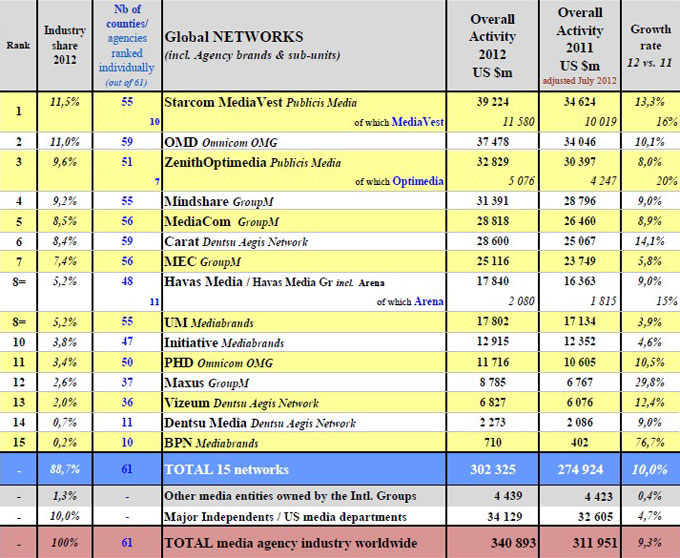
    Leading media agency research firm RECMA has released its Global Ranking 2012. While India-specific numbers are important, in a globalised order, the overall numbers are also noteworthy.


    A little background: since 1999, RECMA has been publishing annually the Global Billings Rankings report standing as the flagship report for the media agency industry. All major advertisers (media / procurement managers), consultants or media agencies use the global, regional or country rankings in their day-to-day business activities.


    This research is based on two metrics:

    1- the measurement of the buying billings based on the compilation of agency client lists with adjusted ad monitored spending allocated to each account

    2- the evaluation of non-measured media spending (or diversified services): a growing field which includes multiple areas from search to marketing strategy consulting.


    Five years ago, the sum of buying billings + specialized services (including digital) got RECMA to produce a new ranking based on the “Overall Activity” volumes. Hence, from now on, the report will be entitled “Overall Activity” – the term Billings (referring to buying media) being dropped.


    Notes a mail from the Paris-based founder Eudes Delafon and Olivier Gauthier, Partner, Director of Research and Sales Development Director: “Among the several improvements of this research, we paid a careful attention to the growth rates y-o-y to adjust the estimated Overall Activity volumes. This new point of analysis is now used as one of the 20 criteria in RECMA Qualitative Evaluations by country – a key benchmark for all industry professionals.


    Following the release of this report, we are updating the 50 country Qualitative Evaluations, starting with the Top 14 countries (to be available by the end of August). Details about the breakdown between buying Billings and Digital / Diversified services are not contained in this report. The Domestic reports as well as the Specialized Resources global report will provide data and analysis on this point.


    In the wake of the announcement that Publicis and Omnicom are merging, Recma has release a second table showing “how this historical deal overturns the hierarchy of the Groups of media networks”. Given the interest in the information, we place this table first.


    Industry shares 2012 in 6 regions
    following the creation of Publicis Omnicom group


    The Industry shares are calculated on the basis of the media agency Industry measured by RECMA.

    RECMA estimates Overall activity figure consisting in the aggregation of: buying billings (measured media spending) + non-measured spending (Digital & Diversified service).

    COMMENTS

    In Asia Pacific and in Others EMEA, the media arms of Publicis Omnicom group and WPP would hold a similar share.

    In Americas, Publicis Omnicom group would become a strong leader with a projected industry share of 41.6% versus 21.7% for WPP/GroupM.

    GroupM would remain the No 1 group in the Top 5 Europe markets, staying ahead of POG by four points.

    Finally, in the 14 countries (representing 75% of the media industry worldwide) the new POG media entity would weigh 36.8% of the industry against 27.1% for WPP/ GroupM: a 10-point gap.

    The three other groups, Dentsu Aegis Network, IPG/ Mediabrans and Havas Media-clearly stand a step behind.


    OVERALL ACTIVITY [BILLINGS] 2012 – Edition 13

    GLOBAL RANKING 2012 BY NETWORK


  • Group M & Optimystix join hands for MashUp

    By A Correspondent


    Group M and the Optimystix Entertainment-promoted O4 Digital Media announced a strategic alliance to create India’s first digital video-led Brand Solutions Company – MashUp. MashUp is a content led brand solutions company with a key focus on ‘video led sustained engagement’ for brands, billed as the ‘first of its kind’ in the Indian digital industry. Mash Up Brand Solutions will work with brands to connect with consumers on digital and social media platforms using customized and differentiated content to create rich engagement.


    With Mash Up, leading TV software company Optimystix Entertainment is now turning its focus to the rapidly growing online video space. And Group M, India’s leading media agency network, is extending its online offering to include strategic content solutions backed with metric and measurement.


    The Internet video consumption market in India is growing at a tremendous pace, with nearly 80% more video views in 2012 than 2011. The current market size in India is equal to 43 million + monthly unique viewers; 3.3 billion + monthly total video streams and approximately 19 billion minutes are spent watching videos online every month. To harness the potential of this untapped market, MashUp, with its expertise in understanding and engaging viewers will create “rich media video packages” and provide brands with additional effective touch points for sustained consumer engagement on social media platforms.


    CVL Srinivas

    Commenting on this development, CVL Srinivas, South Asia CEO at Group M, said, “Internet video consumption is expected to further increase six-fold by 2016. The Internet audience size is crossing the English-speaking audience size in our country and video has a larger role to play considering the formatcomprises a universal appeal. We see an untapped as well as cost-effective opportunity in this market for leading brands to engage with their consumers on a more personal level. Optimystix Entertainment is the leading premiumcontent creator and we are happy to combine our strengths to form MashUp.”


    Speaking about the venture, Sanjiv Sharma, CEO and Executive Chairman at Optimystix Entertainment India Pvt. Ltd. said, “India is the second-largest consumer of Online Videos.  Having produced TV Commercials for every leading brand in the country and producing highly successful Primetime TV Programming for all leading broadcasters, our DNA as company allows us to understand and service brand needs and create high quality video content at an industrial level.”


    The key focus for Mash Up will be to understand the brand needs in the social media space and to create a compelling digital engagement strategy using “rich video packages” to create and nourish this relationship with consumers.  Mash Up shall work with Group M clients as well as other players, and currently some of its clients include established brands such as Airtel, Ford, Mercedez Benz, Shoppers Stop, Streax, Citibank, Skoda, Gillette, etc.


  • Advertisers serious about backing comedy

    By Vijaya Rathore


    Laugh and the viewers -and advertisers – laugh with you. That’s a formula working like a charm for broadcasters who are riding on the increasing popularity of comedy programming.


    And with a record 151 million people watching comedy shows on Hindi general entertainment channels in the first 10 months of 2012 -as per data from TAM Media – marketers at Procter & Gamble, L’Oreal, Nokia, Samsung, M&M and Vodafone are jostling for ad spots on a variety of standups and sitcoms on Hindi, English and even regional entertainment channels.


    Popular shows like Comedy Circus now sell on a par with primetime soaps, pulling in as much as Rs 2.5 lakh for a 10-second spot. The year-old Comedy Central channel, which has 150 advertisers on board, is developing local content and is expanding its network beyond the top seven cities of the country.


    According to TAM data sourced from a broadcaster, the comedy genre was the second-largest contributor to ratings, after action/thrillers between week 49 and week 52 in six metros. Among English programmes, half of the top 10 shows were comedies in seven metros in this period.


    These include comedies like Everybody Loves Raymond, Last Man Standing and How I met your Mother.


    Reliance Broadcast Network, a part of the Anil Ambani-led Reliance Group, is working on producing Prime Nights, a stand-up comedy property. The company is currently engaged in discussions with sponsors. “We will do onground events and televise them in order to reach out to a larger audience,” says Tarun Katial, CEO, RBNL, which has a joint venture with BIG Studios. Says Abraham Koshy, professor at IIM-A: “The audience may enjoy seeing others’ sorrows on national TV, but such programmes may not be popular in terms of brand association. Brands prefer to associate with happiness.”


    “Every brand wants to get associated with comedy,” adds Rohit Gupta, president network sales, MSM India, which has channels like Sony Entertainment, SET Max and SAB TV in its bouquet.


    SAB TV is a Hindi channel focused entirely on comedy, and Sony TV has Comedy Circus, a reality-based stand-up comedy show that is one of its most popular programmes. Comedy Central, the English entertainment TV channel owned by Viacom18 Media, which completes a year this week, has done “exceptionally well”, according to business head Ferzad Palia. “The channel is expected to break even much ahead of the original business plan on the back of strong advertising and subscription revenues,” adds Mr Palia without sharing financial details.


    Endemol India, which was the one of the first production houses to bring in stand-up comedy shows on Indian television about eight years back, is experimenting with formats such as comedy panel game shows and sitcoms.


    “We plan to bring in new formats to India in line with the international markets that have popular comedy game shows and sitcoms. Talks are on with broadcasters,” says Deepak Dhar, chief executive, Endemol India, adding, “This is a staple diet for Indian audience.” Endemol boasts of shows such as Bigg Boss, Laughter Challenge, Fear Factor – Khatron Ke Khiladi, Jo Jeeta Wohi Super Star, Wipeout and Chottey Miyaan.


    Advertisers for their part have a sound reason for associating with the comedy genre.


    “When consumers are watching content in a good or happy state of mind, the message is clearly more effective. Comedy shows are often watched by families which helps a lot of brands get the message across in the right way to the right set of audience,” says Alok Bharadwaj, senior vice-president at Canon India. TAM data indicates that comedies are most popular with kids (between 4 and 14), the 15-24, 35-44 and 45-54 age brackets, which pretty much covers most of the Indian demographic.


    According to media planners, comedy attracts advertisers from automobile makers to financial services providers and from shampoo brands to telecom companies.


    According to Hiren Pandit, managing partner with media-buying agency Group M, brands that use the humour element in their advertising prefer to ride on comedy. “However, brands cannot survive purely on the back of one genre and should plan the media mix diligently,” he adds.


    Source:The Economic Times

    Copyright © 2013, Bennett, Coleman & Co. Ltd. All Rights Reserved


  • Advertisers crib as TRPs fall for Satyamev Jayate

    By Ratna Bhushan


    The truth isn’t quite triumphing – not at least in the way some advertisers on Aamir Khan’s hyped debut television reality show Satyamev Jayate thought it would. Television rating points (TRPs) have fallen short of expectations, say at least two marketing heads of associate sponsors, although publicly most advertisers are making the right noises. That, however, hasn’t stopped media buying firms, on behalf of advertisers, from pushing for result and performance-based ad rates on reality shows. They say that TRPs should decide the ad rates of reality shows instead of the channels charging advertisers fixed rates even before the show goes live.


    As per rating agency TAM’s data released by Star on June 13, Satyamev Jayate – which is being aired on Sunday mornings across nine channels of the Star Network (as well as on the state-owned Doordarshan) delivered a national TVR of 3.9. That’s lower than the ratings of blockbuster shows of the past like Kaun Banega Crorepati (Sony Entertainment) and Bigg Boss’ debut show (Colors).


    Navin Khemka, managing partner of media buying firm ZenithOptimedia, which represents consumer goods major Reckitt Benckiser, one of the associate sponsors of Satyamev Jayate said: “All the risk cannot be passed on to the advertiser. With high entry-level costs on reality shows, it is critical that channels take more accountability on the returns on investment.”


    Increasingly, agencies and clients will ask for certain minimum guarantees on programme performance and viewership, he added: “It has to be a win-win for both the brand and the show.”


    While Bharti Airtel coughed up a chunky Rs17-20 crore for the presenting sponsor slot, associate sponsors like Axis Bank, Reckitt Benckiser, Skoda, Coca-Cola and Johnson & Johnson paid Rs6-7 crore each for the 13-week show.


    Star has charged Rs8-10 lakh per 10 seconds for spot rates for Satyamev Jayate while spot rates for KBC were Rs 3.5-4 lakh per 10 seconds.


    According to the marketing head of an associate sponsor who did not wish to be quoted, returns on investment on the show could have been higher. “The way the show was sold to us, we expected higher ratings. It’s disappointing and we hope the ratings increase as the show progresses.”


    However, Bharat Bambawale, global brand director at Bharti Airtel, defended the investment: “To view the success of a show based only on television ratings would limit its overall value. The success of a show has to be looked at collectively and in a holistic way… the content of a show will impact ratings.” On whether broadcasters should rationalise ad rates on reality shows, Bambawale said: “It’s a matter of individual judgement for every sponsor.”


    Basabdutta Chowdhury, CEO of Platinum Media, a division of media buying firm Madison World, which buys media for Bharti Airtel, said: “Advertisers do want accountability and minimum guarantees factored in for reality shows in general, although Satyamev Jayate was not meant to be a mass ratings show.”


    On reality shows, deals are structured in a way that they cannot be re-negotiated through the entire program. This is unlike cricket where broadcasters keep at least some ad inventory – like the semi-finals and finals – open to negotiations based on the ratings.


    Ajit Varghese, MD, South Asia of Maxus, which is owned by the country’s largest media buying house Group M, said: “While there’s no standardised way of looking at a deal, we all are pushing for deals with a minimum guarantee. Of course, the arrangement should factor in an upside too, but overall ad deals should be linked to a programme’s performance.”


    Veteran ad man Santosh Desai is of the view that Satyamev Jayate needs to be evaluated not just by viewership but also for the impact it has. “It’s a difficult show to watch…. Some subjects don’t have a mass audience at all so to be watched week after week by masses will be a challenge.” KBC’s most recent season had opened to a rating of 5.24, and Bigg Boss Season 5 had opened to a TRP of 4.25. The Amitabh Bachchan-hosted KBC had managed ratings of over 4 all through its run.


    A Star India spokesperson says the show has delivered a reach of Rs40 crore over the first five episodes (including repeats). The launch episode delivered a TVR of 4.9 in Hindi-speaking markets and a 4.1 TVR all-India. Subsequently, all episodes have consistently delivered a 4+ rating in HSM and 3.5+ ratings at the all-India level.


    Kevin Vaz, Star India president, ad sales said: “Satyamev has ranked amongst the top few every week on an all-India level.”


    Source: The Economic Times

    Copyright © 2012, Bennett, Coleman & Co. Ltd. All Rights Reserved


  • Creative agencies have allowed themselves to be dumbed down: Vikram Sakhuja


    By Anil Thakraney


    Vikram Sakhuja heads GroupM, India’s largest media buying conglomerate. In a long and animated discussion, the ace number cruncher shares with us insights from the Indian media industry. As well as his own organization’s approach to the various challenges staring at the media business.


    Fifty-year-old Sakhuja is an IIT/IIM grad, and he did a number of years in marketing before he shifted to the world of media in 2001, when he signed up as Managing Director of Mindshare Fulcrum. During our meet, I could see that the outspoken GroupM boss is extremely passionate about his work, and is someone who could get easily agitated over provocative questions. Thankfully, we had a smooth run. Guess it’s all thanks to Yoga which Sakhuja has recently taken up. 🙂


    You were a hard-core marketing man at one point. What prompted the switch to media?

    I believe in taking the career as it goes, and taking decisions at different points of time. Let me take you through my career graph to explain this. After IIM, Calcutta, I was pretty clear I wanted to get into the marketing side of things. So I joined P&G and did eight years there. When I joined them, Richardson Hindustan Limited (RHL) was becoming Procter & Gamble (P&G). So when I started out, the company had RHL values and very quickly the organization got Procterised.


    And you were not happy with that?

    I was happy with that, but Procter believed in the system of specialization. So the guy who gets into sales, stays in sales. The guy who gets into advertising, sticks to advertising. I was in research and they extended that to marketing services. I learnt a lot there, but later on I wanted to move to brand management and P&G wasn’t allowing me that. And I didn’t want my epitaph to read ‘Marketing Researcher’. So I moved to Coca-Cola which was more flexible in these areas. Out there I managed the entire brand portfolio. That worked very well for 5 years. I was reporting to Sanjeev Gupta in those days, and he was handling both, marketing and bottling. And later he went on to take up a bigger job. So they got Shripad (Nadkarni) to head marketing, and I felt my job would get undermined a little bit. And so I left to join Star TV.


    And you lasted there for just one year.

    It was a mistake. I call it jawaani ki bhool. Peter (Mukerjea) said they wanted to start a strategic marketing function there, and it would include marketing of the creative product as well as on-air marketing, which is where the bulk of the spending goes. But it didn’t pan out like that because the programming department had a territorial interest in the programming piece. So it became very clear to me this was going to be an off-air game, and that didn’t have too many legs. And I left Star without a job. Later, Ranjan Kapur introduced me to Andre Nair (this is year 2001) who was looking for people to start Mindshare in India. We had a drink and one thing led to another. I felt a little trepidation in the beginning because I perceived ad agencies to be a little unprofessional. But later I thought about it rationally and it made sense. And so here I am.


    There are large media shops under the GroupM umbrella. How do you manage to give personal attention to each one?

    I am running GroupM, I am not running Mindshare or Maxus. There are capable people running those. I am a management by objectives kind of a person. One aspect of my deliverable is Profit & Loss, there’s no getting away from it. I have told my guys we should get growth from our existing clients. We should have the source credibility to go to them and manage 100% of their marketing investments. That is the agenda I drive. Then, I have to create an eco system for technology, talent and on how to do things better. The scope of service has actually dumbed down, clients are paying peanuts and they are getting monkeys. So I go and tell my clients if they want the right kind of talent and want to get the value out of it, then this is how it works.


    I suppose you operate more as a coach than as a player.

    Do I meet clients? Yes, I do. Am I directly involved in the day to day plans? No, I am not. Unilever is our biggest client. So every year at least one or two deals I will sit in on. Also for other clients. I love to be there for the sheer passion of it.


    What is Sir Martin Sorrell’s brief to you?

    Martin is pretty hands-on in most of the businesses. I rely on him more for counsel. I whet my new plans with him. For example, I went to him with the idea of celeb endorsements. And he felt it wouldn’t work, but asked us to try it anyway. And it didn’t work. Then there was a time we were offered some sweat equity in the IPL Deccan Chargers team. I took it up to Martin and he didn’t think it was a good idea, because he didn’t know the nature of the animal. But he’s brilliant, he is one of the few guys who understands our business, he wants to get in deeper.


    What is your stand on the shift from the commission system to the fixed fee system for media agencies?

    I definitely support the fee system. Though I would prefer a balance of commission and fee. Because in a growing economy you win with commissions. But when spends are not looking good at all, as is the case this year, fee bails you out. In principle, however, I like the fee system.


    How are the clients reacting to it?

    The people who take their marketing seriously believe in the fee system in letter and spirit. The top notch companies like Unilever, Ford, Pepsi, etc, totally get this. I believe clients should pay us Cost + for service, and a factor of that for the value we are able to demonstrate.


    What qualities do you look for in a media buyer in today’s time?

    You must understand that in our organization we don’t just buy media. I would like to believe that our agencies are actually driving the marketing agenda, probably more than the creative agencies. Most of the creative agencies have allowed themselves to be dumbed down, most of them are only interpreting briefs in a TV commercial format. They are only driven by the tactical creative idea rather than a long term view of the brand. All these wonderful creative minds should spend a little time thinking brand stewardship. Out here, we want people who can think account planning and communications. People who can understand the brand, the consumer, and then have the ability to unlock all the media solutions. So the media person needs to understand content, activation, digital, conventional media, and then he has to see how all this comes together.


    Key challenges ahead for media agencies?

    The clichéd one of course is that the commissions we earn are not allowing us to invest in the best talent. But we have to all individually work ourselves, show value and then ask for stuff. The other challenge is in the digital space. The erstwhile DNA of the media companies excluded digital. I believe integrated media planning is the way to go. This is distinct from multimedia planning, which had the TV plan, print plan, radio plan, etc, all working in silos. But with the increasingly multi media environment, the key is integrated planning. And digital is allowing that seamlessness even more. We have embraced this some time back.


    And yet, the media buying business, after the unbundling, has got totally commoditized. Shashi Sinha said to me the media planner has become a zombie.

    I was the first guy to bring the AOR into the country. So you can blame me for the disintegration of the full service agency. (Laughs) I would say each of our agencies has its own planning way. Maxus has something called ‘Relationship Media’, MEC has got ‘Navigator’, and so on. Each of them talks the consumer journey. They talk much more about the communication challenge. I am actually finding the plans looking more different now than they were earlier. So I disagree with my dear friend Shashi Sinha. Maybe I am not cynical. The planner is alive and kicking. It’s in fact the most exciting time to be in the media because of the large amount of fragmentation and the large amount of media choices.


    You did a stint with television. Do you foresee threats to this medium in the near future?

    Yes. The problem with TV today is that it has become a media game of the value of the inventory. At the end of the day, there are only about four million commercial GRPs being broadcast every year at an all India level. And that’s growing at 2 or 3% per year. This is the market for TV eyeballs. So like it or not, you have to extract value out of this. Today, at last count, we have 500 or 600 channels, and it’s getting fragmented. If an Imagine TV dies, someone else will pick up ratings. And if someone else launches, there’s further fragmentation. So the problem is that the same money is chasing some eyeballs. Until the new ratings system comes up and there’s a tectonic shift, you are talking about a metastable equilibrium. Now if the value has to go up, either you have to deliver more reach, or you have to deliver some associated imagery or sponsorships or incremental value.


    When do you expect the shake-out to happen in television?

    We’ve been expecting a shake-out since 1996. I guess some people seem to be having deeper pockets. I am not a finance guy so I don’t know how it works. But I can’t imagine many of them are making money.


    Think the IPL is losing some of its sheen?

    No. The ratings this year were a tad higher than the last year. But for all practical purposes, have held on to last year’s levels. It has stabilized at about 5 rating points. In fact, this year was the best year primarily because of the games, which went down to the wire.


    And it’s a good investment for team owners?

    For them it’s going to be a slow burn. You have do it sensibly, like the KKR franchise does, and I think they make money. Whereas a large number of other people don’t make money. It’s about how you manage the entire franchise.


    There’s a perception that you guys are not passing on bulk rates you get from the media to your clients.

    We have something called the WPP Compliance. And we take it very, very seriously. So we are making sure that we do everything as per our contract with each client. In letter and spirit. We are definitely not holding back anything which is due to a client. We have a media owner invoice and it’s backed by an agency invoice. If the clients want to audit us, they are most welcome to do so. We are a global leader in this space doing global deals, we won’t mess around with something where there’s a breach of trust involved. We can’t afford that.


    Perhaps this was one of the reasons Reckitt Benckiser came up with the idea of agencies paying to pitch, and compensating them in case of a drop in ratings.

    They invited us to pitch and we asked them if they were being ridiculous. We turned them down. If somebody has an obscene point of view, I cannot subscribe to it.


    And yet, some agencies pitched for that account. Isn’t the industry united in these things?

    I thought we were united on that but obviously we weren’t. What do I say now?


    You’ve done many years in this business. Ever thought of starting out on your own?

    The thought has crossed my mind but I didn’t pursue it. I am not a very entrepreneurial guy. My philosophy is: Don’t fix it unless it’s broken.


    Does the lack of adequate talent in the media industry frustrate you? Is it a constant battle to find the right people?

    Yes, it is. But we have to be able to pay right to get the right talent. And for that we have to work our own internal financial structures. The level at which we work, there’s only so much we can afford to pay people at the entry level.


    Is there corruption in this business? There are allegations of planners taking money and other favours.

    One hears about these things from time to time. There is an opportunity for something like this, and clearly we have to plug it. This is where I believe organization culture is very important. If conversations in an organization involving integrity are strong, then the one or two people who entertain these thoughts will find themselves in a very uncomfortable situation.


    Have you ever fired people from your company because of this?

    Oh yes, I have.


    I saw a Youtube video of yours where you mention something about getting stressed out at work.

    I tend to be very animated and passionate, and I do get worked up. But I have been doing Yoga and stuff like that. And that’s helped. I have also started taking it a bit easier now, we have a good team. And at the end of the day, tension lene ka nahin, dene ka! (Laughs.)




  • No (or low) ads on HD. Anybody complaining?


    By Meghna Sharma


    While there is no denying the importance of advertisements in a world where subscribers are unwilling to pay subscription fee for channels, there exist many viewers who are tired of innumerable ads interrupting their favourite soaps or sporting. The good news for them is that their ordeal has been put to an end through HD channels. At least for the moment


    With various broadcasters launching HD variations of their channels, many upper-end subscribers are shifting to HD set-up boxes or subscribing to an HD channel. However, as there are no free lunches in the world, these channels come at a premium.


    What media planners think?

    Most media planners feel that since HD channels come with a certain cost attached to them, it is but obvious that they cater to a limited audience.  So, most channels are aware of it and their target group.


    Anita Nayyar

    Talking about the HD channels’ reach, Anita Nayyar, director (customer strategy), BCCL, agrees that not many avail of the facility. However, with digitization being made compulsory, especially in the four metros things might change. “Unlike the West, inIndia a broadcasters make most of their money through advertisements, and not distribution. So, if HD channels reach only a certain section, then how will a channel make its revenue?”


    Ms Nayyar added: “Today, one might pay a premium cost to watch an ad-free telecast, but in the near future, if availability doesn’t increase then channels won’t have an option but to make exception to the rule. They will be forced to show advertisements; however, they might charge a higher cost or have a limited time slot.


    On the other hand, Hiren Pandit, managing partner of Group M, felt that broadcasters with HD channels aren’t feeling the pinch, since they want to cater to a different audience: “Apart from the top-notch TG, most broadcasters have non-HD channels as well, so they capitalize through them. And over a certain period of time, they’ll be able to cut losses.”


    Agreeing with Ms Nayyar and Mr Pandit, Janardhan Pandey added: “It’s not just about reach or money, there is another reason which plays an important part in making HD channels a hit and that’s viewers’ psyche.  A person who might be able to afford HD package might still go for cheaper option because he/she might feel why pay more when the same can be watched at a lesser cost. For them, a few advertisements don’t matter.”


    Marketers’ foresight

    A brand reaches its target audience through advertisements and in today’s time one can reach a cross-section of society through television. Hence, most marketers spend their most of their ad-revenue on TV.


    Karthi Marshan

    Karthi Marshan, EVP & Head Group Marketing, Kotak Mahindra Bank said: “Our estimate is that of the 136mn cable and satellite homes in India, 44mn are DTH. Of these, about 8 lakh are currently HD subscribers. That is less than 2% of DTH homes and a tad over 0.5% of all C&S homes. Now whether this affects a marketer or not depends on who is her core TG. For the average brand with SEC A & B as their TG this probably does not matter much, but yes, premium and super premium brands do stand to miss out on what could be core TG due to the fact that some of the HD channels still don’t run advertising.”


    He added: “The next question that marketers will have to contend with is broadcasters expecting to be paid separately or additionally for these audiences. While brands will make the argument that we have bought programs or channel presences and hence our ads should carry seamlessly to HD as well, broadcasters may well have a tenable argument to the effect that they are in the audience delivery business, and a premium audience can and should command a premium for access.”


    Similarly, Ashutosh Tiwary, EVP- Strategic Marketing, Godrej, feels that one needs to observe the situation over a period of time to know what will happen next: “If the ratings and numbers of non-HD channels on which the media deals are based, get affected due to HD feeds, then HD channels will probably will have to air the ads to make up. However, if HD numbers prove to be totally incremental, then the converse might hold true. Overall, if viewer retention and engagement goes up due to higher quality and reduced clutter, HD might require specific treatment.”


    While Simeran Bhasin, marketing head, Fastrack and new brands at Titan said that as a consumer she loves to watch her favourite programmes on ad-free HD channels, but as marketer she’ll have to look for other methods to reach the TG. “HD is here to stay and marketers will have to figure out ways to reach out their consumers. Because with technology available everywhere, one can easily switch-off their TV sets to watch something online which is accessible without any interruptions. So, marketers will have to sooner or later adapt to survive.”


    Vipin Mehra, former sales head, Pidilite, said: “It’s very important for any brand to send constant reminders to its TG about its existence, especially in today’s competitive market. So, brands will prefer a channel which will help them in doing so.”


    Keeping their fingers crossed

    Creative people on the other hand aren’t very happy with HD channels as they affect their work/business, but feel that things will change for good.


    KS Chakravarthy, director, DraftFCB Ulka, felt that though one might want to enjoy an ad-free telecast, it’s just a passing phase because channels have to make revenue which comes from advertisements. KV Sridhar, National Creative Director at Leo Burnett, too agreed with Mr Chakravarthy, adding: “When and as HD channels availability increases, broadcasters might be forced to start showcasing advertisements as well.”


    Who’ll be the ‘real’ beneficiary?

    Advertisements or not advertisements, broadcasters have to follow a business plan and many feel that they’ll have to succumb to it. “One or two networks have begun taking a smattering of ads, and this will only grow, I am guessing,” said Mr Marshan. A business is run on revenue and if it cannot be generated, then changes have to be made. However, for the time being, the viewer can enjoy an ad-free programme.

    One will just have to wait and watch.


  • Digital is the way to go, but…


    By Robin Thomas


    Consumers in India are evolving rapidly from print and radio to television and now digital. Just when you thought that digital was all about display advertising, bulk SMS, search, email advertising and online classifieds, in came the social media, video advertising, smart phones, tablets, apps, mobile advertising and so on.


    According to industry estimates there are 120 million internet users in India today, of which almost 30 per cent are from small towns. While India’s broadband internet penetration is still low, it is believed that the next phase of growth in internet will come from mobile users which are estimated to be over 800 million.


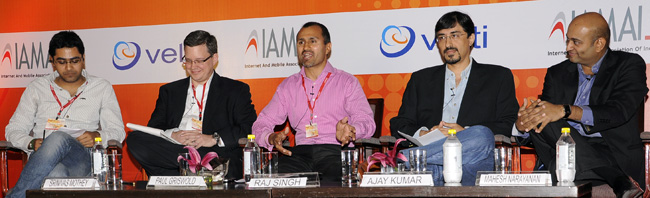
    As more and more youngsters gain access to various digital platforms, there is a greater need for marketers to not only engage the young consumers, but they must also be able to give them a unique experience across the digital platforms. The IAMAI (Internet And Mobile Association of India), which held its 8th Marketing Conclave, 2012 – ‘Digital Marketing 3.0’ on April 13 in Mumbai, extensively discussed the role of social media, video advertising and mobile advertising in the near future.


    Using Social Media:

    Today most companies have multiple social networking sites – Facebook, Twiter, LinkedIn and others. There are separate teams handling social media marketing for the company, but, are brands listening to their consumers? Do they interact and respond to queries and complaints? Do marketers understand the social media and know how to monetize it? Or are brands simply satisfied with the number of ‘Likes’ and views they generate on their social networking sites?


    Karthik Nagarajan, National Director, Social and Insights, Group M was of the view that unless one is not ready and mature enough as an organisation for the medium, the organization must stay away from social media.


    According to Usha Sangwan, Executive Director, LIC India, what brands lack today is the courage to be transparent, they don’t respond to negative feedback and fail to turn the customer as an advocate of their product. “Brands must not see social media as a mere marketing tool and limit to generating numbers alone, but social media must be used mainly for connecting with the TG and co-creating the product. Brands must try and understand their TG and become a part of their customer’s day to day life.”


    Virginia Sharma, Chief Marketing Officer, IBM India hit the nail on the head by stating that brands must have the ability to admit their mistake and apologise to the customer. She admitted that while there is a certain amount of fear among brands to apologise for a mistake committed because it may lead to negative public opinion, but felt it is always better to apologise and rectify the mistake which could lead customers to becoming an advocate of the brand.


    Vinay Bhatia, Customer Care Associate and Vice President Marketing and Loyalty, Shoppers Stop added that it a company’s reputation is harmed only when it fails to act responsibly to a complaint made, and not when it apologises for a mistake and tries to rectify it. “The problem with the companies today is that they make policies as if the consumer is a criminal. Accepting a feedback and acting upon it will not harm the brand but, if one chooses to remain silent about a complaint, that’s the worst one can do to his brand.”


    Leveraging Mobile Advertising:

    Besides the social media, mobile advertising is another challenge faced by marketers who have more or less failed to leverage the small screen. Sadly, mobile advertising is largely limited to only SMSes. Marketers are said to often mistake mobile as an extension of broadband internet and as a result they fail to give their consumers a unique experience on mobile.


    Speaking from a marketer’s point of view, Ajay Kakar, CMO, Financial Services, Aditya Birla Group stated that although the potential for mobile advertising is high, there is still a section of people who have not seen the mobile as an opportunity. He added that mobile industry must follow the ‘Jo dikhta hain, wahi bikhta hain’ policy and evangalise the benefits of mobile advertising. “Content is very important, don’t tells me about your brand, but tell me what’s in it for me? Give me the case study of successful mobile advertising. What I want to know is how much money mobile advertising is making for my brand and for my business? What you must do is to stop saying ‘buy me, buy me’ but, instead tell me ‘why me, why me’?”


    With the introduction of 3G and now 4G services, mobile internet is expected to be faster and with high quality content, better mobile applications, much better video and much more. In addition to these, smart phones and tablets are also said to play important roles in the growth of mobile internet in India.


    Mahesh Narayanan, Country Head-Mobile, GoogleIndiasaid that there is not only lack of understanding about mobile advertising, but also lack of discussion about mobile as a medium in board room meetings. “The consumer shift is already happening from traditional media to mobile; however, great amount of content for mobile is yet to be created. People are looking for your brand on their mobile phones but, ironically brands are absent on mobile.”


    While mobile subscribers will continue to grow and more people will access internet through their mobile phones, the challenge lies in monetizing the medium and to find newer ways to reach out to consumers besides SMS advertising.


    Paul Griswold, Director Product Management, Mobile Marketing, Velti was of the view that mobile is not treated as an integrated part of marketing strategy, but is seen as an extension to online. “There has been a failure to take the advantage of the one on one interactivity mobile offers and just sending SMS is definitely not the way.”


    The participants outlined not only the problems but also possible solutions. According to Srinivas Mothey, Head Mobile Marketing and Advertising, One97, the first step is to educate advertisers and agencies about the benefits of mobile advertising. Although every advertiser may have a different view about the medium, nevertheless they need to be encouraged to invest in mobile. “We are also encouraging advertisers to create mobile assets and not just mobile apps. We are beginning to see the positive results but, in order to see more results, it may take some more, but the first step needs to be taken.”


    Video Marketing:

    Video advertising/ marketing is not a new phenomenon for marketers. Traditionally, marketers are said to be comfortable with video and we have been seeing that on television, and will probably see the same, and in a much bigger way, online and on mobile in the near future.


    According to Debadutta Upadhyaya, Vice President, Vdopia Media, there has been over 50 per cent growth in video consumption in the last one year alone, the fourth largest globally. “Unlike other countries,Indiahas made the leap from web to email to social media and now video. There is still a long way to go on the creative aspect because the primary advertising medium of a creative agency has always been television, so creativity in video advertising is bound to take some time.”


    As India’s broadband penetration and mobile internet accessibility increases, it would be just a matter of time when video marketing would explode inIndia. Besides online, with 3G and 4G services, video consumption on mobile should be an altogether different experience for users and marketers.


    But Shubhranshu Singh, Marketing Director-IndiaandSouth Asia, Visa cautioned: “There is a difference between video on web and video on mobile, and the difference between the two is galloping ahead in terms of content. Perhaps the youngest audience in our country today will watch television online for the first time which could be an opportunity or a threat if we are not ready for it.”


    Digital marketing in itself has become 360 degree for marketers. It has gone beyond display and banner advertising, to becoming more interactive and innovative to reach out to consumers. Digital marketing, as the industry players pointed out, is in a transition phase from web, to email and now brands are trying to reach out to their customers through social media, mobile and video.


    Marketers must stop considering mobile internet as an extension to online and, therefore, give mobile users unique experience of mobile advertising. Social media must not be seen as a mere marketing but, a medium to interact with their consumers, know their behavior and be a part of their day to day life.


    Brands must be receptive to both positive and negative feedback of customers, admit to their mistakes, apologise to the customer and rectify the fault. Digital marketing will undoubtedly grow but, marketers must first be evangalised not only about the benefits of the medium but, also ways and means to leverage it.

    Imaging: Rafiq