Tag: GECs

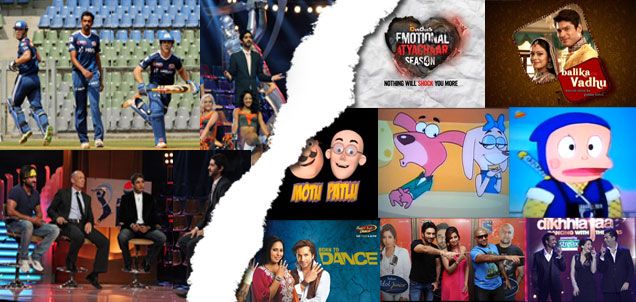
  • IPL vs Drama: Who will win this match?


    By Meghna Sharma


    Since its inception, the cricket Indian Premiere League (IPL) has been in the news – sometimes in the best of ways but often for all the bad reasons, but this hasn’t made any difference to the cricket-crazy country. When the almost-two-month-long tournament starts, there is very little else that occupies top of mind for the Indian public.


    For television channels, it is an extra busy time. In addition to their own one-upmanship battles, they also have to step up programming to beat the IPL’s popularity.


    Most channels, especially English entertainment, try to woo audiences with special packages. For instance, Zee Studio started it early with its package – Powerplay 2.0, which aimed at its male TG through action movies and lasts till the end of the month. “Cricket being a religion in this country, the idea is not to counter IPL but to create a property that viewers can move on to post the matches,” says the channel spokesperson.


    Prashaant Bhatt

    According to the recent data, IPL has impacted ratings, especially that of GECs. And with around 10 days left of the extravaganza, what can or should a channel do to boost its ratings during the yearly event? “IPL is one of the biggest events on television. And it does have an impact on all entertainment channels but beyond a point, since because both have different sets of audiences, the impact varies,” says Prashaant Bhatt, Weekday Programming Head, Colors.


    The channel, however, says that their launches and highpoints are thought through months in advance, keeping in mind the audience viewing preferences and content requirements of the channel. “This year as well, we planned our strategy accordingly and now we have four of our shows in the top 10, which is a testament to the fact that we are going about it the right way with our plans. We reckon that there is a loyal audience for cricket just as GECs, and don’t see a huge overlap of the two. Moreover, if the content and concept of the show is strong, the audiences will continue to watch their favourite shows over IPL.”


    Having said that, one can easily see that most of them do make certain efforts to make sure that they don’t lose out viewers by showing either maha-episodes or blockbuster movies. Many GECs even wait till the event to finish before they can launch their shows. Jhalak Dikhla Ja, Indian Idol Junior and Dance India Dance are some.


    On the other hand, for youth entertainment channels like Comedy Centeral or MTV, UTV Bindaas, the IPL doesn’t matter as most show re-runs of their popular shows during that time slots. Indrajit Ray, Director, Content, DisneyUTV says, “Despite IPL, our channel’s ratings have grown. The genre usually doesn’t get affected by IPL because of the content it showcases. Youth will consume it irrespective of whether IPL is there or not.”


    And since cricket cuts through age, are children’s channels wary too? “April, May and June are very important months for the entire category thanks to the kids being on vacations. Over the years we have noticed that IPL has a minimal impact on the category with 5-10 percent deviation. Since it is summer vacation time, we at Nick have a content and marketing strategy that will ensure that kids stick continuously on the channel with the least amount of outage. We will put our best foot forward with our frontrunners Ninja Hattori, Motu Patlu, Keymon Ache and Pakdam Pakdai. Apart from the new shows/seasons there will also be a lot of interactivity through contests like ‘Party with Ninja’ to keep the kids engaged beyond TV,” says Mr Ray.


  • MxM Mondays: Are general entertainment channels turning social activists?


    Television reflects society and social trends, and hence, a look at TV programmes over the years shows that channels have, from time to time, taken up social issues and woven stories around serious themes. From the era of Doordarshan to today, soaps like Hum Log, Rajni to Balika Vadhu, and reality shows like Satyamev Jayate, to name some, have tackled issues which need people’s attention. And recently, the trend has increased as many issues like female foeticide, surrogacy etc are being shown on primetime.

    So, does this mean that the general entertainment channels (GECs) have taken up the role of social activists or is it just another bid to garner more eyeballs? What role does a channel/broadcaster play while showing such issues? MxMIndia spoke to a few experts and industry people…


    Dr B Manjula, associate professor, School of Media and Cultural Studies, Tata InsISS:

    Intially when television was launched in the country, its main role was to educated and enlighten people. Doordarshan showcased not only documentaries but also shows dealing with social issues. With a high rate of illteracy in the country, television was seen as a great option to bring about a change. However, with privatisation and coming in of cable TV, things changed. Media became more of a business than a medium to bring about that change. Broadcasters now are more worried about ratings and gaining popularity among its audience. However, in the past few years, GECs are showcasing serials which have taken a bend towards social issues. But there are two things one needs to keep in mind:


    1. How aware are they of the issue itself? Many a times, shows /channels are not aware of issue but only touch it on a peripheral level. Proper and thorough research needs to be done so that not only can shows get an in-depth meaning into their storyline but also help in bringing about a change in people’s mindsets and important points aren’t lost in translation.


    2. What is channel more interested in – TRPs or change? Not only channels but many companies too aren’t clear about the two. Corporate social responsibility isn’t about just doing something once in a while but to bring about a change at grass-root level. There is a gap between an idea and what is practiced. An idea might be good but unless and until, it is shown properly, it will be lost. The bridge between the two needs to be filled.


    I feel that broadcasters shouldn’t forget that there is still a high rate of illiteracy (around 40%) in the country; hence, for them television is the ‘world’. Therefore, they need to be credible and responsible too instead of just focusing on money making.


    Ajay Bhalwankar, Content Head (Hindi GECs), Zee Entertainment:

    That’s been the trend even from the days of Doordarshan. Social issues like discrimination against skin colour, education of the girl child, female foeticide, remarriage, child abuse and surrogacy, etc., are common on primetime shows. They highlight a reality prevalent in society and it gets an instant connect with lakhs of viewers…


    We have always handled any social issue very sensitively and showcased the ‘Umeed’ aspect to edutain viewers on how to get rigid customs and views out of their minds and work towards a happier and progressive society. However, GECs do not want to be social activists but are definitely instrumental in spreading the message or creating awareness about a pertinent social cause. The primary purpose of any GEC is to entertain people. I would like to add that Zee TV has a multi-genre offering and is living up to its image of being a socially conscious channel. With path breaking shows like Hasne aur Hasane Ka Tonic Ladies Special, Agle Janam Mohe Bitiya Hi Kijo, Aapki Antara, Pavitra Rishta, Shree, Maayka, Punarvivaah, Phir Subah Hogi, Sa Re Ga Ma Pa and Dance India Dance, the channel has established icons such as Laali, Archana, Antara, Lakshmi, Aarti and Sugni who have entertained audiences at the same time addressed socially relevant issues like autism, child trafficking and remarriage to name a few. So, it won’t be wrong to say that, it has helped in educating the audience. It has also helped in changing perceptions. For instance, parents encouraged their kids to take up dance as a serious career option in India after watching ‘Dance India Dance.’ Punarvivaah, our primetime show on remarriage, has received tremendous positive feedback. Lakhs of people across the world have written into us sharing their stories and how they’ve changed their mindsets to allow their family and friends find happiness a second time around.


    Yes, we would all like our shows to have maximum eyeballs but there has to be honesty in showcasing any concept. And not all shows with social causes are successful… that the industry attempts such stories to entertain and edutain viewers in India is good! Change is slow and a constant around us…Our primary objective is to entertain and if in the process, awareness, positivity, happier families and relations are built, we are doubly pleased.


    Prashaant Bhatt, Weekday Programming Head – Colors:

    GECs are not taking up the role of social activitss, but just presenting shows that have a context and relevance. If by bringing socially relevant content, we are successful in initiating a social change, we consider our message delivered. Television, today, is more than a medium of entertainment; it’s a mouthpiece for the common man to put his views across. By introducing content that has a social impact, we are doing our bit in raising not only awareness but also extending a platform for discussion.


    As a channel, we believe in variety entertainment and offering an experience that is educative and enriching. With this added in our bouquet of programming, we are catering to the different entertainment options of the audiences. It does have an impact on the common man who watches these shows regularly. One case example being a Rajasthani girl named Lakshmi Sangara, who was married off to a much elderly man at a young age. She, aided by her lawyer, succeeded in getting a divorce from her husband after watching Balika Vadhu and realizing that child marriage is an offence. This is our success, if this is the result and the power of a show then we are not looking at chasing numbers but rather making a real difference. It is a challenge for the channel to portray such strong situations in a socially acceptable manner. For us, it is not just about portraying the issue, but being a General Entertainment Channel, we need to craft storylines that are appealing and accepted by the audiences. By using content to set the context for prevalent issues, we are making an attempt to bring about a change in society and the prevailing mindset. And living in a democratic country, it is highly essential to euphemize these issues and present them to the viewers to make their choices.


    Samir Khanna, EVP and Head, DDB MudraMax Media:

    We need to make the differentiation when we say that GECs are taking up the role of social activists; that is, break up GECs into two verticals: fictional and non-fictional shows. When we talk of fictional shows, there are issues in these serials that agitate the mind of the audience today with the everyday issues such as dowry, corruption, rape etc which are seamed into the storyline. Now because it agitates the mind of the audience, the viewer gets absorbed into the episode or the episodes of the fictional show. I don’t think, in the fictional shows, they are trying to be the activists. At the end of it all, the aim of fictional show is essentially to sell it to the advertising and marketing fraternity, and to grab eyeballs. Being an activist in a fictional show is difficult since the show follows the storyline with the characters into it. Usually, what they do is plug a sub-story into the show and then they carry it forward. The moment you try to talk too much about it, the show becomes preachy, which people wouldn’t like. It is all about eyeballs.


    But the moment you talk of non-fiction shows, like Satyamev Jayate, on the GECs, they not only talk but debate about societal issues and also try to come up with advice. There is this non-fictional weekend show, ‘Zindagi ki Haqeekat se Aamna Saamna’, wherein you have a courtroom set up and the show tries to come up solutions for the fighting family members. There are non-fictional shows that do come up with solutions and advice.

     

  • Does anyone care about GEC GRPs see-sawing?


    By Meghna Sharma


    The battle of the Hindi general entertainment channels has intensified in the past few months. With most of them showing new seasons of popular shows like Kaun Banega Crorepati, Jhalak Dikhla Jaa, Dance India Dance etc, the competition has not only increased between the channels but also viewers – who wants to watch what?


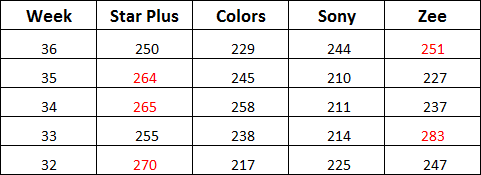
    If the TAM ratings of the past few weeks are studied, it becomes very clear that there is no sure-shot contender for the numero uno position. The weekend which saw the first episode of KBC on Sony made the channel numero uno for the weekend slot. However, overall ratings for week 36 saw Zee in the top slot. Week 35, saw Star Plus in the top place whereas for week 33, it was Zee at number one position.


    The yo-yoing has been going on for sometime now, so who gets affected by this – channels, media planners or advertisers? Or don’t the weekly ratings matter much? MxMIndia spoke to a few media planners/buyers and advertisers to get their perspective on it and to find a few answers.


    According to Anita Nayyar, CEO, India and Southeast Asia, Havas Media, in the GEC space there are four top channels – Star Plus, Sony, Zee and Colors – and their ratings keep fluctuating among themselves, which isn’t a recent phenomenon. “One week, one channel is peaking so the other week it’s another channel’s chance. Also, there isn’t much difference between their GRPs; it’s a matter of only a few numbers that they fall short of each other in the race. Therefore, it’s nothing alarming even for the clients who follow the GRPs to the T. However, we do keep in mind the trends and what gets the eyeballs to the channel. For instance, KBC taking Sony to number slot was expected. One needs to keep such issues in mind and plan accordingly.”
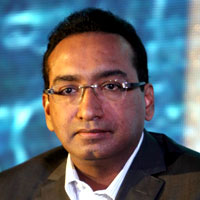
     

    Agreeing with Ms Nayyar, Hiren Pandit, managing partner, GroupM adds that one needs to keep in mind what is the programming mix of different channels. With KBC opening with 6.1 TVR, Sony was bound to reach the top slot. Therefore, one needs to track the new big shows coming up and how they’ll fare rather than worrying about channel shares which keeps see-sawing because of these shows. As for advertisers, they too focus more on shows and its performance rather than channels. Hence, such yo-yoing shouldn’t bother anyone unless it’s a drastic one.


    “I don’t think anyone takes these weekly GRPs of GECs into account; therefore, such weekly see-sawing shouldn’t matter. If one looks at various channels, you’ll see that most of them have reality shows or special episodes or Grand finale etc as their strategy to drive channel GRPs especially on the weekend. Hence, a media planner or buyer doesn’t get affected by it as most of the deals are separate for these (channel driver) reality shows and separate for rest of channel (regular) programs. And to advertisers what matters is the consistent deliveries through regular shows and not these few spike on select shows,” adds Neelkamal Sharma, COO – Buying, Madison Group.


    However, the advertisers feel a little different as GECs which have a vast reach in the country are seen by the advertisers as the best way to reach out to their audiences and brands spend millions to use the visibility given by these channels.


    Kamal Nandi, vice-president (sales & marketing) of Godrej & Boyce Manufacturing explains that as a brand, for them the two things that matter the most are efficiency and effectiveness. “Therefore, as advertisers on these GECs, we do look at cost and ratings points as the two most critical evaluating parameters. Hence, such fluctuations do effect our decisions as we monitor them closely.”


    Similarly, Mayank Shah, Group Product Manager, Parle Products says, “The content of every show on every channel varies. Despite the fluctuations, there are certain properties that continue to be at the top. These shows provide great opportunities for advertisers. However, strategies keep changing. So we do keep these fluctuations in our mind and alter the strategy as and when required. Advertising strategies are based on the kind of viewership a channel has. If a product matches with the channel’s target group, then advertisers will continue to advertise on that channel because the reach is effective. Also, there are various aspects to consider while choosing channels. Hence, the positioning is an important criteria, but not the sole criteria.”


    Hence, one thing is clear, that weekly ratings of GECs might not be considered as the sole criteria by planners or advertisers as much a monthly or the performance of the show in general. But they do matter when it comes to brands spending on GECs to reach their desired audience.


  • I am shocked and disappointed: Sameer Nair

    By Anil Thakraney


    Sameer Nair, whose baby Imagine channel was, is quite surprised by its sudden demise. Mr Nair founded Imagine in 2007 in partnership with NDTV, and ran it for four years. He quit last year after Turner bought the channel from NDTV.


    Speaking to MxMIndia, he said: “I am quite shocked and disappointed to hear that they’ve decided to shut the channel down. They (Turner) seemed to be quite gung ho about Imagine, and I thought they were going full steam ahead. There is a lot of investment and a number of jobs at stake.”


    When asked what in his view may have gone wrong with Imagine, Mr Nair said GECs is a very difficult segment and it needs deep pockets and a determination to go the long haul. And that he thought Turner had the muscle power to go the distance. Talking about his own stint at the channel, he said: “We had some successes and some failures. It was a tough market, we faced economic difficulties. And GECs is a tough space to be in, it’s a very competitive category. We were the first to re-create the Ramayana and we launched ‘Rakhi Ka Swayamwar’, a show like that had never been done before. I think we did some good work.”


    And what were the reasons behind his own departure from the channel? Mr Nair’s response is pretty frank. “I was used to operating independently. After Turner took over, one had to integrate into the Turner system. And this made me just a department head. And so I left.”


    Mr Nair says he’s currently working on some exciting projects but will reveal details once it all falls into place.


  • @FF12: Niche isn’t niche any more


    By Rishi Vora


    It is a fact that Hindi GECs command a premium position in the TV space in India and the primary reason behind that is its mass appeal. And thereforea lot of advertiser interest tends to go in favour of the so-called mass channels.


    But there is another set of audiences that prefer a certain kind of content – speciality content such as Action, Comedy, Food, Music and so on; channels that cater to the tastes ofaudiences with a peculiar taste. These channels are termed as niche channels.


    The concept of niche channels started about 18-20 years ago, and now, as experts believe, niche isn’t niche any more as all niche channels put together command a share that is equivalent of the share of Hindi GECs and the mass channels, so to say.


    On day 2 of FICCI Frames, in a session titled “Building Sustainable Models for Niche Content” honchos from the broadcast industry such as Paritosh Joshi, CEO, Star CJ (session moderator); Smeeta Chakrabarti, CEO, NDTV Lifestyle; Monica Tata, General Manager, Entertainment Networks, South Asia for Turner International India; Ajay Chacko, President, A + E Networks I TV 18 JV; Atul Pande, CEO, Sports Business, Zee; and Rasika Tyagi, Sr VP – English Programming, Star India discussed on revenue models to sustain TV content catering to niche audiences and its long-term sustainability.


    Atul Pande talked about the launch of Ten Golf, a speciality channel for Golf followers in India. He stressed on the need to charge premium to audiences who really are on the lookout for speciality content.


    Smeeta Chakrabarti said that as a speciality channel one cannot talk about TRPs, rather it is the brand connect that what needs to be spoken about as far as ad sales was concerned. Rasika Tyagi on the other hand remarked that the whole idea of measuring a speciality interest channel should be relooked at. “It’s not about how many people are watching you, it’s more what kind of people are watching you.” She also said that the audiences of niche channels are of such quality that they do not mind paying, and that broadcast companies should look to tap into that opportunity.


    Atul Pande remarked that the Pay TV as a concept does not yield great deal of revenue as the pricing of the niche channels are on the lower side. “We keep the pricing on the lower side because we don’t want the consumers to be shocked despite the fact that some of the content that we do justifies a price in the higher range.


    On whether the industry requires a different approach as far as measurement for these channels was concerned, Paritosh Joshi said, “The big challenge with respect to measurement is that we need to find a way to measure both quantity as well as quality. The quality aspect is very critical for a speciality channel.” Monica Tata added, “We need to have a different measurement system to evaluate special interest channels.”


    As for the digitization mandate that all channels have to follow, Ms Tata was of the opinion that to move from the present model of advertising to embracing the digital opportunities will be a challenge, and something that will take time before becoming an industry norm.


    The panel also discussed the need to create global content, thus opening up monetisation opportunities across markets.


    Photograph: Fotocorp

  • Is the serial woman tellying it like it is?


    By Ritu Midha


    About a decade ago, we saw the emergence of Tulsi, Parvati and Kussum. Strong protagonists – but all of them set in more or less the same socio-cultural setting, grounded in traditions but fighting against the evil (another woman in most cases) trying to tear their families apart.


    Cut to the present-day GEC. The protagonist is stronger, and differentiated. She is no longer just about pacifying the mother-in-law, and mothering her growing-up children. She is aware, educated, has a mind of her own, and she speaks it too. She has the spunk, and many a time, she takes the lead in decision-making. To put it simply, she does not wait for someone to save her, she is fully capable of doing the saving. And in between all this, she has a heart too, and dotes on her family.


    There is a Pratigya fighting against the issues in her own house – a decision maker in Allahabad; there are working or aspiring-to-work women in quite a few soaps – among them Kuch Toh Log Kahenge set in Lucknow and Afsar Bitiya with a Bihar backdrop. There also is a Hitler Didi, where the protagonist, living in Delhi, is the master of the house, and of course Balika Vadhu and Diya Aur Baati Hum (both set in Rajasthan), which propagate women’s empowerment in the rural and semi-urban areas.


    Is it an accurate reflection of the real Indian woman, or are these shows akin to the funhouse mirrors that exaggerate certain parts of our collective reality? Even if it does exaggerate the social consciousness, it definitely provides an example for those women whose staple diet of entertainment is still the Hindi GEC.


    States Anamika Mehta, COO, Lodestar Universal: “Undoubtedly media, at an overall level, influences society and television has a huge role to play in that sense. While at some level, some shows and protagonists do play a role in sounding a wake-up call or instilling confidence, courage, and independence of thought, they thereby create followers or loyalists. However it’s more of media mirroring society on television essentially – witnessed for instance in the shift from ‘saas bahu’ soaps to the current lot.”


    While the woman protagonists are bolder and more intelligent now, the socio-cultural cauldron from which they emerge varies from show to show. The reason, of course, is increase in purchasing power of women across middle India – Madhya Pradesh, not a favourite setting for television serials till some time ago, suddenly finds itself as the backdrop for a number of soaps. Is the appeal of these shows universal or does it appeal to audiences in a particular geography? States Nandini Dias: “The traditional shows like Uttaran and Balika Vadhu do find better resonance in smaller towns while the talk shows like Oprah Winfrey or Barkha Dutt show a skew towards metros. The shows which do well across all towns are usually love stories like Kuch Toh Log Kahenge.”


    However, Shubha George, COO, MEC, South Asia, believes that in case the objective is to target a specific audience profile, a lot more needs to be done in this direction. She states: “Indian TV shows are fairly homogeneous and cater to a pan-India audience in most instances. I cannot think of any particular example that is more popular in metros because of a bolder woman character. Rather, this is a concept which is yet to be experimented on by Indian TV shows for mass audiences.”


    Many of these shows depict subjects like second marriages, domestic violence and other women-centric issues, but do they manage to send a message across to society? As per Anamika Mehta: “Frankly it’s little to do with evoking social consciousness and more to do with experimentation with new audiences, new generation, different content and eventually eyeballs. While many of these shows initially kicked off with a social idea and an attempt to rouse audiences, eventually, given the eyeball battle, they turn more into trials and tribulations of a woman with plot twists and turns.”


    There is a conscious attempt at creating a protagonist who wants to change the world, who would capture the attention and imagination of young women. Are these shows with the new realistic woman favoured by certain brands – or it is only TRPs that matter in the end? States Ms Dias: “Media planning is called a science and an art for exactly these reasons. Media planners do look at data , quantitative parameters. But finally when they take decisions they need to predict the future of how a show will do in the future. So the qualitative factors need to be considered too. In fact with the number of brand integrations that are done, it is detrimental to a brand if they do these brand integrations without understanding the content and relevance of the show.”


    Ms Mehta too states that brands do look at the content of the show, however, many times the storyline changes in chase of TRPs. She says, “Only if the brand’s personality is in sync with the show do they look at doing show exclusive deals. Very often the shows digress/change/derail chasing eye balls which often could defeat the rationale for association.”


    On India’s wide-ranging social canvas, there are many Indias, and the psychographics change not only from New Delhi to Basti, but also from Defence Colony to Rohini. It is not easy to depict the myriad colours of the Indian woman. However, the effort is being made towards being progressive, covering a broader spectrum, and bringing to the fore social issues that women in particular face. Does it matter that it is for the sake of eyeballs, or to get more advertisers on board, if the issues are addressed in the end?


    INDEX
    Success mantras from media captains
    All work and some play
    Riding the creative crest
    Holding up the managerial sky
    Celebrating the difference
    Managing Middle India’s Golden Lady
    Wooing vibrant India’s Wonder Woman
    Rural women – how strong is their ‘spending say’?
    Is the serial woman tellying it like it is?


  • Sony bullish on being numero uno Hindi GEC

    By Rishi Vora


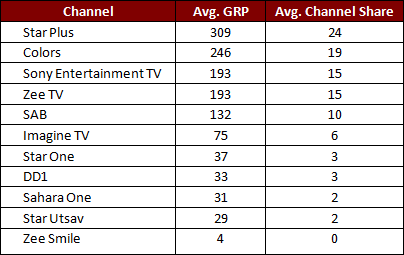
    Sony Entertainment channel, which is sitting pretty at No 2 position in the line-up of Hindi general entertainment channels (currently at 210 GRPs, week 7, Source: TAM Media Research), is quite positive on the chances of becoming the genre leader – something the channel has long awaited in the many years it has been in the business.


    For Sony, however, Colors is seen as a tough contender for now. And the challenge, as viewed by many experts, is to increase the gap from the No 3 player and slowly but surely, reach to a point from where it could become the No 1 player.


    “Though the idea is to be the No 1 channel, we are not focussing too much on that. “We’re not desperate to get there,” says Sony Business Head Sneha Rajani.


    CID is doing well for the channel. The show, which was launched by Sony in the year 1998 – the longest TV series in India, continues to deliver the goods even today. If previous week’s numbers are to be considered, the show features in the Top 10 shows in the Hindi GEC segment with a rating of 4.12 TVR along with Crime Patrol.


    As far as the programming strategy is concerned, the focus continues to be on fiction. In a bid to enhance its fiction offering and also open its early prime time slot of 7: 30 pm, the channel is all set to launch Shubh Vivaah, produced by UTV Television.


    Ms Rajani said at the launch of the show: “Having consolidated our fiction line-up between 8 pm – 11 pm slot; we wanted to extend our offering further. So with this we’ve extended our prime time offering, from 7: 30 pm to 11 pm.”


    On Feb 19, the channel aired 57th Filmfare awards. As informed by Marketing head Danish Khan, the channel is expecting a TVR of over 5.


  • [LOOKBACK 2011] The Year for GECs

    By Ritu Midha


    One-upmanship among the General Entertainment Channels (GECs) continues. While the top slot, for now, seems to be reserved for Star Plus, number 2 slot is now occupied by Sony. The tough fight between the channels has definitely benefited the viewer, who gets to see differentiated content now.  It is appointment viewing all the way – with viewers happily surfing from channel to channel, depending on the shows being shown at a specific time slot.  With a number of new shows hitting television at the same time – multiple show viewing at the same time (sampling) too is quite common – which is likely to reduce once the programme loyalty sets in.


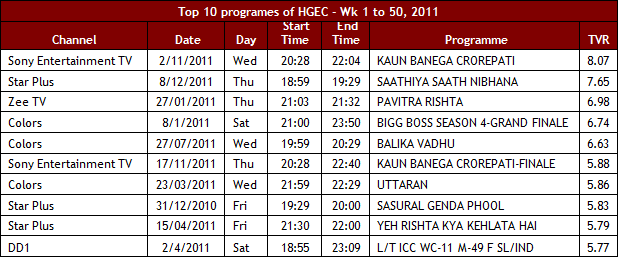
    The top 10 shows in GECs include three reality shows (including the top slot). And the 10th slot is occupied by Cricket (Doordarshan). This effectively indicates that only six of the top ten shows for 2011 (first 11 months) were fiction shows.

    Source: TAM Media Research
    TG: CS 4+yrs
    Market: HSM
    Channels : Hindi GEC
    Period : Wk 1 to 50,2011


    Perhaps, the picture would be bit different if one looked at the entire year, with quite a few new shows like Kuch to Log Kahenge,  Diya Aur Baati Hum, Hitler didi and Bade Acche Lagte Haen settling down.  Interestingly – none of the four is a classic saas bahu drama.

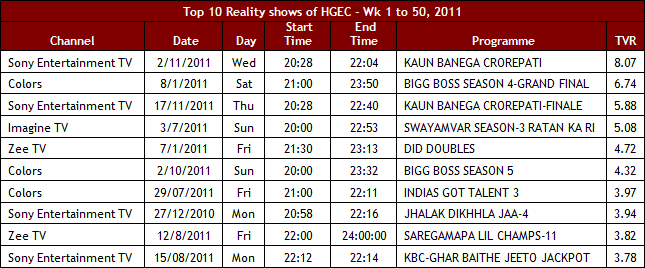
    As for the reality shows, only KBC and Big Boss (Finale) could find a place in top 10 – however others too brought in reasonable numbers for the channel. A quick look at them is here:

    Source: TAM Media Research
    TG: CS 4+yrs
    Market: HSM
    Channels : Hindi GEC
    Period : Wk 1 to 50,2011


    Now a look at the average TVR of the channels -If one looks at GEC viewership for the first 11 months, Star Plus rules as numero uno, with Colors at number two and ZEE and Sony rubbing shoulders at number 3:

    Source : TAM Media Research

    Period : Jan – Nov 2011

    TG : CS4+
    Market : HSM
    Period : Wk 1 to 50,2011


    However, if one breaks the data by month, it becomes the story of Sony’s steady climb through the year. The channel got it right post KBC. Its numbers did not dip as was being anticipated – but the new shows it brought in have, in fact, consolidated its positions as the number two GEC.  Multi Screen Media with two channels in top 5 GEC, and MAX too going strong is doing well for itself. It would be interesting to watch if Star One in it its new avatar – Life OK proves to be a threat.

  • Star gets set for Life OK…


    By Rishi Vora


    The channel was rumoured to be called Star Desh. A predictable name to ward off those on the hunt for info on the channel that was set to replace the beleaguered Star One.
     

    But the identity has now been revealed on billboards and social networks. It’s called Life Ok. The descriptor on the channel’s YouTube page says: “Life OK, a new television channel from 18th Dec, through its unforgettable and powerful stories brings to life its unique philosophy of ‘cherishing what you have’. Life OK reminds and invites everyone to value the things that well and truly matter in life like family ties, relationships, valuing traditions and peace of mind, while in the eternal quest for more.”


    Since Star India and its public relations agency are tightlipped on the details, we don’t know whether Star One will shut on December 17 or be phased out gradually.


    Life OK, it is learnt, will cater to a wide audience targeting Tier 1 and Tier II cities of the country. Special attention is being paid on packaging and presentation. The leadership team has former MSM Sony business head Mr Ajit Thakur at the helm. That, indeed, is testimony of Star India’s plans to launch a serious challenger brand.


    A high decibel marketing push is planned for the launch.

    But, is there a scope for yeta another general entertainment channel? Top of mind, of course is Colors’ success in the not too distant past. Madison Media CEO Punitha Arumugam explains, “Yes there is room for more channels in the GEC space. A case in point being the launch of Colors when one thought that the GEC market was saturated, Colors launched and expanded the GEC channel share. Also, given the high demand situation for GEC inventory today, there does seem to be room for another channel.”


    Colors was backed by differentiated content and big-ticket shows; aggressive marketing and distribution, which helped the channel to grab the No 3 position weeks after its launch. That, however, was introduced as Viacom 18’s flagship GEC channel. Will Life OK be a successful second GEC channel?


    There are instances where the second channel hasn’t delivered results as per expectations. Zee Next and Star One are a few examples. Historically, second channels have received motherly treatment from networks, as the strategy has always been towards prioritising investments towards flagship channels. There have been cases where successful shows on the second channel shifted to flagship channels… but, from what is seen of the new channel from Star, special efforts are being made to ensure differentiated programming.


    Dentsu Media CEO Divya Gupta believes that a new channel needs to create and carve a niche for itself. “Is there a need? Perhaps not from the consumer perspective, but definitely from the marketers’ perspective! Star would do well to have a successful flanker brand.To be successful, however, it needs a distinct and independent raison de etre, which is a big challenge. The plan to feature ‘Sach Ka Saamna’ may draw initial eyeballs, but longevity and distinctiveness remain a challenge.”


    Janardhan Pandey, AVP, Mudra Max had a different view. “It is hard to predict if the new channel from Star will succeed or not. The market keeps changing, so one has to constantly evolve as a channel. In the GEC space, success is rare for a new channel, but not obsolete.”


    On the programming front, several shows are set to go on air on the new channel. Sach Ka Saamna… Bhrashtachaar Ke Khilaaf, which was to initially feature on Star Plus, has been shifted to Life OK as a strategy to give that extra push to the channel. Others include Tum Dena Saath Mera, Meri Maa, Dil se di dua…Saubhagyavati Bhava and Devon ke Dev…Mahadev.


    The channel will launch at 12 noon on Sunday, December 18 with an eight-hour live ‘online concert’ featuring leading leading rock bands and artists like Shankar Ehsaan Loy, Euphoria, Agni, Shaa’ir and Funk, Indus Creed, Salim Sulaiman and Kailash Kher amongst others. Interestingly, the live event will happen only for audiences on the internet, signifying an attempt to woo young, digitally-inclined viewers.

     

    Ms Arumugam remarked, “The success of the GEC channel depends totally on the content and engagement they provide the viewer – so it does not matter whether it is the second channel or the umpteenth channel from the same network”


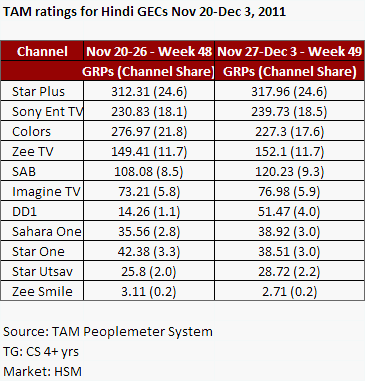
    While all eyes will be on the new channel from Star, there is no doubt these are interesting times in the GEC space, where there is healthy competition between No 2 and No 3 (see table alongside for GRPs and channel shares from November 20-December 3, 2011). If Life OK does have a successful launch, battles will intensify and healthy competition will help increase the genre further.


    With bureau reports

  • Thakraney: Sony after KBC. Reality shows must face the music

    By Anil Thakraney


    I really don’t know what Sony’s revenue model was for the recently concluded KBC. As in, did the channel actually make money on advertising and sponsorships after deducting the massive costs? Which include phenomenal sums going to the host Big B, not to speak of all the prize monies (Mr Sushil Kumar alone walked away with five crore rupees). Maybe they did make a little profit on the show, maybe they did not. But here’s what has happened immediately post the show: On the ratings chart, the channel slipped to No 3 from its position of No 2.


    Now, traditional programming logic suggests that expensive reality shows and blockbuster cinema films play the role of a magnet, of getting a channel some stickiness with the viewers. Having come onto the platform, viewers would taste the regular fare on the channel and hopefully stay on. Well, KBC doesn’t seem to have delivered on that promise. After enjoying the show, clearly many viewers defected to the other channels. This naturally raises a doubt in the mind: Are reality shows over-hyped in the desi entertainment channels? Are they worth all the effort and the expenditure? Is too much expectation being loaded on them?


    There are no easy answers to this one. But one thing is clear: You can tempt patrons into a restaurant by offering an outstanding dessert, but they will only return if the food is delicious. You can’t build loyalty through window dressing. The idea should be to first build a powerful back-end… which is to create super regular programming. And then run a huge reality show, so that viewers like what they taste when it comes to the ‘bread and butter’ shows.


    In this context, one has to wonder if Sony put the cart before the horse. Star Plus’s consistent No 1 position should provide a way forward for other channels: Which is to first do the basics rights. And then dial Mr Bachchan’s number.

    ***

    PS: LOL! Watch this ad for Snickers. A good example of how to (literally) use research methods in advertising, AND make it work very nicely!

  • 7pm, the New prime time


    By Ritu Midha


    Once upon a time in Hindi GEC, 8 to 10 PM was known as prime time. Then happened Kahin To Hoga and Kaahin Kissii Roz (both on Star Plus), and prime time viewership extended up to 11 pm. The interesting thing here was that while 10 to 10.30 pm slot was viewed across HSM, 10.30 to 11 was largely metro centric. And today, the slot is used for more mature stories like Maryada Lekin Kab Tak.


    Interestingly, channels have now realised that older children and teenagers are not watching that much television any more – and there really is no requirement for shows tailored specifically for them in the 7 to 8 pm slot. Enter Saathiya – and now 7-8 pm has become an integral part of prime time television viewing. Star Plus successfully proved yet once again that Saas Bahu still works – and good scheduling too can be an excellent programming innovation. More on prime time expansion in a minute.


    Another interesting phenomenon one notices these days is that shows are not killed in too much of a hurry – shows that stop being TVR-garners are nudged, and shifted to another time slot preferably in the afternoon – two very recent examples are Na Anaa Iss Desh Lado and Laagi Tujhse Lagan. Elucidates Dinesh Vyas, Business Head, MEC Global, India, “Channels try out possible routes before killing the programme. And as a strategy they try putting programmes between two good performing programmes hoping for viewers to move on to this programme too.”


    While quite a bit of television slots are still sold based on GRPs, and many brands insist on prime time slots – there are a few which are keen to advertise on a specific show. what happens when these shows are moved from one time band to the other. Explains V Narayanan, General Manager , Maxus, Delhi, “This requires a deeper analysis of the new slot where the following parameters are taken into consideration in predicting the ratings which includes, Current viewership of the time slot, Whether the new slot is in prime time or non-prime time slot?, Ratings of competing programmes in the new slot, Promotion plan from the channel in promoting the specific programme slot etc.”


    Adds Mr Vyas, “The media planner analyses that time slot (over at-least 13 weeks) to which it has been shifted, to estimate drop or rise in viewership. Loaded with this data the planner/buying negotiate with the channel for better deal in rates proportionately to the drop percentage.”


    In place of these shows, in their previous time slot arrive new shows- which may or may not capture viewers’ attention – but this is a risk that channels have to take. It is after all about getting the desired eyeballs and audience acceptance.


    Moving back to the extended prime time, the 7 pm slot was made popular by Star’s Sathiya and 7.30 by Sasural Genda Phool on the same channel. However, now shows on Zee and Colors too are working well for their respective channels.


    A quick look at the delivery of this time slot:Star Plus: 

    Rank Date Day Start Time Programme TVR

    1

    25/10/2011 Tue

    19:00

    SAATHIYA SAATH NIBHANA

    4.3

    16

    27/10/2011 Thu

    19:30

    SASURAL GENDA PHOOL

    2.24


    Colors:

    Rank Date Day Start Time Programme TVR

    21

    25/10/2011 Tue

    19:32

    SASURAL SIMAR KA

    2

    87

    27/10/2011 Thu

    18:59

    HAVAN

    0.76

    Zee:

    Rank Date Day Start Time Programme TVR

    27

    24/10/2011 Mon

    19:30

    CHHOTI BAHU

    1.84

    70

    25/10/2011 Tue

    18:59

    EK NAYI CHOTI SI ZINDAGI

    0.89


    Target Group : CS 4 + Yrs ;

    For the week from 23/10/2011 to 29/10/2011

    Source: TAM peoplemeter system


    Havan, has, incidentally, not been able to do as well as anticipated yet. Says Mr Narayanan, “Saathiya is a popular programme and garners loyal viewership amongst the female viewers. Yes, with Havan being promoted aggressively by Colors, Saathiya viewership did drop during the first week of telecast which was expected. “

    While late night slots attracted metro audiences, the 7 pm to 8 pm slot has succeeded in attracting non metro audiences. States Mr Vyas, “I have always believed 7-8pm slots work best in non-metros where the audiences are home by that time.”

    Mr Narayanan, meanwhile elaborates that it is the mid-sized towns where this slot attracts maximum viewership, “ A closer look at Saathiya viewership across 8 weeks ( 2011, Wks: 33-40 & for the top channels only. Tg: All, AA, 15+, C&S.) indicates that 1 million + towns in Gujarat, Punjab/Haryana, UP, Rajasthan, MP procures higher ratings than 0.1-1million towns within each state respectively. As a comparison, the program ratings within the 1Million + towns of the above markets are relatively higher than Delhi & Mumbai ratings. “

    Interestingly the 7 to 8 pm slot is not doing well only in HSM but a similar trends can be observed in South markets as well. Explains Narayanan, “Within the 7-8 pm slot, the rest of AP and the rest of Karnataka performs better than Hyderabad and Bangalore respectively. Specific to TN, Sun TV programmes do well in 0.1-1 million towns than Chennai and 1 million+ towns.”

    Television always has options – programming experimentation, scheduling experimentation, changing the protagonist, the story line etc – and hence has the capability of being a step ahead of the curve. With three and a half hours of prime time – GEC don’t have much to worry – all they need is good characters. The next battle heating up is for the real prime time – 8  to 9 pm with all the channels bringing up new shows there.

  • New programming to make BIG CBS bigger

    By A Correspondent

    BIG CBS Networks Pvt. Ltd., an equal joint venture between Reliance Broadcast Network Limited and CBS Studios International, has announced its new fresh programming line-up and future plans for its channels. The network, which went live with three channels in a record breaking time of under six months, has captured hearts of the discerning Indian audiences and stands as the No 1 English General Entertainment Network today.

    In keeping with its promise of offering the latest seasons of programming, airing concurrent to the US, the channel has acquired fresh content from leaders in the international entertainment space like Boman Bridge, Alfred Haber, Bobby Goldstein and Medi-Asia. Offering audiences more than 25 hours of original fresh programming each week, on each channel, the Network offers audiences a further assortment of programming, and advertisers, the best platform to partner with for their brands.

    Speaking on the occasion, Mr Nikhil Mirchandani, Business Head, Television Channels, Reliance Broadcast Network Ltd said, “We are very pleased with the way the channels have shaped and delivered. The channels have grown the market and we have been able to successfully bridge the existing void in international quality programming that existed. We now enter our next growth phase and are completely equipped with our hand-picked shows that match the tastes and sensibilities of our target audiences.”

    Mr Mirchandani further added, “BIG CBS’ programming is in keeping with our endeavour to offer Indians the latest, freshest and hottest content straight from America. Today, audiences have evolved and are looking for more than just soaps and films. The well travelled Indian viewer is always looking for quality content and we continue to bring the best of American television to our viewers here. Also, our effort to give audiences India-grown content has worked excellently for us with the overwhelming response to India’s Sexiest Bachelor. Tracing this success, BIG CBS is now launching the next Indian property, India’s Glam Diva. With this and more shows planned BIG CBS Network is poised to become a network to reckon with.”