Tag: Future Group

  • Big Bazaar joins hands with the biggest brands for “Hum Taiyaar Hain” campaign

    By A Correspondent


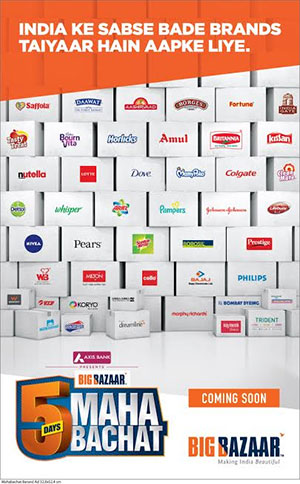
    Big Bazaar (Future Group) has partnered with leading brands across categories for the popular ‘Maha Bachat’ sale. This partnership will be in the form of a campaign “Hum Taiyaar Hain” which will feature the CEOs and MDs of the respective brands communicating to the audience that they are ready with their products on stand for the ‘Maha Bachat’ sale. The motive behind the campaign is to mark the efforts of the brand partners who invest equal amount of enthusiasm and dedication to make the sale possible. Also, for the first time these brands are voicing their support for ‘Maha Bachat’. The sale will be held from the 13th till 17th of August 2016 across all Big Bazaar stores in India.


    The “Hum Taiyaar Hain” campaign will principally revolve around the CEOs and MDs making it loud and clear to the customers on how they’re well in advance prepared for the upcoming ‘Maha Bachat’ sale. Different print and other advertorials will showcase the brand heads giving out the message of the campaign. There are big sales, big discounts and big savings on over 300 brands across all cities.


    A spokesperson from Big Bazaar said, “Maha Bachat which is in its 11th year, offers incredible discounts on every product and every brand, it is an unparalleled opportunity for customers to save on everything they buy. A sale of such incredible proportion is impossible without our partners just like us, they too prepare for it months in advance and work towards the success of ‘Maha Bachat’ every year. Continuous cooperation from partners is a definitive and crucial factor in Maha Bachat’s success over the years. So let’s have a campaign that shows this partnership.”


  • Does tweet spat herald consolidation?


    By Sagar Malviya


    Future Group CEO Kishore Biyani said the Twitter spat between India’s ecommerce poster boys Sachin Bansal and Kunal Bahl could indicate a consolidation wave triggered by Alibaba’s imminent entry into the space.


    Biyani, who runs the country’s largest brick-and-mortar retail company and is known to disparage ecommerce rivals, said social media had become the medium of engagement for many entrepreneurs. “Very often I see conversation as a precursor to hint something strategic or big. In this case, it could even be consolidation or something more,” he said.


    Flipkart’s Sachin Bansal vs Snapdeal CEO Kunal Bahl: Right guys stuck in a tough ecommerce battle


    By Biswarup Gooptu & Madhav Chanchani


    Three months into 2016 and the battle lines between India’s top two ecommerce companies are being drawn deeper. The exchange of barbs between Flipkart’s executive chairman Sachin Bansal and Snapdeal CEO Kunal Bahl on Twitter on Friday evening wasn’t merely a spillover of their rivalry but emblematic also of the significant pressure they are under with investors’ becoming tightfisted. It portends more ugly confrontations.


    “While in 2014 it looked like the game had consolidated between Flipkart and Amazon, the market suddenly opened with Snapdeal, Paytm and Shopclues jumping into the fray,” said Harminder Sahni, founder of retail consulting firm Wazir Advisors. “Now investors are evaluating (ecommerce firms) closely, so it becomes (important to establish) not only how good you are but also how bad the other players are.”


    This year is expected to be an inflection point for Flipkart and Snapdeal, which, along with Amazon, have dominated India’s $23-billion (Rs 1.5 lakh crore) market but are yet to show paths to profitability.


    Investors who have poured billions of dollars into Flipkart and Snapdeal are pressurising the firm’s managements to optimise their operations, curb discounts and focus on improving margins as they seek ways to sell their investments and maximise returns. Both Flipkart and Snapdeal are scouting for new investors to back them as they compete for top honours in India’s ecommerce industry while staving off the challenge from Amazon.


    Flipkart has been in the market awhile to raise $1.4 billion and, according to media reports, had approached Alibaba for funding, but investors have become fussy amid growing uncertainty.


    Snapdeal was able to raise $200 million in February in funding led by Ontario Teachers’ Pension Plan at a valuation of about $6.5 billion. A lot of that money, though, went to existing investors selling their shares in the company. “The pressure is too much,” said Sahni. “I don’t think we have seen this kind of a public spat between people from the industry in the modern times.”


    India’s ecommerce industry, though, is not in a position of uncertainty. In February, Morgan Stanley raised its forecast for the gross merchandise value of Indian online retailers to $119 billion by 2020 from its earlier estimate of $102 billion, indicating that more consumers are buying online.


    Source:The Economic Times

    Copyright © 2016, Bennett, Coleman & Co. Ltd. All Rights Reserved

    Licensed to republish


    While the Chinese ecommerce giant is a fringe player in its core business-to-business online trade in India, it has an indirect presence in the country’s ecommerce segment. It invested more than $500 million for a 40 per cent stake in One97 Communications, which runs Paytm, a wallet and ecommerce company, while Snapdeal raised $500 million from a clutch of investors including Alibaba last year.


    Alibaba said recently it will make a direct entry into India’s online space and is said to be looking at several options. One could be increasing its stake in Paytm and spinning off its marketplace into a separate venture.


    It has also been reported that it (Alibaba) was talking to the Tatas for a broader strategic alliance besides deepening its relationship with Snapdeal.


    The consolidation buzz in the ecommerce space has been strengthened by talks swirling around Flipkart. The Economic Times (ET) had reported on failed talks between the company and Amazon. Flipkart founders Sachin Bansal and Binny Bansal denied this.


    ET and a few other newspapers have also reported that Flipkart was in funding talks with Alibaba. The founders of Flipkart and Snapdeal had lashed out at each other on Twitter Friday night over Alibaba’s entry plans.


    Bansal, executive chairman of Flipkart, indirectly criticised the companies in which Alibaba has invested. “Alibaba deciding to start operations directly shows how badly their Indian investments have done so far,” he tweeted.


    Bahl responded with. “Didn’t Morgan Stanley just flush $5 billion worth market cap in Flipkart down the toilet. Focus on ur business not commentary :)”


    The reference was to a mutual fund managed by Morgan Stanley marking down the value of Flipkart’s shares by 27 per cent, signalling that global investors believe India’s largest Internet company may be overvalued. Flipkart had said in a press statement that it is valued at $15.2 billion. A 27 per cent drop would put this at $11 billion.


    In comparison, stocks of Biyani-owned entities — Future Retail, Future Consumer and Future Lifestyle Fashions — have gained 14-80 per cent on the BSE and have a combined market capitalisation of $1.5 billion. Biyani had accused online retailers of adopting predatory pricing two years ago. Earlier this month, he released a series of ads targeted at the three main online marketplaces — Flipkart, Amazon India and Snapdeal.


    Last month, investor Rakesh Jhunjhunwala said ecommerce companies were attracting too much investment without any meaningful retail disruption and was bearish on the business model. “I will consider buying Flipkart’s stake if it is valued at $100 million,” he had joked.


    The combined losses of the three leading online retailing platforms widened to Rs 5,052 crore in FY15 as they spent heavily on infrastructure and discounts to woo consumers.


    Source:The Economic Times

    Copyright © 2016, Bennett, Coleman & Co. Ltd. All Rights Reserved

    Licensed to republish


  • Flip the Cart, Snap the Deal and Amaz-Off. Future to tease ecom majors with ad offensive


    By Sagar Malviya & Pritha Mitra Dasgupta


    Future Group CEO Kishore Biyani, who’s never made a secret of his disdain for ecommerce rivals, plans to step up the offensive with a series of ads that use word play to target the three main marketplaces – Flip the Cart, Snap the Deal and Amaz-Off.


    This is probably the first time a brick-and-mortar retailer will engage in comparative advertising against online rivals, which have been grabbing share by discounting products.


    After nearly three years of deep discounting, most online sellers are now pulling back from this strategy in a desperate effort to shore up their finances, making them vulnerable on this front. Ecommerce discounts are now mostly limited to select brands such as online exclusives, old merchandise and own labels.


    The combined losses of the three leading online companies — Amazon, Flipkart and Snapdeal — ballooned to Rs 5,052 crore in FY15 from Rs 1,000 crore in the year before as they sought to build market share. At the same time, several brickand-mortar retailers clocked double-digit same-store sales growth last year, a reversal from the trend in 2014 when physical stores reported subdued demand as ecommerce players wooed away consumers.


    As part of the Future exercise, three newspaper jacket ads on Friday will direct shoppers to its Brand Factory discount outlet instead of hunting online for better prices in a manner reminiscent of the pot shots that Pepsi and Coca-Cola took against each other in the 1990s.


    The theme will be continued inside the stores, with staff and cashiers wearing T-shirts with messages such as ‘My deal got snapped’ and ‘My cart got flipped’. The 40 or so Brand Factory stores will also wear new facades and selfie zones with the same theme targeting Flipkart, Snapdeal and Amazon.


    “We just want to prove the point that both our merchandise assortment and pricing are better compared to online companies. We need to make consumers aware of this fact,” said Biyani, adding that Brand Factory’s gross merchandise value (GMV) in the year to March 2016 was Rs 3,500 crore. Future is India’s biggest listed retailer.


    “While we use sales numbers to talk about performance, we are bigger than Myntra or Flipkart in terms of GMV,” he said. As part of its Great Offline Denim Festival, Brand Factory will sell nearly a dozen brands such as Levi’s, Benetton, Lee, Wrangler and Pepe jeans at a 50% discount for three days.


    Future has fired ad shots at ecommerce before. For instance, “You can’t take the nation for granted even for a day,” was aimed at Flipkart’s Big Billion Day sale in 2014.


    Snapdeal has taken digs at Flipkart and Amazon with its campaign tag line: ‘You don’t need a billion offers to amaze you. You just need to snap the best ones’. It also had about 100 billboards in 20 cities emblazoned with the phrase ‘Achha kiya bata diya, #YahanSeKharido’ aimed at Flipkart, which was running the ‘Nahin khareeda? #AchhaKiya’ campaign last year.


    “The intent of a campaign is really crucial,” said McCann India CEO Prasoon Joshi. “Whether the campaign is offensive or not will depend on the intent of the brand. If the intent is shallow fun then it is different. But I personally believe that taking creative potshots at competition cannot be a long-term strategy.”


    Brick-and-mortar retailers are also investing in omni-channel strategies and experimenting with global models such as flash sales, such as by offering a single product for sale for a period of 24 to 36 hours. “We are planning flash sales where consumers can get discounts, coupons and offers on several brands by using an app but buying at physical stores for certain hours or days,” said Rajiv Prakash, cofounder of Shouut, which is in talks with Shoppers Stop, Oberoi Mall, Decathlon and DLF Promenade for deal-of-the-day sales.


    Source:The Economic Times

    Copyright © 2016, Bennett, Coleman & Co. Ltd. All Rights Reserved

    Licensed to republish


  • Jai Patanjali! Jai Herbal!


    By Sagar Malviya & Neha Tyagi


    MUMBAI: In a short span of time, Patanjali Ayurved has not only made a name for itself among Indian consumers, but also fuelled expansion of the herbal products market and helped rivals sell more home and personal care products, grabbing share from MNCs.


    The Baba Ramdev-led company’s sales jumped 64 per cent to Rs 731 crore in the six months ended December and rivals Dabur and Himalaya grew in double digits in a consumer products market that expanded barely 6 per cent, according to IMRB data. The figures exclude commodity products such as ghee and atta.


    What’s helping these firms is a growing preference for Ayurvedic products known for natural ingredients and health benefits. In addition, herbal products are cheaper.


    “Patanjali has registered a near-80 per cent growth in penetration, which is about 5 per centage points on an absolute level, in one year,” said K Ramakrishnan, general manager, IMRB Kantar Worldpanel.


    “The first wave of growth came from personal care products only, but the recent growth has been driven by homecare and food and beverages, which still has a smaller base,” said Ramakrishnan.


    Patanjali started in 1997 as a small pharmacy in the holy town of Haridwar to make healthcare products and was incorporated in 2006 as a company to sell personal care, food and beverage products through its own outlets. The company expanded its reach from 200 Patanjali outlets in 2014 to 5,000 franchise stores currently and launched more than two dozen mainstream FMCG products as none of the existing herbal players catered to categories such as noodles, oats and detergents.


    In October last year, Patanjali formed a marketing partnership with Future Group, which will offer over 300 of its products in 77 categories through stores such as Big Bazaar in about 250 cities. Four months after partnering with Future Group, the country’s largest retailer, Patanjali products have cornered a 7-12 per cent share in categories such as detergents, toothpastes, soaps and shampoos at Big Bazaar stores. In food products including oats, noodles and honey, the share gains are 7-37 per cent, according to Dunnhumby, a UK-based research company that has tied up with Future Group for data science.


    Patanjali has grabbed share from non-Ayurvedic companies. While the growth of Ayurvedic brands in the face wash category increased to 50 per cent from 36 per cent earlier, the growth of non-Ayurvedic brands eased to 16 per cent from 21 per cent a year ago. The share of market leader Himalaya remained unchanged at 35 per cent as Patanjali gained 7 per cent share.


    In shampoos, sales of Ayurvedic brands more than doubled to 194 per cent, while for multinational companies, it declined to 15 per cent from 21 per cent earlier. Categories such as chyawanprash, amla and aloe vera juice saw growth double to 42 per cent, with Dabur retaining its 53 per cent market share.


    “This unusual phenomenon of consumer products market disruption is rare as brand erosion or loyalty for well-established brands generally doesn’t happen so quickly,” said Devendra Chawla, president, food and FMCG, at Future Group.


    Patanjali products were purchased by about 21 per cent of Future Group shoppers in January compared with 2 per cent in October. “While Ayurveda brands were always there, the entire category has now arrived with a bang, thanks to heightened awareness benefiting the overall ecosystem,” Chawla said.


    Patanjali attributes its success to consumer shift from non-Ayurvedic brands owned by multinationals to Indian herbal companies. Its products are on average 15-20 per cent cheaper than the competition and several rival companies have been running offers and promotions to compete with them.


    “Other Ayurvedic companies are coming up with good quality products at even cheaper prices, which is ultimately doing good. The country is huge and the FMCG market is so large that we may not be able to provide for everyone,” said Acharya Balkrishna, managing director at Patanjali Ayurved, adding that the company has almost met its sales target of  Rs 5,000 crore for the financial year ending March 2016, more than double the revenue of Rs 2,000 crore in 2014-15.


    Hindustan Unilever’s net sales increased 10 per cent to more than Rs 30,000 crore in the previous financial year and Colgate-Palmolive (India) sales rose 12 per cent to Rs  3,955 crore.


    Source:The Economic Times

    Copyright © 2016, Bennett, Coleman & Co. Ltd. All Rights Reserved

    Licensed to republish


  • Shoppers haven’t stopped shopping at brick-and-mortar outlets


    By Writankar Mukherjee & Sagar Malviya


    Leading brick-and-mortar retailers are seeing double-digit surge in their same-store sales this Diwali season despite top online rivals’ big discount sales last month, signalling a sharp reversal from last year’s trend when physical stores reported subdued demand as ecommerce players wooed away consumers.


    Top retailers such as Future Group, Arvind Brands, Shoppers Stop, Vijay Sales, Puma and Max report buoyant demand over the past two weeks. Future Group founder and CEO Kishore Biyani said the country’s largest retailer is set to grow its business 25-30% this Diwali over last as sentiments look positive. “Ecommerce is still a minuscule of the entire market, except a few categories like mobile phones, so there is not any impact on business,” he said.


    Some other retailers attributed the rise in demand to fresh merchandise, fewer discounted merchandise of big brands on online portals, and early onset of winter chill in some parts of the country.


    “It (online) had a novelty factor that helped last time,” said J Suresh, chief executive at Arvind Lifestyle Brands, which sells brands such as Gap, US Polo, Wrangler and Calvin Klein. “With fewer discounts by ecommerce and new season merchandise offered by physical retailers, we are seeing same-store sales growth of 8-15%,” he said. A year ago, ecommerce giants Flipkart, Amazon and Snapdeal had pursued an aggressive discounting policy during the festive season to gain market share and traffic. This impacted demand in physical stores, even prompting traditional retailers to approach the government over what they said was predatory pricing.


    This season, while the ecommerce players got good response to their big sale events, their discounts were mostly limited to select brands such as online exclusive ones, old merchandise and their own labels as they looked to protect margins.


    This also signals that ecommerce players and brick-andmortar retailers can coexist in the market, without necessarily harming each other. Historically, Diwali is considered a no-discount period for physical retailers as brands try to cash in on the positive festive season sentiment and fresh merchandise. Physical retailers have not changed this strategy this year despite reporting low same-store sales growth of 5-8% in the last two quarters and their online rivals advancing their sale period.


    Govind Shrikhande, managing director at the country’s largest department store chain Shoppers Stop, said the “huge gap” between end of season sales in August and Diwali has also helped the surge in demand. “There was a pentup demand which is reflecting in a higher double-digit growth since last month after a dull September,” he said. “We aren’t seeing a huge surge in footfalls which indicates higher billing size or better conversion at stores,” Shrikhande added.


    A survey by global research firm Ipsos suggested that nearly 81% consumers would buy from offline stores during festive season and not from online companies even as they were holding up purchases in anticipation of discounts.

    The festive season peaks between Durga Puja and Diwali with Karva Chauth and Bhai Dhuj coming in between. The period — which is also when the salaried get their bonuses — traditionally marks an upsurge in consumer spending, accounting for at least a third of sales for big brands. “Money is never an issue for consumers during Diwali,” said Nilesh Gupta, MD at electronics retail chain Vijay Sales. “Our sense is either there is a revival in consumer sentiment or they are hopeful that things could get positive soon at the macro level.” Vijay Sales, he said, is seeing a growth of over 20% this season, its highest in the last three years.

    Industry insiders said big marketers such as LG, Apple and Panasonic started their festive promotions much earlier than usual this year to ensure the offline trade is not hit hard by online discounts. K Krishna Pawan, executive director at cellphone retail chains BigC Mobiles and Lot Mobile, said sales in their 225-odd stores have not been impacted by online discount sales because there was hardly any online deals on mainline smartphone brands and current models.

    Puma India managing director Abhishek Ganguly said the sports shoes and activity wear brand has so far grown samestore growth by 13% this Diwali season over last, with sales in East India during Durga Puja growing 25%, with winter apparel driving growth.

    Meanwhile, ecommerce majors have started consolidating their business, having significantly increased the number of vendors and product categories on their platforms and with more and more people taking to online shopping through mobile apps, which has helped expand the overall market.

    Max Retail executive director Vasanth Kumar said consumers’ wallet size may be getting thinner due to some shopping online, but it is getting compensated by newer customers and a positive sentiment all around. Max has grown same-store sales by 15% over the last festive season and its average billing value has increased 10% over last Diwali. Industry estimates suggest that ecommerce companies will spend Rs 2,000 crore this year on marketing and offering discounts to consumers during the festive season.


    Source:The Economic Times

    Copyright © 2015, Bennett, Coleman & Co. Ltd. All Rights Reserved

    Licensed to republish


  • Dainik Bhaskar unveils ‘Unmetro – The Action is Elsewhere’ campaign

    By A Correspondent


    DB Corp Limited (DBCL) announced the launch of ‘Unmetro- Action Is Elsewhere’, a new campaign aimed at marketers, advertisers and the media planner/buyer audiences. Designed as a digital / social media campaign, it will also be supported by Print, OOH and also supported by the company’s Unmetro Conclave events, which have over a period of time developed into one of the most noteworthy pan-India marketing events focused on exploring and analyzing the untapped economic potential of India’s non-metro towns and cities.


    ‘Unmetros’ signify the non-metro urban Indian markets (Tier 2 & 3 markets) which are fast emerging as India’s key growth centres. These markets are at the core of dynamic progress, being under served and hence presenting an opportunity of rapidly growing consumer demand, with significant purchasing power and greater media reach. This potential of Unmetros, together with the rise of digital media, the fragmentation of mass media, the growing power of young consumers, creates a very compelling proposition for the Indian retail industry. Also significant is the leveling out of purchasing power across India that brings into focus the markets beyond the metros.


    Kishore Biyani
    Girish Agarwaal

    Kishor Biyani, Group CEO, Future Group has flagged off the launch of the campaign, as a 60 second film, which will be amplified with the help of print ads, web banners and across the Unmetro web page. The campaign idea revolves around the fact that, generally people have been enamoured by life in the metros, while the real action is brewing in the Unmetro heartland of India, to say that the ‘Action is elsewhere’.


    Commenting on the launch of the digital campaign, Girish Agarwaal, Director, Dainik Bhaskar, said, “We see a whole new opportunity in Unmetros where the rising affluence levels and changing consumption patterns are opening doors for marketers to service these new regions. Consumerism is on the rise, as also the desire to experience better lifestyles and enjoy global brands. This has created numerous opportunities for both national and international brands in India. Through the Unmetro initiative, we champion the cause of Tier II and III markets, helping marketers and advertisers to serve these markets better and play a role in transforming them into stronger growth centers.”


  • Raja of Retail reinvents himself


    By Malini Goyal


    I wouldn’t suggest we are an ideal organization, but I think we have made the beginning towards building one” Kishore Biyani, in his autobiography ‘It Happened in India’.


    Seven years after India’s Raja of Retail penned his entrepreneurial journey – and in the process convinced his elder daughter Ashni that he wasn’t writing it, as she feared, “too soon” – Kishore Biyani’s “ideal organization” is still a work in progress. By 2007 – 16 years after he opened his first store to sell apparel, Pantaloons – Biyani had done enough in the retail space, and more, to earn the Raja handle.


    His Future Group was selling food and groceries, apparel, footwear, furniture, consumer electronics, home products, books, medicines, mobiles et al through multiple formats like supermarkets, hypermarkets, malls, specialty stores – and, yes, an online portal too.


    Forays into the broader consumption space – restaurants, entertainment centres and even consumer finance and insurance – were all prongs of the group that hit revenues of just over Rs 5,000 crore in the year ended June 2008.


    Today, Biyani looks back at the no-holds-barred growth phase with mixed emotions. “Success is very heady. [But] difficult times humble you.”


    Those difficult times came courtesy of the global financial crisis of 2008.


    The Future Group found itself saddled with a debt of over Rs 4,000 crore even as liquidity dried up and consumers tightened their purse strings.


    The debt kept rising, peaking at Rs 7,800 crore in 2012. The post-2008 phase was of gritty survival, culminating in the sale of Pantaloon to the AV Birla group for Rs 1,600 crore in 2012; and a series of selloff deals are still in the pipeline.


    Over the next couple of years, rationalizing stores became the buzzword and, as things stand today, Reliance Retail is the largest organized retailer – the newly crowned ‘Raja’, if you will – and e-commerce giants Amazon, Flipkart, Snapdeal et al have captured the mind space of consumers and the moneybags of investors.


    Yesterday’s Raja of Retail, now 53, seemingly with a smaller fire in the belly, is watching the new kids on the block, happy that he wrote his tome at the right time – after all, wasn’t it Biyani himself who told an investor: “Retail is like riding a bicycle uphill, if you stop pedaling you will slide down?”


    Biyani hasn’t stopped pedalling. The only difference is that he now wants to ride a faster, larger cycle, a road bike perhaps, that traverses terrains beyond organized retailing and bunny-hops onto the track of food – processing it, marketing it and branding it.


    At the same time he wants to throw his hat once again in the ring in which he was one of the first to do so: e-commerce. Don’t forget he had set up Futurebazaar.com in 2007 – the same year Flipkart was born.


    “He [Biyani] is in the most exciting phase of his career. I have never seen him so engaged and committed,” says Shailesh Haribhakti, managing partner, Haribhakti & Co, an independent director of Future Lifestyle. On the board, Haribhakti has known Biyani for over two decades now.


    Food for Thought

    Last month, prime minister Narendra Modi inaugurated a 110-acre food park in Tumkur in Karnataka, Biyani’s first iron in the fire of foodprocessing.


    He plans to set up two more – one in Madhya Pradesh and West Bengal each – with the aim of fuelling the foods business into a Rs 20,000-crore behemoth by 2020, from just Rs 1,000 crore currently.


    The processed and packaged foods business in India is a gargantuan pie, at Rs 40,000 crore; however, it is fragmented and dominated by unorganized players. In 2012-13, Indian households are estimated to have spent Rs 11,00,000 crore on food.


    For his part, Biyani doesn’t see the food foray as a shift from the core business. “I have never looked at myself as just a retailer,” he says. “We have always been an FMCG company,” he adds.


    To be sure, group company Future Consumer Enterprises is present in over 60 product categories, and the plan is to make frozen foods, ready-to-eat and baked items at the food parks. “India does not have home-grown food products that cater to Indian tastes,” adds Biyani.


    Biyani wants to do to food what he did to retail in the 1990s. “Hopefully, we will be the largest food FMCG company in the country by 2020,” says Biyani. His vision is to make Future Group a Rs 1,00,000 crore entity by 2020, with food contributing a fifth of those revenues.


    When Biyani took the plunge into retail, Walmart founder Sam Walton was doubtless an inspiration – but not necessarily for the Walmart model. The Future Group CEO has been influenced by Walton’s desire to “rewrite rules”.


    Biyani reckons he’s done something similar by creating a unique retailing model in India that has the look and feel of mandis, and takes into account local tastes and cultures. The food venture will follow the similar principles of providing indigenous solutions.


    Twist in E-tail, too

    Biyani made headlines early this month when he squared off with trailblazing etailer Flipkart. After Flipkart’s big sale day, on which it claimed to have sold goods worth $100 million, Biyani slammed it. “How can someone sell products below the manufacturing price? This is not legal,” he told the media.


    A few days later, Biyani chose to collaborate with Flipkart’s rival Amazon to exclusively retail Future Group’s 45 private label brands on its platform. And there’s more to the deal, insists Biyani. “This is not a transactional tie-up. It is deeper and strategic.”


    “The deal is significant. It is the first time that Amazon India has entered such a strategic partnership with a big organized retailer,” avers Amit Agarwal, country manager, Amazon India.


    Arvind Singhal, chairman of Technopak Advisors, isn’t impressed. “People are misreading the alliance, which is not between two partners but a seller and a buyer. That is all it is.” Both Agarwal and Biyani disagree. “It’s a win-win partnership. They have great consumer insights [offline].


    We understand online customers well, in real time,” Agarwal says. The two partners will use each other’s strengths to woo consumers, explore product development and brands in new categories, collaborate in distribution and cross promotions. The alliance will later extend to food.


    “The partnership has etched out a certain guaranteed [level of ] sales, throughputs and margins,” says Biyani. Experts say fashion is one of the fastest growing segments in etailing due to its fatter margins (than in groceries) and also growing consumer demand.


    Amazon is not the only piece in the online play. Future Group is betting big on catering to customers using multiple online channels, or omni-channel retailing. It has invested heavily in the backend in terms of supply logistics and inventory to make servicing offline-online orders seamless. Soon, it will allow customers to place orders online and pick up delivery from one of its retail stores.


    In Tier II and III cities, last September it rolled out direct selling service Big Bazaar Direct that allows customers to place orders with appointed franchisees. Armed with a tablet preloaded with Big Bazaar product catalogues, these franchises can collect orders from consumers’ doorsteps and earn a commission.


    Biyani is no newbie to e-commerce, having set up an online portal in 2007 that went through various tweaks and experiments. He first set up information kiosks that displayed products and offered information to consumers.


    According to news reports, in six months in Uttar Pradesh alone, Biyani wanted to set up 37 such stores selling – along with books, apparels and movies – regional brands. It did not work. “We were ahead of the times,” is how Biyani explains it.


    In 2010, Biyani re-launched the digital platform with a target of garnering a tenth of the group’s projected revenues of Rs 30,000 crore in 4-5 years. The platform spanned e-commerce, m-commerce and teleshopping.


    By 2011, muted consumer response tempered the projections to daily sales of Rs 1 crore. A year later, the business-to-consumer model was tweaked to include business-to-business, with an eye on corporate gifting. That too hasn’t set the Ganges on fire. Futurebazaar. com did business worth just Rs 100 crore last year.


    The Idea Man and His Execution Problems

    Clearly Biyani, whose grandfather made the move to Mumbai from Nagaur district of Rajasthan in the mid-1930s, is one of those earthy Indian entrepreneurs who didn’t need to go to Ivy League B-schools to sniff out business opportunities. Perhaps the closest similarity to Biyani is the Hissar-born Subhash Chandra of the Essel group who was the first mover in businesses from flexible packaging and satellite television to a cricket league and direct-to-home television.


    Like in Chandra’s case, however, execution – and building professional teams that work seamlessly with the founder and his family over a reasonable period to help in execution – has proven to be harder.


    “Biyani’s biggest strength is ideation – you will see a steady flow of announcements and ideas, but not enough attention is paid to execution,” says a former senior executive who worked with Biyani. “I still think he is doing too many things,” adds Abhishek Ranganathan, vice-president, PhillipCapital, a financial services firm.


    Execution suffers because of a lack of strategic management bandwidth. It is not that Biyani does not realize the significance of getting smart professionals. According to media reports, he tried hard to hire Amazon India head Agarwal but could not.


    Around 2010, he went on a hiring spree. A 2010 media report says Biyani had hired over 30 senior executives from HUL, Pepsi and Coke for leadership positions in a four-year burst. In 2010 alone, he hired six of them, including V Vaidyanthan of ICICI, Vibha Paul Rishi of Pepsi and Sameer Sain from Goldman Sachs. But few of the high-profile honchos hung around for long.


    The absence of structures and processes in operations rattled many who were used to an MNC work culture. They found that often they did not have complete control over their department. “Imagine I am heading Big Bazaar. And then somebody has a marketing suggestion that KB loves. The next thing I know, without even consulting me, the idea has been approved,” says a senior executive who was in a leadership role with the group.


    At the other end, those responsible for mistakes were not being pulled up adequately. “KB is a brilliant visionary. He gives a long rope to make mistakes. But at the end, if you are not delivering then you have to be accountable. That accountability was often missing,” adds the senior executive. Explains Ranganathan of PhillipCapital: “Poor management bandwidth is also a function of objectives not being made very clear [to professionals].”


    The Succession Issue

    Those who have worked in the Future group – we spoke to over 10 such senior executives – say there is a bigger issue that the group must address: family and succession.


    The Future group has gone through three phases. In the first, till around 2008 or so, the group was KBdriven. “His word was gospel. And he called the shots. The organization was well aligned,” says a former executive. Then post-2008, Biyani hired a bunch of professionals to run the business and the family took a back seat. But by 2012, as the group stared at a debt crisis, the family was back with a bang, with cousin Rakesh Biyani playing a critical role in pushing for operational efficiencies.


    “We were buying sales, not earning them. We forgot the basics of retailing. We did not put enough effort to fix internal operations,” says Rakesh, director, Future Group. Last year, Future Group closed about 40% of its underperforming Food Bazaar stores. All other formats – from KB Fairprice to home furnishing chain Home-Town and Big Bazaar – are being scrutinized.


    Some 2 million sq ft of the 16 million sq ft retail space has been rationalized (after which the group has added 3 million sq ft). Higher margin products like in the fashion category are being given more space and display while in the low-margin food and grocery category, the thrust is to do more with less, points out Rajan Malhotra, president, retail strategy, Future Group.


    A Morgan Stanley report released early this month takes note of “a decisive shift in philosophy and strategy to focus on balance sheet restructuring, lower leverage, improved capital efficiency and high same-store sales growth vs unbridled space additions and investment in non-core businesses.”


    Future Group’s leverage crisis has taught Biyani many lessons. He now believes in the dictum “Big does not equal great and great does not equal big.” Creation with control rather than unbridled growth is a constant theme. He realizes that profit, balance sheets and stock market are important and keeps a close watch on the numbers. And the pioneer who leaned heavily on his gut to take decisions will also use science, technology and data analytics a lot to make business calls. “In the digital world, things are different,” he adds.


    Building for Growth

    On the back of this recalibration of the core business, Biyani is laying the foundation for the future with the food processing game plan. The food parks will have flour and rice mills, pasta plants, bakeries etc. The products will be sold through Future group’s retail chains (particularly the neighbourhood format KB Fairprice).


    Biyani’s upmarket food retail format, Foodhall, is a crucial piece of the food processing blueprint. The Mumbai outlet in the Palladium mall in Lower Parel is a far cry from the mandi imagery one associates with Big Bazaar, and has a fair slice of the high-spending consumer, many of them expats.


    “It is very profitable. We see this more as our food laboratory where we test our new products and recipes before going for mass production,” says Avni, Biyani’s younger daughter who steers this business. Biyani’s bet on food could prove a masterstroke. A recent Crisil report says that smaller tier II regional players have outpaced giants like HUL, ITC and Nestle in the Rs 1,20,000-crore food and beverages category.


    From 20% in 2008, their share has gone up to 30% in 2014 and by 2019 it is likely to touch 40%. The big marketers have found it difficult to operate in a segment that offers slim margins and requires a regional product focus in a country with varied food habits. For Future Group, food is a vertical integration from the retail business, presenting Biyani the opportunity to push his own private food labels (which offer higher margins).


    Like in the past, Biyani needs a seasoned team to execute his vision. “We have a good leadership team. We are working with Egon Zehnder and Ram Charan to further boost it,” says Biyani. Those who know the group well say the family is still deeply involved and the group lacks professional management bandwidth.


    While Biyani’s cousin Rakesh is operationally involved, his other brothers – Vijay, Anil and cousin Sunil – are directors in the group with no executive roles in listed firms. The second generation comprising Kishore’s daughters Avni and Ashni and his nephew Vivek (Vijay’s son) too have joined. “I see the group going through two big transitions – from one generation to the next, and from one business [retail] to another [food]. Doing both the transitions simultaneously won’t prove easy,” says a former executive at the group.


    Another is more candid: “Kishore needs to sort the palace once and for all. There can be only one king. When everybody is not pulling in one direction, the army does not work well.”


    The army also needs more colonels, majors and lieutenants. Biyani denies that hiring talent is an issue, and says it is an ongoing effort. A Mumbai-based headhunter who refused to be named says: “When I look at the group, I see that it has many doers who can manage the operations but no visible leaders. A family business has to look at long-term institution building.”


    In It Happened in India, Biyani makes a telling observation of his influence on the family: “I believe it was our generation and myself who were responsible for making the family look at things differently first about the social customs that were being practiced and, some years later, the way it did business.”


    Perhaps it’s time for Biyani to once again look at the way the family does business. Or is it time for the nextgen to show the way?


    Source:The Economic Times

    Copyright © 2014, Bennett, Coleman & Co. Ltd. All Rights Reserved

    Licensed to republish
     

  • Alliance time for Amazon & Future Group


    By Sagar Malviya


    The world’s largest online store Amazon and India’s largest listed retailer Future Group have signed a deal to jointly sell goods over the Internet amid growing friction between online and offline retailers over heavy discounting.


    Future Group will sell more than 45 own labels of apparel initially, followed by in-house brands in the home, electronics and food categories, while the US-headquartered company will handle order fulfillment and customer service for the merchandise on its portal. Both firms will also develop a new line of products across categories to be exclusively sold at Amazon and Future Group’s retail stores. As was reported, that Amazon founder Jeff Bezos and Future Group’s Kishore Biyani met in New Delhi to discuss an alliance.


    “The deal is deeper than just transactional involvement with Amazon. We are exploring several synergies in data sharing, co-branding, cross-promotion and distribution network sharing through the partnership,” confirmed Mr Biyani, who has been quite vocal on whether ecommerce firms’ deep discounting strategy makes business sense, suggesting that offering cheaper prices wouldn’t help in the long run. “We are targeting gross merchandise sales of Rs 6,000 crore in next 3 years through the alliance,” he added. The deal comes soon after Flipkart’s Billion Day Sale on October 6 led to protests by traditional retailers that they were being hurt by the alleged predatory pricing.


    The complaints by traditional retailers led to the government saying it would examine the policy on ecommerce. Following this, Amazon’s October 10-16 Diwali Dhamaka Week has been a subdued affair with sharp discounts restricted to stock clearances and products only being sold on the site. Under the deal, Amazon and Future will also jointly develop discounting strategy and price tags on their products won’t be very different from rates at stores so that both channels don’t end up cannibalising each other.


    In its home market, Amazon had similar alliances with retailers such as Target Corp and Toys R Us in the past decade though both soured over time once the online seller gained scale and attracted other large brands.


    Following the India deal, Future Group’s four dozen own brands such as Lee Cooper, John Miller and Indigo Nation will be taken off from other online marketplaces where they are currently being sold.


    Amazon’s agreement in India also indicates its aggressive intent to spread itself across many product areas quickly in India – especially foods – a relatively niche category for online retail, which it has only recently entered. In July, the US company announced it would invest $2 billion in India operations that exceeded gross merchandise sales of more than $1 billion within a year of its launch. It completed a year in June this year.


    Meanwhile, it was reported recently that Amazon plans to open its first brick-and-mortar store in New York.


    The company’s main rivals in India are Bangalore-based Flipkart and Snapdeal, the latter a Delhi-based company that counts eBay, Azim Premji and Ratan Tata as investors.


    Together, they have sold goods worth more than $4 billion, with Flipkart alone estimated to have crossed $2 billion. The battle is set to intensify. According to a report by consulting firm Technopak, the $2.3-billion e-tailing market is expected to swell to $32 billion by 2020 and account for 3% of the total Indian retail sector.


    In the offline retail market, just three companies – Aditya Birla’s Madura Garments, Arvind Brands and Future Group – either own or sell more than two dozen brands each, thus becoming the preferred options for any online player looking to partner retailers.


    The move holds benefits for both sides, but there are pitfalls as well.


    “The upside is Amazon getting instant product diversity and capability while Future Group can explore a new channel for sales,” said Devangshu Dutta, chief executive at retail consultancy Third Eyesight. “However, if the business is not aligned in terms of orientation and customer service, then it could create issues going forward, especially when one of the biggest barriers for online sale is inconsistency of products.” Future Group has more than 75 own brands that earn it at least 15% higher margins on average compared with national brands, which is why Biyani is bullish on private labels across categories. The tie-up means Future Group’s brands that now have a presence in 98 cities and towns will be marketed to 19,000 PIN codes serviced by Amazon across India.


    Industry insiders also said the Indian retailer’s move reflects a bid to expand into new distribution channels such as ecommerce in the search for growth. Last month, Snapdeal agreed to create Croma’s Flagship Store on its ecommerce portal to sell electronics items including mobiles, tablets and laptops.


    The $3-billion Future Group, on its part, has opted for SAP’s Hybris OmniCommerce solutions and plans to invest nearly Rs 100 crore to beef up its ecommerce venture. It is targeting about 20% of revenue from online sales over the next 18 months. By 2020, the aim is even higher – at 40% of its sales through ecommerce or virtual platforms.


    Source:The Economic Times

    Copyright © 2014, Bennett, Coleman & Co. Ltd. All Rights Reserved

    Licensed to republish


  • Brands like M&M and Future Group bet on Pro Kabbadi League for rural push

    By Shambhavi Anand


    The Pro Kabaddi League (PKL), the ongoing Indian Premier League-style kabaddi tournament that has given a glamorous makeover to the rustic Indian game played mostly in the hinterland, has also given brands an opportunity to bond with India’s rural masses.


    Several companies, including leading utility vehicle maker M&M and Future Group, are piggybacking on a newly launched professional kabaddi league to connect with the semi-urban and rural folks and to market their products in villages, home to 70% of India’s population.


    Ankit Patidar, VP marketing at Shakti Pumps, said its association with the league has helped the firm enhance its brand recognition in the rural areas. Shakti Pumps is sponsoring the Jaipur Pink Panther team in the Pro Kabaddi League.


    “We hold regular chaupals and melas in rural areas to keep in touch with our customers. In some of the recent chaupals, we have had our customers coming and discussing the game with our local distribution team,” Patidar said.


    Future Group, which owns the franchisee of the Bengal team in the PKL, has started a talent hunt programme by organising kabaddi matches outside some of the Big Bazaar outlets in West Bengal. The move instantly struck a chord with the locals as seen in the massive turnout at each location.


    Sandip Tarkas, president customer strategy, at Future Group and CEO of Bengal Warriors, said, “The investment has turned out so well from a business point of view that we are hoping to break even in just three years. The tournament has struck a chord with rural as well as urban audience.” He said the game is popular among women also.


    Source:The Economic Times

    Copyright © 2014, Bennett, Coleman & Co. Ltd. All Rights Reserved

    Licensed to republish


  • After much decline, now Retail awaits ‘achche din’

    By Writankar Mukherjee & Sagar Malviya


    Modern retail for consumer products slumped to its slowest ever sales growth as retailers shut stores, consumers cut back on discretionary items sold by supermarkets amid an economic slump and a fizzling out of the much-anticipated surge in FDI because of burdensome conditions.


    The segment, which accounts for 7% of total sales, grew 8% in 2013, a sharp fall from 32% growth in 2012, according to market researcher Nielsen. In comparison, grocers, which contributed 72% to overall FMCG sales, grew 9%. Even chemists and other channels such as paanwallahs grew faster than modern trade despite having a higher base.


    Nielsen said this was the first time modern trade slowed below double digits, with expansion plans being put on hold also contributing to the effect.


    Inaction over FDI policy made way for retail downturn 3 years ago

    “Most retailers went in for major store count expansion initially to capture higher market share so that they could look attractive to foreign operators and get higher valuation from them,” said Ruchi Sally, director at boutique retail consultancy Elargir Solutions. “However, this impacted profitability as major retailers had B2B background and little experience in a customer-centric industry such as retail. Hence, they had to scale down, especially when the FDI environment was uncertain.”


    Tesco is the only foreign supermarket chain that is investing in India, through a joint venture with the Tata Group’s Trent Hypermarket. Apart from stringent terms attached to the policy, not all states allow FDI in multi-brand retail and the ruling BJP is not in favour of liberalisation of the sector.


    Future Group CEO Kishore Biyani said the slower rate of growth is because of expansion being stalled in food and grocery retailing due to consolidation by the leading firms. He expects things to improve though.


    “Strong growth is recorded from this quarter, which will trigger back growth generated from modern retail to FMCG sales,” Biyani said. Meanwhile, the new Narendra Modi government is seeking to revive the wider economy, holding out the prospect of consumers opening up their wallets a little more. The downturn for supermarkets began more than three years ago as government inaction over FDI policy dented retailers’ confidence. Most of them, weighed down by heavy losses, were waiting to sell off stakes to global players.


    “With a sense of uncertainty in the retail sector where regulations are concerned, many major operators have put expansion plans on hold,” said Vijay Udasi and Vikram Dhunta of Nielsen India, who authored the study.


    “Shoppers have pulled back on the number of visits they are making to modern retail stores, downgrading from 2.5 trips per month to about 1.5 in 2013.”


    This forced several retailers to freeze or slow down expansion plans and in some cases shut unprofitable stores.


    For instance, Future Group cut down its standalone Food Bazaar store count to 24 outlets as of March 2014 from 43 nearly two years ago. Bharti Retail, after opening more than 140 stores mostly during 2008-11, added just 60 more in the next three years. Reliance Retail, now the largest retailer in the country with 718 value format stores, shut more than 42 outlets last fiscal. Spencer’s Retail closed several unviable stores in 2012 and also exited the west, whereby its total trading area fell to 8.9 lakh sq ft in April 2013 from 10 lakh square feet in April 2012. In 2013-14, it added nine new stores to bring its current trading area to 10.5 lakh sq ft.


    Nielsen’s numbers reflects this- the modern trade universe in India grew merely 0.4% with a sales volume decline of 2.2% in 2013.


    Footfalls were low in modern retail last year compared with the previous few years, which had an impact on consumption, said Chitranjan Dar, ITC divisional chief executive (foods). ITC said in its annual result announcement recently that categories involving higher discretionary spends or with relatively high penetration levels were impacted the most last fiscal, as was the trend of premiumisation in most major categories. A senior official at a leading food and grocery retailer said premiumisation had been a major growth driver of food and grocery retailing and the hit on this added to the slump.


    To be fair, several smaller brands rode modern trade to grow their business piggybacking on pan-India reach. For instance, Murtaza Mala, partner at Mala’s Fruit Products that sells jams and squashes, said his company has grown 10 times in the past six years thanks to large supermarkets. “Visibility at modern stores for our products also helped brand recall at kirana stores. While there is a higher margin pressure at modern trade, we can consider it as a marketing cost for our overall business,” said Mala.


    At the same time, most consumer goods companies recruited more grocers across urban and rural India. Distribution was another key lever utilised by the top 10 companies allowing them to expand distribution in both urban and rural centres. In rural areas, they added about 1.8 lakh outlets collectively, said the Nielsen report.


    Despite retailers’ cost-cutting efforts, India’s top 10 food retailers are estimated to have accumulated losses worth $2.20 billion in the fiscal year ended March 2014, according to a report by ratings agency Crisil.


    Source:The Economic Times

    Copyright © 2014, Bennett, Coleman & Co. Ltd. All Rights Reserved

    Licensed to republish


  • Summer Blues: Sales dip for retailers, FMCGs


    By Writankar Mukherjee & Rasul Bailay


    Top fashion retailers in the country plan to cut down on discounts and sale durations this year, after resorting to extended discount season last year to clear inventory pileups and create demand.


    Retailers such as Future Group, Arvind Brands, DLF Brands and Adidas say they have rationalised their buying patterns and inventory management to reduce dependence on discount sales.


    FMCG market growth dips during January-March quarter


    By Ratna Bhushan & Sagar Malviya


    Global consumer companies, which consider India as one of their last bastions for growth, saw demand taper off during the January-March quarter despite a low base last year. Top multinationals including Unilever, Yum Brands, L’Oreal, SABMiller, Nestle, Coca-Cola and Pepsi-Co have all reported slower growth in India in the quarter ended March compared to a year ago period, as Indian consumers remained cautious about spending amid high inflation and a slowing economy.


    While most of these firms had reported slower growth in every quarter last calendar year too, it was against a relatively high growth of 2012. “What we were experiencing in terms of the FMCG market growth slowing down has continued this quarter, both in terms of volume and value,” R Sridhar, Hindustan Unilever’s CFO, said while announcing the firm’s quarterly performance on Monday.


    “Premium segment and discretionary categories were really under pressure. The markets are still growing, but the pace of growth is slow,” he said. The overall FMCG growth has come down to 6per cent in the quarter ended March from 18per cent a year earlier. Experts said continuing slowdown in formerly fast-growing emerging markets such as India has dimmed multinationals’ prospect at least for the next few quarters. Yet, India is better than developed markets.


    “The India growth story is muted but it (India) is still growing faster than developed markets,” Debashish Mukherjee, partner at consulting firm AT Kearney, said. “There are structural headwinds in some sectors and downtrading across categories, but the overall macro outlook is steady,” he added.


    In the Jan-March quarter Yum! India, which owns KFC and Pizza Hut quick-service restaurant (QSR) chains, saw its same-store sales growth decline 1per cent. While consumer demand continues to remain subdued, top QSR players such as Yum! have maintained a high level of promotional intensity to enhance customer footfall.”Understanding the market sentiment, we have doubled our efforts to increase variety in our menu and hence increase ‘relevance’ to attract new customers,” a Yum! Restaurants India spokesperson said.


    Coca-Cola has reported 6per cent volume growth for its Indian operations in the quarter, impacted to some extent by a prolonged monsoon season, while its rival PepsiCo India delivered high single-digit organic revenue growth for its India operations. Companies’ performance also indicated that growth has been harder to achieve with most of them focusing on high-margin premium products even as consumers downtrade to lower prices products.


    Some companies feel that support from India is fading. For instance, Nestle SA in its Q1’14 sales release highlighted that trading conditions in India remained weak due to the weaker economy and consumer sentiment. Nestle India will announce its first quarter result next week. World’s second largest brewer SAB Miller also noted that India group revenue declined by 3per cent due to a volume decline of 7per cent, partially offset by robust realisation growth of 4per cent. “Volumes were impacted by regulatory changes made in the earlier part of the year in several key states, coupled with the prolonged monsoon season during the year,” said SABMiller in its investor update.


    Source:The Economic Times

    Copyright © 2014, Bennett, Coleman & Co. Ltd. All Rights Reserved

    Licensed to republish


    “Last year, retailers went overboard and the discounts went really deep. This year, the retailers are having a re-look at the strategy and might cut back on the discounts,” said Dipak Agarwal, chief executive at DLF Brands, which markets global brands such as Mango and Mothercare in the country. “Last year was best for consumers but this year will certainly be not going to be like last year,” he said.


    Some retailers have already taken the lead. Adidas AG, which used to run four-five weeks of discount sales in January, restricted it to just two weeks this year.


    According to Tushar Goculdas, brand director for Adidas India, the firm plans to have only short duration season discount, not exceeding two weeks, this year.


    “We support our partners to ensure a more effective merchandise mix and sharper demand planning. As a result of these measures, our need to clear inventory at discount has been steadily declining,” he said.


    Over the years when consumer spending soared in a booming economy, most fashion retailers started stocking heavy in anticipation of even higher demand. But an economic slowdown hit consumer sentiment in late 2012 and suddenly retailers were saddled with piles of stocks. To clear that inventory, retailers resorted to extended discount season last year.


    Industry insiders say fashion retailers are now working hard on managing their inventory to avoid such a fate this year.


    “Most of the retailers have become very smart and careful in terms of stock they hold and they currently hold very lean stocks,” Kumar Rajagopalan, chief executive of the Retailers Association of India, said. “It is also a matter of maturity of retailers. As they become mature their buying becomes more careful,” he said.


    According to Rajagopalan, till some three-four years ago retailers would start the spring-summer discount season only in August; but more recently many retailers have been going on sale as early as in June and the discounts went on all the way till August.


    Retailers say that such extended discount season hurt their businesses as sales have gone down substantially post-discount months.


    “The sales seasons have stretched from four weeks to six weeks to eight weeks, so the actual season for fullprice is coming down, particularly the spring-summer which is a shorter season,” said J Suresh, chief executive at Arvind Brands, which sells various global brands including USPA and Gant here.


    “There is a consciousness among everyone today that we should not unnecessarily get into too much discounting, but what happens (is that) if someone has extra stock they start (discount sales) and how the whole thing spreads,” he said.


    Future Group, ITC Wills Lifestyle and Woodland too have decided to cut down the number of discount days and margin of discount they offered. “The problem of discount-led demand generation has been a self-created problem of the retail industry and the industry is now trying to solve the problem together,” said Rachna Aggarwal, CEO at Future Lifestyle Fashions. She said Future Group has decided to reduce the number of discount days and discount mark-up, and also to finish the discount period at least two weeks before main buying seasons.


    “We are also placing fresh merchandise alongside the discounted products which has spurt sales of the fresh merchandise to almost 30% of the total sales during the last end-of-season sale in January,” Aggarwal said.


    ITC-owned Wills Lifestyle has decided to reduce the discount markdowns by 5%-10% this year and will also put less number of stock keeping units or SKUs up for sale, said Atul Chand, ITC’s lifestyle retailing business chief executive. This will help ease the pressure on margins, he said. “We are rolling out six collections this year as compared to four collections before to drive sales without promotions,” Chand said.


    Harkirat Singh, MD at Woodland, said the shoe and apparel retailer wants to reduce the share of discount-led sales on its total revenues to 15% this fiscal from 22% last year by cutting down on discount days as well as merchandise put on sale. “However, it is not possible and neither is it desirable to completely eradicate discount sales since in the fashion industry it is the best way to clear out old stock,” Singh said.


    What gives retailers confidence to reduce discounts and improve sales of fresh merchandise is that many of them clocked double-digit growth in March-April without offering any discount. Also, consumer demand is expected to pick up once a new government takes office later this month.


    Source:The Economic Times

    Copyright © 2014, Bennett, Coleman & Co. Ltd. All Rights Reserved

    Licensed to republish


  • And now the Sau Crore ad campaign

    The Big Bazaar and DDB Mudra teams while announcing the campaign to the media. Sonal Dabral was travelling


    By A Correspondent


    If their offices aren’t buzzing with business cards from television adsales folk, they will do so now. Future Group’s Big Bazaar and its Media AOR Allied Media (of the Percept group) will see budgets for television adspends zooming from 10 to 40 percent. Printwallahs needn’t despair: while the allocation will go down from the current 70 taka to 40, in value terms the moolah isn’t going to go down.


    The purse of Rs 200 crore on adspends is going to expand by another Rs 75 crore. Rs 100 crore is going to be spent on the TVCs alone, with another Rs 20 crore on allied activities around the expanded purse of Rs 275 crore now earmarked for TVCs.


    Inspired by Swedish homestore Ikea’s 365 ads in 365 days campaign, the Big Bazaar bosses commissioned its creative agency DDB Mudra to craft a strategy which the agency’s Group CEO and Managing Director Madhukar Kamath says is the biggest ever marketing campaign he has seen in his near four-decade-long career. “We were commissioned five weeks back, and produced the commercial within days,” said Kamath.


    For Future Group CEO Kishore Biyani, the attempt is to adapt to changing times. He isn’t fazed by the extra marketing spends with Rs 120 crore on this year-long blitz. “The increase in sales will take care of the enhanced spends,” he told MxMIndia. Added Sandeep Tarkas, President, Customer Strategy (Future Group) and CEO (Future Media): “We hope to see sales grow by 20 per cent on the back of this campaign.” Until now, the hypermart thinktank’s strategy has been on tactical advertising, but this 52-TVC campaign which goes on air on March 24 takes one product every week from Big Bazaar and through them demonstrate how these products are making the lives of Indians more beautiful. The campaign will be backed by outdoor, radio and in-store visual merchandising. Print will not be a part of the campaign, though.


    Each TVC is a light-hearted commentary on the changes that are happening in Indian society, and make for interesting stories of the role that products play in making people’s life more beautiful and enriching. Added SonalDabral, Chairman & CCO, DDB Mudra Group: “In terms of tonality, we have kept it real because that’s the voice of Big Bazaar. These are not ad films they are closely observed 52 sparkling stories of the small changes Big Bazaar and its products are bringing to everyday India.”


    Added Mr Kamath: “It is a unique, never done before and a brave campaign which can only come from a leader like Big Bazaar. The brand has been at the forefront of innovation and leading change. This campaign redefines the step-change that Big Bazaar is making in its relationship with its current and prospective shoppers. It will further establish Big Bazaar as a company that sells products which enable and inspire every Indian to make their world look beautiful on the outside, as well as on the inside.”