
Tag: freaking news

  • Ranjona Banerji: Nothing’s changed in a no news week!

    By Ranjona Banerji


    The last week has been spent on holiday in Munnar, surrounded by tea estates and no internet connectivity. And given the enormous natural beauty around, there has been no time or inclination to watch television. News has been gleaned from a cursory glance at a newspaper at breakfast before rushing off somewhere or the other.


    And what have I found? That when you come back to it, nothing has changed. There’s Anna Hazare smiling his gummy smile in support of Mamata Banerjee. There’s Andhra Pradesh in an uproar over its imminent separation into two states. There’sNarendra Modi thundering along in some mock martial pose. And there’s the Aam Aadmi Party ready with its plan to take over the country. And there’s India, losing another cricket series away from home.


    Of course, the news cycle is what it is. When you work in a newsroom you do not always realise how little you have to work with. The latest scandal or some new revelation in an ongoing case consumes you. But as a “consumer”, you are faced with a wall of homogenous mediocrity from which you try and find something that might interest you. The short lesson is this: journalists need to spend a little time as consumers of their own products to understand how boring or predictable they can become.


    **


    The upside of being in a new place of course is the local news: the auto drivers’ striking in Coimbatore over set rates, the bird-sighting successes in the Ooty-Coonoor area, the latest freebie from the Jayalalitha government in Tamil Nadu or the side-stepping between the Communists and the Congress in Kerala are far more informative than the tedium of national news. The fact that the film stars are all different in South India also helps – the grasp of Bollywood reaches only so far.


    **


    The biggest loss of bad connectivity, at least on my part, came from the sudden divorce from social media. You do not realise, until you do not have it, how much those of us who use it depend on social media for the latest news and views. Twitter for the news and Facebook for the links which your friends find useful, instructive or annoying. You get glimpses into worlds you are not always familiar with and those can be used for topics of discussion in Twitter. Mainstream media needs to do a bit of thinking here, even while it still reaches where the dongle does not work!


    **


    Television news in India is still struggling with whether it is a news provider or an opinion aggregator, which is odd. It is clearly, the first place for “breaking news” as it never ceases to tell us (until the internet wins that war, which it will). But in India, it is still obsessed with picking up millions of opinions and presenting those, without establishing what is being discussed. Our host tried desperately on Wednesday morning to find out from television news just what had happened to the last Test match India played in New Zealand. But all he got from TV was a discussion on MS Dhoni’s captaincy from the anchors, from Rahul Dravid and from Sunil Gavaskar. From reading between the lines, we gathered that the Test was drawn. Who knows what the truth is. What is it, by the way?


    Ranjona Banerji is a senior journalist and commentator based in Mumbai. She is also Contributing Editor, MxMIndia. She can be reached via Twitter at @ranjona. The views here are her own
     

  • Ranjona Banerji: Falling caliber of editors & the crisis in news media

    By Ranjona Banerji


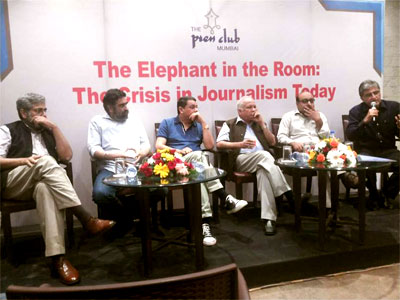
    The Press Club Mumbai held a discussion called, The Elephant in the Room: The Crisis in Journalism Today on Thursday evening. Participants were Kumar Ketkar, editor of Divya Marathi, Siddharth Varadarajan, former editor The Hindu, Hartosh Singh Bal, former political editor of Open magazine, Indrajit Gupta, former editor of Forbes magazine and Uday Shankar, CEO of the Star television network. The discussion was coordinated by Gurbir Singh, president of the Press Club.


    At the outset, the Mumbai Press Club has to be congratulated for confronting and seeking to address the problems faced by journalists and journalism today and flying down participants from Delhi for this discussion. If we do not discuss these things ourselves, it will become impossible to deal with the credibility and sustenance crisis we face. The bodies that have existed so far – like The Editors’ guild for instance – are quite frankly useless.


    The discussion started with Siddharth Varadarajan and Hartosh Singh Bal discussing the involvement of owners in the day to day running of publications and the pressures of advertising and management. Both Vardarajan and Bal lost their jobs because of owner interference. Kumar Ketkar questioned why owner, politicians and corporates imagine that journalists are really that powerful! Indrajit Gupta, who also left Forbes after a confrontation with management, pointed out how advertising pressure often does not allow journalists to function properly. Uday Shankar was scathing in the dereliction of duty by editors, pointing out that many had found it easier to go with the owner-flow rather than resist pressure, for their personal profit or advancement.


    Actually, almost everyone agrees with that. Editors, for the most part, are not what they were. But as veteran journalist Jyoti Punwani pointed out from the audience, the editorial versus management is age-old. The panellists could not agree on any solutions however. Bal for instance wanted a legal framework to protect journalists from owner pressure. Everyone wanted ownership patterns to be more transparent. And that was the crux of the discussion: dealing with management pressures whether it was to do with politics or business interests. How to make money and uphold the principles of journalism was a major issue discussed, including every journalist’s dream: to have a publication or broadcast house where the owners/managers did not interfere. The problems of credibility caused by the revelations of the Radia tapes and the questionable roles of Barkha Dutt and Vir Sanghvi also came up.
     

    All in all, it was a lively discussion. The event was web-streamed, which was an excellent way for the Mumbai Press Club to widen the debate’s audience and keep up with the 21st century. Net viewers sent in their questions via SMS.


    Although no conclusions were reached – the discussion went on for two hours – it is enough that the crisis was talked openly and candidly. Kudos to the Mumbai Press Club and all the participants.


    **


    Is it a sign of pride or insecurity that makes the Indian media go overboard whenever any person of Indian origin does anything at all? The ascension of Satya Nadella to the head of Microsoft was treated by some Indian newspapers in particular like Nadella had become President of the United States. Yes, Microsoft is a big and powerful company and yes, Nadella is of Indian origin. But above-the-fold on the front page is overdoing it, surely. In any case, the business pages had been predicting it for days.


    I suppose all it needs is for American newspapers to run front page stories headlined, “Microsoft founder Bill Gates is an American”. Yeah, I bet you would laugh then.


    **


    The battle over the Indian Readership Survey is getting more serious but remains funny. That Hindu Business Line should have more readers in Manipur than Chennai or that Nagpur’s Hitavada should have no readers at all speaks of completely mismanagement if not deliberate fudging of figures. Those with some memory may recall that the National Readership Survey was abandoned in favour of the IRS precisely because of such problems – but of course not quite so daft.


    **


    Somebody asked a question at the Mumbai Press Club last night to which I had no answer. Why, she said, is it okay for Swapan Dasgupta and MV Kamath to be openly pro-BJP and rightwing but it is not okay for anyone to be pro-Congress? Indeed. Why?


    Ranjona Banerji is a senior journalist and commentator based in Mumbai. She is also Contributing Editor, MxMIndia. She can be reached via Twitter at @ranjona. The views here are her own


  • Ranjona Banerji: News media and its political leanings

    By Ranjona Banerji


    If you go by the internet alone, the Indian media is involved in some gigantic Spy vs Spy battle where Congress and BJP aligned journalists are playing a cloak and dagger game as sinister and silly as the one in Mad magazine. The words “paid media” are used so often that they have stopped being tiresome and are now just funny.


    And yet and yet, there is something that is going on under the surface, a division in the journalistic world perhaps not seen on this scale since the BJP’s rath yatra and the split in the country between those who wanted to break down a mosque to build a temple and those who did not. At that time, many journalists were quite surprised to discover that their colleagues were actually not as “secular” as they seemed and many were quite turned on by the religious sectarianism propounded by LK Advani and his BJP. The default image of the journalist as a jhola-bag-carrying Commie was forever banished.


    But there is a subtle difference between what happened then and what is happening now. At that time, individual journalists expressed their choices. For instance, The Times of India was a middle of the road newspaper, rather dull in fact while its editor Girilal Jain was a Hindutva supporter. The ownership played little role. The Indian Express and Ramnath Goenka were openly anti-Congress but in those days, pre the Ram Janmabhoomi movement, there was a sort of innocence as far as religious loyalties were concerned.


    Now, it is managements who are setting the agenda and journalists who are falling in line – some, it must be said, with more enthusiasm than others. TV18 has been the most obvious and the most prominent to recently align itself with the political right and most notably with the BJP’s prime ministerial candidate Narendra Modi. Before this switch though Rajdeep Sardesai, editor-in-chief of CNN-IBN had been accused of being in favour of the Congress. Even now, Karan Thapar is scrupulously fair and Sagorika Ghose is seen as the last Congress outpost in a BJP bastion! And what about the others? NDTV has long been accused of being pro-Congress. But during the Kargil “war-like” situation, others called it out for its “embedded” journalism which benefitted the BJP electorally.


    I worked with The Times of India in Ahmedabad during the Gujarat riots of 2002. Despite enormous pressure on the newspaper ownership and management from the governments in Delhi and Gandhinagar to stop our edition from reporting on the riots freely and fairly, the management not only stood by us but supported us wholeheartedly.


    The Living Media group has been accused of being pro-Sangh Parivar for some years now. And there was a time when its flagship magazine India Today was clearly tilted towards the right. (I worked with the group for many years in the 1980s when no such tilt was visible or conveyed to us.) But in that case, what does one make of the So Sorry cartoon series on Headlines Today which lampoons all Indian politicians quite superbly? This is unlike the once excellent The Week That Wasn’t on CNN-IBN which has suffered since TV18 turned right. It’s a tough call here – maybe they change their minds from week to week.


    One of the reasons why The Hindu apparently removed Siddharth Vardarajan as editor was because he did not give enough coverage to Narendra Modi on the front pages of that venerable newspaper. But The Hindu has always been seen as a pro-Left newspaper (and therefore not pro-right). So what is one to make of that?


    The Indian Express often receives the most flak from the rightwing on social media so evidently it has not stuck to the Ramnath Goenka brief.


    The fact is that because the Indian media does not openly align with political parties or movements, confusion is easy and suspicions even easier. In the UK, for instance everyone knows where a Guardian reader stands politically vis-a-vis a Daily Telegraph reader. The best compliment a newspaper or media group can be paid in India one supposes is when all groups accuse it of being biased. That means that something is being done right.


    The new player in the pack is the Aam Aadmi Party which has learnt the game very quickly and throws around allegations of media conspiracy theories with impunity. The irony in the fact that several senior journalists have jumped on to the AAP bandwagon does not occur to them. That is not surprising because irony-deficiency is a well-known symptom in the congenitally self-righteous.


    In all this, the maximum confusion is over the expression “paid news”. When the media uses the phrase, it is a direct reference to money taken by newspaper or media house managements from a political party to get favourable news printed. This is also how the Election Commission uses the phrase. When social media uses the phrase, it means any journalist who does not agree with the political position of the accuser! Ah well, sticks and stones.


    Ranjona Banerji is a senior journalist and commentator based in Mumbai. She is also Contributing Editor, MxMIndia. She can be reached via Twitter at @ranjona. The views here are her own


  • Ranjona Banerji: Disappointing and limited political coverage by Eng media

    By Ranjona Banerji


    Remember these words: “You shouldn’t think the media can do everything. It has a limited role.” This is Bihar chief minister Nitish Kumar talking to The Economic Times in a straight-talking, candid interview, about the BJP and Narendra Modi’s chances at the general elections. This interview comes just as I was getting bored with The Economic Times! Some food for thought for the media here: it does have a limited role. And the way the English media at least is going, ignoring large swathes of India to focus on the nitty-gritty of the local Delhi government, it is limiting its own role.


    Kumar mentions in this interview that a senior Delhi journalist had told him in 2012 – after his party the Janata Dal (United) split from the NDA – that four rounds of opinion polls had been planned to promote Modi and BJP as the winners in 2014. The collusion between political parties and Delhi’s journalists is nothing new and we see it in our newspapers and on our TV screens every day.


    For instance, Mamata Banerjee held a massive rally in Kolkata which saw lakhs of people turn up on January 30. It did not dominate media space the way any of Modi’s tiny little conversations or Arvind Kejriwal’s coughing fits do. I could not find a photograph in any of the national newspapers which I receive at home (four) although they did carry stories. Banerjee also has prime ministerial ambitions and as of now, she has control of Bengal, which sends 42 parliamentarians to the Lok Sabha.


    Talking about interviews, I only caught the Omar Abdullah interview on the BBC’s Hard Talk series in India. Stephen Sackur asked tough questions but interacted with Abdullah, who stuck to his own and answered those questions. If there is no back and forth in a conversation, the viewer gets distracted or annoyed. This interview managed to grab your attention. But enough flogging the same dead horse because from what I can see, people are still talking about the “interview of the century”!


    **


    In a small segue to sports coverage, I am disappointed to see so little about the Davis Cup ties which are about to start today. The Times of India has sidestepped tennis completely, except for a small mention that Roger Federer will play for Switzerland. Mid-Day, surprisingly, has nothing. The Indian Express comes good – with a focus on how both Leander Paes, who has India’s best Davis Cup record, and Mahesh Bhupathi are not playing.


    But the winner has to be Hindustan Times. On January 30, it carried an excellent interview (here we go again!) with Leander Paes and why he’s not playing this Davis Cup tie, underlying the politics that is strangling tennis in India. In today’s paper, (January 31), the back page is dedicated to tennis.


    The Times is perhaps like Star Sports India for whom sport is equal to cricket.


    **


    In all this media bashing, one has to acknowledge that when it comes to gender issues and violence against women, the media is not letting up. Every day, more and more horror stories are highlighted about just how women are treated in this country. Distressing as all this is to read, wider publicity is one way to tackle the issue if just to highlight what is going wrong. The media’s role may be limited but this is one instance where it can be effective!


    Ranjona Banerji is a senior journalist and commentator based in Mumbai. She is also Contributing Editor, MxMIndia. She can be reached via Twitter at @ranjona. The views here are her own


  • Ranjona Banerji: The Rahul Gandhi interview was more about Arnab Goswami

    By Ranjona Banerji


    Am I a serious journalist? After last night’s interview of Rahul Gandhi conducted by Arnab “I am a serious journalist” Goswami, I have come to the conclusion that I am emphatically not. My understanding of being a journalist is less me and more you. An interview has to draw out the interviewee. It has to place them on the spot, yes, but it cannot be about the interviewer. And an interview has to move along – if it’s getting stuck, you have to step back and come back to that unanswered point later. The reader or the viewer has to be your first priority.


    In this case, the unanswered point was the 1984 riots in Delhi where thousands of Sikhs were massacred by Congress members and others after Indira Gandhi’s assassination by her Sikh bodyguards. The horror of the killings was exacerbated by Rajiv Gandhi’s comment at the time that the ground shakes when a big tree falls. The point is important. The problem was that Rahul Gandhi was not the person to answer it. He was a child when it happened. The party has apologised since then as has the current prime minister. Why badger Rahul Gandhi endlessly on this issue when you can take him up on so many others.


    Then there’s the issue of corruption. Instead of talking about the sea of allegations against the Congress Party and issues like the coal allocation scam, Goswami got stuck on allegations against Virbhadra Singh, chief minister of Himachal Pradesh, based on some investigation that Times Now had done. Much as the nation apparently wants to know what Goswami thinks every weeknight at 9 pm, there is an India beyond Times Now. Really.


    Moreover, the number of times Rahul Gandhi mentioned “RTI”, “youngsters”, “women” and “empowerment”, anyone else would have taken him up on those issues and questioned him on what he had done about it. There are a number of problems with RTI in the states, including Congress-ruled states. Why not bring those up? What about the brother-in-law Robert Vadra? Not a single question on that.


    Bringing up Subramaniam Swamy’s allegations about Rahul Gandhi’s education was ludicrous. The kindest thing one can say about Swamy is that he is a “maverick” and he is infamous for throwing allegations all around, hoping something somewhere will stick. He is hardly the gold standard for information.


    The endless questions on Narendra Modi and the Gujarat riots became tedious after a point. And just to inform journalists in general, Modi did not get a “clean chit” from anyone. The SIT report said “no prosecutable evidence” which is quite a different matter.


    The whole interview sounded too structured. There was no flow and there was no charm. As of now, Rahul Gandhi does not stand accused of anything except being seemingly reluctant to take on too much and vanishing after making declamatory statements.


    I for one learnt little new about Rahul Gandhi except that he has some good artwork on his walls.


    However, the funniest thing about this interview was the “discussion” later with Vinod Mehta, editor emeritus of Outlook magazine and Siddharth Vardarajan, former editor of The Hindu. This was a first for me: an interviewer holding a discussion on how his interview went. If this is how serious journalists behave, well, thank the lord there are so many of us non-serious ones around!


    I hear that tonight there’s going to be even more discussion, from 8 to 11 pm. Luckily I have found itvchoice on my HD set top box so I shall watch some British reality TV shows about dancing on ice, dancing in your house and dancing in general. As it is I missed Elementary on AXN because of this interview.


    Or there’s always the BBC’s Hard Talk series on India…


    **


    Twitter not unnaturally was abuzz with the Rahul Gandhi speech and suddenly, Modi and Arvind Kejriwal (have I got the order wrong?) were off the grid, except when mentioned with regard to Gandhi.


    Now that was funny. May not last too long though.


    Ranjona Banerji is a senior journalist and commentator based in Mumbai. She is also Contributing Editor, MxMIndia. She can be reached via Twitter at @ranjona. The views here are her own


  • Ranjona Banerji: Did Sunanda Pushkar story merit top billing?

    By Ranjona Banerji


    The last few days saw the news cycle consumed by Sunanda Pushkar, Shashi Tharoor and Mehr Taraar with allegations of affairs and unhappiness. There was a tragic culmination to the story with the suspected suicide of Pushkar. But how important was this story, that newspapers and news channels gave it top billing?


    Sunanda Pushkar was the wife of junior minister Shashi Tharoor. The world (other than the cocktail circuit of Dubai and perhaps New Delhi) knew of her because of the controversy of the Kochi IPL team, where both she and Tharoor had some involvement. It was IPL commissioner Lalit Modi who revealed details of the Kochi team through his Twitter account. Tharoor had to resign as minister, Pushkar removed herself from the Kochi team and the rest of us became familiar with the term “sweat equity”. Tharoor married Pushkar and then both became the darlings of the Delhi cocktail party crowd.


    So far, there is no indication of how important either Tharoor or Pushkar are to the national narrative. When Pushkar started tweeting last week from her husband’s phenomenally popular Twitter account, it was all about how some Pakistani female journalist was stalking her husband. The journalist in question, Taraar, denied allegations, Tharoor said his account had been hacked, Pushkar said it wasn’t hacked and that she had been tweeting. She made elliptical allusions to an affair and then to how she had been made the scapegoat in the IPL controversy. All this was played out on social media and to a salacious mainstream media.


    Still, nothing of national interest is visible here except a gossipy prying into other people’s lives. It is true that Pushkar made it all public but that has no bearing on the importance of the material. Then Pushkar is found dead by her husband in a Delhi hotel room and that ends all other news. Apparently, top news anchors even stopped the nightly debates when they got the news on the cellphones.


    When Princess Diana died in a car crash in Paris in 1997, The New York Times famously decided not to make it the top story of the day. By any reckoning, Diana was more famous than Pushkar. As obituaries of the poor woman appeared in newspapers across India, most people had nothing more to say than Pushkar was warm, vivacious, a good cook and lit up parties when she entered them. Others mentioned that she was a bit of a social climber and old school friends popped up to tell us that she was a shy, withdrawn girl who wanted to shrug off her small town origins.


    The significance of the front-page leads and top billing on news channels is still unclear. The Delhi government with India’s new hope Arvind Kejriwal is involved in all kinds of bizarre tactics. Rahul Gandhi and the Congress are making valiant efforts to get back into the conversation. Narendra Modi is smarting from Kejriwal’s popularity while trying to save the country. And enough other sundry horrors happening all over the country and world to keep journalists occupied. So why did this story get so much importance?


    Here’s a theory: Delhi’s journalists knew Pushkar and Tharoor socially and therefore felt a personal loss with her death. They also felt some guilt at the way the affair allegations were played out in the media. The decision to make Pushkar top news was therefore a personal one, where the reader or viewer was forgotten. There is no justification at all for making this story more important than any other, even with the understanding that every such decision is a judgment call that can be contested.


    Even with Shashi Tharoor being a minister, this story was overplayed. The only takeaway is that everybody in India who takes part in the English media knows more about Sunanda Pushkar in her death than before. C’est la vie?


  • Ranjona Banerji: When newsmedia went nuts about Tharoor

    By Ranjona Banerji


    And so we reach our most ridiculous news headlines via Twitter – so far. A bizarre and somewhat corny marital spat between Union minister Shashi Tharoor, his wife Sunanda Pushkar and a Pakistani journalist, Mehr Tarar. Tharoor is not new to Twitter controversies. He has got into trouble for a jokey tweet about travelling “cattle class” to please the “holy cows” of his parties. His involvement in the shortlived Kochi IPL team and that of Pushkar was revealed by Lalit Modi on Twitter and cost him a ministry position.


    But this was something else. Tharoor, who has over 2 million followers on Twitter, was suddenly found to be tweeting odd messages from Tarar, claiming undying love on whatnot. Then he issued a tweet saying his account had been hacked. Then his wife popped up saying the account was not hacked and that she had put up those tweets, based on messages sent on the Blackberry messaging service to her husband. Then Pushkar gave a series of interviews claiming that Tarar was an ISI agent who was stalking her husband, then she denied some of them, then she didn’t. Tarar jumped in, defending herself and threatened to sue Pushkar.


    All in all, another fine mess for Tharoor and a hilarious day for the world of Twitter and the media. Getting into the personal lives of celebrities is normally the domain of film publications and even they pussyfoot around our precious film stars (for fear of being denied the next interview) or upsetting some PR person. But for the Economic Times to put this Twitter fight on the front page is certainly unusual. Thursday’s ET had this headline, above the fold: “Tharoor gets into a Border Love Row”.


    By Friday, every newspaper had the story. The Times of India dedicated a whole page to the matter – and this when there was one more horrific rape in the national capital, the AAP was involved some questionable form of vigilante justice and Rahul Gandhi was or was not going to be the Congress nominee for prime minister. Now we all know all about Pushkar, Tarar and Tharoor – or at least I know far more about them than I ever wanted to.


    What to make into news… Journalists use the term “judgment call”. So how much news was in a spat between a husband, a wife and another woman? Yes, the husband is famous, the wife is high profile and the other woman was a great admirer of the husband. But was this front-page worthy for anyone, apart from the salacious nature of the story and the fact that the wife made it public? It is difficult to make a value judgment here but it is easy to see that this will not be an exception. It is likely to become the rule.


    Once again, social media is changing the equation as far as the traditional media is concerned. I am holding back from using a cliché like “interesting times” but I do concede that this particular story is quite funny, proving that other cliche that the truth is much funnier than fiction.


    **


    The media spotlight on the Aam Aadmi Party and Arvind Kejriwal is turning out to be a curse as much as it was a boon in the movement’s formative days. The vigilante actions by two AAP ministers in Delhi and their run-in with the police, Kejriwal’s need to hold a press conference every two minutes, the revolt by a vocal member – all these have only increased the scrutiny and the more the scrutiny, the more the trouble up ahead.


    **


    The only person weeping right now (apart perhaps from Tharoor) is Gujarat chief minister Narendra Modi who will have to pull off something staggering to become the media’s foremost darling once again.


    Ranjona Banerji is a senior journalist and commentator based in Mumbai. She is also Contributing Editor, MxMIndia. She can be reached via Twitter at @ranjona. The views here are her own


  • Ranjona Banerji: No ‘fine and dry’ puhleez, dear BBC!

    By Ranjona Banerji


    I have spent the last three weeks reading back issues of Time magazine. And I am amazed that their rewriting style (from what I recall, you are not really allowed to have a writing style at Time) has not changed at all. The same inverted sentences. The same twist at the end. The same short phrases to try and be current, even though some go back at least 25 years. This is testament to Time’s covenant with its principles – stick to what you started with even if your readership is shrinking and everyone around you has changed. A tip of the hat to this nostalgia-inducing standard practice: I practically went back to my childhood which was… well, it was a long time ago. You don’t want to know!


    **


    I have to confess that I have not read too many newspapers (this is a gross exaggeration: I have read precisely two) in the past 10 days. I have kept up with the news through social media and through some television. And by watching English news channels, you may forget that India is such a massive country.


    Instead: there is Arvind Kejriwal, chief minister of Delhi. Now New Delhi may be India’s national capital and it may have a state government but it cannot compare to any other state government. The chief minister of Delhi is responsible for about a quarter of the things – I am being generous here – that other chief ministers contend with. Yet, we have national news channels behaving like local cable news channels. What Kejriwal had for breakfast, what he wears to bed, the progress of his cold, how Delhi government officials may well be crooked, how to get a water connection in Delhi and on and on and on. We get it. Kejriwal and his Aam Aadmi Party achieved something miraculous in the Delhi assembly elections. Now move on. Other things are happening in the rest of India.


    The rest of TV news however is as blinkered. We are stuck in an endless spiral of Congress versus BJP fistfights. One party says blue so the other says yellow and it never ends. News channels set themselves up as pasties here as shrewd politicians play them for fools so easily. We understand that newsgathering is expensive and laborious. We know that TV has to look for instant gratification. We are aware that fighting for attention is a mug’s game. But still, it would be interesting once in a while to watch television and just get a picture of what’s happening in the world instead of a tailored picture of what might possibly create the most sensation.


    **


    This is a request to the BBC World Service’s weather department. We understand that the English are obsessed with the rain and crave the sun. But the whole world is not England. India for instance gets most of its rain from the monsoon. It rains sporadically in a few parts of India outside the monsoon – and most of this rainfall follows a very specific meteorological pattern. We in India are taught this as school children. For instance, if it rains in Mumbai consistently after the monsoon is over then it is a possible indication that the world’s climate is undergoing some immediate catastrophic crisis. Similarly, some parts of South India get the retreating monsoon. The North will be affected by westerly disturbances and it will snow in the Himalayas in winter.


    So we need some pertinent weather forecasts from the BBC World Service. Like when people are dying of the cold in North India, we don’t need to be told that the weather is “fine and dry”. We need to be told about falling temperatures. We know that it is not likely to rain in Madhya Pradesh in December. So “fine and dry” are tautological. Conversely, when there is a heat wave in summer and people are dying, “fine and dry” sounds like a slap in face. Summer is when we crave for rain, really, we pray for the monsoon. We sing those Bollywood songs your pop culture experts are so fond of.


    Also, when you run weather forecasts for the British in Britain on the BBC, you can advise them where to holiday. But for the World Service, it might be nice to concentrate on us. And tell us the weather of the world as well – there could have been more on the polar vortex, on the heat wave in Australia, on flooding in Europe. Please don’t take this badly. It’s just we’re so tired of “fine and dry”.


    Ranjona Banerji is a senior journalist and commentator based in Mumbai. She is also Contributing Editor, MxMIndia. She can be reached via Twitter at @ranjona. The views here are her own


  • Ranjona Banerji: Debauchery UnLtd on News TV

    By Ranjona Banerji


    There are few things in the media as amusing as the manufactured outrage of TV anchors as they work themselves into a state over some burning issue of the day. In this case, the case was that of freezing but the anger was far from cold. Imagine this list of horrors: people freezing in riot-relief camps in Muzaffarnagar, UP. Children dying from the cold. And UP chief minister Akhilesh Yadav and his father Mulayam Singh Yadav got Bollywood stars to dance at a function at their village, Saifai. And 17 UP legislators including several ministers skipped off on a “study tour” of Egypt, Venice and the UK amongst other destinations in spite of strict proscriptions from news channels.


    The sheer disobedience of these politicians is not to be countenanced. It was not for nothing that Arnab Goswami informed a Samajwadi politician from Mumbai in stentorian tones: “It is time you politicians learnt to listen.” The “to me” was implied and not missed by anyone.


    Arnab Goswami, I have to say, was at his best. His lip curling, his constant use of the word “debauchery” to describe Bollywood dances, the utter contempt in his voice as he spat out the phrase, “nagin dance” to describe the “snake dances” so popular in Indian cinema: these were all gems that had the making of a classic News Hour debate. In fact, debauchery was the word du jour as it was repeated across channels to explain what was happening in Saifai, with images of Madhuri Dixit and random starlets (at least I think they were starlets) wiggling their hips and bosoms across our TV screens.


    It is true that the extravaganza at Saifai was inappropriate and deeply lacking in compassion in light of what was happening in Muzaffarnagar. But everything that happened in Muzaffarnagar was an abomination from the riots to the post-riot reactions. The song and dance at Saifai was just one more example of this.


    It was intriguing though that there was no Bollywood rep on the Times Hour debate to explain just why stars like Salman Khan and Madhuri Dixit had agreed to dance for Mulayam and son. And I have to say I have seen senior TV anchors (and this includes Goswami) just snivelling and grovelling in front of Bollywood’s most vacuous and vapid “stars”. If they were so angry with Bollywood for going to Saifai, there’s no point shouting at politicians. Get the whole of civil society involved in the discussion and ask Bollywood point blank why it is so brainless and lacking in compassion. Or even common sense. Don’t just expound on the issue. And try and remember a bit of this outrage the next time you make some movie star your guest editor for the day just in time for the release of his or her new movie.


    Watching News Hour and some of Rahul Kanwal’s Centre Stage on Headlines Today, you have to feel for these star TV anchors. What they really want is a platform where they can share their opinions with the world. Instead, they’re stuck in a format where they have to ask other people for their opinions. I would advise Indian television news once again to watch the film Network and craft programmes based on Howard Beale’s long rants (so brilliantly played by Peter Finch). That way, these TV stars will not have to be forced to listen to other people’s opinions when all they want to do is editorialise. I must say us print-wallahs have it much easier because we have platforms available where we can share our opinions.


    Of the shows in this format, Karan Thapar’s Last Word on CNN-IBN and Nidhi Razdan’s Left Right and Centre remain the least hysterical. The others? Well, they’re all mad as hell and don’t want to take it any more. So let them tell us freely and openly, no?


  • Ranjona Banerji: Knives out for AAP & Kejriwal as media tries to be judge, jury & executioner

    By Ranjona Banerji


    When the India Against Corruption movement started two years ago, I like so many else, watched its genesis with amazement on TV. I got so amazed in fact at the crowds that I dragged a friend of mine, who is interested in political affairs, to Mumbai’s Azad Maidan to see these massive crowds of people coming out in solidarity against corruption.


    Alas, like corruption is endemic in the Indian system so is exaggeration in the media. There were barely 500 people at Azad Maidan. Luckily for disappointed journalists, the Press Club is pretty close to Azad Maidan and we could drown our murdered amazement and toast our inherent cynicism with plenty of gin, vodka and as other friends joined us, rum.


    Reporters I spoke to who had spent more time at the rally said crowds rose to about 1000. At the basis of a journalist’s mindset is cynicism or for those of a kinder mien, scepticism. And the reason for this long-winded personal recounting is that I could no longer look at the India Against Corruption movement with anything but a questioning air after that day in Azad Maidan.


    If I had believed TV news, I would have thought this really was comparable to the Independence Movement, to Jayaprakash Narain’s revolt against Indira Gandhi and so on. And when the last India Against Corruption meeting in Mumbai’s MMRDA grounds in Bandra fizzled out one December, it seemed to be in the fitness of things.


    However, even cynics like me must acknowledge that Arvind Kejriwal and the Aam Aadmi Party have pulled off a coup in the Delhi Assembly elections. They have shaken the political establishment and sent strategists running for cover. But the media reaction is most curious of all. The media built both IAC and AAP, and in the run up to the election gave more coverage to the candidate for Delhi chief minister than even to the BJP’s prime ministerial hopeful.


    But as soon as the government was formed, the knives were out. The same TV channels which had lauded Kejriwal and the AAP as the greatest political invention since democracy was established by the ancient Greeks now decided to expose their somewhat extravagant promises. Let’s take Headlines Today’s latest sting operation on corruption in various government departments in Delhi. By itself the Headlines Today sting was a brave and necessary act of journalism, even for someone who is ambivalent on sting operations which create news rather than report on them.


    The problem is the positioning of the sting as a failure of a nine-day-old government and the insinuation that the new party has already fallen apart on its promises. Maybe the government will fail and maybe it won’t. But this judge, jury and executioner attitude of the media does not do it credit. Moreover, it sounds both childish and churlish.


    By all means do a sting operation but present it as just that – the continuing shameless manipulation of the system by petty government officers and bureaucrats. Sentencing can wait. It ruins a perfectly good expose of government corruption if nothing else.


    The rest of TV seems unable to get out of a Congress-versus-Bharatiya Janata Party mindset. Everything that happens is seen through that prism and it is definitely tedious and boring now. The same faces saying the same things everyday and the same accusations being exchanged. There has to be something more to a journalists’ life than this.


    Meanwhile Lok Sabha TV had an excellent and informative discussion on the recent elections in Bangladesh and the skewed attitudes of western powers when it comes to South Asia. You know Bangladesh? That country next door?


    Ranjona Banerji is a senior journalist and commentator based in Mumbai. She is also Contributing Editor, MxMIndia. She can be reached via Twitter at @ranjona. The views here are her own


  • The Year in News Media


    By Ranjona Banerji


    It’s Tarun Tejpal, right? I cannot think of a bigger media story of 2013. The outrages before that had been layoffs, ill-treatment by employers, closing down of publications. Network 18 and Outlook group were most talked about on those issues.


    We even had a few high-profile sackings. The Hindu suddenly decided that it no longer wanted the services of editor-in-chief Siddharth Vardarajan. This was a bit of a surprise since Vardarajan had been appointed the year before with much drama: highlighting the immense family feud which is the Hindu board, where N Ram had overridden everyone else. Ram had then claimed that the newspaper had to employ professional journalists for the top posts and not keep it all in the family. However, along the way he changed his mind, and some of the siblings joined forces, ousted Vardarajan and took control of the paper again. It should be noted that some family members disagreed with this decision and against Ram’s claiming two votes for himself.


    Hartosh Singh Bal, political editor of Open magazine, was also “let go”, he said because the owner (Sanjiv Goenka) didn’t like his political leanings. Goenka said he didn’t and never had liked Bal. Manu Joseph said he had protected Bal as long as he could but could not do so any more. Bal said he was going to sue Open because for too long had owners taken journalists for a ride.


    Forbes magazine saw the exit of its top editorial staff as well as its CEO, seen by many as part of Network 18’s downsizing drive. The senior staff also said they would take legal action against the group.


    Television saw many sackings but few of them were high profile. Hundreds of nameless and faceless video journalists and support staff were not interviewed by top television anchors and who knows if they have exercised the option of a judicial solution.


    The stomach-wrenching gangrape of a young photojournalist out on assignment in Mumbai brought the issue of women’s safety in public places back to the front pages. The young woman was accompanied by a male colleague, it was still daylight and although they were in a deserted mill, it was situated in a crowded part of the city. The nation mourned at one more heinous assault and marvelled at the courage of one more woman.


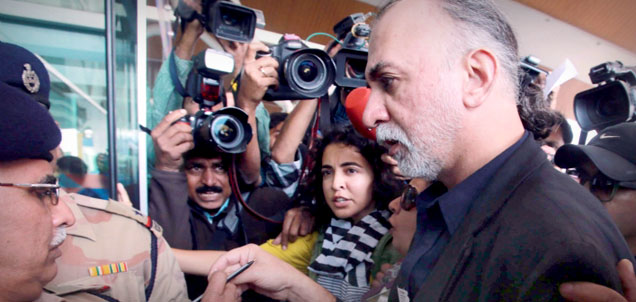
    And then there was Tehelka. The story about editor-in-chief and founder Tarun Tejpal and his “alleged” assault on a young reporter who worked for him broke suddenly and each passing day provided new shocking material. The assaults happened in Goa, during the ‘Thinkfest’ which is some sort of a Tehelka subsidiary. The reporter complained to Tehelka managing editor Shoma Chaudhury that Tejpal had assaulted her 10 days before and then within days, the Tehelka story was over, nothing was secret or hidden and Tejpal was in judicial custody.


    The lessons for the media seem pretty clear. For one, there is no protection for journalists any more, especially from fellow journalists. Public pressure if nothing else will make cover-ups difficult, if the supposed transgression causes enough outrage. For another, the internet has busted everyone and it is in control in its own crazy haphazard way.  The way information spreads (or even misinformation for that matter) and the way the sender can be anonymous, you cannot be surprised that the word given to it is “viral”.


    So Tarun Tejpal and Shoma Chaudhury became “victims” of this new world where little can remain secret. And set a message to the media that while it must highlight everyone else’s misdemeanours, it cannot ignore its own. How effectively we take that into the future remains to be seen… my bets are on more mistakes before better sense hits people on the head.


    Ranjona Banerji is a senior journalist and commentator based in Mumbai. She is also Contributing Editor, MxMIndia. She can be reached via Twitter at @ranjona. The views here are her own


  • Ranjona Banerji: Patriotism rules in US media in Khobragade case

    By Ranjona Banerji


    The Devyani Khobragade and Sangeeta Richard case continue to dominate headlines mainly because it still remains so confusing. Every time you feel that the diplomat (or consular officer if you prefer) was the victim, some new bit of information surfaces that makes it clear that the domestic “assistant” was the one being mistreated. And so on. I watched Barkha Dutt’s ‘We the People’ on this subject and it answered none of the questions.


    Uttam Khobragade, Devyani’s father, was in a rage. The former Indian diplomats on the show dismissed the US’s actions and brought up their double standards. The diplomats said that the US had no jurisdiction on anything that happens in a contract between two Indians on what can be considered Indian “territory”. The academics and activists brought up the issue of the ill-treatment of domestics in India and by Indians. The sole American, a journalist with the New York Times, tried to defend his country’s actions in arresting Khobragade and brought up the issue of domestics.


    The audience, except for one person who said the US had to follow its own laws, was furious, although a few did accept that domestics were not treated well. Meanwhile, allegations have surfaced that Richard may be a CIA agent! On the face of it, this sounds a little far-fetched although it will give conspiracy theorists much to fulminate about.


    The US media however has sided firmly with their government and severely scolded India for forgetting the “other victim” – as in the domestic assistant. Edits and opeds in The New York Times, the Washington Post, The Wall Street Journal and for all I know the Poughkeepsie Bugle have all rapped us on the knuckles. Some of these have been written by well-known American columnists like Roger Cohen. Others have been written by the vast army of non-resident Indians who are all experts on India, having lived here until they were six and returned at 26. Good to know that the patriotic journalist is alive and well. I however would have expected more cynicism against their government from American journalists but perhaps not from a media which made “embedded journalism” into an accepted form of the profession?


    In India, however confusion or freedom of speech reigns and different columnists and editorial writers have taken different stands on the issue.


    **


    How do you spell “aam aadmi” as in the common man as in the name of India’s newest and most definitive political party? The general consensus would be “aam aadmi” but The Times of India has bucked the trend and gone with “aam admi”. Sounds and looks odd.


    **


    Is it because of sustained social media pressure that mainstream newspapers have started covering the Aston Martin accident on Pedder Road again? After silence for a few days, the name “Reliance” has surfaced again in newspaper reports. However, these are just tiny little single columns…


    **


    I was part of a panel discussion at the St Pauls Institute of Communication Education in Mumbai’s Bandra area on Saturday, December 21, where the subject was, “The Media vs Tarun Tejpal: Activism or Selective Conscience. My fellow panellists were Bharat Kumar Raut, a senior journalist and currently a Rajya Sabha MP, Dilip D’Souza, author and columnist and Swati Deshpande, legal editor of The Times of India. The discussion was moderated by Shashi Baliga, a senior journalist, columnist and executive director of Literature Live.


    It was a lively chat where each of us had our unique perspective but the general consensus was that the media was right in the way it covered the Tejpal case, even if there was some overstepping of boundaries. Heartening was the fact that the media knows that it has been lax about dealing with internal cases of sexual harassment.