Tag: freaking news

  • Ranjona Banerji: Peeves about Pronunciation

    By Ranjona Banerji


    In the Indian Express of December 10, Kabir Firaque wrote an article about how Assamese names are often mispronounced by Indian in general and especially Hindi-speakers. He was referring largely to the little political spat between current Assam chief minister Tarun Gogoi and the BJP in the state over this issue. However, the media were also mentioned.


    As anyone who is not from the Hindi heartland knows, there is every chance that your name and your language will be mangled beyond repair by journalists on television. Firaque explains how something as basic as murder victim Sheena Bora’s name is pronounced wrong almost every time it is used on TV, which is very often. The “Bo”, he says, is not the “Bo” of “Bose”; it is the “Bo” of “Bond”.


    How much effort does it take to get the pronunciation of a word correct, if you’re job is to speak in public? My teeth are on edge every time Kolkata is mispronounced (always). It is not “Kol” as in the “pol” of politics. It is “coal-kaata”, with a soft th. Might as well call it Calcutta as every Bengali has called it in English for years, just as every  Bengali calls the city Coal-kaatha” when speaking Bengali. Even the grating Hindi “Kul-kuthha” is better than the abomination of the Kol-pol.


    Okay, rant over.


    Of course, no one has more right to complain (sorry, Tarun Gogoi) than every state in South India. The North makes a merry mess of everything to the extent that even those of us who are not from the South know that something is amiss. It started with Doordarshan’s Hindi news bulletins years ago, which referred to the states of “Keral” and “Tamil Nad”. Since then, whatever the Hindi belt things is correct is what goes. The only thing in their defence is that no one from the rest of India can really make out why the “zh” stands for in so many names. The only possibly positive outcome for the media by the shocking revelations of the Niira Radia tapes is that more people now know how to pronounce Kanimozhi’s name correctly. Or somewhere close to correctly.


    On a personal note, and this has nothing to do with the media, my own name because of its peculiar spelling has been pronounced wrong my whole life. I now find it amusing, mainly because I’m not a politician trying to win an election on sectarian grounds. The best mispronunciation of my name was in Norway where the offensive “j” was replaced to give me an interesting “Ronya”. Maybe I should have changed it to that to start a whole new merry-go-round!


    **


    Is the following sentence incipient sexism or just someone trying to be too clever? The December 10 edition of the Dehradun edition of The Times of India carried a story its front-page News Digest and also on the inside pages headlined, “Girl turns back groom for flunking IQ test”.


    Let’s let the “girl” go though if you are old enough to be married legally, you are not a girl but a woman. The first line of the story reads, “God save men from brides like this.” The line is so offensive in so many ways that one can only hope that someone, either the writer or the sub-editor was trying to be funny. The story is about a woman (bride) who discovers that her groom who was supposed to be an engineer was quite clueless about most things and probably lied about his education.


    In fact, if I had edited or written this story my first line would have been, “God save women from lying men like this”.


    As is clear, I am not with the zeitgeist. Patriarchy rules.


  • Two views on news on Chennai


    Shailesh Kapoor: For our Media, Chennai is no Mumbai or Delhi


    By Shailesh Kapoor


    Call it nature’s fury or a man-made calamity, or indeed a combination of the two, Chennai is reeling under one of the most severe crises a big city in India has seen in many years. And it doesn’t seem to be getting over in a hurry, despite great support from various constituencies, ranging from the Army to the social media.


    News of incessant rains in Chennai began to come in about two weeks ago itself. It was given the status of an also-ran headline, getting 30-second coverage in non-primetime, or a cursory mention in the inside pages of national newspapers.


    Earlier this week, when it became clear that the crisis is only deepening than solving itself out, media reluctantly began to cover Chennai. It was still outside the main hours and the front pages. Only about Wednesday (just two days ago) did Chennai become the main story in the Indian media. Ironically, the social media had taken up the subject at least two days before that.


    Chennai is no North-East. It’s not that obscure part of India that people have barely heard about, and have no social or commercial connect with. It’s a big city, traditionally classified as one of the four metros in India.


    But the media treatment of Chennai rains would make you believe something happened in Nagaland or Lakshadweep (not to say that these places do not deserve media coverage). It was news from the outside, through the lens of a media that operates out of Delhi and Mumbai, and looks at rest of India as if it’s only a matter of completion.


    Remember July 26, 2005? One day of rains and the resultant situation made the media follow the story full-throttle, for at least a week. Even this week, Delhi’s pollution story has competed with Chennai for coverage on most Hindi news channels.


    When it comes to showing and seeing Tamilian (or “Madrasi”) characters as caricatures in our entertainment content, most of us don’t bat an eyelid. But when it comes to covering a big story from Chennai, another section of the same media can develop cold feet. And “forced” to cover it, they carry headlines like “India stands united with Chennai”. What does that even mean? Chennai is a part of India. Why does India have to show its unity for one of its own?


    I call this the ‘Head Office (HO) Bias’. The editorial team tends to give naturally high weightage to stories from the city it is based in, or runs major operations from. There are two reasons for this. One, you see the story around you, e.g. if you are based out of Delhi, you can feel the pollution in the air. Two, you have some of your best journalists placed in these cities, especially the HO. So you are likely to get better stories and exclusives from there.


    Some would even give the ratings argument, such as Hindi news channels not being watched down South, and the story being of limited public interest in the rest of India. I would normally support that argument for a conventional political story, but when it comes to national crisis, a different lens can surely be applied. Or is that too much to ask for?


    Ranjona Banerji: Thankfully, the national media woke up to Chennai’s plight in December


    By Ranjona Banerji


    Tamil Nadu has been battered by rain for most of November. The city of Chennai has been particularly ravaged. Close to 150 people died from rain-related crises in November. But for the national media, especially television, all we saw was raging and fury over why Delhi chief minister Arvind Kerjiwal hugged former Bihar chief minister Lalu Yadav and how dare actor Aamir Khan’s wife express an opinion.


    It is unfair to claim this was just a north-south divide that we have seen in the media for decades. There was something more on display here. It was that sort of hysterical mindless race to find the subjects that could generate the most sound and fury that seems to have become the rule these days. It also demonstrated an obsession with politics and playing upon the political divide. When people’s lives and homes are being destroyed by unprecedented rain, you cannot really have a good noisy debate of Sambit Patra versus Sanjay Jha.


    One can grant them that many other things were happening. Paris suffered one more terrorist attack. The prime minister was travelling and meeting his overseas fan clubs. The climate was visiting the global stage once more. Election results had to be discussed threadbare. Artists and intellectuals continued to express distress. Rain, no matter how much damage it caused, was obviously not exciting enough.


    Thankfully, the terrible surge in rainfall in Tamil Nadu in December suddenly got the media’s attention. Newspapers had it on their front pages and news channels gave us 24 hour coverage. All of them were relatively sober in their coverage and until Thursday night had not descended into a political blame game. Massive efforts were made to coordinate with rescue services and to highlight the efforts being made by voluntary organisations and concerned citizens to help affected people in any way possible.


    Full marks must be given to all those reporters and camerapersons who braved rain and flood water to bring us their stories. It is they who are the backbone of this celebrity-driven TV media we are now surrounded by. TV has changed the dynamics of a newsroom to the extent that viewers cannot see beyond the anchors and young wannabe journalists only aim for that perceived fame and glory without realising background work that goes into making a story a success. Yeah, end of lecture and please watch Network (the film) if you haven’t already.


    But you have to feel for newsrooms here, even when it comes to getting politicians to comment on just about everything. We in India appear to have a shortage of experts who are well-known enough or articulate or can be easily located. It sounds odd to write this but it is something experienced firsthand when I was part of several edit page teams. We have partitioned our lives in such strange ways that academia is often aloof and also unwilling to communicate in a manner than non-experts will understand.


    Especially now when it comes to the environment and climate change and technology, we need public intellectuals to come forward and explain and share. If they don’t, we’re going to be stuck with Sambit Patra holding forth on everything…


    **


    December 1 was World Aids Day. There was cursory coverage in most newspapers and the horror story is that India, having done so well, is now back to the edge of disaster in controlling HIV/Aids, government funding having been cut and foreign funding having dried up. The best coverage of this impending horror came from the comedy group AIB, on their new very watchable show on Star World. Ya I know, but really. Go figure.


    Image courtesy: Press Information Bureau


  • Ranjona Banerji: Arun Shourie criticises the government on Karan Thapar’s show and the channel’s editors play it down on Twitter?

    By Ranjona Banerji


    So Arun Shourie, former editor, former minister in the AB Vajpayee government and now author and commentator, goes on Karan Thapar’s show on India Today TV again to discuss the Narendra Modi government. Shourie repeats what he said at a book launch last week and adds some extra garam masala to his criticism. The prime minister should stop acting like a section officer in the department of homeopathy and needs to be the moral leader of the country, he says. He also mentions that senior BJP leaders and ministers are frightened of writers and thinkers because they haven’t read a book in 20 years. He talks about how Nayantara Sahgal was an integral part of the movement which demanded action against those who participated in the anti-Sikh riots but her attackers have forgotten that.


    Indeed, Shourie, a former BJP member himself, criticised the government more effectively than any other commentator so far.
    http://indiatoday.intoday.in/video/pm-modi-has-failed-to-fulfill-his-moral-responsibility-arun-shourie/1/514331.html


    India Today TV has in it two of India’s most patriotic journalists. The senior one, Rahul Kanwal, is always on the lookout for evil liberal journalists who criticise the government and are not patriotic enough. On his very popular Twitter account he often puts out pithy bits of news, with no links and no evidence that his own channel or media group has covered the same news, and asks why there is no outrage about it.


    Most often, these bits of news are to do with attacks, physical, mental or emotional, on Hindus usually by Muslims or Christians or non BJP-governments.


    This is what Kanwal had to say on Twitter (at the time I wrote this at 10 am on the morning of November 3) about the Shourie interview carried on his own channel, in which he holds some important position:
    “Arun Shourie launches another attack on @PMOIndia Wonder what his responses to these questions would’ve been if he had been made a minister.”


    Perhaps Kanwal should have better briefed Thapar on the sort of interview to conduct. In fact, Thapar, a very thorough journalist and one of India’s best TV interviewers, did ask Shourie a similar question which Shourie dismissed very effectively.


    For some bizarre reason, I would have expected prominent members of the India Today TV team to have given this interview more publicity on social media, considering the channel itself was flogging it all day before the broadcast.


    India Today TV however walks the cleverest line of balance between being pro-government and critical of government of all the channels. Karan Thapar and the absolutely brilliant cartoon series So Sorry do the job of bringing down egos in government and opposition, daytime anchors like Shiv Aroor are balanced and Kanwal and Sawant operate in Uber Patriot Off With Your Head If You Criticise The Central Government mode. Rajdeep Sardesai these days dances on both side of the Line of Political Control.


    Of course, this is how a media house must be. It has to represent all points of view, even those that may make it unpopular with the ruling party rather than sucking up all the time. Perhaps some senior staff in the India Today TV newsroom need to look at journalism with a little more perspective.


    **


    Gangster Chhota Rajan, just arrested in Indonesia, was once part of Bombay’s famed Underworld. He was an important cog in Dawood Ibrahim’s gang but apparently quit after Ibrahim and Tiger Memon orchestrated the 1993 bomb blasts. However, he has been on the run from the authorities, once even jumping out of a hospital window to escape arrest.


    Sadly, today’s journalists who have no memory of the time when the underworld ran Bombay, have fallen hook line and sinker for the romanticism game played by Bollywood. Which itself sang, danced for the Underworld in real life and also acted in gangster-funded films.


    So Chhota Rajan is being treated like he is some sort of a film star by the media. Some even call him the “patriotic don” (Hindu) as if that gives him some claim on clemency.


    Distateful and frankly disgusting.


  • Ranjona Banerji: Whiners gonna whine, but why the daft arguments?

    By Ranjona Banerji


    Most of my life in the media I have heard how opinion pieces are meaningless, no one reads edit pages, they are a waste of space which could be used to make money from advertising and so on. Marketing people plus journalists and editors with borderline writing skills would regularly produce data which showed that an edit page is read by two per cent of the newspaper readership. Some editors even got rid of the edit page when they were in charge of a newspaper.

    Now we have the piquant situation where the same editors and journalists have been putting their opinions out in the public domain and apparently, they love it. So the narrative changes when it suits their political perspective. Opinions, which no one reads, are now world- and life-changers and certainly influential when it comes to the Prime Minister of India, Narendra Modi.

    Apparently, Modi has not just walked into a trap set for him by evil, liberal English language journalists, all of whom live in the part of Delhi built by the British architect Edwin Lutyen, but his life is being affected by this trap. Actually I do not know if this is one trap or many or whether there is one EVIL LIBERAL ENGLISH LANGUAGE JOURNALIST IN LUTYENS DELHI who is manipulating Modi’s fortunes like Gogia Pasha did with the waters of India or whether there are many.

    Oddly though there are a large number of journalists and commentators who have been supporting Modi since he became the BJP’s prime ministerial candidate before the 2014 general elections. These worthies also write in English and many live in Delhi though I am not familiar enough with the national capital to know the architects who built their particular houses.

    Should we name some of them? Let’s see. Swapan Dasgupta and Chandan Mitra, also editor-owner of the Pioneer, have long been BJP faithfuls and are regulars on TV channels and in newspapers. They are the genuine old guard. Then there are those who jumped on to the bandwagon or joined the party later like Minhaz Merchant and MJ Akbar, both very well-respected names in Indian journalism. Veteran journalist Tavleen Singh, academic and author Meghnad Desai and economist Surjit Bhalla delight us with their ideas on who exactly is ruining Modi’s party every week in the Indian Express. Author and India’s most influential opinion-maker amongst the young, Chetan Bhagat, regularly offers advice to Modi, the BJP, women, Muslims, people in general. R Jagannathan, till recently editor of the influential English news and opinion website firstpost.com has been regularly telling Modi the five things he should do today and the ten things he must do tomorrow.

    These are just some of the brightest and biggest names in the Indian media and Indian public space who are avid supporters of Narendra Modi and/or also the BJP.

    This is from Jagannathan’s recent article in firstpost on Modi’s media strategy and the evil English media. (Disclaimer: I have worked with Jagannathan when he was editor of the business section of DNA and later when he was editor of DNA. The Daily News and Analysis was first a joint venture between Dainik Bhaskar and Zee and was later bought out by Zee.)

    “Modi’s communication strategy is simply not working. Making a rousing election speech is Bihar and speaking from the heart at a Mann ki Baat session are, of course, important, but they can achieve little when your rivals have a better strategy and, moreover, control the mainstream English media, with allies in the powerful international media, the Indian and international Left, and the Christian Right in the US.

    Let’s look at some media houses, whose flagship journals and channels are in English. Firstpost is owned by Mukesh Ambani’s Reliance and before that by Raghav Bahl’s Network 18. Dainik Bhaskar is owned by the Agarwal family of Bhopal. Zee is owned by Subhash Chandra. The Hindu is owned by the Kasturi family. Deccan Chronicle and Asian Age are owned by Ram Reddy. The Telegraph is owned by the Sarkars. The Hindustan Times is owned by the Birlas. The Times of India, by far India’s most powerful media group, is owned by the Jains.

    Which of these, I wonder, is allied with or controlled by the Kremlin, Karl Marx’s ghost and the Vatican or the Mormons.

    I have not mentioned the language media which is larger and more influential than any the entire English media regardless of whether language journalists live in homes designed by Lutyens or not. There is a fallacy that the language media is wholly in favour of the current prime minister and the BJP. Or that all journalists who write in languages other than English are cheerleaders for this dispensation. The argument of classism made by Swapan Dasgupta for instance is patronising in the extreme, implying that people who do not write in English cannot think for themselves or hold different and diverse viewpoints.

    Sadly, although I do not believe that no one reads edit pages or cares about opinions, I also do not believe that the media in India is strong or powerful enough to oust anyone from power. The people of India will decide and the people of India are intelligent enough to see through you, me and everyone. For all that Modi supporters in the media whine endlessly about how others in the media hate him and only support the Congress, remember that the Congress won only 44 seats in the 2014 general elections. The might of the Vatican and the US Bible belt and whoever else controls the Indian media was not enough.

    That might lead some of these worthies to realise how daft their arguments are but I doubt it. Like Taylor Swift could have sung, “Whiners gonna whine”.


  • Ranjona Banerji: Did the North Indian media underplay a Hindutva activist’s death in Karnataka? (+ Winds of change @ CNN-IBN)

    By Ranjona Banerji


    There is some anguish going around in rightwing circles and among members of the media who see themselves as “true” liberals, that the murder of Bajrang Dal activist Prashant Poojary is being ignored in the mainstream media. Poojary was a flower-seller in Karnataka and an active anti-cow slaughter campaigner and activist. He was attacked, allegedly by six (or four?) men on motorcycles, as he and his uncle were setting up their flower shop on the morning of October 9. Some men have been arrested in connection with Poojary’s murder, all Muslims and action has been demanded by Hindutva rightwing organisations against an outfit called the PFI or Popular Front of India.


    I write all this but with almost no conviction of whether my facts are correct because the rightwing is, well, right: news on this murder has been thin on the ground in newspapers and television, especially papers which come out of North India. I have scraped through the internet and till last week, most references to the Poojary murder came from The Hindu and from assorted non-media websites.


    The “facts” are therefore all over the place. Was it four men or six? Have the police claimed the death was a suicide? Was the victim shot or beaten up? I was even more confused by one website which datelined the accident to one year ago: October 2014.


    Karnataka has clearly become a breeding ground for incidents of religion-based hatred of all kinds. Perhaps that in itself requires extra media scrutiny. But, apart from the media’s late arrival to this gruesome crime there is one more intriguing factor: The number of journalists who work in large mainstream organisations who took to social media to complain that the media was not covering this death and concentrating only on Mohammed Ikhlaq. The accusation, by these journalists, was that other journalists were not true liberals like them and only covered the death of Muslims but not Hindus. I repeat: these accusations were made not by members of Hindutva organisations who are legion on social media but by journalists, mainly from the print media, who hold important and responsible positions.


    There is a terrible irony at work here: most of the stories on Poojary’s death did not appear in the newspapers these journalists work for. If they felt so strongly about this murder, as they should have, what stopped them from carrying them in their own newspapers and journals? It is impossible for commentators like me, for instance, who do not work in newsrooms any more, to outrage about matters that are not given press coverage.


    Any Google search done up to a week ago showed the most consistent coverage in The Hindu. Yesterday’s print edition had a follow-up as well, even in the early edition which comes to Dehradun. But I spent some time in Gurgaon last week and saw nothing in the North Indian print editions of some major Indian newspapers.


    I would request these true liberal journalists to please provide their readers with a wider coverage of India before making accusations which only expose their own incompetence as media people.


    **


    Former chief of army staff and current Union minister of state for external affairs VK Singh once more demonstrated his remarkable knack for insensitive and insulting statements by comparing the burning of a Dalit family in his Lok Sabha constituency to persons throwing stones at dogs.


    His remark was rightly the subject of much discussion on television on Thursday night. However on many panels, several non-BJP invitees felt that the BJP spokesperson was being given more time than them. At first glance, this accusation appeared to be true. However, on closer analysis it just appeared as if the anchors were unable to control their guests.


    Of course, this is not new on Indian TV but surely even a public weaned on sensationalism is tired of trying to decipher what various screaming people are saying? I am now genuinely surprised that people with something to say actually agree to appear on these channels.


    **


    I end again with CNN-IBN where Zakka Jacob was an exception to the rule: he was tougher than most and did not allow the BJP spokesperson to run his show. There is a slight perceptible change in the way CNN-IBN presents news. Is it the elevation of Bhupendra Chaubey to executive editor or some other winds of change flowing from the new inductees to top editorial and management positions at Network 18.


  • Time for the media to wake up!


    By Ranjona Banerji


    The media in India has been getting flak from two very different quarters, heightened in the last two and a half years. One section thinks that the media is too Congress-oriented and too secular and liberal. The other section thinks that the media is too BJP-Sangh Parivar oriented and too communal.


    Am I exaggerating the case? Yes. But ever since this current BJP-led government swept into power, we have seen battle lines being more firmly drawn. Social media contributes to this division and news television “debates” are all about atmospherics and rising temperatures.
    However, two recent incidents appear to have made most the media realise that its primary role is adversarial when it comes to the government and that the excuses for brutality and assault run out of steam quite fast. The murder of Mohammed Akhlaq in Dadri, Uttar Pradesh, in September, on the basis of a rumour (false) emanating from a temple, that he had eaten beef (cow meat) did shock most of India. Most of the inhumane responses came from the RSS’s Hindutva supporters on social media, especially those who live in nations where cows are seen as no more than breakfast, lunch and dinner. So the less said about them and their cowardly hypocrisy the better.


    The media as a whole though did realise that the fear, hatred and violence instigated by a communal thought process had breached enough boundaries. The condemnation from most was swift. Commentators like Surjit Bhalla and Tavleen Singh who have been supporters of Prime Minister Narendra Modi, both in the Indian Express, wrote about their shock and horror. Even in cynical terms, incidents like this seriously affect India’s international image and the media realised it faster than the Prime Minister’s Office which is usually up and away on image-building and public relations.


    The “whatabout” arguments mainly came from the two patriotic stalwarts on India Today Television which is in some ways in deep competition with CNNIBN in the popularity-with-the-government stakes. Times Now dances to its own tune. NDTV attempts to be responsible. And NewsX gets inspired by a different competitor everyday.


    Journals and websites are a better indicator of media responsibility than TV and social media. They also have the chance to both report on news and editorialise and are able to maintain the distinction. This gives them the edge when we have a watershed event like the Dadri lynching and the murder of a man based on what he ate for dinner.


    And yet, it has to be said, that many in the media again either wilfully or mistakenly misunderstood why so many authors and writers returned their Sahitya Akademi awards and monies. As all of them stated, it was the murder of Kannada writer and scholar MM Kalburgi, killed it seems for his stand against superstition and idol worship that made them protest. The current climate where writers are threatened and murdered for holding unpopular or dissenting views has frightened them. The Dadri lynching cemented that fear. In a deep sense, what writers feel today is no different from what journalists who do not toe the majority line are made to feel. It is only that journalists are more used to abuse and threats.


    The nasty thought that occurs to one that some in the media who have themselves received government benefits and awards are the most scathing of writers who return their awards…
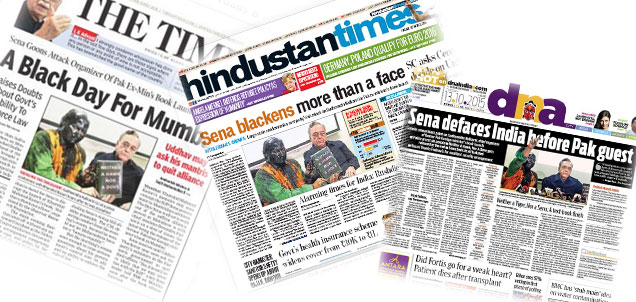
    The attack on Sudheendra Kulkarni, former speechwriter for LK Advani and member of the PMO under AB Vajpayee, has been the second event for the media to stand together. Here though the situation is more nuanced. Kulkarni was warned by the Shiv Sena not to hold an event to launch former Pakistan foreign minister Khurshid Kasuri’s book Neither a Hawk Nor a Dove at the Nehru Centre in Mumbai.


    The Shiv Sena has long had a tradition of objecting to and disrupting events which feature Pakistanis. There is nothing new in this. Only last week they got organisers to cancel a concert featuring Pakistani ghazal singer Ghulam Ali. Since Kulkarni and the Observer Research Foundation and Kulkarni decided to go ahead with the event, Shiv Sena activists acted in the way they know best: as hooligans.


    That the Shiv Sena is part of the BJP government in Maharashtra and an ally at the Centre is one more embarrassment which the media has been quick to pick up on. Condemnation however was universal, which is welcome.


    What the media may well come to realise – and I am not holding my breath here – is that its first role has to be to question the governments in power. Every time it has not done this, whether in the past or now, it has failed. The current government, it has to be understood, is no different from any other, regardless of the size of its mandate. When he became prime minister Rajiv Gandhi, who got the biggest mandate ever, soon realised that admiration can become criticism very quickly when large promises about changing the system vanish when the system hits back.


    Some of that is happening now and the media would be wise to wake up.


  • Ranjona Banerji: Is the Indian media anti-Hindu?

    By Ranjona Banerji


    Bashing the media is a wonderful pastime, isn’t it? Even I do it, you can argue, twice a week on MxM. But blaming the media when society behaves in a despicable manner or beating up the media… well, that’s another story altogether. Fashionable (if a little old and idiotic) in some circles as it is to accuse the media in India of running some agenda set by the Vatican, the media is the messenger. It may be intrusive, annoying, inconvenient, but that is what it is.


    In Dadri in Uttar Pradesh, after a man was lynched and killed by a mob ostensibly for eating beef, the media faced some of the flak. People on social media told me that the media never responds when a Hindu is attacked (never, please note) and only responded to Dadri because the victim was a Muslim. Others, some journalists even, accused the media of “never” responding in case someone’s hands are cut off (the implication being that the perpetrator would be a Muslim following Sharia law). The media (this from journalists too) also did not condemn the Charlie Hedbo killers since they were Muslim and approved of the ban on Salman Rushdie’s Satanic Verses since the book upset Muslims.


    You can see therefore that media bashing, even within the media, can take on ludicrous and nonsensical proportions. I do recall a case of a teacher’s hands being chopped off in Kerala being extensively covered and condemned. As it happens, we do not have Sharia law in India. As for Charlie Hebdo, what can one say? To my obviously biased mind, there seemed to be global shock and opprobrium. If those Indian journalists who blame the media for “appeasing Muslims” feel so strongly about this, they should carry the Charlie Hebdo cartoons in their own publications rather than bleat on about liberals in the media. So also when it comes to Salman Rushdie and the fatwa against him, although India banned Satanic Verses, there was plenty of support for him. Also, it is unclear to me why exactly the Vatican would want the media companies it owns to be nice to Muslims. Or perhaps these are those media organisations which are owned by Saudi Arabia.


    (I have a complaint here though. Where was the total condemnation of the cruel and inhuman punishment meted out by Saudi Arabia to blogger Rauf Badawi by these same sanctimonious journalists? Instead, we had breathless coverage of the prime minister’s meeting with the Saudis… I rest my case.)


    It’s easy thought to turn the tables on such brainless and frankly tainted media criticism, even when it is from within the media. What happened in Dadri? A temple priest says he was forced into announcing that Mohammed Akhlak’s family had stored beef in their house and the family was eating it. An angry mob stormed into the house, beat Akhlak to death and injured his son, who is now in hospital. The UP government in some odd wisdom sent the meat in the house to a forensic lab (it turned out not to be beef).


    Politicians of all hues descended on Dadri. First they made the right noises of sympathy, blah blah. Then they took off on their set paths of finger-pointing and defensiveness. Members of the media, which also arrived in Dadri, were beaten up and blamed for only focusing on the victims and not on those who had been falsely accused, according to their families. So are we to look for media solidarity from these genius in-media critics? Or do they perhaps toe the Central government line and approve of this sort of media bashing?


    I’m not holding my breath on this one.


  • Ranjona Banerji: Goodbye to Modi rah-rah!

    By Ranjona Banerji


    The prime minister of India’s second visit to the USA in his 16-month term was a slight reality check for a breathless media. Unlike last year, it was not blanket coverage of Narendra Modi’s every waking moment, there was a small realisation that NRI hysteria does not reflect the situation at home and there was, gasp, some small criticism even from the head honchos of Silicon Valley about India’s business-friendliness.


    There were a few other problems as well. Much of the world was also in the US and the main topics of discussion were IS, Syria, Ukraine, Russia and the US. The visit by the Pope overshadowed everything else. In fact, the rah-rah over India having been done last year, this year was business as usual and the US media as it happened barely registered the Indian prime minister’s visit. C’est la vie. Running a government is not the same as running a fan club and no matter how many cheerleaders you have, the world will move on. I am of course very clearly pointing fingers at TV news here for its jaw-dropping sycophancy of last year.


    And then there’s this video of Narendra Modi and Mark Zuckerbery and Shelly Sandberg of Facebook. A few months ago, it would have been shared on social media and that would have been it. But now it has made to the mainstream media. That’s the problem with democracy you see – sooner or later even a whom-are-we-here-for media realises that it is here for the people and not for politicians and prime ministers…


    **


    Since the subject is a matter of discussion from Silicon Valley to here, it would be extremely helpful if the mainstream media paid some more attention to the topics of net neutrality, Digital India and Facebook’s idea of a controlled internet. There have been columns and interviews across some newspapers but I would hazard a guess that more is necessary. At the best of times most of us are hapless consumers blundering through websites and apps. A little more help here, guys.


    **


    I have said this before but I feel I must mention it again. It is nothing short of appalling when members of the media are so blinded by their political leanings that they forget the basics of their profession. The political divisions in the Indian media – particularly between left, right, centre and objective – were made clear when LK Advani – started his Rath Yatra to build a Ram Temple in Ayodhya at the site of the Babri Masjid. This divide has become extremely bitter and even more fractious since the BJP-led government came to power at the Centre last year.


    I must reiterate that I am not talking about members of the public here. I am talking about working journalists and former journalists and journalists who understand very well how a newsroom functions. They bombard you on social media with vicious uncorroborated rubbish which would not pass muster even with a raw intern. When you question them, they dissemble and pretend like they’ve made a mistake. I am ashamed to say that I have even worked with some of these people now that I see their understanding of journalism is so shallow.


    Many of these are journalists who are younger than me but are still experienced enough to be at the top of the pile, running newsrooms. It makes you wonder how they ever manage to sieve through the information they receive at work, if they cannot in a casual sense, separate arrant nonsense from fact.


    If people like this are the future – and I see them everywhere – I shudder for the future of journalism. I see open upper caste superiority, hatred for minority communities, complete non-application of mind when it comes to internet cons and an inherent need to support this political dispensation or that.


    Sad.


  • Ranjona Banerji: Defending journalists’ right to live

    By Ranjona Banerji:


    There is a point of view, understandably er, Hindutva rightwing, that journalists, liberals, intellectuals, academics and “secular” individuals are just making too much of a fuss about the sudden voice found by “fringe elements” of the Sangh Parivar, after the Narendra Modi government came to power at the Centre.


    After all, and this is true, successive government, including and in some cases especially those of the Congress, have in the past tried to muffle critical voices. The sedition charges brought against cartoonist Aseem Trivedi by the Maharashtra government during the India Against Corruption is a very good example of that. Also the banning of Javier Moro’s book on Sonia Gandhi. You can add to the list the fact that rationalist Narendra Dabholkar was killed in Pune during Congress rule and the police drew a blank there. And that writer and scholar MM Kalburgi was killed in Karnataka which is a Congress-ruled state.


    However, there is no justification in copying someone else’s daft behaviour, having criticised it while you were in opposition. Also, there is the question of who threatened the lives of Dabholkar and Kalburgi and who has been arrested for the murder of Communist leader Govind Pansare. And then there is nowhere to run for supporters of the Hindutva rightwing. The space for intelligent or even reasoned discussion becomes limited when murder enters the equation. The Hindutva rightwing is fond of attacking Islamic fundamentalism and Islamists and Muslims in general all day and all night on social media but clearly are unable (or unwilling) to acknowledge that murdering those against their tenets is as reprehensible. Once that happens, we are fed the justifications. The Islamist terrorists who killed the cartoonists and employees of the French satirical magazine Charlie Hebdo were wrong but killing Pansare, Dabholkar and Kalburgi is correct?


    Their so-called crimes? Questioning the practice of idol worship, blind superstition and pushing forward a rationalist agenda. All of which are still legal in this nation.


    In the Pansare murder, the spotlight has fallen on the group Sanatan Sanstha. According to the police, the suspects had also threatened journalists Shyamsundar Sonnar and Nikhil Wagle. Sonnar for rationalist views and his interpretations of Sant Tukaram’s teachings and Wagle of course has long been a target for his refusal to be cowed down, in spite of all the vicious hatred he has been subjected to, with a lot of help it must sadly be said, from his colleagues. While Sonar has filed a police complaint and requested security, Wagle has refused anything that will hamper his journalistic activities.


    As media people, most will stand with both Sonnar and Wagle but there will always be some specimens, particularly within the Marathi journalism fraternity. There is a particular sort of venom here which I am unable to understand. You can disagree with someone’s values, with the way they practise their craft even. But secretly approving of harm and death seems a bit, well extreme. There are many journalists I myself don’t like much and some very prominent ones, but I will defend to the end their right to live!


    This article in Mumbai Mirror, by the way, explains the irrationality of the Hindutva supporter: http://www.mumbaimirror.com/mumbai/cover-story/We-had-requested-him-warned-him-but-he-didnt-stop/articleshow/49039957.cms


    **


    With sustained media, social media and public pressure the UP police managed to arrest the man who had been threatening the women journalists of Khabar Lahariya. Although this story from scroll.in says that the man is unrepentant, he is at least in jail by now. If only, though, police would take harassment charges more seriously. If this the way journalists, who have some influence, are treated, we all know how the common man or woman is dismissed by the police and government authorities…

    http://scroll.in/article/756664/man-who-harassed-up-women-journalists-for-months-is-finally-caught-and-hes-unrepentant


  • Ranjona Banerji: Time to stand together against despicable targeting of women journos

    By Ranjona Banerji


    There is a despicable Whatsapp forward doing the rounds about women journalists at NDTV, naming them and outlining how many times they have been married, how they have “trapped” men and how they are carrying on “illicit affairs”. The message ends with the “witticism”: Is this NDTV or Shaadi.com”, a reference to a popular marriage website.


    It does not matter whether the allegations or “facts” are correct or not. What is worrying is the snide venom that is behind this particular message and such messages in general. Women remain easy targets on social media and women in journalism even easier. The easiest way to attack is of course by sexual innuendo because then it reduces women to one aspect of their existence: their genitalia and/or their reproductive uses.

    This is a classic male, patriarchal response to successful women or women who appear to be successful. And NDTV is the particular target of a certain mindset. Although there are female editors, anchors and reporters in every television newsroom, across languages, in India, NDTV bears the brunt of social media anger.

    The most obvious reason is that the channel has long been perceived as pro-Congress Party. This apparently is reason enough for any amount of targeted viciousness. Interestingly, the men in the channel do not bear the brunt of this social media anger. In fact, NDTV founder Dr Prannoy Roy remains one of the most respected names in Indian television, as he well deserves to be. But the women he employs apparently all paid Congress agents and sexual predators. The anger against NDTV, especially amongst the Indian rightwing and supporters of the BJP-RSS, is so extreme that a few months ago Union finance minister Arun Jaitley was attacked just for being interviewed by Barkha Dutt. The irony of Jaitley being part of the BJP and a vital part of this government was completely lost on his attackers.

    But is Indian journalism’s worst sin the sexcapades of female journalists? Let’s see. We continue to deal with the problem of paid media, which specifically refers to media house managements selling editorial space to political parties with or without the knowledge of editors. Then we have the deals with businesses. Almost every newsroom has a list of industrialists who are untouchable. Media gossip says that Mumbai police commissioner Rakesh Maria had to be transferred out because he was getting too close to the Mukerjea-9X money trail. Then there is the problem of political affiliations impinging on free reporting and analysis.

    One of the biggest unspoken problem in newsrooms, regardless of the sexual harassment case against Tehelka founder Tarun Tejpal, is that of predatory male editors and junior staff, usually female. Most newsrooms have not followed the Supreme Court’s Vishakha guidelines or if they have implemented them, scant attention is paid to them. Innumerable horror stories continue to emerge. But do tell, how many Whatsapp messages have you seen about these incidents?

    Online trolling of women journalists, often by their male colleague or peers continues. Many of these trolls are well-known names hiding behind anonymous handles. Yet most women journalists would rather follow the law or are squeamish – which is why their names are not made public. Men, as we see everyday, have no such scruples.

    The torment that the women journalists of the Hindi newspaper Khabar Lahariya have suffered for most of 2015 by a persistent stalker and the apathy of the UP police was discussed in my last column. Apparently, some progress is being made in that case now that the problem has been made public.

    It is time for women and men in journalism to stand together. This sort of targeting of prominent women journalists needs outright condemnation. You do not have to be admirers of their journalistic skills. You just have to know that targeting them for being female is unacceptable.

  • Ranjona Banerji: Journos of Khabar Lahariya need our support. Despicable harassment must stop

    By Ranjona Banerji


    This is a horrifying story from the editor of Khabar Lahariya, an independent journalism effort from Uttar Pradesh, which has done commendable work. The reporters in Khabar Lahariya are all women. Since the beginning of the year they have consistently and frighteningly been harassed on their mobile phones by a man who calls himself “Nishu”. Neither the police nor the phone company, Vodafone, have been able to help. As the editor’s article shows, pasted below, the reactions of the police are reprehensible. The horror is not just about journalists not being able to work. It is also about how you can be harassed to such an extent that you cannot work.


    As journalists, this is one case where we need to put our collective heads together and pull out all the stops to help Khabar Lahariya. Sexual harassment is one part of this story but more than that, it is an effort to push you into utter helplessness. It must not be allowed to succeed.
    http://theladiesfinger.com/the-policeman-said-why-dont-you-tell-me-what-gaalis-he-whispers-in-your-ear/

    **

    Both these clips caused a lot of laughter on social media, but… to have panellists on televised debates slapping each other? You might argue that this was inevitable. News channels push for “debates” on controversial subjects and allow (encourage?) participants to get as vicious as possible with each other. Usually though this animosity is verbal.


    On a discussion on Radhe Maa, a Mumbai-based “guru” who has got into a little trouble for dowry collection and her predilection for dancing to Bollywood songs in miniskirts, two contestants – also “holy” types – decided that hitting each other was the only way out. IBN7, the channel on which this happened, has this stern, terse comment on its website, IBNLive: “We didn’t expect this kind of behaviour from our guests and we strictly condemn this.”
    One is sure they didn’t but you have to wonder about the direction which these “debates” are going in general.
    http://www.ibnlive.com/news/india/discussion-on-radhe-maa-turns-violent-during-live-discussion-on-ibn7-1095504.html


    The second such incident was on a discussion on India News when an Aam Aadmi Party spokesperson was slapped by a former Aam Aadmi Party member. The anchor tried to be very strict and headmistress-ish but the guests were beyond taking a ticking off seriously. Violence went very quickly from verbal to physical.


    We go on and on about the greatness of Indian culture but clearly we have very different notions of what culture means. Where does hitting people during a televised debate fit in? I have only seen this before on the Jerry Springer type of show where it is actively encouraged of course. Perhaps news channels need to put some of their studio guests in cages so that they do not attack each other?


    **

    Why do we still have an Information and Broadcasting ministry? Is the Government of India so weak that it needs a whole ministry to protect it from the media exercising its rights? Surely trolls on social media are enough?


    But jokes aside, they’re all the same. The UPA went after cartoonists and people who criticised Sonia Gandhi. And the current government has been using show-cause notices to new channel either for someone to prove their loyalty or because someone genuinely believes that free speech is a hindrance.


    GSTV, run by the mammoth Gujarat newspaper Gujarat Samachar, has received a show-cause notice from the I&B ministry for a programme it carried on Mahatma Gandhi’s assassination in which the motive behind an unnamed politician’s “Clean India” or Swachh Bharat initiative was questioned. The charge sounds ludicrous almost, but here we are. Of course, Gujarat Samachar has an intriguing relationship with the powers-that-be and this could be an old grouse coming to the fore.
    http://economictimes.indiatimes.com/industry/media/entertainment/media/for-swipe-at-swachh-bharat-leader-gujarati-channel-gstv-gets-the-broomstick/articleshow/48963465.cms


  • Ranjona Banerji: So how long news channels take to prove me wrong in my defence of their coverage of the Sheena Bora murder case?

    By Ranjona Banerji


    So how long did it take for news channels to prove me wrong in my defence of their coverage of the Sheena Bora murder case? One day? Two days? I still vigorously defend the decision to cover the murder – surely one of the most intriguing and compelling in recent times – but the manner of coverage? O my sweet lord!


    I understand that many of us fancy ourselves as crime-solving detectives. And apparently a good number of us imagine ourselves to be psychiatrists, psychologists and therapists as well. Because it was not just the prime time debates but also the all-day broadcasts which have anchors, reporters, random guests and members of the general public all attributing motive as well as diagnosing the prime accused, Indrani Mukerjea.


    Television, sadly, is the worst culprit here. Again, it suffers because it puts its news-gathering process on camera. In a print or web journal, the reader does not know how you got your information and while this means that reporters do not become world famous in their neighbourhoods and their mummy-daddy’s friends, it also means that they do not become notorious. There were times, watching the coverage, when you felt you were in a movie about how bad the paparazzi and an intrusive media can be. This reporter from Times Now chasing after Sheena Bora’s boyfriend and or step-brother or step-nephew Rahul Mukerjea at Mumbai airport is the best example of how not to practise journalism. Or, at any rate, not to share it on air for viewers to be impressed with how low you can sink.

    https://www.youtube.com/watch?v=sinr35K4UJo


    Of course tabloid journalism exists and has a massive following. Let us not fool ourselves that the human race is only concerned with the philosophy of the Upanishads, Plato and Wittgenstein. Anyone who tells you that is a liar and not even a good one at that. The worst of human nature fascinates everyone. But speculation about why someone did what they did is not journalism. It’s drawing room conversation and water filer gossip. And it’s not good journalism, no matter how much it sells.


    However, thanks to the media we have found out more about the Mukerjeas, Boras, Khannas, Dases, Rais and their friends than we perhaps know about our own families. We have seen the lure of media fame entice friends, relatives, colleagues into sharing their tiny titbits of information and conjecture and for all we know, downright lies, about the Boras and Mukerjeas. Senior and not-so-senior journalists who worked with the Peter and Indrani Mukerjea have told us what they think of them and shared their experiences. We have also heard from every single person whom Sanjeev Khanna ever had a drink with at the CC&FC in Calcutta.


    I want to make it clear that there is no moral high ground here for any of us, especially the media which by its very nature trawls the garbage heaps of humankind. But there is a way of going about this which is not so downright foolish. Arnab Goswami’s nightly courts border on the hilarious, if only because they have become caricatures of themselves. NewsX has been rivalling Times Now with its judgmental hysterics. These so-called high society grande dames, with enough skeletons in their own closets to rattle a few medical college storerooms, sitting on judgment in TV studios is another farce. To me in fact it exposes journalism’s biggest downfall – to have insufficient background information on your sources or public faces. The psychiatrists and psychologists who are happy to come on TV to diagnose the accused, without ever having met them, is nothing but outright publicity-seeking. This includes former police officers, some of whom had terrible track records when in office. These high-powered members of the public showcase themselves as desperate publicity seekers – and not so different from those they seek to condemn.


    Newspapers meanwhile have moved on and the Sheena Bora case no longer dominates the front pages. My one beef here (if I am still allowed to use that word) is with the Times of India’s Dehradun edition which did not think the good people of North India needed anything but cursory information about the horrifying assassination of Kannada scholar and writer MM Kalburgi. That is criminal stereotyping of your readership, especially when the news of his death is all over news channels.