Tag: Economic Times

  • 2024: BJP versus I.N.D.I.A. 2023: News channel war hots up

    By Our Staff


    The real war will happen next year with the general elections, as the combined (or perhaps not so in spirit) opposition taking on the ruling BJP. But ahead of that, in the run-up to the elections in the five states including the all-important Madhya Pradesh and Rajasthan assemblies, News18 India has launched a 360-degree media campaign to showcase its dominance in the Hindi news segment. And more importantly to take on Aaj Tak, leaders and among the earliest entrants in the India private news television space.


    The Hindi news channel released a page one ad in all editions of Economic Times to showcase its leadership in the genre. According to a communique which doesn’t quote any spokesperson, the campaign will also go live on digital and social media, with extensive visibility on trade media as well.


    As per the ad, the TV data shows that Aaj Tak has captured 0.8 crore lesser AMAs in Week 32 of 2023. Now we don’t know if BARC is fine with use of just one week’s dominance in advertising material, but we leave that to the wisdom of the measurement body and the association of news broadcasters which includes members of a large number of news channels, including Aaj Tak and News18.


    On the digital front, the ad says that News18 India received more video views on Facebook compared to Aaj Tak in July. (Source: Crowdtangle, July, 2023). Moreover, News18 India was also ahead of Aaj Tak by 12% in terms of YouTube views last month. (Source: Databeings, Video Views, Stats as of August 5 for all videos uploaded in July, 2023)


    We are certain we haven’t heard the last on this war of words and claims, but, as long as the viewer benefits and the broadcasters don’t lose on revenues in the tu-tu-main-main skirmish, we aren’t really complaining.


  • Finger on your Lips!


    By Ranjona Banerji


    Ranjona Banerji“Official attempts to curb information and debate trigger suspicion,” says a Times of India editorial on the gag order issued by the National Disaster Management Authority on the Indian Space Research Organisation, after satellite images of ground subsidence in the Himalayan town of Joshimath were released to the public.

    For the people of Joshimath, the ISRO images substantiated their suspicions. For India’s officials, ISRO halted some attempts at official obfuscation and control of information.

    At least, that’s what the edit tells us.

    But did the officials act alone or was there some other power that wanted information to be suppressed?

    Everything in India, as we well know, and especially those of us in the media know, is politics.

    So did the NDMA act alone or was there a diktat from elsewhere?

    Sadly, most media houses have no sources in the ruling party, so they cannot inform the public of anything brewing. They do have direct access to the BJP’s public relations department however, which is why top TV anchors always know at least five minutes before the PM is about to go somewhere or do something, so that they can announce it on Twitter. An honourable exception is a particular news agency which showed up for a clandestine swearing-in ceremony before most politicians even found out about it. That news agency has top sources.

    Of course, all media houses have plenty of sources in the Congress and other opposition parties so they always know which disgruntled obscure party member has organised his or her own desertion to the BJP and wants maximum publicity for this act.

    So, this “gag order” on state agencies like ISRO has not been called a travesty of democracy, of authoritarianism and so on. It’s just some bureaucrats thinking too much of themselves, ha ha ha, this is how India is.

    I have named The Times of India but the situation is no different in the rest of the Indian mainstream media.

    Or else, it would have investigated inequality in India itself, rather than just publish the stellar job done by Oxfam India.

    https://www.oxfam.org/en/india-extreme-inequality-numbers

    Frankly, the numbers presented by Oxfam are horrific: That the top 10 per cent of India holds 77 per cent of India’s wealth, that 73 per cent of the wealth generated in 2017 went to only the richest one per cent and that 670 million people saw only a one per cent increase in their wealth.

    Let’s forgive today’s journalists for not finding this out themselves. We know, we know all the excuses. They are not allowed to work. Their owners are horrific. Such stories would never get published anyway. Who cares about the poor when we have so many billionaires and so on.

    But it is more sinister than that. Misinformation has to be spread that so that no stain is cast on the current administration and especially on the current prime minister. That work trumps all others.

    And the manner in which this misinformation spreads and takes hold is definitely remarkable. An interaction with senior school children in this week provided a small insight. They were certain that Narendra Modi as prime minister had done a stellar job in increasing employment in India and pushing India’s GDP higher. These were intelligent, aware children. Where did they get this idea from? Their teachers, their parents, the media?

    Take for instance the inauguration of a private cruise ship by the prime minister last week. Why Modi should inaugurate a privately-run cruise is not up for discussion. Or let’s buy the excuse that this was a tourism-boosting exercise and that since the cruise ship ran down the Ganga in which Modi has a personal interest, it was the correct thing to do. How should the media present the news that the cruise ship ran aground three days later because of the shallow waters of the river in Bihar?

    Exactly the same way the media largely ignored the fact that the roll on roll off boat that the PM inaugurated did not work a couple of days later or the seaplane he inaugurated did subsequently not take off. The brief for the media is to provide publicity for the event. And build Modi’s image as India’s greatest leader. Not to follow up on the story or to even mention the PM. Excoriation, jest, sneers, jeers – these are all reserved for opposition politicians.

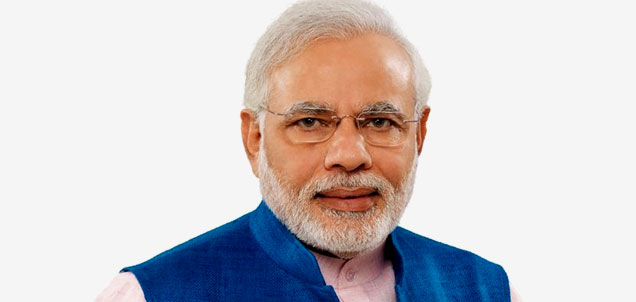
    Thus the Economic Times uses a photograph of Modi to illustrate its news article about the song Naatu Naatu, from the film RRR, winning best original song at the Golden Globes.

    He won it for India, didn’t he?


    Ranjona Banerji is a senior journalist and commentator. She writes on MxMIndia on Tuesdays and Fridays. Her views here are personal.


  • The Future of Digital India lies in Voice, Video & Vernacular


    By Indrani Sen


    Indrani SenThe IAMAI-Kantar ICUBE report published in 2020 predicted that internet users in India would increase by 45% between 2021 to 2025 and will touch 900 million. The report also made a forecast that the growth will be driven by higher adoption of internet by users in small towns and rural areas. In 2020, two out of every five active internet users in the country came from small towns and there was a 13% growth in the number of rural internet users between 2019 and 2020. The report also estimated that by 2025, the number of rural internet users will surpass the number of urban internet users. In a country with 29 states based on linguistic divisions and 22 major regional languages (including Hindi), the emerging digital ecosystem is calling for urgent applications of voice and video in vernacular to reach out to the new internet users.


    An article in Economic Times by Rahul Sachitanand published on October 7, 2018 did an excellent analysis of India’s  changing internet landscape covering its past, present and future (https://economictimes.indiatimes.com/tech/internet/voice-video-and-vernacular-indias-internet-landscape-is-changing-to-tap-next-wave-of-users/articleshow/66102478.cms). The article talked about the three waves of internet adoption in India, the first wave (1995-2005) saw the arrival and early adoption of internet and digital content in India followed by the second wave (2005-2015) when internet took the centre stage and a variety of new businesses were built in travel, e-commerce and fintech riding on internet which not only attracted international players and investors but also laid the foundation of Digital India. The third wave, which began from 2015 (2015-2025), saw the validation of Indian Internet market with Flipkart’s sale to Walmart for $16 bn. Data prices crashed as reliance Jio entered the telecom market and mobile became the main device for accessing internet across the country breaking geographic and demographic boundaries.


    I wrote two articles here, the first one “The Deep Divide” published on February 5, 2018 dealt with the difference between the language of communication used by our advertising industry and the language understood and appreciated by their target audience across India in the digital age (https://www.mxmindia.com/2018/02/the-deep-divide/); and the second one published on November 4, 2019 dealt with the inevitable upcoming process of localisation of Indian digital market (https://www.mxmindia.com/2019/11/localisation-in-indian-digital-media-market/). However, in 2019 I was not able to foresee how fast the timeframe of reaching out digitally to the rural internet users would shrink during the three waves of the pandemic, national/ regional lockdowns and forced online education at primary and secondary school levels. A lot of water has passed under the bridge during the last two years and today a number of new entrepreneurs are ready to offer AI solutions for enabling Voice and Video in vernaculars for reaching out to the new Indian internet users from small towns and rural areas.


    The Indian internet which was initially designed in English for the top end of the market is now going through an explosion of vernaculars enabling usage of voice and video for enabling the new users to graduate from utility services to online transactions. Today, it is estimated that more than 60% of smartphone users in India consume various content in their mother tongue and about 30% consume content in multiple Indian languages along with English. Only 10% of the smartphone users consume content only in English and this percentage is expected to decrease with the increase in the number of smartphone users. According to Google, there has been a four-fold increase in rural internet users. India’s data consumption now can be easily compared with developed countries at an average of 8GB per month per user. The transacting audience kas gone beyond the large cities to touch 170 million. The next generation of Indian internet users would prefer to have content, communication and ecommerce in non-English vernaculars and would be more comfortable with voice rather than typing messages in their mother tongues.


    Google has introduced India First and India-only apps to bring in new users to its fold. It has launched support on its Gboard handset keyboard in all Indian languages; its voice assistant can understand and interact in eight Indian languages and its web browser Chrome can translate web pages into eleven Indian languages. More Indian languages would be added to the Google apps in near future.


    For over 10 years, Reverie Language Technologies, a vernacular language venture, has been building capabilities for search and discovery in multiple languages. They have gone beyond translation and have built interfaces to engage via voice the need of the new users of internet by focussing on customer relationship management (CRM) of this emerging digital consumer segments. Over the last couple of years, a whole new B2B sector with digital organisations like vernacular.ai offering AI enabled use of voice and video in vernacular has opened up.  VIVA or Vernacular Intelligent Virtual Assistant is one of the services which are offered by vernacular.ai today. All large ecommerce companies operating in India have started voice enabled transactions in vernaculars.


    YouTube, Hotstar, Voot, etc. along with first TikTok and then desi versions of TikTok have shown us the operations with videos, particularly videos in vernacular can reach a massive scale. Research has shown that close to 90% of marketing companies use videos as the main tool for digital marketing. More than 75% of all B2C content is delivered through videos which have higher engagement rate leading to greater penetration of the messages. In future with technological developments, search operations will be done through voice search or video search in multiple Indian languages.  While voice and video will be adopted in future by the entire digital world, Digital India will be clearly different market by the use of at least a dozen of vernacular platforms.


  • The More you Succumb, the More Dangerous the World Becomes


    By Ranjona Banerji


    Ranjona BanerjiOn July 22, the Income Tax department carried out a series of raids on the offices of the Dainik Bhaskar group across India.


    Even for those sleeping under a rock to avoid criticising the Modi government, these raids were a sign that someone up there in the higher reaches of power was angry. Very angry.


    The anger could be two-fold: The revelations this week of the Pegasus Project and that Bhaskar covered it widely.


    And that this Pegasus coverage only added to the rage the government had felt at the relentless manner in which this large chain of newspapers had covered the Covid-19 pandemic. Government lies on Covid cases, lies on the number of deaths, on the lack of oxygen in hospitals, on the dead bodies floating in the Ganga and other rivers and buried in shallow graves in riverbanks were exposed every day in both Gujarat’s Divya Bhaskar and Dainik Bhaskar editions elsewhere.


    National Editor Om Gaur took DB’s coverage even further in his edit page piece for the New York Times about the dire Covid situation during India’s second wave, which was headlined: “The Ganges is returning the dead”. As ever, negative international exposure enrages an image-conscious Prime Minister and his government.


    Whatever has irked the government more, it is clear that it is riled. And when that happens, there is a malicious, vindictive reaction. Perhaps for almost seven years, the Modi government has got so used to the lavish praise piled on it, for all its transgressions, mistakes, lies, aggressions, disasters, any resistance is seen as unacceptable. Okay, cut that “perhaps”. We know that this is a government, more than any other until now, which cannot handle dissent, disagreement, questions, opposition. And has been enabled by a captive mainstream media.


    Between the Pegasus Projects and its revelations, and these raids on a media house, where does the rest of the media stand? The old days when all newspapers ignored each other and operated in their separate silos have gone, and for the better, together with that ivory tower editor who barely comprehended what was happening in his own newsroom forget the nitty-gritties of the world itself. The media has to comment on itself and allow others to comment on it.


    The revelations that someone within the government of India was using/ had used Israeli-made military-purpose malware to both hack into people’s electronic devices, run surveillance on them and possibly also implant material into their devices has shaken the world and forced the media not involved in the investigation to take notice. But the voice of the media has been far from uniform and at times, shockingly pro-government even though journalists, citizens, businesspeople, activists and others have been targets.


    So how did we respond to the Dainik Bhaskar raids.


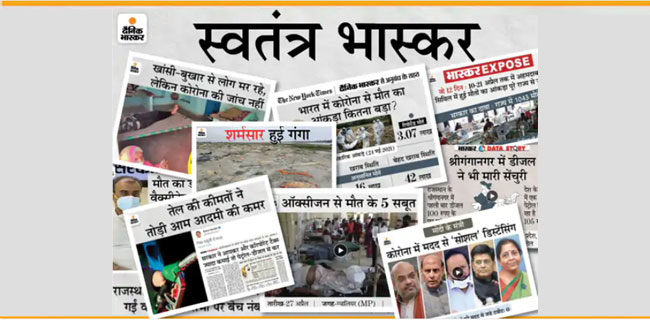
    Bhaskar itself called itself “Swatantra Bhaskar” or Free Bhaskar and announced on its front pages, with a series of images of its Covid and other coverage, that the government had to do what it had to do and the media group what it had to do.


    The Mumbai edition of the Times of India, July 23, had an article on Nation pages 11, the focus of which was the Opposition’s reactions to the raid. Shooting from the opposition’s shoulder, rather than straightforward coverage.


    The Economic Times, Mumbai, July 23, covered the possibility that industrialist Anil Ambani’s phone had been hacked as well as the corporate reaction to Pegasus on Page 6. But page 2 had Union minister Meenakshi Lekhi’s lies that Amnesty had distanced itself from the Pegasus Project, minus the clear clarification to the contrary that Amnesty had issued soon after.


    The Dainik Bhaskar raid was on Page 8.


    Hindustan Times, Mumbai, July 23, did better than its rival TOI. The first two pages were dedicated to the Olympics. Therefore, the Pegasus uproar in Parliament and the Ambani phone hack were on page 3. City page 5 had a single column on the DB raid in Mumbai. Nation page 5 ran with the raid as the lead, above the fold. And Nation page 7 had more Pegasus coverage. However once again, Lekhi, was allowed to run with her lie.


    The Indian Express, Mumbai has upped its game (although in the days to come expect more government ministers pushing Modi/BJP propaganda on their oped pages). The Dainik Bhaskar raid and Pegasus were on Page 1, continued on 2 as is the paper’s style. On Page 8, the Amnesty rebuttal to Lekhi’s claim made an appearance and Pegasus found space on the economy and world pages.


    The Hindu, Chennai had a much better showing, despite the photo of group head Malini Parthasarathy in Modi’s “illuminating” presence, which she put up on Twitter on July 22. Both the raid and Pegasus were on the front page, on page 10 in further detail. Pages 11 (nation) and 13 (world) had further Pegasus coverage.


    Of the English language papers MxM looked at, The Telegraph, Calcutta stood out. Both the raid on DB and Pegasus ran as the lead. The Ambani phone hack also found space. The lead story quoted DB National editor Om Gaur about why he thought the group was raided – the strong Covid coverage – as well as his NYT piece.


    Of the Hindi papers, Amar Ujala, Delhi had the best coverage: The raids on Dainik Bhaskar as well as the independent UP-based news channel Bharat Samachar were second lead, above the fold. No one else mentioned Bharat Samachar, which has been increasingly critical of the government.


    The Pegasus uproar in Parliament was the lead. Amar Ujala also mentioned prominently how Lekhi had called protesting farmers “mawalis” or hooligans. Most English newspapers ignored this stroke of genius from the Union minister.


    Rajasthan Patrika, Jaipur, carried the raid on the front page and also had an edit.


    Hindustan Delhi: Had the Pegasus arguments in Parliament, but focused on the IT minister as the lead. A small mention of the DB raid on Page 1 sent the reader to page 11, where Pegasus was also covered.


    Dainik Bhaskar’s biggest competitor, Dainik Jagran Delhi, carried a tiny mention of the raid on page 4.


    Regardless of the extent of the coverage we went through, all media owners and editors know what all journalists also know: that the more you succumb, the more dangerous the world becomes. You may think I was going to say that the more you resist, the more you are under threat. That is true. But unless you want the threat to last forever, you have to resist.


    Kudos to Dainik Bhaskar for its stand so far.


    And to those who have not been too afraid to cover the actions of a vindictive government.


    For those who cover up, well…


    Ranjona Banerji is a senior journalist and commentator. She is also Consulting Editor, MxMIndia. She writes on MxMIndia every Tuesday and Friday. Her views here are personal


  • Forest Essentials awards digital mandate to ET Medialabs

    By A Correspondent


    Forest Essentials, the Ayurveda skincare brand, has awarded its digital mandate to ET Medialabs. ET Medialabs has nothing to do with Economic Times.


    In addition to performance marketing, ET Medialabs will pursue off-page and on-page SEO for its new client.


    Said Amitek Sinha, COO, ET Medialabs:“We expect to meet and exceed the mandate entrusted to us by Forest Essentials. ET Medialabs is one of the leading digital marketing agencies because we have deep insights about how to create brand awareness online. We also understand how to optimise spends on online marketing channels. Insights gleaned by us help create larger funnels at all levels. One of our biggest strengths is making luxury brands more robust.  In the past, we have consistently added value to luxury brands and will undoubtedly do so for our newest client”.


    Added Tara Antony, Senior Manager, Digital Marketing of Forest Essentials: “We are looking forward to our strategic tie-up with ET Medialabs for our Digital mandate. As luxurious Ayurvedic brand we are particular about how the brand is represented and we believe that with their experience and expertise in digital marketing, ET Medialabs will be a suitable  partner. We hope for a fruitful collaboration ahead.


  • Durga Raghunath & Rohit Saran join Times Internet

    By A Correspondent


    Durga Raghunath
    Rohit Saran

    Times Internet has announced the appointment of Durga Raghunath and Rohit Saran to lead its digital properties.


    Raghunath has been named Digital Head of Times of India, Mirror Brands (Mumbai Mirror, Pune Mirror, Bangalore Mirror and Ahmedabad Mirror), Newspoint, Gadgets Now and Etimes. She was until recently SVP Growth at Zomato (Dec 2018-Aug 2020) and was previously Founder and CEO of Firstpost and Network18 Digital (2010-14). She has also been CEO, Indian Express Digital (Dec 2017-Dec 2018) and Co-founder and CEO of Juggernaut Books (Sep 2015- Aug 2017).


    Meanwhile, Rohit Saran has been named Chief Editor of Times Internet.  He was previously the managing editor for The Times of India (Print) and Executive Editor of The Economic Times (Print). He has held senior editorial positions at the India Today Group where he was Executive Editor of India Today and Editor of Business Today. He also edited The Khaleej Times in Dubai. He was also Editor of the South Asian edition of Harvard Business Review and Scientific American.


    Speaking on the announcement, Gautam Sinha, CEO, Times Internet said: “We are excited about our next stage of technology-led relationships with users, content producers and advertisers. Durga’s entrepreneurial energy and experience, and Rohit’s broad editorial exposure and deep understanding make us believe we can set and achieve audacious goals over the next five years. Both senior leaders would report to Times Internet COO Mr. Puneet Gupt.”


  • Punit Goenka defines 5Gs of Zee 4.0

    By A Correspondent


    Punit Goenka

    It’s been a horrible year-odd for Zee Enterprises. Possibly a year-and-a-half or more. But the Mumbai-based entertainment conglomerate has seen its ups and downs. Like the Hoola Loop roller-coaster ride of its amusment park Esselworld, it has sprung back. Again, and again, and again.


    The results that were declared in the wee hours didn’t paint a great picture. But as one industry observer told MxMIndia, it was Operation Clean-up time at the Central Mumbai offices of the company.


    Ahead of the declaration of results, Punit Goenka, the 40-something director of the entertainment biz, shared his shared his strategic vision for a new avatar of his company – labelling it Zee 4.0. Goenka laid out the future roadmap to propel the company as a premier media and entertainment powerhouse. Which it is, but it needs to get there. Soon.


    In a country where leaders from the Prime Minister downwards are known to jargonise their plans, Goenka said Zee 4.0 will be implementing a 5G formula focusing on – Governance, Granularity, Growth, Goodwill and Gusto. In his letter, Goenka said that the 5G approach will define the future of the Company, as it gears up to take the next big leap.


    “The start of this financial year has been a rather special one for me and the entire team at Zee. Since for us it is not just the beginning of another new year, but the beginning of an entirely new life for the Company. The beginning of a company which is transforming in line with its new realities. The beginning of a sharper, leaner, greener version of Zee. The beginning of Zee 4.0.”


    In an interview with The Economic Times on Monday, Goenka was exceedingly candid about the present and the future. And how he is rebuilding the empire, virtually brick by brick.


    Click here to access the Open Letter by Mr. Punit Goenka


  • Rahul Joshi joins Network18 as Group Editor-in-Chief & CEO News

    By A Correspondent


    What Raghav Bahl couldn’t achieve, AP Parigi and the bosses at Reliance Industries have been able to.


    Bahl, it may be remembered, had almost signed on Jaideep ‘Jojo’ Bose for his proposed Financial Times newspaper project. But now Parigi, an old Times of India hand, has pulled in Rahul Joshi as CEO News and Group Editor-in-Chief.


    Presently Editorial Director with The Economic Times, the appointment is of special interest to readers of MxMIndia because he used to be once editor of Brand Equity, the popular pull-out for advertising professionals.


    In a mail addressed to all employees of the group, Parigi introduced Joshi as “outstanding leader with stirring success behind in all formats of the media”.


  • Ranjona Banerji: Indian journalism exposed by ‘one year’ coverage


    By Ranjona Banerji


    The great gaps in Indian journalism have been exposed by the coverage of one year of the Narendra Modi government at the Centre. And also, the great divide within.


    The media, print, television and digital (if only we could add radio to this list), have embarked on a first anniversary analysis of the government’s performance. This includes report cards, which former prime minister Manmohan Singh used to do with his Cabinet.


    However, who do you find to both praise and critique the government’s performance and appear to be objective? Commentators and analysts have been very sharply divided between pro-Modi and anti-Modi since the nation kicked into election mode in 2014. The supporters are usually either BJP members or open admirers. The anti-brigade are the usual suspects and somewhat larger in number because they include academics and activists.


    The only recourse therefore to “balanced” coverage is to ask members of the BJP itself and BJP-appointed members of organisations or pro-BJP corporate to assess the government’s performance. Obviously there is no balance there at all but perhaps there is no option.


    So that’s as far as columnists and analysts go. What about bog-standard newspaper coverage? Here we see, more or less, straight outright hero worship. The Times of India’s Mumbai edition gives the Modi government over 77 per cent on May 26, the anniversary of the swearing-in or anointment as TV anchors preferred to gush. Oddly a survey for May 16, the first anniversary of the election results, in the same newspaper, showed many Indians, especially those living in Mumbai, not quite so happy with the government’s performance. Perhaps something dramatic happened in the last 10 days that the rest of us are unaware of?


    The Economic Times outdid its sibling paper with its 20 or more days of coverage and analysis of the first year. The paper on May 26 led with the headline “Lage Raho Narendrabhai”, a salute to the successful Lage Raho Munnabhai movies about the life and times of a lovable petty gangster. Not sure if the editors saw the irony there or had not seen the movies… Judging by the gush and mush, I would reckon they thought they were just being super-clever.


    The Hindustan Times, Hindu, Telegraph, Indian Express and so on follow the model but with comparatively less hero worship… but am not sure that that’s saying a lot… TV is so idiotically breathlessly ra-ra that analysis is sometimes not possible. The websites have managed to be better sources of opinion than newspapers but is that because they depend not as much on advertising revenue?


    **


    Rather than speaking to so many “experts”, how would it have worked if newspaper reporters or maybe editors themselves, actually ventured out to the streets to speak to the general public. After all, they are the ones who vote and who wanted “achche din” after four years of stagnation. Had these people understood that the promises made were dismissed as “jumla” or that the promised good days were not supposed to arrive for the next 60 years?


    It might have been interesting to know how editors would spin the word on the street. Surveys are so much easier and so what if they’re not always right? You can always increase the margin of error to plus-minus 15 per cent, no?


    The foreign media, perhaps most interested in India because of Modi, has been more balanced in their assessment. This is actually a scathing indictment of the Indian media as a whole because it means that too many managements and editors put business interests ahead of truth… Hmm, what’s new, eh?


    **


    Meanwhile, some Hindi newspapers reported that chairs were broken by crowds angry with Modi’s one-year celebration speech in Mathura on Sunday. Did any English newspaper or TV channel report this?


    Ranjona Banerji is a senior journalist and commentator. She is also Consulting Editor, MxMIndia. The views expressed here are her own. She can be reached via Twitter at @ranjona


  • Eco Times unveils ‘ET Panache’

    By A Correspondent

    Business daily The Economic Times has launched ET Panache, a thrice-a-week lifestyle and leisure accompaniment to the main newspaper. ET Panache is ET’s stylish nod to bigwigs, honchos, top guns – be it in India Inc, sports, politics, Bollywood, et al.

    ET Panache is a reflection of the lives of today’s young readers – busy, driven, ambitious and forever pursuing new dreams,” said Ravi Dhariwal, CEO, BCCL.

    As a reading experience, ET Panache will comprise lists, recommendations, reviews, opinions, DIYs, great finds and more, constitute the staple, even as it delves in-depth into the rarefied universe of upscale travel, dining, wellness and style, notes a communique.

    The first issue of ET Panache appeared with the paper today. The supplement will be published on Wednesdays, Thursdays and Fridays.


  • Economic Times stands up against ‘Half Knowledge’

    By Ananya Saha


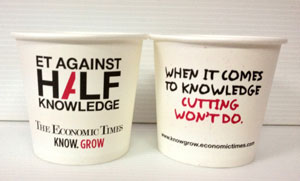
    As part of its ongoing campaign against Half Knowledge, ET launched a unique activity targeting working professionals at tea stalls outside corporate parks. Called Tea with ET, it is an unusual tea-stall act over three cities. Nearly two lakh corporate executives who visited any of 120 tea stalls in and around corporate parks in the three cities over three days were greeted with a custom-designed tea cup. The messages included lines like ‘When it comes to knowledge, cutting won’t do’; adapted for Bengaluru as, ‘When it comes to knowledge, by 2 won’t do’ etc.

     

    The teacup activity was experienced by executives across tea vendors at major corporate campuses such as Peninsula Corporate Park, Express Towers, Kamla Mills in Mumbai; Global Business Park (Gurgaon), International Trade Tower, Statesman House in Delhi and IBC Knowledge Park, ITPL, Salapuria Infinity in Bengaluru. This was part of The Economic Times’ latest marketing campaign Against Half Knowledge. The objective of this particular activity was to engage with India Inc’s young workforce in casual settings with a whacky yet serious message.


    Conceived by Lowe Lintas + Partners, the campaign – ET Against Half Knowledge “seeks to connect with young corporate executives wherever we can find them – at corporate parks, in our newspapers, on TV, radio, in coffee houses, on Facebook and other Internet channels, on the road, in cinema houses. We are using all channels that connect them with us,” said Ravi Dhariwal, CEO, BCCL. The campaign uses humour, colour and illustrations in an otherwise serious category. Much of the campaign rides on media channels owned by BCCL and Group companies.


    Multi-media approach

    The print campaign exposes the various stereotypes of half-knowledge people, in office and outside. “With a compelling combination of colourful illustrations and witty lines, the ads bring out the reasons why we need to arm ourselves with relevant, continual knowledge and ward off half knowledge. Some of the lines include: ‘Half Knowledge is always very loud, never necessarily clear’; ‘A visit to the auto expo and Half Knowledge becomes an auto expert’; ‘Half Knowledge has an answer to every question, even before it is asked’,” said Mr Dhariwal.


    Lodestar handled Media Planning, Indigo Consultant & Technology for Website outreach, Windchimes was involved with Social media engagement and several other agencies such as Fountainhead, Hungama Digital Services, Elevate and Candid Marketing have executed on-ground activations.


    “The trio of TV spots is a fresh jab at short film-making and a creative introduction to three Half Knowledge stereotypes. “In just 30 seconds, we are introduced to a body-painted “Corporate Explorer”, who, in turn, introduces us to Half Knowledge stereotypes in the form of Last-Mile Repeaters; Elevator-Leeches; and Watering-Hole Hunters. The satirical narrative exposes Half Knowledge types that bump into us in our private and professional lives every other day. Those that are waiting to find the opportune moment to try and sound intelligent, offer suggestions that are mostly wrong, and feed off opinions that aren’t their own,” he said. The TVC is currently playing on Times channels (Movies Now, Times Now, ET Now), besides Star Movies, HBO and National Geographic Channel. Apart from this, three catchy jungles dedicated to Half Knowledge types were run on Radio Mirchi and additionally onRadioCityin Bengaluru, Big FM inDelhiand Red FM in Mumbai where listeners were invited to dedicate the Half Knowledge jingle to anyone in their office or peers. The campaign was launched with its own microsite – www.knowgrow.economictimes.com – and Facebook page – www.facebook.com/etagainsthk. Both sites also run a series of contests that invite consumers to win some cool merchandise by sharing their views and stories on Half Knowledge. Airports and some strategic locations were taken up in Mumbai,Delhiand Bengaluru for a period of a month to amplify the message.


    In a partnership with Cafe Coffee Day, 24 cafes inDelhi, Mumbai and Bengaluru carried tent-cards busting common Half Knowledge myths. Branded newsstands carried the day’s copies of ET for visitors to sample and read the newspaper and dispel other such myths. Media planners, Creative Directors, CMOs and CEOs of about 204 companies (creative agencies, media agencies, top marketers in FMCG, Auto, BFSI, Luxury), were sent a bright green box, which instructed them to prick a balloon (with an elegant pin placed inside) and burst a Half Knowledge myth – that ET is only about finance and stock markets.


    In the first week of April, over 80 percent of the 2,000-plus attendees at GoaFest were rapping at the ‘ET Against Half Knowledge’ booth. A graffiti wall invited them to doodle and have their say on the subject. A Balloon Wall was burst with darts and revealed ET’s depth of coverage such as Business of Brands, Worldview, Personal Technology etc. And a specially made song Against Half Knowledge saw people rap to the lyrics.


    Participation

    The campaign has witnessed over 1.6 lakh active participants on digital and on-ground media in a span of a month, besides the engagements that we have generated with millions of consumers in mass-media – print, TV, radio, outdoors. The thought behind this campaign was to start a dialogue with young corporate executives, but in an unconventional manner.


    “Everybody knows The Economic Times as a knowledge powerhouse and an essential catalyst for professional success. So just saying so would have gone unnoticed, elaborated Mr Dhariwal, adding, “At the same time, we found a growing trend of 2-minute experts (like 2-minute noodles) mushrooming everywhere around us, but being particularly disturbing in corporate life because of their potential for harm. This gave us the chance to experiment with a lateral thought – half knowledge and how it comes in the way of your growth, hence staying in touch with ET everyday for continual learning and professional growth.”


    The campaign, which has been rolled out nationally, will run in phases through the year.


  • Ranjona Banerji: Economy on the front seat

    By Ranjona Banerji


    After months of political turmoil taking centre stage, the economy is back to dominating headlines. Ever since government went ahead with raising diesel prices and allowing foreign investment in multi-brand retail, we’re back to reading about various economic proposals, which are either going to change our lives or at any rate postpone complete devastation.


    This means that the usual political high rollers will have to be off the headlines for a bit unless they can stage some new theatrics. Mamata Banerjee may be the first to feel the pinch. In a story which talked about Banerjee wanting to make sure she is not consigned to oblivion, the Times of India chose not to use the TMC’s beloved leader’s photograph and went instead with US ambassador to India, Nancy Powell. Irony? Self-fulfilling prophecy? One can predict though that Banerjee is likely to see more of that happening.


    **


    The Economic Times, in somewhat unfortunate phrasing, headlines the next possible tranche of economic reforms, “PMO’s bucket list”. We understand that the prime minister is going to turn 80 this week but to link reforms to his dying wishes seems as yet a bit premature. Or does the newspaper refer to the prime minister’s office alone, an entity much hated by the residents of twitter?


    **


    The Times of India’s Mumbai edition has for a while now taken on Maharashtra’s deputy chief minister Ajit Pawar of the NCP, for his role in the irrigation scam that has been uncovered in the state. Pawar (nephew) when he was irrigation minister had apparently involved himself in practically every single deal and where subsequently, costs escalated. Another NCP minister Sunil Tatkare is already under the scanner for his tenure as irrigation minister.


    **


    The Indian Express has once more outlined for us the frivolous reasons used by police investigators to detain people under tough laws like the Unlawful Activities (Prevention) Act. These include children’s magazines and books of poetry – especially if they are written in Urdu. The Maharashtra police have the dubious distinction of considering ownership of Joseph Stalin’s biography a dangerous crime. This is in a country where Adolf Hitler’s Mein Kampf never gets off best-seller lists.


    Perhaps we need a more sustained campaign for better education of the police as well as greater use of forensic science in investigations.


    **


    On television, Rajdeep Sardesai on CNNIBN discussed with Arun Shourie why the diesel price hike was necessary and why FDI in multi-brand retail was not the end of the world. Karan Thapar on the Last Word also on CNNIBN discussed freedom of speech in the context of the contentious film on Islam and the needlessly violent protests against it. Arnab Goswami on Times Now took on the killings of sarpanches in Jammu and Kashmir, presumably by miltants. Goswami is very fond of the idea of Kashmir and works very hard to solve its problems – more than any other journalist in the country. One suspects however his rather black and white approach may not help in what is a very complicated situation.


    **


    If you want to look for TV news viewing from the main news channels that is minus the hysteria of prime time, the afternoons often pay dividends. Shiv Aroor of Headlines Today and Bhupendra Chaubey of CNNIBN both conduct well-behaved discussions – as was evident on the day Mamata Banerjee pulled the plug on her national role in Indian politics.


    **


    I apologise for the delay in posting this link from pointer.org. It discusses why “patchwriting” which is what both Fareed Zakaria and Samar Harlarnkar can be accused of, id as dishonest as plagiarism. Adds more depth to the argument but not more malice. http://www.poynter.org/latest-news/everyday-ethics/188789/patchwriting-is-more-common-than-plagiarism-just-as-dishonest/