Tag: e-commerce

  • Ecommerce and online video to fuel 11% recovery in global adspends: Zenith

    By Our Staff


    Global advertising expenditure will grow 11.2% in 2021, driven by exceptional demand for performance-led ecommerce advertising and brand advertising on online video, according to Zenith’s latest ‘Advertising Expenditure Forecasts’ report. Advertising expenditure will total US$669 billion this year, US$40 billion more than was spent before the pandemic in 2019.


    Growth in advertising expenditure is expected to remain robust in the medium term, with 6.9% growth forecast for 2022 and 5.6% for 2023.


    The coronavirus pandemic has accelerated the structural shift in the economy from bricks-and-mortar sales to ecommerce, driving more consumers than ever to research and complete purchases online. Brands have responded by forming partnerships with retailers and creating new direct-to-consumer operations, using performance-driven advertising – primarily in social media and paid search – to lead consumers down the path to purchase. Zenith forecasts that social media advertising will expand by 25% this year to reach US$137 billion, overtaking paid search in scale for the first time. Paid search will expand by 19% to reach US$135 billion.


    Much of this is new money to the ad market, coming from small businesses that have had to pivot rapidly to ecommerce to survive lockdowns, and from budgets that brands would previously have allocated to retailers to secure physical shelf-space, which they are now spending on display and search ads on retailer websites. The shift to ecommerce will slow down as coronavirus restrictions lift and economies open up again, but won’t go into reverse. Zenith expects ecommerce to continue to pull in incremental revenues to the ad market, driving 13% growth in social media and 12% growth in search in 2022.


    Audiences continue to migrate online, and online video viewing is growing rapidly, even as traditional television ratings shrink again after a one-off spike when lockdowns began in 2020. Advertisers value online video as a means of maintaining reach while television declines, but it’s an effective form of brand communication in its own right. Demand is strong, although the popularity of subscription-funded video-on-demand has helped limit the supply of high-quality online video available to advertisers. Zenith predicts that online video advertising will be the fastest-growing digital channel in 2021, rising by 26% to reach US$63 billion. Specific numbers for India have not been given by Zenith in this forecast.


    Said Benoit Cacheux, Global Chief Digital Officer at Zenith: “The online video landscape continues to transform, fuelled by the growth of streaming services and connected TVs. Its continued evolution requires a radical rethink of how to build the optimal screen-neutral reach model. The ingestion of new data sources into TV planning also creates further opportunities to further sync TV and video planning.”


    Social media and online video have eclipsed traditional static display, which is forecast to shrink by 15% this year, while online classified grows by just 4%. Overall, Zenith expects digital advertising to grow by 19% in 2021, and increase its share of total adspend to 58%, up from 48% in 2019 and 54% in 2020.


    Most other media are enjoying growth this year, as spending rebounds from the 16% drop in traditional media adspend in 2020. Cinema and out-of-home were the worst affected by Covid-related restrictions, shrinking by 72% and 28% respectively, and will enjoy the fastest recovery in 2021, with respective growth rates of 116% and 16%. Radio advertising, which shrank by 22% in 2020, is forecast to grow by 4% in 2021, while television fell 8% in 2020 and is forecast to grow 1% in 2021. Print will continue its long decline, now in its 14th consecutive year, with an 8% drop in adspend in 2021. In 2023 adspend in all these media will still be below 2019 levels, though cinema and out-of-home will have made up almost all of their lost ground.


    Limited supply and rising demand are stoking media inflation

    This year’s rapid recovery in adspend, coupled with the continued migration of audiences from traditional to digital channels, is fuelling substantial increases in media prices, particularly in television. The cost of television advertising is up 5% this year on average, though the variance between markets and audiences is wide. Television spend is up by 1%, so the volume of audiences reached globally is shrinking. Digital media growth, in contrast, is mainly driven by rising audiences and more extensive monetisation, with online video inflation averaging 7%, and social media roughly flat, compared to their 26% and 25% respective adspend growth rates.


    US to add nearly half of all new ad dollars

    All regions will enjoy robust adspend growth in 2021, ranging from 9% in Asia Pacific to 15% in the Middle East and North Africa, which is recovering from the steepest decline in 2020, of 21%. The strongest underlying growth since 2019 is taking place in North America, which is forecast to grow by 13% this year despite shrinking by only 1% last year. Growth in North America is being driven by the very rapid pace of digital transformation in its industries, as well as strong investment in connected TV and advertising-funded video-on-demand.


    The US will be by far the largest contributor to global growth in 2021, accounting for 46% of the US$67 billion added to the global ad market this year, followed by China with 11%, and Japan and the UK with 6% each.


    “After a very tough year last year, the ad market is enjoying rapid and broad-based recovery, and will end this year well above the level it achieved in 2019,” added Jonathan Barnard, Head of Forecasting at Zenith. “Digital advertising is becoming a more effective tool for brand growth as media and commerce continue to move online, attracting greater investment from large brands and small businesses alike.”


  • Dentsu merges all commerce capabilities under ‘Total Commerce’

    By Our Staff


    To align its years of commerce expertise under one umbrella and deliver efficient business outcomes, Dentsu International has launched its global commerce unit ‘Total Commerce’ in India. ‘Total Commerce’ will unite all of Dentsu India’s commerce capabilities under a single umbrella.

    Notes a communique: “‘Total Commerce’ is an attempt to find solutions to a world where manufacturers are jumping to consumers directly, where start-ups are disrupting the marketplace, and where branding is playing a significantly unique role. The solution has already, and over time, allowed many brands and retailers to take on various marketplaces and big-box distributors, thereby, enabling several wins. This has been achieved by our helping brands prioritise and succeed anywhere in commerce by mapping their commerce maturity to a strategic road map covering creative, data and ops, experience, and performance and media.”


    The end-to-end offering activates a research based success framework that ensures:

    Desirability (Brand Equity): Are we loved and sought after by consumers?

    Availability (Distribution Strategy): Planning presence and availability priorities by audience and demand

    Findability (Position Optimisation): Optimising visibility where audience are

    Buyability (Content Effectiveness): Optimising product listings for purchase conversion

    Repeatability (Purchase Experience): Auditing reviews and sentiments


    Brands, under the four broad groups of Performance and Media, Creative, Interactive, and Data & Ops and through the Total Commerce framework, will now be able to tap onto several proprietary products and solutions designed to support all stages of the commerce journey. These will include:

    • Total Commerce Analytics
    • B2B Commerce Transformation
    • Commerce Intelligence
    • 020 Commerce Framework
    • E-commerce Enablement
    • Loyalty & Customer Lifetime Value Optimisation
    • Dentsu Tracking
    • Fast Track Commerce
    • Symphony Product Merchandising
    • Marketplace Consulting
    • eRetail & Performance Activation
    • Marketplace Optimisation
    Anand Bhadkamkar
    Anand Bhadkamkar

    Speaking on the latest integration, Anand Bhadkamkar, CEO India, Dentsu said: “We have always been focused on the changing market scenario and have built capabilities ahead of the market. In line with this, we had built capabilities in Commerce, Performance, Retail design and last-mile and experience design. All these capabilities are now being brought together under one umbrella of dentsu Commerce. In these testing times, we are certain that the capabilities of building on D2C offerings will enable our clients to stay ahead of the market and harness the power of the digitally comfortable consumer.”

    To ensure that clients have a specialist in every field, Dentsu Commerce has built a team with Nihal Nambiar (AVP – Strategic Solutions, iProspect) for Performance Media, Krutika Shroff (Senior UX Lead, Fractal Ink Linked by Isobar) and Richa Gupta (Senior UX Lead, Fractal Ink Linked by Isobar) for Design and Experience, Aniket Khare (VP – Business Development, Merkle Sokrati) for Data and Analytics, Deepak Kumar (Director, Hyperspace) for Retail design and experience and Provit Chemmani (Group Tech – Ecommencify, WATConsult) for holistic e-comm design and delivery. It is pertinent to note here that this group will be the lead team. They have been empowered to bring together every capability of the group to build solutions for brands.

  • E-comm Trends: Marketplace Thrives, D2C Slows


    By Brian Wieser


    Brian Wieser

    The increasing importance of e-commerce is two-fold:  it shapes the behaviors of consumers and manufacturers and it also has a significant impact on the media industry because of the different ways advertising is used to support different kinds of e-commerce activity. Consequently, variations in growth between direct-to-consumer (D2C), first party online retail and third-party marketplaces are important to monitor.


    Key takeaways:  
    1. E-Commerce is still growing but is decelerating in key markets and will decelerate globally by a couple of percentage points.
    2. Marketplaces are dominating e-commerce and are growing faster than the overall industry.
    3. E-commerce related spending on advertising is growing much faster than total digital advertising and holds implications for both marketers and media owners.


    E-commerce is still growing fast, but it is also decelerating. E-commerce (usually defined as retail sales transacted primarily through internet-based devices, but not including online travel nor including offline sales completed after browsing online) is growing rapidly and transforming how consumers engage with brands around the world; however, the sector is decelerating overall:
    •  According to data from the U.S. Census Bureau, e-commerce in the United States grew by +14% in 2018 following on a +16% growth rate in 2017. However, growth appears to be decelerating further in 2019 as the sector rose by +12% in the first quarter of this year.
    •  China’s official government statistics service indicated online retail sales of physical goods were up +25% in 2018 versus +28% in 2017. Sales slowed further in the first quarter, rising +21%.
    •  Meanwhile, in Europe, trade association Ecommerce Europe estimates +12% growth there in 2018, down from +14% in 2017. While the most recent quarterly data is not yet available for all of Europe, the largest market in the region, the U.K. saw +16% growth in 2017, +14% growth in 2018 and, in the first quarter of 2019, experienced similar deceleration with only +12% growth.

    These trends seem to indicate that global growth will also likely decelerate by a couple of percentage points over the course of 2019 as well.  Within these averages, there will be different rates of growth for different types of e-commerce activity including:
    •  Conventional retail, where an entity takes possession of products made by other manufacturers
    •  Marketplaces, where an entity provides a platform for manufacturers to sell
    •  D2C, where a manufacturer sells products directly to consumers without an intermediary. There is also a dimension of “mass” vs. “niche” focus, and hybrids of each of these concepts can exist in every combination.


    Marketplaces are dominating e-commerce. With annual spending on e-commerce around the world amounting to $2.9 trillion (on Internet Retailer’s estimates), marketplaces account for a majority of activity and are growing faster than the overall industry. The top 100 marketplaces generated $1.7 trillion in sales in 2018, up +20% year-over-year, which followed on 34% growth during 2017 for a similar group of entities. Within this segment of the industry, niche marketplaces have generally grown faster than the overall average in both years as well.


    By contrast, D2C, while harder to define narrowly let alone quantify with much precision, is likely growing much slower. A subset of companies among the U.S. Interactive Advertising Bureau list of 250 direct-to-consumer (D2C) companies, or direct brands, which we have identified as having more than 100 employees as of the end of 2016 indicates employment growth of +17% in 2017 and +9% in 2018. Growth for this group of companies through the end of June amounted to a similar +8%.

    Growth rates deviate for individual direct brands, but also indicate a broader slowdown: the median growth rate for individual companies among this group was +17% during 2017, but only +2% during 2018. Year-over-year median growth for the group was a similarly tepid +4% through the end of June 2019. Of course, revenue growth, will not likely track as closely to LinkedIn data for companies in this sector as in others, such as ad tech or marketing tech, but the data is likely reflective of broader trends. Importantly, the concept of the direct brand is most likely growing faster than these levels indicate as larger marketers incorporate D2C business concepts into their overall strategies and invest more heavily into this sector.


    E-commerce-related spending on advertising is growing much faster than total digital advertising. The U.S. Census Bureau has produced data indicating that electronic shopping retail companies allocated four percent of their gross revenue to their own advertising activities during 2017.  This is similar to the percentage of gross merchandise value (GMV) that Amazon allocates to advertising as well as the advertising/gross merchandise volume ratio for a composite of five other scaled e-commerce pure-plays with explicit advertising spending disclosures including eBay, Wayfair, Stitch Fix, Etsy and Overstock.

    While it is worth noting that smaller e-commerce companies allocate a significantly higher share of GMV to advertising, one could reasonably assume four percent of retail-related e-commerce activity is allocated to advertising in markets where these companies operate.  In a country such as the United States, assuming most of the spending goes to digital media, this would translate to around 20% of total digital advertising activity for the industry’s media owners. Importantly, the four percent of e-commerce activity assumption does not appear hold up in China, the world’s largest e-commerce market, as the two biggest owners of e-commerce properties there allocate less than one percent of GMV to paid advertising.

    Whatever the current share, it is likely rising and growth in ad spending by e-commerce companies is expanding by much more than GMVs.  As we can see from e-commerce company financial statements:
    •  Amazon accelerated its spending on advertising during 2018 as well, with +30% growth last year vs. +26% growth in 2017, although the acquisition of Whole Foods and non-e-commerce initiatives undoubtedly contributed to their outcome.
    •  A composite of eBay, Wayfair, Stich Fix, Etsy and Overstock increased spending on advertising by +23% during 2018 after expanding by +19% in 2018. GMV for this group rose by +9% in 2018 and +7% in 2017.
    •  Looking only at Wayfair, Stich Fix, Etsy and Overstock, advertising growth was +45% in 2018 after growth of +38% in 2017 while GMV was up by only +29% in 2018 and +22% in 2017.

    If overall growth in spending on advertising by e-commerce companies on digital media exceeded +30%, this would have far outpaced total digital advertising growth, which we estimate averaged +20% in 2017 and +19% in 2018 around the world.


    Different types of e-commerce activities will impact digital media ad spending trends in different ways. Marketplaces are media owners themselves and can generate ad revenue from the manufacturers they work with. Individual participants in the marketplace – especially smaller ones – compete to drive incremental sales, and may increase their spending on advertising at a pace that exceeds revenue growth as they compete with other marketplace participants. Conventional e-commerce-related retail platforms also generate ad revenue but will mostly do so from larger manufacturer co-op budgets which are more likely to only grow in-line with sales. Both marketplaces and conventional e-commerce retail have opportunities to expand their roles as sellers by investing more heavily in search related capabilities for their properties.

    And yet, at the same time, growth in these types of e-commerce platforms can help traditional sellers of search advertising because the e-commerce platforms need to spend money to drive traffic to their properties, and search can be a particularly effective way to do this. Faster growth for marketplaces, especially including niche ones, will probably help sustain this trend.

    By contrast, direct brands typically spend much more heavily on social platforms and with influencers, especially as they first emerge. A slowdown in D2C revenue growth could have a decelerating effect on the preferred media channels of direct brands, offset by increases in spending as a percentage of revenue. As social commerce takes on greater importance for all participants in e-commerce, social media platforms could benefit from this trend as well.


    As e-commerce takes on greater importance, implications for media owners follow. When it comes to e-commerce, business strategy is still paramount. As our colleagues at Wavemaker have conveyed, marketers need to begin by focusing on retail planning, the role of each channel, designs of internal structures, catalog strategies and product setups, and retail optimization, operational excellence, commercial excellence, retail analytics and business intelligence as well as promotions and events.  Retail amplification – including paid media as well as reviews – is critical, but it depends heavily on planning and optimization as a starting point. Understanding growth trends underlying e-commerce-related advertising can help to support this latter objective by identifying which media are likely to fare relatively better or relatively worse into the future.


    Brian Wieser is Global President, Business Intelligence at GroupM. This article was published at


  • Is E-commerce Advertising a Sea of Sameness?


    By Alpana Parida


    Over the last five years, e-commerce has consistently clocked double digit growth. With 300 million active internet users (and growing), e-commerce in India is still at an approximate 1.7% of the total retail sales (by revenue). The opportunity is massive and investors are betting big on the category and are pouring in money on marketing and customer acquisition.  E-commerce is one of the biggest spenders on advertising today.


    With Snapdeal spending upwards of Rs 200cr, and Amazon spending Rs 250cr for the advertising of their annual Diwali sales, you would imagine their brands would benefit – and that they would acquire new consumers, create a preference for their brands and thus cause retention of these consumers for the future.


    Actually, this high-spending category is still unable to create brand loyalists. The problem lies with the medium. At brick and mortar establishments, a customer, once in the store, finds store-hopping painful as he/she needs to walk or find transport and physically go to the next destination. E-commerce, however, allows infidelity with a click as choice has no cost and a better deal is just a click away. The entire category has largely played on deals and discounts – a strategy that is inherently at odds with online shopping.  When Big Bazaar says “Is se sasta kahin nahin”, the consumer finds loss-leaders that are cheap such as sugar, atta and other staples and the store benefits because not everything is discounted. The consumer buys into the store and then proceeds to buy discounted AND full-price products. In contrast, for e-commerce, every product can be compared across stores and the lowest price means just that. Lowest price. The entire industry has abetted in creating this unfaithful consumer who only seeks the lowest price.


    The communication strategy of the key players, thus far, has largely been about a deal or choice. Both have been category promises and have done little to build the brand. While Snapdeal, Amazon, eBay, Flipkart, Myntra and Jabong became household names, they did little to distinguish themselves uniquely. With the notable exception of Flipkart, who while also making category promises of genuineness, easy returns, lowest prices etc, broke through the category clutter with its masterful use of kids to subliminally register ‘child’s play’ to the initiates into the category.


    When all promise the same thing, the brand that is the most differentiated benefits the most. Memorable advertising does not translate into long-term brand loyalty. Rather, creation of a distinctive brand that has a distinctive promise and a unique selling proposition requires consistent reinforcement and manifestation of the brand visually and experientially.  They have to engage, provoke and delight.


    Thus, the recent move away from mere category promises to create a deeper connection with the consumer emotionally by all the key players was a much needed shift away from the pure deal/ choice/ exchange based undifferentiated communication.


    But the scourge of undifferentiated communication continues. The eBay ad has an old woman skipping rope, the Amazon ad has a badminton racquet send to a young mother and the Snapdeal ad sends ghungroos to an older lady to help them rediscover their passion. Jabong goes a step ahead, urging consumers to be comfortable in their skins, and boldly expressing themselves. While each one is visualized differently with Snapdeal calling it ‘Unbox Zindagi’, eBay claiming that products do not judge and Amazon exhorting mothers to be a girl again – each is playing on the same theme of rediscovering yourself being true to yourselves and reliving old dreams. Web only ads of Myntra also ran a series of 4 ads that cover homosexuality, single motherhood, career and notions of character. These were cast in the same mould. The exception is their current TV campaign using theuber cool couple – AbhayDeol and Ira Dubey as Myntra shoppers raising the fashion quotient of the brand. Myntra would do well to use them for a longer term – much as Idea telecom had created an association with Abhishek Bachchan.


    What is remarkable in each of these stories is the power that is vested in the self.  Over time, similar ads show a blurring of recall and do not attach clearly to a single brand unless a brand stands out. The red Snapdeal box is clearly distinctive – and if the idea of ‘Unbox Zindagi’ comes alive not just with an evocative box but across all consumer touchpoints – then the brand gains traction. The others, well, will have the satisfaction of creating the category and see some of that growth attaching to themselves.


    The ecommerce space is becoming increasingly cluttered and similar consumer insights have led to similar advertising. When the brand proposition is the same and not differentiated, brands need to stand apart through a clearer definition of their personality and tone of voice. In another category – Axe remains a funny pied piper every single time or an Indigo celebrates the joy of flying in a tongue in cheek way. They tell you that consistency is important and it need not be boring. Ecommerce brands need to learn that before burning more cash. Fast.


    Alpana Parida is Managing Director, DY Works. A graduate from IIM Ahmedabad and St Stephen’s College, Delhi, she has spent over 30 years across various marketing functions in the United States and India. As part of the steering team at DY Works, she espouses the use semiotics to both decode consumer and category and encode the solutions in design. Brand Matters is a new column by Alpana Parida for MxMIndia. The views expressed here are not necessarily those of her organisation.


  • E-commerce: It’s time you get your Onions right!


    By Jaisurya Das


    It may just be a coincidence but just a few weeks after I questioned the future of online shopping ventures and their dangerous losses, Flipkart has been downgraded by Morgan Stanley.


    What is worrying is that, if this is how a key investor is reacting, it won’t be time before we see more toeing the line.


    I wonder if the exit of Mukesh Bansal created a void of sorts, or possibly fear of a possible mass attrition. Well, I am no expert in e-commerce but write I will, from my own perspective.


    Honestly I think it’s a lot to do with the model and the inflated expectations from the serviced audience. Let us examine a few of the premises used for loyalty prediction.


    Acquire a customer at any cost. Service is above all.

    Brilliant. I tested this with two separate ventures:

    Test #1.  Order : Buttered bun: 1, delivered in 1.5hours from well-known bun outlet : Prompt, courteous service , coupled with sms messages and mail confirmation, payment gateway etc. Transaction Value: Rs 25 .


    Test #2. Grocery and daily needs. Order: 6 eggs and 500ml of coke. Order placed, payment gateway confirmation (2 mails, 2 messages) received in few minutes. Order delivered in 2 hours. Transaction value: Rs 56.


    Our customers believe in repeat purchase.

    Not true. Customers browse like there is no tomorrow. Whoever attracts their carnal instinct, wins! The more you pop right in their face, the more chances are that you will get a clickthrough.


    The more the customers, the more the revenue.

    Rubbish. There are classic examples of huge companies who have the highest volume and value market shares and yet are unprofitable. Let’s take the classic example of the erstwhile music mammoth HMV or Bata (till very recently) for that matter.


    Remember, profitability is about managing overheads well and how much your yield is per transaction. Volumes bereft of sensible yield mean nothing more than a bunch of Excel sheets!


    Average transaction value per customer will be Rs 500/ 250 minimum.

    Test: Leading e-commerce venture:

    Order : One landline splitter. Ordered , 8 text messages, 6 emails , a well-wrapped parcel and a well-spoken delivery man all within 48 hours. 2 mails post delivery. Transaction value: Rs 32.


    If customers can buy at this cost, it is almost certain that the site will only end up fulfilling the necessity and immediate need of its audience. The “I must have this” segment will slowly move away to another shopping destination which is all about their persona and their exclusivity.


    The wider the range the higher the sale.

    In fact, today’s customer is highly impulsive and tends to take purchase decisions fast. Hence too wide a range can in fact be detrimental since the customer is forced to go through pages and pages of options before hitting the Buy button !


    The lower the price, the higher the sale.

    This is the famous belief that everything cheap sells. What wasn’t factored though is the propensity of our neural networks to reinvent themselves. Price is a deciding factor and yet not the critical ruling factor in a purchase decision.


    Brand familiarity, peer confidence, persona etc are all significant drivers of purchase. Indulgence is often way beyond price barriers. Its about carnal satisfaction. Its about fulfilling an immediate desire to own….


    No matter what, valuations will only go skyward.

    Well, I guess the proof of the pudding is in eating it.  As Isaac Newton discovered: “All things that go up will come down “. Tragically this seems to apply to even fictional valuations!! We just had one example to show things can go wrong…. No, this isn’t the bubble we saw years back. This is for real and this time with much, much more money!


    Unfortunately, even the mammoth Titanic sank…Was it an iceberg of overconfidence?


    Time will tell. This mystery will be unravelled for sure.


    The market is rocking. People buy any idea. We have it sealed!

    How I wish this were true. All of us would be millionaires by now. Yes, a lot of us have seemingly bright ideas yet, not all of them sell! I may think idlis and gun powder delivered in real-time worldwide is a bright idea but when it comes to the consumer, s/he may demand it hot and fresh from an outlet s/he is familiar with!


    We can exit anytime and get our pound of flesh. From the day we take off, we are only valued higher and higher.

    How I wish entrepreneurship is as simple as jumping on a good horse and riding it into the horizon of success. No, you can’t exit anytime, nor can you expect valuations to soar. If you don’t have a winning product and later a brand to reckon with, it’s unlikely that you can exit with any wealth.


    Venture capitalists and angel investors are not as dumb as they may look. They know their onions well and monitor every rupee that they invest. Some give more rope but believe me, they know when you to tie that fateful knot!


    When the basic premise of a business and its success can be questioned (no matter how absurd the questions may be!) you can be sure that there is problem somewhere.


    Consumers aren’t idiots. They are human beings with a well-developed brain that can seamlessly skim through millions of data bytes to arrive at one quick answer;  Buy or Skip!


    Entrepreneurs and start-ups underestimate the consumers capacity to think and rationalise since all inferences are based on their own imagery of what is good and what isn’t.


    Today’s consumer isn’t a reflection of anyone. Each individual has a unique capacity to emote and connect, be it with a brand or a peer. This enables them to gather infinite pulses from the marketplace that most people cant imagine or decipher.


    What triggers purchase? What enables a decision? What prompts someone to leave one site and go browse through the other? What prompts a consumer to stop just before s/he hits the Buy button and abort the purchase ?


    This is just a glimpse of the unexplored terrain of the human brain. It takes much more than a great idea and an over enthusiastic bunch of youngsters to build a company and brands that will stand the test of time ….or the human brain!


    Today, if I may take the liberty of quoting Galileo…


    “ I do not feel obliged to believe that the same God who has endowed us with sense , reason and intellect has intended us to forgo their use ”


    Be sensible. Please do take instructions if you are in unfamiliar territory.


    Jaisurya Das, the maverick media-evangelist, eats, sleeps and romance’s brands. His cerebral consulting interventions are aimed at making brands powerful and sustainable. He is also the Contributing Editor of MxM India. The views expressed here are his own.


    The views expressed in this article are his own.


  • E-commerce traffic during Diwali surged 75.5%

    By A Correspondent


    UCWeb, India’s leading mobile browser with an over 54% market share, said e-commerce traffic during the Diwali shopping season surged a whopping 75.5% this year.


    “The number of users who visited e-commerce sites Flipkart, Amazon and Snapdeal via UC Browser in the month leading to Diwali 2015, increased over 75% compared to last year,” Kenny Ye, Managing Director of UCWeb India, said Thursday.


    Parent UCWeb Inc, which is a leading provider of mobile internet software and services, is a business within Alibaba Group’s mobile division.


    “Indians are increasingly embracing shopping on-the-go, splashing out on various items through mobile shopping during festive sales. There’s no doubt m-commerce is prospering,” he added.


    A big portion of users eventually placed orders on Amazon via UC Browser through the campaign, the company said in a media statement.


    Popular items including lifestyle products such as electronics, ethnic and fashion apparel as well as household products that received most visits contributed to the vast majority of total page views.


    According to UCWeb India, the traffic upsurge reflected the public perception of Diwali in the age of e-commerce. “As e-tailer giants rolled out sales promotions to usher in the festive season, UC Browser and Amazon India also joined hands distributing coupons and vouchers to users through a #HarGharUCDiwali campaign launched exclusively on UC Browser,” the company said.


    The two-week long shopping carnival eventually saw over 17 million users coming on board trying their luck for coupons and vouchers.


    According to latest reports by IAMAI and IMRB, mobile Internet users in India are roughly at 306 million, up from 276 million in October this year. The number of mobile users who shop via their smartphones has also seen a steady rise, with 75% increase in e-commerce traffic throughout Diwali shopping season.


  • Acche Din as ecom players expect $4bn sales this Puja/Dassera-Diwali-Xmas


    By Anjal Agarwal


    E-commerce firms are running their preparations for the coming festive season at full steam, expecting sales to the tune of Rs 25,600 crore ($4 billion). The festive months from October-December are expected to account for 40% of the $10-billion annual sales e-commerce firms are likely to record this year, according to management consulting firm Technopark Advisors. The industry had reported $7 billion sales in FY15, with 40% sales coming during the festive season, the firm’s senior vice-president Ankur Bisen said.


    Online marketplace Snapdeal, which saw a 15x increase in traffic last Diwali, is strengthening all aspects of business operations, including logistics, supply-chain, financial and technological support, Idi Srinivas Murthy, senior vicepresident, marketing, Snapdeal said. “We have launched faster last-mile delivery solutions and a refreshed user interface. We are also developing a host of solutions for our 1,50,000 sellers,” he added.


    Two major areas come into sharp focus as dozens of etailers jostle with each other for greater share of festive spends – delivery performance and customer satisfaction.


    Mumbai-based furniture and home products marketplace Pepperfry has increased merchant base, multiplied marketing outreach, and invested in doubling its logistics capabilities by expanding fulfilment centres, delivery and assembly capabilities as well as technology capabilities, according to chief marketing officer Kashyap Vadapalli. “Our sales were up 200% (last Diwali) as we took necessary steps both at the logistics and supply end,” he added.


    The coming festive months are crucial not just to the ecommerce industry, but also for companies providing logistics solutions. Logistics startup Delhivery is expecting a significant surge in volumes, similar to last year. “Delhivery is continuously investing in technology, infrastructure and automation to ensure such surges are managed well during the festive season,” said Mohit Tandon, co-founder, Delhivery. However, with rising demand, these companies are bound to face innumerable challenges.


    “Since the logistics partners are common to almost all players, fulfilling the demands over a given period of time becomes a concern,” said Praveen Sinha, managing director and founder of online fashion retailer Jabong. “It is not always easy due to the overwhelming response that we get during this time. It sometimes becomes challenging to have a constant stock of products,” he added.


    In the past one year mobile and internet penetration has increased further indicating that this year online purchasing will grow multi-fold compared to Diwali 2014, Kushal Nahata, CEO and cofounder of enterprise mobility platform FarEye said.


    Source:The Economic Times

    Copyright © 2015, Bennett, Coleman & Co. Ltd. All Rights Reserved

    Licensed to republish


  • Inventory-based e-com needs FDI: IAMAI-KPMG report

    An IAMAI-KPMG report “e-Commerce: Rhetoric, Reality and Opportunity” released on Tuesday has recommended that inventory-based e-commerce be opened to foreign direct investment (FDI). FDI in this format of e-retail is currently not allowed.


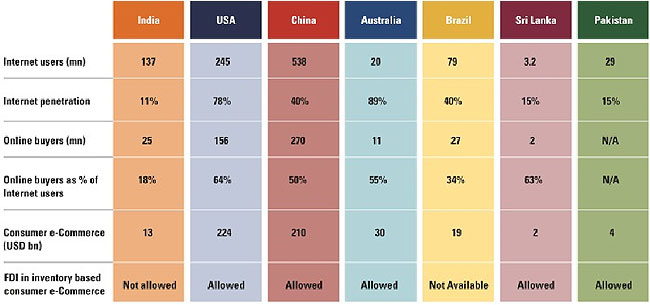
    The report has suggested that disallowing FDI in this form of e-commerce is a curious policy not followed by many countries including US, China, Australia, Sri Lanka and Pakistan.


    The report has established a direct co-relation between internet users, online buyers, value of e-commerce and openness to FDI in inventory-based e-commerce. The report found that India was the only one among a list of developed and developing economies that did not allow FDI in inventory based e-commerce.


    The result of this policy may have a direct bearing on a) slowdown in the growth of internet users; b) proportionately low online buyers; and c) shrinking of the e-commerce business.


    In the US, there are 245 million internet users and 156 million online buyers, while China has 538 million internet users with 270 million online buyers. Closer home, Sri Lanka, with 3.2 million internet users, has 2 million online buyers and Australia, which is a similar economy to India, has 20 million internet users with 11 million online buyers. Unfortunately, India, which is the 3rd largest in the world with 137 million internet users, has mere 25 million online buyers. It is evident that internet usage will grow much slower than expected if we do not increase online buyers.


    Further, the report finds that online buyers and the size of consumer e-commerce industry are high in countries where FDI in inventory based e-commerce business is allowed. In the US, the size of the consumer e-commerce industry is US$224 billion, while in China, it is US$210 billion. In Sri Lanka, it is US$2 billion, while the size of the consumer e-commerce industry in Australia is US$30 billion. In India, with 25 million online buyers, the size of the industry is a mere US$13 billion. This co-relation is clear from the chart as collated in the report.


    Salient Features Of e-Commerce in India, USA, China, Australia, Brazil, Sri Lanka and Pakistan

    Source: Internet World Stats (2013); eMarketer (2013); Forrester McKinsey Global Institute (2013); Digital-Commerce, IAMAI-IMRB (2013); e-Commerce Disruption: A Global Theme, Morgan Stanley (2013)


    Dr. Subho Ray

    Commenting on the findings, Dr Subho Ray, President, IAMAI, said “On a larger canvas, we believe that inventory based e-commerce needs deep and sustained investments on technology and other back end operations, marketing and brand building areas where domestic investment is not forthcoming. Opening up of inventory based e-commerce would also take care of the current anomaly where FDI in multi-brand retail is allowed up to 51% whereas it is not allowed on inventory based e-commerce business.”


    The report also makes other important recommendations such as more investments in innovation and customer servicing on part of the industry. According to the report, several issues exist on the demand side, supply side and government and regulatory side that need to be addressed to ensure rapid progress of e-Commerce industry in India. The relevant stakeholders would need to focus on some key solution areas to positively impact the e-Commerce industry and to put it on a transformational growth trajectory. These key solution focus areas have been identified as: a) Developing and building human capital; b) Adopting effective business practices; c) Strengthening the technology backbone; and d) Building a favorable yet controlled regulatory environment.


  • e-Commerce set for steady growth in 2013: IAMAI

    By A Correspondent


    While 2012 witnessed consolidation and increase in e-Commerce, the current year looks set for exponential growth. Going by the IAMAI Internet Watch Report, e-Tailing is witnessing steady growth. Panelists at a session of the 7th India Digital Summit organized by the Internet & Mobile Association of India aptly titled “e-Commerce 2.0 – Emerging Trend” discussed threabare the opportunities that lie ahead in 2013. Chaired by Avnish Bajaj, Managing Director – Matrix Partners, the session saw participation from Alok Mittal, Managing Partner – Canaan Partners India, Sachin Bansal, Co-Founder & CEO – Flipkart, Sundeep Malhotra, CEO – Homeshop18, Murlikrishnan B. Country Manager – eBay, Mukesh Bansal, Founder – Myntra.com and Ankur Warikoo, CEO – Groupon India.


    Discussing about new users, devices and new business models, Mukesh Bansal reiterated that acceptance for e-commerce has evolved in 2012 and will witness growth in tier 2-3 cities. However, Murlikrishnan B had a word of caution. According to him, “While the year 2012 was a year of engagement and supply dynamics to evolve, 2013 will be a year of reality check.”


    Sundeep Malhotra stressed on the fact that women are driving the e-commerce category and will continue to do so. The same trend can be seen the monthly tracker ‘Internet Economy Watch’ by IAMAI where a tremendous and steady growth has been seen in e-tailing of fashion accessories, branded apparel and footwear segment, a category dominated by women heavily. As per the latest data, the branded apparel and footwear segment has seen a y-o-y growth of 56 percent and 71 percent respectively.


    However, according to Alok Mittal the new e-commerce companies have to evolve unique strategies in the competitive world. With the market size still being naïve, the need to integrate all mediums to reach consumers across platforms is required. As Sachin Bansal put it, “Better online experience is what e-commerce companies should aim at.”


  • Online booking of air tickets registers 7% growth

    By A Correspondent


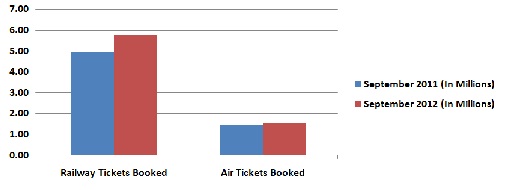
    The Internet Economy Watch Report for the month of September 2012, released by the Internet & Mobile Association of India (IAMAI) indicates a marginal growth of 7 percent in online booking of air tickets when compared with the numbers of corresponding month last year. Air tickets booked online in September 2012 were 1.55 million as compared to 1.46 million in September 2011. The growth rate is the lowest when compared with the numbers of the previous months of the current financial year. The online bookings on irctc.com witnessed y-o-y growth of 17 percent with 5.77 million online bookings in September 2012 as compared to 4.92 million in September 2011.


    Source: IAMAI/ Online Travel Portals


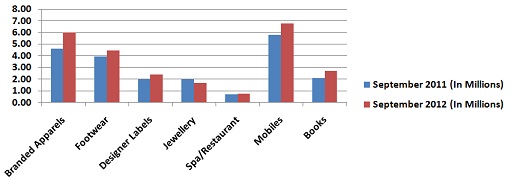
    According to the data captured from prominent e-tailing sites in the monthly tracker, the online user visit to mobile phone and book segment has increased by 17 percent and 27 percent respectively, when compared to the numbers of corresponding month last year. A significant increase has been registered in the online user visit to branded apparel segment. The number of hits has increased to 5.99 million in September 2012 from 4.62 million in September 2011. The online user visit to footwear segment increased from 3.94 million in September 2011 to 4.49 million in September 2012, a y-o-y increase of 14 percent.


    Source: IAMAI/e-Commerce sites


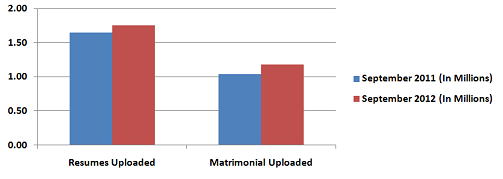
    In September 2012, the number of resume uploads on job portals and profile uploads on matrimonial sites has indicated a y-o-y growth of 6 percent and 13 percent respectively. While the number of resume uploads in September 2012 was 1.75 million as compared to 1.65 million in corresponding month last year, the number of profile upload on matrimonial websites was 1.18 million in September 2012 as compared to 1.04 million September 2011.


    Source: IAMAI/ Vertical Classifieds


    The monthly internet tracker by IAMAI is based on absolute numbers captured from various relevant sites, and encapsulates online usage for E-tailing, Online Travel and Vertical Classifieds.


  • The Anchor: 5 reasons India can accommodate more e-commerce sites

    By Satish Mani


    #1 Increased Digital Connectivity:

    With the explosive growth in broadband penetration and mobile phone usage across population strata and town classes, the online population in India is expected to double by 2015. This will fuel the demand for products and services available online.


    #2 Enhancement of service levels by e-commerce firms:

    E-commerce companies are constantly enhancing their service levels through better delivery, more realistic shopping experience, customer-centric purchase and return policies. This will lead to an increase in customer confidence for shopping online and they will migrate a higher proportion of their discretionary spends online.


    #3 Increasing need for convenience:

    Traffic congestion and crowded retail infrastructure in smaller towns and cities increase the demand for home delivery. We will soon see major retailers adopting the e-commerce route to keep up with consumer demand.


    #4 Increasing adoption of online shopping by the younger population:

    The younger population, with an early exposure to the internet has been quick to adopt online shopping. This increasing adoption opens more growth opportunity for the e-commerce industry.


    #5 High infrastructural costs for brick and mortar outlets:

    As the cost of establishing and maintaining an offline retail presence becomes increasingly expensive, big brands will be prompted to invest in increasing their online presence.


    Satish Mani is Chief Technical Officer of Zovi.com


  • Indiatimes Shopping launches online shopping store for home appliances; to launch Jewellery brand soon

    By A Correspondent


    With online shopping portals becoming increasingly popular amongst consumers, Godrej Appliances has launched an online shopping portal – Shopping.Indiatimes.com, powered by Indiatimes Shopping which is a part of Times Internet Limited (TIL).


    Consumers can search for products by category and look for ‘Deals of the Week’, offering select products at competitive prices, from the range of consumer durables on the site, ranging from air conditioners and refrigerators to washing machine and microwave ovens. While the Godrej online store will exclusively sell Godrej merchandise, Indiatimes Shopping aims to launch a jewellery brand very soon.


    In conversation with MxMIndia, Mr Subhanker Sarker, COO, Indiatimes Shopping explained that while Godrej was the natural choice for home appliance, Indiatimes Shopping has partnered with Nokia for mobiles. “Indiatimes Shopping’s strategy is to partner with the leading players in each significant retail category. In the home appliances space, Godrej is the natural choice in India as it is a brand customer’s trust. We have partnered with Nokia in the mobiles category and are in discussions with a major jewellery player.”


    According to IAMAI (Internet and Mobile Association of India) March 2011 report, the e-commerce industry in India is growing at an average of 55 percent year on year since the past four years. In addition to this, the size of the home and kitchen appliances segment is valued at about Rs 62 crore.


    With the robust growth of e-commerce business, Godrej Appliances are said to be targeting growth of its online business at over 150 per cent year on year. While Indiatimes Shopping already has an android and iPhone app for its horizontal shopping store, Godrej products are also now available on app. “Going forward the preferred route is through responsive design where you don’t have to build different products for different devices. We will go that route and will enable the store on all kinds of devices within this financial year itself,” added Mr Sarker.


    Asked whether this indicates a growth in consumer trust regarding online shopping, Mr Sarker said that today there is a lot of comfort with the online format, although it is a limited to a certain psychographic profile. “It is definitely not limited by the traditional demographic models. We have all kinds of payment options, the most popular being net banking and credit cards with free EMIs. There are immense growth opportunities in the e-commerce space; however, customers first experiment with the model through low-value standard goods and low-risk payment options like COD (Cash on Delivery). But once comfortable with the format and service levels, they then go for goods with high perceived value like baby products and apparel.”