Broadcast Audience Research Council (BARC) India has announced the appointment of Dr Bikramjit Chaudhuri as Chief of Measurement Science & Analytics. He will succeed Dr Derrick Gray, who has been a member of the BARC India family for six years. He has been heading measurement science at BARC since mid-2018.
Dr Bikramjit Chaudhuri is a PhD. from IIT Bombay and holds a Master of Statistics degree from the Indian Statistical Institute. He joins BARC from the Datamatics Group of Companies where he has been Global Head of Data Science and Advanced Analytics, since 2016. Prior to Datamatics, he has held multiple leadership roles, and has led large teams of senior talent across levels at KPMG, Nielsen and ZS Associates in India and elsewhere in the world.
Said Nakul Chopra, Chief Executive Officer, BARC India: “Derrick has been a wonderful partner, a mentor and a friend to numerous individuals and industry peers. We congratulate him as he embraces his next adventure and wish him nothing but the absolute best. In his stead, I’m happy to welcome Bikram to the BARC India family. He brings deep knowledge and rich expertise in Big Data, Research and Business Intelligence. I’m confident that with his strategic vision and passion for excellence, he will not only uphold the legacy Derrick leaves us with, but also help navigate our future in this fast-evolving environment.”
Dr Derrick Gray, Chief of Measurement Science and Business Analytics at BARC India, has been appointed as the Vice-President of the Market Research Society of India (MRSI). Earlier this year, he was also appointed as the Chair of the Professional Standards Committee at the MRSI, where he will help guide the committee in ensuring strong ethical and professional standards for the Indian market research industry.
Commenting on his appointment, Dr. Gray, said: “I am quite honoured to assume the role of Vice-President in the current Managing Committee at MRSI India. With my experience over the years in statistical research, measurement and data science, I am looking forward to working collaboratively with the team at MRSI. We hope to be able to make significant progress together as a team.”
Added Nakul Chopra, Chief Executive Officer, BARC India: “We at BARC India are extremely proud of Derrick’s recent appointment and would like to congratulate him on his becoming the Vice-President of the Managing Committee at MRSI. We wish him all the success for this new role and look forward to him guiding market research in India to even greater heights.”
Television measurement body Broadcast Audience Research Council India (BARC India), has released its TV Universe Estimates 2021 (TV UE).
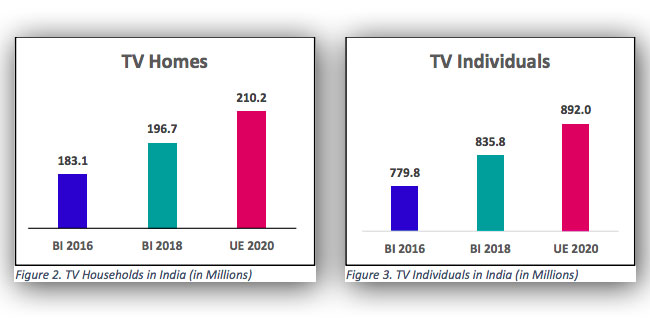
According to BARC India’s TV UEs 2020, 210 mn Indian households now own a TV set, an increase of 6.9% from 197 Mn in 2018. Simultaneously, TV viewing individuals also witnessed an increase of 6.7%, reaching 892 Mn from 836 Mn in 2018, an increase of 57 million individuals in 2020. TV Owning female population grew by 7%, while male population grew by 6%. In terms of age-groups, the highest growth was witnessed in the “kids” category (age 2 to 14) at 9%.
Meanwhile, TV households in Urban markets grew by 4% from 87.8 Mn in 2018 to 91 Mn while Rural markets have grown by 9%, up from 108.9 Mn to 119.2 Mn in 2020. While TV households across India grew by 6.9%, HSM grew by 8% outpacing All India as well as the South states which grew by 5%.
NCCS
As the Indian population continues to move up the socio-economic pyramid, changes are also observed in the NCCS profile of TV households. As per the TV UE-2020, the proportion of NCCS A and B has increased to 27% and 31% respectively while NCCS DE has further contracted to 9% of TV households in the country.
Sunil Lulla
On presenting the updated TV Universe Estimates for broadcasters, advertisers, agencies and other industry stakeholders, Sunil Lulla, Chief Executive Officer, BARC India, said, “As a body that is deeply rooted in data science, BARC India is committed to providing its stakeholders with a true representation of the television universe. We are happy we have been able to ascertain that television continues to be the screen of choice for Indians. With an additional 13 Mn TV households and an opportunity for another 90 Mn households that are yet to own a TV set, India’s broadcast ecosystem continues to have a significant potential for growth in the years to come.”
Dr Derrick Gray
Added Dr Derrick Gray, Chief of Measurement Science & Business Analytics, BARC India: “At BARC India, we are deeply invested in providing data that is statistically accurate by factoring in changes in the various “control and weighting variables” that are shown to be highly associated with television viewing. The updated Universe Estimates, UE 2020 aptly sums up India’s linear TV ecosystem and highlights that TV owning households continue to grow. Given the global pandemic scenario, the updated estimate is robust and is developed with the help of data and findings based from various previously validated field studies. We are certain that these estimates will help the industry to a great extent. We will continue to provide the industry with a currency that is reliable and of global standards. I would like to thank the TechComm on behalf of all of us for all their support and contributions in formalising the UE 2020.”
TV UE 2020 has been developed by computingthe Linear growth of TV Households and TV Individuals from Broadcast India (BI) Studies conducted in 2016 and 2018at geographic and demographic levels. The distribution of the TV population by NCCS was taken from the most recent Indian Readership Survey (IRS). BARC India will implement the findings from the TV Universe Estimates 2020 for its data starting Week 14, 2021, which will release on April 16, 2021 (that’s tomorrow). While an establishment survey as a part of Broadcast India (BI) 2021 is also currently underway, the updated estimates will reflect for BARC India subscribers in the YUMI Analytics platform with immediate effect.
Keeping in line with global television measurement standards, BARC India, will transition from using the term ‘Impressions’ to ‘Average Minute Audience’, abbreviated as ‘AMA’, in cognisance with the Technical Committee.
Average Minute Audience (AMA) is defined as the number of individuals of a target audience who viewed an “Event”, averaged across minutes. The methodology for the calculation of AMA will continue to remain the same as that of Impressions.
Data releases via the BARC India website for Week 47 onwards will reflect AMA. The change in terminology started reflecting on YUMI Analytics for BARC India subscribers December 1, 2020 onwards.
Dr Derrick Gray
Speaking on the development, Dr Derrick Gray, Chief of Measurement Science and Business Analytics at BARC India said: “At BARC India, it is our constant endeavour to ensure that our subscribers are provided with a currency which is true representation of What India Watches. At the same time, we are determined to provide our stakeholders with technology that is at par with global standards as well as clear metrics that match up to global metrics. We recently completed our transition to YUMI Analytics and as a step forward will move on to using AMA across data releases. We will continue to introduce world class practices and standards for our clients while evolving as a robust measurement body.”
BARC India recently collaborated with the Indian Institute of Management, Ahmedabad (IIM-A) to undertake a review of the current sample design and methodology. The statistical review team at IIM-A led by Prof Tathagata Bandyopadhyay, Professor of Statistics at IIM Ahmedabad, suggested the implementation of a new design which takes into account the cost of data collection and heterogeneity across markets.
However, no significant deviation was found in the sample size arrived at through the new design and the one being implemented by BARC India presently, thereby validating the representativeness of the panel. The team also expressed its pleasure with the overall sample allocation mechanisms put in place by BARC India.
It may be recalled that in 2018, the Indian Statistical Institute (ISI) Kolkata had certified the representativeness of BARC India’s Panel design and methodology. More recently, in July 2019, IIM-C had also presented a report on BARC India’s TV sample and appreciated the existing practices.
IIM-A in its report stated that no significant increase in the current sample size is required with the proviso that the current cost levels are being maintained. The team noted that a panel size of 50K TV homes is reasonable to move forward, with an additional 5K -7K homes to help capture detailed insights from TV viewership data.
The review teams of both IIM-C and IIM-A were of the opinion that an ideal sample size is subjective and based on factors such as sample design, cost of sampling, overall budget, and population characteristics. There is therefore, ‘no unique or ideal solution’. They also maintain that sample sizes should be reviewed periodically.
Said Prof Bandyopadhyay: “The entire review process has been an enriching experience and full of learnings for both teams. BARC India utilises an efficient sample design and sampling procedure for the management of their television viewing panel in a large and diverse market like India. The interaction with the BARC India team was extremely seamless and they extended their full support to us during the project.”
Added Dr Derrick Gray, Chief of Measurement Science, BARC India: “IIM-A’s endorsement of our sample design and methodology is yet another affirmation of our ability to accurately measure and report ‘What India Watches’ 365 days a year. We work round the clock to deliver accurate and credible data to a dynamic TV industry and will take into consideration the recommendations made by the review teams to make our systems more robust.”