Tag: Delhi

  • Red Alert! Monsoon Mazaa or Disability Distress?

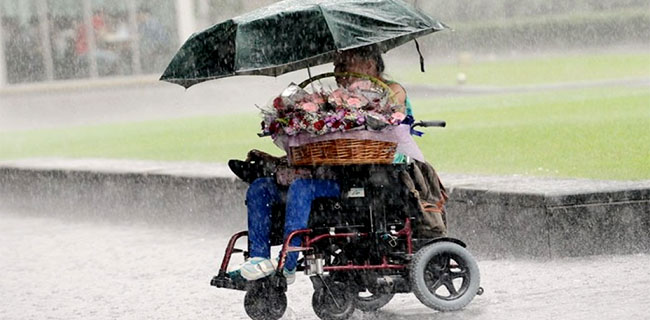
    Representative image. Photograph source: https://www.ohchr.org/


    By Shruti Pushkarna


    Shruti PushkarnaIn the past few weeks, monsoon fury has topped news headlines across different parts of India. If you google rain+news, the search throws updates of orange and red alerts in parts of Maharashtra, Gujarat, Karnataka and more. Then there’s the frightful, shrieky voices of television anchors warning us about the dangerously rising levels of Yamuna and Ganga. Not to miss the conspiracy theories and political buck-passing between neighbouring states on releasing excess water.


    Growing up in Delhi, I haven’t witnessed the city at such a standstill in the past, with roads completely blocked off because of water-logging. The situation is definitely bad. In fact, climate conditions across the world have been uncertain and alarming.


    Both traditional and digital (and social) media are brimming with accounts of lives lost, infrastructural damage, crops destroyed, poor urban planning, homes demolished, et cetera. Average (wo)man is posting photos and videos on social media from their places of work/ study and residence, highlighting the respective perils they are facing.


    I still recall the horror of July 26, 2005, one of the first few serious news stories I witnessed as a budding journalist. ‘Mumbai Deluge’, the headline and the corresponding pictures are vividly etched in my brain. The city received 944 mm rain, the eighth-heaviest 24-hour rainfall recorded ever, claiming thousands of lives.


    Then too, similar coverage ensued. Eighteen years on, our cities and states still seem unprepared to battle the nature’s wrath. But I’ll leave that debate for another day.


    For the average Indian citizen, what does monsoon mean? Baarish or pitter-patter raindrops throw up varied imagery and meaning for different people. A steaming cup of tea paired with hot pakodas, swaying lush green trees, potholes, overflowing sewers, watered-down roads, damp clothes, dripping huts, traffic snarls, careless children jumping in muddy puddles. I’m sure you can think of more!


    Ever think of what it means for an average disabled citizen?


    Twenty-nine-year-old Payal Bhattad lives in Virar near Mumbai and until recently, she traveled to Wilson College in Mumbai to teach history to undergraduates. The daily commute in the local train would easily take up three hours of her day. And Payal is a totally blind person who uses a white cane to navigate her way across the bustling city. When the heavy raindrops fall on the tin sheds of the train station, Payal is unable to register any other audio cues which otherwise guide her to move forward, backward, left, or right. She cannot hear the murmurs of fellow passengers, or hawkers’ cries, nothing that indicates any familiar direction or territory to her. Once, the roaring rain misled her to the edge of the platform and she fell onto the tracks. And no one noticed or stopped to help her up.


    Akash Nimbalkar is a 30-year-old social worker who also lives in Virar. He is a person with low vision, who finds it extremely challenging to wade through knee-deep water on his way to work, using a cane. He is always worried of submerging into an open gutter or losing balance and slipping on the flooded road. His family hesitantly stops him from going to the office every day, as they worry about their visually impaired son getting stranded in the rain.


    With wind blowing amidst heavy rain, it’s hard to steadily hold an umbrella, and manage to stay dry. Additionally, there’s personal belongings to juggle with the gamp. Forty-six-year-old Shirin Kheriwala works as a counsellor with a national helpline for the blind. She usually relies on sighted people to help her cross busy main roads and assist with directions. But during the monsoon, everyone is running to find shelter and save themselves. Coming back from work one day, she found herself isolated on the highway. And her umbrella broke. But as they say, necessity is the mother of invention. Shirin folded the umbrella to use as a cane and held her white cane up in the other hand as an indication to the rushing traffic, that she was walking across.


    The situation is equally precarious for persons with orthopaedic or locomotor disabilities. It is difficult, sometimes even impossible to use wheelchairs, crutches, or any other assistive aids in such extreme weather conditions.


    Saurabh Kohli is a 40-year-old person with multiple sclerosis (MS). Apart from the usual fatigue accompanying MS, he experiences balance issues and severe weakness in his legs. Although he drives a slightly modified automatic car to his office at Amity University in Noida, he uses a walker or wheelchair to get from one place to another. Walking without such assistance is next to impossible for him. He drives around 70 kms every day, but in rainy weather, he avoids stepping out alone. The humid weather conditions also adversely affect his medical condition.


    Prosenjit Chakraborty is also a person with multiple sclerosis. He lives in Guwahati, and drives a battery-operated tricycle to run his errands, visit the doctor’s clinic and the hospital for follow-ups. He fears the day when rainwater seeps into the battery of his vehicle and stops it from functioning, leaving him helpless on the road. So far, he’s been lucky!


    All these folks, like many other persons with disabilities don’t want to stay home, take leave, or not show up to work because of the additional challenges they face due to their disability, in the monsoon season. Instead, they look for solutions and brace up for perilous times.


    But is the administration aware of their difficulties? Are policies being designed and implemented to prevent or tackle such hazardous situations facing approximately 2.68 crore people?


    And what about the fourth pillar of democracy? Why doesn’t the media focus on reporting issues and accounts of persons with disabilities who have equal rights as citizens of India? Before raging another debate on urban development woes, climate change, or disaster management, the media should understand and include the stories of millions of overlooked disabled stakeholders.


    Wondering why MxMIndia publishes a disability advocacy column? Well, we strongly feel that the media can dramatically transform the world of persons with disabilities. And this series can help bring forth issues that the media must champion to create a truly inclusive and accessible India. To write this column, we invited Shruti Pushkarna, a former journalist who is now a disability inclusion advocate based in New Delhi. Her views here are personal. To access the archives of her 75-plus columns, please visit: https://www.mxmindia.com/category/ columns/shruti-pushkarna/


    If you have a view on the issues raise or would like to align with MxMIndia on this cause, write to us at editor [at] mxmindia.com.


  • Shruti Pushkarna: ‘Coupling’ with Covid: One hell of a roller coaster ride

    Shruti PushkarnaBy Shruti Pushkarna


    As promised, here is a personal account of my three months’ absence, when I couldn’t put pen to paper and furnish my otherwise extremely regular fortnightly column. If you are wondering what’s this got to do with the theme of disability, the answer is probably nothing. Except maybe it articulates a similar sense of helplessness and frustration, experienced by the disabled folk on varied levels 24×7. A first for me, it was truly novel and intense.


    The start of a new financial year, April 2021 saw a sudden explosion of Covid cases in the country. Delhi and NCR were badly hit. As I took my marital vows (in a close family setting), Chief Minister Arvind Kejriwal announced a curfew with immediate effect. En route to my new abode, we were stopped and questioned by cops for disregarding the latest notification. Caught off-guard, we requested the trail of cars be allowed to pass the barricade.


    Oblivious to the alarming crisis building outside, we chuckled and chatted, celebrating our conjugal beginnings. But in two days, things changed drastically. One after the other, the whole family tested positive for Covid-19. With each phone call, the tally went up, everyone reporting cases from their circle of family and friends.


    Initial symptoms of fever and cough didn’t seem so bad. It was the messaging going around that instilled fear, forcing one to imagine the worst scenarios. ICU videos of patients struggling to breathe, accounts of people dying from the lack of oxygen on their way to the hospital, shortage of beds and oxygen, hoarding of drugs, news and social media was full of it. Not to miss the emphatic promotions of oxygen concentrators, oxymeters (not made in China), homeopathy medicines and what not. Everyone and their uncle was an expert on coronavirus!


    Grappling with isolation and new relationship dynamics, best decisions weren’t easy to come by.  Starting with doctors.


    What do you do when you first start to show symptoms? Who do you call? Most physicians you’ve known all your life have no experience with Covid, so whose opinion do you trust? And to top it all, various Covid treatment guidelines floating around add to the imbroglio.


    For a week, we diligently followed the usual course of antibiotics, vitamins and breathing exercises. Things didn’t improve, in fact went downhill. The viral videos came to life, as my husband struggled to breathe and I made endless calls to arrange for a concentrator. We were lucky, the machine finally arrived, but as both of us tried to make the contraption work, things took a risky turn. We had to rush to a nearby hospital.


    I helped my husband into an ambulance and loaded my car with the oxygen backup (since the hospital wasn’t equipped), clothes and some essentials. As I got behind the wheel, my own O2 levels dipped.


    It seemed surreal, but it was all happening in real time and space.


    Picture this. My husband on one bed, breathing with the oxygen tube jutting into his nostrils, his O2 numbers fluctuating, causing the machine to beep incessantly. I lay on the bed next to him, with a cannula in my wrist, injecting steroids and antibiotics into my body. Sometimes, I tried to look out the window, for a ray of hope. But all I saw was the backyard of another hospital where new patients and dead bodies lined up daily. The beeping from the machine and the siren from the ambulance became my staple aural diet.


    Even so, there was no room to express any anxiety. In there, I had only one mission, to get us out of there. To make sure we got the right treatment. Thanks to my mother’s chronic illness, I have reasonable amount of experience with caretaking and dealing with doctors. I have learnt not to depend on nurses or hospital staff for adequate patient care. Services are shoddy, often due to low compensation and dearth of human resources. Given the dire circumstances and the volume of cases at the time, one could hardly blame the health workers.


    I saw other Covid patients on the same floor, battling alone, as no family member wanted to enter the infected zone. I wondered how many of them got proper attention. Those who weren’t medically aware or aggressive enough simply relied on whatever the staff handed out to them.


    It’s amazing how most citizens don’t question the treatment administered to them. Not just in Covid, doctors don’t like patients or their caretakers seeking clarification on the prescribed course of action. Bedside manners and hospital management don’t seem to feature in medical school curricula.


    So why am I indulging you in this elaborate excruciating extravaganza?


    With the scare of a third wave brewing, one can’t help worrying about what will happen if people act as recklessly as they did the last time around. I want to share some do’s and don’ts that can help.


    Don’t read the news.

    It never helps. Every case is different and there is no point in drawing parallels. Just focus on your body and its recovery. Also, the prime motive of coverage seems fear mongering to garner eyeballs.


    Don’t engage in medical updates and futile conversations.

    Limit your communication to what helps your case. Reiterations of your physical state will only exhaust you emotionally. Stick to speaking with those who ‘really’ care.


    Trust your doctor.

    As tempted as you might be to follow multiple medical advisories, don’t. Have faith in your doctor’s expertise and let her/him help you come out of it.


    Stay positive.

    The only thing that pulls you out of any tough situation is a healthy mind. No matter how bad your physical condition, remind yourself constantly, that you can overcome. Our mental state impacts our physiology, so use it to heal from within.


    Focus on disease management.

    Covid is all about proper management, starting from Day 1 at home. Ensure you are in touch with a good doctor from the start. Follow the advice diligently and keep an eye on changing symptoms. Take an informed call (without worrying) on when to get hospital care. Arrange for oxygen backup and have a network of friends and family lined up for remote help. If you plan and manage it well, the likelihood of recovery is higher.


    Don’t lose patience.

    This virus takes a toll on your body and mind, in unfathomable ways. The disease has after-effects that can trouble you for months (I’m still suffering). It’s a test of your tolerance. It helps to accept the situation and wait for it to recede, of course with necessary treatment and precautions. It’s easy to get frustrated because it turns your world upside down, but you need to exercise patience.


    Save for a rainy day.

    If you have money in your bank, half your stress gets taken care of. The disease starting from testing, treatment, after care and logistics, makes you bleed. Throwing money at the problem eases some troubles for sure. But be watchful of obvious traps and treachery. I wasn’t and I regret it.


    I must confess that working with the disabled community has given me valuable insights into acceptance, threshold and grit. And firsthand trauma made me realise what it is to be up against odds every singly day of your life.


    It’s been a lesson in compassion, forbearance and gratitude.


    (Welcome back, Shruti – Ed)


    Shruti Pushkarna heads operations of the New Delhi-based Score Foundation where she works as Director-Programmes & Communications. She is a former journalist (part of the founding team of MxMIndia) who has moved full-time to the social sector. Shruti writes for MxMIndia every other Thursday. Her views here are personal. You can tweet your comments and suggestions to @shrutipushkarna

  • Shruti Pushkarna: Are there hints of hypocrisy underneath the dissenting voices?

    Shruti PushkarnaBy Shruti Pushkarna


    Yesterday I had a unique experience. Almost 37 years old, I have grown up listening to stories of the India-Pakistan Partition from my paternal grandfather, stories of my maternal grandfather about protesting against the authorities to protect the rights of labourers, and more recently, stories from my father and aunt from their time in prison when they upped their voices against the Emergency imposed by the then Indian Prime Minister, Indira Gandhi.


    However graphic the pictures were in my head as these stories were narrated to me, but never had I experienced anything first-hand. Now before I build up your hopes as a reader for some thrilling piece here, I must confess I was not part of any action. I was just a first-hand witness. Not a listener, a spectator, watching the action live on the ground.


    The entire country is up in arms against the Citizen Amendment Act, recently cleared by the two houses of the Indian Parliament. Protests and slogan shouting everywhere. We have witnessed reports of services being disrupted, internet being withdrawn etc on several occasions from other parts of the country, but yesterday it was the capital of India. Parts of the Delhi city had internet, voice and SMS services withdrawn by network providers, on a directive issued by the government. This was a first for us. Access to media thwarted. How can the political capital of the country, the news hub of India, witness such a media blackout at the behest of politicians’ will? Are we assuming that if I’m unable to share my views using social media or develop an opinion based on others’ experiences being posted on media platforms, my voice can be drowned? We all assumed we were living in a fortress, untouched by common man’s woes. But yesterday these assumptions came crumbling down in the face of dissenting voices dissing the arrogant ruling class.


    When I left home yesterday morning, it was a regular working day for me. Taking a one-hour cab ride to my office in South Delhi, getting through meetings, meeting deadlines and so on. And then the news alerts started to pour in. One after the other. Roads blocked, police barricades, long winding traffic jams, metro stations being closed down, Section 144 imposed in pockets of Central Delhi. News bits went from bad to worse. I stepped out for a cup of coffee in my lunch break and saw CISF troops being rushed into the metro station nearby (same one I access to travel home daily). And it all came alive. Offices started to close down, parking lots started to clear up, people started to rush back homewards.


    As I took the Delhi metro back home (taking the roads was a bad option because of the violence on the streets), I looked around at my fellow commuters. Some were responding to phone calls from worried loved ones. Some were watching the news on their mobiles struggling with the sketchy mobile data. Some were watching right wing videos loudly on their phones, telling others around them that India is a Hindu sovereign. This last set of people actually broke out into shrieks of “Bharat Mata ki Jai” on the train. Some scared travellers looked away. Confused ones simple stared. A third category of people like me, not confused or scared, simple outraged, looked at them in disgust.


    A train journey is not the place to voice your opinion in an unruly manner. A train journey at that, where most stations were shut and people couldn’t wilfully deboard at their desired destinations. Also I doubt how much of the so-called ‘Bharatvarsha’ sentiment do these people embrace when it comes to other issues crippling the country.


    I for one work towards getting persons with disabilities an equal status as citizens of India. Will the same people stand by me, and fight for rights of this minority section tomorrow? I don’t think so.


    Will the same people offer food to the cook, driver or maid working tirelessly for their families? I don’t think so.


    When I go to a restaurant in Delhi, I see the same ‘protesting’ lot of people enjoying their dinner and drinks as their children’s nannies look from a distance. The nannies who are feeding their babies are not allowed on the same table, not offered the same food.


    I respect equality for everyone. I standby each religious group and their rights. But I also respect other vulnerable groups in their fight for rights. And I practise that respect in my day-to-day actions as much as I would do if I were at Jantar Mantar tomorrow.


    Let’s not be hypocrites ourselves when we accuse our leaders of the same. Would the same people hurl stones at the authorities if tomorrow a person with disability seeks equal employment or education rights? Will their children be told not to isolate disabled students in their classroom?


    If we talk of an equal India, then I must confess we are so far away from it. So who are we kidding.


    Shruti Pushkarna is a former journalist (part of the founding team of MxMIndia). who has now moved full-time to the social sector. She heads operations of New Delhi-based Score Foundation where she works as Director. Her views here are personal. She can be reached via Twitter at @shrutipushkarna


  • Jaldi 5 with Ashwin Padmanabhan: The retro way to rise in ratings in Mumbai

    Two Sundays back, Reliance Broadcasting Network Ltd’s 92.7 Big FM in Mumbai switched from being a current hits radio station to one that plays retro music. Last year, after it did the same in Delhi, the station leapfrogged the RAM ratings charts to the Top 3. With the change to retro, the RBNL thinktank hopes to achieve much success in Mumbai too.We posed a few questions to Ashwin Padmanabhan, Business Head of the 45-station 92.7 Big FM. Here goes the Q&A.


    1. So why the switch to retro in Mumbai too?

    We initiated an exhaustive research to evaluate the preferences of our listeners and understand our brand positioning better. The results showed that listeners favoured retro music and there emerged an opportunity to offer listeners music and content of their choice. This decision was also influenced by the success generated at the 92.7 Big FM Delhi Station, which went retro sometime ago and the market has reacted exceedingly well. The response from listeners was overwhelming, with the station reaching leadership numbers.


    2. Would you go retro with your other stations too?

    We have never believed in a one-shoe-fits-all format. We evaluate and treat each market independent of the other and understand the requirements of each individual market. We have gone retro in six markets – Mumbai, Delhi, Baroda, Kolkata, Bhopal and Rajkot.


    3. 92.7 BIG FM was meant to be a mainstream FM radio station. By going retro, while your listenership rises, you move away from the mainstream… something that you would’ve possibly have as your second station do post Phase 3?

    The team has mapped out its positioning strategy based on unique yet strong on-air and digital concepts, while taking into consideration the lifestyle of Mumbaikars, the amount of time they spend in travelling and the blend of listeners in Mumbai. Although the stationality has been changed to retro, the revamped content strategy will also bring to listeners a plethora of current happenings in the city including stock and gold updates, city affairs, traffic and weather updates, sports, music-related trivia and more. In addition to this, 92.7 Big FM Mumbai intends to keep up with the local roots of Maharashtra by airing Marathi music and will have Marathi-speaking RJs as well. So no, I would think we are still very mainstream.


    3a. Tell us more about the local Marathi content? How much of it will be at peak hour?

    We are still working on this and might be a little early to talk about.


    4. How do you anticipate the retro positioning faring in terms of ratings?

    Well, we believe this will work in the Mumbai market. Our endeavour is to break the clutter and offer listeners content that is engaging and meets their aural preferences. Right now might be a little premature, but the feedback coming in from across the city has been extremely encouraging. We are confident it will work well with listeners.


    4a. Yes, your Delhi ratings have most certainly improved… In terms of ads, how has the higher ranking helped?

    Advertisers pan India have supported our decision. Differentiation is the way forward, and our advertisers realize that.


    5. What does your Delhi experience say… does retro music alienate the young and restless?

    Certainly not. We think the music from the sixties and seventies has always been appreciated by listeners across age groups. We think 92.7 Big FM can offer a distinctive change from the monotonous pattern of music that is heard elsewhere. We have seen an increase in listenership and are very happy with the results of the new positioning.


  • DNA to launch Delhi edition on May 13


    By A Correspondent


    The six-edition Daily News & Analysis (DNA) is set to launch an edition in Delhi on Monday, May 13.


    May 13 is also Akshay Trittiya, a day normally considered auspicious for starting new projects or buying gold, automobiles or property. The editorial team at DNA is in place with Saikat Datta as Resident Editor. An aggressive marketing plan is scheduled give the newspaper prominence in a market dominated by Hindustan Times and The Times of India.


    In the last quarter, under the leadership of Dr Bhaskar Das, group CEO, News Cluster, DNA has gone in for a new look – in the paper as well as in the team bringing it out and running the company. The subscription offer has been withdrawn and the emphasis is on profitability without compromising on editorial quality.


    DNA is now owned and managed by the Zee group. With the Delhi launch, the newspaper will have editions in seven centres. Currently, while Mumbai, Bengaluru and Pune are managed by DNA, the Ahmedabad, Jaipur and Indore editions have been franchised to the Dainik Bhaskar group, which co-owned the paper until a few years back. The Delhi edition will be managed by the Zee-owned DNA.


  • The Anchor: Asif Syed on 5 Things that are getting hotter in New Delhi

    By Asif Syed


    1. Manmohan Singh – Will the sardar become asardar?

    For a while now, many observers of the Delhi durbar have felt that the real Prime Minister wasn’t Manmohan Singh, (no, not Sonia Gandhi, she’s the super PM) but Pranab Mukherjee. Whether it was with government work, party work, troubleshooting for the UPA sarkar or heading 13 Groups of Ministers that deliberate on government policy, Pranab was the man. The joke is that the PM (Manmohan) spoke so little is because the real PM (Pranab) didn’t let him.


    Now with Pranab on his way to becoming President of our republic, many ministers in the Union Cabinet have found some additional breathing space, but none so much as Manmohan Singh. So much so that the very day he took over the Finance Ministry, the sardar ordered the government to go looking its lost “animal spirits!”


    So will the sardar become asardar or will the real number 2 – P Chidambaram, who was second only to Pranab in the GoM count with 12 in his kitty – muscle in and fill in the vacuum.


    2. The Summer of 2012

    The venerable Times of India has reported that Delhi has had the hottest summer in the past 33 years with the average temperature frizzing the mercury to an average of 41.25 degrees. Interestingly, and what is probably a sign of the times, the data for this investigative story was sourced not from the Metrological Department of India but from the website of the National Climatic Data Centre (NCDC) in the United States.


    Unlike Bombay and (ahem) some other parts of the developed world that have uninterrupted power supply, Delhi seems to have introduced the new concept of uninterrupted power cuts. Add to this the severe water shortage – basically no water at all from the MCD – and one gets situation where residents who are out on the streets to protest the lack of bijli get into a scuffle with each other over tankers delivering water.


    Of course, Lutyens Delhi, home to national level politicians, bureaucrats and businessmen has no bijli or paani problems. The air conditioners in the MPs homes are humming and sprinklers keep their lawns achingly green.


    There is fervent hope that the monsoon rains will bring some respite but they too seem to be avoiding Delhi and are stalled somewhere over central India. Maybe the ToI can talk to the NCDC about what to do…


    3. The most modern thing in Delhi

    Not all is bad in Delhi and the Delhi Metro Rail Corporation is the best thing going on the ground, below the ground and above the ground. It has changed the face of Delhi for the better like nothing else and with every phase of expansion it is bringing the spread out city of Delhi and the other parts of the National Capital Region closer to each other. It is the one thing that works in the city of a thousand hindrances and works very well.


    With two phases completed and almost 200 km of track laid and services running, the DMRC has commenced Phase III which it aims to complete by 2015 and Phase IV by 2021. By then the Metro will have more than 400 km of track and will reach every corner of the megapolis. It is already one of the most advanced metros in the world and soon will also be one of the largest. (check out this map – http://en.wikipedia.org/wiki/File:Masterplan_of_Delhi_Metro.png)


    Like Vicky the eponymous sperm philanthropist of the move Vicky Donor says to his nani, “Dill mein sirf do cheezein modern hain, ek hai metro aur ek tu.” I can’t vouch for the old lady, but he is bang on with the metro.


    4. News Capital

    For a city where the large majority of the people have at best only a passing acquaintance with the English language (or as they say in Delhi – bus sirf hi/hello hai), it is home to more English language newspapers, magazines and television news channels than any city in India.


    At last count there are more than 15 mainstream general and business daily newspapers being published from the city in English. The Millennium Post was the latest of the blocks and a couple more are reportedly in the pipeline. At this rate we run the risk of soon having more English newspapers than readers who read English.


    Throw in Hindi and other language publications and Delhi is probably host to the largest print news industry, with more print journalists than any city in the world. And in no other city can one find such a large number of journalists that speak, report and write in such a range of Indian languages.


    Sucking in all the content produced everyday and spitting it out in a physical form is a robust contract printing industry that is centred largely in neighbouring Noida. The printing industry there probably has the distinction of having not just the largest number of printing presses of all shapes and sizes of any city but of also printing newspapers not just in English in Hindi but also a number of other languages. For example, Vibha Printers (in NOIDA obviously) print newspapers in six languages.


    Never mind the lack of revenue, let alone profits, the news business inIndiais growing faster than ever before.


    5. Rahul Gandhi – naram but still garam

    As ever, Rahul Gandhi remains the hottest politician in India and with talks of an impending Cabinet reshuffle he is hotter property than ever.


    There is now talk about him finally finding a seat in the Cabinet as the Deputy Prime Minister, no less. The logic goes that this will be a suitable post for him to make his entry into the government as it won’t be decried as nepotism at its most obvious and it will still be a prominent enough to position him as the next leader of the party and the government. Party pundits feel the results of the next general election in 2014 will be determined by the ‘Youth Vote’ and who is better to capitalise on this demographic dividend than the youthful Rahul Gandhi.


    His middle-of-the-road pragmatism and firm resolve to stay away from the politics of caste and religion give him a universal appeal. And that, the thinking goes, will lead to a windfall of young urban and rural votes for the Congress and its allies.


    Though it would be wise to recall the ‘Rahul Effect’ in recent elections. Beginning with Bihar and followed by Pondicherry and most recently Uttar Pradesh, the last three assembly elections where he has played a significant role, it has become clear that Rahul’s presence alone does not bring in electoral results for the Congress party.


    However, the party, and specially dye-in-the-wool Congressmen, can’t stop gushing about him like schoolgirls with a crush on Ranbir Kapoor.


    Asif Syed is Editor and Publisher of Current and www.CurrentNews.in. He toggles between New Delhi, Mumbai and Buenos Aires


  • RAMcheck: Besides Mumbai, no change in #1s

    By A Correspondent


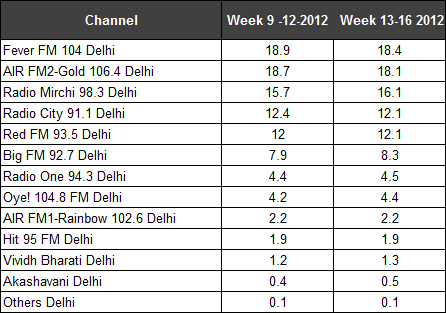
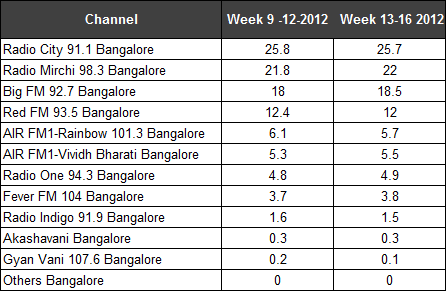
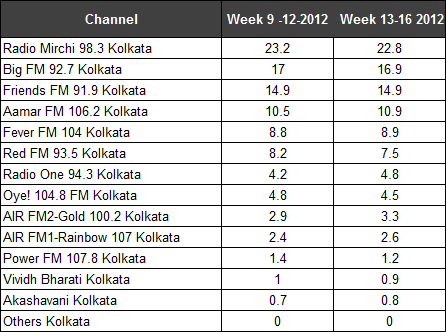
    TAM Media’s Radio Audience Measurement (RAM) – which covers four key metros, Mumbai, Delhi, Kolkata and Bengaluru – released its latest radio listenership figures for wk 13 to wk 16, 2012 (Last week of March to first three weeks of April, 2012). According to the latest RAM data, for listeners of 12 years of age and above, all places of listening, and according to radio channel shares, RadioCity, Radio Mirchi, Fever FM, Big FM, Red FM, Radio One, Oye! FM continue to be the top FM stations in the big four metros.


    Mumbai:


    Radio Mirchi emerges as the number one FM station in Mumbai with a market share of 15.3 per cent, followed closely byRadioCityat 15.2 per cent. The two FM stations are closely competing for the top spot, but what remains to be seen is which of these two FM stations retains the top spot. AIR FM2 Gold, Fever FM and Big FM make the top five FM stations in Mumbai. The other FM stations in the Mumbai market include Red FM, Radio One, Oye! FM, AIR FM1 Rainbow, Vividh Bharati and Akashavani.


    Delhi:


    Fever FM continues to be the most popular FM station in Delhi with a market share of 18.4 per cent, its nearest rival is the AIR FM2 Gold which is comfortably placed at number two with 18.1 per cent market share. Ranked three is Radio Mirchi followed by RadioCity which is ranked four and Red FM as ranked five in theDelhimarket. The rest of the FM stations in Delhi include Big FM, Radio One, Oye! FM, Hit FM, AIR FM1 Rainbow, Akashavani and Vividh Bharati.


    Bengaluru:


    RadioCity continues to maintain its leadership position in the city. RadioCity, Radio Mirchi and Big FM are the top three most popular FM stations in Bengaluru. RadioCity received a market share of 25.7 per cent whereas Radio Mirchi and Big FM received a market share of 22 per cent and 18.5 per cent respectively. Ranked four is Red FM with 12 per cent and the fifth most popular FM station is AIR FM1 Rainbow with 5.7 per cent. The other FM stations in Bengaluru include AIR FM1 Vividh Bharati, Radio One, Fever FM, Radio Indigo, Akashavani and Gyan Vani.


    Kolkata:


    Radio Mirchi is the clear winner in Kolkata with a market share of 22.8 per cent. The top three FM stations in Kolkata haven’t changed as Radio Mirchi continues to be the number one FM station of the city followed by Big FM with a share of 16.9 per cent and at the number three FM station of Kolkata, Friends FM received a share of 14.9 per cent of the share. Ranked four and five are Aamar FM and Fever FM with a share of 10.9 per cent and 8.9 per cent respectively. The other FM stations in the city are Red FM, Radio One, Oye! FM, Power FM, AIR FM1 Rainbow, AIR FM2 Gold, Vividh Bharati and Akashavani.


  • RAMcheck: No change in #1 stations across RAM markets

    By A Correspondent


    TAM Media’s Radio Audience Measurement (RAM) – which covers four key metros, Mumbai,Delhi, Kolkata and Bengaluru – released its latest radio listenership figures for Wk 8 to Wk11 (Last two weeks of February 2012 and first two weeks of March 2012).


    According to the latest RAM data, for listeners of 12 years of age and above, all places of listening, and according to radio channel shares,RadioCity, Radio Mirchi, Fever FM, Big FM, Red FM, Radio One, Oye! FM were some of the top FM stations in the big four metros.


    WhileRadioCityretained its leadership position in Mumbai and Bengaluru, Fever FM and Radio Mirchi also continued to remain the leading FM stations inDelhiand Kolkata respectively.


    Mumbai:

    RadioCitycontinues to be the most popular FM station in Mumbai, as the FM station has maintained its leadership position in the city. Ranked second is Radio Mirchi followed by AIR FM2 Gold, Fever FM and Big FM which are ranked third, fourth and fifth respectively. These top five FM stations and Red FM, ranked sixth have secured their listenership share in double digits. The other FM stations in the city include Oye! FM, Radio One, AIR FM1 Rainbow, Vividh Bharati and Akashavani Mumbai.


    Delhi:

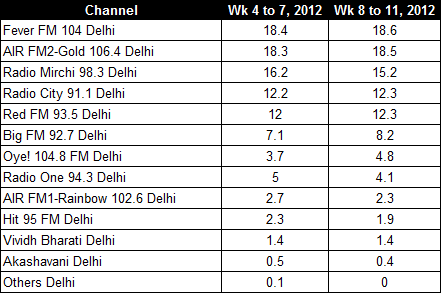
    According to the Wk8 to Wk 11 RAM data, Fever FM has once again retained its leadership position inDelhiwith a listenership share of 18.6 per cent followed by AIR FM2 Gold which garnered a share of 18.5 per cent. Although Fever FM is the number one FM station ofDelhi, the government owned AIR FM2 Gold is a close second. What remains to be seen is whether Fever FM is able to widen the gap between the number one and number two FM station? Or will AIR FM2 Gold claim the leadership title?  Once the undisputed leader ofDelhi, Radio Mirchi is now ranked three with a share of 15.2 per cent followed byRadioCityand Red FM with a share of 12.3 per cent respectively. The top five FM stations have received their station share in double digits. The other cluster of FM stations inDelhiincludes Oye! FM, Radio One, AIR FM1 Rainbow, Hit FM, Vividh Bharati and Akashvani Mumbai.


    Bengaluru:

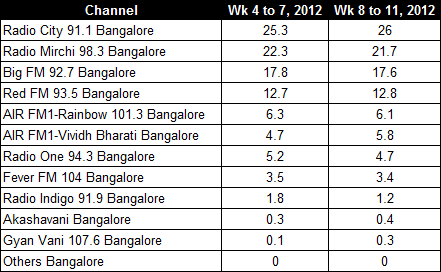
    RadioCitymaintained its leadership position in Bengaluru with a share of 26 per cent, its nearest rival Radio Mirchi, on the other hand, received a share of 21.7 per cent. Ranked three is Big FM with a share of 17.6 per cent followed by Red FM which received a share of 12.8 per cent. While the top four FM radio stations in Bengaluru received a double digit share, AIR FM1 Rainbow which is ranked five received a share of 6.1 per cent. The other clusters of FM station in the city are Fever FM, Radio One, Radio Indigo, Gyan Vani, Akashavani and Vividh Bharati.


    Kolkata:

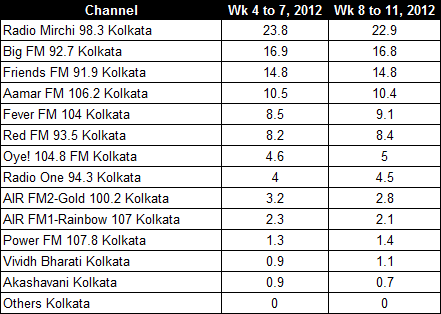
    The top five FM stations of Kolkata continue to remain the same. Radio Mirchi is unanimously the most popular FM station in Kolkata with a whopping 22.9 per cent of the station share. Its nearest rival is Big FM which received a share of 16.8 per cent followed by Friends FM and Aamar FM which are ranked four and five respectively. Kolkata is the only RAM market which perhaps has not seen a change in the top four rankings in a long time. While Fever FM and Red FM are ranked five and six respectively, other clusters of FM station in Kolkata are Oye! FM, Radio One, Power FM, AIR FM1 Rainbow, AIR FM2 Gold, Vividh Bharati and Akashavani Kolkata.


  • RAMcheck: More surprises for FM players

    By A Correspondent


    TAM Media’s Radio Audience Measurement (RAM) – which covers four key metros, Mumbai,Delhi, Kolkata and Bengaluru – released its latest radio listenership figures for Wk 4 to Wk7 (Last two weeks of January 2012 and first two weeks of February 2012).


    According to the latest RAM data, for listeners of 12 years of age and above, all places of listening, and according to radio channel shares,RadioCity, Radio Mirchi, Fever FM, Big FM, Red FM, Radio One, Oye! FM were some of the top FM stations in the big four metros.


    Mumbai:

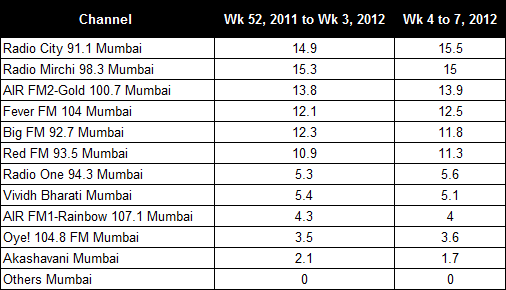
    Radio City surged ahead of Radio Mirchi as the most popular FM station in the city with 15.5 per cent channel share from Wk 4 to Wk7, 2012 whereas Radio Mirchi’s channel share stood at 15 per cent. Ranked three is AIR FM2 Gold which more or less remained unchanged in listenership share from wk 4 to 7, 2012 as against Wk 52, 2011 to Wk 3, 2012. As compared to Wk 52, 2011 to Wk 3, 2012, six FM stations witnessed growth in their listenership share in Wk 4 to Wk 7, 2012 namely, Radio City, Fever FM, Red FM, Radio One, Oye! FM and AIR FM2 Gold.


    Source : RAM

    Market: MUMBAI

    Demographic: All People 12+ Filter Demographic: None

    Statistic: Share %

    Daypart: Sun – Sat 12:00 AM – 12:00 AM

    Place of Listening: All


    Delhi:

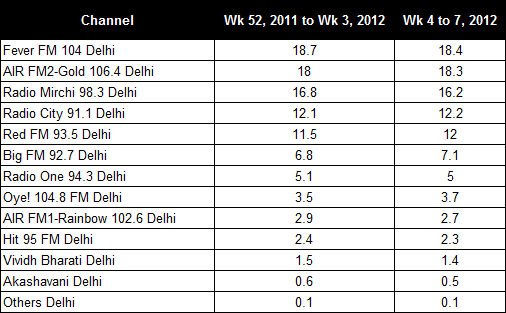
    Fever FM once again manages to retain its leadership position inDelhi, its nearest rival in Delhi is Radio Mirchi, if the government owned AIR FM2 Gold is excluded. According to figures for Wk4 to Wk 7, 2012, AIR FM2 Gold is close behind Fever FM for the top spot. What remains to be seen is whether or not Fever FM is able to retain its leadership position inDelhi.


    The Wk4 to Wk 7, 2012 RAM numbers reveals that in comparison to Wk 52, 2011 to Wk 3, 2012 only five FM stations witnessed any growth in the Delhi market. The FM stations to have seen growth in their listenership shares are Radio City, Big FM, Red FM, Oye! FM and AIR FM2 Gold.

    The other FM stations in the Delhi market are Radio One, Hit FM, AIR FM1 Rainbow, Vividh Bharathi and Akashavani Delhi.


    Market: DELHI

    Demographic: All People 12+ Filter Demographic: None

    Statistic: Share %

    Daypart: Sun – Sat 12:00 AM – 12:00 AM

    Place of Listening: All


    Bengaluru:

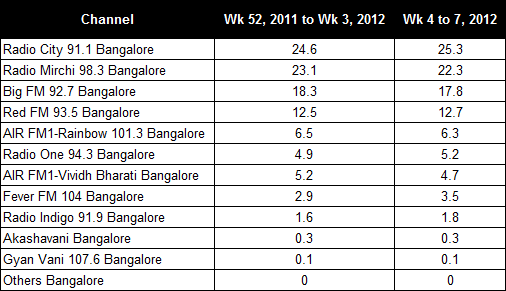
    In Bengaluru too, Radio City continues maintain its numero uno position, the FM station has managed further grow its listenership share in Wk 4 to Wk 7, 2012 as against Wk 52, 2011 to Wk 3, 2012. The second most popular FM station in Bengaluru is Radio Mirchi followed by Big FM and Red FM, ranked third and fourth respectively. Ranked fifth is AIR FM1 Rainbow and Radio One is ranked sixth. The five of the eleven FM stations in the Bengaluru market which witnessed growth in listenership share areRadioCity, Red FM, Radio One, Fever FM and Radio Indigo.


    Market: BENGALURU

    Demographic: All People 12+ Filter Demographic: None

    Statistic: Share %

    Daypart: Sun – Sat 12:00 AM – 12:00 AM

    Place of Listening: All


    Kolkata:

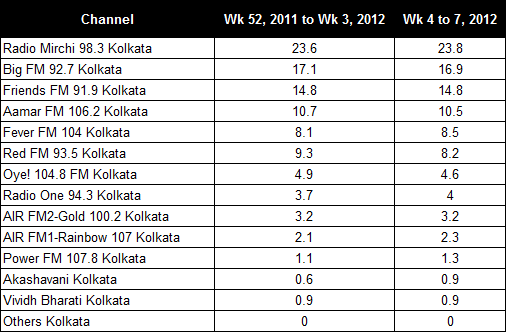
    Radio Mirchi has not only maintained its leadership position in the city, but has also witnessed some growth according to the Wk4 to Wk 7, 2012 RAM data as against Wk 52, 2011 to Wk3, 2012. Kolkata is the only RAM market to have seen no change in atleast the top three rankings. Radio Mirchi, Big FM and Friends FM continue to be the top three FM stations in the city. Ranked four is Aamar FM, followed by Fever FM, Red FM and Oye! FM. Of the thirteen FM stations in Kolkata, six FM stations in the city have witnessed growth in their listenership shares: Radio Mirchi, Fever FM, Radio One, Power FM and AIR FM1 Rainbow. Although Friends FM remained stagnant in its listenership share, nevertheless it is comfortably placed at number three. The other FM stations in the Kolkata market include Radio One, Power FM, AIR FM1 Rainbow, AIR FM2 Gold, Akashavani Kolkata and Vividh Bharati.


    Market: KOLKATA

    Demographic: All People 12+ Filter Demographic: None

    Statistic: Share %

    Daypart: Sun – Sat 12:00 AM – 12:00 AM

    Place of Listening: All


  • Anil Thakraney: Deccan Herald’s Mission Impossible

    By Anil Thakraney


    Having learnt to live a life in India where just about anything is possible, nothing ever unnerves me. But I must say I woke up on Sunday morning to rather shocking news, it totally rattled me. No, not that Anna Sahib is going on another fast (that’s no news, really), but that Bangalore’s Deccan Herald has launched a Delhi edition. To be honest, I am still reeling from this totally sensational khabar.


    Here are few reasons why the Deccan Herald simply CANNOT be undertaking this suicidal mission: One, newspapers are closing down all over the world. And India, because of its massive reading population and a continuous flow of new readers, will survive this danger for some more years. But closures will happen, it’s only a matter of time. In fact, quite ironically, Deccan Herald’s foray into Delhi comes close on the heels of Mid Day’s closure out there. Given that, prudence lies in beefing up strong editions and putting all the resources into your main markets, so that the demise can be postponed as much as possible. One would imagine that the proprietors of the Deccan Herald would go all out to spruce up their Bangalore edition. And what do they do? They go to Delhi! Wow!


    Next. Delhi is a very crowded newspaper market, and it’s pretty much dominated by the very deep pocket wallahs, the TOI and the HT. It took the Times many years and lots of moolah before it could manage to eat into HT’s market share. And there are other cash rich players too. In this fish market scenario bravely trots in the low profile southern Deccan Herald, hoping to make a dent in the market. And from what I know, owners of the DH aren’t exactly loaded like the owners of the TOI and the HT, so they will always struggle to get noticed.


    And finally, what sort of freshness can the DH bring to an alien territory? The name ‘Deccan’ itself cues south of India. Why would a Dilliwallah be interested in finding out from a southie what’s going on in his backyard. And where he must wine and dine. Makes no editorial sense at all.


    Well, all I can say is that the publishers of the Deccan Herald are either being very brave. Or very foolish. Either way, let’s wish them luck. They’ll need loads of it.


    ***


    PS: Some of the more enterprising ex-O&M guys organised an agency reunion in Mumbai last week. To catch up and mark David Ogilvy’s 100th centenary. Was fantastic meeting the old boys and gals, it felt like homecoming. I must say this: no reunion brings me as much joy as the one with the Ogilvy gang. Not school, not college, not other organization reunions. Must be Sir Ogilvy’s magical touch. Can’t think of another reason.


    Anil Thakraney is a Mumbai-based columnist and commentator and is a former adman and editor. He is Editor-at-Large, MxMIndia. The views expressed here are his own.

  • ‘Diplomacy? Not for Mail Today’

    Rahul Thappa, COO, Mail Today in a candid conversation with MxM India’s Akash Raha.

    Q: For a long time you had been in Malaysia, how does it feel to come back to India and join the India Today Group?

    Well, these are two different questions and I will take them separately. Coming back to India… I don’t think I ever had a big departure from India. Perhaps, there a few more cars on the road and lots of development since then, but the people are still familiar and the same. Moreover, I was in India fairly often even when I was working abroad, so coming back wasn’t a shock. As far as the rest of the family is concerned, and it was important decision for them too, they have been doing very good. Whereas joining India Today Group is concerned, I think it has been an excellent experience and a very good opportunity thus far. It is one of the best media houses and also one of the oldest. Usually in media, the oldest have the advantage of having settled down well and not being in a state of flux, like many new media organizations trying to find their DNA. So it’s been good on both accounts.

    Q: What is change of tactic that you are adopting, since you have been on the other side of the business too – Media Planning?

    How I characterize it is, I came from the demand side (for media) which would be the advertiser, advertising agency side of the business. And now, I have come to the supply side. I know how the demand side works. I know the psyche of the demand side and that helps me to understand on our end how our supply is to be sold to the demand side, what changes they may need to facilitate the exchange better etc. The knowledge helps us in building and positioning our product better in their mindset and in the way they conceive our product.  Since, we all have an ad-revenue model it is essential know more about the demand side. If we were a subscription based model, it would, perhaps be not as essential. I think that is what I bring to the table apart from the fact that I have been in senior managerial roles for a while now which helps me shape an organization; you could call us (Mail Today) a start up considering that we have spent merely three and a half years in the industry. I hope my past experience will help shape our team further as we will have exciting times ahead. We bring a strong differentiated product in the market and it’s doing very well. I am not saying it will meet the main stream newspapers head-on, as it was never meant to. It might very well contest against the magazines. It was purposed differently and not to take on the big boys on, and our aim was never so. It might look like such a product, but our content is packaged very differently, unlike other newspapers. Hindustan Times and Times of India are everything for everyone. And anyone who wants to read an English newspaper can pick them up. They are fairly democratic that ways and the entry barrier for those who want to come in is low. They have something for everybody. However, we are not everything for everyone… Our content is curated and our content is for a certain demographic.  And in that demographic itself we have several focal points. SEC as we know it today is not as flat as it is… IRS in the coming years with developed and enhanced methodology will aptly point out the fact where they will have a more living standard measure gauge of SEC’s rather than educational and occupational parameters. So if I were to see SEC as a pyramid, which it rightly is, then we as a product, we cater to the top half of that pyramid. Hence, we will not go deep in the market, because we don’t intend to…We don’t intend to access that audience. By choice we have defined our own playing field and it is, in a way, a niche product. We have lower values in mass product and yet, we are a subscription based product. Since we are a subscription based model in time we will have the leeway or flexibility to depend less on ad revenue and focus more on subscription.

    Q: So what are some of the changes that Mail Today has seen since you joined the group and what are some of the changes that the group is likely to see in future?

    Change in management doesn’t mean change in the way how a company is run. There are only subtle changes where efficiencies are creamed out of each system. A person X will look in efficiencies in one place and a person Y will look at efficiencies at another. That is how they are made and that is how they think. But yes, since I have joined, I have looked for efficiencies in certain places… Given the state of economy currently, everyone is making sure across all boards that all processes are running smoothly and efficiently. But a change in management doesn’t change a way in which a newspaper works… the DNA of our product can’t be changed. As we learn about the market, consumers and demand side of the industry, if any process needs to be changed/improved then so be it.

    Q: Efficiency since the slowdown has become an euphemism for job cuts, is that what you are hinting at?

    No, job cuts happens when one process grows faster, builds up fat and then realizing that that process wasn’t necessary to begin with . But in a media industry all processes are equal and that is not what I am hinting at.

    Q: Mail Today began as a paper for the newer audience – the office goers, to put more literally, the metro commuters. Being a ‘compact’ it is easier to handle and read? Are we right in understanding that this focus still continues?

    No, our compact size had nothing to do with the ease at which it could be handled in tight situation, like the model Mid Day in Mumbai. At least, that was never the overt intention. However, if does mean that a person travelling in a metro finds it easier to read, then so be it. One can observe a trend that successful international newspaper are or have switched to compacts such as Daily Mail, Independent, Guardian… One, it is good for savings in terms of the newsprint cost on the other hand it is also fairly easy to read. Ease of reading, pleasing to the eye, logistical advantages, cost advantages… We think that the newspaper industry can take this (compact) route in the years to come. We have taken a bold decision first and we are proud of that. We have taken the first step towards taking compact forward this format that has been a trend internationally too.  If people say only broadsheet is a serious daily then they are out of date… their size has got nothing to do with the seriousness of content. That’s just stereotyping. One cannot compartmentalize the products content by its size.

    Q: Talking about content… Mail Today was known as the ‘Paper Tiger’.

    Yes that focus still continues and will always continue because that is the belief on which media organizations are built. There is no ‘Madhyam Marg’ to it for us…which is what we call our competitors. They are large and fairly entrenched and they take the ‘Madhyam Marg’, or what we will call, being diplomatic. And we don’t believe in that. We tell a story straight, take the bull by the horns… several idioms come to my mind, but in essence we are very direct. We say what we mean and mean what we say, whatever be the consequences.

    Q: Not too long ago Mail Today used to have their circulation number on the masthead. We see that it is not there anymore… Any specific reasons for this change?

    We can put it back there… that is not a problem. But if it becomes two million and two hundred copies I can’t change it every day. It is a little tedious too and is nothing short of a live ticker. We started it only to tell that we were approaching a milestone and thereafter, that we have crossed it. Printing it every day will not make any difference to anybody’s mindset. Eventually, it will become a blind spot. We are currently at over two lakh copies and when we reach our next big milestone, we will put it up too. But keeping it up there permanently solves no purpose. It was for our detractors who said that we won’t grow. The market is growing and with it we are growing too. The market is not only growing only vertically but also horizontally… and there is enough space for us to grow in it. Everything is being diced up and segmentalized according to age, gender and so many other parameters. So the way media is going to grow is with more choice and there is going to be space for everybody; in fact, journalists will have far more trouble keeping their roots. But getting back to your point, the numbers were just to point out to the fact that we are alive and kicking and growing at a steady rate. In three and half half years, I think the numbers we have got in this cut-throat market is phenomenal.

    Q: Since Mail Today was launched in 2007, it was said that expansion was on the cards. Especially Mumbai and Chandigarh were being talked about. Yet, the industry is still awaiting the expansion. Is it still on or has it been scrapped?

    Hopefully you will hear of it soon, expansion has always on the cards. But expansion just for the sake of expansion, what you would have seen in several publications, is something we won’t like to do. We have seen several premiere media houses which saw splits, mergers, acquisitions expanding and trying to enter into every business, launching in every market that they can think off. And look where they are, look what the recession has done to them… Yes, money has become scarce; funding has become scarce too… There are companies in the market close to 80 and 150 years old and that’s why they are successful. We won’t take that long to be successful as they are, but we will get there. But we won’t ruin our work by trying too hard to get into newer markets. Delhi is our market and we know this market and stabilizing Delhi is of critical importance, which we have done. And very soon you will hear of us launching into major markets in a major way. We don’t want to be insignificant players in several markets. We won’t go into a market just because it’s large and growing… Big newspapers which are meant for all audience types can do that but not us. We are also looking for a certain/specific audience type; be it Bhopal, Cuttack or Port Blair. However, we already have a few marked city, the plans are at place and are being deliberated by the management. And very soon you will hear of our first foray out of Delhi.

    Q: What is your annual revenue from Mail Today, and what is your revenue target for 2011-12 and what is the growth number it has seen?

    Our readership is constantly growing. As far supply side, we are growing on that front too. As far as revenue side, we are growing at high double digits. Our growth over the last year is well into 40 per cent. For us, being a relatively new organization and having faced the slowdown, and yet being in the market with such a substantial growth figure is an even bigger achievement. Otherwise the way we started in 2007, we would have been growing currently at 60-70 per cent. We would love those times to come around but till then we are fairly happy with our growth rate.

    Q: It is being said that the IRS-NRS merger are at hand. Do you think it will solve the measurement problem that the industry faces?

    It won’t solve the measurement problem but it will certainly reduce the confusion. We will have one metric to go by and it will make it easy to everybody to look for improvements. When there are two measurements, it’s like having a pound and metric systems working together. The merger won’t solve the endemic problems immediately that publications may have but it will benefit if everyone focuses on one metric. For example, the simplest thing is when you go to a client or planner or agency you might find one of them focusing on one set of data and another one on the other. You waste a lot of productive time that way, which we can now do away with. Two sets of money which was used in setting up samples can now be used to set up double the samples, hence more robust data.

    Q: What are your digital plans?  We have seen your epaper on the digital space but do you have a plan to do more on the digital space and monetize it with advertising revenue, and perhaps subscription revenue through partial pay walls etc.

    We realize that the digital era is already here, yet, none of the Indian players have been able to do anything substantial on it. But I can’t hide behind and say since it’s not working and we will not go there. Digital has become a way of life, information is dynamic and people want information at any time and at any place. When the demand will increase, so will the entire market and then, people will have many models. For example, if you have a complete pay wall it might not work, yet, if you have a partial pay wall it might just work. Also, you can focus on advertising and give content for free. Ad rates, as we see today differ for a digital pixel and a print pixel, which is not right. It is a peculiarity of mindset and it has to change. In years to come, digital will reign. Yet as I say that, I believe that physical product will co-exist. In 20 -25 years when today’s generation consuming digital grow older and new generation of people consuming arrive, print might see a little fall, yet it will co-exsist and then better product will reign. Mobile, tabs and more futuristic system will come into existence and then the sole factor will be how you reach out to a consumer throughout his day on various mediums. Answering your question, eminently, we have been a little slow on that front (going digital) because we are just a start up and we wanted our editorial to focus on the paper product first and we wanted to keep it growing. The demand side still understands print better and hence it was understandable to keep that going before we jump into anything new. We are already making plans to go digital… But we want to come up with something different… Not something regular and utility base like the other Indian websites we have today. The idea will be to be a Huffington Post equivalent, otherwise, the content and the medium will not be differentiated. For example, god-forbid, if there is a bomb-blast everyone in a matter of 10 minutes will have the news. Hence, time is not a differentiator in that space because everyone has caught up and is as fast. Wealth, is the second dimension (one could be paid, one is not) yet, there is yet to be a successful model in it. Lastly it is skill, which is where one can differentiate. A well curated news and content is important. How does an event affect a person’s life and how you add value to it, which is the skill dimension… Currently at number two, Mail Today, our parent in the UK are competing on time and content. They have most of the news and on time too… You have to see it to believe it, how they put content together, on time and seamlessly where the designing is superb.

    Q: It is interesting how you say Daily Mail is your parent, I was more expecting a term like partner.

    Yeah, they are our parent as far as the website is concerned. And then again, I could say that we have two parents, one is Daily Mail and the other is India Today group, which undoubtedly is a parent. If you see the mast head (of Mail today), one can say that they are similar. We borrow a lot from them. Our DNA in terms of look, feel and the physical self of the paper is from Daily Mail. The way the content is put together is an India Today DNA.

    Q: What is the interaction level of Daily Mail with Mail Today after three years?

    We are very interactive. In content sharing of course we are the equity partners. Apart from that, they provide us the glimpse into the future and whole lot of other learning, as to how to handle multi-national clients. They have been handling the same format for a longer duration of time than us, hence the expertise. Our relationship is a fairly active and very cohesive.

    Q: Do you think that media houses should do something to change the current overdependence on advertisement revenues? Do you think rationalizing cover prices will help? What are the challenges?

    Yes they should. The biggest challenge is, the fear that if prices are hiked circulation will be affected. For example, there are houses where there are 4-5 a paper going in each day and the fear is with a hike in price they might cut down on 1-2 paper. But I don’t really see it as fear, rather it is a affirmation of two things –How valuable your product was in that person’s life if he can do away with it? On the other hand if that person was so price elastic that he couldn’t pay another two rupees for valuable information he or she is buying the first thing in  the morning, it creates serious doubts over the buyability of the reader as a valuable asset to an advertiser. For certain advertisers selling regular day to day stuff it will be bad. But for an advertiser selling a car, it becomes interesting… Let’s say my circulation is one million. If all products become double the price, the people who drop out are for instance 300 thousand. In that case, I would value that 700,000 more than the entire 1 million. Now that 700,000 I have are taking me no matter what the cost, they are actually reading the product and see value in it. The other 300 million weren’t reading me and taking me only because I was cheap.

    My argument to the advertiser would be, as it is earlier only 700 thousand were reading the product. And hence you continue paying me as much as you were, since that’s the exact number I still have. Then, my cost comes down and my revenue stays stable and I am a little more profitable. Some of these costs can be shared with the advertisers like they will want you to, but there are other ways of doing that; by elongating their campaigns, making content for them, doing events etc.,  not by giving them a price off.  The aims should not be to talk to everyone, but to talk to fewer people and be sharper in the communication.   It is time we bite the bullet, it is time we increase our price and it is time we do something rational for ourselves rather than keep digging ourselves deeper in the pit. If two rupees a day can bring down the edifices of large organizations then it is a slap on their face. If the whole network of large newspapers is built on Rs 2 a copy then there is no point discussing their value anyway.  It speaks a lot about what you have built over the past so many years. If you have built content-based credible organizations then the consumers will read you irrespective of a Rs 2-3 price hike. It can’t do away with what I call ‘Elasticity of Doom’. ‘Elasticity of Doom’ will come irrespective of the money – Sorry, you didn’t build a strong enough organization. You can very well increase 50 paise every month for four month. Then people in the industry say that do it all together, how would it make a difference, what is the point of doing it slowly. But like one of my colleagues in Mindshare used to say, you don’t boil a frog by putting it in hot water, it jumps out. You heat it slowly, and sooner or later you can boil the frog and make a nice broth. And all publishers can do it together, 1st of every quarter, across all boards. So that one is not costlier than the other and the parity stays. So it’s possible, you just need will to do it, because the ‘Elasticity of Doom’ eventually is inevitable. The cost of paper has to rise up, it’s not a renewal source, so might as well do it right now. Especially in the paper industry there is no reverse logistic. So till reverse logistics become a part and parcel of life, you will never have cheap recycling and cheap paper. Most of the paper today gets imported and there are tariffs, company disputes etc., due to which prices will always keep rising.

    Q: Talking about lighter subjects, Mail Today comes up with interesting initiatives. What are some of the upcoming marketing initiatives that the paper has planned?

    We have planned a lot of initiatives. But unfortunately we can’t talk much about it as it is a revenue stream for us. Olympics, Delhi centenary year we plan to do a lot on a lot of topics. Delhi has its own problems and being Delhi’s own paper we will try to tackle it in the best way possible. You will see several campaigns in times to come.

    Q: On a broader note, what are the new emerging trends in print media?

    There are wiser people who can talk about trends, but there is one trend that I will talk about which is the rise of tablets. I think it’s at our doorstep right now. While it might seem very quiet… you see cheap tablets of Reliance, Beetel. Samsung too have been known to lower costs drastically. The ipad market, I feel, will grow faster than the penetration of smart phones. There is still very little Indian content on the ipad. Yes the Times of India has an ipad app and a few others too, which is good and evolving, but it is not seamless yet. It is nothing like the foreignpolicy.com apps. We were talking about consuming content at ease in a metro. Consider the iPad which collapses a newspaper to one-eighth its size. You don’t have to open it any more, you can just slide your way through the complete newspaper. There are already about 250 thousand iPads in the country by official or unofficial estimate. Every second member in our industry has an iPad. It’s just a matter of time before the market explodes, and when it does, it will be everywhere without anyone having to curate content for it. That is something we should all keep our eyes on.

    Q: Can we expect Mail Today to come out with an iPad app soon?

    Mail Today would certainly like to do it; but probably as an organization we don’t think we ‘need’ to do it right now. But we have our eyes pinned on it, and will offer a value package to our consumers if and when we think it is the right time.

  • Largest OOH display leaves footprint in Delhi


    By A Correspondent

    BIG Street, the OOH initiative of Reliance Broadcast Network Limited, and Mudra Max have created the largest out-of-home display for Reebok on the façade of the Dhaula Kuan Airport Metro Station.

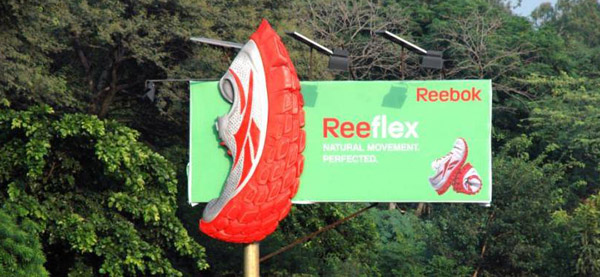
    Reebok, the leading producer of athletic shoes, apparel, and accessories, introduced a new range of running and training shoes called ‘ReeFlex’. A product of advance research, the shoes feature 76 independent ‘sensors’ on the bottom, planned in a way to adjust to all training surfaces. Throughout the stride of the wearer, these inbuilt sensors work together to promote the natural movement and flexibility. To promote such an innovative product, Reebok India partnered with BIG Street and Mudra Max to create an equally innovative OOH display.

    BIG Street, which holds the advertising rights to the display media in the Delhi Airport Metro Express stations, proposed the branding of the Dhaula Kuan Airport Metro Station’s façade – an enormous glass structure overlooking the busy NH8 stretch. Subsequent to the approval of the concept by Reebok, Mudra Max flawlessly completed the execution, branding the mid portion of the façade, a huge area of about 8,602 sq feet.

    Since the canvas itself was a building, high quality, international standard one-way contra vision from 3M was used, that was unobtrusive to the metro passengers inside the station but left an indelible impact on the motorists and pedestrians on the road.

    The branding has already created a huge buzz, with people reducing the speed of their vehicles to look at the giant display in awe. The impact of the communication has been compounded by the fact that the station is bang opposite a traffic light, ensuring a captive audience for a good two to five minutes.

    Commenting on the campaign, Mr Rabe Iyer, Executive Vice President, RBNL & Business Head BIG Street & BIG Live said, “BIG Street has time and again proved its ability to create eye-catching innovations for its clients. This cutting edge display for Reebok has firmly positioned BIG Street as a ‘thought leader’ in the Out-of-home space.”

    Mr Mandeep Malhotra, President, Mudra Max, OOH, said, “It has always been a pleasure to work on Reebok. The passion and desire to create innovative OOH by the team Reebok gives us the kicks to run around and deliver the best campaign after campaign.”