Tag: Dainik Bhaskar

  • IRS 2012Q1: Hindi readership sways its way towards +ve growth

    By A Correspondent


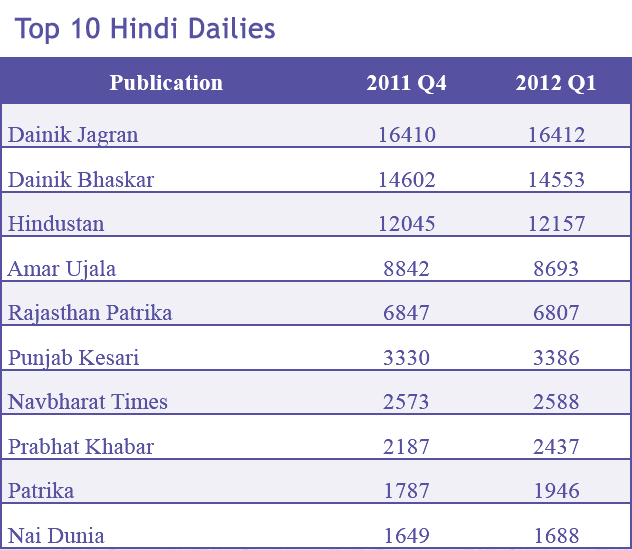
    As a large population of this country continue to swear by the usage of the national language – Hindi, it is no surprise that newspapers and magazines in this language have seen moderate growth in IRS 2012Q1. In the Top 10 Hindi dailies, Dainik Jagran dominates with AIR of 16,412 versus 16,410 that it reported last quarter. At second place is Dainik Bhaskar that recorded an AIR of 14,553 as against 14,602 in 2011Q4.Hindustancomes next with an AIR of 12,157; Amar Ujala at fourth with 8693 and Rajasthan Patrika at fifth with an AIR of 6807. Punjab Kesari has posted positive growth with an AIR of 3,386 compared to 3,330 in the last quarter. Navbharat Times is next with an AIR of 2588. Prabhat Khabar is the best placed with an AIR of 2,437 compared to 2,187 reported last quarter – an 11 per cent growth. Patrika is next at 1,946 (growth of 9 per cent) and Nai Duniya at 1,688.
     

    (AIR numbers; all figures in ‘000)


    Among the magazines, there has been a moderate effect that has been witnessed in the Hindi readership. Pratiyogita Darpan has seen a drop of 5.4 per cent with an AIR of 1,893 compared to an AIR of 2,001 in last quarter. SamanyaGyan Darpan has posted an AIR of 1,644 versus 1,678 recorded last quarter. At three is Saras Salil that has seen a big drop with an AIR of 1,601 versus 1,768 recorded last quarter – a drop of 9.5 per cent. Meri Saheli is steady at fourth with an AIR of 1,259 and Cricket Samrat is next with 1,176. India Today is next with 1,051 while Grahlakshmi follows with an AIR of 958. Completing the list is Grihshobha with an AIR of 860, Champak at ninth place with an AIR of 811 and Nirogdham with an AIR of 747.
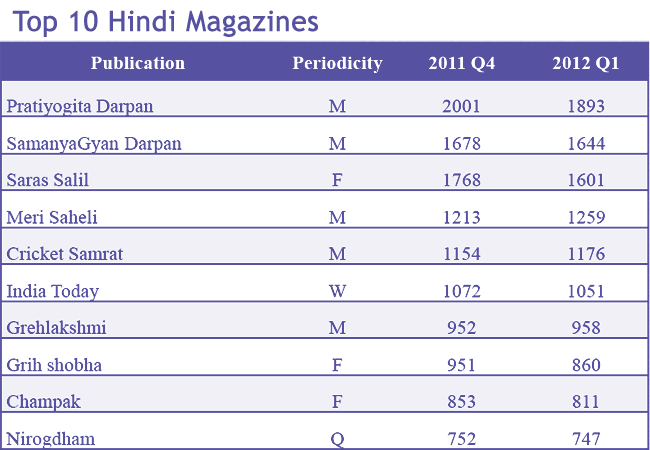
     

    (AIR numbers; all figures in ‘000)


    Dinesh Rathore, Vice President, MediaVest Worldwide said: “The population of people who speak Hindi and English is seeing a rise and that explains the overall rise in readership of these language editions. Also, a lot of players are moving out of their markets and launching in other states leading to newer set of readers. Players like Dainik Jagran, Dainik Bhaskar, Rajasthan Patrika are launching in many new states. So this explains the rise in the readership of their papers.”


    Adding inputs, Anamika Mehta of Lodestar UM said: “By launching in newer markets you are creating specialists products to cater to those markets and therefore, language readership will see a rise to an extent. Also, as explosion of business happens in small towns and markets the regional media will follow suit and grow too. That is what we have seen in television too. For SMEs and business houses, print will continue to be an important medium for them.”
     

  • Stagnancy stages a comeback in IRS 2012Q1


    By A Correspondent


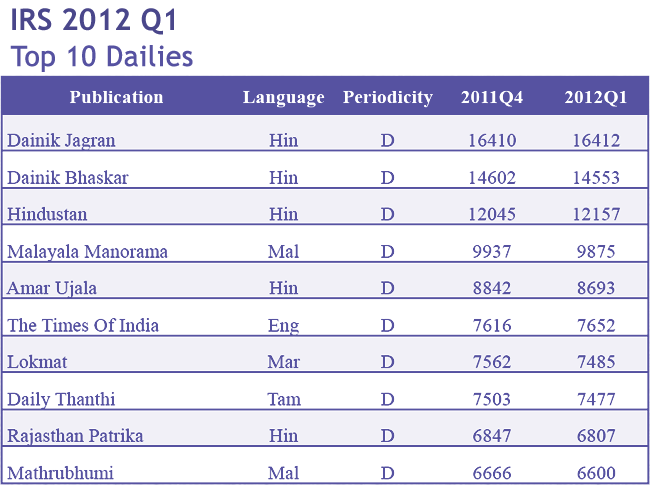
    The IRS 2012 Q1 readership results released by MRUC and Hansa has nothing new to tell but the obvious tale of the apparent rise in numbers of a few publications and the decline in readership of a majority of players. Going by the Average Issue Readership norm, in the Top 10 dailies there has been no change in the pecking order of the top performers but the readership of 7 out of 10 dailies has seen a marginal decline. Of the ten publications, five are Hindi in origin, two are in Malayalam, and one each in Tamil, English and Marathi.


    Emerging a frontrunner once again, Dainik Jagran manages to hold its forte showing slight readership growth with 16,412 in 2012Q1 as against 16,410 that it reported in 2011Q4. At No 2, Dainik Bhaskar has reported numbers totalling 14,553 a decline by 0.33 per cent from 2011Q4 figure of 14,602.Hindustansits comfortably at the third spot having reported a 1 per cent growth of 12,157 as against 12,045 reported in 2011Q4. Malayala Manorama is at the fourth spot with an AIR of 9,875 as against 9,937 in 2011Q4 – a drop of 0.6 per cent. Amar Ujala is next reporting an AIR of 8693 against an AIR of 8842 in 2011Q4 – a drop of 1.7 per cent. The Times of India English edition continues to see growth and comes in sixth with AIR of 7,652 as against 7,616 registered last quarter. Marathi daily Lokmat sees a marginal decline to end 2012Q1 at 7,485 compared to 2011Q4 AIR of 7,562. Tamil daily Daily Thanthi is next with AIR numbers of 7,477 as against 7,503 recorded in 2011Q4. Rajasthan Patrika with 6,807 and Mathrubhumi with 6,600 end the tally occupying the ninth and tenth spot respectively.


    Reacting to the overall trend, Dinesh Rathore, Vice President, MediaVest Worldwide said, “The study hasn’t thrown any new surprises. What is known is that the readership time spent on print is coming down these days, which is even lesser in case of magazines. Newspapers as a habit are not going to die soon but the time spent is surely on a decline. Also, if people were subscribing to more newspapers earlier, they are subscribing to one less now because of the options available on digital.”


    Highlighting her stance on the numbers, Anamika Mehta of Lodestar UM said: “What I infer is that the drop is very marginal. Print will continue to hold its ground in India. With literacy rates going up and the launch of several new products print will continue to drive growth in India . Also, what is seen is that there is a growth of consumption that is happening on the web and moreover, India is a very young country. Almost 60 per cent plus of the population are younger than 35 years. With these audiences the consumption is more on the web than on the physical newspaper. Also, we are seeing a lot of launches by players in the regional markets. So it’s not as bad as it seems.”


    Voicing a similar opinion as given by Mr Rathore, Priti Murthy, National Director – Insights, Maxus said, “I am not surprised by the overall trend that has been thrown up. Why do we read newspapers and magazines, for the sheer content that it provides and content is available faster in other mediums today – definitely digital and to a large extent even TV. I see this trend continuing in the next 3-4 years after which it will reach a saturation point. Also, how much ever tactical initiatives publications engage in to increase circulation, it clearly shows that readership is not going to increase. The time spent in reading newspapers and magazines will continue to see a decline. Also the new generation that is growing up may not grow up on a newspaper alone. They rely on mobile and other AV modes to receive their communication.”


    (AIR numbers; all figures in ‘000)


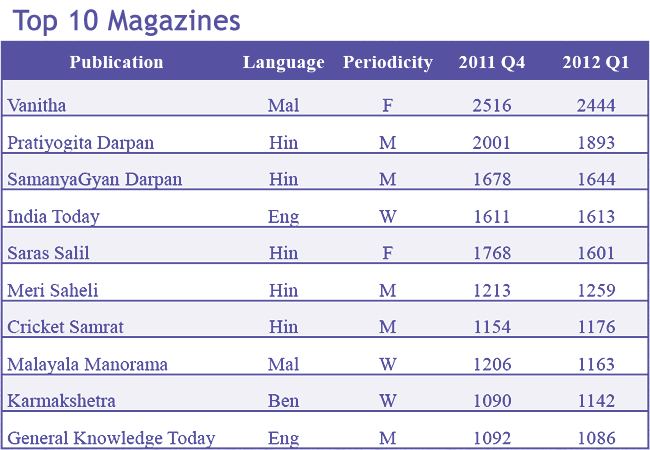
    The downfall story continues with magazines as well with leader Vanitha (Malayalam) reporting an AIR of 2,444 as against 2,516 in 2011Q4 – a decline by 3 per cent. Pratiyogita Darpan too sees a decline of 5.4 per cent having registered an AIR of 1,893 in 2012Q1 as against an AIR of 2001 in 2011Q4. SamanyaGyan Darpan sees a marginal decline with an AIR of 1,644 as against 1,678 reported last quarter. India Today is the topmost English magazine in this list and figures at the fourth spot with 1,613 as against an AIR of 1,611 reported last quarter. Saras Salil is next on the line-up and has reported a big drop of 9.5 per cent registering an AIR of 1601 as against an AIR of 1,768 reported in 2011Q4. Meri Saheli and Cricket Samrat have posted growth with an AIR of 1,259 and 1,176 respectively. Malayalam Manorama at 1,163 has seen a decline of 3.5 per cent while Bengali magazine Karmakshetra has seen a growth in its AIR at 1,142 as against 1,090 in 2011Q4. General Knowledge Today completes the list with an AIR of 1086.


    Throwing light on the trend spotted in magazines, Anamika Mehta said: “In the case of magazines, what we are seeing is that the time spent on magazines is going down but there are a lot of new and niche products being launched. A lot of international players too are coming into this market. So that should give it some scope for growth. But right now I think magazines are in a more worrying state than dailies in India but having said that I do not see the death of the medium coming here anytime soon.”


    (AIR numbers; all figures in ‘000)


  • Divya Marathi launches fifth edition from Solapur

    By A Correspondent


    The Dainik Bhaskar group announced the launch of the fifth edition of its Marathi newspaper, Divya Marathi, from Solapur.


    Solapur with an urban population of more than14.7 lac and a high per-capita income of Rs61,700 is one of the major cities of South-western Maharashtra. The first edition of Divya Marathi from Aurangabad started in May 2011 and soon other editions from Nashik, Jalgaon and Ahmednagar were launched. With 5 editions of Divya Marathi, it now covers complete central Maharashtra. Divya Marathi, Solapur is also the 65th Edition of the Group.


    “Through the Solapur launch of Divya Marathi, we continue to steadily enhance our footprint in Maharashtra and we now have 5 strong Marathi editions along withAurangabad, Nashik, Jalgaon and Ahmednagar, said Sudhir Agarwal, Managing Director, DB Corp Limited, commenting on the successful launch.


    The key proposition of Divya Marathi  Solapur launch campaign continued to be based on presenting an unbiased and fearless newspaper – “Na Ravanchi, Na Sahebanchi, Aata Chalel Tumchi Marji” (Neither influential class, nor Politicians, now public opinions will matter! ) – a theme that was central to the launches of the other 4 editions of Divya Marathi.


    Commenting on the success Nishit Jain, State Head; Maharashtra said: “The success is a reflection of the critical role brand building can play for a new entrant. It reflects across our processes. Our planning has been meticulous, including our strategically classifying city to understand its demographic nuances. This sharp focus on planning, management, marketing and branding has resulted in a successful launch of Solapur edition.”


  • Dainik Bhaskar’s Save the Girl Child campaign in Punjab,Chandigarhand Haryana

    By A Correspondent


    Dainik Bhaskar, as part of its social responsibility, conducted a month-long educative drive against female foeticide and abandonment of girl child at birth. The ‘Beti Bachao Muhim’ (Save the Girl Child) initiative is concentrated in the state ofPunjaband Haryana, where this practice has lead to a serious gender imbalance.


    The campaign was aimed at creating enhanced awareness on this social menace of female foeticide by educating the masses through a series of editorial articles and public rallies and to create the much needed social impact through participative ground movement.


    The campaign saw relentless editorial coverage for 23 days. Additional local level focus group discussions among eminent personalities of the region were conducted and shared with the readers. Other than the local social and political influencers, 23 Bollywood celebrities like Vidya Balan, Bipasha Basu, Shilpa Shetty, Kiran Kher, Preity Zinta, Juhi Chawla, Divya Dutta, Shabana Azmi, Lara Dutta and Aishwarya Rai shared their point of view on the initiative.


    A series of interactive activities were conducted to further enhance awareness across 40 centres inPunjaband Haryana. Among the activities conducted, a signature campaign on March 20 saw 4 lakh people signing an oath against this social menace. On March 22, a candle light vigil was organized across 40 centres inChandigarh,Punjaband Haryana.


    The culmination of the campaign saw a ‘Beti Bachao’ March on March 23 with collective participation of more than 3 lakh people.


    Dainik Bhaskar will keep working on its agenda of socio-economic changes, catalyzing the mass psyche on social and economic issues. Speaking on the ‘Beti Bachao Muhim’ Ashu Phakey, COO, Dainik Bhaskar said: “Declining sex ratio is a serious problem in the state ofPunjaband Haryana. As an enabler of socio-economic change, Dainik Bhaskar has a responsibility to create awareness against this social menace and making more people aware of this social evil. This endeavour from Bhaskar is small step to uproot this social evil from society. We will continue our work against this social menace”


    Kamlesh Singh, State Editor, and the force behind the critical editorial environment for the initiative said: “Punjaband Haryana are industrious and prosperous states but always figure at the bottom in case of gender ratio. Female foeticide is rampant and known but the two states have not woken up to the harsh reality of a crisis. We were overwhelmed by the response and to quote a reader from Ambala who sent a message the following day, it was organized in “an unprecedented manner. The scale of coverage and number of people involved is unbelievably large.” That quite sums it up”.


    Dainik Bhaskar is the leading newspaper in Chattisgarh with editions fromRaipur, Bilaspur, Jagdalpur and Bhilai. The Dainik Bhaskar Group has a strong presence in newspapers, radio, event marketing, printing, short code, Digital, services andMobileapplication. Its flagship Hindi daily newspapers are Dainik Bhaskar, Divya Bhaskar, Divya Marathi and DNA. It covers 13 States with 64 editions reaching across 19 million readers every day.


    Additionally, it publishes 3 other newspaper – Business Bhaskar, DB Gold, DB Star. In magazine sphere it publishes Aha! Zindagi, Bal Bhaskar for young readers and Lakshay.


  • Satish Singh back @ Laqshya as President, plans rapid growth for OOH major

    By A Correspondent


    Veteran out-of-home industry captain, Satish Kailash Singh is back at Laqshya. He took charge as President of the company earlier this month.


    Mr Singh, an alumnus of the Jamnalal Bajaj Institute of Management, was until recently Managing Director at Realm Media, a company which he and a former colleague, Mr Yuvraj Agarwal had set up.


    Mr Singh has been with the outdoor sector since 1998 after 11-year stint in print – at Dainik Bhaskar, Mid-Day and Sterling Newspapers. He spent a decade at Outdoor Media Integrated (OMI) where he was CEO and later moved to Laqshya as President.


    “The out-of-home industry is at a very interesting juncture and at Laqshya we are equipped to attain greater heights,” said Mr Singh, highlighting that his company has some seasoned professionals holding key roles and portfolios.


  • Dainik Bhaskar’s ‘Junior Editor’ creates history

    By A Correspondent


    Junior Editor-2011, an initiative of Dainik Bhaskar, under the umbrella of Bhaskar Champ’s club has created history by being recognised by Guinness World Records as “The Largest Writing Competition”, by ‘Limca World Record’ as “The Largest Countrywide Newspaper Making Competition for Children” and also recognised by ‘India Book of Records’ for “The Largest Number of Manually Prepared Newspapers by Kids.” A total of 67,130 manually created newspapers were submitted by children from 41 cities of 10 states. The activity commenced on February 2011 and culminated in September 2011.


    Junior Editor was an exceptional interactive programme with elements of editorial, designing, creative writing and reporting of the major happenings in and around the world. 67.130 participants of class 1 to class 12 manually created their own newspapers using the framework provided in the 8 page templates. These even had creative spaces for subject as varied as ‘Cartoon & Caricature” and ‘Ad Mad – Creativity at its best’.


    Vinay Maheshwari, Vice-President- Sales & Market Development, Dainik Bhaskar Group said, “Guinness World Record is just an affirmation of scale. The Junior Editor 2011 has made to all the three relevant records, ‘Limca World Record’ & ‘India Book of Records’ and the participation of 67,130 participants from 592 schools joining in reflects the stature of the club as well as the strong brand presence of DB Group”.


    He added ‘The idea behind the initiative was not only to engage kids but the entire family by providing them a smart reader engagement, as the participants were expected not to just cut-paste the information but to give their own interpretation and at times use imagination to complete a story, it definitely had the family interacting as a unit. That was also the focal point of Ideation”. Such initiatives tap the existing enormous potential of strengthening reader connect with the brand.’


    The participants participated in 2 categories based in level of expertise and expectations. Category- A (Class 1st to 4th), Category- B (Class 5th to 8th) & Category C (Class 9th to 12th). It was interesting to see the spectrum of subjects picked up for making the newspaper by different categories of participants.


  • We are a silent partner in DNA: Girish Agarwal (on Video)

    The Dainik Bhaskar Group has been making rapid strides in publishing and its expansion into hitherto uncharted territories like Maharashtra have led to questions on where the group will head next. Girish Agarwal, director of the group, spoke to MxMIndia’s Shruti Pushkarna in an exclusive interview on the sidelines of Ficci-Frames 2012.
     

    Dainik Bhaskar was among the first to innovate in order to get more readership. What are the new frontiers… where are you headed next?

    We operate already in some 14 states in India. We have recently launched a Marathi newspaper, so we have some time to spend in Maharashtra as well as Jharkhand. At the same time, the states which we are already present in, like Rajasthan, Gujarat and Punjab, we need to work a lot there also to grow, because those states have a huge potential for us to grow. A large part of the growth we’ve been seeing in last 10 years, is coming from our existing states, so we need to work hard there.


    [youtube width=”400″ height=”250″]http://www.youtube.com/watch?v=UN43L63SCoU[/youtube]

    Technology and internet hasn’t really taken off as well as it was expected to have taken off. What are your views on the same?

    Internet penetration in India is roughly around 7 to 8 per cent, so with this kind of penetration, I don’t think we need to fear anything that they would take away from us. But at the same time we need to prepare for the future. For example, our website in Hindi today is the largest website in Hindi news as well as the Gujarati one, so we are preparing ourselves for the future. But at the moment, is the business shifting from the print platform to the internet? No.


    How do the readership wars affect newspapers?

    I think it is pretty good because anything that’s good for the market is good for the organization too. For the readership war, you actually go out and try to take more readers, for that you need to ensure that you are still relevant to the reader, because if you are not relevant, the reader won’t buy you at all.


    There is talk about Dainik Bhaskar opting out of DNA, how true is that?

    Yes, it is true that DNA is currently managed by our partner, Zee Group, which has the majority in DNA. We are a silent partner.


  • IRS 2011Q4: Not much change in rankings but dailies witness significant growth

    By A Correspondent


    Top 10 Hindi Dailies:

    IRS Q4, 2010 v/s IRS Q4, 2011

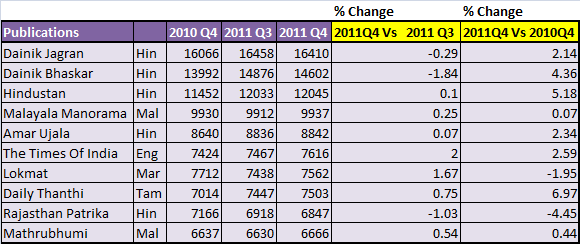
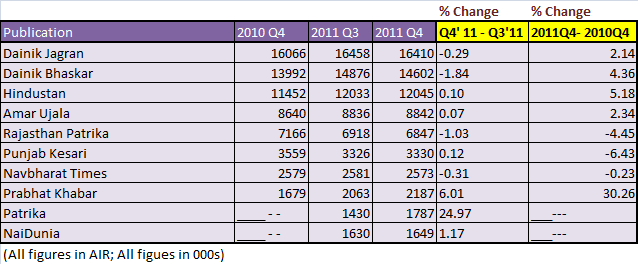
    There is not much of a difference in the rankings of the Top 10 Hindi Dailies. Dainik Jagran, Dainik Bhaskar,Hindustan, Amar Ujala and Rajasthan Patrika continue as the Top 5 Hindi Dailies. When compared to IRS 2010 Q4, IRS 2011 Q4 reveals the Top 4 Hindi Dailies, namely Dainik Jagran, Dainik Bhaskar,Hindustanand Amar Ujala have further strengthened their readership.


    A look at percentage change from Q4, 2010 to Q4, 2011 finds that Dainik Jagran has witnessed a growth of 2.14 per cent, Dainik Bhaskar grew by 4.36 per cent,Hindustanby 5.18 per cent while Amar Ujala grew by 2.34 per cent. The only Hindi daily to have witnessed double digit growth is Prabhat Khabar with a whopping 30.26 per cent growth in Q4, 2011 as against Q4, 2010. A total of five Hindi dailies have witnessed growth Quarter on Quarter.


    Q3, 2011 Vs Q4, 2011

    But the results for IRS Q4, 2011 Vs Q3, 2011 have a slightly different story to tell. The top two most read Hindi dailies – Dainik Jagran and Dainik Bhaskar – have witnessed a decline in Average Issue Readership (AIR), the decline is however marginal. Besides Dainik Jagran and Dainik Bhaskar, the Hindi dailies to have recorded growth in Q4, 2011 v/s Q3, 2011 are Hindustan, Amar Ujala, Punjab Kesari and Prabhat Khabar.


    Top 10 English Dailies:

    IRS Q4, 2010 Vs IRS Q4, 2011:

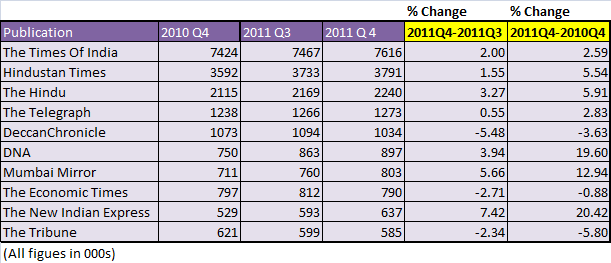
    The English dailies have performed exceedingly well in Q4, 2011. Seven out of the Top 10 English dailies have registered growth in their AIR. While DNA, Mumbai Mirror and The New Indian Express have registered growth in double digits, the top four English Dailies: The Times of India, Hindustan Times, The Hindu and The Telegraph have also witnessed growth quarter on quarter.


    IRS Q4, 2011 Vs Q3, 2011:

    The results for Q4, 2011 in comparison to the previous quarter also highlight the growth for most of the top Ten English dailies.


    Top 10 Language Dailies:

    IRS Q4, 2010 Vs IRS Q4, 2011:

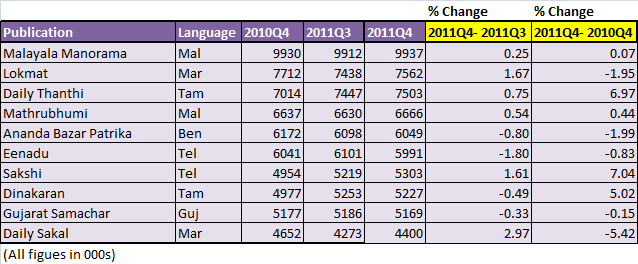
    The Q4, 2011 results as compared to the Q4, 2010 results have shown mixed reactions for Language dailies as only five publications witnessed growth since Q4, 2010 to Q4, 2011. Malayala Manorama continues to be the number one publication among the Language Dailies. According to IRS Q4, 2011 v/s Q4, 2010 findings, the Malayalam daily grew 0.07 per cent.


    Ranked second is Marathi daily, Lokmat which saw a decline of 1.95 per cent. The other Language dailies to have registered growth in their AIR are Daily Thanthi, Mathrubhumi, Sakshi and Dinakaran.


    Unlike the top two dailies, Daily Thanthi, ranked as third Language daily, grew by 6.97 per cent in IRS Q4, 2011 when compared to IRS Q4, 2010.


    It has been observed that the Malayalam dailies – Malayala Manorama and Mathrubhumi and the Tamil dailies – Daily Thanthi and Dinakaran have recorded growth in their AIR. Malayalam, Marathi, Tamil, Telugu, Gujarati and Bengali are some of the popular language dailies to have found a place in the Top 10 Language dailies.


    IRS Q4, 2011 v/s Q3, 2011:

    The top four Language dailies: Malayala Manorama, Lokmat, Daily Thanthi and Mathrubhumi have registered growth in their AIR numbers in IRS Q4, 2011 v/s IRS Q3, 2011. Besides the top four language dailies, Sakshi, the Telugu daily and Daily Sakal, the Marathi daily have also witnessed growth in their readership numbers.


    AIR or Average Issue Readership is defined as the readers of an average issue of a publication i.e. the estimated number of those who have read or looked at any issue of the publication within a specified time interval, which is equal to the periodicity of the publication (excluding the day of the interview). This is the preferred currency of media agencies across the country though often publications quote Total Readership (TR) when their AIR numbers are not impressive. MxMIndia only uses AIR in its IRS reportage.

  • IRS Q4 2011: Dailies flourish Year-on-Year


    The fourth quarter results of 2011 for the Indian Readership Survey were published on Monday and a quick look at comparing the numbers of IRS Q4 2011 versus Q4 2010 data, eight of the Top 10 publications – Dainik Jagran, Dainik Bhaskar, Hindustan, Malayala Manorama, Amar Ujala, The Times of India, Daily Thanthi and Mathrubhumi ­- have grown in their AIR (Average Issue Readership) Year-on-Year (YoY). Tamil daily Daily Thanthi and Marathi Daily Lokmat and Hindi Daily and the second most popular newspaper, Dainik Bhaskar  have registered the highest growths in AIR.


    When we compare Q3 2011 V/s Q4 2011, Dainik Jagran, Dainik Bhaskar and Rajasthan Patrika witnessed a slight decline in their readership. Dainik Jagran, Dainik Bhaskar, Hindustan, Malayala Manorama and Amar Ujala have retained their spots as the top five publications.


    After looking at the numbers, MxMIndia spoke to some of the publications for their views on the IRS Q4 2011 Topline numbers. Mr Rahul Kansal, Chief Marketing Officer, Times of India Group said: “Overall, I am quite happy with results, we have done pretty well in most of the markets including Delhi, Mumbai and Chennai, where we have seen very good growth.”


    However, Mr Rajiv Verma, CEO of HT Media Ltd, is disappointed with the IRS numbers but said in a statement, he will continue with investments in various markets. “While Hindustan Times has for long been No 1 in Delhi and No 2 in Mumbai, and Hindustan and Mint have consolidated their positions in their respective markets, as a group we are disappointed that these IRS numbers don’t reflect the full picture of our growth, and the reality of our investments and our efforts in the various markets across the country. However, we will continue to invest in various markets, to meet the needs of our readers and our advertisers, and will hope that the readership growth will be fully captured going forward.”


    Mr Sanjeev Kotnala, Vice President, Dainik Bhaskar Group said: “The IRS figures justify our focus on the urban, non-metro cities. Dainik Bhaskar is the only Gujarati newspaper to have a readership of more than 10 lakh in cities like Jaipur and Ahmedabad. If you see the figures for only the urban, non-metro cities, then you will realise that Dainik Bhaskar dominates the list. As far as the overall figures are concerned, we feel that it is a minor fluctuation, nothing major as far as our own perspective is concerned.”


    Speaking on trends from IRS Q4 findings, Mr Gautam Dalal, Vice President, Marketing, DNA said: “We observe that within Mumbai there is an increase in the overlap of English dailies readership – for every two readers there are three dailies being read. Mumbai, therefore, is seeing more penetration of English dailies and the trend of reading multiple newspapers is on the rise. Having such a high overlap percentage is a positive sign.”


    “In Mumbai we have had the highest number of growth for DNA, and these numbers are a testimony to our stand of having a high level of copy supported by the cutting edge editorial and by a focused market programme,” he added.


  • Is the Bhaskar group exiting DNA?

    By A Correspondent


    Since the day Zee supremo Subhash Chandra took charge of operations at Diligent Media Corporation (DMC), the company that publishes newspaper Daily News and Analysis (DNA), rumours are rife that co-owners Dainik Bhaskar are exiting the JV. This happened two years ago, and nearly every week since then we hear stories about the Bhaskars selling their stake. There have been times when we’ve heard the same about Mr Chandra too, but if a report on the BusinessWorld website is to be believed, the Dainik Bhaskar Group (DB Corp) is in the process of exiting DMC.


    “Following the exit of the Bhaskar Group, Subhash Chandra and his associates will have 100 per cent ownership of Diligent Media. The road map for decoupling the English language media project, launched in June 2005 as a 50:50 JV, was confirmed by a senior D B Corp executive; but the promoters of the Bhaskar Group, the Aggarwal family, said the deal was “yet to be consummated”, the report adds.


    (Link: http://www.businessworld.in/businessworld/businessworld/content/Dainik-Bhaskar-Exiting-DNA.html)


    The Agarwals are known to be hands-on and aggressive newspaper owners. So while the official reason being given was that Mr Girish Agarwal needed to concentrate on the power projects, it was evident that interest had waned. A Bhaskar spokesperson said he was unaware of any such development.


  • “No Paid News” in Dainik Bhaskar

    By A Correspondent


    Dainik Bhaskar has unveiled a campaign  ‘No Paid News’ with a promised to readers that they will not be misguided.


    Simple yet stark statements and visuals in a very common man’s language and imagery were used to drive home the differentiator and the message was amplified by radio. The campaign ran through the entire election duration ending with the polling.


  • Dainik Bhaskar asks voters to select the right candidate in Punjab

    By A Correspondent


    The state of Punjab went for polls just after the nation-wide public uprising against corruption. The whole nation was reeling under wide spread mismanagement and corruption, and it had provoked the citizens to rethink and hard.


    Elections are the most important part of democracies and societies in transition and the Punjab elections were an ideal platform for the people of Punjab to set tone for rest of the country, to rise and choose the right candidate, who would truly work in the interest of the public.


    Keeping in view the kind of awareness as well as apathy among voters, Dainik Bhaskar took an unique approach – Sahi Ko Chuno.


    Dainik Bhaskar, as India’s largest newspaper, felt that it was their responsibility to create the awareness among people, and to remind them that if they really wanted to eradicate corruption, and improve the overall system, they could not do it just by holding protests and picking up anti-corruption placards! If people really wanted their representatives to work for their benefits, to create policies and laws that were pro-public, they would have to choose their political representative with much thought. Sahi Ko Chuno (choose the right candidate) was Dainik Bhaskar’s call to the readers.


    The “Sahi ko Chuno” campaign did not align with any political party. It was a truly citizen agenda. It just provided platform for common public to voice their views and express themselves.


    On November 22, 2011, Dainik Bhaskar’s editorial team announced the start of campaign ‘Sahi Ko Chuno’ across all its editions in Punjab. This created high awareness and buzz on why was it important for voters to “Choose the right candidate”.


    A special initiative, “Yuva Sansad”, was organized in colleges and universities acrossPunjab, to catalyze productive discussions amongst youth on the prevailing political scenario and to educate them of the need to choose the right candidate.


    Public’s opinion on what is an “Ideal Candidate” was initiated in 32 cities of Punjab. The ground survey was completed in 26 days. Results of the survey were announced in Dainik Bhaskar on January 2. More than 85 per cent of voters inPunjabhad expressed their views that while voting they would be given due weightage to the “candidate” instead of “party”.


    The ‘Sahi ko Chuno’ campaign set a tone in Punjab, creating high awareness on need to choose the right candidate, as a right candidate would represent them in future as well as playing a significant role in policy making for the betterment of Punjab and its people.


    The campaign also used cable, FM, print promo ads as well as outdoor media including gates, standees, banners, posters in major touch points across 32 cities of Punjab.