Tag: Dainik Bhaskar Group

  • Dainik Bhaskar picks up Concept

    By Our Staff


    Dainik Bhaskar has launched in Mumbai. Concept agency has been mandated to manage the brand.


    Concept Communication brings with it deep knowledge subject categories coupled with a thorough  understanding of the consumers’ spectrum that influence and impact its PR solutions  something that matches Dainik Bhaskar’s current set of requirements –  to do with their launch and future sustenance.


    Commenting on the win, Vivek Suchanti, Chairman and Managing Director of Concept Communications, said: “Dainik Bhaskar Group and Concept Group have a long-standing association. Trust of brands like Dainik Bhaskar, one of India’s premier brands, is of paramount importance. We are naturally very happy that they have chosen us to partner with them with such a prestigious launch.  We look forward to creating a targeted and effective solution for the brand.”


    Kailash Agarwal, Managing Director of Bhaskar Prakashan Pvt Ltd, added: “We are on a journey to expand our footprint across the country and consolidate our current position of No 1 newspaper. We were looking for strong partners who could help us launch the brand in Mumbai. We found the team Concept both insightful and proactive. We believe that they are the right partners for us in our journey.”


  • New campaign by Dainik Bhaskar

    By Our Staff


    The Dainik Bhaskar group has announced a new advertising campaign titled ‘Sachchi Baat, Bedhadak’. Notes a communique: “With the symbol of a pen, torch and fist, where the pen denotes impartial journalism, the torch is a symbol of the light and the fist the signage of the loud voice to protest untruth, the objective of the ‘Sachchi Baat, Bedhadak’ campaign is also to underline the faith of the people towards truth and courage.”


    Commenting on the campaign, Dainik Bhaskar Group Promoter Director Girish Agarwaal, said: “Dainik Bhaskar has always been known to push the boundaries when it comes to courageous journalism and its impact on the lives of our readers. This national campaign aptly titled ‘Sachchi Baat, Bedhadak’ commemorates and reinforces this fearless journalistic ethos. We are proud of our team that has embraced this campaign wholeheartedly and brought to life the age-old saying – the pen is mightier than the sword.”


  • Dainik Bhaskar cites HBR article on marketers returning to traditional media

    By Our Staff


    Questioned often on the efficacy of traditional media vis-à-vis digital and the growing clout of the streaming platforms esp amongst high-spending premium customers, the print media has been dismissed as a medium with diminishing primacy especially amongst younger readers.


    Given this, a recently published article in Harvard Business Review titled ‘Why Marketers Are Returning to Traditional Advertising’ comes as a shot in the arm for print major in the country.


    Some highlights from the article:

    :: Traditional ads are experiencing increased engagement, with the consumer-facing companies leading the shift, with B2C service companies predicting the largest increase in traditional advertising spending (+10.2%), followed by B2C product companies (+4.9%). Companies that earn 100% of their sales through the internet are leading this inflection.


    :: The top five most trusted advertising formats are all traditional, with customers trusting most print advertising (82%) and as a result, marketers can use traditional advertising to build brand credibility and trust with jaded buyers.


    Said Girish Agarwal, Promoter director, DB Corp Ltd: “The Dainik Bhaskar Group has always maintained that Print Media holds the highest trust amongst its readers as a result of higher editorial integrity. The advent of fake news has also taken a toll on the trustworthiness of some of these digital media and as a result advertisers were unable to establish a strong connect with their target audience. The HBR article validates a trend that we had begun witnessing a couple of quarters ago where even new age businesses were looking at Print Media in general and Dainik Bhaskar in particular, for their ad campaigns. Importantly, it validates what we have always believed in – keeping the readers at the centre of all our efforts.”


  • Delhi HC restrains WhatsApp on Dainik Bhaskar group epaper circulation

    By Our Staff


    The Delhi High Court has passed an ad interim exparte order directing WhatsApp LLC to block/ take down the groups that are circulating the epapers of the Dainik Bhaskar group, as per a communique received from the newspaper (happened on December 24). Other than WhatsApp LLC, the DoT, GoI and unknown administrators of the offending groups (identified by their mobile numbers) are also parties to the suit and notice has been issued to all defendants. DB Corp Ltd (Dainik Bhaskar) had earlier approached WhatsApp LLC through a legal notice with a request to block/ take down the offending groups as they were infringing the copyright and registered trademark(s) of the Dainik Bhaskar Group. WhatsApp LLC, however, in its response had declined the request seeking production of a court order.


    Recently, DB Corp Ltd (Dainik Bhaskar) approached the Delhi HC seeking directions to WhatsApp LLC to block/ take down certain groups operating on its instant messaging platform wherein the Group’s e-newspapers were being shared and circulated illegally and without authorisation. Users are neither permitted to download the epapers, nor are they permitted to share and circulate the same. Illegal and unauthorised sharing of E-Newspapers, across publications, has become rampant and is prejudicial to the interests of the publishers, notes the communique, adding: “Being aggrieved by such illegal and unauthorised sharing and circulation of its E-Newspapers, DB Corp Ltd (Dainik Bhaskar) considered it necessary to initiate legal action to protect its proprietary interests and, as aforesaid, has been granted an ad-interim ex-parte injunction in its favour.”


  • Marketnest predicts festive growth in Tier 2 & 3 cities

    By Our Staff


    Marketnest, a Delhi-based market intelligence firm, predicts that many markets in the Hindi-speaking markets have regained their vibrancy with marketplaces, shops, and even schools reopening. The survey commissioned by the Dainik Bhaskar group was conducted in Madhya Pradesh, Chhattisgarh, Rajasthan, Gujarat, Bihar, Jharkhand, and Chandigarh, to check on consumer sentiments with the pandemic settling down.


    The research was conducted in September 2021 and examined over 15 product categories, with approximately a hundred brands featured in each and via interviews with 9000 respondents.


    “The survey highlights the market’s remarkable rebound following the second wave of the Covid-19 pandemic, owing to pent-up and strong festive demand. The patterns show that strong demand will emerge from Tier II and III cities, with products across all categories experiencing robust demand during the festive season,” notes a communique.


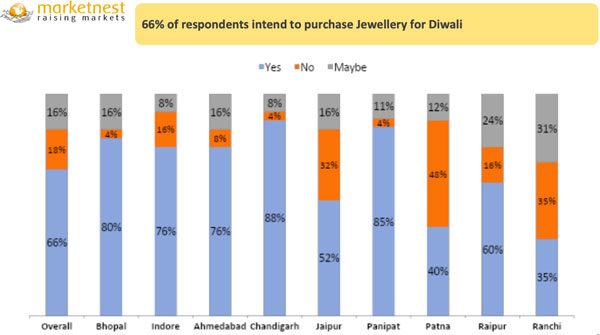
    Commenting on the report, Nitin Garg, Director, Marketnest said: “This festival season, Tier II & III cities appear to be more hopeful about festive shopping than Metros & Tier-I cities. This trend is visible across all product categories, from the most basic such as cookware, to consumer durables such as washing machines, televisions, and refrigerators, to high-ticket products such as jewellery and two-or four-wheelers. For example, over 65% of respondents to the poll stated that they want to purchase jewellery this festive season, with 50% choosing larger retail chains due to their higher level of trust, brand recognition, ease of returns, and variety of designs,” adding: “This festive season could be a rebound season for retailers, especially in Tier II and III markets. Individuals have already begun browsing for newer things, shortlisting items to purchase, and checking out advertisements. We believe that now is the appropriate time for businesses to spend in marketing and promotional efforts to connect with their customers.”


  • Dainik Bhaskar’s 120-pg edition in Jodhpur

    By Our Staff


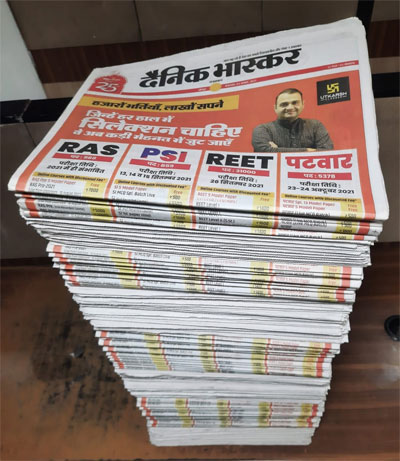
    Jodhpur, known as the Sun City (perhaps because the Marwar rulers were sun worshippers) witnessed a sunny day on Wednesday, as Dainik Bhaskar celebrated its 25th anniversary with a 120-page edition.


    Commenting on this during a challenging operating environment, Vareesh Tiwari, COO of Rajashthan at the newspaper group, said: “Dainik Bhaskar Group always believes in doing something extraordinary and interesting for its readers, clients and agencies and in keeping with this tradition, we created this mega edition on the 25th anniversary of our Jodhpur Edition. Amid concerns over the market situation, this is a great step towards building confidence in the business community as well as the public. This commendable feat demonstrates that print media is still the most trusted medium for readers & advertisers.”


    Added Suchit Bhandari – Zonal Head, Dainik Bhaskar Rajasthan: “The mammoth edition to celebrate the 25th anniversary of the Jodhpur edition reiterates Dainik Bhaskar’s resolve to cater to its readers nothing but the best. It wouldn’t have been possible without our readers’ and trade associates’ trust and support, which consistently lead and inspire us to rise to the challenge and set new milestones. All advertiser categories fired and wholeheartedly participated in this special edition like real estate, education, consumer durables, FMCG, auto, health, lifestyle, government, telcom, NGOs, social media etc ”


  • The More you Succumb, the More Dangerous the World Becomes


    By Ranjona Banerji


    Ranjona BanerjiOn July 22, the Income Tax department carried out a series of raids on the offices of the Dainik Bhaskar group across India.


    Even for those sleeping under a rock to avoid criticising the Modi government, these raids were a sign that someone up there in the higher reaches of power was angry. Very angry.


    The anger could be two-fold: The revelations this week of the Pegasus Project and that Bhaskar covered it widely.


    And that this Pegasus coverage only added to the rage the government had felt at the relentless manner in which this large chain of newspapers had covered the Covid-19 pandemic. Government lies on Covid cases, lies on the number of deaths, on the lack of oxygen in hospitals, on the dead bodies floating in the Ganga and other rivers and buried in shallow graves in riverbanks were exposed every day in both Gujarat’s Divya Bhaskar and Dainik Bhaskar editions elsewhere.


    National Editor Om Gaur took DB’s coverage even further in his edit page piece for the New York Times about the dire Covid situation during India’s second wave, which was headlined: “The Ganges is returning the dead”. As ever, negative international exposure enrages an image-conscious Prime Minister and his government.


    Whatever has irked the government more, it is clear that it is riled. And when that happens, there is a malicious, vindictive reaction. Perhaps for almost seven years, the Modi government has got so used to the lavish praise piled on it, for all its transgressions, mistakes, lies, aggressions, disasters, any resistance is seen as unacceptable. Okay, cut that “perhaps”. We know that this is a government, more than any other until now, which cannot handle dissent, disagreement, questions, opposition. And has been enabled by a captive mainstream media.


    Between the Pegasus Projects and its revelations, and these raids on a media house, where does the rest of the media stand? The old days when all newspapers ignored each other and operated in their separate silos have gone, and for the better, together with that ivory tower editor who barely comprehended what was happening in his own newsroom forget the nitty-gritties of the world itself. The media has to comment on itself and allow others to comment on it.


    The revelations that someone within the government of India was using/ had used Israeli-made military-purpose malware to both hack into people’s electronic devices, run surveillance on them and possibly also implant material into their devices has shaken the world and forced the media not involved in the investigation to take notice. But the voice of the media has been far from uniform and at times, shockingly pro-government even though journalists, citizens, businesspeople, activists and others have been targets.


    So how did we respond to the Dainik Bhaskar raids.


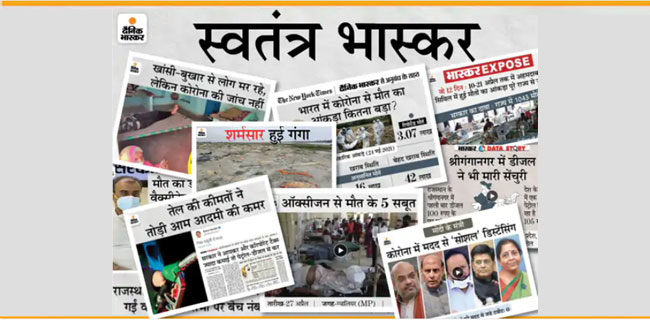
    Bhaskar itself called itself “Swatantra Bhaskar” or Free Bhaskar and announced on its front pages, with a series of images of its Covid and other coverage, that the government had to do what it had to do and the media group what it had to do.


    The Mumbai edition of the Times of India, July 23, had an article on Nation pages 11, the focus of which was the Opposition’s reactions to the raid. Shooting from the opposition’s shoulder, rather than straightforward coverage.


    The Economic Times, Mumbai, July 23, covered the possibility that industrialist Anil Ambani’s phone had been hacked as well as the corporate reaction to Pegasus on Page 6. But page 2 had Union minister Meenakshi Lekhi’s lies that Amnesty had distanced itself from the Pegasus Project, minus the clear clarification to the contrary that Amnesty had issued soon after.


    The Dainik Bhaskar raid was on Page 8.


    Hindustan Times, Mumbai, July 23, did better than its rival TOI. The first two pages were dedicated to the Olympics. Therefore, the Pegasus uproar in Parliament and the Ambani phone hack were on page 3. City page 5 had a single column on the DB raid in Mumbai. Nation page 5 ran with the raid as the lead, above the fold. And Nation page 7 had more Pegasus coverage. However once again, Lekhi, was allowed to run with her lie.


    The Indian Express, Mumbai has upped its game (although in the days to come expect more government ministers pushing Modi/BJP propaganda on their oped pages). The Dainik Bhaskar raid and Pegasus were on Page 1, continued on 2 as is the paper’s style. On Page 8, the Amnesty rebuttal to Lekhi’s claim made an appearance and Pegasus found space on the economy and world pages.


    The Hindu, Chennai had a much better showing, despite the photo of group head Malini Parthasarathy in Modi’s “illuminating” presence, which she put up on Twitter on July 22. Both the raid and Pegasus were on the front page, on page 10 in further detail. Pages 11 (nation) and 13 (world) had further Pegasus coverage.


    Of the English language papers MxM looked at, The Telegraph, Calcutta stood out. Both the raid on DB and Pegasus ran as the lead. The Ambani phone hack also found space. The lead story quoted DB National editor Om Gaur about why he thought the group was raided – the strong Covid coverage – as well as his NYT piece.


    Of the Hindi papers, Amar Ujala, Delhi had the best coverage: The raids on Dainik Bhaskar as well as the independent UP-based news channel Bharat Samachar were second lead, above the fold. No one else mentioned Bharat Samachar, which has been increasingly critical of the government.


    The Pegasus uproar in Parliament was the lead. Amar Ujala also mentioned prominently how Lekhi had called protesting farmers “mawalis” or hooligans. Most English newspapers ignored this stroke of genius from the Union minister.


    Rajasthan Patrika, Jaipur, carried the raid on the front page and also had an edit.


    Hindustan Delhi: Had the Pegasus arguments in Parliament, but focused on the IT minister as the lead. A small mention of the DB raid on Page 1 sent the reader to page 11, where Pegasus was also covered.


    Dainik Bhaskar’s biggest competitor, Dainik Jagran Delhi, carried a tiny mention of the raid on page 4.


    Regardless of the extent of the coverage we went through, all media owners and editors know what all journalists also know: that the more you succumb, the more dangerous the world becomes. You may think I was going to say that the more you resist, the more you are under threat. That is true. But unless you want the threat to last forever, you have to resist.


    Kudos to Dainik Bhaskar for its stand so far.


    And to those who have not been too afraid to cover the actions of a vindictive government.


    For those who cover up, well…


    Ranjona Banerji is a senior journalist and commentator. She is also Consulting Editor, MxMIndia. She writes on MxMIndia every Tuesday and Friday. Her views here are personal
     

  • Dr Bhaskar Das: Every Strategy has an Expiry Date


    By A Correspondent


     In early 2005, when it was clear to the big bosses at the Old Lady of Boribunder that Hindustan Times and DNA were set to launch in Mumbai, there was much concern about the future of the Empire. While HT may still be this North India superpower, the paper had turned stylish and had some great writers and people at the helm.


    The bigger worry was DNA, short for Daily News & Analysis. It was being set up in a jv of the Dainik Bhaskar group and Zee. Bhaskar had essayed huge success in Gujarat with Divya Bhaskar and the Zee TV group chairman Subhash Chandra is a tough fighter and was keen on extending his domination to print. Plus there was Pradeep Guha, the former Times of India bossman who knew it all. And had a point to prove. When Guha moved to Zee, there was much talk of his trust lieutenant and second-in-command Dr Bhaskar Das also moving with him. But his bosses – Samir and Vineet Jain – held him back.


    Das suggested the flanking strategy to the Jains, and get the newbies battle it out with Mirror first. The gambit worked, and Mirror in Mumbai was a profitable venture in three-odd years. The circulation was large thanks to the fact it went free with The Times of India. The going was good, business-wise and editorially, though it had achieved its purpose.


    The Agarwals sold their stake in DNA to Chandra at Zee, and the paper finally folded up a year-odd back. HT could weather the onslaught, but it was a never a close #2 in Mumbai amongst broadsheets. Mid-Day, which was once #2 in Mumbai, suffered through the fight among the big ones.


    Post the announcement of The Times of India group on Saturday to close Mumbai Mirror as a daily, we asked Dr Bhaskar Das (BD) a few questions as part of the Das ka Dum series. We couldn’t help not asking him many questions on the development as part of the questions for the week. He was after all the boss of the project. We then thought it would be good to carry the entire Q&A together, and add a couple of more questions.


    Even if state this ourselves, we think it makes for a great interview, and he’s been reasonably candid. There’s a wee bit written between the lines, but then that’s BD for you. Enjoy.


    If the Print Media were to look at itself in the Mirror, what would it see? A self that’s Deflated, Defeated and Dead?


    None of them, according to me. Naysayers or doomsday predictors might agree with your observation. I am not oblivious to the emotional aspect of the reflection in the mirror. But in business, as in life, recalibration of the forward journey is a constant imperative. Learnings happen when one cleans up the mirror first before cleaning one’s face only. A deep introspection followed by a resilient approach would engender a realisation that death is the beginning of life and life is the beginning of death. Accordingly, new roadmap would emerge.


    Your sentiments on the closure of Mumbai Mirror, the daily, since you headed the team and started it all. In fact I am told you thought of the idea…


    What sentiments? � The company started a project. I was an incidental steward. When one is (in this case me) lovingly detached, launch or closure is part of a continuum, as in life. The pragmatism of business and its strategy compels an organisation to take a decision which might have to be revoked in future when the landscape changes. For business process continuity and for conservation of finite resources, an organisation has to choose an alternative from amongst multiple choices in an altered landscape.  After all, any  strategy is ultimately  a cascade of choices. Hence emotion has no legitimate space in such a decision-making. An engrossed passion helps a rational decision get wings. For the concerned daily, the dominant sentiment at that relevant time was perhaps like that. Hence an individual sentiment doesn’t matter.


    Does the closure of the Mumbai Mirror as a daily augur sad times for the newspaper industry. After all this is an offering from the #1 newspaper group in the country/ continent/ world, and operates in Mumbai, one of the most important advertising markets on land?


    As if this is the first time a publication has been shut. Every strategy has an expiry date. The publication had served a strategic purpose perhaps at that relevant time. Changing times need new strategy to navigate the operating environment. So I can presume the group has enough in its arsenal to leverage in the most important advertising market of India. From the outside it might look as a dystopian development. But it can be a precursor to a ‘manthan’ too. Who knows? As an incorrigible optimist , I think so.


    Our heart goes out to the employees engaged by newspapers, esp those who aren’t shared resources. With jobs not easily available what would you recommend to people who are set to be displaced?


    I can empathise with this question. I really have no answer to this. Sometimes silence is important to respect emotions. I can only pray for their well-being. The employees created a fantastic brand. They will do well anywhere. I am convinced.


    There are sentiments that BCCL should have absorbed the losses and grow the brand. Your thoughts.


    Theoretically, everything is possible. But how do I simulate a probabilistic answer without having any access to the compulsions that led to this decision? The only point that I can make is that the print sector itself is under dual threat  of format obsolescence and Covid-led tepid business headwind, and hence, even a supposedly deep-pocketed organisation  may not have the luxury of  taking  decisions that are unrelated to the basic tenets of commercial viability.


    As an academic in marketing, would you say that the existence or longevity of a product or service that’s set up essentially to combat competition is always in suspect?


    Not necessarily. INS Vikrant was also useful once upon a time. Then it got replaced by a more state-of-the-art aircraft carrier. Besides, strategic imperatives change. A market-facing organisation has to continuously readjust its gear depending on the terrain change and organisational priorities. Hence any deterministic prediction on this matter is as reliable as any decision that is predicated dominantly on convenient sampling.


    Do your responses really reflect your true emotions? Or are you just being politically correct?


    Political and correctness are oxymoronish terms, to my mind. I am neither political nor  claiming to be correct in my answers. May be my answers are not fitting into an expected paradigm of response. Then you should first decide if you want a rational answer or an emotional one. I am sure you would prefer the former.

  • MxM Leadership Series with Girish Agarwaal


    By Pradyuman Maheshwari


    Those who know him would appreciate what a candid conversation with him means. For Girish Agarwaal, Promoter Director of the Dainik Bhaskar Group doesn’t mince words. And is perhaps the Indian newspaper business’s biggest evangelist.


    Over the last few months, Agarwaal and his team of over 10,000 people across the country have been working overtime to undo the damage that the Covid-19-led pandemic caused to the newspaper business. And the proof of the pudding is in the eating: Dainik Bhaskar and Divya Bhaskar has had some blockbuster, jumbo editions in the last few weeks.


    As part of the MxM India Leadership Series interviews, I had a 23-odd-minute chat with Girish Agarwaal, clearly one of the most influential newspaper owners in the country. When you watch the interview – especially his clarion call to advertisers and media agency folk, you know why he’s like few others.


    Watch. Enjoy. Like


  • Dainik Bhaskar Group binges on mega-editions

    By A Correspondent


    After an 128-page edition in Indore, a 72-page one in Bhopal, 60 pages in Hoshangabad and 54 pages in Bilaspur, the Bhaskar group’s offensive against the impact of the Corona continues with Divya Bhaskar’s 80-page edition in Ahmedabad.


    Said Devendra Bhatnagar – State Editorial Head: “This is indeed a special milestone for the group because the very discerning readers of Gujarat expect only the best and we have hopefully been able to deliver on our promise of editorial excellence.” Added Harish Bhatia, President, DB Corp: “The 80-page edition in Ahmedabad that follows mega-editions in Indore, Bhopal, Hoshangabad and Bilaspur clearly indicates that Dainik Bhaskar has been able to capture advertising spends across all the markets it operates in. It also validates the recent EY report that spoke of Tier 2 and Tier 3 cities leading the economic revival in the country.”


    Said Sanjeev Chouhan, Gujarat Head of the group: “The overwhelming response of the advertisers for our special Divya Bhaskar – edition, is very encouraging. Participation has been across the board with advertisers from multiple sectors such as Real Estate, Jewellery, Automobile, FMCG, Electronics and Social sectors coming on board.”


  • Dainik Bhaskar Group launches ‘Seva Parmo Dharma’ donation drive

    By A Correspondent


    Dainik Bhaskar Group joins the fight against the Covid-19 pandemic by starting a major donation drive ‘Seva Parmo Dharma’, to help the daily wage workers combat the economic hardship arising due to the declaration of 21-days lockdown across India.


    Notes a communique: “Dainik Bhaskar Group has pledged to distribute one week worth of food supplies to 1 lakh families in 40 cities across 12 states in India and has also partnered with local NGOs in each of the cities to ensure responsible distribution. To kickstart this initiative, the Bhaskar Group and its family of employees are donating Rs 1 crore and targeting to collect Rs 7 crore from others. It has also appealed to the common public for their whole-hearted contributions to this just cause.”


  • DB Digital appoints Paresh Goel as CTO

    By A Correspondent


    Paresh Goel

    DB Digital from the Dainik Bhaskar Group has announced the appointment of Paresh Goel as the Chief Technology Officer. Paresh has close to two decades experience in building and operating technology systems at scale while working with some of the leading digital consumer companies including Adobe. He will be responsible for the Technology Function at DB Digital.


    Prior to joining DB Digital, Goel was VP, Engineering at Meesho and had also started his own company before selling it to Adda247.


    Commenting on the appointment, Pathik Shah, CEO, DB Digital said:  “I’m extremely excited to welcome Paresh on board. We have worked together in the past on growing consumer products to tens of millions of users and built a lot of innovative features together. We’re looking forward to forming a stellar product and technology team for building an extremely high quality, engaging and personalised News product which can serve and delight the entire vernacular news market, the likes of which India, unfortunately, lacks right now. We are at a very interesting stage of growth at present, and we’re looking forward to taking DB Digital to the next level”.