Tag: D Shivakumar

  • MMA gets a new Country Head

    By A Correspondent


    Moneka Khurana
    Namita Ved

    The Mobile Marketing Association (MMA) announced two senior leadership appointments in India. Leading the way is the appointment of Moneka Khurana as Country Head in India, joined by Namita Ved as Head of Business Development and Operations, India.


    Said D Shivakumar, Chairman MMA India & Group Executive President – Corporate Strategy and Business Development, Aditya Birla Group: “We are excited to have both Moneka and Namita on board. Given their varied experiences we look forward to fueling MMA’s growth of limitless possibilities, agility, just like a start-up company. We look forward to continue to build and help brands target audiences across the emerging range of mobile media opportunities and physical environments across the country.”


    Said Rohit Dadwal, Managing Director, MMA, Asia Pacific: “Moneka’s vast experiences with some of the top brands in the industry alongside Namita’s marketing and communications expertise will propel MMA forward as the leading trade association for mobile marketing. We are delighted to have both Moneka and Namita represent us in the Indian market and accelerate the country’s mobile agenda.”


  • Adspends to grow 12% in 2018: Madison


    By A Correspondent


    The agency that pushed the ‘Achche Din’ campaign for the BJP in 2014 indicated that it may well be the good times this year. For, what we had in 2017 was indeed ‘burre din’. The AdEx grew just 7.4 per cent last year. Compare the growth number in 2016… it was 12.5% and in 2010 it was 27.8%. Of course in 2012, it was just 5.2%.


    That’s enough to get a better view of the findings of the Pitch Madison Advertising Report 2018 that was released by D Shivakumar, President, Aditya Birla Group on Thursday. MxMIndia was invited to the event.


    Key findings of the report:

    A. Overall:

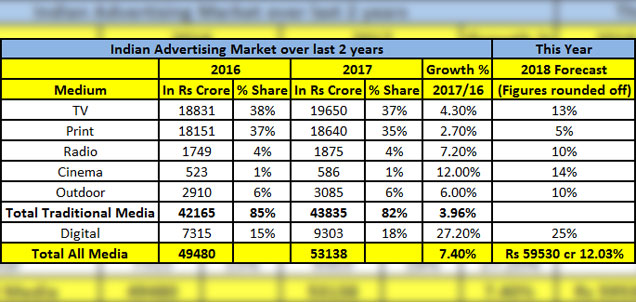
    1. Growth in the Indian Advertising Market slowed down to 4% in 2017, thanks to the after-effects of demonisation and GST roll-out. Traditional Media during 2017 grew by only 4%, the lowest in half a decade while Digital Media grew by 27.2%, taking the overall growth to 7.4%. In absolute terms, the Indian Ad market grew by Rs3,658 crores to take the industry to Rs 53,138 crores in 2017.

    2. AdEx was slow to recover from the impact of demonetization and first quarter of 2017 saw a de-growth of 2% and a growth of mere 2% in second quarter. Just when we expected AdEx to gather steam, GST was announced in July and the market saw a drop of close to 20% in traditional media over June 2017 and a drop of 5% as compared to July 2016. Mercifully, the  festive period brought cheer to AdEx and it grew from August to December by 13%. But because of the slow start in the first half and a drop in July the whole year’s AdEx is estimated at Rs. 53,138 crores, a growth of mere 7.4%.

    3. With a growth rate of 7.4% the Indian market has lost its stellar position of being the fastest growing advertising market in the world and has conceded that position to Russia, going by WARC estimates of international markets.

    4. Television continues to be largest contributor to AdEx with 37% share, but grew by just 4.3%, closely followed by Print at 35% share but with even a lower growth of just 2.7%.

    5. Digital that grew by 27.2% now contributes to a whopping 18% of Indian AdEx. Digital gained 3% share points at the expense of Television and Print who lost 1% and 2% share points respectively.

    6. Radio, Cinema and Outdoor have all grown at a much faster pace than Television and Print and maintained their share in 2017. But share of Digital continues to be more than combined share of Radio + OOH + Cinema and we don’t expect this trend to change in near future.

    7. The categories that have contributed to growth in Print, Television and Radio (and accounted for 56% of growth of Rs. 3,658 crores) have been FMCG followed by Telecom and Automobiles. FMCG continues to be the most dominant sector with a 32% share followed by Auto at 10% and Telecom at 8%. E-commerce that had taken the media market by storm three years ago contributed only 4% to AdEx (compared to 10% in 2015). With implementation of Real Estate Regulation and Development Act (RERA), Real Estate and Home Improvement category as a whole has registered a de-growth of -3%.


    B. Television:

    8. Television AdEx grew by a mere 4.3% and reached Rs. 19,650 crores. This is the lowest growth television has witnessed in the last 5 years. The growth is so low, despite the addition of 100 new channels including cable channels, which in turn contributed to an increase in FCT supply of 11% in 2017. Like-to-like channels shows an increased FCT supply of 7% leading one to conclude that on an average television rates were suppressed, but Advertisers could not reap the benefit of this because of lower ratings.

    9. HD emerged stronger during the year with the launch of 22 HD channels, now reaching 50 million homes split equally between Urban and Rural. Viewership of HD channels has also seen exponential growth and we estimate that HD is today Rs. 2,000 crore advertising market contributing over 10% to the television Adex.

    10. FMCG continues to rule the roost contributing 51% to the total Television spends followed by Telecom 12% and Auto 8%. It’s the same 3 categories that have mainly contributed to the growth of Rs. 820 crores in Television AdEx in 2017. E-Commerce maintained its contribution at 4%.

    11. Hindi GECs including FTA contribute 28% of overall television AdEx and Hindi is by far the largest contributor to television AdEx. FTAs channels have seen robust growth in viewership during the year and account for 19% of the Hindi GEC plus FTA genre.


    C. Print:

    12. Print grew by a mere 2.7% during the year. This is the lowest growth we have seen in 9 years. But it continues to be 2nd highest contributor after television with a share of 35%. It is significant to note that for the last 3 years, Print has been steadily losing share at a rate of 1% share point every year for last 3 years, but this year the decline accelerated and Print lost 2% share points. Dailies increased 3.4%, a bit higher than the total Print AdEx, because Magazines as a medium failed to gain advertiser interest for the 3rd year in succession.

    13. In terms of volume, Hindi publications continue to be ahead of English publications, contributing 34% of the total volume. English publications come close behind at 27%. Contrary to popular belief, volume in English publications has grown by 4% while volume in Hindi publications degrew by -4%. The degrowth in volume of Hindi publications has been observed for the first time in many years. Among other languages, Kannada and Gujarati publications have shown a substantial increase in volume, but Punjabi, Urdu and Tamil publications show a decline.


    D. Digital:

    14. Though there has been exponential growth in Video consumption over the past year, Display, Native and Programmatic have also picked up rather well with Mobile becoming the primary choice to consume content. Newer display advertising elements, Mobile, Online Video and Programmatic are all helping attract more advertising investment into Digital.


    E. Forecast:

    15. The forecast for 2018, is that Adex will grow by 12.03% taking the industry to Rs. 59,530 crores.Highest growth rate should be achieved by Digital (25%) followed by Cinema (14%), TV (13%), Radio & Outdoor (10% each) and Print (5%).


    Said Sam Balsara, Chairman, Madison World: “Demonetisation and GST have causedheadwinds resulting in a stunted AdEx. But you can’t keep advertising or for that matter the Indian economy down for too long. So we are cautiously optimistic about 2018 and project a growth rate of 12% for 2018 with digital again growing by 25%. To take advantage of the figures released by IRS which revealed dramatic growth in Total Readership, publishers will be well advised to offer incentives to advertisers for repeating the same ad in the same publication 2-3 times a month.”

    Pitch Madison Ad Outlook 2018 Published Report


  • Abanti Sankaranarayanan is Chairman of ASCI

    By A Correspondent


    Abanti Sankaranarayanan

    At Abanti Sankaranarayanan, Chief Strategy & Corporate Affairs Officer at Diageo India and former Vice Chairman, Confederation of Indian Alcoholic Beverage Companies (CIABC) has been elected as Chairman of the Advertising Standards Council of India (ASCI).


    D. Shivakumar, Chairman & CEO PepsiCo India was elected as Vice-Chairman and Shashi Sinha, CEO, IPG Mediabrands was re-appointed as the Honorary Treasurer.


    Other members of the Board of Governors are Al Rajwani (Managing Director & Chief Executive, Procter & Gamble Hygiene and Health Care Ltd.), Benoy Roychowdhury (Executive Director, HT Media Ltd.), Gurmit Singh (Vice President  India Business, Oath), N.S. Rajan (Global Partner & Managing Director, Ketchum Sampark Pvt. Ltd.), Narendra Ambwani (Director, Agro Tech Foods Ltd.), Prashant Singh (Managing Director, Nielsen India Region), Raj Jain (Chief Executive Officer, Bennett, Coleman & Co. Ltd.), Rohit Gupta (President – Network Sales & International Business, Sony Pictures Networks India Pvt. Ltd.), Sandeep Kohli (Executive Director & Vice President, Personal Care, Hindustan Unilever Ltd.), S.K. Palekar (Adjunct Professor & Advisor – Executive Education, Institute of Management Technology), Srinivasan K. Swamy (Chairman & Managing Director, R K SWAMY BBDO P. Ltd.), Subhash Kamath (Managing Partner, BBH Comms India Pvt. Ltd.) and Sunil Lulla (Chairman & Managing Director, GREY Group  India).


    Said Swamy, who is the outgoing Chairman of ASCI: “2016-17 has been an interesting year for ASCI as it marked some impressive advancements. In a noteworthy achievement, ASCI received positive re-enforcement for the role it plays as a self-regulatory body in a landmark Supreme Court Judgement. Renewal of the Memorandum of Understanding (MoU) with The Department of Consumer Affairs (DoCA) which is currently on its third year, and the signing of two new MOUs with the Food Safety and Standards Authority of India (FSSAI) and the Ministry of AYUSH, has collectively proven credibility ASCI enjoys with the Government. Other noteworthy aspects include ASCI being included as an Expert Committee member to look into matters pertaining to advertising of High Fat Sugar and Salt (HFSS) foods and Sugar Sweetened beverages (SSBs), and as a key stakeholder in the committee constituted by the National Highways Authority of India (NHAI). ASCI is now a part of the Executive Committee of International Council on Ad Self-Regulation (ICAS). Interestingly ASCI was a Gold winner at Global EASAs Best Practice Awards for its mobile app, a service that was introduced in 2016. Another significant step was introduction of an Independent Review Process by a retired Supreme Court/High Court Judge, when CCC decisions are sought to be reviewed by affected advertisers. Guidelines were issued relating to Celebrity endorsements of products/services given the importance consumers attach to such association.   Im delighted to have been an enabler for this years journey for ASCI and Im sure the Council will take proactive steps in the cause of self-regulation in advertising.”


    Added Sankaranarayanan: “ASCI has seen a remarkable year on year progress through formalised collaborations with various regulators, notable recognitions from eminent external organisations, further facilitation of robust codes and guidelines and swifter processes to promote the cause of self-regulation in advertising. I feel privileged to be elected as Chairman of ASCI and Im elated to take over as the torch bearer for several more successful initiatives and significantly contribute to effective self-regulation in advertising. Its heartening to see ASCIs relentless efforts being recognised by the judicial body, prominent regulators and government bodies and we shall take all efforts to continue to keep it so. Core to ASCIs mission to ensure protection of the interests of consumers, through supporting Honesty, Decency, Responsibility and Fairness in Advertising, ASCI shall carry on to keep true with its consumer focused tagline, So you can trust advertising.”


  • Indians spend more time on cellphones than TV


    The Mobile Marketing Association (MMA) in association with Kantar IMRB has released a report on Smartphones and Feature Phones Usage and Behaviour 2016-17 in India. The report studies the evolving nature of the Indian mobile consumers, and provides insights and behaviors individually on smartphones and feature phones.


    KEY FINDINGS ON SMARTPHONES

    I. Time spent on mobile surpasses any other media

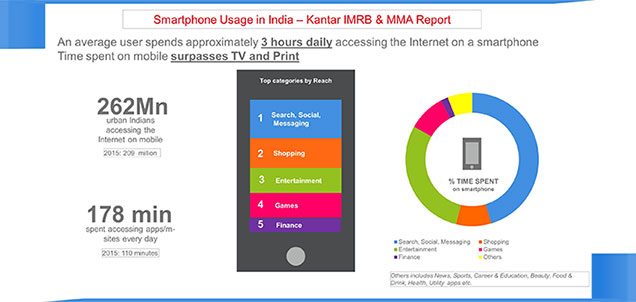
    An average consumer spends 3 hours per day on their smartphones (an increase of 55% from 2015), which surpasses time spent on TV or any other media. Social media and messaging apps were the clear leaders accounting for almost 50% of all time spent on smartphones.

    II. Women more engaged than Men

    The study shows that Women spend 2x more time on their smartphones compared to Men – on YouTube and games. They also spent 80% more time on Facebook than their male counterparts.

    III. Online shopping gains in leaps and bounds


    Another finding revealed the rise of online shopping category, which now has 15% higher reach than the entertainment – making it the second most popular category in terms of reach.


    KEY FINDINGS ON FEATURE PHONES

    I. Prime users are from upper SECs

    The study shows a whopping 75% of feature phone users were from the upper SECs, while only 25% of respondents were from SEC C, D and E (NCCS).

    II. Feature phone users don’t intend to switch

    A big revelation has been that almost 85% feature phone users do not intend to switch to smartphones on their next purchase indicating that the functional benefits of feature phones combined with their durability, battery life and ease of repair were highly coveted by these users.

    III. Feature phones users spend more on mobile plans


    Feature phone users spend more money on their mobile plans. The ARPUs was almost 20% higher compared to the national average.


    Said D Shivakumar, Chairman and CEO, PepsiCo India Holdings and Chairman of the Mobile Marketing Association: “With over 85% mobile penetration, we are today one of the largest mobile markets globally and insights on mobile usage in India are of critical importance to the modern day marketer. We are in an age now where we need to seriously think about marketing measurement and attribution, giving marketers better measurements, tools and confidence in connecting marketing to business outcomes.  A thorough understanding of the differential usage and consumer segments that are using smartphones and feature phones will only help marketers use their monies more efficiently. While most designing and applications are being targeted at smartphones, this report is a wake-up call. Today, the mobile is undeniably the closest we can get to our consumers, and it is this that will help marketers seek to understand – and leverage – a consumer’s path to purchase”.


    Added  Preeti Desai, Country Manager, Mobile Marketing Association India: “Mobile is clearly the third largest mass medium in terms of Ad spends in India today, with estimated spends in 2016 amounting to ₹.4,200 Cr. Hence it becomes very important for the industry to have credible research and measurement guidelines and reports, to help fully understand and leverage mobile’s ability to drive the future growth of business. With this in mind, MMA India has collaborated with Kantar IMRB to deep-dive into the dynamics implications and impact of smart phones and feature phones India focusing on each category separately and giving each their due focus. The insights of this study will be published in a series of industry reports that will go a long way in helping marketers use the medium effectively and efficiently. It is a great data set for marketers to reassess and optimize their spending with the most impactful allocations in their marketing mix, while leveraging mobile with double digit spend.”


    Hemant Mehta, Senior Vice President, media and retail, Kantar IMRB, said, “Mobile has had an outsized influence on the way consumers interact with each other, make decisions, transact and shop. This has significantly impacted the way companies and brands connect with their consumers and do business. But we’ve only seen the tip of the iceberg. With the advent of 4G, reduced data costs and free voice and SMS, we expect to see even more rapid changes in the mobile landscape. It is, therefore, important to keep a continuous pulse on the way consumers interact with and use their mobile phones. Along with MMA, we at Kantar IMRB have embarked on a journey to help marketers understand the impact of these changes and to identify emerging trends. The Smartphone and Feature phone reports are a step in this direction – providing an unbiased and insightful view on the evolution of mobile usage in India.”


    The report enables all members of the ecosystem to stay updated with consumer mobile trends and media consumption habits. Also at the same time, it elaborates the role of mobile as an influencer in the consumer path-to-purchase.


  • IndIAA Awards set for September 16

    By A Correspondent


    The India Chapter of the International Advertising Association (IAA), launched the IndIAA awards “for real creative advertising that was backed by real budgets” last year. Nominations for the second edition were invited and unprecedented number of nominations was received and reviewed.


    D Shivakumar, Chairman & CEO, PepsiCo India, chaired a jury of senior business leaders, which included Shantanu Khosla, VL Rajesh, GeetuVerma, Sanjay Behl and Amit Syngle.


    Said Shivakumar: “We just finished seeing over 100 shortlisted commercials from 19-20 categories. We spend about four-and-a-half hours reviewing some outstanding and some average work. We judged the commercials and the whole campaign under three parameters: 1) does it make us think on the brand and the category in a fresh way 2) Is the benefit visualised brilliantly as a lot of it is in the audio visual medium 3) How campaignable is this. I must say that the whole process has been outstanding and the results have been pretty simple and clear. I wish all the winners the very best and for those who haven’t won, best of luck for the next time”


    Pradeep Guha

    Added Pradeep Guha, Chairman, IndIAA Awards: “In our second edition, advertising campaigns that were released between July 1, 2015 and June 30, 2016 will be honoured in multiple product and service categories. To qualify for the Award, the campaign should have film (TV or Digital) as one of its elements. In each product or service category, no more than an overall winner was awarded. The awards ceremony is slated for September 16 at the ITC Maratha, near Sahar Airport in Mumbai.”


    Srinivasan K Swamy

    Said Srinivasan Swamy, President, IAA India Chapter and SVP, IAA Global: “At the IndIAA Awards event, you will see campaigns that have been watched and loved, and went on to impress our stellar jury. Therefore, we will invite on stage all the co-creators of the campaign to accept the award. This will include the marketing team, the agency creative team, the media team and other agencies that contributed to the success of the campaign. A special website www.indiaa-awards.org now hosts all the nominees of the campaigns across 20 categories. Advertising and Marketing professionals can review the work and indicate their choices by clicking on the ‘like’ button.”


  • Hail the consumer @ IAMAI Marketing Conclave


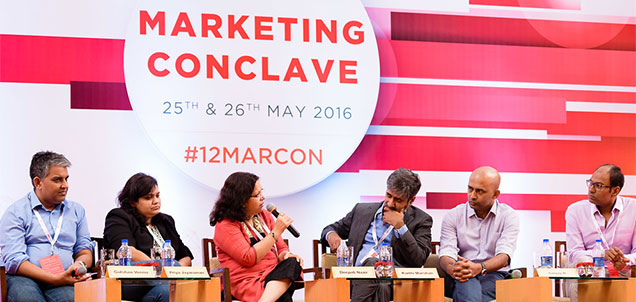
    ‘Untangling Marketing Convolutions’ is the tagline for the 12th Marketing Conclave presented by the Internet And Mobile Association of India (IAMAI).  And ‘Untangling’ it was from the word go. Day 1 of the two-day event started with a welcome address by Tushar Vyas, Managing Partner- South Asia, GroupM and a special address by D Shivakumar, Chaiman and CEO, PepsiCo India. The day was predominantly centered on digital marketing, better way of utilising the platform and the digital future of India.


    A chat about ‘Global Marketing’ was conducted by Virginia Sharma, Director- Marketing Solutions, LinkedIn India with Sameer Desai, Head of Consumer Healthcare, Mundipharma and VP Asia Pacific, World Federation of Advertisers. At the start of the conversation, Sharma announced that 58 per cent of LinkedIn consumers access the network through mobile, which began the conversations on what are the learnings from emerging and global markets. Desai shared his own experience and challenges that he faced when he entered the pharma sector and about global marketing. He said: “The challenge was to consumerise the pharma model.” Desai also said that it is very important to understand the internal organisational culture while going global. “Working together and maintaining coordination within each department is the key,” he said when asked to give some tips for being a business leader. Sharma and Desai both praised the way e-commerce has fared in India and suggested that instead of looking West, we should be focusing within the country. In conclusion, Desai said research is an important part but it should not dominate decision making, the moment that happens, people stop being marketers.


    Moving from global marketing to marketing technologies, the first panel discussion moderated by Sourabh Gupta, Engagement Manager, Tata Strategic Management Group started. ‘The age of marketing technologists’ was the topic and panelists included Manav Sethi, Group Head- Marketing and Digital Platforms, Head- Classifieds and Deals, AskMe Group India and Malaysia, Gunjan Soni, Chief Marketing Officer, Myntra, Pallavi Chopra, Head Marketing, redBus.in, Mohan Menon, Head Marketing, Max Healthcare and Sanjay Tripathy, Senior Executive Vice President- Head Marketing, Analytics, Digital and E-Commerce, HDFC Life. The discussion was divided in to four parts: the cultural change in companies due to digitisation, KPIs beyond sales and marketing, the changes in roles within the organisation and leveraging digital marketing dashboard. In the context of digitization, Soni said: “It has impacted quality and speed of decision making” and was quick to add that digital is a way of living for Myntra. The panelists agreed that the widespread digitisation has helped in breaking the hierarchies within a company. Consumer engagement and creating a consumer centric product were some of the major talking points in this discussion. Chopra shared that his company has developed a unique algorithm bus code to understand the consumer demands better and so that the bus operators start taking the consumers seriously. A case study session was being taken in parallel by Theodore Hayes, AVP Analytics, iProspect Communicate 2.


    Next was a presentation followed by a discussion session with the presenters. The presenters included Apurva Chamaria, Vice President and Head Corporate Marketing, HCL, Virat Khullar, Head Marketing, Renault India, Karthik Jain, EVP Head Marketing and Customer Analytics, HDFC Bank and Raja Hussain, Chief Executive Officer, Airloyal, who also moderated the discussion. The topic was ‘ Maketing Automation: Golden opportunity for marketers’. Chamaria was the first presenter, he discussed the transition from MarCom (Marketing Communication) to MarTech (Marketing Technology) and now, MarOp (Marketing Operations). He said there is a need for agile marketing strategies in MarTech through personalisation , geo-based targeting, programmatic SEO strategy etc. The next presenter, Khullar shared how Renault launched its new car Kwid in the digital platform and developed an exclusive app for it. He emphasised on the effective usage of social media for marketing automation. Jain, named his presentation ‘Sharper Marketing’ and he said that it is very important to be customer centric. He also advised that the Analytics and Campaigning teams have to work closely to succeed. Last but not the least, Hussain focused on how feedback is the life blood of marketing and it can be used to make a bigger impact. The discussion that was followed mainly highlighted the personal experiences and the challenges that each panelist faced in their respective fields. The common consensus of the discussion was that it is important to understand the consumer psyche and change the mindset about digital, that is digital should be looked as a priority.


    Parallel case study sessions were held by Deepak Kumar, Vice President- Ambient OOH, Posterscope India Group and Martin Nygate, Founder and Chief Executive Officer, Gentay Communications, who took the session on ‘Mobile advertising is killing your brand. What if we could make it powerful?’


    After an insightful discussion on various techniques of marketing, Tushar Vyasconducted a one-on-one with Prasant Peres, Director- Marketing (Chocolates), Mondelez India. They discussed about ‘The old-new age curve of brands: how new age brand’s marketing techniques are different than old age brands and vice versa’. The chat started with a quick volley of questions thrown at Peres, from which it was concluded that: the ad character Lalitaji is still stuck with him and he is a Kishore Kumar and Shahrukh Khan admirer. After the fun beginning, Vyas was back to the topic of discussion. He asked Peres to describe the evolution of marketing. “Marketing evolved not in the last 10 years but in the last five years, which was quite dramatic. Digital is a big change and we have become a mobile nation”, was Peres’s reply. He also added that he was awestruck by the transformation in mobile. “Engagement has become a core point of marketing,” Peres said. Another interesting point that was raised by Peres was that family TV viewing might become nostalgia as the current scenario demands focus on individual demands. He also said the success and failures in digital should be treated similarly as in traditional mediums.


    The post-lunch panel discussion was moderated by Deepali Naair, Advisor, IAMAI and the topic was ‘Beyond numbers: The art of digital marketing’. Karthi Marshan, Head Marketing, Kotak Mahindra Bank, Gulshan Verma, Chief Revenue Officer, Times Internet, Priya Jayaraman, Cofounder and Business Director, Propaganda India, Gyan Gupta, Chief Executive Officer, DB Digital and Sanjay R, Marketing and Network Head, Flipkart ads were the panelists. ‘Brand building’ and ‘brand engagement’ dominated most of the discussion. With everyone agreeing that digital offers ample opportunities for brand building and should be used to its potential. A workshop on ‘Out of stock in 24 hours- Marketing Exclusively on Digital’ was being conducted simultaneously by Anthony Padayachi, Associate Creative Director, BC Web Wise and SiddharthPednekar, Business Director, BC Web Wise.


    This was followed by a session on ‘Mobile Storytelling’ by Vishal Rupani, Business Head, M-Canvas, Affinity. The highlight of his presentation was he drew analogies between the immensely popular HBO series ‘Game of Thrones’ and the mobile storytelling. He demonstrated a few examples on how advertising can be made interactive and engaging for the audience. “Seduce your consumers through beautiful story telling through brands” was his tip to every marketer.


    The last panel discussion was moderated by Milind Pathak, Chief Operating Officer, Madhouse and the panelists were Dhruv Chopra, Chief Marketing Officer, Carwale, PrakashSikaria, Business Head, Flipkart ads, Gaurav Gandhi, Chief Operating Officer, Viacom 18 Digital Ventures (Voot) and Vishal Rupani.  The topic was ‘Mobile: Is it minor screen or the major screen?’ “Digital marketing is equal to mobile marketing” said Pathak at the start and set the tone of the discussion. There was a unanimous agreement that mobile should be given more importance and content for mobile should also be given thought about seriously. “Mobiles should be the only screen looked at,” said Chopra in answer to the topic. “We believe that over time data price will neutralise and you will have opportunity to charge for content as well. The future looks very good of online video per say and eventually every screen will be connected.” said Gandhi, when MxM asked him about consumers not being ready to pay for content.


  • D Shivakumar to Chair MMA India Board

    By A Correspondent


    D Shivakumar

    The Mobile Marketing Association (MMA), the leading global trade association for the mobile industry, announced the appointment of the first MMA India Board of Directors, which includes 12 industry stalwarts, across the marketing, technology and advertising spectrum. The newly appointed board in their first board meeting set up an ambitious agenda to enable marketers to better understand and adapt to the evolving mobile environment in India with regards to advertising and commerce.


    Appointed by the MMA for their leadership and visionary approach to the mobile medium, the MMA India Board is led by Chairman D Shivakumar, Chairman & CEO, PepsiCo India Holdings Pvt. Ltd.


    The other board members include:

    • Ajit Mohan, President, Novi Digital Entertainment Pvt. Ltd
    • Amarjit Singh Batra, CEO, OLX South Asia
    • Amrit Thomas, Chief Marketing Officer, United Spirits Limited
    • CVL Srinivas, CEO South Asia, GroupM
    • Kirthiga Reddy, MD, Facebook India
    • Prasun Basu, MD South Asia, Millward Brown
    • Priya Nair, Executive Director – Home Care, Hindustan Unilever Limited
    • Rohit Dadwal, MD, Mobile Marketing Association Asia Pacific Ltd
    • Senthil Kumar, Chief Creative Officer, J. Walter Thompson
    • Shireesh Joshi, Head – Strategic Marketing, Godrej Group
    • Vijay Shekhar Sharma, Founder & CEO, One97 Communications & Paytm


    Speaking on the appointment of the new board, Chairman D Shivakumar commented, “The Indian market is brimming with great opportunities for Mobile media and marketing. The MMA India Board of Directors brings together some of the best practitioners and  minds in marketing, advertising and media, and our collective experience and expertise will hopefully propel the market to quickly adopt mobile marketing as a mainstream medium.” He further added, “Our board members have identified key areas where our immediate focus in needed. These initiatives will facilitate sharing insights, create industry benchmarks and guidelines that will help marketers leverage mobile as core to their business and marketing strategies.”


    “Mobile continues to push India marketers to re-think the way they approach marketing and use data and technology to engage with consumers. The conversation has shifted towards how we can build capabilities and further help the ecosystem to leverage mobile,” said Rohit Dadwal, Managing Director for MMA APAC. “I’m confident that under the guidance of the new Board, our members will be able to leverage the MMA’s resources and network to accelerate mobile marketing in India. The Board of Directors will be instrumental in shaping the future of the industry and developing the MMA and its initiatives. I look forward to working with them to drive the growth of our industry.”


    The MMA board members have commenced work on key initiatives that are focused on Research, Measurement and Education to help marketers understand consumer behavior and usage of data and non-data mobile users and capabilities across Voice, Text and Data. Studies will help evaluate and analyze traffic sources, path to purchase, creative campaign evaluation, mobile content, and mobile commerce. These initiatives will help in demystifying mobile marketing by cultivating inspiration, building capabilities for success and demonstrating impact thus supporting the growth of mobile as an indispensable part of the marketing mix.


  • Jury & awards shortlist announced for The Smarties

    By A Correspondent


    The Mobile Marketing Association (MMA), announced the jury and awards shortlist for the 2015 edition of the MMA India Smarties Awards. The Smarties is the only global mobile marketing awards program that honours innovation, creativity and success in the field of mobile marketing. The MMA Smarties India Awards, where the final winners will be announced, will take place on September 16 2015 at The Leela hotel in Gurgaon.


    This year, an ‘all-Brand Jury’, led by Jury Chairperson D Shivakumar, Chairman & CEO, PepsiCo India Holdings Pvt Ltd, and consisting of other celebrated marketers in India, will evaluate shortlisted campaigns under 15 categories. The jury will be joined by brand & communication research company, Millward Brown, The Smarties Knowledge Partner.


    “The mobile industry is about 20 years old and the mobile phone is the most deep personal experience for the user. Marketers are learning to innovate with this medium and I saw a number of great mobile marketing innovations from Colgate, HUL, PepsiCo, UB, Kelloggs and Paytm. We are in the third year of these awards and I expect to see a revolution here in the next few years,” said Jury Chairperson D Shivakumar, Chairman & CEO, PepsiCo India Holdings Pvt. Ltd.


    The shortlist consists of 62 campaigns over 15 categories from all over the country with an increment in participation from regional markets. The FMCG companies lead the pack, accounting for over 40 percent of the shortlisted entries. The range of industries which the campaign entries came from only underscores the growing prominence of mobile as a marketing medium. Lead Generation / Conversion / Direct Response, Product / Service Launch, Cross Media Integration, Best Brand experience in Mobile Rich Media, Relationship Building proved to be the most popular categories overall.


    “The response that we have received for The Smarties™ India 2015 is very encouraging and demonstrative of the growing potential of mobile marketing in India. These entries are representative of the breakthrough mobile strategies that have been adopted by brands and agencies in varied industries through the past year,” said Rohit Dadwal, Managing Director, Mobile Marketing Association – Asia Pacific. “The campaigns that have been shortlisted are inspiring and demonstrate the countless applications of mobile marketing in India, and providing more opportunities for brands to get closer to their customers.”


  • Now, award for ‘real advertising’ from IAA

    By A Correspondent


    A new advertising award is set to debut in India – and this one promises to reward “real, hard-working advertising.” It’s the brainchild of the India chapter of the International Advertising Association (IAA), and will be called the IndIAA awards.


    The inaugural round of awards will be held in Mumbai in October 2015. The winners will be picked by a high-powered jury chaired by Harish Manwani, chief operating officer of Unilever, and featuring D Shivakumar, chairman of PepsiCo India; Bhaskar Bhatt, managing director, Titan; Mayank Pareek, president, Tata Motors; Sangeeta Pendurkar, managing director, Kellogg India; Sanjeeb Chaudhuri, global chief marketing officer Standard Chartered Bank and B Sriram, managing director, State Bank of India.


    Manwani said, “Effective advertising implies the existence of deep consumer insights, the rigour of a repeatable process between the client and agency and optimal levels of media spends. Only then does a great creative idea get transformed into effective advertising.”


    Pradeep Guha, chairman IndIAA awards, explained that ad campaigns released between July 1, 2014, and June 30, 2015, are eligible for the inaugural awards, but the campaign must have a film component – whether it’s been released on TV or digitally.


    “This is an initiative to reward truly creative advertising and I am confident it will win great respect for its objectives,” he said. Srinivasan Swamy president IAA said, “At the IndIAA awards event, you will see campaigns that have been watched and loved, being awarded. Therefore, we will invite on stage all the co-creators of the campaign to accept the award.”


    Source:The Economic Times

    Copyright © 2015, Bennett, Coleman & Co. Ltd. All Rights Reserved

    Licensed to republish


  • Big Nite for the Datawallahs!


    By A Correspondent


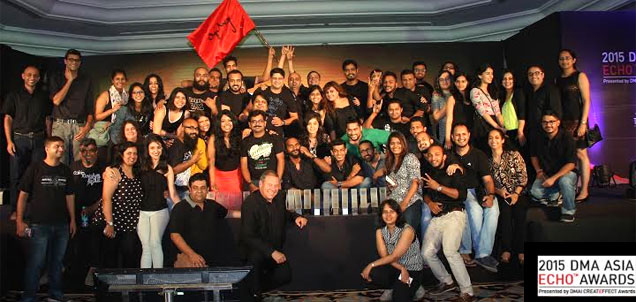
    What’s one awards nite where many of the Big Pros of the A&M-land assembled and, no, it wasn’t the Abby, the Effies, the Emvies or Kyoorius? We’re talking of names like Piyush Pandey, D Shivakumar, Madhukar Kamath, Nagesh Alai, KV Sridhar, Bobby Pawar, Manish Bhatt, Damodar Mall, Tarun Katial and many, many others?  It was the DMA Asia Echo Awards, held last Friday (Aug 6) in Mumbai.


    Fast Facts:

    Entries from 542 participants, 75 agencies, 175 Brands


    Entries from 8 countries – India, Singapore, Hong Kong, Malaysia, Phillipines, China, Japan, Thailand.


    Awards presented:

    4 Overall

    1 Best of Show

    1 Diamond

    142 Metals

    29 Golds

    26 Leaders


    Unilever was adjudged Client of the Year, while OgilvyOne Worldwide was Agency of the Year. Ogilvy & Mather was Network of the Year and WPP the Holding Company of the Year. The Best of Show for Creativity was awarded to Visa India for Visa Sarees and the Diamond for Effectiveness was taken away by OgilvyOne Worldwide Philipines.


    The International Echo Awards are the most prestigious awards in the data-driven marketing and advertising world. This year, DMAi, the Indian association which has been in existence since 1992, was accepted entries from across 17 countries in Asia for both the awards – the 2015 DMA Asia Echo Awards and The DMA International Echo Awards 2015.


    Underscoring the importance of the Echo awards, Rakhshin Patel, Managing Director, Pi Communications & Grand Jury Chairperson, said:  “For an athlete, the Olympics are the ultimate stage. Data-driven marketers share the same feeling about the Echo programme. There is indeed no bigger stage to showcase ideas and work that have yielded measurable, tangible, real results.”


    There were 15 Effectiveness categories and 3 Creative Effectiveness categories each headed by a biggie – Piyush Pandey, D Shivakumar, Madhukar Kamath, Geetu Verma, Nagesh Alai, Jasmin Sohrabji, Anupriya Acharya, Agnello Dias, Pratap Bose, Bobby Pawar, KV Sridhar, Tarun Katial, Manish Bhatt, Nishi Vasudeva, Damodar Mall, Susana Tsui, Anant Rangaswami  and Rajesh Kumar.


    Said Vatsal Asher, CEO & Shelly Singh, COO, DMAi: “We are honoured to be hosting and managing the Asia Echo Awards. Campaigns got judged with the best in the Region. We had a fantastic panel of Jury Presidents and 194 online judges this year. We hope to see an increase the list of Asian winners at the International Echo 2015 awards in the US where all Asian winners will fasttrack to Round 2.”


    As an apex, not for profit DMAi, since 1992, brings about collective action for advancing & protecting responsible Data Driven Marketing and Advertising. The DMAi is run on a day-to-day basis by Vatsal Asher (CEO) and Shelly Singh (COO) and the awards have been championed by Rakshin Patel (Grand Jury Chairperson) and Ajay Chandwani, (Chairman Emeritus).


  • Personal care drives FMCG business on rural push

    By John Sarkar & Shubham Mukherjee


    If you are stuck in a remote village in India, dusty and hungry, chances are you will find more options to wash your hair than fill your stomach.


    For decades, food items have been the most widely distributed FMCG products in the country. But that rule of thumb is changing. Indians are more likely to find more personal care products than food in a shop these days—a result of consumer goods players pushing the distribution of an entire range of their products in the face of wary consumer spending.


    Latest data from market research firm Nielsen reveals that on the list of the top five FMCG product categories, only one food product—biscuits— finds place. The category with the maximum reach, or penetration as it’s called in market parlance, is shampoos at 79 per cent, followed closely by biscuits at 78 per cent.


    Distribution of categories has undergone a dramatic transformation in the last 15 years. FMCG is available in 8.8 million outlets and shampoo is available in 80 per cent of those outlets, says D Shivakumar, chairman and CEO, PepsiCo India.


    “Skin creams have got into the top 10 distributed list and packaged tea, which was the most distributed category a few decades ago, is now out of the top 10. Daily-use, low-unit price, easy-to-sell via wholesale are the key lessons for categories in the last 10 years.” Data suggests that most of this evolution is due to a lot of un-branded consumption shifting to branded consumption. For instance, in utensil cleaners and edible oils penetration has increased to 36 per cent from 33 per cent and 21 per cent to 17 per cent from 2012 to 2014, respectively. “Earlier, people would turn up at shops with bottles to buy loose mustard oil. That’s changing with rising affluence levels and lower packaging costs. In future, we will see more un-branded-to-branded consumption in non-mature categories such as, hair oils and hair conditioners,” says Vijay Udasi, executive director, Nielsen India.


    The findings also reveal a drop in penetration levels of detergents cakes and bars from 60 per cent in 2012 to 59 per cent in 2014 as more consumers shift to washing machines to do their laundry. Similarly, skin creams have also seen a drop of 2 per cent due to changes in consumer behaviour. “The segments within the skin creams category have also changed. More people are buying emerging products like face washes, anti-ageing and under-eye creams,” says Mr Udasi.


    For HUL, the next step now is to make its brands accessible using pack sizes and price points tailored to win across the country. “We have been able to maintain our leadership position in a growing market by following a market development approach. One of the most successful attempts on this front has been the Dove ‘twin sachet’, which offers a shampoo and conditioner together at a Rs 5 price point to induce trials,” says Srirup Mitra, category head – Hair Care, HUL.


    But the dominance of non-food categories on the top could change. There are ominous signs. Take the salty snacks category for instance. Penetration has risen from 58 per cent to 64 per cent. Even a category like noodles, which has still not broken into the top-ten list, has seen an increase in penetration from 38 per cent to 42 per cent. “The next level of growth lies within branded foods,” says Mr Udasi. “There is an emergence of new food categories in bread spreads, including peanut butter and branded spices. As affluence levels rise, rural consumers will spend more on grocery items and food.”


    Although FMCG growth has been slowing for some time now, sliding by 8.1 per cent from 2010 to 2013, Nielsen predicts that India’s FMCG industry will grow from $37 billion in 2013 to $49 billion in 2016. Distribution growth and innovations around sachet offerings will play major roles in fuelling growth, which had slowed down in the last few years. While the rise of e-commerce is being keenly watched, several new models may evolve over the next few years.


    Source:The Economic Times

    Copyright © 2014, Bennett, Coleman & Co. Ltd. All Rights Reserved

    Licensed to republish


  • Power points to target & track youth


    Youth is more homogeneous today than ever before: D Shivakumar Reach the younger & funkier generation 
     

    D Shivakumar

    CEO, Pepsico India


    Youth and youthfulness are evergreen concepts. The eternal truths of college, friends, and hangouts, falling in love and falling out persist. There are some differences in this generation due to technology and wider exposure.


    Earlier generations saw basic brands and services. This generation has challenges with everything from quality education seats to public utilities. Let’s look at life, technology, relationships with brands and what marketers need to do to connect better.


    Youth is more homogeneous today than ever before; they dress the same, talk the same, tap into the same sources for information and quickly form digital tribes. However, small town youth is about conformity, values and tradition playing the role of glue as well as shackles.


    They try balancing between being trendy and managing family expectations. Their urban peers are about group belonging, but wanting to stand out -a ‘first amongst equals’ syndrome. They are more ‘global’ savvy. So, brands can be traditional and leading edge with the youth.


    Indian youth recognise the world’s fragilities and life’s insecurities. This makes them ambitious about material success. It is about fulfilling potential and owning the badges. The markers are visible ‘money can buy’ symbols.


    Their role models are talented sporting geniuses like Messi, Ronaldo and Tendulkar, smart tech guys like the Flipkart founders (Sachin and Binny Bansal), Mark Zuckerberg, Steve Jobs and Edward Snowden, the whistle blower.


    They admire the journeys of Dr APJ Kalam and MS Dhoni and anyone who has achieved rare competence in his or her field. Celebrities are aspirational and advertising which offers a peek into the celebrity’s world wins.


    They are idealistic, realistic and competitive, all at once. The choice of careers is getting more diverse. They keep things light and aren’t deeply attached. They realise relationships have side exits.


    Girls are postponing marriage to experience independence and be financially secure. Priyanka Chopra’s ‘it’s more than a phone’ ad which tapped into this attitude was a big success.


    A competitive society pushes youth to be extra smart or hardworking. Most find the latter a difficult and boring path. Hence they resort to ‘jugaad’, the ‘chota short cut’ or ‘patli galli’. White lies are okay truths for them to get to the goal.


    This dark side of youth is sometimes admired and often not condoned by peers and society! Movies have captured this; brands haven’t done so as yet.


    Let’s look at the impact of technology. Every young Indian has access to a cellphone. India’s youth population dominates the 200 million Internet user base, the 100 million Facebook users, 80 million YouTube users and 30 million Twitter users. Technology allows youth to have multiple identities, mostly anonymous. It has made them multitasking champions and reduced attention spans.


    Mobile phones and social apps have given them a way to connect with the opposite sex in their own private space and express themselves through words and visuals. Youth from ‘love marriage’ families do talk about their girlfriends and boyfriends with their parents. Boys and girls are open to discussing their relationships candidly. Can brands use these insights in their communication?


    Technology makes youth consume, converse and create and gives youth social currency, however transient. It needs to be acquired by doing new and different things. ‘Talk value’ brands play a big role in building social currency. Brands can co-create by tapping into this consume, converse, create cycle.


    Indian youth are comfortable with consumerism. They happily switch between branded and unbranded choices and use a wide repertoire. Brands give them identity and are important to expressing their coolness but always at the right value.


    They want and respect socially conscious brands, however, they do not necessarily reward them with more business. Recycling in technology is a good example. How do brands get youth commitment to ecology and societal issues while staying on business strategy?


    The challenge is to market inclusiveness memorably, and be authentic. The good of the brand is in its product promise and delivery, the challenge is in behaviour and responsiveness in the social space. Brands need to engage with youth on their turf, on their terms.


    Youth passion revolves around sport, music, movies, shopping and hanging out. The emergence of English Premier League, the Spanish La Liga, NBA and F1 threaten cricket’s position. Brands that connect these broad passions do well; brands that force connection do poorly and are mocked for trying too hard.


    Youth and aspiration are two sides of the same coin in every generation, aspiration of a new way and today a new technology. Youth always seek ‘the next wave to surf’.


    India has 55,000 brands in the FMCG sector. Most of these brands view youth as the prime target segment. Yet, few get it right. Brands fail because they try too hard to be cool and in reality are too cold to be hot!


    Source:The Economic Times

    Copyright © 2014, Bennett, Coleman & Co. Ltd. All Rights Reserved

    Licensed to republish


    Harish Bijoor

    Brand expert & CEO, Harish Bijoor Consults Inc
     

    Youth and trends – that’s really an oxymoron, moron! And that opening sentence, in-the-eye, in-the-face, and in the gut, is the way the youth talk. “Hey Dawg” is a loving appellation. Aside hug follows, that could get your shoulder dislocated, but it’s away of bonding and telling you we come from the same generation, and are headed to the same hell.


    Youth and trends are words that don’t necessarily go together.The moment something sets in, the category moves its cheese, chips and Coke. Trend is for the old.The young believe in change that is forever, and discontinuous.Anda discontinuous trend is really not a trend; difficult to track with method, science and meaning.Those who believe they are trend spotters live in a fool’s paradise.


    The trend you write about is as old as the day it was written. This piece is therefore not as much about telling you trends as teaching you how to trend-track. Teach a man to fish, rather than give him the now-truly dead Pomfret you caught this morning.


    Since trends are difficult to track, and have this yen to change, there is a great way of keeping in touch with the youth;what they do, wear, speak, eat and drink. Just watch them at it. Track them without them knowing. Catch them in their natural surroundings.


    By the way this is not home, school, college or even a spanking new entry-level office. Instead, it is the third-place where they are letting their hair down. Gyms, beauty-parlours, cafes, pubs, discs and more. It is here that they are themselves.


    Catch them on Twitter, Facebook or Tagged. Catch them with their pants down, with their second and third digital handles, on sites you never thought guys and girls like them would ever visit.The footprints you track today must be both physical and digital.


    Just as there are “physical third-places”, there are “digital third-places”. And thenwhen you havewatched them 1:1 inmyriad “third-place” locations, build that sketch of theirs.This will change in three months flat.Therefore, keep building, calibrating their mind, mood, language, tone and tenor. You just might be on the right track, then. I call this generation “The I-Gen” where I stands for Impatient.


    It’s the hallmark of youth. Patience cycles have progressively become smaller. Impatience is the newvirtue.The more impatient you are, the more of a ‘go-getter-youth’ you are.Whenyou can be Impatient, why be patient? Impatience hits you in the face all around.The youth are impatient with love.There are relationships on the front-burner, just as there is a parallel one on the back-burner.


    Multi-hob is the way to go. There is impatience in sex and no binding yourself tight within the confines of a marriage. Impatience is everywhere, and the salivating marketer is ready to cater to it.Whenyou fracture your patella and rush to the hospital, there are two cures possible.


    The patient one is to be in a cast for six weeks, and the impatient one is dowhat the doctor in the big hospital is recommending. Put in those nuts and bolts and be up and about in a week flat.The marketer here (in benign disguise) is the doctor recommending the high-priced quick-fix versus the low-priced plaster of paris in blue. This is everywhere in the youth space.


    Pay the price and get the lost time back.Welive with two currencies today: time and money. And often, time is at a premium. There is impatience in the foods we eat, fast food versus regular. Restaurants versus QSR’s. Quick-serve restaurants versus slow-serve restaurants, if you will. There is impatience in the yen to create wealth, just as there is impatience to spend it all.


    The bio-clock of the youth at large is ticking at a pace that seemsmuch more frenetic than at any time in our marketing history.There seems to be very little time to live, might as well live it fast and furious. Fashion, lifestyle, entertainment and digital use is witnessing this impatience all around. What then is the real problem at hand? It’s not what, it’s who.


    The marketers in the country who are an older lot,much older than the people they sell to.Whoare good at the old marketing format: Patience Marketing. Impatience is a mindset they just do not understand well enough. Even if they do, there is lip-service done to it.


    There is also this dominant attitude and notion in the minds of older marketers (and by old I mean age 30 and above, ouch!), that this impatience is a fad, and it will pass. Marketers instead need to learn and practice impatience. Embrace it within your brand DNA.


    Pack it within your brand offering, and showcase it to the youth. Resonate with this impatience and be a part of it rather than criticise and passes value-judgments, as an older person is bound to. Re-check your ‘young quotient’ dear marketer, before you attempt to market to the youth effectively.When was the last time you hit a discotheque and grooved to the tune of Timber and Dubstep? Do you even know what we are talking about? Ouch!


    Source:The Economic Times

    Copyright © 2014, Bennett, Coleman & Co. Ltd. All Rights Reserved

    Licensed to republish

    Â