Tag: cricket

  • Cricket gets even more interesting with Zapak’s Cricville

    By A Correspondent


    Zapak.com, India’s leading gaming portal, announced on Tuesday the official launch of Cricville, a social cricket game on Facebook. This is Zapak’s second initiative in the social gaming, first one being Zapak Tambola. Before the official launch, the game was launched in the open Beta testing phase and got rave reviews.


    http://www.insidesocialgames.com/2012/02/06/social-cricket-game-cricville-aims-to-hit-a-six-on-facebook/


    Cricville broadly follows the IPL-pattern gameplay where the user can own a cricket club and work towards making it bigger and better. The user can work as a club manager, and build the club’s city and stadium. S/he can also hire a coach to train and upgrade the players’ overall performance.


    Users can choose from an array of exciting modes to play. These include Challenges, where the users can throw challenges to their friends on Facebook; Tournaments which will help increase the user’s rankings and in turn help the user’s chances of winning Gold, Silver & Bronze trophies. The users can also play practice matches to improve their overall skills. The game also allows them to upgrade their players by improving their batting, bowling and fitness to score over their friends.


    Speaking on the launch of Cricville, Manish Agarwal, Chief Operating Officer – Reliance Entertainment – Digital Business, said: “Cricket is not just a game but a complete religion by itself in India. With IPL just round the corner, this is the perfect time to launch Cricville, which follows an easy and competitive gameplay that will appeal not only to cricket fans but also to other gaming enthusiasts on Facebook. Zapak wants to tap the Indian-themed games segment which offer universal appeal on Facebook and what better way to spearhead that other than Cricket.”


    Zapak Digital Entertainment Ltd. is India’s largest gaming company that addresses the complete value chain of digital gaming. With currently 8 million registered gamers, Zapak.com is not only the largest casual gaming sites in the country but amongst the top casual gaming sites in the world. As per a recent survey on an average a user spends about 21 minutes on Zapak.com, which is way higher than the average time one spends on any gaming website.


  • Anil Thakraney: A Sahara lesson for BCCI

    By Anil Thakraney


    Though they may eventually resolve their dispute, and Sahara could again partner the BCCI in some form, it must be said one feels happy that the former decided to pull the plug on constant moolah supply to the cricket board. And the Sahara group has also opted out of the IPL. The world’s richest (and most arrogant) cricketing body can do with some hard jolts like these.


    In fact, I do believe sponsors and advertisers are the ONLY entities with the power to clean up cricket in India, so that the sport doesn’t wither away and lose its mass appeal. They must list down harsh terms and conditions on the BCCI before they put the money down. And this includes demand for complete transparency in the way the BCCI functions. The cricket body has conveniently cloaked its workings in dark secrecy, and this has led to many dubious deeds. Including financial scandals, unethical business practices, badly planned tour itineraries and a myopic vision of the future of Indian cricket. Humiliating defeats of the team in the recent past is sure to affect viewership of both, international tournaments and the great IPL. This means ad rates must be slashed as well.


    The big problem is that the BCCI appears to be accountable to no one. And quite characteristically, they are completely allergic to being put under the purview of the RTI Act. Which means there is no way to clean up this dodgy organization. Unless of course the advertisers gang up against them, and put some serious pressure. The autocratic style of operating Indian cricket cannot be allowed to go on. This is very important for the future of cricket in this country.


    Hopefully, Sahara’s bombshell will serve as a wake-up call for everyone else.


    ***


    [youtube width=”400″ height=”200″]http://www.youtube.com/watch?v=pGMOhOYvcw4[/youtube]

    PS: An ad tailor-made for the commercial break. Chrysler released this stunning patriotic commercial during the Super Bowl half-time, featuring the Hollywood superstar, Clint Eastwood. I can feel the blood rising miles away in Mumbai, imagine the impact on Americans. Super stuff.


  • The Anchor: 5 reasons advertisers should bet on new sports that appeal to Gen Y

    #1 75 percent of India is below the age of 35 years.

    They are more connected and the world is a smaller place for them. They consume all global sporting action including Soccer, Motor Sports and so on. Advertisers trying to reach them need to understand that they do not consume the same old mix of cricket. The brand needs to be clear if they are targeting 25 per cent ofIndiaor the 75 per cent.


    #2 Cricket is expensive.

    Advertisers used to get best ROI with Indian Cricket in the earlier days. But now the property is very expensive and out of reach of most advertisers. Brands with a few million rupees to spend for a month cannot even dream of cricket properties like IPL.


    #3 Brands looking to be multinational need to associate and build the brand around multinational sports.

    With more and more Indian brands buying global companies and entering new countries, they realize the need to look beyond sports played in a very few countries. Only Soccer and Motor sport are truly global.


    #4 The future lies wide open to companies that are willing to be nimble, adventurous and innovative.

    With the market dynamics changing so quickly brands need to invest into new age sports that allow innovation and brand integration. Unfortunately, established sports do not allow any tweaking as the rules are very firmly set. New sporting ventures keen to gain market share will be more open to innovations.


    #5 Cricket is overcrowded.

    The market is already very crowded with new competitors are entering every day. And every new brand seems to try and build around the platform of cricket. How will you differentiate your brand and its ethos if everyone has the same product features, same benefits and now the same brand ambassador? Investing into new sports will give the brands a new and exclusive identity. They help brands stand out of the crowd.


    Darshan M is the CEO, I1 Super Series at Machdar Motorsports Private Limited.


  • Is cricket overpriced?


    By A Correspondent


    The past six to nine months has been a phase where Indian cricket has seen a remarkable slump. BCCI, which is at the helm of affairs, has been criticised for not keeping an eye on the future. The general sense is that the board is not prepared to mend this sorry state of Indian cricket despite pressures from broadcasters, the media and of course, viewers at large which matter the most if the plan is to sustain the sport in the long run.


    Yes, cricket is the only celebrated sport in the country and advertisers have banked on its popularity. But recently, the game has come under the scanner with India’s debacle in its current series. Sahara has decided to end its 11-year association with BCCI and the Indian cricket team. And have also put the fate of Pune Warriors in jeopardy. The question here is whether cricket, as it is today, is an overpriced sport.


    Jai Lala, Principal Partner – The Exchange, Mindshare said, “Cricket has always been a very attractive sport for advertisers. Therefore, it has been priced highly. When the performance of the Indian cricket team goes down, the viewership goes down and hence advertisers find it expensive. Advertisers want guaranteed viewership. So as a broadcaster if you’re able to provide that, advertisers will be more open to pay expensive ad rates on cricket.”


    So it’s about the TRPs. R Sridhar, CEO, Brand-Comm offers a different dimension. “I think there is too much of cricket and too many properties are being created. What needs to be done is to bring focus back on the game and once India starts to win matches, which it shall as for the next 20 months it is playing at the home turf, it’ll be business as usual. Cricket will always have takers. But, with the current development there is likely to be some kind of negotiation.”


    On whether BCCI is losing the plot, Mr Lala said, “BCCI has to be more professional. They are riding on a monopoly as far as Cricket in India is concerned. I think the time has come for them to corporatize their proceedings. There is a need to ensure that the future of Cricket in India is safe. The systems, procedures etc. needs to be relooked at.


    IPL as is known is the game that corporate czars play, and are in no mood to go soft on their plans around the property.


    However, a senior media planner on condition of anonymity said that there is a swing in the opinion because of India’s performance where the same people were betting high on the game. She said, “Cricket was not an expensive sport when India was winning, people who advertised during the Word Cup paid off their skins and didn’t complain. Now that India is losing, there’s been a negative sentiment among all stake-holders.”


    On the recent development of Sahara pulling out of the Indian team sponsorship, the senior source said: “This is nothing but politics. Unfortunately, BCCI is interested in only making money rather than focusing on the future of this sport.”


    Another media planner is of the opinion that there may be a bit of caution in the air. But he says, “There is no property better than cricket when it comes to capturing a large chunk of audience. So one pays premium for the kind of viewership which in any other property is difficult to get.”


    He added that the association of Sahara and Indian cricket team was that of passion. Though it was not a brand-building exercise for Sahara, in the bargain the brand gained too. He says Rs 120 cr is what it takes to spend on cricket in India in a year. And if one thinks of that number, then the choice of corporates wanting to associate would be a handful. “Telecom players would have been a good bet but with the fiasco that they are facing, that seems to be an unlikely choice. However, there might be some price cutting on this front but getting a sponsor would not be difficult.”


    For now, it seems everything rests on BCCI as far as the margins for broadcasters are concerned. Nimbus has found itself in a fix, with BCCI terminating the contract on non-payment of dues. An insider reveals that the heavy price levied on the part of BCCI, plus the slowdown, impacted ROI for the broadcast major.


    Even in the case of IPL, MSM has already paid a heavy price, and are looking to monetise the same via hiking ad rates (by 10 per cent this year, as stated by President of MSM, Mr Rohit Gupta). Any plans to relook the 10-second on air-spots will drastically bring down revenues for the broadcaster.


    Plus, the back-to-back cricketing schedule lined up by BCCI, as many opinion makers within the sporting arena agree, is the single reason why Indian cricket is experiencing a downfall never seen before, which could mean India losing many more matches, loss in viewership, loss in advertisers/sponsors. In a nutshell, cricket as a sport in India will lose its sheen

    Photograph: Fotocorp


  • Be-Sahara BCCI | Mahesh Ranka: Why this cricket-veri… ?

    By Mahesh Ranka


    Indian cricket doesn’t need a plan to stay in the news – it always does. Let’s look at the last few years… in no particular order India wins 2007 T20 world Cup, ICL starts, BCCI bans ICL, IPL launched… amongst the biggest sports property in the world (valuation), rules changed at will, IPL moves to RSA, comes back, SET Max-IPL deal off.. on again (sweetened with more greenbacks) Lalit Modi ousted… and away… Sahara renews large team sponsor deal… Nike extends deal, record auction for two new teams of IPL, Shashi Tharoor force drops ministerial post, Kochi’s new owners, IPL 4 changed from 94 games to 74, Kochi sacked, Nimbus sacked as BCCI broadcast rights holder… Sahara walks out of IPL and Indian Team sponsorship.


    Media loves cricket and BCCI

    If there ever was a need to find news, BCCI-IPL-Cricket was always feeding the hungry.

    So, what happens each time BCCI-IPL-Indian Cricket gets dragged into a controversy? The fans get upset…. Team performance is blamed on off field activities… marketers (who are mostly fans as well) translate emotion (masked as rationale) to talk about How Cricket Is Losing Its Sheen… and foreign cricket boards take the opportunity to take a dig at BCCI or Indian cricket in general.


    The trigger for this article

    The 4th of February 2012 at about 10 am, a massive explosion took place in Bangalore … that of Sahara leaving the IPL auction room and announcing walking out of IPL as well as withdrawal of the Indian team sponsorship deal. I got a call from a journalist friend to talk about it… and I was blissfully unaware of it… till one of the news channels enlightened me.


    My mind and heart was full of questions, doubts, worries etc, like most cricket fans and many sports marketers.

    What will happen to BCCI-Indian Cricket-Sahara, will IPL be laced with litigation, What happens to the Pune warriors sponsors… etc.


    I have a few points to make:


    1. What happens to the Indian Team playing currently- will they change their jerseys overnight?

    2. What happens to IPL – will it be back to the ‘8 teams 60 matches’ format?

    3. Will IPL get into litigation?

    4. What happens to the image of cricket in India?

    5. How will this affect Indian cricket and the commerce involved?

    6. What is the long-term impact?


    For the last few months, we haven’t heard good news in Indian cricket: with two consecutive overseas whitewashes and lowering TVRs: everyone is questioning the viability of cricket at current prices. Add to that the Nimbus contract’s abrupt termination and now Sahara.


    Will Indian cricket commerce grow or de-grow from here?

    Sahara’s Rs 1700 crore-odd IPL deal and Rs 3.34 Cr per match deal (approx Rs 500 cr in 4 years) are clearly things no other corporate will look at investing: meaning loss of revenue for BCCI. This from a rational point of view… and emotional reason sure can take the stakes high… but no one on the horizon seems to be ready with that kind of moolah.


    Looking at the current business and economic environment, it looks extremely difficult to get someone to fill slot vacated. This may be the beginning, then, of rationalizing prices by BCCI, as there are brands and businesses ready to participate but are aware of the value-benefit equation. BCCI on its part has taken the brickbats, but not done enough to put forth a point of view that is acceptable: forget whether agreeable or not.


    Nimbus’s contract didn’t allow them to make enough money – as reported – meaning they were in loss, how can another channel / rights company think of making it work?


    The whole cricket controversy is a good reason for many marketers to negotiate harder “Not too many people (consumers / marketers) are interested in cricket”… “I don’t get the required ROI” – even as there’s no measurement metric envisaged for ROI.


    We have seen rates falling in TV broadcast of cricket, except IPL of course, but is it foolish to think that with controversy after controversy and issue after issue, IPL will be overlooked? It’s quite possible in fact that public opinion changes and then it might be too late. BCCI-IPL has to take concrete steps to ensure these fiascos don’t occur… at least not in full view of the public; these things can be clearly sorted in the boardrooms before the media and public get to know it.


    BCCI needs to look at a better way to manage a crisis than they are currently, else all of the above will lead to less greenbacks in the BCCI bags and maybe an opportunity for other sports to get a share of the money.


    Opportunity for other sports?

    Sahara India has made public its plans to support other sports and provide basic necessities to the underprivileged Indian population. This possibly is not a thought only with Sahara (especially the other sports). Many other corporate thinkers will look at options to invest and associate with sports that have been neglected for far too long – not that corporate support was the only missing factor. Last year has seen the advent of and importance given to other sports / sportspersons; this current cricket controversy may help the same to grow, even as BCCI spoke about “talking to Sahara” and Sahara stating that they are not “rigid” about the decision.


    For now, one thing is for sure, that the BCCI-IPL has a lot to do in terms of positive image-building, something that happened naturally for them all these years.


    What’s the likely long-term impact?

    It’s quite likely that the current young generation and generations to come, that are exposed to global sports and are making their choices, may be driven away from cricket. If this happens, we may be in for a different scenario a decade or so down the line. Fewer followers = less popularity = fewer eyeballs = less TVR = less greenbacks will lead to more effort and investment to attract followers, which in turn can put great pressure on the BCCI coffers : leading to less money in the sport itself.


    Re-invention is the key – not only of the sport, but also of the sports administration and development.

    What transpires in the next few days is anybody’s guess, but looking at the long term, cricket and its administration needs to become and behave like a consumer marketing company; they can no longer afford to have controversies and negative news float continuously.


    Mahesh Ranka is CEO, Indus Sports and Sponsorship. An expert in sports marketing, he was with Starcom Worldwide until last year and headed Relay Worldwide.

     

  • Media gets it wrong on Republic Day

    By Ranjona Banerji


    Republic Day is not about freedom from colonial rule, it’s about the Constitution and the way we rule ourselves. How did the media respond? After 63 years, maybe they feel that there’s little left to say, even though we have, in 2011, suffered a number of crises that examine or question our schedule of rights, responsibilities, freedoms and systems.


    Even the advertisers got it wrong. Bank of America, for instance, talked about some medieval version of the Panchatantra that they had helped restore. Wonderful news though that is, it has nothing whatsoever to do with India becoming a Republic. The Google doodle was some very cute cavorting elephants – but cute does not quite cover what Republic Day means.


    Anna Hazare used the opportunity to declare that “gram sabhas” are more important than the Lok Sabha. Luckily Mumbai is newspaper-free on January 27 or Hazare’s urban supporters would have been really confused. He was not, you see, talking about a sprouted moong salad or any other health food. What he means is that village assemblies are more important and should be more powerful than the elected representatives chosen by systems laid down in our very carefully constructed Constitution. As The Times of India’s Hyderabad edition put it, “Struggling to stay relevant amid signs of growing public indifference, Anna Hazare…” The Deccan Chronicle’s Hyderabad edition, it must be pointed out, did not bother to front-page Hazare archaic notions.


    But what the DC does have is an interesting story about how Nitin Gadkari, BJP party president, has changed his tune a bit about Gujarat chief minister Narendra Modi for prime minister. Now he says Sushma Swaraj and Arun Jaitley are in the race too. Perhaps the BJP, which is so enamoured of the US presidential system, now wants to internally implement the US political party system for choosing presidential candidates. It will be great fun if they do it – Modi, Swaraj and Jaitley locked in public fights with each other for the privilege of running for prime minister. Can you imagine the amount of fodder for our TV anchors?


    * * *


    Talking of TV (as I ran through the channels on Republic Day), the terrible story of a battered baby at New Delhi’s All India Institute of Medical Sciences dominated the headlines, together with the Indian cricket teams continuing travails in Australia. Virat Kohli’s century in Adelaide got some accolades but it was mainly doom and gloom. The battered baby got front page lead in the Delhi edition of the Hindustan Times, so can I forecast a more “people-friendly” 2012 in the media?


    * * *


    For the first time in several years, the Republic Day awards did not cause media hysteria. If Sachin Tendulkar had got his 100th 100th, the fact that he did not get a Bharat Ratna may have been a matter of huge melodrama. As it happens, no one got a Bharat Ratna.


    My only observation here is possibly a very visible parochialism where newspapers were happiest about awards given to local people. Now not only do you have to be jingoistic about India as a media person, you also have to fall prey to all the foibles of regional identity politics. I hope that’s not a prediction!


  • Corporate India loses interest in cricket with team’s loss

    By Rajiv Singh & Ratna Bhushan


    It’s being marketed as the ‘Agneepath’ series and Team India’s disastrous tour of Australia will most certainly leave brand cricket with severe burns as companies turn to non-cricketer brand ambassadors, pull cricketer ads off air and negotiate a cut in advertising rates.


    The Indian cricket team is staring at a humiliating second consecutive whitewash overseas after surrendering meekly in the first three Tests in Australia on the back of a debacle in England last year, and most cricket sponsors are unable to hide their disappointment as Indian TV viewers surf away from cricket.


    “We were planning to rope in one of the top Indian cricketers for our forthcoming campaign, but have now decided against having cricketers,” says a top official of a mobile handset brand requesting anonymity. “Going by their present performance, it’s not worth a gamble now.”


    Media experts predict that television advertisement rates will fall at least 20% after this series as cricket is fast losing mindspace after hitting a peak following India’s World Cup triumph last year.


    “There’s absolutely no doubt that advertising rates will fall in the forthcoming series,” says Ms Punita Arumugam, media group chief executive officer of Madison, which buys media for Bharti Airtel, ITC and Cadbury Kraft.


    A senior official of Maruti Suzuki, one of the key sponsors of the ongoing series, says the Tests have been a big disappointment for the country’s largest carmaker.


    “While we will continue to invest in cricket, we feel cricket is over-priced. Considering that results of the team have not been spectacular except for the World Cup, we hope rates will be rationalised,” says Maruti Suzuki Chief General Manager – Marketing, Mr Shashank Srivastava.


    While India’s tour of England had a low average television viewer rating of only 1.79, the first two Tests in Australia fared even worse, with ratings of 0.89 and 0.70, respectively, says rating agency TAM. “Several advertisers are in talks to reduce inventory or pull out from cricket,” says Madison’s Ms Arumugam, declining to mention names.


    ESPN-Star Sports, the official broadcaster of the current series, however, has ruled out a drop in prices for the one-day series. Mr Sanjay Kailash, EVP & head of sales, says the company has sold out 70% of ad inventory for the ODIs.


    He agrees that there has been a dip in advertising interest over 2010-11. “But that’s more to do with the general economic slowdown.”


    Media buyers say the broadcaster sold advertisement slots between Rs70,000-80,000 per 10 seconds for Test matches, and Rs2.75-3.25 lakh per 10 seconds for the One-Day Internationals.


    They say these rates will come down as India’s humiliating shows abroad have alienated millions of loyal TV viewers, already dealing with an overdose of cricket. “As long as you cheese off sponsors, it’s still okay. But this time the fans are feeling betrayed and extremely disappointed,” says Mr Shailendra Singh, joint MD of Percept, a sports and media entertainment firm. “No sponsor would put in money if there are no viewers.”


    SOOTHSAYER DRAVID


    It looks like the warning that Indian batsman Rahul Dravid had sounded during his Bradman Oration address in December is turning prophetic. “Empty stands (during Tests) do not make for good television. Bad television can lead to a fall in ratings, fall in ratings will be felt by media planners and advertisers’ looking elsewhere,” he had said.


    Maybe it’s coming true. No brand has signed an Indian cricketer as its endorser since Gulf Oil signed Indian captain Mahendra Singh Dhoni for its lubricant brand Gulf in September last.


    And there are not many television commercials featuring cricketers on air, despite it being a cricket season. Brands such as McDowell’s and Revital, which had been advertising heavily with their cricketer ambassadors till recently, have become conspicuous by their absence.


    Beverage maker Coca-Cola, which had planned to flood shop shelves with 6.5 million ‘Sachin’ special cans to celebrate Sachin Tendulkar’s 100th international century, is still waiting for the magical moment as 10 months have passed after the master blaster scored his 99th during the World Cup. So do many other brands.


    Also, there are not many potential brand endorsers as most youngsters are yet to cement their place and seniors such as Tendulkar, Dravid and VVS Laxman are set to retire. Captain Dhoni’s comment on retiring from one version of the game may impact his demand, while batting and bowling spearheads Virender Sehwag and Zaheer Khan may not be around for too long either.


    WAITING FOR REBOUND


    While Lady Luck may have deserted Team India, brands such as Emami, which had roped in Dhoni in February 2010, still cheer for the team. “Ups and downs are a part of the game,” says Mr Krishna Mohan, CEO (sales, supply chain and human capital), Emami.


    Source:The Economic Times

    Copyright © 2012, Bennett, Coleman & Co. Ltd. All Rights Reserved


  • Kejriwal’s TOI article: same old same old

    By Ranjona Banerji


    Arvind Kejriwal has reached out to fellow Indians in a plea in The Times of India today. The front page of The Times of India says ‘Team Anna confused, does not know the way forward’. It quotes from an article which Kejriwal has written for the paper. But while the front page report talks about the “apparent” confusion in Team Anna, especially after it has been attacked for going after the Congress while being soft on other parties, Kejriwal’s article is, in fact, the same old same old. He does not talk about the Mumbai debacle; he adds a throwaway line about the BJP and corruption but concentrates the article on the perfidy of the Congress.


    Anna Hazare’s ill-health, he conjectures, had more to do with the bad Lokpal bill presented by the government than anything else. If one can venture an opinion, it is this single-minded insistence on attacking only the Congress which has worked against Team Anna. If it loses media sponsorship, it might find the way forward a tad tough. Kejriwal has asked concerned citizens for ideas on how the movement should proceed. It will be interesting to see those suggestions.


    Meanwhile, Hazare’s health remains a matter of concern, with most newspapers and channels focusing on it. TV continues to target members of the anti-corruption movement. The BJP is not the flavour of the week at the moment and if you do not come out strongly against it, then TV will not forgive you – this week at least. This leaves the leaders of the anti-corruption movement floundering a bit since they have not had their core committee meeting to decide on what to do yet! Till the triumvirate speaks, all are lost!


    * * *


    The Indian traders who were detained/ tortured/ attacked in China got so much play on TV that newspapers have started giving the incident more attention. Of course, newspapers have the advantage of setting aside nationalistic outrage and looking at the larger picture. Which includes: other traders not wanting to stop going to that part of China since stuff there is cheap and China requesting Indian traders to follow their laws! This makes for a much larger and more complicated story.


    * * *


    Inflation is down the newspapers tell us and interest rates may be cut as well. Presumably, this is good news.


    * * *


    Will Friday night and Saturday morning be all about slamming the Indian cricket team for its dismal performance so far in Australia? I’m not a fortune teller but my crystal ball says that heavy weather is approaching for MS Dhoni and company!


  • [LOOKBACK 2011] The Year for News TV

    By Ritu Midha


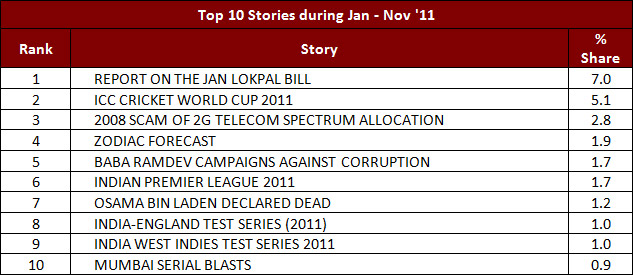
    Anna Hazare got the largest percentage share as far as the news channels go. The other top stories of the year 2011 were Cricket World Cup 2011, 2GScam. Interestingly post these comes Zodiac Forecast, which is two rungs above IPL coverage. Here is a list of top 10 new stories by percentage share:

    Source: Source: News Content Track – A service of TAM Media Research Pvt. Ltd

    Channels: Aaj Tak, CNN IBN, Headlines Today, IBN 7, India TV, NDTV 24/7, NDTV India, Star News, Times Now, News 24 & Zee News
    Period: Jan – Nov, 2011

    Note : Analysis is based on the Telecast duration


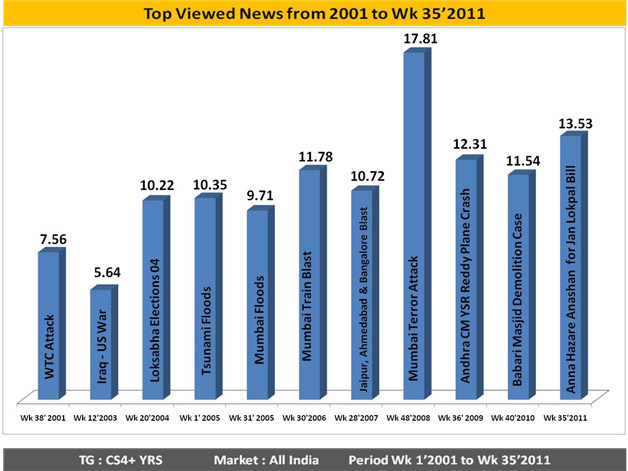
    If one looks at data from 2001, the Lokpal Bill at its peak was the second most watched news in 11 years – second only to the Mumbai Terror Attacks:


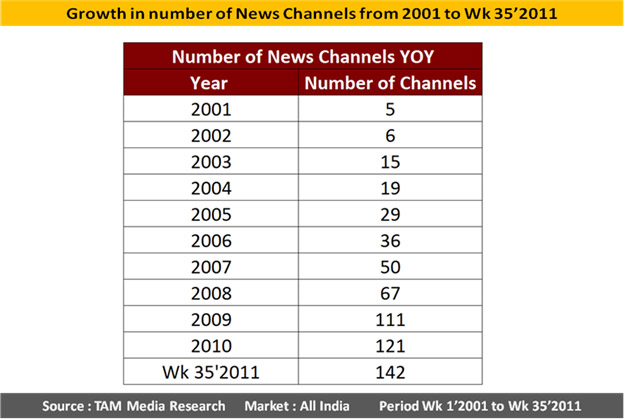
    News, interestingly is the fastest expanding genre with eight new news channels being launched (excluding regional languages) till week 50, 2011: 7 in Hindi and 1 in English.

    Even if on e looks at year on year growth – news is one of the fastest growing genres:

    With the first quarter of 2012 seeing assembly elections including heavyweights like Uttar Pradesh and Punjab – and Lokpal Bill still in the eye of the storm – the share of news channels is expected to grow.

  • Anna’s RSS links and TV’s outrage

    By Ranjona Banerji


    As was expected, the India-Australia Boxing Day Test match has started dominating TV news bulletins. This is not to suggest that Anna Hazare and the anti-corruption movement will be replaced by cricket – shame on me for even hinting at that – but it does mean that TV producers will have to do some juggling.


    However there is a chance that if anything controversial happens on the field, well… This is after all an India-Australia series and judging from a quick peek that I had this morning, the crowds are in…


    Newspapers, of course, do not have the same problems. They have the space and the wisdom gained through reflection and time to pick and choose. Cricket will find its place, as will Hazare and a whole lot of other stuff.


    * * *


    I was fascinated to see that NewsX chose to broadcast Midnight Mass on Christmas Eve live, from various services across India. Equally, to watch the Queen of England’s Christmas message on Al-Jazeera. This could be addressing niche audiences or a refusal to patronise viewers by segmenting them into tight demographic categories as determined by a marketing department.


    * * *


    Nai Duniya carried a story this weekend about Anna Hazare’s links to the RSS with proof of his association with Nanaji Deshmukh and a joint collaboration they did on village affairs. This, naturally enough, outraged TV anchors. Even the NewsX anchor – the channel is affiliated to the newspaper – found that he had to practically interrogate the editor of Nai Duniya on this ‘sacrilegious’ story. Like so many print journalists, the editor was unrepentant and unfazed. His story was not based on allegation but on fact.


    Very oddly, after that – and including in Monday’s papers – the story was presented as a Congress allegation on Hazare and was sourced to a tweet by Hazare-baiter Digvijay Singh.


    Is this journalistic laziness or a reluctance to credit Nai Duniya? After all, whoever looked for Singh’s tweet could just have easily have Googled Nai Duniya!


  • Anil Thakraney: Treating the fan like shit

    By Anil Thakraney


    Everyone’s talking about Rahul Dravid’s speech at the Bradman Oration. It is sharp and insightful. And it proves that the man is not just a great batsman, he’s got a thinking brain when it comes to the sport. Jammy makes many pertinent points about the dangers to cricket, but one that caught my attention was on disrespecting the fan. Quite coincidentally, I had alluded to this in an earlier post.


    Dravid warns that not thinking about the fan is one of the reasons for the fast-diminishing crowds at Indian stadia. And how this portends very badly for the future of the game. He is right, of course, and I believe it’s TV that is busy slaying the goose that lays the golden eggs. Because the BCCI earns almost all its revenues from television rights, they have paid scant attention to the stadia. The last time I made the mistake of going for a one-day match, it turned out to be such an awful experience, I swore never go back, even if someone paid me a whole lot of money to do so. Stinking, dirty toilets. Crowd mismanagement. Shortage of drinking water. Very uncomfortable seats. It was like the organizers were saying to me: “Who asked you to come here, you idiot? Go home and watch.”


    Dravid categorically states that it is no fun for the players either. That it is depressing playing in front of empty stadia. Really hope the BCCI is listening to him and takes urgent measures to sort this out. If they won’t take the rest of us seriously, surely they must pay close attention to what the experienced cricketer has to say. He can’t be wrong.


    [youtube width=”400″ height=”200″]http://www.youtube.com/watch?v=qr4bK63WxXY[/youtube]Here’s the link to Dravid’s speech if you haven’t watched it yet. In addition to his views, the suits must pay attention to his style. Dravid makes very serious points, but he doesn’t bore the audience. Something to learn from here for those who speak at seminars. Boring speakers who never fail to put us to sleep. (One of the main reasons I politely decline invitations to seminars.)


    ***


    PS: Completely wacko ad from BurgerKing,Russia. It’s over-the-top and bizarre, perhaps an indication of the desperation caused by their declining market share. But you have to say one thing: At least they’ve made the burger the hero!


  • ESPN acquires Cricket Australia rights

    By A Correspondent


    ESPN Star Sports has announced a five-year contract for the exclusive rights to broadcast Cricket Australia’s (CA) domestic and home international matches across various platforms including television, internet, mobile and radio, covering the entire Asian region.


    As a part of this deal, the current Future Tours Program (FTP) sees ESPN Star Sports broadcasting more than 191 days of live International cricket action from Australia, which includes 27 test matches, 44 one day internationals and 12 twenty-twenty games.


    This is the first time ever that a broadcast deal with Cricket Australia will give ESPN Star Sports rights to showcase two India series. India is slated to play four Test matches and a tri-series with England as the third team in the 2014-2015 season. This tri-series, featuring India, Australia and England and scheduled right before the ICC World Cup in 2015, is positioned as the ‘Clash of the Titans’. India will visit Australia again for seven one-day internationals and two twenty-twenty matches in the year 2015-2016.


    Over the next five years, all of the leading teams will be visiting Australia. In addition to the Ashes between arch rivals England and Australia in the year 2013-2014 which, based on the current FTP, will see 5 test matches, five ODIs and three twenty-twenty matches; other top cricket nations including South Africa, Pakistan, Sri Lanka, West Indies and New Zealand will tour Australia to test their mettle in the fiercely competitive environment of cricket down under.


    James Sutherland, Chief Executive Officer of Cricket Australia, said, “We are delighted that a telecaster of ESPN Star Sports’ standing and class will be putting Australian cricket in front of many cricket fans.”


    Manu Sawhney, Managing Director, ESPN Star Sports, said, “We are very pleased to announce this partnership with Cricket Australia with whom we share a very strong relationship. Australian Cricket has always been exciting and is played with utmost competitiveness in a super charged atmosphere which makes for every fan’s delight. It is therefore not surprising that it is called the ultimate test for any cricket player”. “This partnership with Cricket Australia is a testament to our commitment to serve our fans with more action packed cricket for years to come, he added.


    In addition to the cricket action, ESS also plans to broadcast Cricket Australia’s domestic cricket over 280 days. This includes popular tournaments such as the KFC Big Bash T20, the four-day Bupa Sheffield Shield tournament and the Ryobi One Day Cup.