Tag: Covid

  • Parle is most chosen brand in India in Kantar’s Brand Footprint 2020 report

    By A Correspondetn


    Last week, Worldpanel Division of Kantar, the leading data, insights and consulting company, released its report, Brand Footprint 2020. The report is an annual ranking of FMCG brands based on the Consumer Reach Points the brands scored in a year. The report is in its 8th edition this year.


    Key findings:

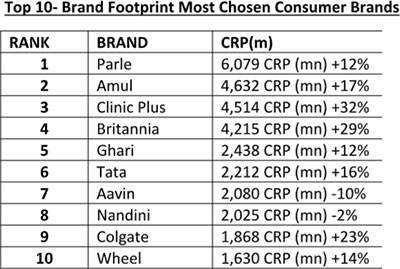
    Scoring the highest CRP (mn) at 6029/ +12% Parle, ranks first followed by Amul at 4,632 CRP (mn)/ +17%, Amul at 4,632 CRP (mn)/ +17%, Clinic Plus at 4,514 CRP (mn)/ +32%, Britannia at 4,215 CRP (mn)/ +29% and Ghari at 2,438 CRP (mn)/ +12%

    Five new brands joined the Billion CRP Club this year Dabur, Vim, Sunfeast, Brooke Bond & Patanjali. 21 brands made it to this group in 2019 compared to 16 in both 2018 and 2017.

    Over 2/3rd of the top 50 brands are Indian Origin brands (36) while global stands at 14.

    Global brands (29 %) show 1.8x growth compared to Indian Origin brands (16%). Global brands are growing almost twice as fast at 29% compared to Indian Origin brands at 16%.

    Consumers make significantly more choices this year leading to a significantly better CRP performance by brands- 57 % brands record growing CRPs.

    Bigger brands find better growth and follow the Golden Rule, brands grow faster by growing penetration

    Colgate stands at the highest penetrated brand at 88%

    Surf excel remains marks a consistent CRP growth rate at +20% scoring 1566 mn CRP.

    58 brands saw a penetration gain of 1% or more. Leading the category is Ponds at 5.8% followed by Harpic (4.8%), Comfort (4.5%). 1% penetration gain adds an extra 2.9mn shoppers to the brand.

    In the foods category Britannia clearly charts out a success story as the 2nd most chosen brand, 7th highest penetrated brand with a household penetration at 67.6%. While Aashirvaad saw a surge with 4% penetration increase and +55% CRP growth.

    Within homecare surf excel marks +48% CRP growth while recording +3.4% penetration increase, closely followed by Vim at +44% CRP growth and +3.2% penetration.

    Dabur comes out strong in the personal care & foods category with +34% CRP growth, making it the 5th most chosen beauty & health brand in India with a 70.0% household penetration.


    Impact of Covid-19:

    Food & Beverage brands get picked up more often except Parle and Tata due to drop in frequency. For example, Amul is chosen over 100,000 additional times during the COVID months of March-May.

    While personal and home care brands drop CRPs

    Despite CRPs, trip size increases causing top brands to grow volume


    Said K Ramakrishnan, MD- South Asia, Worldpanel Division, Kantar: “Consumer Reach Points are a great way to measure and rank brands as it is a measure of the number of opportunities a brand has, to interact with a consumer. It is great to see consistent validation for the fact that if you build penetration, frequency and growth follow. This has really been a year of global brands in terms of their higher growth than others. Like these, this year’s report has a lot of interesting nuggets to derive a lot of information and insights on top the behaviour of consumers towards brands in the last year.”
     

  • Das ka Dum with Dr Bhaskar Das | The first half of 2020 will be past us in a few days. Your sentiments as we move over to the second?

    Bhaskar DasIt’s an unfair question to ask, coz who could predict at the start of the year that 2020 which will be such a @#$#@$% year (the number of characters in the prefix to year is no indicator of the word we wanted to use, so chill!)?!. But we are incorrigible. We ask. And our dear Wizard with Word is such a sport, he answers. So without any further ado, presenting the June 26 edition of Das ka Dum with Dr Bhaskar Da. Read on…

     

    If you wish to access the archives, please go to the Das Ka Dum tab on the website’s top navigation bar.


    Q. The first half of 2020 will be past us in a few days. Your sentiments as we move over to the second?


    A. I am usually not a believer (or expert) in prescriptive pontification. It’s a reality that the economy is under stress across sectors. The demand side of each business is undergoing challenges at multiple levels. Though the process of selective unlockdown has started, the recovery process would take at least one more quarter, if not more. But the collective grief of loss of normalcy and the prevailing uncertainty in various facets of life would take time to bounce back. Hence I feel the second half would be better than the first. But it may not reach the pre-Covid level soon. Some sectors like IT/ tech-led sectors would grow very well, ‘need’ categories would also perform well but ‘ want’ categories would might return to normalcy, a tad slowly.

  • Post-Covid Challenges: Hindi GECs will be Tested


    By Shailesh Kapoor


    The pandemic is still all around us. Fatigued from a long, early lockdown, and facing dire economic consequences, India has begun to open up slowly. But we are nowhere close to “normal”. Not even close to the “new normal”, an oft-bandied phrase that means different things to different people.


     

    The entertainment sector is preparing to take small steps towards normalcy. Shooting of TV serials has started in some markets, and others will follow in July perhaps. It will not be the usually bustling, chaotic shoots that we are so used to. With limited resources at hand, the frills and the overheads will be cut out. This may pave way for cost-saving ideas in the long run. But that’s another topic for another day.


    There’s a lot of talk of how post-Covid media consumption in India (and the world) will look like. I wrote about prevailing “lockdown myths” in May, expressing my view that fundamental change in habits is not as easy as many are suggesting. But much as habits won’t change, the lockdown has created a break in them, which allows for disruption, offering opportunities in particular for weaker TV channels to come back stronger than before, and challenge the leaders. Of course, that is easier said than done, especially in categories like Hindi GEC, which have their own share of problems.


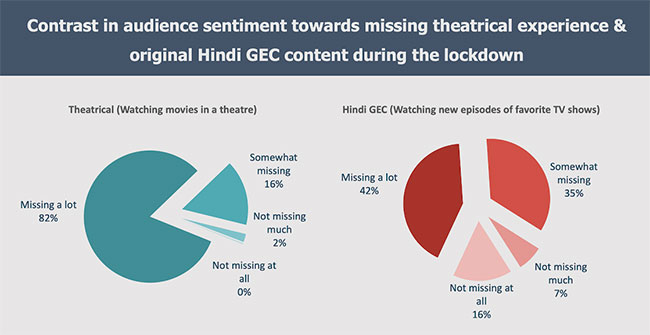
    When Ormax Media released the findings of its research (see chart above) stating that the Hindi GEC audience are missing original episodes of their favourite serials a lot less than they should, the reactions from those involved ranged from scepticism to outright denial. Unfortunately, one can’t even say the reactions were surprising.


    Using ratings to predict audience sentiment has been an age-old fallacy in the TV industry. We saw that back in 2006-2008, when the growing audience resentment towards the ‘K-serials’ was met with a standard “but they rate so well” response. It took the launch of Colors in 2008 to prove that a sentiment just needs a good catalyst to convert into behaviour.


    Even though news and movies have made inroads into primetime family viewing during the lockdown (as indeed over the last 3-4 years too), it is safe to say that GEC content will remain the staple primetime diet of a very large section of the universe. But what the chart above tells us is that a sizeable proportion of this large section is not giving the Hindi GEC category (the results will be different and significantly better for regional GEC categories) the love it should get. The relationship between Hindi GEC content and the viewer is now less emotional and more ephemeral in nature.


    Some say this could be simply a function of the times that we live in, where attention spans have gotten shorter, distractions have increased, and concepts like loyalty and appointment viewership are things of the past. But there are multiple reasons to disagree with that line of thinking. For one, the regional categories are faring much better. Secondly, if distraction and clutter was the driving force, it should have reflected in a geographic skew. But that’s not the case. The metros, the mini-metros and the small-towns all perform equally poorly on the question asked for the chart above.


    Will there be post-Covid viewership attrition for Hindi GECs? A drop of more than 5-10% compared to pre-Covid times is unlikely in the near future. But the ground cannot be more fertile for one of the top players to sow the seeds of long-pending category evolution.


    Streaming will not take away TV audience. But certain TV channels and genres have enough other competition on TV itself to contend with anyway.


  • Facebook-BCG report on new path-to-purchase

    FB-BCG Guidance bo Brands based on Report Findings


    By A Correspondent


    Facebook India in association with Boston Consulting Group has released a report titled ‘Turn the Tide’ that focuses on how Covid-19 has dramatically changed consumer behaviour and altered the path-to-purchase. The report also shares actionable guidance for brands to build for the new consumer journeys in times of Covid -19 and beyond.


    Sandeep Bhushan

    Said Sandeep Bhushan, Director and Head, Global Marketing Solutions, Facebook India: “As business after business joins the dots to understand consumer shifts in both mindsets and behaviours as a result of COVID-19, we have invested in studying the new paths to purchase in continuing our commitment to enabling growth for businesses both large and small. The ‘Turn the Tide’ report outlines the opportunities that businesses need to embrace in the context of new consumer journeys and category needs. In response to consumers embracing the digital medium, brands need to focus on solutions that are relevant for the new normal such as hyper-localization, creating virtual experiences, re-looking at the media-mix to build efficiency, or building messaging around new habits such as DIY and the increased focus on health and hygiene.”


    Facebook and Boston Consulting Group are also expected to share vertical-specific insights to help businesses gain almost real-time insights, enabling them to ‘Turn the Tide’.


    The report delves into key consumer-shifts based on three societal-truths that have emerged as a result of the pandemic – social distancing, increasing focus on health and hygiene, and increasing income uncertainty. Within each of these shifts, the report finds that there are three kinds of behavior change movements that are being observed – reversal of past trends, acceleration of existing trends, and formation of new habits.


    Nimisha Jain

    Added Nimisha Jain, Managing Director and Partner, Boston Consulting Group: “We are experiencing unprecedented shifts in consumer attitudes and behaviors – 80%+ consumers will continue to practice social distancing and are bringing the outside inside, over 40% of consumers are dialing up on health and wellness spends, e-commerce adoption has already advanced by 2-3 years – to name a few. These aren’t just temporary surges, and many will last longer and become more defining traits. Our analysis reveals that only one in six companies emerged stronger in past crises – players who show the agility to reinvent their value propositions, go-to-market plans and business models to address these demand shifts will be the ones that set themselves apart from the pack”


    The reports especially calls out the massive acceleration in digital led by social media, the emergence of micro-market opportunities, an increase in value consciousness leading to more utility-led shopping, consumers embracing digital even in historically offline categories such as education, health, and fitness, the increase in spend on e-commerce in the coming months even for traditionally offline categories, a definite increase in spends on health, hygiene and wellness, and a rise in do-it-yourself (DIY) trends.


    Executive Summary of Turn The Tide report

    The COVID-19 outbreak has proven to be a global pandemic of an unprecedented scale impacting people, communities, and businesses across nations. In India, as with the rest of the world, the first few weeks of the lockdown saw the industry in a wave of panic and uncertainty as the disruption in business continuity threatened to potentially destabilize the economy.


    Facebook has always been committed to developing and sharing industry-leading full-funnel solutions for brands across all categories. As India opens up to limited business activity, this joint collaboration with the Boston Consulting Group  – a consumer sentiment survey, titled  ‘Turn the Tide’ – aims to serve as a reference point on consumer insights, trends, and guidance for the industry, brands, and agencies as they begin to negotiate the commencement of operations.


    What’s different about this report is that it’s not just a research study but that it also provides actionable guidance that brands can deploy right away. It brings together the expertise of BCG’s deep insights and years of consulting experience with Facebook’s experience across thousands of campaigns run on its platforms.


    Covid-19 has impacted lives in 3 big ways:

    :: Social Distancing

    :: Health & Hygiene

    :: Income Uncertainty


    Key points:

    :: Consumer journey has altered; brands need to urgently identify opportunities to build for new consumer journeys.

    :: COVID-19 has fueled the digital medium in an unprecedented manner. Some of these consumer trends are here to stay.

    :: Brands are already leveraging social media platforms to build for the new consumer journeys.


    Consumer Behavior has fundamentally changed: Emerging Trends (11 Uber themes)

    A. Reversal of Past Trends

    1. Bringing the outside inside: 79% people are not going out of house, except work

    2. Trust in Brand above all else: 63% people are paying more attention to origin of product

    3. Trading Down and Bargain Hunting: 43% people are expecting decrease in overall spend in next 6 months

    4. Shopping for Utility: Purchase triggers expected to become more “functional”


    B. Acceleration of Existing Trends

    1. Embracing digital services & experiences: 51% consumers saw an increase in payment via digital wallets

    2. Accelerated adoption of e-commerce and O2O: 50% of all consumers expect to increase e-commerce spend in next 1 month

    3. Strive for Health & Wellness: +40% may increase spend on Health and Wellness

    4. Rise of Smart Shoppers: Informed purchase decision; High salience of digital research


    C. New Habits:

    1. Remote way of living: The new normal

    2. Do It Yourself: Spike in new hobbies and habits

    3. Superior Hygiene and Clean Living: 91% Indian households washing hands more often


  • TBWA collaborates with CRY for Covid-19 relief efforts

    By A Correspondent


    As the lockdown continues and India battles with its biggest healthcare crisis, life has come to a standstill for thousands of economically disadvantaged families and their children. TBWA\India confronted this problem in a webinar by teaching the Art of Conscious Disruption, the philosophy behind all its creative work.


    An online session titled ‘Disruption and the art of seeing differently’ was hosted by CRY and conducted by Parixit Bhattacharya, Managing Partner – Creative of TBWA\India and Krishnan Subramanian, its Chief Strategy Officer.


    Commenting on the initiative, Bhattacharya said: “While it seems like our hands are tied and donation drives start to lose steam, it is crucial to figure out an equal exchange. Something that will add value to individuals while making them want to donate to the cause of Covid relief.”


    Added Subramanian: “At the core of this initiative was our desire to give netizens the tools to create something good for people and society, while supporting CRY’s Covid Relief measures which attempts to help 1.76 lakh households and children by providing them with ration and health kits.”


    Said Puja Marwaha, CEO of CRY:  “Solutions to stubborn problems, like child marriage and school dropout, need simple yet disruptive ideas. We are deeply grateful to TBWA India for this session which doubled up as a fund raiser for CRY and we found the session immensely helpful not just from an advertising lens but also for social workers, teachers, parents and children themselves.”