Tag: Coronavirus

  • Shruti Pushkarna: Is Coronavirus also inflicting some life lessons at us?

    Shruti PushkarnaBy Shruti Pushkarna


    It’s been a month since the Indian government announced the official lockdown to prevent the spread of Covid-19. People’s daily conversations now include casual mentions of a pre- and a post-corona world. We are slowly becoming accustomed to a ‘new normal’. It seems that nature has hit the ‘pause’ button on all our plans.


    I’m reminded of my grandfather’s favourite phrase, “Man proposes, God disposes”. Never have those words rung so loud in my ears.


    Negative sentiments are on the rise, as every news item seems to bring us closer to doomsday. Of course with the exception of promising research and recovering numbers.


    It’s a good idea to take a break from the tragic reality enveloping us 24×7. In fact some media platforms are going out of their way to cull out positive stories and courageous, inspiring accounts.


    It might sound strange but coronavirus is not all bad news. In the past few weeks, we’ve witnessed unified action, individual contributions and immense perseverance to fight a crisis, collectively.


    In the non-profit sector, we’ve seen organisations and individuals come together to ease the challenges faced by vulnerable communities. People are stepping out of their committed areas of work, some even outside of their comfort zones, venturing into unchartered territory. All to help resolve immediate challenges of those trapped in different parts of the country.


    This is also a ‘coronavirus effect’, but one which is heartwarming. Chasing government representatives and influential individuals, groups of NGOs are working tirelessly towards ensuring that essentials are delivered to the poor, old, disabled, and the desolate.


    In Delhi, Mumbai, Pune, Bengaluru, Chennai and several other cities, volunteer groups are running services for those in need. Individuals from the non-profit sector might have set these up, but people across the board have pitched in. These include delivery services for ration, medicines, other essentials, taxi services for the disabled and so on.


    As in the past times of crises, several people have stepped forward to donate. Messages are being circulated in the media as well, asking for help both in cash and kind.


    What’s amazing in the current scenario is that people across the country are also volunteering their time to help another. This should give us hope.


    For several people who might be feeling trapped in their homes, this is an opportunity to devote time and effort to government and non-government agencies in addressing the needs of every citizen.


    As part of the work at the NGO I am associated with, recently we put out a message, seeking volunteers to handle calls from disabled people in states where our helpline is not active. The response was immediate and impressive. Without even a clear understanding of the work expected, individuals were willing to offer support. We were flooded with calls and emails from people eager to contribute in any form.


    In a country like India where resources are scarce, it becomes pertinent to channelise them to areas and people with a greater need. And human chains of communication work well with identifying the ground level requirements and prioritising services to those sections or communities.


    So far, I’d say that the NGO model of collaboration is not only working well for those benefiting from it, but indirectly inspiring thousands of others to join hands to contribute outside their proximate environment.


    Once the lockdown eases up and we get sucked back into our daily routines, the memory of these past months will fade away. However, the lessons we learn from these ‘hard times’ will stay with us forever.


    A lot of us are already talking about things we would do differently post-corona, or things we won’t forget from this experience et cetera, but how about each one of us identifies and holds on to at least one such thing. Almost like a New Year resolution, except this might be termed a ‘New World’ resolution.


    Well my biggest takeaway is what seems overwhelming individually, is easily handled communally.


    So what’s your Covid-19 learning?


    Shruti Pushkarna is a former journalist (part of the founding team of MxMIndia) who has now moved full-time to the social sector. She heads operations of the New Delhi-based Score Foundation where she works as Director-Programmes & Communications. She writes for MxMIndia every other Thursday. Her views here are personal. She can be reached via Twitter at @shrutipushkarna



  • Taboola report highlights readership gains made by media firms

    By A Correspondent


    Taboola, the discovery platform has released findings of its ‘Moments of Next’ research series with Nielsen. The findings reveal the shift in online news readership and content consumption pattern of consumers as it relates to Covid-19.


    Larger online audiences on publisher news sites:

    Since the WHO declared coronavirus a pandemic, Taboola readership data shows that news publishers have seen an uptick in traffic and engagement with content across the board, including an 8 per cent increase in unique readers, 14 per cent increase in page views and 25 per cent increase in time on page.


    News readership spikes in different categories:

    Globally, when looking at news readership over the past two weeks compared to the previous 10 weeks, we found large increases in the amount of time spent reading in Local news (63 per cent), Government and politics (62 per cent), Business (59 per cent), Technology (46 per cent), Lifestyle (31 per cent), Entertainment (18 per cent), Gaming (11 per cent)


    Consumers open to ads, as long as ads appear on trusted sources:

    In a new survey of 1,000 people about what they trust more in times of coronavirus, 4x more people trust advertisements on news sites compared to ads on social media websites.


    Consumers are more open to ads in certain mindsets:

    In general, the top moments where people admit to being open to information, including advertisements (their ‘Moment of Next’) are:

    Before going to sleep (31 per cent)

    Taking a break from work (17.5 per cent)

    In the bathroom (16 per cent)


  • Nissan invites all to #DrawDrawDraw

    By A Correspondent


    It all starts with a single line. That is the message from Nissan’s global design team as it looks to connect a worldwide community of artists through the new #DrawDrawDraw social project.


    Nissan is offering 23 newly created, downloadable colouring pages featuring Nissan classic cars, current models and futuristic concepts. Nissan designers from around the world created the pages over the last few weeks, a time during which many people have been staying home because of the global coronavirus pandemic.


    Said Alfonso Albaisa, Nissan’s senior vice president for global design: “To draw, draw, draw, in our world, is one of the best ways to close the gap between wonderful creative impulses in your head and making it a reality – especially as we face this global pandemic together. Our team of designers, worldwide, are using this time to breathe, to draw, to dream creatively. I know that some of their best work will come from the challenges that we’re facing now. So we thought, ‘Why not give everyone a chance to express themselves creatively and share it with those who will appreciate it?’”


  • Mumbai Press Club urges Maharashtra CM to protect journos covering Covid-19

    By A Correspondent


    With the Covid-19 situation in Maharashtra showing no signs of abating, the focus is now on journos who are facing the heat in the line of duty. After a record spike in number of journalists testing positive for Covid-19, the Mumbai Press Club has reached out to the Chief Minister of Maharashtra Uddhav Thackeray, urging him to protect them with several measures.


    The Mumbai Press Club has written a letter to the CM, the full text of which is reproduced below:


    Dear Uddhavji Thackeray,


    It is with dismay and shock that we have learnt that as many as 53 Mumbai-based journalists, many of whom are our members, have tested positive for the Covid-19 virus. The tests were carried out at a special camp held by the BMC for 171 journalists working in the field. Most of the journalists – photo journalists, video journalists and reporters – are fortunately asymptomatic and have been quarantined and being looked after by the BMC health authorities.


    It must be pointed out that as Mumbai City locked down to face the challenge of the Coronavirus, these field journalists even today continue to stand by their duty, filing their reports, taking photographs and recording videos in the most hazardous locations.


    Most media houses have shut their offices and have not provided any protective gear, or special insurance to these frontline personnel. However, they continue to demand reports and visuals and expect the journalists to move around the city risking life and limb.


    In these circumstances, the Mumbai Press Club had taken some initiative to provide some logistical support as well as accident insurance, etc. but that is not enough.


    As can be seen, the pandemic shows no signs of dying away, and journalists are forced to continue to work to provide news and information to the public. While some of us have the privilege of working from home, many journalists have still to venture out in hazardous zones and common spaces, and require immediate protection.


    As journalists and news media are declared as ‘essential services’ we request you to take the following immediate steps to safeguard our lives and profession:


    1. Ensure that all media companies immediately provide proper transport, safety equipment and sanitized space to work. Where it is not possible for the media companies to provide the above, the state government should ensure necessary personal protective equipment (PPE) and sanitized space to those venturing in the field.


    2. To provide immediate testing facilities for all journalists who are suspecting symptoms, or who have been in proximity of colleagues who have tested positive. There should be no time lost in this, and the testing location must be a captive facility without crowding and only for journalists.


    3. The state government has been providing special insurance cover for all emergency and essential category of workers who are tackling the coronavirus pandemic for the sum of Rs 50 lakh. Since journalists are performing an ‘essential service’, it is requested that the category of working journalists be brought under the same umbrella with cover of Rs 50 lakh and provided the protection of an essential worker.


  • As Society Changes, Will Your Marketing Plan Change Too?


    By Brian Wieser


    KEY TAKEAWAYS

    We review changes relevant to marketers that will occur as the coronavirus crisis evolves. We specifically consider new ways consumers will spend time, how they will change media consumption and how B2B marketing will evolve.

    In assessing the behavioral changes following from the current crisis that will impact marketing, we must lay out our assumptions regarding the path forward for the virus and societies around the world alongside our expectations for the evolution of the economy.

    In general, we can assume that while containment efforts will generally be successful in most countries and that the phase of the crisis involving country-wide formal lockdowns will come to an end, risks of further outbreaks will persist until a vaccine is both discovered and widely distributed.  As a result, while there will be a gradual and at least partial resumption of many pre-crisis behaviors over the course of the next year, a complete return of old social patterns will not occur any time soon.  Because of the sudden shut-down and related disruptions in economic activity, we can also assume the economy is likely weak for the foreseeable future, with a disproportionate impact on workers in retail and hospitality sectors who tend to be lower income.  Any concentration of negative outcomes among certain groups of people could exacerbate existing trends, which could play out in public policies related to populism, global trade and taxation among other issues.

    For all of these reasons, it is reasonable to assume that some behaviours will permanently shift because of the time people will have had to get used to new patterns and because of the new products and services that will evolve to meet changing needs between now and then.   From here, with an eye toward identifying the behavioural changes from societies under lockdown, the changes that will follow as society gradually opens up and the changes that will follow once a vaccine is widely distributed, are worth noting.

    Following from these assumptions, in the remainder of this note we consider three general groups of behaviours relevant to marketers, including ways consumers will spend their time and money, how their media consumption patterns will change and how work – which impacts B2B marketing in particular – will evolve over time.


    HOW WILL THE WAYS IN WHICH CONSUMERS SPEND TIME CHANGE?

    Behaviour Description
    Spending on being at-home vs. away-from-home Consumers will alter their mix of spending where choices involve avoiding leaving the home or not and could involve trade-offs of services for products. While some people may initially look to reconnect with distant family, most will presumably spend less on vacations. Consumers may choose to spend more on home improvement or expensive home-based products (backyard jungle gyms or staycations, for examples).
    Physical proximity to large vs. small numbers of other people Going to see live sports or live events won’t be an option if venues are closed and large crowds are not allowed to congregate; however, even going out to large venues – such as clubs, bars and restaurants or sports-related environments – may be out-of-favour even where it is allowed. Socialising may become home-based or more focused on smaller groups.People could become less focused on conspicuous consumption of certain luxury goods, but could consume different ones, such as wines or lipsticks especially where they are objectively superior or personally preferred products.
    Changes in time allocations beyond media Home-based hobbies will expand.
    Other social preferences Owning your “space” takes on new importance. “Rental economy” companies such as Zipcar, VRBO, WeWork will require a mix of reinvention and repositioning or may be negatively impacted.  Additionally, many companies are realising that more physical space is not necessary to accomplish their business goals, which may have additional consequences at a social level
    E-Commerce purchasing habits E-Commerce growth accelerates, especially within certain categories and for certain people where penetration rates were previously low (groceries, older people).


    HOW WILL MEDIA CONSUMPTION CHANGE?

    Behaviour Description
    Video consumption More at-home video-based entertainment will be consumed, although there is risk of screen “fatigue” prompting consumers to look for different types of media exposure.With Hollywood/professional content production in question, more potential for viral content (virtually produced).

    AVOD probably becomes bigger because of appealing value proposition.

    Outdoor advertising consumption There will be fewer opportunities to reach consumers with OOH ad products until normal social patterns return, although advertising could very well be more impactful if there is less clutter.Different places may become differently valuable: for example, pharmacies or places where essential workers travel may become much more valuable on a relative basis
    Event marketing Event marketing falls off or needs to get reinvented.Virtual / home-based experiences explode in importance.
    Audio consumption Audio platform consumption patterns will change and to the extent that audio associated with commuting, it will probably fall.  On the other hand, some of these providers will evolve to produce content that is more desirable to consumers while at home.  To illustrate: consider that if podcasts were primarily consumed by commuters, can they evolve to be consumed by people at home?
    Digital media consumption Breadth of users of platforms might expand along with depth; niche digital platforms probably widen their audiences if more free time causes more people to experiment.Video game usage explodes.
    Other activities New activities could redefine media (gardening, cooking, DIY) and could have new media assets attached to them.

    HOW WILL B2B MARKETING CHANGE?

    Behaviour Description
    Influencing sales / senior decision-makers and managing ongoing relationships Sales and service involves fewer in-person meetings. More is accomplished via webinars, digital platforms, white papers.  Historical relationships may be worth more than before.Senior managers / influencers / decision-makers may spend more or less time managing than before, which alters how they prioritise their time.  Those managers will likely spend more time interacting with distributed teams, and degree to which those teams influence decisions may also change.

    Sales efforts could become more objective (less subject to casual lobbying by salespeople or internal constituents).

    B2B vs. B2C orientation / disintermediation B2B businesses looking to avoid retail disruption in the future will invest more in B2C / DTC wherever possible.

    Opportunities to disrupt supply chains (i.e. movie studios “breaking” the windows) will emerge.


    Societal changes seem highly likely to occur as a consequence of the current crisis, and consumers will change the ways they interact with people and brands for the foreseeable future.  While many behaviours will revert to historical patterns once a vaccine is discovered and distributed, there will be many that will become permanent.  Brands have opportunities in the interim to find new ways to become relevant or maintain relevance.  They will also be able to find new ways to be tangibly helpful as consumers adapt to the new behaviours they will adopt.  Planning for those opportunities now will help brands drive growth in the future as economies eventually and inevitably improve.


    Brian Wieser is Global President, Business Intelligence, GroupM. Republished from https://www.groupm.com/changes-following-the-crisis/


  • AAAI reaches out to government for business continuity

    By A Correspondent


    Everyone has been witnessing with growing alarm the spread of the coronavirus across the globe and in India. Our Country has been on a lockdown for a few weeks now and Governments, both Central and the States, have taken many effective steps to reduce the impact of this pandemic.


    But all this is coming at a huge economic cost. The Advertising Agency business, like many other businesses have been seriously affected. The bulk of the agency’s costs are fixed in nature, be it Salaries, Rent, Electricity, Communication, Upkeep, Media Audience measurement reports, etc. The income and cash flow has been in serious stress in the last month and unless there is some intervention, many businesses will either file for bankruptcy or will have to undersize considerably.


    Ashish Bhasin

    While the Indian Newspapers Society and Indian Broadcasting Federation, the media associations representing the interest of print and television edia respectively, have permitted AAAI members to pay monies they have collected from their clients and not insist on what is due to them on the due dates, the continuity of the agency business cannot be for long without the help of the Government of India, note a commuique from the Advertising Agencies Association of India. In this regard, Ashish Bhasin, President of AAAI, has sent a detailed set of recommendations on behalf of the members of AAAI to the Union Minister of Information & Broadcasting Prakash Javadekar. In this he has stressed the importance of advertising industry for the accelerated revival of the economy.


    “What we have asked the Government is very reasonable. We want principally money that is owed to us by way of IT & GST refunds, and dues from Government and PSUs for our advertising bills to be settled immediately. We have also said that any payment made to us should not suffer any TDS deduction going forward, since there is unlikely to be any significant profit for the year. Further we have sought a direction to banks and our debtors that they provide the much needed cashflow to pay salaries and meet other essential expenses, etc,” said Bhasin, adding: “These do not lead to any revenue loss to the Government. They just need to show a kind heart. The timely help they will provide actually is the help they are providing to the people of India, since advertising is a critical input that can provide a ripple effect in reviving many sectors of the economy.”


    One other recommendation made is to treat advertising expenses as an investment and have this cost amortised over the next three years. AAAI believes this will encourage larger advertising outlay which will help revive the economy faster. In the same vein, AAAI also suggested that advertising expenses could be given weighted deduction while computing taxes. The suggestion was that every Rs 100 spent on advertising, should be treated as Rs 200, while computing the taxable income.


  • Music Broadcast Ltd ranks amongst the Best Workplaces in Asia

    By A Correspondent


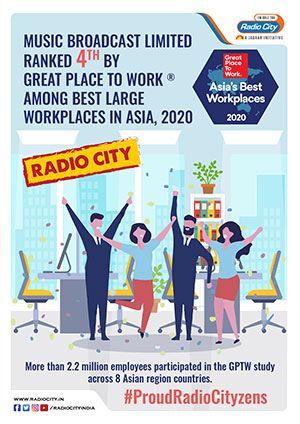
    As per the Great Place to Work, a chronicler of workplace culture, Music Broadcast Limited ranks fourth on the 2020 Best Workplaces in Asia list.
     

    The ranking of Asia’s Best Workplaces is based on data collected prior to the Coronavirus outbreak.


    Said Apurva Purohit, President, Jagran Prakashan Limited: ”We are elated to yet again feature as Best Workplaces in Asia. As a company, our endeavor is to build an environment that encourages employee growth and organization productivity. Our ranking in Asia’s Top 5 Best companies to work for, is a testimony of our culture that promotes diversity, work life balance and collaborative approach.”


  • Does the Current Crisis call for Greater Social Responsibility?


    By Shruti Pushkarna


    Shruti PushkarnaI must confess I was struggling to write this column as I didn’t want to add to the several critiques circling around on the internet. If anything I wanted to share something positive. But keeping a close watch on the ground situation vis-a-vis persons with disabilities during the Covid-19 crisis, it’s hard to dish out a cheerful piece.


    Locked up in their homes, some people are busy forwarding irrational WhatsApp messages, propagating panic via unreliable information. Some are busy competing for a bigger Instagram audience through culinary exhibits or workout videos. And then there are some who simply sit and criticise the ‘other’, including administration, media, politicians, other countries, liberals, bhakts, Muslims, Christians, their next door neighbors and possibly even their pets!


    While a person might be struggling to stay alive because of a chronic condition in the absence of a caretaker to assist her or him due to the lockdown, another’s problems hover around having to do dishes or cook their own food.


    People are oblivious to each other’s realities. Even at a point of being universally hit by coronavirus, we only care for ourselves or at most our immediate family. That’s how selfish we all are. We don’t pay heed to what’s happening to a daily wager, a blind hawker, a disabled orphan, a thalassaemia patient, a paraplegic or anyone who’s more vulnerable than us.


    I want to appeal to the media fraternity to spread awareness and help citizens of India gain some perspective into what another human being could be experiencing at the same time in an alternate reality. Except this one’s not fictional.


    There is a need to report stories from across the spectrum. Not just the ones that make for an ‘OMG’ moment, not just the shortlived coverage of immigrants’ mass exodus, but day-to-day accounts of those who get beaten up standing in lines for ration, of disabled people who’ve been abandoned by their institutions, unwilling to take responsibility. Of siblings shunning away their disabled brothers and sisters, of persons with severe disabilities losing out on (an already meagre) means of living.


    I work for a non-profit which runs a helpline for persons with vision impairment and we’ve been getting calls from all parts of India. Callers are citing challenges in getting medicines, milk, groceries, or getting curfew passes issued for their caretakers. People with other disabilities are reporting similar challenges, some are even unable to communicate to the cops stationed in different cities that their condition makes visits to hospital pertinent for survival despite the lockdown.


    Not that desperate stories from various strata of society aren’t making news but when we speak of a section that is anyway marginalised and faceless, one can imagine how grave their situation is and thus the need for greater emphasis.


    Statistics and graphics, updated every few minutes are being shoved at us, highlighting the rising impact of the pandemic. Is this a cricket match that people are tuning in to keep a tab on the latest score? Why do we have so many debates on whether we are in Stage 1, 2 or 3? How about asking some tough questions on how differently should we as a country be prepared for the various stages? What will happen to the weaker sections of the population under different circumstances and imposed measures?


    Governments have asked for essential items to be distributed for free to those in need. But no proper procedure has been spelt out. While some places are generously handing out material, others are insisting on a ration card. In the absence of one, people are being asked to apply for it online. What is stopping the media from questioning the administration on how is a disabled person with no smartphone or internet access, expected to apply and produce a ration card in order to get some atta, dal, chawal?


    Guidelines have been issued by both central and state authorities for relaxations in the case of disabled population, but the implementation is as usual shoddy given the utter lack of understanding and empathy.


    I’m hoping the media can draw attention to such issues being faced by the disabled. Not with the objective of dissing the authorities or the cops or the healthcare workers. But with an intent to help them understand closely what needs to be amended and endorsed.


    A list of national and state helplines has been circulated by the government but most numbers are often engaged. Now this is expected because of the fear among people and a lack of resources to handle a problem of such magnitude. We need to think of alternatives. NGOs are putting out their numbers (some even sharing their personal mobiles) as a response mechanism for various communities. If the media widely circulates these resources, a larger population could benefit.


    Community efforts need to be backed up by state and national media so we can all join hands in lessening the chaos. These unusual times call for extraordinary efforts from each one of us, whether we are a part of the government, healthcare industry, media, social welfare system or civil society.


    Shruti Pushkarna is a former journalist (part of the founding team of MxMIndia) who has now moved full-time to the social sector. She heads operations of the New Delhi-based Score Foundation where she works as Director-Programmes & Communications. She writes for MxMIndia every other Thursday. Her views here are personal. She can be reached via Twitter at @shrutipushkarna


  • Kantar publishes Covid-19 Barometer report

    By A Correspondent


    Kantar has released a new study that understands urban India’s sentiments, behaviours and expectations from brands during the Covid-19 pandemic.


    As consumer behaviour shifts dramatically and an anxious India waits it out, the new study provides brand owners the answers to burning questions like:


    What are people thinking, their major concerns, fears and expectations

    How the current crisis is impacting purchase behaviour

    Implications for brands and marketing


    In the wake of the pandemic, urban India emerges deeply anxious with a strong need for reassurance and stabilization. Some highlights of the study are:


    Urban India sentiments and behaviour

    Despite a significantly lower number of cases and death toll compared to many nations, India has a high score on the concern index at 57 per cent

    Day-to-day disruption bothers India more (69 per cent) when compared to

    Health concerns (48 per cent)

    Economic recession (18 per cent)

    Financial preparedness of the nation (47 per cent)

    Standing at 54 per cent, India supersedes the global average of 34 per cent when it comes to expecting speedy recovery

    We are optimistic attitudinally, but behaviours are contrary. Driven by high concerns for scarcity (51 per cent) India is stocking up for worse; mainly essentials

    Going by the current scenario, shared mobility is likely to take a hit – the numbers are heavily skewed towards a complete stop on usage of public transport (55 per cent), taxis/ride hailing apps (35 per cent), domestic air travel (58 per cent), domestic railway travel (57 per cent) as opposed to private vehicles (17 per cent)


    Expectations of brands


    A “New Normal” is gradually forming  If you don’t build desire, we will learn to live with less indicates the Kantar study.


    Brands are expected to be a trusted source of accurate information (28 per cent)

    Consumers don’t want brands to stop advertising and it must not be exploitative

    71 per cent believe coronavirus must not be exploited to promote a brand

    Brands must show how they can be helpful in the new everyday life (79 per cent)

    Inform about their efforts to face the situation (77 per cent)

    Offer a positive perspective (74 per cent)


    Kantar’s Covid-19 Barometer India study was conducted among 1100+ sample across 19 cities and 15 states. The respondents are 18+ years men and women and belongs to NCCS A and B. The data collection was done through March 19-22.


  • Harkness Screens joins fight against Covid-19

    By A Correspondent


    Harkness Screens has announced that it would be starting a number of research and development projects into ways that they could support healthcare workers, social care workers and key workers; thereby using their unique skills and broad geographical footprint. With factories in the United States, UK, France, India and China, the effects of the Coronavirus have been felt by all branches of the Harkness tree, notes a communique.


    Said Mark Ashcroft, CEO of Harkness Screens: “For us, this pandemic could be felt at the tail end of last year when the onset of it in China meant that our factory remained closed from Chinese New Year to the end of March. As a result, when Covid-19 reached the other regions we operate in, we knew what to expect and were proactive in thinking of new ways to help. Our team across the world have been collaborating to think of products that could help those on the frontline. I have seen images of medical staff at drive through testing centres in the USA and UK wearing aprons that are made from a material no thicker than that of a plastic bag you can get from a grocery store. They blow in the wind easily and expose people putting themselves in danger of contracting the disease. These heavy-duty aprons made out of PVC would sit far stiller and would take much more than a breeze to disrupt them. We truly believe that we can help those on the frontline at the moment and hope that people take us up on our sincere offer to provide assistance in these unprecedented times.”


  • NBA expresses concern over threat faced by news reporters (+MxM View)

    By A Correspondent


    The News Broadcasters Association (NBA) has raised concerns on the tendency among people belonging to a certain section of society resorting to abuses and threats against anchors and reporters working in news channels.


    Notes a statement: “Anchors and reporters working in news channels are being specifically targeted through social media platforms like WhatsApp, TikTok and Twitter. There are videos circulating on social media in which some religious preachers are naming some TV news anchors and threatening attacks on the reporters of those channels. The NBA strongly deplores this pernicious trend in a section of society and appeals to the government and law enforcing agencies to take immediate preventive action against such anti-social elements.”


    MxM View: We think the NBA should also ask some of its member-channels to exercise caution in the headlines and direction of its news reports. Yes, it was congregation of a certain religious community, but one needs to be careful that you don’t damn the entire community.


  • T-Series & Red FM announce ‘The Care Concert’

    By A Correspondent


    FM radio network 93.5 Red FM and T-Series have come together to bring a new digital initiative ‘The Care Concert’ on April 11, 2020, 6pm onwards. The concert would be streamed on YouTube and Facebook handles of both T-Series and the Red FM network. Viewers can log in, enjoy the performances with the line-up of 15 plus artists and contribute any amount they wish to the PM CARES Fund through a link provided for the donations.


    Bhushan Kuma

    Speaking about the association, Bhushan Kumar, Chairman & Managing Director, T-Series, said: “Amidst such unprecedented and uncertain times when the world is grappling to fight the Coronavirus pandemic, we wanted to spread some cheer and also help everyone to fight this unitedly. Moreover, we saw synergies with Red FM to entertain and engage the audience in a creative format. ‘The Care Concert’ is an initiative to unite all of us together and motivate everyone to stay at home. We hope to bring some positivity in the current scenario through music and also create an opportunity which allows us to do our bit for the society by donating to the PM Cares Fund.”


    Nisha Narayanan

    Added Nisha Narayanan, Director and COO, RED FM and Magic FM: “Covid-19, without a doubt, has been harsh on the business front with most sectors taking a hit. Yet, it is important to understand every crisis presents a ray of hope and new opportunities too. We are happy to announce ‘The Care Concert’ in association with India’s largest music record label, T-Series to bring forth some of the renowned music artists for a digital concert. People have always found strength and hope in art and music during crisis and this is a humble effort by RED FM and T-Series to bring together everybody for a common cause.”