Tag: Congress

  • The Karnataka results and after…


    By Ranjona Banerji


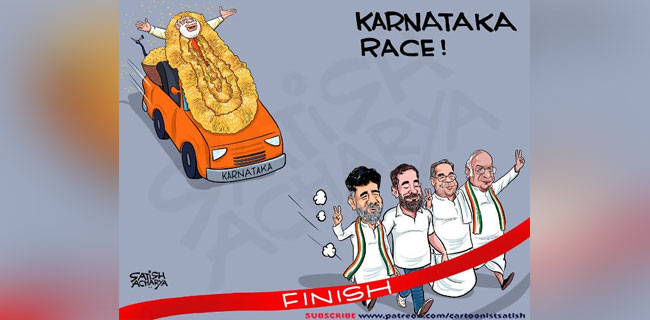
    Ranjona BanerjiThe defeat of the incumbent BJP government in the Karnataka assembly elections had the predictable effect on our captive TV channels. Some pretended to be happy that their expensive exit polls had got it more or less correct. Others switched to the UP local body elections, because mayors in UP are more important that chief ministers in some southern state, especially when the BJP wins. Others could not contain their sorrow that not only had the BJP lost but the dreaded Congress had won.

    I can hear the murmurs: oh, but many TV wallahs were equally upset when the Congress won in the past, all a “durbar-dynasty” clan, now smarting because the great King Emperor is triumphant and so on.

    Let’s accept that all political formulations have some support within the media.

    The question we now face is of degrees.

    Never before has the mass media been as captivated by one political regime.

    Never before has the mass media covered up transgressions and failures by a government as it does now.

    Never before has the mass media spread sectarian hatred to suit the political dispensation has it does now.

    The dangers are real. Citations from the past may make some commentators feel they’re being “objective” but in fact they are doing the opposite; they’re enabling fascism.

    And the extent of the entitlement that fascist forces feel was evident when India Today invited BJP IT Cell chief Amit Malviya to discuss the election results. The BJP was understandably upset at the way Karnataka voted. After all, the entire might of the BJP had descended on the state. Narendra Modi and Amit Shah had held several rallies and road shows. The media had promoted every marigold petal showered on Modi with as much enthusiasm had it had ignored Rahul Gandhi’s Bharat Jodo Yatra.

    Malviya’s meltdown on TV which included a massive personal attack on TV anchor Rajdeep Sardesai underlined why promoting sectarian, divisive political ideologies on the pretext of being “objective” can be counter-productive. But because TV has imposed on itself this A versus B format of entertainment and propaganda, it has not just lost journalism but lost itself.

    Many Indians continue to watch TV and take this sort of stuff seriously. They get indoctrinated and radicalised.

    TV knows this and continues with it.

    Recently two people were apprehended on suspicion of playing Hitler’s speeches on an Austrian train’s intercom system. The “freedom of speech” argument used by bigots and fascists is specious. There are limits on hate speech. Adolf Hitler is one limit, and with good reason.

    https://edition.cnn.com/2023/05/15/europe/austria-hitler-loudspeakers-train-intl/index.html#:~:text=Passengers%20on%20an%20Austrian%20train,several%20passengers% 20on%20the%20train.

    But India’s TV channels are unable to make such distinctions. I cannot imagine that Malviya will be avoided, let alone banned. He is likely to continue to be a treasured guest on most of these Leni Riefenstahl channels.

    Meanwhile, I will remind you that there are important reasons why the BJP lost Karnataka, from its Hindu majoritarianism to its Islamophobic policies and its lack of a proper economic growth model. Much like in the rest of India.

    I can guarantee you however that the majority of our mainstream media will now focus on lobbying within the Congress Party to become chief minister of Karnataka.

    The reasons are obvious.

    It will be interesting to see though how many channels get outraged with the United States and call for diplomatic action against them for this report about increasing attacks on religious minorities against India. Narendra Modi is due on a state visit to the US in June, the first in nine years.

    https://preview.state.gov/reports/2022-report-on-international-religious-freedom/india/

    O my.


    Ranjona Banerji is a senior journalist and commentator. She writes on MxMIndia on Tuesdays and Fridays. Her views here are personal.


  • The End of the ‘Managing Agency’


    By Avik Chattopadhyay

     

    Avik ChattopadhyayThis is my second in a series of thoughts on ‘India@75’. The first was to do with the very concept of ‘democracy’ in India as we enter our 75th year. This one is to do with the last stages of one of the oldest brands of this country that has important lessons for all of us in the world of brand strategy and management.


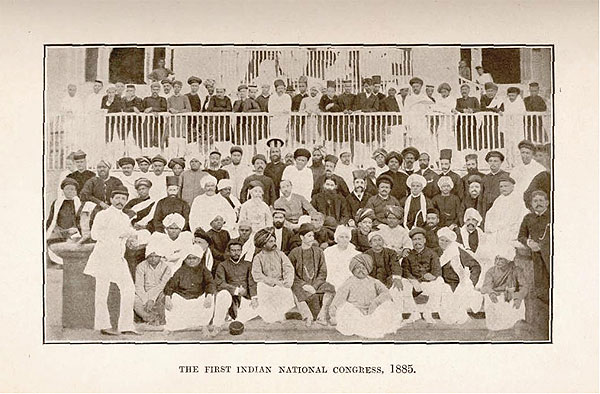
    The Indian National Congress was established on December 28, 1885 at the Gokuldas Tejpal Sanskrit College in Mumbai with 72 delegates responding to a call by retired Indian Civil Service officer Allan Octavian Hume of creating a platform for educated Indians to discuss and debate civil and political issues. In a letter to select alumni of Calcutta Presidency in 1883, Hume implored, “Every nation secures precisely as good a government as it merits. If you, the picked men, the most highly educated of the nation, cannot, scorning personal ease and selfish objects, make a resolute struggle to secure greater freedom for yourselves and your country, a more impartial administration, a larger share in the management of your own affairs, then we, your friends, are wrong and our adversaries right…and India truly neither desires nor deserves any better government than she enjoys.”


    The Congress was the ‘bridge’ between the ruler and the ruled. Its task was perfectly cut out in relaying the ruler’s orders and diktats in the required tone and language to the ruled while also carrying the requests and entreaties of the ruled up to the ruler. The elite members of society who made up the Congress were expected to coerce the ruler into becoming a bit more empathetic towards the subjects and have a softer approach to administration while looting the land.


    The plot took a twist with a man returning home from South Africa in 1915. The initial years were as per the norm with the points of inflection being the agitations in Champaran and Kheda. In 1920, Mohandas Gandhi took over the leadership of the Congress at it become more agitational in nature leading to the declaration of independence on 26th January 1930. The bridge had been drawn. It took numerous failed negotiations and betrayed assurances over the next twelve years to reach break point with ‘Quit India’. The Congress had firmly established itself as the only alternative to the Queen as ruler of India. A jilted and jealous Muslim League took away portions from the west and east but once the tricolour was raised atop Red Fort on 15th August 1947 the die was cast.


    The nature and structure of the rule remained more or less the same. The colour and language of the “my baap” had changed. And the fact that all that was now being done was for an independent India and ourselves. The nation had finally secured precisely as good a government as it merited, true to Hume’s words.


    The British ruled basically through agents and representatives who were given licences by the Queen / King to conduct business or trade in India on behalf of large British organisations. Independent individuals, mostly erstwhile officers of the East India Company, got multiple operating licences through bribery and nepotism and were called “managing agents”. Important names were Andrew Yule, Balmer & Lawrie, Burn & Currie and Martin & Co. who evolved over the years into not just managing various businesses through commissions but also into limited liability companies in areas like tea, real estate, engineering, paper, timber and manufacturing. At the core, the managing agents were as they were called…agents who protected the interests of the crown at any cost through managing all stakeholders using whatever means necessary.


    Though India got independent in 1947, their operating licences continued well into the 1960s. records show that in 1954-55 there were close to 3.944 managing agents who handled 5,055 joint stock companies. Once the licences expired, most of the agencies were either nationalised or conveniently handed over to ‘friends’ of the Congress. This was the beginning of the long chain of nepotism and ‘licence raj’ in the country.


    The new ruler became the de facto “managing agency” of an independent India. It operated just as one, with no enemies, no burning bridges and no ‘outcastes’ in the system. Everyone was welcome to the party, pun intended. This was a political movement that rallied a subjugated people around itself to demand freedom. In 1947 it was expected to govern a heterogenous conglomerate of 500+ kingdoms and 300 million people!


    The 1950s and 1960s were spent in a mix of utopia and resolve to build the nation. Some of the country’s most enduring institutions and ideas were born, built, and established. The largely impoverished but dreamy-eyed 300 million looked at the ‘Temples of Modern India’ with pride and aspiration. Some of the best brains in the world came to the world’s largest democracy to both teach and learn. Here was a nation crafted out of non-violence, a flagbearer of an ideal new world that every colony could take inspiration from.
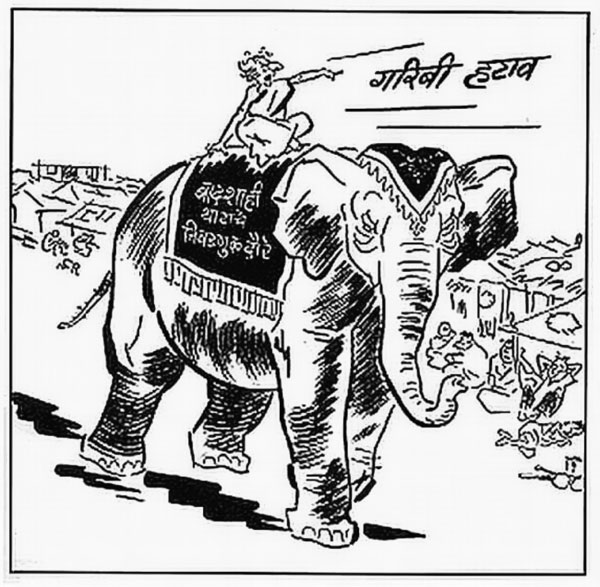
     

    Cartoon on Indira Gandhi’s “Garibi Hatao” campaign, 1971


    The 1970s was the decade of rude realisation that the promises of 1947 were not being met. Nepotism, in-fighting and corruption had become the norm. Disillusionment had set in. And the “angry young man” was born…brooding, bruised and brash, out to challenge the establishment and question the status quo.


    The political organisation was not cut out for governance after all. Regional parties were anyway in power in a few places, but the continental plate shifted when the Congress was dethroned. The feet of clay were finally exposed, and the first cracks had appeared in its imposing superstructure.


    It has taken another 50 years for the Congress as an organisation to stare at the possibility of folding up even before it celebrates its 150th anniversary in 2035. Over this period the “brand” Congress has slowly but surely lost relevance in the India of today and tomorrow. Its current situation is not an outcome of the last seven years. The decline surely has accelerated since 2014 but the cracks just kept widening since 1975. Intermittent electoral victories in the centre and various states could not repair the cracks. The end is inevitable. The brand is in a lifecycle stage of “Fatigue” hurtling towards fatality.


    The 1950s were about Fascination.

    The 1960s were about Familiarity.

    The 1970s saw the onset of Frustration.

    The 2000s evolved into Fatigue.
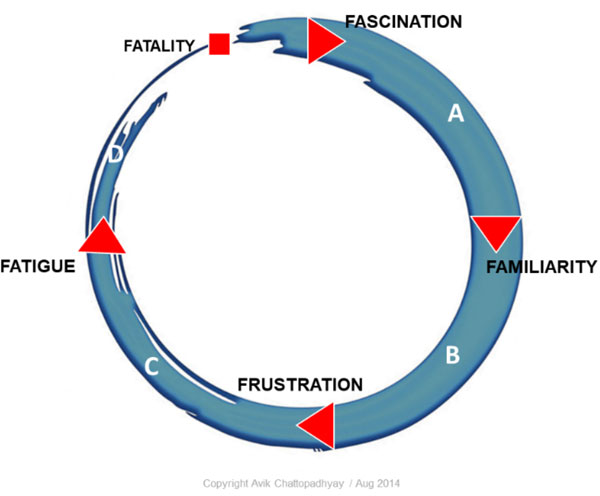


    This is the lifecycle of a brand, as defined by me. Every brand has to go through this inevitable cycle. The successful ones stretch stage “B” as much as they can to ensure longevity by keeping their purpose and promise relevant and constantly refreshed. Stage “C” is the one where disruptive transformation is required to ensure the brand holds itself back from reaching Fatigue. This stage is where a Netflix switches from renting DVDs to creating OTT content. This is where Ford decides to go electric. This is where the brand purpose, promise and personality need to be recast, addressing a new consumer / recipient.


    The Congress did not change any of its brand parameters since the 1950s. At the stroke of the midnight hour, it had promised the new nation peace, progress, and prosperity. It had promised the 300 million to take them out of poverty. It had promised safety, security, and stability. It had promised opportunity based on merit and performance. While its demonstration of the promises has left a lot to be desired, there are some aspects of its purpose that has not evolved, as if we are still a just-independent nation, all at sea with the world around us. The aspects of its brand promise that it continues to talk about have lost relevance in the current context.


    Many aspects of the Congress’s promise have been usurped by other political entities. The BJP has taken aspects of national identity, progress, and world-recognition. The Trinamool has taken secularism and inclusiveness. The DMK is about regional identity and stability. The CPI-M is about socialism and collective development. The AAP and BJD are about transparent governance. What is equally important is that each of them has ably demonstrated bits of their promise in the states / regions they govern.


    The Congress continues to believe that its core voter is still the dreamy-eyed poverty-stricken villager. The villager continues to be poverty-stricken but does not believe in old-world dreams anymore. The aspirations have changed over the decades and there are new elements of religious identity, revival and divisions thrown in to divert focus from rising unemployment, rising cost of living and diminishing civic facilities. The Congress did not wake up to this changing narrative, born out of years of apathetic and corrupt governance.
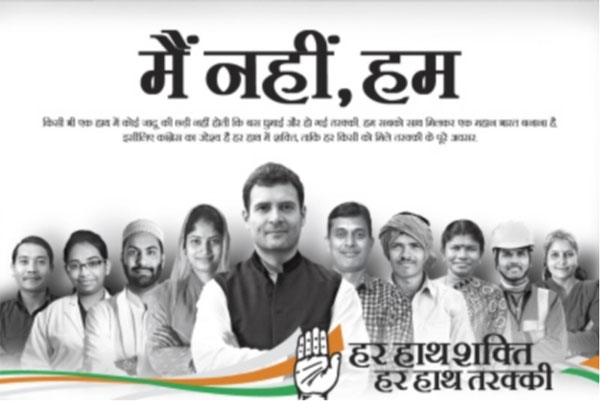


    The average Indian is willing to support an inept government against a corrupt one, patient enough to put up with stumbles, blunders, and greater hardships than unending favouritism, nepotism and siphoning of public funds. Promises like safety, security and unity are not relevant anymore to this Indian for this India is not united but carved out into castes and regions out to secure their own livelihoods at the cost of others.


    To top it all, the insistence not to change the leadership is very Orwellian. The current leadership is obviously happy to see the sand totally slip out of its hand but not hand over power to others and call it a day. Possibly the ugly fact that an entire army of termites depend on one family for their existence push this oddity to eternity. the biggest internal disruption and upheaval would have come about with that one single move of abdication by the family. The Fatigue would have been arrested and yet another attempt at stretching Stage “D” in the lifecycle would have been elongated. Or maybe the leadership does actually want the end to come…fast and final.


    The Congress of 2021 can be equated to Nokia in 2011, completely irrelevant and outfoxed by competition only because it refused to recognise the change around it and evolve accordingly, instead resting on its laurels and misplaced confidence in its own capabilities and on the loyalty of its supporters.


    The British left in 1947.

    The last managing agency is preparing to leave now!


    Avik Chattopadhyay is a senior brand strategist and commentator. His column will now appear every other Tuesday. The next part in this series will appear on Tuesday, October 26 with a focus on Democracy as a Brand
     

  • Breaking News? Ha ha ha!!!


    By Ranjona Banerji


    Breaking, breaking: Sachin Pilot of the Congress is about to join the BJP, will not join the BJP, will not speak to the Gandhis in charge, the Gandhis in charge will not speak to him, the Gandhis in charge have spoken to him, Pilot has met the BJP president, Pilot has not met the BJP president, the Rajasthan government has fallen, the Rajasthan government has not fallen, Pilot is a turncoat, Pilot is a true patriot, Ashok Gehlot is a greedy old man, Ashok Gehlot is a not a greedy old man, Pilot has more followers than Gehlot, Gehlot has more followers than Pilot, the Congress is finished, the Congress is not finished, the BJP is buying, selling and then back to Pilot is meeting, not meeting, crisis averted, not averted…


    O to be a political correspondent in such high spirits! Okay, I cannot make claims about my own sources about what spirits were consumed while all this “news” was put out, but I hope someone somewhere had some fun doing it!


    As I write this, at 10 am, I have no clue what’s happening. And as I watch the news, it is clear that no one has any clue. Maybe the players involved know, maybe they don’t.


    And thus the whole problem of “breaking news” and “source-based journalism” all gets exposed. Yes, it is big news if the Rajasthan government falls. But the merry-go-round of conflicting “information” does nothing for media credibility. I know we hope that everyone will forget. And someone will pull out from the depths of all the rubbish that one person who predicted everything correctly – most likely a friend of theirs – and then that person will become the new Nostradamus or Messiah or placed on some spurious pedestal for the next 10 minutes.


    In fact, given the massive jumble playing out in the media in front of us, there is more chance of scientists discovering what dark matter is than anyone giving us a true “inside” story on these wheeling-dealings


    Am I being unfair? Errr, maybe. Anyone in a newsroom has been here. You have to trust your colleagues and at the same time, you have to get them to ask tough questions of their sources (Here’s a hack, half of them won’t ask those tough questions because they will lose access). In any evolving situation, it’s difficult to know what’s happening. But the demand for constant, instant news makes life tough for correspondents on the frontline.


    Strangely, few in these newsrooms appear to care what happens to their credibility when they put out streams of conflicting information. As for the poor correspondents under unrelenting pressure, who knows what “sources” they are forced to rely on? Voices in their heads? Neighbourhood chatter around tea stalls? Friends and neighbours? And, most likely, vested interests around political formations who either have an agenda or just want to stir up the pot. Or both. Which is where newsroom filters would be vital but according to my mostly reliable sources, many newsrooms have just done away with filters these days.


    It is not possible for news to “break” every five minutes. Anyone who says otherwise is lying. And that is why, Pilot is shifting here and there, the Gandhis are somewhere else, the BJP is there and here and Gehlot is where he is.


    Is it surprising that some news channels would rather concentrate on what Amitabh Bachchan had for breakfast?


    Ranjona Banerji is a senior journalist and commentator. She is also Consulting Editor, MxMIndia. Her views here are personal

  • Utterly Buttery Polit-icious!


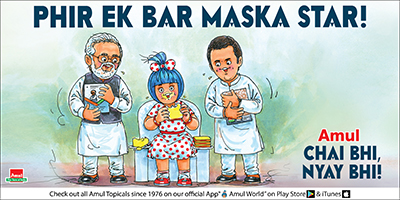
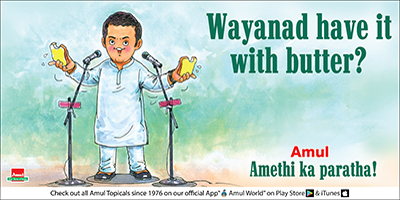
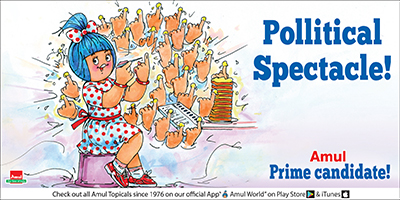
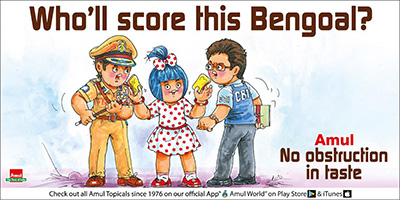
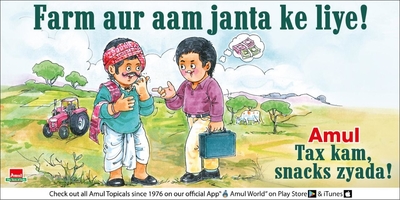
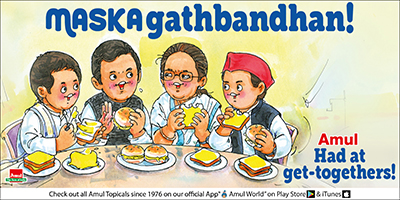
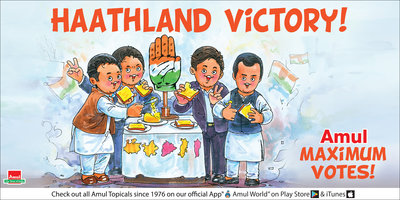
    Celebrating the Election Season via Amul topical advertisements


  • 1 Minute View: Damn all equally, Editors Guild

    1 Minute ViewThe Editor’s Guild statement on Rahul Gandhi’s remark on the Smita Prakash interview is welcome. However, as senior journalist and MxMIndia Consulting Editor Ranjona Banerji writes (http://www.mxmindia.com/2019/01/ranjona-banerji-spare-me-your-outrage-over-pliable/), it’s critical for the Guild to also make a noise when significant and not-so-significant others damn the media with words and actions that don’t speak well for the politicians and their political parties.
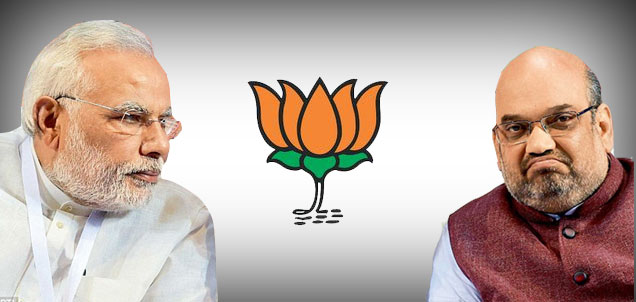


     

    In this case at the receiving end was Rahul Gandhi and the Congress. But the ruling dispensation at the centre, specifically the BJP and its biggies must also be damned, by name if and when there is need for it.


    Then, as Banerji writes, there has been no statement till date by the Guild on the arrest and detention of Kishorechandra Wangkhem of Manipur. Why not? Is this because the Chief Minister is from the BJP?


    The Editors Guild officebearers are some of the better known names in Indian journalism. One expects them to ensure bias in dealing with such cases.

  • Has Modi’s Brand-I taken a beating?


    By Sanjeev Kotnala


    The results of the five state elections are out. Many are surprised and many are iterating, they have predicted this resurgence of Congress. Meanwhile, there is a big debate if the aura of Narendra Modi’s Brand-I has taken a beating.
    It is a subject of debate and argument, if these state elections will have bearing on the national election in 2019. State elections are more nearer to the ground and reflect the widening expectation gap in the voter’s mind-space. BJP had senior leaders including the PM doing a spate of rallies across states. Hence, Incumbency or otherwise, central leaders too will have to introspect the verdict.
    One of the Giant Monolith images that must have been taken a beating is that of Modi, the PM and Amit Shah the shrewd political manipulator also nicknamed Chanakya of this era.
    On the other side ‘Papu Pass Ho gaya’. The image of Congress President, Rahul Gandhi has definitely seen an upswing. Expectations from Rahul Gandhi leading the 2019 election to win are now high with MP, Rajasthan and Chhattisgarh in the bag. But first he has a test of deciding on Rajasthan leadership with two strong contenders.
    The fundamental plank of ‘Jawan and Kissan’ and their issues in states seem to have won. Meanwhile the ‘Gabbar Singh Tax’ and ‘de-notification’ will be discussed and dissected in the days to come.
    Leave aside how the Brand Modi has been working on international stage. International coordination has no impact on the voters who define the results. The intricacies and the impact of the chain of international alliances are lost on common people. In fact this too much of ‘On Tour PM’ is seen as alienating and scheming by the voters.
    Every TG has a point to pick with Modi Brand. Only the die-hard loyalist has some points of understated appreciation.
    The delay in Ram Mandir, the handling of farmer agitation, the 56th inch proud chest, the language used, again ‘de-monetisation’ and ‘Gabbar SinghTax’. The opening of an on-going half completed projects all add to a sense of disenchantment.
    Modi image suffers from two common problems Brand-I is face with.
    It is really the perceived gap of over promise and expectations.
    The first is ‘What you claim and how you behave’.
    The second ‘How you think you are performing vs. what the TG thinks how you are performing’.
    Brand images are contextual and comparative in nature. And in a binary situation the brand images tend to be inversely associated with the opponent. So whenever Modi Brand (say Modi-Amit Shah co-existing brand) takes a beating the benefit goes to the next option. Modi brand is more are seen as benefiting selective business, as tainted as any other party and a perfect case have over promise-under delivery. It is never the best thing. Someone has to talk about brand promise- customer delight and consistency to this brand.
    Rahul Gandhi has been benefiting in this context and this election has suddenly put him in front of the race from the other side of the Modi fence. It is not going to be easy. Brand image repair takes time. Let us hope for Modi and the country that the voters are able to differentiate between the need and difference between a state and national election.
    One thing that has worked for the Brand Modi and what it can use to get the shine is closing the issue of tempering with EVMs. Maybe politically there could be more to read in the minor sacrifices of states and political aspirants.
    As BJP remains a strong opposition in MP and Rajasthan, its role in the next few months could be sued to add another coat to the MODI’s IMAGE OF BEING FAIR AND DEMOCRATICALLY INCLINED.


    Sanjeev Kotnala is a senior media strategist and educator. The views here are personal


  • Time to show the door to Exit Polls?


    By Ranjona Banerji


    Uttar Pradesh

    Exit Polls

    Today’s Chanakya: BJP+ 285, SP Congress 88, BSP 27

    Times Now-VMR: BJP+ 190-210, SP-Congress 110-130, BSP 57-74

    India News-MRC: BJP+ 185, SP-Congress 120, BSP 90

    India Today-Axis: BJP+ 251-279, SP-Congress 88-112, BSP 28-42

    India TV-CVoter: BJP+ 155-167, SP-Congress 135-147, BSP 81-93

    ABP-Lokniti CSDS: BJP+ 164-176, SP-Congress 155-169, BSP 60-72

    Voters: BJP+ 325, SP-Congress 54, BSP 19


    Punjab

    Exit polls

    Today’s Chanakya: AAP 54, Congress 54, SAD-BJP 9

    India Today-Axis: AAP 42-51, Congress 62-71, SAD-BJP 4-7

    ABP-Lokniti CSDS: AAP 36-46, Congress 46-56, SAD-BJP 19-27

    India TV-CVoter: AAP 59-67, Congress 41-49, SAD-BJP 5-13

    Voters: AAP 22, Congress 77, SAD-BJP 18


    Uttarakhand

    Exit Polls

    Today’s Chanakya BJP 53, Congress 15

    India TV-CVoter BJP 29-35, Congress 29-35

    India Today-Axis BJP 46-53, Congress 12-21

    Voters: BJP 57, Congress 11


    Manipur

    Exit Polls

    India TV-CVoter: BJP 25-31, Congress 17-23

    NewsX-MRC: BJP 16-32, Congress 30-36

    Voters: BJP 21, Congress 28


    Goa

    Exit Polls

    India TV-CVoter: BJP 15-21, Congress 12-18, AAP 4

    NewsX-MRC BJP 15, Congress 10, AAP 7

    Voters: Congress 18, BJP 14, AAP 0


    Should one start by being kind? Scour through the exit polls to see who got it nearly right? Take UP. Everyone suggested that there was a surge for the BJP, especially from Phase 4 of voting onwards. In that sense, all the exit polls were correct. The BJP was the winner. But if one wanted a general idea of who was winning, why would you do an exit poll? The best that the exit polls gave the BJP in Uttar Pradesh was 285, from Today’s Chanakya. The Samajwadi Party and Congress alliance was not doing so badly according to the pollsters and apart from Today’s Chanakya, everyone else thought Mayawati and the BSP might come up with some decent numbers.

     

    The voters had other ideas altogether. In fact, the voters’ ideas were so different from the pollsters’ ideas that it is unfair to even say that Today’s Chanakya is the winner because it got it so wrong. Unless my arithmetic is very faulty, the BJP’s final tally beat Today’s Chanakya’s forecast by 40 seats. Mayawati and the BSP managed a pretty dismal tally of 19 seats and the Samajwadi Party and Congress could not do better than 54. That is, even Today’s Chanakya gave the BSP eight seats more than it would get and every exit poll gave the SP-Congress combine much more than the voters did. The lowest was Today’s Chanakya with 88 and minus 54 from that and you get it wrong by 34 seats.


    Don’t want to do it statewise because it’s so tedious? Take the AamAadmi Party’s seat-gathering ability then. According to our crystal ballgazers, Arvind Kejriwal’s push for a middle class, corruption-free India would win between 71 (CVoter, Punjab plus Goa) and 36 (ABP-Lokinit CSDS only Punjab) seats in two states. What did AAP win? A total of 22 seats in Punjab and zero in Goa.


    To say that there is a serious need for the media and for exit pollsters to relook at their methodology is a gross understatement. It may be better to admit that you have no idea what is going on that to get it so wrong. Many journalists one spoke to privately admitted just as much. In the end, even ground reports did not suggest the sort of victory that the BJP got in Uttar Pradesh and Uttarakhand. And while everyone was sure that the SAD-BJP alliance was going to lose Punjab, everyone also expected a bigger chunk of Punjab going to AAP.


    It is interesting, as an aside, to see how much our national media cares about India’s smaller states. Only two exit polls each were conducted for Manipur and Goa and it is as ever significant that both polls did not get it right.


    Today, after the results are out, hindsight has made us all wiser and some of us, illogically but egotistically, prescient. In fact, all that is rubbish. There is something going on in the Indian voters’ mind which is not being picked up by the media. You can choose between love for NarendraModi (UP and Uttarakhand but not Punjab, Goa and Manipur), joy over demonetisation, no joy over demonetisation, Hindu consolidation, the end of caste, the end of the Muslim vote, shoddy electronic voting machines and the arrival of new voters from Mars.


    Either editors in newsrooms do not listen to what their reporters tell them or reporters doctor their reports to fit in with newsroom ideas. Or, even worse and even more likely, few national newsrooms have enough people on the ground thanks to cost-cutting and the low value given to newsgathering by managements. That is why so many newsrooms houses rely so strongly on exit polls to do the work that they can no longer do. One cannot be certain that it is working. In fact, one can be perfectly sure that it is not.

    No?


  • Ranjona Banerji: Election of the Trivial & Telegenic


    By Ranjona Banerji


    If this general election is indeed a watershed moment for Indian polity then it is no less a groundbreaker for the Indian media. Television has dominated this election practically setting agendas and leading the battle from the frontlines when it comes to chosen candidates and parties. The battle is won by the trivial and the telegenic. The smaller India grows in terms of communication thanks to telephony and technology, the larger the disconnect from reality: or so it appears.


    If the media is going to play such a significant role from here on, then the elements within the media must come out and identify themselves by their ideological and philosophical bearings. The old argument used by journals that they are all things to all people cannot stand any longer. It is in many cases patently untrue. Further, it has reached a stage where you are taking readers for a ride.


    Television has no such argument at all and instead has created an atmosphere of rumours, allegations and gossip to thrive. Even within the media fraternity, there is a constant stream of stories about which channel has been sold to which political party or who favours which candidate. Some parties are barely being mentioned when it is evident that they will have some bearing on these elections. Thrown a few corporate houses into the mix and you have a great Indian muddle which barely resembles a delicious homemade khichdi.


    Who has financed all these opinion polls to project election results for instance? What is the consumer of news to make of them when ground reports from journalists are at odds with those surveys? In a two-month long voting schedule, a constant stream of opinion polls amounts in fact to trying to influence those who have not yet voted, even if the Election Commission has not cottoned on to it yet. The figures for conducting these polls which are going round the grapevine are astronomical.


    It is time therefore for all newspapers, news channels and websites to declare their political leanings. There is no shame in this. All over the world, the reader and viewer knows what their chosen media outlet stands for. This is not just about individual columnists to declare their leanings. This is about the organisation itself. Given the growth of the influence of the media – and these are strong words – to fool your consumer any more is tantamount to fraud.


    It is evident that it is not just a nudge from one corporate house and a wink from another that dictates media flow. We have seen epic and sudden changes of direction from left to right to centre and back. What most newspapers do to cover this up is provide a variety of columnists on their opinion pages to portray first one point of view and then another to prove that they are “neutral”. It no longer cuts it.


    TV of course is another jungle with its own rules, quite distinct in some cases from print. Editorialising and on the spot opinion-making is now par for the course. As a very senior editor who has a career in both print and television pointed out to me, if a star anchor, who is also the editor, asks a young reporter on live television, “Isn’t the political rally proving what I say?”, what is the young reporter to do? Disagreeing with the boss is not an option. And so news is created, not reported.


    For a long time in India, journalists were more left of centre than right but that was not an absolute truth. For instance Girilal Jain, a colossus in the Times of India was distinctly right of centre and the Indian Express was distinctly anti-establishment in the days when the only establishment was Congress.


    One must distinguish between the need for media outlets to declare their politics and the accusations and muck thrown at individuals on social media. Gutter language and threats will continue. But now the target will be clear and much larger. And in the interests of fairness, everyone will have a target!


  • Ranjona Banerji: How the media is everyone’s whipping boy

    By Ranjona Banerji


    The media is now everyone’s whipping boy and there is no need for the media to get defensive about this. As long as everyone thinks you’re doing everything wrong, it is clear that you are doing everything right. The expression “paid media” is now indiscriminately used to describe journalists who do not subscribe to your political point of view, when the term within the media is used to describe managements who sell editorial space to political parties or politicians without informing readers or viewers.


    Arvind Kejriwal of the Aam Aadmi Party has accused the media of being pro-Bharatiya Janata Party and pro-Congress and also said that some of the media is dancing to the diktats of Mukesh Ambani and Reliance. More specifically, the media he says is either pro-Narendra Modi or pro-Rahul Gandhi; the unspoken implication being that the media is anti-him. However, through 2011 the media was extremely pro-Kejriwal and the India Against Corruption movement headed by Anna Hazare. One might wager that without media support, the IAC movement would have gone nowhere. Non-stop coverage of every IAC event, gross exaggeration of public participation figures all ensured that IAC, Hazare, Kejriwal, Manish Sisodia, Kumar Vishwas, Kiran  Bedi, Prashant Bhushan and others became household names.


    India’s controversial former chief of army staff VK Singh has also jumped into the fray, calling journalists “presstitutes”. This is how urbandictionary.com describes “presstitute”: “A term coined by Gerald Celente and often used by independent journalists and writers in the alternative media in reference to journalists and talking heads in the mainstream media who give biased and predetermined views in favour of the government and corporations, thus neglecting their fundamental duty of reporting news impartially. It is a portmanteau of press and prostitute.”


    In fact, I would question Celente’s (an American “trend forecaster) wisdom and political correctness in damning commercial sex workers (the now accepted term for prostitutes) by associating them with the media and with journalists.


    Jokes aside, Singh has been angry for a number of reasons – his various dates of birth did not sit well with either the Indian Army, the GOI or the Supreme Court, his various PR efforts sometimes backfired and Indian Express published a story last year about how some troop movements during his tenure were looked at suspiciously by the Government.


    The Editors Guild has taken exception to all this media-bashing and issued a strong statement: “Ironically, leaders who built up reputations and support by engaging the public through the media are now turning on the very media when they come under critical scrutiny…


    “The media that question and criticise political leaders and indeed every section of society should of course be open to criticism, even if it is harsh, of its functioning and to its flaws being exposed. The problem arises, however, when abuse and vague, unsubstantiated accusations of corrupt motives take the place of reasoned refutation and debate. An additional danger is that some of the followers could take their cue from the statements of leaders and may not stop with verbal attacks. Both print and television journalists have been subject to physical violence as well by political party workers.”


    Physical attacks on journalists are reprehensible and have to be tackled strongly by law and order. But general criticism of the media and of journalists has to be accepted as par for the course. As we have pointed out in these columns, there are clear instances of media bias on display at times and criticism of political parties, politicians and big business is sometimes a carefully calibrated exercise.


    The spread of the tentacles of lobbyists and PR people is well-known when it comes to film and business journalism for instance. And the Niira Radia tapes exposed the susceptibility of some of India’s biggest names. These are problems which the media must discuss more stringently, or criticism from those we criticise will only get stronger.


    If we don’t guard ourselves, someone else is going to try and do it for us. And that would be the real disaster.


  • It’s Dentsu, Taproot & JWT for Congress


    By Pritha Mitra Dasgupta


    The Congress party has opted for many of the same people who were behind its advertising campaign for the 2009 elections, picking Dentsu and Taproot to join JWT as the agencies that will handle the Rs 500 crore contract.


    The party made its choice last week, said more than five people aware of the decision. They didn’t want to be named. It was reported earlier that JWT had been chosen by the party to run its ad campaign.


    While the three agencies have been barred from speaking to the media by the party, the people familiar said Dentsu and its unit Taproot will handle the above-the-line (ATL) communications or those with a mass focus. Dentsu picked up a 51% stake in Taproot last year and both agencies made a joint pitch. JWT will handle the activation or on-ground events for Congress.


    The party is expected to spend nearly Rs 400 crore on ATL messaging that includes television, print, radio, outdoor and digital and around Rs 100 crore for the on-ground activities.


    The party will be looking to the ad agencies to burnish an image that’s been battered by corruption scandals and criticism over inaction on policy changes for much of its term. Experts said the Congress party will be looking to the food security legislation, the Right to Information Act, the direct transfer of benefits initiative and others as its main campaign planks for the election, besides indirect, subtle attacks on the opposition party over its secular credentials.


    “Rahul Gandhi wants to use ’empowering the common man’ as the primary theme of the election campaign and most likely it will drop the ‘aam aadmi’ tagline this time. The party is now exploring which will be the most effective medium to build this campaign,” said one of the people cited above.


    An email to Sanjeev Bhargava, managing partner and head of JWT Delhi, wasn’t answered. Agnello Dias, chairman and co- founder of Taproot India, and Rohit Ohri, executive chairman of Dentsu India Group, declined to comment. The Dentsu-Taproot team presented its media plan to Digvijay Singh and Jairam Ramesh last week, according to one of the people cited above.


    “Since Rahul Gandhi has been travelling extensively, they could not show the media plan to him. Gandhi is back this week and will go through the media plan following which the agencies will start working on the campaign,” this person said. Work will begin shortly on the nuts and bolts of the advertising campaign.


    “The agencies will appoint the production agency, song writers and so on, who will work on the campaign in November,” said the person cited above. “The ad campaigns will break in a phase-wise manner from January 2014.”


    The Congress party didn’t give a brief to start with but would provide feedback once it began whittling down the contending agencies, said a senior industry official on the condition of anonymity. “During the pitch process there were no briefs given to the agencies,” this person said. “There were nine rounds of presentations. Following every round, once the agencies were shortlisted, they were re-briefed by the party.”


    Both Messrs Gandhi and Singh played key roles in the special committee that oversaw the process, a party official said.


    “It was Rahul Gandhi who took the final decision to go ahead with Dentsu India and Taproot,” said this person.


    The choice of the agencies means that most of the people who worked on the 2009 campaign will also be working on this one. For instance, Messrs Dias and Ohri used to be with JWT, one of the agencies that handled the advertising campaign for the Congress party last time around. Also handling the Congress account in the 2009 election was Percept/H and Crayon.


    At JWT, the campaign was led by Mr Ohri, who was then senior vice president and managing partner of JWT’s Delhi branch along with Jitender Dabas, vice president and strategic planning director. While Dabas is now at McCann Worldgroup, Mr Ohri moved to Dentsu India and took with him the team that worked on the Congress campaign.


    This includes Soumitra Karnik, Suprotim Dey, Rajendra Singh and Chirantan Chandran. Mr Dias was with JWT until 2008 as chief creative officer but left soon after the election campaign started appearing.


    For the last election, JWT created a three-month campaign for Congress backed by the tagline “Aam aadmi ke badhte kadam”. The campaign took place in three phases with some 250 films and radio spots in 22 languages. Special films were also made to reach out first-time voters with the slogan “Yuva Bharat ke badhte kadam”, leveraging Rahul Gandhi’s leadership and the late Rajiv Gandhi’s contribution to the country’s development.


    They have a tough task ahead of them, given the current image of the party and the popularity of the BJP’s Narendra Modi.


    Source:The Economic Times

    Copyright © 2013, Bennett, Coleman & Co. Ltd. All Rights Reserved

    Licensed to republish


  • Vijay Mukhi: Are Narendra Modi’s Twitter followers fake? And what about Shashi Tharoor’s?

    By Vijay Mukhi


    The best job on the planet is being a columnist on Politics and Technology, because no one in this space  talks sense or hard facts and numbers. Breaking news everyday is about Narendra Modi’s Twitter followers being fake, but no one is offering any credible evidence on either side of the debate, fake or real. So, before I throw my hat in the ring and get egg all over me (which is all in days work for me) let me tell you that I believe in the maxim Trust but Verify so before you cast the first stone, please download all the data that I have gathered from Twitter from my website www.vijaymukhis.com. We are also comparing only Narendra Modi and Shashi Tharoor as the other politicians are pygmies on Twitter compared to these two giants.


    Modi, today,  has 19,34,170 followers on Twitter compared to Tharoor who has  18,42,046,  a lead of just under a lakh. Modi and Tharoor share  447,920 followers in common which is around 25% of their followers , Modi and Kiran Bedi share 408,401 followers and Modi also shares 2,98,005 followers with Arvind Kejriwal. Thus, we can safely conclude that there are about 4 lakh people on Twitter who just like following politicians from India — why, we have no answer. This leaves Modi with a maximum of 15 lakh fake followers as fake followers would not share politicians from different groupings.


    How do we define a fake follower? Simple answer, someone who does not tweet. Modi has 6,77,296 followers who have never ever tweeted. Now imagine, why would someone join Twitter and not tweet at all! This is very extremely damning and conclusive evidence, we need no judge or jury to convict that these have to be fake followers. Thus if 35% of Modi followers have to be fake, what more evidence do you need! But, do not open the bubbly to celebrate, Tharoor has only 5,23,843 followers who also have never ever tweeted , which make up 28% of his followers. Can we thus draw a line in sand that says that if up to 28% of your followers have never ever tweeted then it is okay but any percentage above that makes these followers a fake? A more charitable explanation is that there is a silent (in terms on not liking the sound of a keyboard) majority out there on Twitter who do not tweet at all, but simply read tweets. If you take a step further, 12% of Modi and Tharoor’s followers tweeted only once and 7% only tweeted twice. A simply addition tells us that over 46% of Tharoor’s followers and 54% of Modi’s followers do not like to tweet or cannot tweet for various reasons. We need to accept that not everyone likes putting pen to paper even though we have to write less than 140 characters.


    The best evidence of popularity or influence on Twitter is how many people follow you. About 4,85,077 or 25% or a quarter of Mod’s followers have 0 people following them. Aha, this nails Modi finally and this is enough  proof that these followers are fake! The obvious answer is that if you do not tweet then obviously no one will follow you and for Tharoor the number is 2,61,883 or 14%. The percentage of the number of followers who have only 1 or 2 followers following their tweets, sort of remains the same. Thus like sending tweets , we have a whole community of users on Twitter who are so important that nobody follows what they do. Twitter Orphans can well be a new addition to the English language, what say?
    The obvious conclusion is that about half your followers would be inert or inactive or to use the TV analogy, coach potatoes who would surf from politician to politician.

    One sureshot way of finding out whether your followers are fake is to look at how many followers did you add every day of the year. During the month of July 2013, Modi added on a average around 5000 followers per month and Dr Tharoor about a 1000. For May and June, these numbers were also similar. The only conclusion we can draw here is that Modi’s team is very smart, had they added 50,000 followers on one day, they could be caught in the deserts of Rajasthan. But what if I paid an agency (millions on the web that do this for a small fee) to increase Modi’s followers count by a lakh on a certain day, the media would go ballistic and say that Modi was caught with his hand in the desert sand.


    I agree we are getting nowhere. So let’s look at another metric. When did  your Twitter followers create their account on Twitter or an ageing analysis. A whopping 1,02,385 of Modi followers were born on Twitter in April 2013, 94,874 in June 2013 or better still 502, 918 of his followers are under 180 days old on Twitter or created in the year 2103. For Tharoor, this number for 2013 is only 171,459. For 2012, the equivalent numbers are 595,656 for Modi and for Tharoor 360,540. A non-convincing explanation is that India is the youngest country in the world population wise and therefore all of your followers must represent this trend of being young. More than half of Modi’s followers have joined Twitter nearly a million , in the last 18 months only ,maybe just for him. This is why Twitter should give Modi an award for bringing so many people to Twitter!


    Where Tharoor leaves Modi biting the dust is when it when to the quality of followers, and that also by a factor of 2. We simply added up all the followers of people who follow Tharoor and the number was an astonishing 27,89,94,347 and for Modi it was half that at 10,87,44,125. We have not removed duplicate followers from this list. So theoretically when Tharoor tweets and if all his followers retweet his tweet around 27 crore people would see that tweet. Tharoor followers have tweeted over  52,26,34,885 times but Modi’s followers being newer and weaker are half that at 27,57,99,883. On a average, a Tharoor follower has 150 followers who tweets 282 times and a Modi follower would have only 56 followers and tweets much less at 143. Thus an average Tharoor follower would beat a Modi follower in a virtual fist fight as Tharoor has a long and khandhani history on Twitter.  Maybe and we have no evidence for saying this, but a Modi follower may have more pets (aka puppies) than a Tharoor follower. It a foregone conclusion that Tharoor’s followers are twice as strong as Modi’s followers and no guesses who would win a twitter slugfest, in spite of what conventional wisdom says that Modi’s followers are winning on Twitter.


    OMG, read over 5000 characters ie 35 tweets (my editor decides column length in tweets and not characters)  and yet no conclusion on whether Modi has fake followers or not! So, let’s muddy the waters even more. Go to the Twitter page of a user vijaymukhi712 by typing www.twitter.com/vijaymukhi712. This user bears my name and I have actually tweeted 86 times, a pretty active user one would have to admit, to a fake user under any yardstick. Every day my internet avatar ( not sure of the sex as you will soon see) quotes a love tweet so has his heart in the right place. But if you check further, say the 19th of every month, you will see the same love quote. This user is a creation of a computer program (which is why I cannot determine the sex)  which wakes up at 7 in the morning GMT and depending of the day of the month sends out a tweet. I did not have the time to create a database with 365 tweets. Is this a fake user or a non-human user, a word that will enter the human lexicon very soon. Twitter makes it very easy to create a user that needs no verification and we all tweet using some computer a program written by a programmer. Will there be a way to distinguish between a fake user from a machine-created one? May be and a big may be in my next life!


    Finally, all fake things must come to an end and so we come to our real conclusion.


    It is in the best (commercial ) interests of the social web to make it very easy to create fake followers as greater the number of Twitter users, the more money Twitter and the rest of its ilk charges for ads. It’s also is in the best interests of the social web that we have no way of determine a fake from a real user. It helps politicians as it make them more important in cyberspace than they really are. I seriously stopped getting women to date me when they realised that my Twitter followers was around 300. We must realise that a large majority of Twitter users will not tweet, they are readers nor writers. If politicians hired the right technology hackers, they will never ever get caught while massing millions of fake followers. Our Internet population will triple from 120 million today to at least 400 million in the next 1000 days thanks to 4G and this problem of fake followers or fake identities or fake tweets or fake anything will never ever be resolved. This emboldens all of us to say what we want about anyone or anything on Twitter and the social web as verification of any type is a miracle and we all know when the last miracle too place.


    My last two bits: Modi’s followers are as genuine or as fake as Tharoor’s followers are. Take your pick by doing the obvious, by tweeting.


  • Mediaah Report Card on Ambika Soni: 7/10

    By Pradyuman Maheshwari


    Although I would hold her responsible for the mess that we have in digitization, Ambika Soni was among the better I&B Ministers we have had in the last decade.


    In my report card, I would give her a 7 on 10.


    In fact had it not been for digitization and the lack of gamechanging vision, she’s could’ve scored higher.


    Remember she took over from Anand Sharma and earlier Priyaranjan Dasmunshi who had made life tough for industry practitioners.  Ms Soni’s tenure came as a breath of fresh air. Reportedly, the advisory she received from her predecessors was that she shouldn’t go easy on media biggies, but she would’ve none of that.


    Everyone has a view on the content dished out on television and in the print media. Parliamentarians, legislators and politicians of all hues, consumer and advocacy groups, corporate, citizens, et al would engage with her to act on their demands. For instance, Balika Vadhu in Colors was found by some to be glorifying child marriage or Sach Ka Saamna and Bigg Boss were found to be unfit for family viewing. Ms Soni heard the complaints and kept the complainants at bay. The general entertainment channels must thank the former minister to ward off a variety of pressures.


    I think just letting various players do their job with a nudge here and there was an achievement. Ms Soni also ensured that entertainment and news broadcasters work out an effective self-regulatory mechanism. This had had its share of hiccups in the past, but in her tenure it happened.


    Ambika soni

    But though her progressive outlook ensured that the industry benefitted, various factors pull her down in this appraisal. In fact, according to one magazine study a few years back, she was judged to be a non-performer.


    Let’s look at the areas where Ms Soni failed:


    1. Doordarshan. The pubcaster had turned 50 in 2009 and there was an opportunity to make it a more professional BBC-like body. Didn’t happen.

    2. Radio. News on FM radio is not allowed due to some silly Home Ministry objections even as there are several cable channels in every nook and corner of the country.

    3. Paid news. If paid news is being discussed much it’s thanks to the Election Commission and a section of the fraternity. The minister had an opportunity to cleanse the system, but she didn’t want to upset the holy cows in the business

    4. Tougher on measures: Had she adopted a sterner stand and asked the industry to act faster, we wouldn’t have seen an NDTV taking TAM to court as BARC would’ve been set up and offered the necessary guidelines.

    5. Digitization. Agreed it’s a bold measure and it’s in her tenure that it gained momentum and was being executed. But the fact that it didn’t was all thanks to the way her ministry went about the task. Even as there are just two days to go, 100 per cent digitization will take another two or three months to happen in the four metros.


    Could this embarrassment have been avoided? Yes, of course.


    I am also shocked at how and why she quit less than a week before what was decidedly the biggest thing in Media and Entertainment in the last decade. Bigger than DTH and other policy initiatives. Yes, it’s a good idea that a senior political leader goes back to help the party in the run-up to the elections, but why do it when the Sunset Date is just a week after?


    Why did the Prime Minister allow her to do so? Why did the UPA chairperson allow it?


    This, I guess, is the reality check for all of us in the media. The powers that be don’t really care.


    As for Madame Soni’s score in my report card. 7/10. And a red line for being irresponsible and leaving the ministry a week before her biggest project was being executed.


    Pradyuman Maheshwari is Editor-in-Chief, MxMIndia. The views expressed here are his own. Inbox him at pradyumanm@mxmindia.com or use the messageboard below