Tag: Cadbury

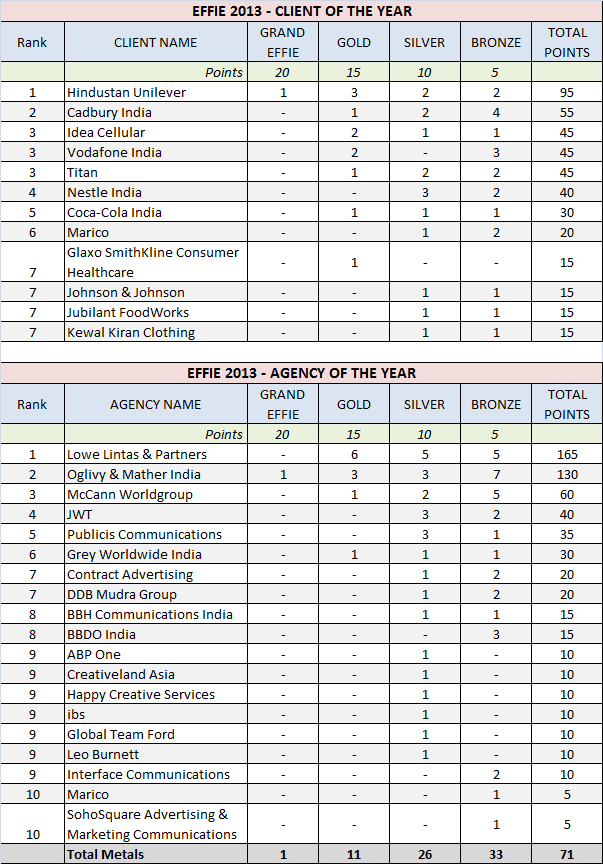
  • Cadbury misses a hat-trick as Ogilvy misses 5th consecutive crown + Effies 2013 Tally tables

    By Our Research Associate


    The last time Lowe Lintas & Partners was Agency of the Year was in the year 2006. Hindustan Unilever was Client of the Year that year too. In 2008, the Effies were awarded on the day when the terrorist struck Mumbai – November 26, and JWT was the Agency of the Year (AOY) while Bennett, Coleman & Company was Client of the Year (COY).


    From 2009 onwards, Ogilvy has been AOY. But the COY title has moved around a bit – in 2009, Vodafone, in 2010 to Tata Teleservices and in 2011 and 2012 to Cadbury.


    Cadbury would’ve scored a hat-trick but this time thanks to both Lowe Lintas and Ogilvy contributing to its kitty, Hindustan Unilever forged ahead.


    According to a member of the jury who requested anonymity, entering the Effie requires some extra effort on the case study presentation. Remember you need to prove the fact that creativity has worked for the advertiser, and unless that’s done, you won’t win.


    A senior member of the industry told MxMIndia that given the body of work that Ogilvy had done, it could’ve surely been #1 had it presented some of its cases better.


    Perhaps.


    Meanwhile, take a look at the AOY and COY tally tables:


  • Cadbury’s sweet interlude with Digital


    By Shephali Bhatt


    Hamilton Holt was right after all – nothing worthwhile comes easily. Which is why if you wanted a Cadbury Bournville back in 2008, you couldn’t just buy it, you had to ‘earn it’.


    It was the campaign that spurred the first big relaunch for the brand which had spent years as a niche product. Some even attributed its continued existence to sentimental reasons: Bournville is named after the site of the first large Cadbury factory and model village. In its revamped avatar, it aimed to appeal to sophisticated adults craving a premium dark chocolate experience. Set in an idyllic European milieu, the launch spot had a quintessentially British journalist bragging about owning a bar of Bournville who gets abducted by a giant bird because he hadn’t “earned” it. With 85% of the marketing spend on TV and the rest on print and OOH, the launch campaign ran for 15-16 weeks a year for three years until it was time to focus on the ingredients that went into making a Bournville.


    The focus of the campaign turned to all those cocoa beans that never became a Bournville, because that was a prerogative of ‘Original Ghana Cocoa beans’ only. “The idea was to build awareness and generate trials for the brand. These campaigns helped establish Bournville as a premium chocolate with an international appeal and a distinct proposition,” says Anil Viswanathan, VP – chocolates category, Cadbury India.


    It was around 2011-12 that the brand started exploring the digital platform and allocated 30% of its marketing budget to the medium. This was followed by a tie-up with Warner Bros around the release of The Dark Knight Rises. “While movie promotions don’t last more than 10 days, conversations around a movie start a month in advance,” notes Shekhar Banerjee, Senior VP and head of Pinnacle at Madison (the media agency that handles Cadbury). Capitalizing on the conversation around the biggest release of last year, the agency created an augmented reality based motion sensing game – The Bean Hunt. The winner won a free trip for two to Warner Bros Movie World in Australia. This was coupled with activity on YouTube (videos with trivia around the Batman franchise) and Facebook. It led to an addition of 6.5 lakh users on the social networking site within a month and the interaction figures soared by 4000%. It was enough to convince the brand to take a huge punt on the medium.


    Starting 2013, Bournville has set digital as its lead, accounting for 60% of its annual budget. TV remains the second with close to 30% with the rest allocated to OOH. Viswanathan explains that Bournville’s current TG (SEC A, between the age group of 19-30) is an audience that uses social media as the primary vehicle to maintain and extend their networks. The shift will help the brand by being present where its target audience is, and will help the brand building exercise by riding on leading trends.


    In March this year, Bournville launched a Cranberry variant, only on digital, and reached out to 26 million unique users. The campaign involved multiple videos created by Ogilvy India, the creative agency on the brand, which were only run online. “Today, Cranberry has a recall of 23% which is higher than the other variants of Bournville that existed in the market for years,” asserts Banerjee.


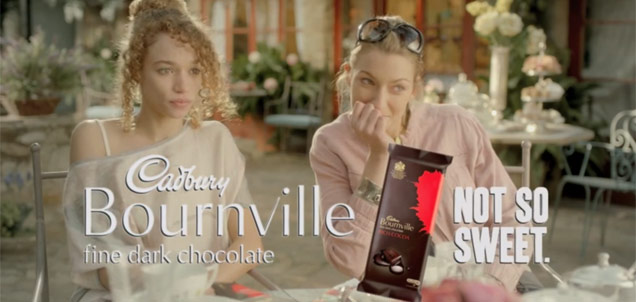
    Bournville’s current campaign ‘not so sweet’ (NSS) is an attempt to retire ‘have you earned it’. It’s tongue-in-cheek, it’s cheeky and aspires to align the brand with young adults who like their not so sweet dark chocolate. The exclusive launch of this campaign on digital media has led to an increase in brand conversation by 800%. Along with the ad film that shuns the overtly sweet, there’s a Twitter campaign called ‘Tape a Tweet’ that allows users to throw overtly sweet situations at the brand on Twitter where they promptly get converted into one minute videos. The 9-person strong digital team at Pinnacle has built analytics that quantify the ROI of social media on its two brand metrics for digital-engagement levels and conversation association of NSS. They like to call them social GRP.


    In addition, they’ve classified their target audience into digital clusters to help draft a better content strategy for the brand. Experts say that 60% of the brand’s marketing budget would be close to Rs 12 crore. “With that kind of money and a significant reach, Bournville will stand out,” Harshil Karia, co-founder and online strategist at Foxymoron points out. Since no other brand in the category is that prevalent in the medium, it gives Bournville the maximum share of voice, he adds. Normally, it takes a period of three years for advertising on this medium to reflect on sales. It will be interesting to see how Bournville’s transition from traditional to digital pays off in the long run.


    Source:The Economic Times

    Copyright © 2013, Bennett, Coleman & Co. Ltd. All Rights Reserved

    Licensed to republish


  • Adult brands patronize kiddie channels

    By Shambhavi Anand


    When Lata Diwan went shopping for the household, her 5-year-old daughter Tanya suggested her to choose a certain brand on mosquito repellent. “It will drive the mosquitoes out as well as leave a fragrance around,” the young scholar told her mother.


    Tanya’s knowledge about mosquito repellents comes from an advertisement she watches in between her favourite programmes on cartoon channels, where it’s no longer just toymakers and children’s product brands that advertise. An increasing number of nontraditional advertisers including Maruti Suzuki, Honda bikes and Samsung is advertising on kids’ channels as more children participate in their parents’ purchase decisions and more parents watch television with their children.


    “While traditional advertisers such as GlaxoSmithKline, Hindustan Unilever, Cadbury, Mattel, Kellogg, Perfetti and ITC are amongst our top spenders, close to 50% of our revenues now come from non-traditional advertisers,” says Juhi Ravindranath, ad sales vice-president for South Asia at Turner International India, which owns Pogo and Cartoon Network channels. Most houses in India have one television set and it’s common that children and adults watch it together, and often the younger ones hold the sceptre – the remote control – and decide what to watch.


    Rahul Johri

    So advertisers targeting parents too are turning to kids’ channels. “Advertisers do not want to miss any opportunity of reaching out to their target audience, whether it is mothers, fathers or grandparents,” says Rahul Johri, senior vice president and general manager, South Asia, at Discovery Networks Asia Pacific, which owns Discovery Kids. The maximum growth in terms of adspend on these channels has been observed in fast-moving consumer goods.


    A spokesperson of Pogo channel says unconventional advertisers on the channel include Maruti Suzuki, Honda bikes, Hero Moto-Corp, Micromax, LG, Samsung and Hitachi. “We expect the number of new categories and advertisers to only grow,” the person adds. That’s because it’s seen as a win-win. While the kids’ channel gains from the increased advertiser base, the non-traditional advertiser benefits from the huge secondary target audience of parents and grandparents.


    Santosh Desai, advertising veteran and MD and CEO of Futurebrands India, says, “For marketers there are a couple of advantages of being on kids’ channels. First there will be some spillover adult viewer and children’s role in decision-making for the household has also increased. Secondly, these channels are relatively cheaper in the overall media mix.”


    A study by Cartoon Network, ‘Cartoon Network New Generations 2012′, shows a majority of parents watch television with their kids. After serials, cartoons are the most preferred genre for parents, ranking above news channels.


    About 75% parents spend time watching TV at least 5-6 times a week with their kids. This number is even higher, close to 80%, for parents of younger children. Channels say that in spite of the decent growth, the kids’ genre is extremely under-monetised, with 7% viewership and just 3% of revenue share.


    Source:The Economic Times

    Copyright © 2013, Bennett, Coleman & Co. Ltd. All Rights Reserved

    Licensed to republish


  • Ranjona Banerji: I also hate the chip chip!

    By Ranjona Banerji


    I’m taking off from next week and staying with the advertising industry since it is also “news” as some Indian media organisations have told us for years. Also, you cannot escape advertising if you watch the news or read newspapers and magazine. After careful consideration and consultation with others, it is clear that Priyanka Chopra’s “chip chip” ad for Garnier remains the most annoying on television. It comes on so often and with such clever cross-channel planning that you are forced to watch it unless you jump up and run every five minutes. By this time, the sun, the dog, the grass have all started looking extremely embarrassed at being made party to the ill-matched song and dance routine.


    But close to this one are those with annoying children like the rude boy in the McCain’s ad. I don’t see why he deserves to be treated with various kinds of fried potatoes. He should stay in his room downloading food while his family has fun without him. Next is the little girl in the Cadbury’s ad who is smiled on indulgently/ protected for not wanting to share her chocolate. (I am far more generous. If anyone gives me a chocolate product made by Cadbury’s I promptly give it away.)


    Today’s newspapers say that table manners are becoming a thing of the past. The advertising industry has long known this which is why it is particularly fond of promoting messy eating. People who eat Cadbury chocolates not only give each other long and profound looks while discussing vegetables they don’t want to eat, they also manage to get half the bar of the chocolate they’re eating all over their faces. This is an Indian rule I think and also applies to eating ice-cream. To save money, these ads should be joint ventures with washing machine/washing powder companies and maybe even whatever Garnier is selling in that “chip chip” ad.


    Then there are irritating mothers – based on the general feeling that the advertising industry specialises in mothers you want to murder. The Kellogg’s mother, who does something as amazingly innovative (sarcasm emoticon please) as putting almonds on top of a bowl of cornflakes, wins the current round of MYWM. If Kellogg’s only sold their variety of cornflakes with almonds in it in India, she wouldn’t have to be quite so smugly clever.


    An award has to be given to both Rahul Bose and Mahesh Bhupathi for agreeing to tell us that their mouths are full of germs. This is courage extraordinary. Also, for the ungrammatical manner in which they both say: “and much less germs”. Since both speak very good English the rest of the time, one assumes (or hopes) that Colgate paid them a lot of money.


    Vodafone’s attempt to make old men cuddly and lovable after Tata Docomo’s portrayal of them as curmudgeonly and crotchety should win an anti-ageism award at one of the next 1,000 award ceremonies the advertising industry seems to organise. At which, the best actress award has to go to Anushka Sharma for not only being convincing in selling cameras, internet services, scooters and so on but also for beating Amitabh Bachchan, Katrina Kaif, Priyanka Chopra and all the rest of the stalwarts for successful grabbing of TV time.


    Currently, there are several ads for a film called Cocktail starring, I think, Saif Ali Khan and Deepika Padukone. I saw a film called Cocktail once. It had Tom Cruise in it. Any relation?


  • HUL, LG etc look beyond regular advtg

    By Bhanu Pande & Ratna Bhushan


    PepsiCo is organising seven-a-side soccer tournaments in neighbourhoods, LG is showcasing its durables in residential complexes, Cadbury is standing outside super markets with its cookies, Hindustan Unilever is standing with a shampoo to assess the state of your scalp… These are some of the biggest companies, with hefty advertising budgets. Yet, to market their wares, they are increasingly looking beyond conventional, passive advertising and spending more on marketing activities where the connect with the target consumer is active and direct.


    In marketing lingo, such on-the-ground events and promotions are called ‘brand activation’, and they generally form the largest chunk of a company’s non-advertising activities. Spurred by brand activation spends, such non-advertising spends, called below-the-line (BTL), are gaining share over advertising spends at several leading consumer companies.


    According to LK Gupta of LG Electronics, 60 per cent of the company’s marketing

    budget is going towards BTL activities, against 35-40 per cent three years ago. “With increasing choices, the consumer has become more discerning,” said Mr Gupta, vice president-marketing. “Therefore, ground activations are gaining traction due to the added impact they give beyond the media clutter.”


    Elsewhere, Homi Battiwalla, category director, PepsiCo India, labels the increase in his company’s BTL spends as “significant”. “Today, consumers have started saying, ‘show me something real’,” he added. In April, in its advertising, PepsiCo India switched from cricket to soccer, and launched a campaign, ‘change the game’.


    Alongside, it hit neighbourhoods with ‘T-20 Football’ – a seven-a-side, 20-minute soccer tourney. “We realised plain advertising wasn’t enough,” said Mr Battiwalla. “We wanted to build the idea, and create an experiential engagement that is grassroots with our target audience.”


    All this is translating into more business for firms like New Delhi-based Candid Marketing, which helps companies with their brand-activation strategies. Its managing director Atul S Nath says its business is growing 25 per cent a year. “Clients are questioning the delivery from plain advertising,” he said. “Delivery from brand activation is almost immediate, though the latter has its limitations.”


    Mr Nath predicts that, in the next five years, the split between BTL and ATL (above-the-line, or advertising) spends will be equal. Currently, companies spend more on mass-media advertising than on events and promotions. He, however, feels, advertising budgets will not fall in absolute terms, but more of the incremental allocation will be to BTL activities. “Overall spends on BTL will significantly rise as people begin to see its impact,” he said.


    Mr Gupta of LG agrees, and attributes it partly to the rise of online marketing and social media, which conveys details of a product quicker than conventional advertising. “The influencing touch points are shifting,” he said. “The customer comes armed with his own research. So, conversion with demo and explanation has become an area of great focus.”


    It’s also the current tight business environment, said brand consultant Harish Bijoor, who sees advertising symbolising ‘theme’ and BTL representing ‘sales’. In a tough market, cash flows are an imperative. “So, they are putting their big bucks on BTL, and money is certainly moving from theme to scheme,” he said.


    Mayank Shah of Parle Products says the idea is to engage with the consumer despite the higher costs. “In case of traditional advertising on television or print, cost per contact is very low,” said Mr Shah, group product manager. “BTL activation is costlier, but it’s the quality of engagement with the consumer that makes a lot of sense. He feels, it is very important to generate trials in food products, which is the company’s main product category. “Sometimes it’s necessary to make consumer sample your products,” said Mr Shah. “And where there’s a big rural and semi-urban opportunity, we need to go BTL.


    Dabur India too has been relying heavily on BTL activities in tier-II and tier-III towns. “With rural consumers increasingly moving towards branded products, just leveraging mainstream media is not enough to connect with them,” said George Angelo, executive director-sales, Dabur.


    The company has the Dabur Amla ‘banke dikhao rani pratiyogita’, a rural beauty and talent hunt where rural women are groomed by trained beauticians. Another of its recent BTL activity was the Dabur Gulabari Miss Rose glow contest – a regional model hunt from state capitals, with the eventual winner receiving a wildcard to the Femina Miss India contest. “A BTL initiative involving Vanya Mishra (a wildcard who was one of the winners at the Miss India contest) resulted in Dabur Gulabari reporting its highest ever monthly sales in April,” said Mr Angelo.


    Source: The Economic Times

    Copyright © 2012, Bennett, Coleman & Co. Ltd. All Rights Reserved
     

  • Debrief: Cadbury Oreo: The importance of execution

    By Anil Thakraney


    A truly refreshing commercial. Fantastic presentation of father/daughter bonding. There is no idea as such in the new Cadbury Oreo commercial, but the powerful execution gives it a huge lift.


    In the TVC, a male exec arrives home. The wife is missing, so his little daughter role plays her mum. And pretends to serve daddy a Cadbury Oreo as if she has laid out a dinner spread for him. And all that happens in the ad is a super, very engaging interaction between the two. Cannot be described in words, you simply have to watch this one.


    A fine example of how smart execution is critical to communication. There’s no storyboard out here really, it’s simply the joy that comes from watching fabulous human bonding. And wonderful performances from both the actors. The little girl is totally cute, and the dad plays a subtle role. This contrast works brilliantly. (Imagine the over-acting Shahrukh Khan might have done in this commercial. He would have killed the emotion.)


    [youtube width=”400″ height=”200″]http://www.youtube.com/watch?v=YfFlaavmqSU[/youtube]

    One more thing: I don’t know if this was intended, but a little beti playing her mommy strikes you subliminally. You are subconsciously left wondering if the man’s wife is no more, or that maybe she’s left him. Or it could be that she’s too busy building her own career. Any which way, that untold angle endears you even more to the father/daughter team. You feel happy for this little family.


    Full marks to the ad filmmaker. This is his/her film.


    Rating: (On a scale of 1 to 5): 4. Superb direction and acting.


  • Tang introduces mango flavour

    By A Correspondent


    Come summer and everyone looks forward to the King of Fruits – juicy mangoes. Tang, introduced last year in India through Cadbury India, part of Kraft Foods, has launched the thick Tang Mango flavour in India. Delicious, refreshing and rich with the taste of mangoes, Tang Mango will give consumers the experience of a juicy mango-flavoured beverage.


    Convenient, affordable and available in delicious flavours, Tang provides mothers with an opportunity to make a quick, refreshing drink for their children by just adding water. Tang also contains vitamins A, B and C; and Iron that normally get depleted during the course of a hectic day in the life of today’s children.


    Announcing the new mango variant, Narayan Sundararaman – Director, Powdered Beverages, Gum & Candy – Kraft Foods, said, “We are extremely happy to announce the launch of Tang Mango, the first product in the Indian powdered beverage category in a unique thick format. Our consumer research showed that consumers prefer mango drinks that are thick, pulpy and give them the mango flavour and experience. Tang Mango has been developed in line with consumer expectations of consuming a thick and juicy mango flavoured beverage.”


    He further added, “We launched the ‘made-in-India’ Tang last year and the consumer response has been very good. We are working towards a bank of flavours that appeal to local tastes. We believe consumers are going to love Tang Mango and the experience that comes with it.”


    Tang Mango will be introduced through a new TVC campaign. Developed by Bates, the campaign is based on the theme of “Surprising Thickness” creatively rendered as ‘isse jaldi se kha jao’– “you will need to eat this”, playing closely on the experience of consuming a mango.


    Developed to suit the Indian palate, Tang Mango will be available in retail stores across the country in two pack sizes of 200 grams for Rs 40 and 500 grams for Rs 85.


  • Big brands use TV stars to connect with masses

    By Rajiv Singh


    Now, Malhotras can raise a toast. After gulping down countless cups of tea during umpteen meetings over the last few months, this middle class family in North West Delhi has finally found a ‘perfect’ match for their son. Rashmi, their prospective daughter-in-law, is not only beautiful but also has a pet name ‘Toasty’ – something that instantly clicked with the Malhotras.


    Reason: The other Toasty they know is a lovable daughter-in-law, played by Aishwarya Sakhuja in Sony’s TV fiction Saas Bina Sasural, who keeps her family together. “I am sure Rashmi has similar qualities like Toasty,” said an elated Mrs Malhotra.


    Malhotras are not alone in getting influenced by serial characters. There are thousands of such people across the country. And several marketers are now waking up to the potential of small screen stars as brand endorsers.


    Over the last six months, a slew of brands including Cadbury, Emami, Hyundai, Maruti, Dulux, Red Label and Lux has roped in popular TV celebrities such as Sakhuja and Hussain Kuwajerwala who can connect well with people at a fraction of cost of hiring a popular Bollywood actor.


    “It’s a great strategic move by brands. The TV characters have a strong resonance with the viewers, especially the middle class that relates to the values shown in the serials,” said Prathap Suthan, an advertising industry veteran who created the government’s ‘India Shining’ and ‘Incredible India’ campaigns and is now the chief creative officer of iYogi, an online technical support services provider.


    Saurabh Uboweja, director of brand consulting firm Brands of Desire, said that by casting TV stars with successful running soaps, advertisers can have the dual advantage of both role and star endorsement for a sensible signing amount: “They get two candies for the price of one.”


    MONEY MATTERS

    While TV celebrities do have their own large fan following, their relatively lower endorsement fee is a huge plus for several companies in the present tough business environment where subdued consumer sentiments and rising costs have hit sales of several products.


    One such company is Maruti Suzuki, the country’s largest carmaker that has had a tough last year and expects its sales to fall 11 per cent in the year ending March.

    “In the current cost-cutting environment, it makes more sense to hire TV stars,” said Shashank Srivastava, Maruti Suzuki Chief General Manager (Marketing). The carmaker roped in TV celebrity Anita Hassanandini this month to feature in its Swift Dzire commercial. Last December, it signed Kavita Kaushik and Rajesh Kumar from SAB TV to endorse its multi-purpose vehicle, Eeco.


    “Selling a car is not like selling a Bournvita,” said Mr Srivastava. “So, there’s no point in shelling out fortune in having big Bollywood celebrities.” Big celebrities have not really worked for Maruti. Father-son duo of Amitabh and Abhishek Bachchan could not boost its Versa sales in 2000-2001. Maruti has also had actor-director Farhan Akhtar and actor R Madhavan to endorse A-Star and Wagon R, respectively, but with limited success.


    CLOSER TO LIFE

    Marketers also say it’s easier for people to relate to TV celebrities than big screen stars. “While a Bollywood celebrity projects an image which is aspirational and larger than life, TV celebrities relate closer to the real life of the viewers and are hence becoming extremely popular,” said Krishna Mohan, CEO of FMCG firm Emami, which signed Suhana of Star Plus’ serial Sasuraal Genda Phool aka Ragini Khanna in November last to endorse its moisturiser Vasocare.


    Unlike film stars, small screen celebrities are identified with the characters they portray in popular long-run serials. So people relate them to the values their characters hold, like a committed housewife, an ideal husband, a perfect daughter… ¦ It helps brands project a distinct identity by endorsing them.


    Late last year, paints brand Dulux rolled out a media innovation by tying up with three popular television serials to create vignettes that resonate with their thematic campaign, ‘Apne Rang Chalakne Do’. AkzoNobel’s brand showed the lead pairs from Star TV soaps Yeh Rishta Kya Kehlata Hai and Iss Pyar Ko Kya Naam Doon, and Sony’s Saas Bina Sasural in its commercial.


    “Since daily soaps are a big draw in India and the consumer follows their journey closely, the protagonists of the daily shows had the appeal that was needed to propel the idea,” said Pushkar Jain, marketing manager for Dulux at AkzoNobel India.


    However, there’s a flip side of using TV celebrities as well, said Mr Uboweja: “Brands want to capture these stars and their soaps when they are running hot. But the shelf life for both is fairly short”. “This ad strategy is a bit like instant noodles, good enough to fill the stomach but not enough to satiate the appetite,” he added.


    Source:The Economic Times

    Copyright © 2012, Bennett, Coleman & Co. Ltd. All Rights Reserved
     

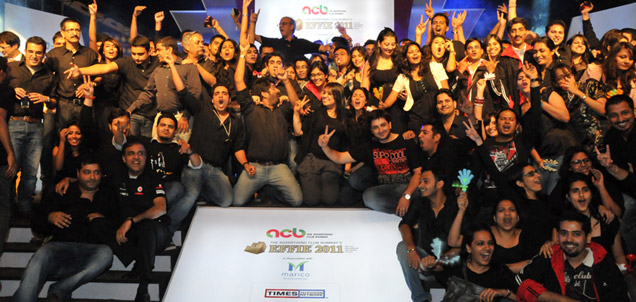
  • Cadbury & O&M top Effies 2011 honours


    By A Correspondent


    On an exhilarating race day, at a place where horses would be galloping and competing their way for a finish to the top, yesterday it was the turn of the advertising fraternity to trot the turf and vie for their prized silverware. Mahalaxmi Racecourse in Mumbai was host to Effies 2011, the only awards show of its kind that recognizes effective advertising by creative agencies.


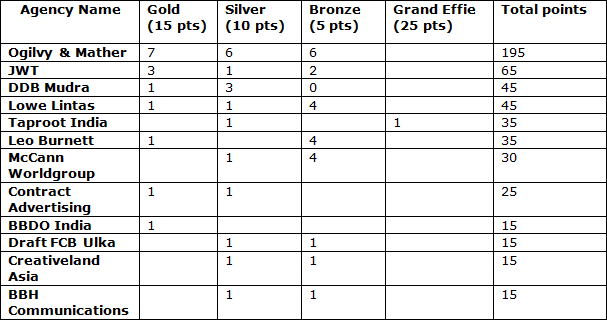
    Having finished as the agency with the highest number of shortlists, Ogilvy & Mather didn’t disappoint as it swooped a bagful of awards – 19 metals in all – leading it to be pronounced the Effie Agency of the Year for 2011. With a tally of 195 points – 7 Golds, 6 Silvers and 6 Bronzes, Ogilvy thumped its nearest rival JWT by almost thrice the number of metals, a milestone that has been a regular affair at the awards. JWT came a distant second with 65 points – 3 Golds, 1 Silver, 2 Bronzes, while DDB Mudra and Lowe Lintas were tied for the third spot with 45 points each.


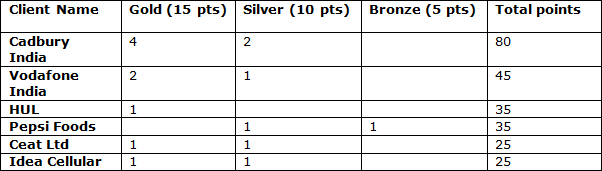
    The icing on the cake for O&M was when its coveted client Cadbury was declared the Effie Client of the Year. With 4 Golds and 2 Silvers, Cadbury edged out Vodafone India – an Ogilvy client as well – which occupied the second spot with 2 Golds, 1 Silver and 1 Bronze. HUL came third with a single Gold and 4 Bronzes.


    Flagging off the awards ceremony, Shashi Sinha, President of the Bombay Ad Club welcomed the gathering by stating that it had been a stellar an experience for the organising committee and the judges who managed to sieve and rummage through a bundle of noteworthy entries. Apart from the big number of entries and new additions the event managed to attract, Sinha said that the awards was different from the others, as it was run on international guidelines and was importantly, controversy-free.


    Lavishing praises on the event, Chairperson – Effie Committee and fellow-member, Ajay Kakar began by citing an anecdote. “During my early days as an executive in an ad agency, I used to often hear marketers say that half the money I spent on advertising is wasted and the trouble is, which half was wasted was not known. But with the instituting of the Effies, that perception has changed. In fact, it is the only awards show where both the client and the ad agency walk together to collect the awards.”


    According to Kakar, it was truly a remarkable experience for the organising committee this year as there were more categories – 12 in all, which saw around 300 entries and the 80 judges had the arduous task of shortlisting the best.


    Winning stance

    Elated with another super showing, Abhijit Avasthi, NCD, Ogilvy India remarked: “We are absolutely thrilled, given that Effies is a culmination of the year’s efforts and that it is the right balance between creativity and effectiveness in the marketplace. What’s more reassuring and satisfying is that the wins are across a lot of categories and clients.”


    When asked to comment on his client bagging the Client of the Year award Avasthi said: “Though we are happy that Cadbury has bagged the Client of the Year award, we have been supported phenomenally well by our other clients too.”


    Not disheartened by the performance of his agency, Colvyn Harris, CEO, JWT India, which came in second, said: “Every year, around this time, we review the works that we do for our clients and given our standing at the Effies this year, we hope to start 2012 with a brand new team so as to compete closely with the No 1.”


    On Effies being a great creative platform for agencies, Colvyn said: “I think Effies is a great platform for one to showcase their work, because finally, creativity may be everything but this is as important, if not more important, from a client’s point of view. If you are not successful in the marketplace, then nothing else matters. So my ambition is obviously to do well at the Effies and back that up with a good creative showing as well.”


    It was a night of thrilling proportions for Agnello Dias and Santosh Padhi from Taproot India as they bagged the envious Grand Effie award. Sharing his initial reaction on the win, Agnello Dias, co-founder, Taproot India said: “It keeps getting better. When I won for Lead India, I thought this is it; I won’t get another Grand Effie. Then Teach India happened and this year I won a Grand Effie again. So it keeps getting better. It’s even more satisfying that we are doing it outside of a large network agency and we are doing it on our own.” On the hopes for next year, Aggie said that he aimed to continue the feat with Airtel and maybe also Pepsi.


    Enumerating on their win, Santosh Padhi, co-founder of Taproot India said: “We had sent four entries, of which three were shortlisted, while two bagged awards. So I guess it was a pretty good showing. Considering the size of our agency – we have around 30 people, versus other big agencies that have 3,000 people, or more. Competing with them and coming fifth is an outstanding achievement for us. This shows that it is not numbers that matter but the power of an idea that is important.”


    Joseph George, CEO, Lowe Lintas, which tied for the third spot, said: “I think we could have done much better because Effies are the only awards that we seriously participate in. Actually, we were a bit disappointed with the shortlist itself considering we had sent more than 20 entries. But no worries, we will try harder and do better next year. What is important is that the No 1 tag is never to be taken for granted and the same goes for No 2 and 3. So we hope to be back next year, bigger and stronger.”


    The other commendable awards for the night included Marico Uncommon Sense Award that was bagged by O&M for Vodafone’s ‘Blackberry for Everyone’ and Brand Equity Bravery Award that was bagged by BBDO India for Gillette Mach3 Turbo – Shavesutra.


    Tally:


    Effie Client tally:

  • The Anchor: 7 ads that star sports and sportsmen

    By Hemant Kenkre


    In no particular order – from the dancing girl on the cricket field to Sehwag’s Ma – there’s something about Indian ads and sports that hits the spot


    #1 Palmolive Da Jawaab Nahi:The Haryana Hurricane, as Kapil Dev was known, endeared himself to millions of Indians (not just cricket fans) with the line from the Palmolive Ad – ‘Palmolive Da Jawaab Nahi. ’ Kapil’s earthy personality and toothy smile in the ad will always be remembered as much as the “Kitne Aadmi The” dialogue from Sholay.
    #2 Cadbury – Asli Swaad Zindagi Ka:Can anyone forget the Cadbury TVC where the lady friend of the batsman prances out on the field and dances her way into the arms of her hero, who has just hit a six? Kucch Khaas Hai Is Ad Main!
    #3 Josh Ka Rang – Coca-Cola 1996 World Cup:In 1996 when Coca-Cola won the pouring rights for the ICC World Cup (India. Pakistan & Sri Lanka), they announced their return into India with a super TVC – Josh Ka Rang –that ‘played’ around the colour red, showed youngsters from the Indian sub-continent playing on the streets, on the banks of the Jamuna, with the Taj as the backdrop, running among red-chillies laid out to dry. All peppered with the awesome ‘Dum Mast Kalandar’ track by Nusrat Fateh Ali Khan
    #4 Nothing Official About It – Pepsi 1996:While Coca-Cola’s TVC and strong PR campaign for the 1996 ICC World Cup was going great guns, rivals Pepsi  pulled the rug from under their feet by launching their campaign ‘Nothing Official About It,’ which featured most Indian and international cricketers who were playing the World Cup and cocked a cheeky snook at Coca-Cola’s ‘Official beverage of the Cup’ status
    #5 Aila Plane – Pepsi  2003 ICC World Cup:This Pepsi campaign, where Shane Warne and Carl Hooper kidnap Sachin Tendulkar – ostensibly to put him out of action from the tournament – is hilarious. Especially Warne and Hooper mouthing Hindi words like ‘Iski Toh Gayee’ and when Sachin sees an aircraft and says ‘Alia Plane’
    #6 Nike 2007 Cricket:The 2007 edition of the ICC World Cup saw Nike, the official apparel sponsor of the Indian team produce a superb TVC where young cricketers atop a bus stuck in a traffic jam, playing the game with passion, smashing tea cups from the hands of innocent bystanders all spiced with the Goan folk song ‘Yo Baile Yo’ playing in the background.
    #7 Karlo Duniyaa Mutthi Main, Sehwag Ki Maa – Reliance Mobile:This TVC was probably inspired by a Bollywood blockbuster where the Najafgarh’s hero (Virendra Sehwag) cannot connect bat to ball and gets a call from his Mother who tells him ‘Karlo Duniyaa Mutthi Main.’ Our hero tosses off his helmet and the ‘villainous’ bowler is promptly whacked out of the park by Viru!


    A communications professional, Hemant Kenkre played cricket for Bombay University and has captained the Cricket Club of India.