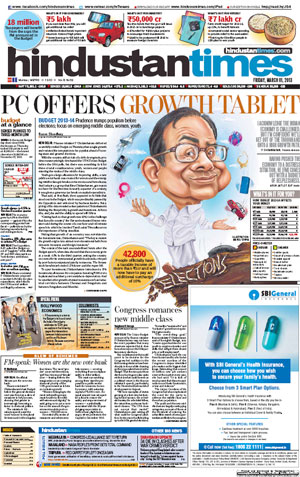
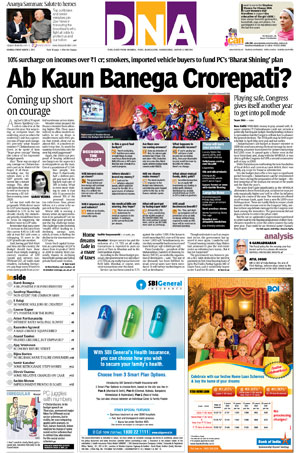
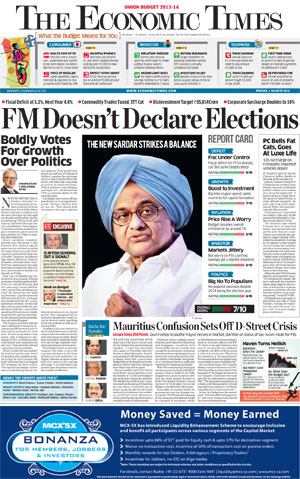
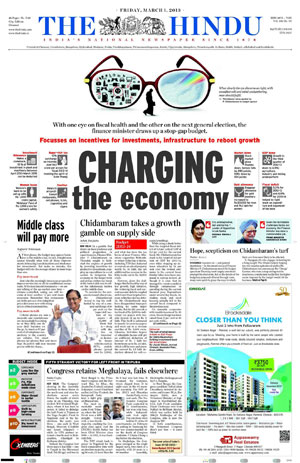
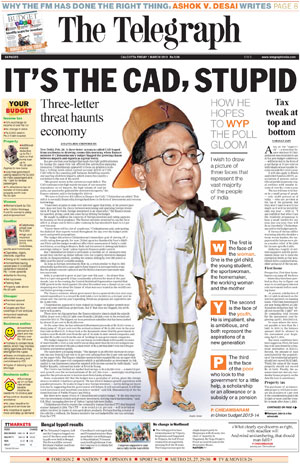
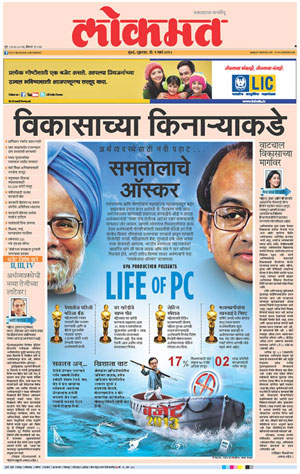
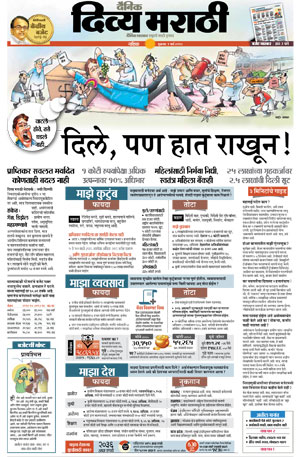
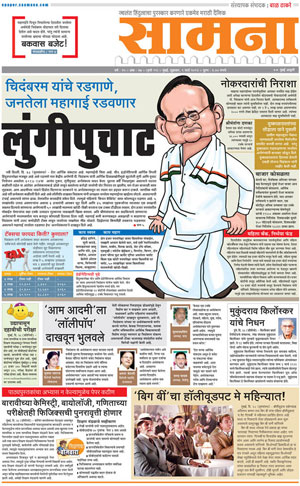
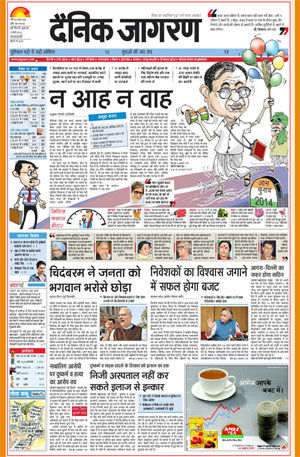
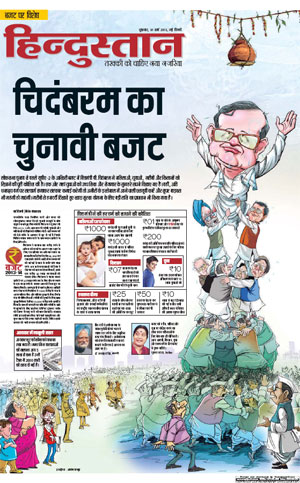
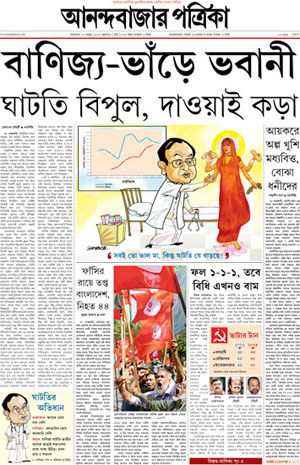
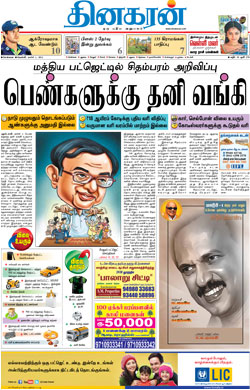
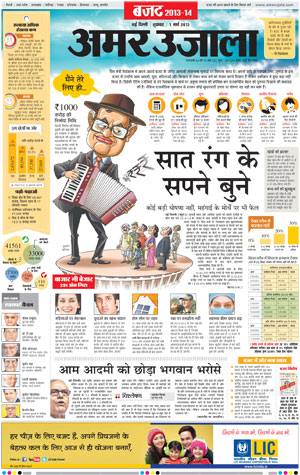
And this is how some newspapers captured the Union Budget 2013-14 proposals on their front pages
|
|
|
|
|
|
|
|
|
|
|
|
|
|
|
|
|
|
|
|
|
|
|
|
|
|
|
|
|
|
|
|
|
 And this is how some newspapers captured the Union Budget 2013-14 proposals on their front pages
|
|
|
|
|
|
|
|
|
|
|
|
|
|
|
|
|
|
|
|
|
|
|
|
|
|
|
|
|
|
|
|
|
By Nandini Raghavendra
The Union Budget 2013 does not have good news for the Cable and DTH operators. The import duty on set top boxes, which are mandatory post the government’s digitization plan, has been increased from the present 5% to 10%.
With almost, 100% of the set top boxes being imported, this directly affects not only the operators but also the consumers as the cost rise will be passed onto them, eventually.
Digitization was a government mandate which the cable industry has supported. However, this increase, which will definitely work out to at least 6-7% eventually, will force us to pass down the rise in price to the consumer.
If you calculate merely Phase II of the digitization roll out, we need 20 million set top boxes, and this rise will make an approximate difference of Rs 100 per box, which means a minimum of Rs 200 crore burden on the operators.
Meanwhile, there is Kolkata and Chennai still to be completed in Phase I. For the consumer, there is also the power consumption a single set top box consumes since it needs to be left on, which is 18-20 watts per box per month.
All of this means adds a huge burden on the consumer,” says a dejected President of the Cable Operators Federation of India, Roop Sharma who counts 60,000 cable operators as members.
An important point she adds is that while we have a section of the country, which cannot afford even the one single set top box, we also have houses with two-three TV sets each of which will need a set top box to function.
The affect of this on the digitization process will affect the whole television industry. A fact, CEO, Colors, Raj Nayak too points out.
“For the broadcasting industry, given the initiative of the government towards digitization, a process which was in acceleration mode with Phase II and III still to be implemented, a hike on the import duty of set top boxes may just act as a speed breaker.”
For the DTH operators, who are taxed heavily in any case, this comes as possibly the worst news. Already paying 32% of their top line as taxes before they even see the money, as Harit Nagpal, CEO Tata Sky and also President of the DTH Association says, this doubling of import duty on set top boxes, comes as a shocker. “On the one hand the government is serious about digitization.
On the other, there is no known reliable source of boxes, so where are we going to source them from. This is a retrograde step from the government which will affect us by at least $20 million approximately.”
The DTH industry, has been crying hoarse about the dual levy of tax, which is service tax as well as VAT on activation charges.
In fact, even bodies like FICCI’s entertainment and media sector had appealed to the ministry and other relevant stakeholders for the need for reduction of customs duty on import of Set top boxes as well as more infrastructure status to the cable, broadcasting and DTH verticals.
How this will affect the roll out of digitization is the most important impact to be seen from here.
Source:The Economic Times
Copyright © 2013, Bennett, Coleman & Co. Ltd. All Rights Reserved
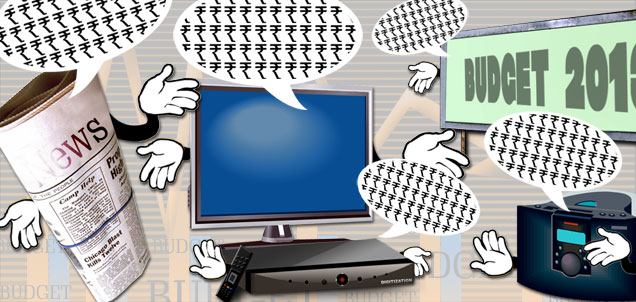
By Johnson Napier
With business as a whole still awaiting an uptrend in the economy, the talk in the media and entertainment sector has centred around how avenues and investment options for growth are drying up and the need for a fillip to resurrect the once-vibrant sector. Trade analysts have been long anticipating the bounce-back in the economy, with projected time-frames going from post-September 2012, to first-half 2013, and now to the second half of 2013.
Finance Minister P Chidambaram was expected to wield a magic wand, but while the Union Budget was announced yesterday, there was nothing really significant that could revive the hopes of thousands of employees in the media and entertainment space who waited with bated breath for SOPs and benefits to be doled out. This was after the media went gaga about how the budget would be a more pragmatic than populist in its approach if the UPA government fancied a third term into power at the Centre.
Of the few measures announced by the Union Finance Minister for the M&E sector, the most important one was directed towards the radio sector. The Minister announced that it would expand private FM services to 294 more cities and that about 839 new FM radio channels would be auctioned in 2013-14 and, after the auction, all cities having a population of more than 100,000 would be covered by private FM radio services. The other important announcement was not a good one where the Minister proposed increasing customs duty on set-top boxes from 5 to 10 per cent.
Hope for a few, dejection for others

Analyzing the overall scenario, including measures announced for the film industry as well, Rakesh Jariwala, Tax Partner, Ernst & Young said, “The budget has given partial relief for the film sector as the non-theatrical revenues of a movie are now brought back in the tax net. Producers and distributors will be able to recover a portion of their input credits with this change, thus mitigating a portion of the adverse impact created by the complete exemption granted last year. For non-film business, impact of removal of exemption to copyright transactions will have to be measured in terms of eligibility of the service receiver to take credits. However, the question of double taxation of transactions in intangible rights (between service tax and Value added tax) remains unanswered.”
Adding further he said, “The budget will increase the income tax cost on account increase in corporate income tax surcharge from 5 percent to 10 percent. Any outbound remittance towards IP royalties (except film exhibition royalties) and/ or fees for technical services will be subject to increased 25 percent tax rate, subject to a better tax treaty rate. Investment in specific plant and machinery towards manufacture of article or thing by media companies in excess of 100 crores will qualify for additional tax allowance at 15 percent. Also, Increase in import duty for set top boxes from 5 percent to 10 percent may increase the cost for DTH/ Cable operators. Applying service tax on exploitation of copyright in cinematograph film with the exception of exhibition rights should result in improved credit situation for the industry.”

So while the good news is mostly limited to the sector of radio, the repercussions of the hike in duty of STBs is not being taken well by the other factions of the industry. Smita Jha, Leader, E&M Practice India, PwC said, “In principle, this move is to encourage local manufacturing of STBs. In that sense, it is a step in the right direction for the prospect of local manufacturers. But having said that and keeping the DAS deadlines in mind, I am not sure if it will really benefit the industry. With customs duty being raised, the cost will be passed onto either the consumer or be borne by the STB importers. Given that the prices of STBs are also very competitive, it is not good news for MSOs and LCOs since they might have to bear the costs.”

Jha’s assessment found resonance with Roop Sharma, President, Cable Operators Federation of India who said, “The increased customs duty on STBs will be passed onto the consumer. Though it is a very good step to promote indigenous STB manufacturers, if it will maintain BIS standards. The imported STBs are Chinese-quality and not very good. From LCO’s point of view, it will be beneficial for consumers for they will get good-quality indigenous STBs.”

The most worrisome response perhaps came from FICCI M&E committee. Uday Shankar, Chairman, FICCI M&E committee said, “FICCI expresses its shock at the proposed doubling of customs duty on the import of set-top boxes to 10 per cent from the existing rate of 5 per cent, announced by the Finance Minister in the Union Budget 2013-14. We strongly believe that an increase in import duties on STBs will be detrimental to the government’s digitization programme that was flagged off last year. This move at this stage will hamper the progress of digitization since it will significantly increase the outlays of the cable and DTH community. It will also adversely impact the government’s tax collections from additional revenues linked to faster digitization.”
According to Mr Shankar, the availability of lower-priced set-top boxes is pivotal for smooth implementation of digitization. “The domestic industry lacks the scale and size required to meet the increased demand for set-top boxes and the industry is heavily dependent on import of these devices to implement the next phase of digitization. This sharp increase in import duty will escalate the costs for consumers and can potentially derail the digitization process,” he said.
Adding further he said, “FICCI has been consistently recommending the lowering of customs duty on set-top boxes. The government could have instead considered lowering excise duty on local manufacturing of set-top boxes, thereby ensuring timely supply of such devices at lower costs and urges the I&B Minister and the Finance Minister to review and reconsider this proposal and provide much-needed relief to the media and entertainment sector.”

Presenting a more diverse view on the budget, Ajay Chacko, President, A+E Networks|TV 18 said that apart from the rise in customs duty on STBs and a forward-looking incentive for radio players, there are other things that one should look at that can impact the way the industry functions. He said, “Media business is primarily driven by consumer products and consumer products means consumption. So if there is an increase in the disposable income it kind of motivates people to spend more. So there have been some attempts to increase consumption and disposable income if not growth of the industry as such.”
According to Chacko, the waiver that has been given to the housing sector and boosters being given to a couple of other industries as well will see the advertising environment picking up in terms of spends. “This will be a good thing to happen as the advertiser spending has been slow in the past two years. So there has been an attempt to revive consumer spending which will at least lead to halt in the downward spiral of advertising spends.”

While a few hopes were indeed crushed, there were others who were satisfied with the outcome of the Budget. Like Tarun Katial, CEO, Reliance Broadcast Network Ltd, who said, “The Budget brings good news for the radio industry, with Phase 3 poised to create optimal reach for the medium. Other benefits like news, networking, current affairs and sports, multiple frequencies etc will add the necessary fillip to further fuel listenership growth through reach and content diversification and will also drive profitability and revenue through cost optimization.”

Expressing his joy, Prashant Panday, Executive Director & CEO, ENIL said, “We are happy that the Finance Minister announced the imminent launch of Phase 3 of radio expansion. With this, we hope all hurdles to the launch of Phase 3 are now removed. We hope quick action now follows this announcement.”

Echoing a similar sentiment, Apurva Purohit, CEO of Radio City, said, “We welcome the announcement of Finance Minister on the government’s resolve to expedite Phase 3. This impetus would help FM radio expand and offer the choice of consuming private FM radio to millions living in smaller towns. We are looking forward to the same.â€
Not much effect on other domains
As for the impact on other mediums, there was a mixed bag of feelings that emerged. Pradeep Gupta, CMD, Cybermedia said, “As I see it there is not much that has come out from the budget for the M&E industry as such. But then the print industry had also made a request to the government to not increase the rates of any duty structure for the benefit of the industry. And the government hasn’t raised any rate on the duty as such. So I suppose it will be business as usual for the print industry.”

IAA President Srinivasan Swamy said, “The budget unfortunately does not do anything to spur growth to the industry which will lead to handsome growth to Media and Advertising industry. This is reflected in the sentiments of the stock market. 2013-14 is only likely to see a single digit growth in the industry and this means the growth is likely to be in line with inflation. Not a happy state to be in.”

Sunder Hemrajani, Managing Director, Times OOH said, “As can be inferred, there is nothing as such for the Outdoor industry in the budget. However, there is a positive correlation between business confidence, investment, GDP growth and growth in advertising spends. Some of the budget proposals are expected to provide the impetus for growth in the economy. This should spur growth of the OOH industry which has had a difficult year. But high food inflation and fiscal deficit continue to be a challenge.”
The overall sentiment could probably be summed by what Amar Ambani, Head of Research, India Infoline Ltd (IIFL), had to say on the Union Budget 2013-14: “The FM presented a rather non-eventful budget given that fiscal deficit targets were vocally communicated earlier. The market was disappointed with the evident populism in the budget through higher social scheme allocations despite limited headroom. The math for achieving 4.8 percent fiscal deficit in FY14 looks vulnerable to slippage. Further, it was also not a budget which can revive the sagging economy. Absence of key reform measures such as GST implementation was also dejecting.”
For now, M&E will have to look to other key industries which have benefited from the Budget, and who advertise heavily, to pump up their growth story so that positive effects rub off onto the M&E sector as well.
By Nandini Raghavendra & Maulik Vyas
So, what has celebrating a centenary of the Indian film industry got from the Finance Minister as a budget present? Some partial relief in terms of a small correction from last year’s budget. So far, non-theatrical revenues of a film like satellite and music and home video, were not in the tax net.
Now, they are. What does this mean?
“Producers and distributors will now be able to recover a portion of their input credits with this change, thus mitigating a portion of the adverse impact created by the complete exemption granted last year,” said Rakesh Jariwala, Tax Partner, Ernst & Young.
Dharma Productions COO, Apoorva Mehta, also welcomed this adding that this would bring some relief as satellite deals account bring in a significant amount helping the producer to off set cost to revenue. In fact, an international studio head not wanting to be quoted said, it would make at least a 7% difference, thereby bringing down the overall 12.33% cost addition.
The partial relief of service tax brings back all exploitation avenues, barring movie exhibitions in cinema halls, within the service tax net.
The move to restrict the exemption on the transfer of copyright in cinematographic films is a welcome move which addresses the anomaly created by the exemption granted last year.
This clarity will help movie makers and cinema halls since it will avoid double taxation to cinema halls. “Last year, at the request of the film industry, full exemption of service tax was granted on copyright on cinematography,” said the FM, in his budget speech.
“The industry has now requested to limit the benefit of exemption to films exhibited in cinema halls. I propose to accept the request.”
A fact, Rohan Shah, Managing Partner of Mumbai-based corporate law firm Economic Laws Practice says will help the around 11, 000 single screen theatres in India and the over 1,000 multiplex screens across the country, projected to grow to 1,600 by 2013.
“There was a significant sunk tax cost on taxes paid on input services consumed by production houses. By this latest amendment, the production house will be able to avail proportionate tax credits in relation to revenues generated through broadcasters and other avenues, other than theatrical release,” says Mr Shah, welcoming the measure of tax and credit efficiency which will benefit all production houses that have revenues generated from a variety of sources.
Source:The Economic Times
Copyright © 2013, Bennett, Coleman & Co. Ltd. All Rights Reserved

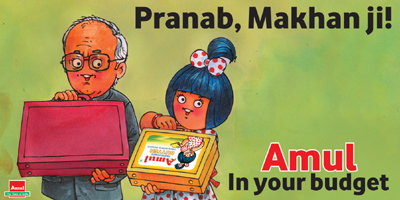
The Amul ad post last year’s Budget (2012)
Pranabda’s Budget (2011)

P Chidambaram’s first Budget (1996)

When Dr Manmohan Singh, then Finance Miniser, increased the Income Tax exemption limits (1993)

Dr Manmohan Singh’s maiden (and much-hailed) Budget (1991)

It’s Budget Times (1983)
 By Anil Thakraney
I am no Nani Palkhivala. Therefore, if you are looking for insights on fiscal deficit and other such financial jargon, you are at the wrong place. Regardless, here’s my vishesh tippani on some of Chiduji’s outstanding proposals, all based on street logic. Which is actually the best way to analyze a budget.
10 percent super tax on the super rich: Good. As I said in an earlier post, if our bada seths won’t be generous voluntarily, they have to be compelled. The sad reality, of course, is that this will be a super tax on the super rich on their ‘white’ income. So you can well imagine what the fat cats’ POA will be to counter this new menace.
Cigarettes will cost more. Wow, that’s a new one! How imaginative, Chiduji! I think time has come to thank our smoker pals. Year after year they help to narrow India’s fiscal deficit. And we keep kicking them out of public places. Unfair!
India’s first All-Women Bank: Well, I can already see the bank robbers smiling. Jokes apart, this is not what India’s aam aurat needs. What she needs is things like public toilets, especially ladies from the lower strata.
Nirbhaya Fund of Rs 1000 crore for women’s safety: Firstly, it’s injustice to the dead girl that this is not being drafted in her own name, but in a pseudonym coined by a newspaper sub. Secondly, I don’t know if the fund will go into keeping our women safe, but it does sound like a lottery win for some netas and babus. Both, male and female.
TDS of 1 percent on property sales exceeding Rs 50 lakh: This will take us right back to the ‘B&W’ era. Even high end apartments will go for 49.5 lakh rupees.
Service tax in air-conditioned restaurants: You are all welcome home. And please invite me too.
My dream of owning an SUV now looks more unreal than ever. Nano, here I come!
One last thing: My maid was swabbing the floor when Chiduji was busy delivering his address to the nation. She asked how the budget will change her life. I said she’ll now have her own bank, so no need to mingle with us lecherous men. Her swift response (which I have politely translated from her Marathi): “But where’s the money to deposit, sahib? I am okay with lecherous men, give me some money instead. That’s more important.”
Good luck to the UPA for the 2014 elections.
***
PS: While on the subject of budgets, I have just one thing to say on the railway one: The mantri forgot an easy revenue source. He should find a way to penalize passengers who litter the compartments and dirty the loos. This will result in many of us ditching air travel and returning to the trains. Make no mistake about this: Railway is the most beautiful way to travel in this country. Unless you own an SUV, which, thanks to Chiduji, is now way out of my league.
By Sunder Hemrajani,
Managing Director, Times OOH
As can be inferred, there is nothing as such for the Outdoor industry in the budget. However, there is a positive correlation between business confidence, investment, GDP growth and growth in advertising spends. Some of the budget proposals are expected to provide the impetus for growth in the economy. This should spur growth of OOH industry which has had a difficult year. But high food inflation and fiscal deficit continue to be a challenge.
By Uday Shankar
FICCI expresses its shock at the proposed doubling of customs duty on the import of Set Top Boxes to 10 per cent from the existing rate of 5 per cent, announced by the Finance Minister in the Union Budget 2013-14.
We strongly believe that an increase in import duties on set top boxes will be detrimental to the government’s digitalization programme that was flagged off last year. This move at this stage will hamper the progress of digitalization since it will significantly increase the outlays of the cable and DTH community. It will also adversely impact the government’s tax collections from additional revenues linked to faster digitalization.
Availability of lower-priced set top boxes is pivotal for smooth implementation of digitalization. The domestic industry lacks the scale and size required to meet the increased demand for set-top boxes and the industry is heavily dependent on import of these devices to implement the next phase of digitalization. This sharp increase in import duty would escalate the costs for consumers and can potentially derail the digitalization process.
FICCI has been consistently recommending the lowering of customs duty on set-top boxes. The government could have instead considered lowering excise duty on local manufacturing of set-top boxes, thereby ensuring timely supply of such devices at lower costs and urges the I&B Minister and the Finance Minister to review and reconsider this proposal and provide much-needed relief to the media and entertainment sector.
Uday Shankar is also CEO, Star India
By Ajay Chacko
President, A+E Networks|TV 18
Apart from the rise in custom duty on STBs and a forward-looking incentive for radio players, there are other things that one should look at that can impact the way we function.
Media business is primarily driven by consumer products and consumer products means consumption. So if there is an increase in the disposable income it kind of motivates people to spend more. So there have been some attempts to increase consumption and disposable income if not growth of the industry as such. The waiver that has been given to the housing sector and booster given to a couple of other industries will see the advertising environment picking up in terms of spends. This will be a good thing to happen as the advertiser spending has been slow in the past two years. So there has been an attempt to revive consumer spending which will at least lead to halt in the downward spiral of advertising spends.
By Tarun Katial
CEO, Reliance Broadcast Network Ltd
The Budget brings good news for the radio industry, with Phase III poised to create optimal reach for the medium. Other benefits like news, networking, current affairs and sports, multiple frequencies etc. will add the necessary fillip to further fuel listenership growth through reach and content diversification and will also drive profitability and revenue through cost optimization. With deeper penetration, radio can play a key role as a catalyst of social transformation through partnership for CSR initiatives, social causes and Government initiatives, as it reaches where no other medium can because of literacy and cost issues. With expansion to 300+ cities, it stands to reach 90% of the Indian population, making it truly, a common man’s medium!
By Smita Jha
Leader, E&M Practice India, PwC
On overall basis, the M&E industry sends several recommendations every year to the ministry. It is of course, not realistic that all of them should be met. And it is not to say that wishlist not be sent every year. It is not realistic that everything on the wishlist be met. There were two things that were talked about, in regards to M&E industry. On FM Radio, it is not very clear from the budget perspective what the statement meant. If at all the statement means that Phase 3 licensing would be undertaken, then I am very pleased. If that is what the statement meant, though it is not very clear yet. Then, of course there is custom duty increase on STBs. In principle, this move is to encourage local manufacturing of STBs. In that sense, it is a step in the right direction for the prospect of local manufacturers. But having said that and keeping the DAS deadlines in mind, I am not sure if it will really benefit the industry. With customs duty being raised, the cost will be passed onto either the consumer or be borne by the STB importers. Given that the prices of STBs are also very competitive, it is not a very good news for MSOs and LCOs since they might have to bear the costs.”
By Rakesh Jariwala
Tax Partner, Ernst & Young
Partial relief for the film sector as the non-theatrical revenues of a movie are now brought back in the tax net. Â Producers and distributors will be able to recover a portion of their input credits with this change, thus mitigating a portion of the adverse impact created by the complete exemption granted last year. Â For non-film business, impact of removal of exemption to copyright transactions will have to be measured in terms of eligibility of the service receiver to take credits. Â However, the question of double taxation of transactions in intangible rights (between service tax and Value added tax) remains unanswered.
The budget will increase the income tax cost on account increase in corporate income tax surcharge from 5% to 10%. Â Any outbound remittance towards IP royalties (except film exhibition royalties) and/ or fees for technical services will be subject to increased 25% tax rate, subject to a better tax treaty rate. Investment in specific plant and machinery towards manufacture of article or thing by media companies in excess of 100 Crores will qualify for additional tax allowance at 15%. Â Increase in import duty for set top boxes from 5% to 10% may increase the cost for DTH/ Cable operators. Applying service tax on exploitation of copyright in cinematograph film with the exception of exhibition rights should result in improved credit situation for the industry.