Tag: BCCL

  • Satyam Joshi has put in his papers as Dy Chief Manager – Brand at BCCL

    By A Correspondent


    Satyam Joshi, who has worked with The Times  of India group for nine years, has put in his papers. As Deputy Chief Manager – Brand, he was actively involved in the language business and was heading marketing for the Delhi edition of Navbharat Times, Sandhya Times and Economic Times (Hindi) since the last 6 years. He is set to take the entrepreneurial route.


    Prior to joining Navbharat Times, Mr Joshi helped set up the ‘Non – traditional revenue stream’ for Radio Mirchi, popularly known as Mirchi Activation.


    In his 13 years in sales and marketing, he has been associated with different industries as well, specifically ICICI Bank and Bombay Dyeing where he was responsible for building the channel and improving the distribution.


  • Tendulkar, Bindra launch ‘Sporting Times’

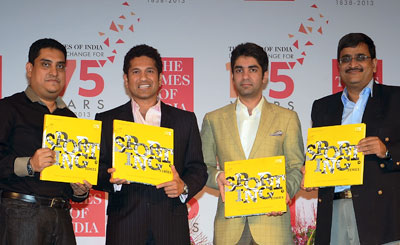
    Sporting Times launched by Sachin Tendulkar, Abhinav Bindra along with Boria Majumdar and Shrijeet Mishra- COO Times Group

    As part of The Times of India’s 175 years’ celebration, seven books highlighting the best from the last 175 years are being launched. The first of this titled ‘Sporting Times’ and compiled by Boria Majumdar was launched by Sachin Tendulkar, Abhinav Bindra and Shrijeet Mishra, COO, BCCL.


    The book is an attempt to document the Indian sporting story through the lens of The Times of India. It talks of 175 events that have made headlines in the history of Indian sport (and in the paper) in the 1838-2013 period.


    Both Tendulkar and Bindra congratulated the newspaper on its 175th anniversary and participated in a Q&A with the media. And, no, there was no question asked on the current controversy raging Indian cricket.


  • Mediaah! Now, BCCL’s Times Publishing House takes on law student-blogger

    By Pradyuman Maheshwari


    I have been receiving various smses and calls since yesterday about the legal notice that Bennett Coleman’s Times Publishing House is said to have sent a student blogger on Spicy IP, a site that deals with intellectual property issues. It was a flashback to some of the stuff that I was subjected to many years back.


    But eight years since that happened, I am wiser, understand the law and what can be construed as defamation.


    My view on the episode:

    I have read the offending article, the TPH lawyer’s notice that the website has put up, the website’s reply to TPH and its coverage of the entire issue. (here, here, here and here).


    The student Aparajita Lath’s article discusses the two decades-old battle that Financial Times of London has had with BCCL’s company Times Publishing House (TPH) over the use of the Financial Times title which TPH has been using for a special edition published from a few centres.


    I don’t think it’s correct to use the words fair or unfair in business, but it would be perhaps be right to say that it was a smart business strategy which obviously BCCL has protected over the years.


    Over the last few years, Financial Times (of London) has been flexing its muscles with an eye on launching in India. Mint, the Hindustan Times group’s business daily, has covered the issue extensively. Mint, has been covering media extensively since launch, so it’s not an issue of a rival media group embarrassing BCCL with these reports. That it happens (the embarrassment) is I guess a welcome byproduct.


    Is Aparajita’s article defamatory? No, it isn’t, though it’s laced with some opinion. She bases her article on four Mint reports and a few posts from Spicy IP.


    Is it embarrassing for BCCL? Not at all, because Spicy IP isn’t read by the masses. It’s a site for a special interest group, and even if it’s popular amongst a small section of legal practitioners and the judges, it would hardly make any impact on the case.


    Yes, the reply from Spicy IP is strong, and I am not sure if all that the editor/publisher has written is warranted, but Aparajita’s post is hardly of the nature that TPH should’ve employed a lawyer to send a legal notice. There’s a technical error, admits Spicy IP, which it would’ve corrected.


    What is upsetting is why The Times of India group did not engage the student and the site either informally with a call or a face-to-face meeting or via a letter or simply a post on the site. By doing what it has done, it’s not only going to earn the wrath of the large and aggressive online fraternity but also have people digging for more negatives of the group. All very avoidable at a time when flagship daily The Times of India celebrates 175 years of existence. After all, doesn’t the group believe in Aman Ki Asha to foster peace with Pakistan and promote various improve-the-country-and-the-world movements like Lead India, Teach India and now I Lead India?


    Pradyuman Maheshwari is Editor-in-Chief and CEO, MxMIndia, but the views expressed here are his own and aren’t necessarily the stated position of MxMIndia. Reach him at Twitter at @pmahesh or BBM at 29fea79c.


  • [RECALL] Inside the Times 175 years’ celebrations


    It’s celebration times in Indian media as The Times of India completes 175 years of existence. The exercise was kicked off in right earnest last fortnight with much fanfare. We posed a few questions on the celebrations to Rahul Kansal, Executive President of BCCL. And since it was Mr Kansal who was giving us a low-down, we also spoken on branding issues and asked him for finer details… beyond what’s already carried in the announcements.

    A veteran adman (Deputy Managing, Leo Burnett – 2000-02; Exec Director, Mudra 1994-2000 and Exec Director, Ogilvy 1989-94), Mr Kansal has been with BCCL since 2007, initially as CMO and since last year as Exec President.


    Excerpts from an interaction of Mr Kansal with Pradyuman Maheshwari:


    Q. One still remembers the 150 years sesquicentennial celebrations of The Times of India. What can one expect from the 175 years’ celebration? We’ve been seeing a celebration in the paper in the form of culling the best of the last 175 years…. Could you share a few specifics?

    Well, we’ve started with celebrating India’s journey over the past 175 years, and of giving readers a glimpse of how we’ve helped lead the change in the country over this period. We’re doing daily editorial spreads mining the best material from our archives and presenting them in a contemporary context.


    We’re also doing seven books on various themes, covering the defining moments over the past 175 years in sports, cinema, society and politics. The books are being anchored by acclaimed journalists and authors like Bachi Karkaria, Jug Suraiya, Santosh Desai, Boria Majumdar, Sandipan Deb and others. The first, Sporting Times, authored by Boria is being launched on May 23 in Mumbai, by some of India’s sporting luminaries like Sachin, Abhinav Bindra and Mary Kom.


    In a few weeks from now we’ll get into the heart of the 175 years’ celebration: a powerful activation programme called ‘I Lead India’. Being launched on a scale bigger than any of our earlier such interventions, the programme is basically an exhortation to India’s youth to stop whining about all that’s going wrong in our society, and instead start doing something about it. It asks our youth to say: Enough of pointing fingers, of blaming the ‘system’, of wanting them to change. I must be the change I wish to see in the world. I (will) Lead India.


    ‘I Lead India’ will peak in early November. This will be followed by a round of celebrations covering 25-odd cities, including, hopefully, some marquee programmes in some of the larger cities.


    Q. It started on April 23…. Till when will it continue (given that the ‘birthday’ is in November).

    The ‘I Lead India’ programme will reach a crescendo on November 10 – the actual birth date. And then we’ll go into a month-and-a-half of celebrations (musical and other cultural events across various cities of India)


    Q. Other than the ads in TOI group publications, we see a Ranbir Kapoor TVC, hoardings across Mumbai . Could you share some details of what the playout is going to be? Any more TVCs being planned?

    For the 175 years’ celebration there are several print ads, the Ranbir Kapoor film, various radio and outdoor messages. Besides, we are developing seven books, some very interesting merchandise (t Shirts, mugs etc) and some other interactive ideas. There will also be a stamp from the Government of India.


    ‘I Lead India’ will have an extensive communication package including 3 TVCs and an intensive package of print, radio and outdoor advertising.


    Q. It was good to see a TOI 175 years’ celebration ad take the HT Delhi Page 1 solus (and HT granting that to TOI). Do we see similar ‘tie-ups’ elsewhere?

    HT and we always agree to take each others’ ads in our papers, so long as they are not directly competitive or denigrating the other’s brands


    Q. The sesquicentennial had in many ways seen The Times of India (the paper) take a quantum leap, turning into a modern-day newspaper publishing company. Do you wish the 175 years celebrations to help you achieve a similar transformation?

    In the past 25 years, the TOI has already become a very robust brand, at the cutting edge of technology and of modern journalistic and management practices. The 175 years’ celebration is more to dedicate ourselves to the future rather than wallow over the past. It will seek to further cement its position as ‘The Masthead of India’, and in particular, as the voice of young India.


    Q. The Times of India footprint (@150) has increased much in the last 25 years. Do we expect a nationwide celebration or restricted to the publishing centres?

    Well, our publishing centres are ‘nationwide’ now. We will have ‘I Lead India’ chapters as well as the subsequent celebrations in 26 centres around the country.


    Q. While at one level you will be obviously talking of the 175-year history and heritage and at the same time you want to portray an image of a young, dynamic, forward-looking newspaper… is there a problem doing that? How are you looking at achieving the best of both?

    To our mind, modernity and heritage must go hand in hand, if either of them is to be meaningful. A first-generation industrialist may be dismissed as nouveau riche; an aristocrat old patriarch as a bore. ‘Money’ needs ‘class’ to become a well-rounded whole; ‘success’ needs ‘breeding’. Neither is complete in itself.


    Our 175 years’ campaign looks ahead even more than it looks back. Our archival stories are presented with a contemporary context. Besides, the centrepiece of the programme ‘I Lead India’ is entirely forward-looking.


    Q. You are a brand specialist… if one were to build a brand personality for The Times of India brand, what would it be?

    a. Sachin Tendulkar: old (in sporting terms), yet young and agile
    b. Ranbir Kapoor: young, energetic, hardworking, flirtatious
    c. Virat Kohli: young, brash, aggressive, streetsmart, a wtf-attitude to life
    d. Any other


    – Sachin’s track record is unparalleled, but his age is taking him to the end of his illustrious career. The TOI will hopefully go on for another long, long time.

    – Virat is probably India’s brightest new cricketing star. But he still has some way to go to reach the stature of some of the greats that preceded him.


    Amongst the above three, Ranbir represents perhaps a more balanced mix of proven achievement, heritage and a promise that ‘the best is yet to come’. To that extent I’d say he represents the values of brand TOI a little more closely.


    Q. And lastly, some finer details:

    How many people from BCCL working on the 175 years project. How many full-time on this? And at what levels?

    The TOI Brand and Edit teams are anchoring the programme, but the whole company is actively involved. Each department is creating its own interventions and celebrations.


    We saw the print ad was crafted by Taproot. Any other agencies?

    Mainly Taproot. Shop (Freddy and Naved) will also do some bits later.


    Any agencies for activation/digital/social media/etc.

    Gopika Chowfla designs for our books, stamp and merchandise.
     

  • Oil’s well at the Times Group

    By A Correspondent


    Bennett, Coleman & Company Limited (BCCL), otherwise known as the Times of India Group, has taken options to buy upto 12 percent equity in Dalmia Continental Pvt Ltd (DCPL), promoters of Leonardo Olive Oil and Hudson Canola Oil. Leonardo Olive Oil is the market leader and No.1 brand of olive oil in the nation and holds 30 percent share in the olive oil market. Hudson Canola Oil is the leading canola oil imported from Canada.


    In 2011-12, Leonardo Olive Oil experienced a growth rate of 120 percent in total revenue with sales of Rs 40 crore. The olive oil sector in India grew at 45 percent over the same period. Leonardo has focused on the use of olive oil for Indian cooking, which is the strategy behind its growth and acceptance by the Indian consumer.


    VN Dalmia, Chairman of Dalmia Continental said, “We will not rest until olive oil becomes the main cooking medium in India. India is World No 1 in heart disease, World No 2 in diabetes and World No 1 in hypertension. The high mono-unsaturated fat in olive oil prevents heart disease, reduces cholesterol, fights diabetes and controls hypertension. There is also higher purpose behind our efforts: to improve the health of the nation. Our sole aim is not only to make profits”.


    A BCCL spokesperson added, “The Times Group has consistently helped promising brands to achieve their potential. Leonardo is the leading olive oil brand and the Times Group is pleased to be associated with a company and brand that have the potential to grow exponentially due to the consumer’s need for their products as well as the higher social purpose behind their efforts. By targeting investments to selected brands that have high potential, the Times Group has assisted several brands to become super-brands.”


    DCPL plans to spend a total of Rs. 100 crore towards its marketing initiatives in the 5 years from 2012-13 to 2016-17. The Leonardo ad campaign, which launched last year, has been designed by Euro RSCG.


  • Bhaskar Das retires from BCCL

    Bhaskar Das

    By Ananya Saha


    Bhaskar Das retires from BCCL on September 28, after having been with the company for the last 32 years. Mr Das had joined the company as a Management Trainee in 1980 and worked in Kolkata and Ahmedabad branches as its Head. He took the responsibility of ET’s Brand Director as well as Director Response for the West.


    He took over as Head of Response in 2005 at BCCL.


    In an official letter announcing the retirement of Mr Das, Ravi Dhariwal, CEO, BCCL, noted, “There were many reasons and qualities why Dr.Das rose to be the President, Response as well as a Member of the Board of BCCL during his illustrious career.


    First and foremost, his performance was outstanding. During his tenure as Response head, company’s turnover more than doubled, excess of 16% revenue growth. During his stewardship, Brand ET rose to its dominant position, and, we launched a very successful newspaper, Mumbai Mirror in record time.”


    At the time of filing this report, his next destination was not ascertained, though there are rumours that he may be associated with a leading Mumbai-based media group.


    In an interview to MxMIndia in August 2012, Mr Das had mentioned, ” I think that’s why my sales track record in the company for 32 years continuously has been flawless.” (http://www.mxmindia.com/2012/08/my-first-sale-im-not-a-conventional-salesman-i-am-a-storyteller-bhaskar-das/)


    Mr Dhariwal further mentions three reasons behind Mr Das’s performance, “He built and led a very competent and, passionate Response team; he exuded energy, youthfulness and was constantly selling, thriving more in new challenges; and he kept himself, his mind and body, modern and current.” On a lighter note, he added, “We all knew what the latest fashion and trend was by looking at Bhaskar, or, by hearing him!”


    About his profession, Mr Das had said in the interview, “I feel sales job is the best because it has great learning about human psychology, sociology, about economics of operation. I have worked in one company but I have learnt from so many industries when I go, inquire, understand and empathize with the client. My learning in the industry is amazing, it creates tremendous sense of resilience. Every time someone says no, it strengthened my intention to succeed.”


  • The Rise and Rise of Deepak Lamba

    By A Correspondent


    When MxMIndia broke the story of Deepak Lamba joining Bennett, Coleman and Company Limited as President, the news spread like wildfire (see link http://www.mxmindia.com/2012/06/first-on-mxm-deepak-lamba-joins-bccl-as-president/). As it spread amongst media circles, it was decidedly the most read story on MxMIndia over the weekend.


    Mr Lamba is one of the youngest professionals in Indian media to occupy the position of President of a large Indian media conglomerate like The Times of India group.


    Until end-April, Mr Lamba was with Bloomberg UTV as business head. He made a sudden exit with no indicator of his next port of call. Except that it was to be with a leading media corporation with diverse interests.


    Although Mr Lamba was not available for comment and nor was it officially announced at BCCL until Friday evening, MxMIndia learns that did join the company on June 1. There is no word on his portfolio except that he is likely to be heading a few new ventures that the group proposes to enter. MxMIndia also learns that the proposed venture may not be in television, the business he has been working with at Bloomberg UTV and MTV, though there may be some linkages.


    Mr Lamba’s rise and rise has been phenomenal and is in fact inspirational to those without any godfathers in the business and/or no Ivy League education. A student of Pune’s premier St Bishop’s School later the Wadia College, he did his MBA from the Pune University thereafter. He was business head of Bloomberg UTV from January 2010 to April 2012 and prior to that was Director – Viacom Brand Solutions and worked with MTV India for five years.


  • First on MxM! Deepak Lamba joins BCCL as President

    By A Correspondent


    Deepak Lamba who had moved on from Bloomberg UTV as business head in end-April has joined Bennett, Coleman and Company Limited as President.


    Although Mr Lamba was not available for comment and nor has it officially been announced at BCCL, MxMIndia learns that he has joined BCCL today. He is likely to be heading a few new ventures that the group proposes to enter.


    Mr Lamba was business head of Bloomberg UTV from January 2010 to April 2012 and prior to that was Director – Viacom Brand Solutions and worked with MTV India for five years.


  • No (or low) ads on HD. Anybody complaining?


    By Meghna Sharma


    While there is no denying the importance of advertisements in a world where subscribers are unwilling to pay subscription fee for channels, there exist many viewers who are tired of innumerable ads interrupting their favourite soaps or sporting. The good news for them is that their ordeal has been put to an end through HD channels. At least for the moment


    With various broadcasters launching HD variations of their channels, many upper-end subscribers are shifting to HD set-up boxes or subscribing to an HD channel. However, as there are no free lunches in the world, these channels come at a premium.


    What media planners think?

    Most media planners feel that since HD channels come with a certain cost attached to them, it is but obvious that they cater to a limited audience.  So, most channels are aware of it and their target group.


    Anita Nayyar

    Talking about the HD channels’ reach, Anita Nayyar, director (customer strategy), BCCL, agrees that not many avail of the facility. However, with digitization being made compulsory, especially in the four metros things might change. “Unlike the West, inIndia a broadcasters make most of their money through advertisements, and not distribution. So, if HD channels reach only a certain section, then how will a channel make its revenue?”


    Ms Nayyar added: “Today, one might pay a premium cost to watch an ad-free telecast, but in the near future, if availability doesn’t increase then channels won’t have an option but to make exception to the rule. They will be forced to show advertisements; however, they might charge a higher cost or have a limited time slot.


    On the other hand, Hiren Pandit, managing partner of Group M, felt that broadcasters with HD channels aren’t feeling the pinch, since they want to cater to a different audience: “Apart from the top-notch TG, most broadcasters have non-HD channels as well, so they capitalize through them. And over a certain period of time, they’ll be able to cut losses.”


    Agreeing with Ms Nayyar and Mr Pandit, Janardhan Pandey added: “It’s not just about reach or money, there is another reason which plays an important part in making HD channels a hit and that’s viewers’ psyche.  A person who might be able to afford HD package might still go for cheaper option because he/she might feel why pay more when the same can be watched at a lesser cost. For them, a few advertisements don’t matter.”


    Marketers’ foresight

    A brand reaches its target audience through advertisements and in today’s time one can reach a cross-section of society through television. Hence, most marketers spend their most of their ad-revenue on TV.


    Karthi Marshan

    Karthi Marshan, EVP & Head Group Marketing, Kotak Mahindra Bank said: “Our estimate is that of the 136mn cable and satellite homes in India, 44mn are DTH. Of these, about 8 lakh are currently HD subscribers. That is less than 2% of DTH homes and a tad over 0.5% of all C&S homes. Now whether this affects a marketer or not depends on who is her core TG. For the average brand with SEC A & B as their TG this probably does not matter much, but yes, premium and super premium brands do stand to miss out on what could be core TG due to the fact that some of the HD channels still don’t run advertising.”


    He added: “The next question that marketers will have to contend with is broadcasters expecting to be paid separately or additionally for these audiences. While brands will make the argument that we have bought programs or channel presences and hence our ads should carry seamlessly to HD as well, broadcasters may well have a tenable argument to the effect that they are in the audience delivery business, and a premium audience can and should command a premium for access.”


    Similarly, Ashutosh Tiwary, EVP- Strategic Marketing, Godrej, feels that one needs to observe the situation over a period of time to know what will happen next: “If the ratings and numbers of non-HD channels on which the media deals are based, get affected due to HD feeds, then HD channels will probably will have to air the ads to make up. However, if HD numbers prove to be totally incremental, then the converse might hold true. Overall, if viewer retention and engagement goes up due to higher quality and reduced clutter, HD might require specific treatment.”


    While Simeran Bhasin, marketing head, Fastrack and new brands at Titan said that as a consumer she loves to watch her favourite programmes on ad-free HD channels, but as marketer she’ll have to look for other methods to reach the TG. “HD is here to stay and marketers will have to figure out ways to reach out their consumers. Because with technology available everywhere, one can easily switch-off their TV sets to watch something online which is accessible without any interruptions. So, marketers will have to sooner or later adapt to survive.”


    Vipin Mehra, former sales head, Pidilite, said: “It’s very important for any brand to send constant reminders to its TG about its existence, especially in today’s competitive market. So, brands will prefer a channel which will help them in doing so.”


    Keeping their fingers crossed

    Creative people on the other hand aren’t very happy with HD channels as they affect their work/business, but feel that things will change for good.


    KS Chakravarthy, director, DraftFCB Ulka, felt that though one might want to enjoy an ad-free telecast, it’s just a passing phase because channels have to make revenue which comes from advertisements. KV Sridhar, National Creative Director at Leo Burnett, too agreed with Mr Chakravarthy, adding: “When and as HD channels availability increases, broadcasters might be forced to start showcasing advertisements as well.”


    Who’ll be the ‘real’ beneficiary?

    Advertisements or not advertisements, broadcasters have to follow a business plan and many feel that they’ll have to succumb to it. “One or two networks have begun taking a smattering of ads, and this will only grow, I am guessing,” said Mr Marshan. A business is run on revenue and if it cannot be generated, then changes have to be made. However, for the time being, the viewer can enjoy an ad-free programme.

    One will just have to wait and watch.


  • Anita Nayyar quits Havas, to join BCCL as Head of Customer Strategy

    By A Correspondent


    Havas Media CEO – South Asia Anita Nayyar is moving on and is joining Bennett Coleman and Company Ltd (BCCL) as Head of Customer Strategy.


    A Havas Media spokesperson has confirmed the development. While a hunt is on for Ms Nayyar’s replacement, Mr Mohit Joshi, until now Managing Partner of MPG India, has now been elevated to Managing Director.


    “It is a challenging role and I will be able to utilise all the learnings of 28 years from the agency side,” Ms Nayyar told MxMIndia indicating that she will continue to be based in Delhi.


    Ms Nayyar has been with Havas since 2007 and prior to this was Executive Director at Starcom and Vice President at Mudra Communications.


    Said Mr Vishnu Mohan, CEO, Havas Media APAC, “After five years, Anita leaves behind an organization seven times stronger with several specialist brands that today are over 40% of group’s portfolio and a strong talent force that are leaders in their own right. We thank her for her stewardship and wish her every success in this new stint on the other side after 28 years in the agency business. We are at present in the process of identifying a suitable leader for this role and should make an announcement to that effect shortly.”


  • The Anchor: 12 media conglomerates to watch out in 2012

    By Pradyuman Maheshwari


    It’s the season for lists and as one who enjoys making (and reading) them, I couldn’t help volunteer to write this one. There were other contenders too for the 12, but these came out top, and not without reason.


    Here goes (in alphabetical order):

    1. BCCL:

    If this were a brands’ list, Bennett, Coleman and Company Limited’s products would make for at least five in the Top 12. There are various reasons why I am going to watch BCCL very closely.


    1. The editorial stand taken by flagship Times of India and Times Now in the election season. It was after TOI’s belligerent stand that Suresh Kalmadi came under fire and later the Anna Hazare movement gained much legitimacy.

    2. How TOI publications takes on regional superpowers: in markets like Chennai, Kolkata and Hyderabad with The Hindu, Telegraph and Deccan Chronicle respectively (they haven’t been able to outwit them), their entry in Kerala and managing markets like Maharashtra where competition will get stiffer.

    3. Times Now: Times Now = Arnab Goswami. He can disrobe any political leader on his day and asks the tough question like few others, but it’s not that the channel is invincible in the ratings game as there have been weeks when we’ve seen it trailing.

    4. Paid Content. The Times of India model of paid content may be the most aboveboard, and it has indeed put a line under the mastheads of Bombay/Delhi/etc Times that each of them is an ‘Advertorial, Entertainment Promotional Feature’, but that’s not enough. An announcement to that effect must be made on and off on the first page of the main paper which carries a pointer to the supplement.

    5. The new leadership team: Their vision and ways have been much discussed outside the portals of the Times offices. (One of the many reasons why I am going to be attending ad-tech Delhi next month is to witness director Satyen Gajwani’s keynote).


    2. Dainik Bhaskar

    If there’s a newspaper group in the country that continues to surprise all with the rapid strides it is taking in publishing, it’s decidedly Dainik Bhaskar. From the time it started the Jaipur edition a decade and a half back, there’s been no looking back for Bhaskar. The group has been diversifying aggressively over the last few years, given that it achieves much strength from its publishing ventures, its face-off with rivals will be watched closely.


    3. Dainik Jagran

    Publishers of the largest daily newspaper, the Kanpur-based group has its eyes set on some big things. The acquisition of Mid-Day saw the expansion of Inquilab and a clumsily handled shutting of two English Mid-Day editions. But its war chest is intact and expect some big announcements of acquisitions from the stable this year.


    4. Government of India

    What’s the government doing in a companies to watch out for list. Well, that’s because one can’t really do without in almost everything a media company does. Last year, we saw the ministry of information and broadcasting flexing its muscles way too much. Regulation, wage structure, renewals of licences and, of course, stray to outlandish comments from the various powers that be. Note: the DAVP which routes all ads to papers could play a crucial role in an election year.


    5. HT Media

    It publishes two newspapers I enjoy reading – Mint and Hindustan Times, but there’s more reason for it to be featured here: the group has been growing steadily across its various markets, and especially Hindustan which has seen a phenenomenal rise in certified readership over the last two years.


    6. MSM

    Its three big GEC rivals – Star, Zee and Colors – won’t let it breathe easy, but 2012 could see a golden opportunity for the Multi Screen Media to outshine the big ‘uns. Some of Sony’s fictions are doing remarkably well, the Sab TV magic continues, it’s IPL time soon and other channels aren’t just bystanders. Could MSM be the numero uno by this time next year? It’s tough, but not impossible.


    There are six more in the list. But as they do on entertainment television, read about them in the second part tomorrow (as part of Mediaah! which I plan to write more regularly from now on).


    Buzz me if you have a story to tell and gossip to share. Confidentiality assured. Andar ki baat will stay under. There are various ways you can reach me: pradyumanm[at]mxmindia.com, BBM @ 23050B5D, Whatsapp/Gtalk pradyumanm[at]gmail.com, @pmahesh, 98338 76278.


    Disclaimer: Although Pradyuman Maheshwari is CEO of MxMIndia other than being editor-in-chief, he chucks those hats while writing Mediaah! So, the views expressed here are entirely his own and not those of the website and the team that runs it (especially the National Sales Head!).