Tag: BARC

  • Q4 2021 records highest ad volumes with a bumper festive spike: BARC

    By Our Staff


    According to the BARC Think Report of December 2021, Q4 2021 recorded highest ad bolumes for a quarter since 2019 with a bumper festive spike.  2021 also recorded 22% growth in Ad Volumes over 2020 and 18% over 2019. 4000+ brands advertised on television in December 2021. Ad Volumes in December 2021 recorded 155 mn seconds on Television.


    Said Aaditya Pathak, Head – Client Partnership & Revenue Function, BARC India, reflecting on the last quarter: “Post a rollercoaster ride in 2020 on account of the pandemic and lockdown, 2021 was a strong positive year for the broadcast industry. We witnessed increased attention from marketers towards television, across languages, while welcoming new brands to the medium throughout the year. Ad Volumes for digital native and e-commerce brands indicate that marketers continued to bet on television to establish stronger relationships and effective communication with their consumers. With a total of 155 million seconds of advertising volumes in December 2021, we can say with optimism that the broadcast industry ended 2021 on an encouraging note.”


    December 2021 Highlights

    > December 2021 recorded a total of 155 mn seconds of Ad Volumes, 25% higher than December 2019

    > Of 2524 advertisers and 4104 brands, there were 19% new advertisers and brands on TV in December 2021

    > Ecommerce, BFSI, Retail and Textiles sectors independently registered over 40% growth each when compared to December 2019

    > Ad Volumes for Corporate/Brand Image category surged by 42% over December 2020

    > Ad Volumes on Hindi language channels continued to grow consistently with 15% and 22% growth over December 2020 and 2019 respectively

    > Ad Volumes for English language channels recovered with a 15% growth over December 2020

    > Ad Volumes for Bhojpuri language channels witnessed highest growth with 120% over December 2019 while Punjabi increased by 83% over December 2019

    > Oriya and Assamese Ad Volumes also recorded an impressive 50% growth over December 2019, while Marathi channels Ad Volumes grew by 47% as compared to December 2019

    > Advertisers beyond the Top 50 enhanced their presence on TV with 30% and 26% growth over December 2020 and 2019 respectively


    Q4 2021 Highlights

    > Q4 2021 showcased stronger growth than Q4 2020 and Q4 2019

    > Q4 2021 recorded 489 mn seconds of Ad Volumes, registering 27% growth over Q4 2019 and 6% over Q4 2020

    > Brands across BFSI, Ecommerce, Corporate/Brand Image and Personal Accessories categories led this growth in Q4 2021 over Q4 2019

    > Ad Volumes on South language channels i.e. Tamil, Telugu, Malayalam and Kannada – registered 25% growth in Q4 2021 over Q4 2019

  • News Ratings: “Approval” Received


    By Shailesh Kapoor


    Shailesh KapoorAdvisory. Directive. Missive. Instruction. Notice. Approval. Order. Go-ahead.


    These are some of the words that have described the communication sent by MIB to BARC India, for the latter to release new channels ratings with “immediate effect”.


    While the decision to revive news channel ratings has been long overdue, that such a decision must come from MIB and not from BARC India itself encapsulates the core issue with India’s television ratings system (or Indian television, in general) today. The industry must suffer from the vagaries arising out of too much interference from government bodies such as TRAI and MIB.


    To begin with, some of this interference is extra-constitutional. MIB has no official role to play in BARC India, which is an independent industry body. Some may argue that the MIB note is just an advisory that’s not legally binding on BARC India. But we know that’s not how things actually work. If MIB has said news ratings must restart, BARC India has no practical option but to comply.


    The restarting of news ratings is a welcome step. But the MIB statement begs the question: Whose decision was it? Why now, just before some big state elections? Have the “problems” that warranted the stopping of ratings in late 2020 been fixed?


    When founded as an independent industry body, BARC India would have aspired to hold the positioning of a credible and progressive TV ratings measurement company of one of the biggest TV markets in the world. It’s a highly technical role, and one that should command immense respect from stakeholders across the board. But today, they are positioned as an agency that’s at the beck and call of ministers and administrators, who seem to know more about research, measurement, and statistics than the company set up to run the show. The role of BARC India CEO should have been arguably the most enviable position in the Indian media and entertainment industry. Instead, it’s one burdened with controversies and bureaucratic hassles.


    It’s difficult to say how we reached here. Did BARC India make the mistake of opening its doors to “interference” in its early years? Avoiding government interference in media altogether may be difficult. After all, you never know when an “advisory” or a notification is coming your way. Perhaps BARC India could have pre-empted some of this, and worked on setting committees and processes in its formative years.


    So, we will soon have news ratings back. That, in isolation, is a good development on several counts, though some would argue that our news channels have become marginally more watchable since the ratings went out of their lives. But the real issue is: The government is finding new ways to run the Indian television industry by proxy, with no apparent logic at the heart of it. From the disasters called NTO and NTO 2.0 to the involvement in BARC India, the government seems to be back in the old Doordarshan mindset: That the state must exert its influence over the media, even if it is just to flex its muscles. And the television industry must grin and bear it!


  • October delivers bumper ad volumes, as per BARC

    By Our Staff


    Advertising volumes on TV continue to witness growth on account of the festive period, as per television audience measurement body BARC India. The total ad volumes for the month of October 2021 stood at 178 mn seconds, highest for 2021, 11% higher than October 2020 and 23% higher than October 2019. The total number of advertisers stood at 2851 and brands were 4624 for October 2021, with 22% being new advertisers.


    Said Aaditya Pathak, Head – Client Partnership & Revenue Function, BARC India:  “Television advertising continues to grow peaking at 178 million seconds in Oct 2021, the highest for the same period over the last three years. Backed by festivities and sporting events, these numbers have reinstated a strong positive sentiment amongst marketers. New advertisers and brands continue to ride this growth wave and place their trust in the medium given its reach.”


    Ad volumes for the Dassera week grew by 13% over the previous four weeks and by 25% over 2019. The number of new advertisers and brands was also the highest for this period. While ad volumes for FMCG dominates charts, Ecommerce and BFSI sectors have recorded an extraordinary growth of 97% and 98% respectively, against Oct 2019, which is highest amongst other sectors. Ad volumes for the Auto sector is also showing a positive curve with growth of 3% over 2019. The Retail sector grew by 127%, Durables by 297% and Personal Accessories by 157%, over the start of the year, January 2021.


    As a positive sentiment in the construction sector, ad volumes for the ‘Building Equipment’ category posted a 23% growth in Oct 2021 over Oct 2019, notes the report.


    Dassera Week 2021 witnessed 13% growth in ad Volumes over the previous four weeks and 25% over 2019. The number of advertisers and brands during the Dassera Week 2021, is the highest as compared to previous years; 18% more than previous four weeks.


    Ad volumes for Bhojpuri language during the festive period were at an all-time high in 2021, recording a growth of 111% compared to the same period in Oct 2019. Apart from Bhojpuri, Panjabi viewership has also recorded a 52% growth over Oct 2019, while the growth percentage for Telugu and Marathi languages was 33% and 35% respectively.


  • TV ad vol grow in Aug 2021: BARC

    By Our Staff


    Indian marketers and brands continue to place their trust in television once again as India kickstarted its festive season for 2021. As per BARC India’s Think report for August 2021, the month recorded the highest advertising volumes on TV since the second lockdown in April 2021 with 158 mn seconds.


    August 2021, notes a communique, saw 17% growth as compared to May 2021, 25% vs June 2021 and 9% vs July 2021. With 2803 active advertisers and 4415 active brands in the same month, there is a 23% growth over August 2019 and 19% growth over August 2020.


    Said Aaditya Pathak, Head of Client Partnership & Revenue, BARC India: “As we kickstarted India’s festive season with Onam, we have seen growth in Ad Volumes in Malayalam channels for August 2021 compared to previous weeks and also compared to previous years. The number of advertisers and brands turning to television continued to increase with August 2021 recording the highest number of active brands and advertisers for the year. We continue to see a strong upward trend in the e-commerce category and a new category, Corporate and Brand Image, joining the Top 10 sectors. Bhojpuri language channels are recording strong growth with Ad Volumes being almost at par with Punjabi and Marathi language channels.”


    Ad Volumes of the Top 10 advertisers grew by 29% while the next 40 saw 19% growth and the remainder, 22% growth in August 2021, versus the same period for 2019. FMCG continued to dominate with the highest share with 92.9 mn seconds of Ad Volumes and has grown by 22% over August 2019. With 4.4. mn seconds of Ad Volumes for Corporate and Brand Image, the sector witnessed a staggering growth of 570% over August 2019 where it had recorded 0.7 mn seconds.


    E-commerce and BFSI sectors grew by 109% and 110% in August 2021 versus August 2019. FMCG, E-commerce, Building, Industrial & Land Materials/Equipments, Corporate and Brand Image and Auto, are the top 5 sectors to dominate by share.


    Ad volumes for Bhojpuri language channels grew by 113% in August 2021, recording the highest growth across languages over August 2019 followed by Punjabi with 47%, Marathi with 32% and Hindi and Tamil at 28% each.  Hindi language channels however continue to dominate share with 49 mn seconds followed by Tamil and Telugu with 17 mn seconds and 13 mn seconds. Onam Week 2021 recorded 2.23 mn seconds of Ad Volumes, 13% higher than 2019. Ad Volumes during Onam Week 2021 for Malayalam Channels also increased by 22% compared to the previous 4 weeks, reaffirming a strong start to the festive season.


  • Post-BARC, it’s Linus and more for Sunil Lulla

    By Our Staff


    As CEO Sunil Lulla said his final goodbyes at the BARC India headquarters in Central Mumbai, he was all set to make a switch from an ‘Employee Life’ to a ‘Portfolio Career’.


     

    The entrepreneurial journey includes:

    • The Linus Adventures which will assist Promoters and CXOs scale their business and become leader brands.

    • Being co-founder of a UAE-based EdTech start-up focussed on India and the MENA region

    • An active angel investor in early-stage start-ups across multiple domains.


    In addition, he will continue his support to the Children’s Movement for Civic Awareness (CMCA and hopes to learn a new way of running (known as Maximum Aerobic Function / Low Heart Rate whereby he can breathe smarter to successfully complete many a marathon and staying more refreshed).


    An MBA from SP Jain Institute, Lulla has spent long and successful years in advertising, broadcast and digital before he took charge at BARC in October 2019. He spent 11 years in JWT in India, China and Taiwan, three years at HMV (now Saregama), three years at MTV India which he turned around, a year at Diageo, two years at Indya.com, three years at Sony Entertainment and then eight years as CEO and MD of the Times Television Network. Later he spent nearly four years as CMD of Grey Group India before making the switch to Balaji where he was there for a year-and-a-half.


    It may be recalled that Lulla had announced his decision to move on from BARC last week. Fellow advertising agency captain Nakul Chopra took charge at the television audience measurement company today (August 25).


  • What next for B**C?


    By A Correspondent [Updated]


    [please read: https://www.mxmindia.com/2021/08/barc-makes-it-official-sunil-lulla-quits-nakul-chopra-to-take-charge-as-ceo-wef-aug-25/]


    In July this year, a not-so-little birdie told us that winds of change could be blowing soon in A&M-land. Some tangible movements were seen in the headquarters of one of the world’s largest television audience measurement bodies.


    This was suitably denied, and scoffed at. But we’ve seen such responses before. When the denial is a scoff, matlab, there is some black in the doll (ugh, dal mein kuch kaala hai!)


    So we stayed put, until a platform scooped the news on Thursday evening. It was more than just breaking khabar, it was laced with nuggets that presented the captain in rather poor light. But that’s possibly in keeping with what it (the platform) has done in the past, so we weren’t surprised, although saddened. If an offering is equally brutal to one and all, it’s fine. But when it gets selective, there is an unnecessary reason to attribute motives.


    But the hows and whys of the development aren’t the mainstay of this story. It just gave us an opportunity to drive home a concern.


    There are concerns. Who now will captain the ship?


    Who from the business is happy to increase her/his stress levels? Perhaps even start popping tranquilisers. Or get sugar levels astray. Whatever.


    Captaining a media audience measurement body in India is the world’s most thankless job. Note: not one of the most. It’s by far the worst. Worser, if there is such a word, than being the Municipal Commissioner of Mumbai. Try your utmost, the city will flood every year. You get the drift?


    While media measurement gets hit always, what happens in television is worse. It required a former captain of his tam, er, time, to be doing 56 sit-ups to build his endurance. Another former captain took to fast cars and gizmos to take his mind off. A recent one is a marathoner, and been, as they say, a lambi race ka ghoda. But the racetrack is full of thorns. It’s worse than the dirt tracks caused by the Mumbai rains.


    Heck, let’s not digress.


    The problem with the measurement body is that there is a tribe within which ought not to be rated so regularly, insists on doing so. Get 12-and-a-half more people to watch it in a certain geography, and you could tilt the balance in statistical analyses. So what do you do? Game the system.


    But this tribe has tightened the noose (again, no pun intended) on the business. And although it contributes just about 10 per cent to the coffers, it results in 90 per cent of the stress. The 90-10 principle.


    Then there are assorted corruption charges. Some proven, and a countless hot on the rumour circuit. Unproven, but not unimaginable.


    All and sundry attempt to cajole and bamboozle the captain and his/her team. Only conversations with some get sadly leaked in public. Others don’t. It’s gotten so bad that even though the ‘discreditors’ have been discredited, the discredited stay discredited.


    Back to the captain of the ship. It’s confirmed, he has opted out. Setting sail to something not-so-dramatically different soon. Let’s say, hypothetically, on a Thursday.


    And who will take controls. There’s no clear co-captain currently. There’s no deputy captain. The grapevine tells us that a former super-captain who also headed the body of one of the stakeholders may well hold interim charge. He’s nice man too. We know it. We’ve fought with him, but we’ve turned friends. And when he was super-captain, we heard he was a great guy. Just. And in a way he knows the system inside-out. Clearly not an outlier. [we were proved wrong here. he’s appointed full-time captain]


    But there are other concerns. It’s not the question of whether the industry deserves the measurement body, but is there a concerted effort to get rid of it? Perhaps there is. Perhaps there isn’t.


    We don’t know. But our heart bleeds. Too much bark, bite and backstabbing. Time that someone calls the bluff. Time that there’s some soulsearching. Atma chintan!


    Many of the law-enforcers are said to have failings, but do we do away with them? Do we make life this miserable that the boss opts out?


    Meanwhile, we at MxM shouldn’t be complaining. Doom in the world outside rings music to the newsperson’s ears. Sadly our ears too.


    Important: Any resemblance to any living and non-living objects, organisations and people (save MxM) is purely coincidental


  • May 20121 observed marginally subdued ad volumes from April: BARC

    By Our Staff


    Television welcomed 63% new advertisers in May 2021. This and more data on advertising volumes was revealed by BARC India on Thursday.


    Said Aaditya Pathak, Head – Client Partnership & Revenue Function, BARC India on the release of BARC India’s ‘Think’ report for May 2021: “2021 began on a high note for television Ad Volumes. Despite a marginal dip from April 2021 due to the ongoing pandemic, Ad Volumes in May 2021 have witnessed a significant growth of 64% as compared to May 2020 and have remained at par with previous years. Moreover, television attracted over 60% new advertisers of the Total Advertisers in May this year, indicating that advertisers continue to bank on the medium. With lockdown easing up and upcoming big events, we expect TV Advertising to remain strong this year.”


    Advertising on GEC and Movies genre continued to grow as per BARC India’s latest TV Ad Volumes Report. Ad Volumes on both the genres outperformed the same period for the previous three years and have registered a growth of 74% & 76% if compared to May 2020. Owing to the increasing consumption of regional content, advertising on South language GECs registered a staggering growth of 103% while the rest of the Regional GECs witnessed 53% growth in May 2021 vs May 2020. South Movies and Regional Movies channels witnessed 85% and 129% growth for the same period.


    Of the total of 2142 advertisers in May 2021, 1347 (63%) were new advertisers. FMCG category continued to dominate Ad Volumes with 72% share, followed by Ecom with 10% share in May 2021. While over 70% of Advertising was dominated by the Top 50 Advertisers in May 2021, the Top 10 advertisers had the highest share since 2018 with 54%. Advertising by the Top 10 advertisers continues to see steady growth.


    Growth observed in Ad Volumes in the first quarter of 2021 has evidently seeped into the ongoing second quarter of the year, despite state-wide partial lockdowns being implemented in various parts of the country. Moreover, the growth witnessed in May 2021 reinforces the strength and robustness of television as a medium.


  • Total TV Owning Households grow 6.9% to reach 210mn


    By Our Staff

    Television measurement body Broadcast Audience Research Council India (BARC India), has released its TV Universe Estimates 2021 (TV UE).

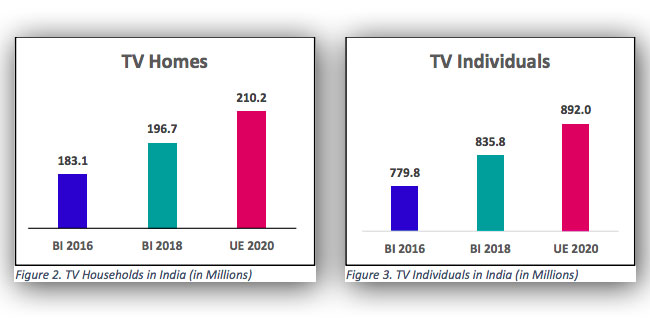
    According to BARC India’s TV UEs 2020, 210 mn Indian households now own a TV set, an increase of 6.9% from 197 Mn in 2018. Simultaneously, TV viewing individuals also witnessed an increase of 6.7%, reaching 892 Mn from 836 Mn in 2018, an increase of 57 million individuals in 2020. TV Owning female population grew by 7%, while male population grew by 6%. In terms of age-groups, the highest growth was witnessed in the “kids” category (age 2 to 14) at 9%.

    Meanwhile, TV households in Urban markets grew by 4% from 87.8 Mn in 2018 to 91 Mn while Rural markets have grown by 9%, up from 108.9 Mn to 119.2 Mn in 2020. While TV households across India grew by 6.9%, HSM grew by 8% outpacing All India as well as the South states which grew by 5%.


    NCCS

    As the Indian population continues to move up the socio-economic pyramid, changes are also observed in the NCCS profile of TV households. As per the TV UE-2020, the proportion of NCCS A and B has increased to 27% and 31% respectively while NCCS DE has further contracted to 9% of TV households in the country.


    Sunil Lulla

    On presenting the updated TV Universe Estimates for broadcasters, advertisers, agencies and other industry stakeholders, Sunil Lulla, Chief Executive Officer, BARC India, said, “As a body that is deeply rooted in data science, BARC India is committed to providing its stakeholders with a true representation of the television universe. We are happy we have been able to ascertain that television continues to be the screen of choice for Indians. With an additional 13 Mn TV households and an opportunity for another 90 Mn households that are yet to own a TV set, India’s broadcast ecosystem continues to have a significant potential for growth in the years to come.”


    Dr Derrick Gray

    Added Dr Derrick Gray, Chief of Measurement Science & Business Analytics, BARC India: “At BARC India, we are deeply invested in providing data that is statistically accurate by factoring in changes in the various “control and weighting variables” that are shown to be highly associated with television viewing. The updated Universe Estimates, UE 2020 aptly sums up India’s linear TV ecosystem and highlights that TV owning households continue to grow. Given the global pandemic scenario, the updated estimate is robust and is developed with the help of data and findings based from various previously validated field studies. We are certain that these estimates will help the industry to a great extent. We will continue to provide the industry with a currency that is reliable and of global standards. I would like to thank the TechComm on behalf of all of us for all their support and contributions in formalising the UE 2020.”


    TV UE 2020 has been developed by computingthe Linear growth of TV Households and TV Individuals from Broadcast India (BI) Studies conducted in 2016 and 2018at geographic and demographic levels. The distribution of the TV population by NCCS was taken from the most recent Indian Readership Survey (IRS). BARC India will implement the findings from the TV Universe Estimates 2020 for its data starting Week 14, 2021, which will release on April 16, 2021 (that’s tomorrow). While an establishment survey as a part of Broadcast India (BI) 2021 is also currently underway, the updated estimates will reflect for BARC India subscribers in the YUMI Analytics platform with immediate effect.


    For more: BARC India TV Universe Estimates 2020


  • Whisper Media releases In-Content Advertising insights

    By Our Staff

    Whisper Media released insights on the effectiveness, efficiency and impact of In-Content Advertising (ICA) on TV audiences across GEC genres in India. The insights of this study on ICA were derived by Kantar. Whisper Media shared 2 years of historical, anonymized data based on their 100 campaigns across 15 brands.

    The research was undertaken across three broad parameters/metrics: Reach, Viewability and Recall. The Reach was measured by using BARC’s Yumi Analytics to ascertain number of users exposed to the campaign, GRPs and frequency, both pre and post campaign. The Viewability was gauged using Eye Tracking studies, which evaluated the attention and focus of the viewer on ICA placements and the time spent by them viewing the campaign. Finally, Recall is an outcome of all parameters to understand the enhanced attention on the content.

    Said Anil Cheriyedath, Director – Marketing and Strategy, Whisper Media: ”India is the largest content producer globally, and GECs remain the biggest drivers of this production where brands prefer to reach the target audience. Brand integrations have always been around in the entertainment industry, but with these studies, it shows the In-Content Advertising through digital embeds have also shown acceptance by brands and audience across all GEC markets which includes the regional and Hindi Speaking Markets. The challenge that integrations faced in India was the measurability aspect, and with that in place through BARC YUMI Tools, it has become easier to validate claims of showcasing effectiveness of ICA campaigns through such unique studies”


  • Legacy Media Must Leap Ahead


    By Bhuvi Gupta


    Bhuvi Gupta

    The media industry the world over is in a state of flux. The internet has made us all both publishers and reviewers and the odd part of that is that it has made the world both biased and unbiased in equal measure. It has never been easier to publish and publicise your opinion and it has never been easier to polarise either. But leaving propaganda aside, the fact that we all have access to multiple media in function and form means that media models are themselves obsolete. While the pandemic has accelerate the print medium’s deceleration, aural media has had a comeback with podcasts going mainstream. But noteworthy in this comeback is the role played by the individual creator.


    This comeback will define what media will come to represent as a whole across the world.  Individual creators will define media because:


    Traditional Media Measurement is Broken

    In India, media as a whole has been slowly losing its credibility. In the earlier part of the last decade both, which I consider a load shed decade for media measurement, both IRS and TAM/BARC overhauled their entire systems to keep up with the times and both ended up getting boycotted or sued – IRS in 2013, and the TAM by NDTV  in 2012, which eventually  resulted in the formation of BARC (LINK – https://timesofindia.indiatimes.com/business/india-business/ndtv-sues-nielsen-for-fraud-negligence/articleshow/15302393.cms). The latest alleged BARC TRP-manipulatiom investigation highlights the flaws of a system based on extrapolation of a relatively small sample data set, especially in a country the size of India.   This is not to point fingers at a case currently sub-judice but to make a case for system which is not so advertising-dependent, that such misdeeds become commonplace. (https://economictimes.indiatimes.com/industry/media/entertainment/media/indian-newspaper-society-rejects-irs-2013-findings/articleshow/29871308.cms?from=mdr)


    Monetisation Models are Fragmented

    The media’s monetisation in itself has gone through many changes.  Once almost entirely run on ads (and later on advertorials as well), media houses realised that their strength lay in the deep networks and complementary relationships they had built with the elite and powerful, which was monetised via events. Then came the digital era when media houses put all their content on the web only for brand visibility with advertising as an afterthought (hence, letting the Google-Facebook duopoly control digital advertising which is now coming to bite them) and now finally the era of subscriptions and donations because survival for media companies has become harder.  What will work going forward is a system based on subscriptions with a content aggregator probably charging the consumer on the basis of the quantity of content consumed


    Media Biases are Clearer than Ever

    While I believe that all individuals have deep-seated biases which are hard to displace even when they try their best, media today seems to align strongly to either the Right or Left. This can become inexcusable when defending a political party in the face of visible wrongdoing.  Once biases become visible by the viewer, especially on major mainstream media, viewers/readers start deserting them.


    For entertainment, a lot of TV content seems to be scripted for audiences in the 90s – the quality of script, actors and direction especially when compared to international content easily accessible on OTT platforms. That has had an impact on TV viewership.


    So, Is there a Way Ahead for Legacy Media?

    Yes, of course, there is. I feel as platforms like Substack and the OTTs move towards the maturation phase in their product lifecycle, there will be further fragmentation in media consumption and clear market leaders will cease to exist. While consumers who are early adopters might have already given up their legacy media subscriptions in favour of Substack, The Ken et al, the majority of the market is yet to catch up. It is here that traditional media outlets must evolve to remain relevant enough.  They have the advantage of knowing what the audience wants, and robust role models like New York Times (NYT) which in November 2020 generated more digital revenue than print with 7 million digital subscriptions. There’s also pay-as-you like journalism which has been implemented in part by Newslaundry.


    Early signs of traditional media evolving are there. Today, most traditional media outlets whether Print, TV or Radio have robust video and print teams and soon-to-be-announced podcast teams as well.


    But as they all put their fingers in more and more pies, I hope they don’t lose the entire plot by spreading themselves thin too soon.


    Bhuvi Gupta is a marketer with over 10 years across industries, of which the last six have been in Media & Entertainment. She has been a part of many launch marketing campaigns – specifically at the Times of India group, Republic TV and the latest in marketing a Bollywood film. She will write on A&M (mostly marketing, but often on advertising too) every other Tuesday. Her views here are personal. She tweets at @bhuvigupta3


  • JF-2021 is ‘Swell’ Time for TV Advtg: BARC data

    By Our Staff

    Advertising volumes for Jan-Feb 2021 are the highest since 2017. FMCG and ECOM categories grew by 36% and 21% respectively during this period compared to 2020.

    Advertising revival has evidently seeped into Jan-Feb 2021, catapulting Ad Volumes, at the start of the year, by 21%, thus making it the highest since 2017.

    Said Aaditya Pathak, Head – Client Partnership and Revenue Function, BARC India: “Continuing the momentum built in H2 of 2020, TV Ad Volumes have had the most promising start with January and February Ad Volume levels of 2021 being the highest ever in 5 years. A lot of sectors/categories, and key non-FMCG brands, also seem to have increased their presence on TV during this period which augurs well for the medium.”

    Among the top genres, Movies & Music + Youth registered higher growth than the average growth in Overall Ad Volumes (25% & 24% respectively), followed by GEC & News with 21% & 18% growth respectively, during Jan-Feb 2021 over the same period in 2020.

    While the Top 10 Advertisers drove the TV Ad Volumes with 45% contribution and 35% growth, the next 40 Advertisers rode alongside, garnering 25% growth during Jan-Feb this year.

    The year 2020 witnessed new entrants in TV Advertising and the rise of the Advertisers in the digital segment, especially the ECOM category. This phenomenon holds true for the current period in consideration as well. ECOM grew by 21% in Jan-Feb 2021, showing a consistent growth YOY in TV Advertising. Other Categories like Retail and Building, Industry & Land Materials, are increasing spends this year, compared to 2020.

    While brands like Lizol, Dettol and Harpic emerged as the most advertised brands during Jan-Feb 2021, many Non-FMCG Brands have also increased their presence on TV during this period.

    TV Advertising has set the bar high for the year that remains. The upcoming big National and International Events are likely to keep TV as the platform of choice for advertisers in reaching out to the millions of homes across India.


  • Partho Dasgupta gets bail. Finally

    By Our Staff


    Partho DasguptaMatter is listed for tomorrow. No 2. That was a terse message which we received last evening.

    And then this morning, a little after 11am, our mobile beeped: Bail is allowed.

    Save some corridors of power – in the media and perhaps elsewhere, there was a sense of relief. For, by targeting Partho Dasgupta, they were actually hitting out at Arnab Goswami, their real nishana. And that worked, but only to an extent.

    Notes a report on LiveLaw website: “The Bombay High Court on Tuesday granted bail to Partho Dasgupta, former CEO of Broadcast Audience Research Council(BARC), Partho Dasgupta, in the case registered by the Mumbai police over the alleged manipulation of Target Rating Points(TRPs) of news channels to give undue favours to Republic TV.

    We suggest going to this link for a more first-hand report on what happened in the courtroom:
    https://www.livelaw.in/top-stories/partho-dasgupta-trp-scam-bombay-high-court-barc-republic-170571?infinitescroll=1

    The former BARC CEO and President of the Advertising Club should be back home soon, we hope. He will also get the right medical attention, that he must get.

    Much relief for his family and friends, some of who in the media world had deserted him. Worried that they may get targeted by the law-enforcers.

    Having said that, the former BARC boss needs to do a lot of explaining. To everyone. And earn back the confidence of all.

    The time right now for him is to recover well to be able to come clean on his not-too-distant past.