Tag: BARC India

  • Reminiscing the BARC set-up days

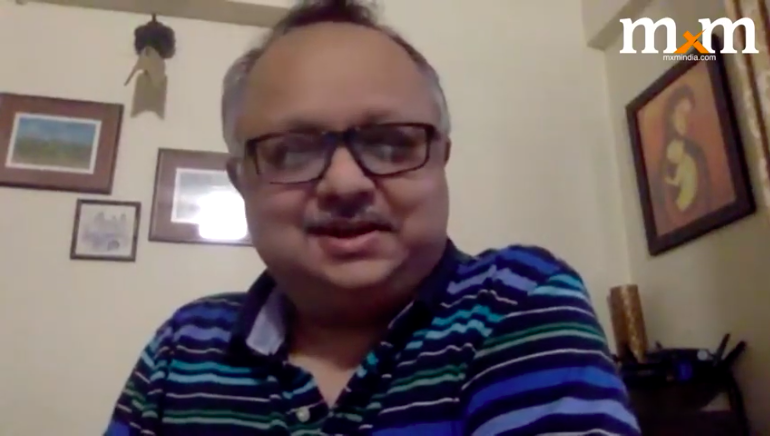
    Partho Dasgupta: Screengrab from Video


    By A Correspondent


    Over the last five-odd years MxMIndia would’ve done over a hundred-odd stories on television audience measurement and central to all of them was Partho Dasgupta, former CEO of BARC India.


    Dasgupta joined BARC in June 2013 and in November last year handed over operations to his friend and former colleague, Sunil Lulla.


    He is now using his experience and learnings to various places in the world, setting up BARC-like entities as an expert. He is also consulting broadcast and new media companies as a management consultant. And overseeing performance management. He of course continues to be President of the Advertising Club.


    Earlier this week, we interviewed Sunil Lulla, CEO, BARC India on the eve of its fifth anniversary. We now speak with Partho Dasgupta, the former CEO of BARC India and get him to reminisce the days before operations began on April 29, 2015.


  • Indians more optimistic about recovery after Covid-19


    By Indrani Sen


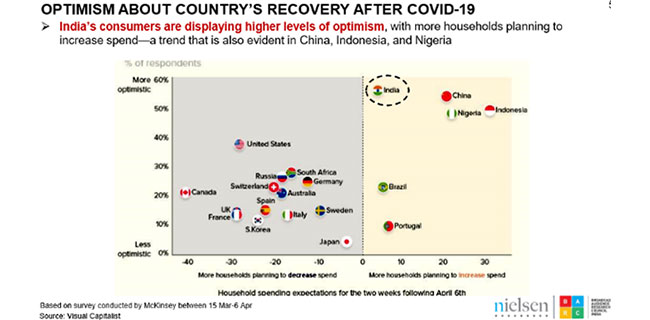
    BARC India and Nielsen Media jointly released the fifth edition of the report on ‘Crisis Consumption on TV and Smartphones’ last week. Their presentation before discussing the details of the TV and smartphone consumptions, gave a brief glimpse of a global scenario showing that Indian consumers are more optimistic about their country’s recovery after Covid-19. Similar trait has also been found among consumers in China, Indonesia and Nigeria who have shown higher levels of optimism than Indian consumers.

    Another chart showing a comparison of growth in TV viewing across the globe compared to the pre Covid-19 period and last week (Week 15) highlights the growth in India (40%), Australia (34%), Czech Republic (25%), France (20%) and United Kingdom (17%). The viewership growth in India was driven by both reach and ATS.

    After a huge dip in FCT in week 14, there was a rise in FCT during week 15 with many Indian advertisers using the COVID19 theme. Advertisement of essentials category saw a growth across TV genres, but Digital Video Advertising spends dropped across most categories. Reruns driven Hindi GEC in HSM were at an all-time high with 8.5 BN impressions with Mythological shows leading the way. HSM Urban maintained a all time high for 3rd week in row.

    TV viewership growth was led by News and Movies and the Movies growth came more from the PAY platforms. Consumption of both News and Movies genre surged after the lock down and now continue to maintain their higher shares. Viewership growth is highest in Mumbai, Bengaluru and Delhi compared to other megacities.

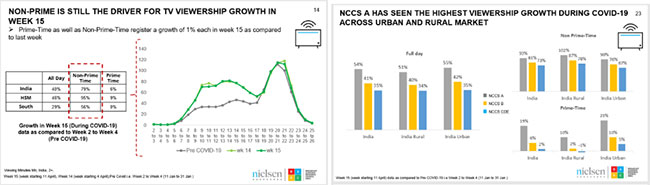
    Nonprime time is still driving the overall growth in TV consumption which raises doubts about the long term stability of this growth as after the lockdown is lifted, consumers would not have time for engaging with nonprime time shows. NCH A has seen the highest viewership growth across urban and rural markets with India rural showing high growth of consumption in non-primetime.

    Strong double-digit growth was seen across various segments of OTTs (movies, originals, etc.) while audio streaming apps show a decline possibly on account of commuting going down. During the lockdown period consumers might be opting for audio visual entertainment against just audio entertainment.

    The new normal of 3 hrs, 40 minutes+ a day on Smartphone continues – 10% increase over pre-Covid-19 times. News franchise on Smartphone continued to be nearly 50% of all smartphone audience, Views grew by 40%. Almost 4 in 10 searches in week 5 were around Coronavirus which is 4 times the searches made during week 1.

    One in five smartphone consumers in India were using the Aarogya Setu app in Week 5 – an 80% + increase v/s the launch week of the app. Consumer time spent on social networking has grown by 35%+ and 1 in 5 spends more than 1 hour per day. With large number of Indians working from home, a staggering 200% increase was seen in time spent on video conferencing and time spent on virtual drives almost doubled.

    There is already lot of speculation on the scope of extending WFH and flexible working hour concepts to our work culture as the lockdown is likely to be lifted gradually and definitely not uniformly across the country. It will take quite a few months for our school and college education system to return to normalcy. The growth spurts which we have witnessed in TV and smartphone consumption will not be reduced abruptly. The higher level of smartphone consumption is more likely to continue even after the cloud of Covid-19 starts moving away from India, whereas the higher level of TV consumption is bound to come down and settle at a level above the pre-Covid days.


  • 10 Takeaways from BARC India-Nielsen Media TV/Smartphone consumption given Covid-19


    By A Correspondent


    Some four weeks back television audience measurement joint industry body BARC India and Nielsen Media unveiled the “Crisis Consumption on TV and Smartphones” series of reports with in a web-based presentation. The fourth edition of the report was presented on Thursday (April 16) and over 950 professsional from across industry were present.


    BARC India, as we know, is the official currency on television measurement in India and Nielsen Media runs a 12,000 strong smartphone panel in India passively capturing smartphone behaviour.


    Some of the key highlights of TV and Smartphone consumption during the fourth week of the 40-day National Lockdown are as follows: –

    1. COVID-19 is taking the most mind space with ~40% of top 100 Google searches last week being in COVIDand 1 in 8 consumers accessing the AAROGYA SETU app

    2. PM’s addresson Lockdown extension garnered 4 Bn viewing minutes  – the highest of the 4 addresses on COVID-19

    3. TV consumptions grows 38% over pre-COVID periodnow at 2 Trillion minutes

    4. Hindi GEC attains all time High Viewership of 4 Bn since 2015 in HSM Urban this week

    5. Movies show an increase across HSM, while GEC maintains share and continues to lead in South markets

    6. Top 5 content for digital audiencesis a mix of Fiction, History, Mythology and Supernatural

    7. Premium audiences onDigital clock remarkable growth in time spent on News, Chat, Fitness and Streaming

    8. The News franchise on Digital is close to 50% now (+25% over PreCovid period) – Video News consumption shows a huge growth of 75% over the PreCovid period

    9. COVID Lockdown  gives a big fillip to Education Apps, Surge by 30%+

    10. Overall FCT on TV drops by 26% over the PreCovid period- however a 142% increaseseen in FCT for Social Ads – Digital ads also showing a slowdown in last week


    Considerations:


  • Forced confinement leading to increase in TV consumption, but…


    By Indrani Sen


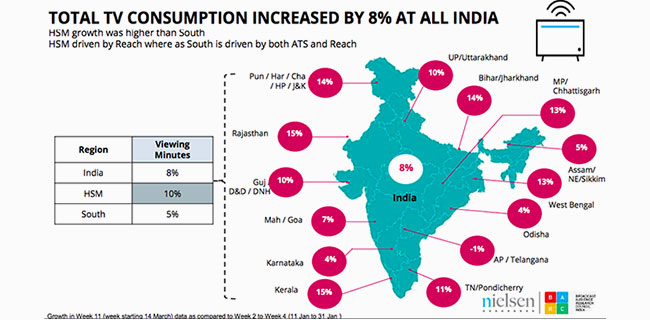
    On March 27, 2020 Nielsen and BARC India shared the first edition of their report “Covid-19 Impact- What’s happening in the TV and smartphone landscape” with the industry at large analysing how the lockdown has increased TV viewership in India. In the first week of the partial lockdown from March 14 to March 20 (BARC Week 11), the all-India TV viewership in minutes/week went up by 8% and TV reach went up y 6%. Overall time spent on TV went up by 2%.


    BARC conducts television audience measurement in India while Nielsen passively captures smartphone behaviour through a 12,000 strong smartphone panel. The time spent on smartphones per user also went up by 6.2%. The time spent/user/week on VOD apps saw an increase of 3%. News apps saw 8% more users per week with an increase of 17% in time spent/user/week stimulated by use of non-English News apps (+87%). Gaming apps saw an increase of 2% in users/week supported by 11% increase in time spent/user/week.


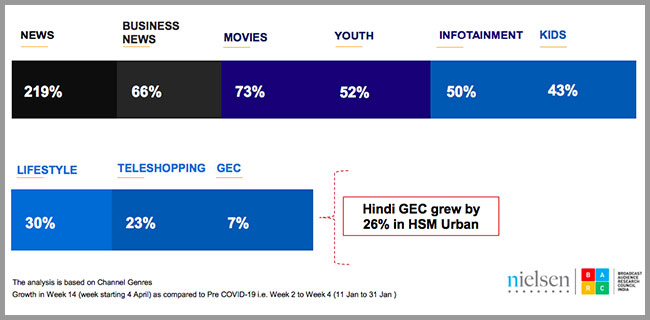
    We will look more closely at changes in TV audience behaviour. In Week 11, average daily viewers grew by 32Mn supported by kids, younger age groups and NCCS A. Viewing time for Television increased by over 70 billion minutes in India with each of 592Mn viewers watching TV daily for 3hr 51 minutes. Strangely, there was hardly any growth in the primetime viewership as the growth in viewership was driven by non-prime time. GECs also grew by 32% in non-primetime slots, but saw a 15% dip in the primetime slots which was higher (23%) in the Hindi Speaking Market (HSM) than the south Indian market (5%). An analysis by genres given below show that news, kids and movies gained the most in terms of daily ATS followed by infotainment, lifestyle and youth.


    Last week, Nielsen and BARC released the second edition of the ‘Crisis Consumption: An Insight Series into TV, Smartphone and Audiences’ report of Week 12 (starting March 21) where four days  coincided with the first week of country wide lockdown, showing an unprecedented growth of  298%  in TV news viewership. The increase in the viewership of news channels was accompanied by a 15% growth of average daily free commercial time (FCT) to 6 lakh seconds in between March 21-27 (Week 12) compared to January 11-31, 2020 or the pre-Covid-19 period reflecting last-minute changes in the allocation of TV budgets.


    All the parameters reported by BARC showed increases during Week 12 with the weekly viewing minutes (total number of minutes spent watching TV) touching 1.2 trillion. The number of people watching TV all seven days a week jumped from 32% to 44%, the average time spent per viewer increased 23% from 3 hours 46 minutes to 4 hours 39 minutes. As a result, the total number of channels consumed per viewer in the week also increased from 16 to 22. This surge is TV viewership is expected to continue during the next few days of the nation wise lock down and the spread of Covid- 19 in India will decide its future course.


    It is heartening to see that the news genre has been able to get additional advertising during this lock down period. Kids’ genre, with 20%+ share of total TV viewership and only 3% share of the overall advertising space, has not been so lucky. However, on the whole the prognosis is not good when we look at ad revenue of TV channels in immediate future. Going by the current trends, TV channels will hardly be able to convert this increase in viewership to increased ad revenue. Financial Express reported on March 21, 2020 (https://www.financialexpress.com/brandwagon/coronavirus-impact-ad-expenditure-to-decline-by-50-55-on-tv-between-april-june-2020/1914445/) “As the novel Coronavirus continues to wreak havoc around the world, television is one such industry which is currently under its grip, besides other sectors. According to industry estimates, advertising expenditure on television is expected to decline 50%- 55% to anywhere between Rs 3,750 crore – Rs 4,125 crore between April-June, that is Q1 FY2021 – if the lockdown continues.”


    The economictimes.indiatimes.com reported on April 2, 2020 in similar lines, though their estimate of the loss was pegged at 30-40% than 50-55% reported by Financial Times – “Top broadcasters, media buyers and advertisers ET spoke with, feel that if the situation doesn’t improve by end of April, the TV industry will end up with a 30-40% drop in ad revenues in April and May.” (https://economictimes.indiatimes.com/industry/media/entertainment/media/broadcasters-stare-at-drop-in-ad-revenues/articleshow/74937708.cms?from=mdr)


    While we wait for FICCI-EY to release an update of their report on M&E industry, FICCI’s recent report on the impact of Covid-19 on the Indian economy has predicted that the pandemic will potentially derail India’s growth story by affecting both the demand and the supply side. We are going through unprecedented times when it is extremely difficult to predict even the immediate future.


  • Covid-19 sees TV & Smartphone grow


    By A Correspondent


    Broadcast Audience Research Council (BARC India) went a step further on its attempt to offer a combined measurement of television and digital consumption. TV viewing minutes and Smartphone usage went up 8% and 6.2% respectively as BARC India and Nielsen unveil report on the impact of Covid-19


    BARC and Nielsen put together a report to understand the changes in consumption behaviour of television and smartphones given the extraordinary situation surrounding the COVID pandemic and its fallout.


    Sharing her views on the current surge in smartphone usage, Dolly Jha, Country Leader Nielsen Global Media, South Asia said, “We are living through unprecedented times! Physical Social Distancing seems to have led to a phenomenal growth in Virtual Social Togetherness with an almost 20% increase in time spent per user on Chats, Social Media and News in the last one week. And we anticipate this to grow further.”


    Elaborating on the topic, Sunil Lulla, Chief Executive Officer, BARC India said: “These are unfortunate and unprecedented times. Working closely with Nielsen, we bring for our customers and stake-holders, this very significant and important update, on change in content and advertising consumption behaviour, with a significant population at home. We will report soon enough, the impact of total lockdown. Our respective brave teams are working (WFH) round the clock to ensure the TV measurement currency, continues uninterrupted.”


    Highlights of the report:

    1. The Covid-19 disruption period has seen an increase in television viewership – 6% increase in TV reach and 8% increase in TV viewing minutes /week. The time spent on TV / viewer has seen a jump by 2%. The PM’s address to the nation on complete lockdown on March 24 garnered unprecedented viewership of 197 million watching it across the country.


    2. When we look at smartphone behaviour the time spent on smartphones per user has gone up by 6.2%. The time spent/user/week on VOD apps has also seen an increase of 3%. If we look at the increase in the time spent/user/week over that of the previous week (to take away the impact of Cricket viewing in the PRE COVID period considered), we can see a jump of 5%.


    3. Kids’ schools being shut and the stress of exams off their shoulders has resulted an increase in television viewing (+20%). With corporate India getting into Work from Home mode, NCCS A showed an 11% increase in viewership. Even on smartphone usage, the increase in driven NCCS A (+7.7%) and 35-44-year-olds (+10.7%).


    4. People staying at home led to watching TV throughout the day and hence the growth in TV viewing is coming from Non-Prime Time slots (8am – 5 pm).


    5. The need for continuous updates expectedly has led to a huge increase in news consumption on Television (57% increase in Impressions), while spending more time as a family together could be leading to the Movies genre and the Kids genre also showing significant increases.


    6. This behaviour is seen in digital consumption as well with News and Gaming showing huge increases. News apps saw 8% more users per week with an increase of 17% in time spent/user/week. This growth was led by non-English News apps (+87%). Gaming apps saw an increase of 2% in users/week and with a 11% increase in time spent/user/week.


    7. With a lot of uncertainty around what is happening, people have increased their time spent on Chatting (+23%) and Social Networking (+25%) apps.  Almost all social networking apps –  Facebook, Instagram and TikTok have seen significant increases not only in time spent /user/week but also in the sessions/ user/ week.


    8. Shopping apps, Travel apps and Food Apps have seen a huge drop in both users/ week and time spent/user/week.


    9. It’s not just TV viewership that has seen an increase –advertising FCT on TV has increased by 13%.


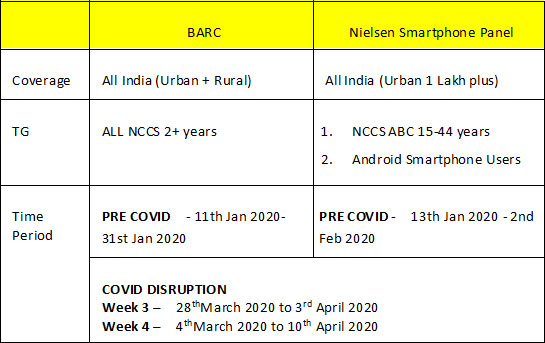
    Measurement considerations:

      BARC Nielsen Smartphone Panel
    Coverage All India (Urban + Rural) All India (Urban 1 Lakh plus)
    TG ALL NCCS 2+ years NCCS ABC 15-44 years

    Android Smartphone Users

    Time Period PRE COVID  – 11th Jan 2020- 31st Jan 2020 PRE COVID –  13th Jan 2020 – 2nd Feb 2020
    COVID DISRUPTION – 14th March 2020 to 20th March 2020 COVID DISRUPTION – 16th March 2020 to 22nd March 2020
    Week definition Saturday to Friday Monday to Sunday


  • The Most Important Emerging Trends of the Decade


    This is the fifth in a series of six decade-ender lists in this column by Shailesh Kapoor.


    The previous lists:

    The most-defining Hindi TV shows of the decade

    The most-defining Hindi films of the decade

    The most successful OTT brands of the decade

    The most successful TV channels of the decade


    By Shailesh Kapoor


    The decade that went by was unmistakably eventful for the media & entertainment industry. But isn’t that true for every decade, and for most industries? Ten years is a long time, especially given the pace at which technology is evolving, and there are bound to be fundamental shifts in how a category is perceived, consumed and transacted.

    Here are the five most significant trends that emerged in the last decade in the media & entertainment business, in no particular order. While a lot happened on the back-end, such as the launch of BARC India or the introduction of NTO, the trends here have been identified from a consumer perspective, leaving out the B2B shifts the decade may have seen.


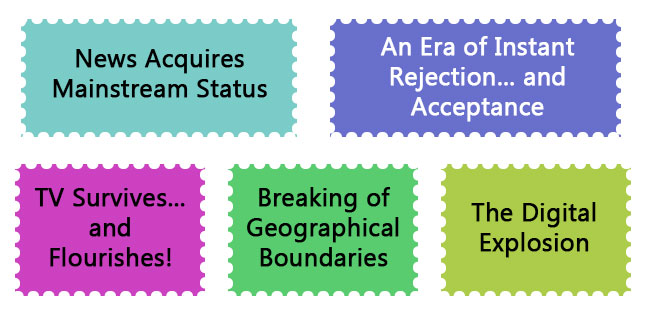
    The Digital Explosion

    Perhaps the most significant shift the decade saw was the rise of the digital media, first in the form of social media and YouTube, and then via the OTT category in the second half of the decade. The presence of unlimited and ever-growing content options online (including television catch-up) had various levels of impact on consumer behaviour and taste. The exposure to genres and languages increased, leading to wider acceptance of different forms of content, including that from the West, at a mainstream level. The digital growth also put increasing pressure on other media, such as TV and films, to up their game, lest they should lose audience to a new-age media option. Eventually, digital has managed to co-exist with other media. TV viewing time has not gone down, and box office has not degrown, over this decade. But digital content has opened up a new realm of possibilities for content creators and consumers alike, the true potential of which may be realised only in the coming decade.


    Breaking of Geographical Boundaries

    While television continued to be culture and language-driven, we saw the breaking of geographical boundaries in films and digital content in this decade. The prime example, of course, is the Bahubali franchise. Who would have predicted at the start of the decade that the biggest ‘Hindi film’ of the decade will be a Telugu film dubbed in Hindi, without any Bollywood actors in it! Hollywood continued to get stronger too, with certain years showing unreal levels of growth in the Indian market, in the range of 25-40%. Marvel Cinematic Universe is probably the strongest entertainment brand in India today, and that itself is a testimony to how geographies matter less today than ever before. All international and regional content did not cut through, but Indian audience latched on to culture-neutral content, especially in the action and adventure genres, from around the world.


    TV Survives… and Flourishes!

    Fallacious, unresearched and over-simplistic arguments around cord cutting and the imminent death of television have gone on for too long now. The truth is: Television is here to stay, at least in India. And that’s not just because India is a mass country with so many small towns and villages that it will take a few years for digital content to truly penetrate. Television’s ‘survival’ story in India is one about culture and values, than about content. Television is the only form of media consumption that’s done almost entirely at a family level in India. Fearful of their children slowly disassociating themselves from all things traditional and cultural, parents have turned to religion and television to keep the family bonding and identity alive. In fact, the arrival of digital content, which is essentially consumed solo, has further amplified the power of television as a collective medium for the entire family. Which is why even the most affluent Indian households have decided not to have a second TV in their house, and at 4-5% only, India’s multi-TV penetration is negligible.


    News Acquires Mainstream Status

    From being as a males-only, North India-skewed genre, news acquired a more mainstream and ‘mass’ status this decade. While comparing viewership over decades is problematic because of the constant changes in the ratings universe, the growth of news ratings at the time of marquee events has been consistent and very noticeable. Women audience have warmed up to watching primetime news to some extent, and hence, in many families, news has emerged as a legit option for 9pm or 10pm family viewing. A large part of this change can be attributed to the change in the political regime in the country in 2014, and the political and ideological polarisation that has followed. The rise of digital news, too, has fueled an overall acceptance of news content across media. And for all the flak they face, news channels have made news more accessible, even if it is via making it ‘entertaining’.


    An Era of Instant Rejection… and Acceptance

    Social media had come in towards the end of the last decade. But its true power was felt this decade. Rejection or acceptance of a new piece of content, such as a film or a series on the internet or television, would earlier be an organic process, lasting upto weeks. Today, it can be a matter of hours before the word spreads around. There is no place to hide for mediocre content, especially as consumers are spoilt for choices, and have ready access to opinions and reviews all the time. Films like Thugs Of Hindostan and Kalank sank within a day of their release. This digital-fueled trend puts increasing pressure on content creators and distributors to raise the bar, or be left behind. The shelf life of content itself has reduced significantly, and even the best content has a window of a few weeks to get its audience. ‘Now’ is everything! And that’s not necessarily a good thing, but that’s a topic for another day.


  • The Most Successful TV Channels of the Decade


    This is the fourth in a series of six decade-ender lists in this column. The previous lists:

    The most-defining Hindi TV shows of the decade

    The most-defining Hindi films of the decade

    The most successful OTT brands of the decade


    By Shailesh Kapoor

     

    The decade of 2010-19 was easily the most uneventful decade in the history of Indian television so far. Each of the previous three decades was dotted with events that unmistakably shaped television in India. The 80s was the golden age of television content, as Doordarshan started to provide primetime programming and engaged with some of the best writing, directing and acting talent in the country for the same. The 90s saw the emergence of satellite television, which widened the options available to the audience multi-fold. The 2000s saw the daily soap movement, led by Star Plus, and then, the rise of the alternative force in Colors, which brought a unique, real and rustic touch to mass entertainment. Each of these decades had a big highlight at the start. The Asian Games in the 80s saw the arrival of the colour TV. The Gulf War telecast in the 90s, albeit niche, introduced us to the fascinating power of satellite television. And Kaun Banega Crorepati ushered in a new era in 2000.

    In contrast, the last decade (2010-19) can only be remembered for what happened ‘off-screen’. The ratings controversies, leading to the birth of BARC India, in the midst of digitisation, headlined the first half of the decade. And TRAI’s New Tariff Order was the big talking point as the decade ended.

    Low content innovation and a general sense of inertia became even more apparent as digital and social media grew on the side, becoming a dominant force by the time the decade ended. Yet, some TV channels stood out, challenging the status quo and making a mark for themselves. Here’s my list of the top 5 most successful TV channels in India over the last 10 years, based on how they navigated through this tricky decade, making a mark for themselves, and their parent networks.


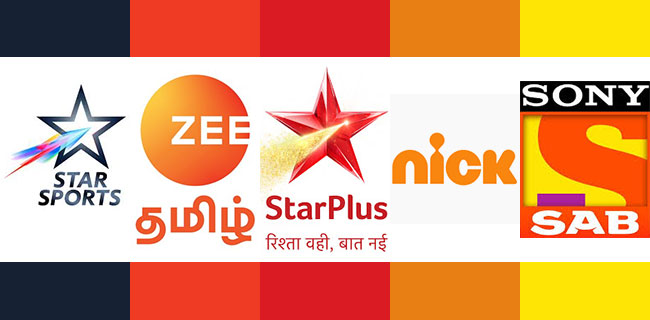
    5. Sony SAB

    SAB’s flagship show Taarak Mehta Ka Ooltah Chashmah (TMKOC) launched in 2008, and kept going strong through this decade. For large chunks of time over the last 10 years, SAB struggled to have a second hit show. But there were strong periods in between, when the channel managed to add fire power to TMKOC to emerge as a strong contender in the Hindi GEC category. 2019 was one such year, and the channel has been on the heels of Star Plus, Colors and Sony for the top spot, and often taken it too. SAB’s success is even more remarkable if you consider than it operates at significantly lower programming costs compared to other top Hindi GECs. TMKOC itself has gone from strength to strength, and SAB’s packaging and family-inclusive positioning are arguably the brightest and the sharpest respectively, in the genre.


    4. Nick

    In a category that’s essentially commoditised, and one flagship show is all you need to dominate the ratings charts, Nick managed to rule the roost for a large share of the decade, and often by a wide margin too. While its competition found it difficult to extend their portfolio beyond one show (e.g. Chhota Bheem on Pogo and Doraemon on Disney), Nick kept the animation mill running, launching several properties through the decade, with varying levels of success. While its 2012 launch Motu Patlu remains its biggest success story till date, the channel managed to sustain a strong second line, and showed nimble-footedness in experimenting with content shifts between the two sister channels Nick and Sonic.


    3. Star Plus

    The decade started with Colors emerging as a disruptive force in the Hindi GEC category, throwing Star Plus and Zee TV off their comfort zone with a new programming outlook. After a year or two of trying to figure out what had hit them, Star Plus found its feet back. Its ‘Rishta Wohi Soch Nayi’ campaign in 2010-11 is easily the most effective brand campaign any mass Hindi TV channel in India has ever launched. Unlike the umpteen ‘brand refreshes’ that GECs indulge in, this one was actually backed by content, ushering in a new line of shows like Diya Aur Baati Hum and Pratigya, which put strong women protagonists on the forefront, in relatable, small-town settings. In the second half of the decade, the Hindi GEC category went through a tough phase, losing ratings to regional, news and movie genres. Star Plus innovated here too, launching the ‘Rishta Wohi Baat Nayi’ campaign, signaling its focus on differentiated content that breaks the monotony of sameness. On the side, experiments like Satyamev Jayate continued, even as the channel managed to steer through many highs and lows over 10 long years.


    2. Zee Tamil

    For the first half of this decade, the Tamil GEC category was a one-horse race. Sun TV led its closest competitor Star Vijay by an embarrassingly-wide margin. The ratio of their viewership was often higher than 10:1. Zee Tamil was in a wooden spoon battle for the second spot with Star Vijay, with no hopes of catching up with the big force at the top. But somewhere in mid-2006, the channel started finding an alternative content space. It took a couple of years, but Zee Tamil became a strong contender, overtaking Sun TV in some prime-time slots, and bringing down the 10:1 ratio to 2:1, even less at times. Importantly, it altered the viewing behaviour of the category, as it made the audience realise there are options beyond Sun TV to consider. Even Star Vijay has gained because of this behaviour change. While Sun TV still ranks no. 1, it has lost about 20-25% of its viewership through the decade, even as Zee Tamil has grown by a whopping 500%+.


    1. Star Sports

    There’s so much to say about Star Sports’ dominance of the sports scene over the last 10 years that it may need a separate article some time. One can talk about the thought leadership shown in backing Kabaddi (and later soccer), or the front-footed approach towards IPL rights, or the digital strategy for sports with Hotstar, or the championing of Hindi commentary in the early part of the decade to the launch of regional channels in the latter. The long list of Star Sports’ innovations in the sports category provides a silver lining to a dull television decade. Star Sports’ much-underplayed tagline says ‘Believe’. It’s probably more a reflection of how Star looks at the future of sports and sports programming in India, than what they want Star Sports viewers to feel about the channel!


    Shailesh Kapoor is founder and CEO, Ormax Media. He writes on MxMIndia every Friday. His views here are personal


  • BARC India appoints Mahendra Upadhyay as Chief Information Officer

    By A Correspondent


    Television audience measurement joint industry body Broadcast Audience Research Council (BARC India) has appointed the appointment of Mahendra Upadhyay as Chief Information Officer.


    Upadhyay has 18 years of experience in telecom, banking, retail and media & advertising industries with expertise in data value chain i.e. Ingestion-Insights-Analytics-Auto AI. He has expertise in end-to-end consumer life cycle management using advanced analytics and marketing interventions.


    Said Sunil Lulla, Chief Executive Officer, BARC India: “We are happy to welcome Mahendra on board as the Chief Information Officer, BARC India. With his mix of leadership roles across Industries, he brings a diverse cross-industry perspective that we will be able to leverage immensely for the benefit of our clients and for the industry,”


    Commenting on his new role, Upadhyay added: “I am absolutely delighted about joining the world’s best television measurement company BARC India as Chief Information Officer. Looking forward to my new role and taking company to next level along with my team.”


  • 2019 MxM Mediaperson of the Year: 43 Days To Go


    By A Correspondent


    Less than 50 days to go for the most prestigious award for an advertising/ media professional in the country. Forty-three days to December 20. We have had three rounds of shortlisting already, and now the final one will happen later this month (November).


    It’s a tough selection this year, is all that we can say. There are many, many achievers, but there are a few who stand tall. And one of them will be the 2019 MxM Mediaperson of the Year.


    As industry persons are aware, over the last few years, the MxMIndia Mediaperson of the Year has earned the reputation of being one of the more credible barometers of the highest performer(s) in the fields of advertising, media and marketing in a calendar year. The quarterly assessment ensures that we don’t miss out on a super achiever of the first quarter.


    Last year’s winner of the accolade was Piyush Pandey on his rise and rise in the global creative world. In 2017, it was Arnab Goswami for the launch of Republic TV. In 2016, we had Dentsu Aegis Network South Asia CEO Ashish Bhasin and for 2015 it was the BARC India core team of Punit Goenka, Shashi Sinha and Partho Dasgupta.


    So who do you think will it be this year?


    Having said that, we have a few days before the final selection, so if you’d like us to consider any name, write to us at editor [at] mxmindia.com or even call or whatsapp the editor – Pradyuman Maheshwari, if you have our coordinates.


  • IIM-A validates BARC India’s sample design and methodology

    By A Correspondent


    BARC India recently collaborated with the Indian Institute of Management, Ahmedabad (IIM-A) to undertake a review of the current sample design and methodology. The statistical review team at IIM-A led by Prof Tathagata Bandyopadhyay, Professor of Statistics at IIM Ahmedabad,  suggested the implementation of a new design which takes into account the cost of data collection and heterogeneity across markets.


    However, no significant deviation was found in the sample size arrived at through the new design and the one being implemented by BARC India presently, thereby validating the representativeness of the panel. The team also expressed its pleasure with the overall sample allocation mechanisms put in place by BARC India.


    It may be recalled that in 2018, the Indian Statistical Institute (ISI) Kolkata had certified the representativeness of BARC India’s Panel design and methodology. More recently, in July 2019, IIM-C had also presented a report on BARC India’s TV sample and appreciated the existing practices.


    IIM-A in its report stated that no significant increase in the current sample size is required with the proviso that the current cost levels are being maintained. The team noted that a panel size of 50K TV homes is reasonable to move forward, with an additional 5K -7K homes to help capture detailed insights from TV viewership data.


    The review teams of both IIM-C and IIM-A were of the opinion that an ideal sample size is subjective and based on factors such as sample design, cost of sampling, overall budget, and population characteristics. There is therefore, ‘no unique or ideal solution’. They also maintain that sample sizes should be reviewed periodically.


    Said Prof Bandyopadhyay: “The entire review process has been an enriching experience and full of learnings for both teams. BARC India utilises an efficient sample design and sampling procedure for the management of their television viewing panel in a large and diverse market like India. The interaction with the BARC India team was extremely seamless and they extended their full support to us during the project.”


    Added Dr Derrick Gray, Chief of Measurement Science, BARC India: “IIM-A’s endorsement of our sample design and methodology is yet another affirmation of our ability to accurately measure and report ‘What India Watches’ 365 days a year.  We work round the clock to deliver accurate and credible data to a dynamic TV industry and will take into consideration the recommendations made by the review teams to make our systems more robust.”


  • The Narendra Modi-Bear Grylls show hits jackpot on ratings roster

    By A Correspondent


    The special edition of Discovery’s popular franchise ‘Man Vs Wild’ featuring Prime Minister Narendra Modi with presenter Bear Grylls, lived up to its hype emerging as the top-rated show for the channel. The premiere on Discovery Network (across 12 Discovery channels) garnered highest slot viewership (on active channels) with 3.69 million impressions overtaking GEC leader Star Plus with 3.67 million impressions (Source: BARC India – TG: All15+AB|Market: India Urban|12th Aug’19: 9pm-10pm|Impressions)


    The premiere also delivered the highest ever slot reach for the infotainment genre with 6.1 million tune-in on Discovery Channel which is 15 times more as compared to the last four weeks average of the same slot (Source: BARC India |TG: All15+AB|Market: India Urban|12th Aug’19: 9pm-10pm |Reach). The show also kept the viewers on the hook delivering an impressive average TSV of 29.2 minutes.


    The special edition of Man Vs Wild with Bear Grylls and Modi was also being showcased on Discovery network of channels across 179 countries.


    Said Megha Tata, Managing Director – South Asia, Discovery: “The historic edition of Man Vs Wild made a larger point about importance of wildlife conservation and sensitised people about environmental change.  In that sense, it was much more than a TV show. We are the undisputed leaders in infotainment genre; our aim is to extend the leadership further with pathbreaking programming. We will go bigger, bolder and better!”


  • BARC launches self-service portal for viewership reports

    By A Correspondent


    BARC India has launched a new online service called the Self-Service Portal. Aimed at catering to professionals who are in the business of data and analytics, the Self-Service Portal offers a range of TV viewership and audience analytics reports.


    Said BARC India COO, Romil Ramgarhia: “BARC India’s viewership is the currency basis which $5.7Bn worth advertising and content decision are made, but the application and impact of the data goes beyond TV ad spends and broadcast revenues. There are multiple entities that can benefit from our robust data to grow their business and we realised the need to make this data accessible to this larger audience and bring it to their fingertips.”


    The portal offers reports related to viewership analysis across channels, genres, TV programming, and advertising campaigns. Users can also customize these reports to suit their specific requirement. The data on the portal can be availed at a charge through online payment and the report will be delivered via e-mail within 2-7 business days depending on the nature of the report requested.