Tag: BARC India

  • Total TV Owning Households grow 6.9% to reach 210mn


    By Our Staff

    Television measurement body Broadcast Audience Research Council India (BARC India), has released its TV Universe Estimates 2021 (TV UE).

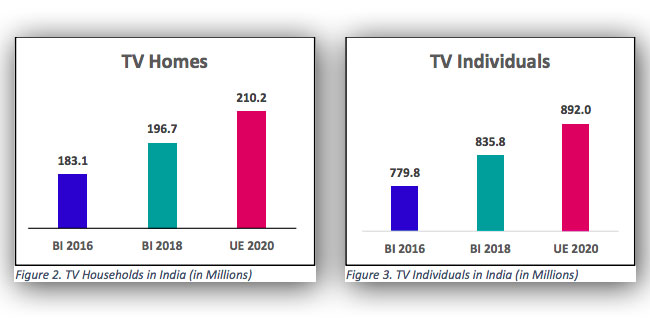
    According to BARC India’s TV UEs 2020, 210 mn Indian households now own a TV set, an increase of 6.9% from 197 Mn in 2018. Simultaneously, TV viewing individuals also witnessed an increase of 6.7%, reaching 892 Mn from 836 Mn in 2018, an increase of 57 million individuals in 2020. TV Owning female population grew by 7%, while male population grew by 6%. In terms of age-groups, the highest growth was witnessed in the “kids” category (age 2 to 14) at 9%.

    Meanwhile, TV households in Urban markets grew by 4% from 87.8 Mn in 2018 to 91 Mn while Rural markets have grown by 9%, up from 108.9 Mn to 119.2 Mn in 2020. While TV households across India grew by 6.9%, HSM grew by 8% outpacing All India as well as the South states which grew by 5%.


    NCCS

    As the Indian population continues to move up the socio-economic pyramid, changes are also observed in the NCCS profile of TV households. As per the TV UE-2020, the proportion of NCCS A and B has increased to 27% and 31% respectively while NCCS DE has further contracted to 9% of TV households in the country.

     

    Sunil Lulla

    On presenting the updated TV Universe Estimates for broadcasters, advertisers, agencies and other industry stakeholders, Sunil Lulla, Chief Executive Officer, BARC India, said, “As a body that is deeply rooted in data science, BARC India is committed to providing its stakeholders with a true representation of the television universe. We are happy we have been able to ascertain that television continues to be the screen of choice for Indians. With an additional 13 Mn TV households and an opportunity for another 90 Mn households that are yet to own a TV set, India’s broadcast ecosystem continues to have a significant potential for growth in the years to come.”

     

    Dr Derrick Gray

    Added Dr Derrick Gray, Chief of Measurement Science & Business Analytics, BARC India: “At BARC India, we are deeply invested in providing data that is statistically accurate by factoring in changes in the various “control and weighting variables” that are shown to be highly associated with television viewing. The updated Universe Estimates, UE 2020 aptly sums up India’s linear TV ecosystem and highlights that TV owning households continue to grow. Given the global pandemic scenario, the updated estimate is robust and is developed with the help of data and findings based from various previously validated field studies. We are certain that these estimates will help the industry to a great extent. We will continue to provide the industry with a currency that is reliable and of global standards. I would like to thank the TechComm on behalf of all of us for all their support and contributions in formalising the UE 2020.”


    TV UE 2020 has been developed by computingthe Linear growth of TV Households and TV Individuals from Broadcast India (BI) Studies conducted in 2016 and 2018at geographic and demographic levels. The distribution of the TV population by NCCS was taken from the most recent Indian Readership Survey (IRS). BARC India will implement the findings from the TV Universe Estimates 2020 for its data starting Week 14, 2021, which will release on April 16, 2021 (that’s tomorrow). While an establishment survey as a part of Broadcast India (BI) 2021 is also currently underway, the updated estimates will reflect for BARC India subscribers in the YUMI Analytics platform with immediate effect.


    For more: BARC India TV Universe Estimates 2020
     

  • JF-2021 is ‘Swell’ Time for TV Advtg: BARC data

    By Our Staff

    Advertising volumes for Jan-Feb 2021 are the highest since 2017. FMCG and ECOM categories grew by 36% and 21% respectively during this period compared to 2020.

    Advertising revival has evidently seeped into Jan-Feb 2021, catapulting Ad Volumes, at the start of the year, by 21%, thus making it the highest since 2017.

    Said Aaditya Pathak, Head – Client Partnership and Revenue Function, BARC India: “Continuing the momentum built in H2 of 2020, TV Ad Volumes have had the most promising start with January and February Ad Volume levels of 2021 being the highest ever in 5 years. A lot of sectors/categories, and key non-FMCG brands, also seem to have increased their presence on TV during this period which augurs well for the medium.”

    Among the top genres, Movies & Music + Youth registered higher growth than the average growth in Overall Ad Volumes (25% & 24% respectively), followed by GEC & News with 21% & 18% growth respectively, during Jan-Feb 2021 over the same period in 2020.

    While the Top 10 Advertisers drove the TV Ad Volumes with 45% contribution and 35% growth, the next 40 Advertisers rode alongside, garnering 25% growth during Jan-Feb this year.

    The year 2020 witnessed new entrants in TV Advertising and the rise of the Advertisers in the digital segment, especially the ECOM category. This phenomenon holds true for the current period in consideration as well. ECOM grew by 21% in Jan-Feb 2021, showing a consistent growth YOY in TV Advertising. Other Categories like Retail and Building, Industry & Land Materials, are increasing spends this year, compared to 2020.

    While brands like Lizol, Dettol and Harpic emerged as the most advertised brands during Jan-Feb 2021, many Non-FMCG Brands have also increased their presence on TV during this period.

    TV Advertising has set the bar high for the year that remains. The upcoming big National and International Events are likely to keep TV as the platform of choice for advertisers in reaching out to the millions of homes across India.


  • In Lockdown Year, Non-Primetime Viewership Leapfrogs


    By Our Staff


    Television audience measurement company BARC India (short for Broadcast Audience Research Council, India) launched the third edition of its annual Yearbook titled The Year After Two Thousand & Nineteen.


    Here are some of the highlights from the volume:

    · Non-Prime Time (NPT) Viewership for General Entertainment Channels (GEC), News and Kids, grew by 16%, 26% and 31% respectively in 2020 compared to 2019.

    > Ad Volumes grew by 34% in 2nd half of 2020 compared to 1st half of 2020.

    > Top 10 Advertising sectors contributed 80% to Total Ad Volumes in 2020

    > Communication by the Government was on an upsurge during lockdown. Ad Volumes for Govt. messaging grew by 184% (2.7 times) during Apr-June 2020 compared to same period in 2019.

    · Mythological Classics like Ramayan & Mahabharat made a comeback on our TV screens, Week 13, 2020 onwards. Ramayana now holds the record of the most watched TV program in the world!

    · Driven by the classics, advertisers placed their bets on DD’s GECs during lockdown. Ad Volumes for DD’s GECs grew by 62% in Apr-June quarter of 2020 compared to the same period in 2019.

    · IPL-13 viewership grew by 23% compared to IPL-12 with 400 Bn Total Viewing Minutes.

    · The Opening match between Mumbai Indians and Chennai Super Kings at Abu Dhabi, was the most viewed with 11.2 Billion Viewing Minutes.


    Said Sunil Lulla, Chief Executive Officer, BARC India: Commenting on the launch of the Yearbook: “The year was a consolidation and reaffirmation year for television in India. It was marked by a substantial increase in TV viewership with total TV growing by 9% and Ad Volumes experiencing a staggering growth of 34% in the second half. 2020 reaffirmed the strength of television as a medium in India amongst both viewers and advertisers, proving TV is indeed the screen of choice for the household. TV continues to grow with regional markets gaining prominence. BARC India will continue to work towards our vision, to always be the trusted source of authentic measurement and reporting of “What India Watches’”.


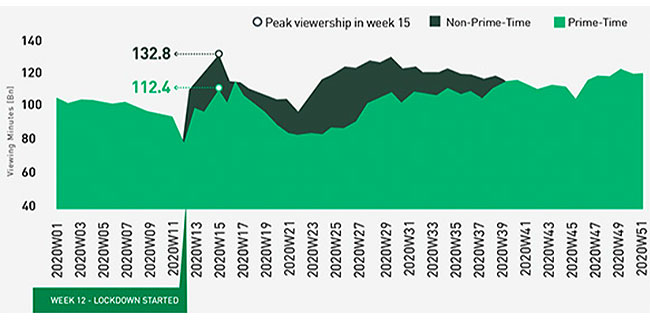
    Added a communique: “TV played a significant role in keeping people connected with the outside world during the lockdown. Consequently, TV Viewership witnessed a growth of 23% during Mid-March to June (Week 11-26) as compared to the January to early March period (Week 1-10).”


  • Shailesh Kapoor: Storm in a Chatroom

    Shailesh Kapoor

    By Shailesh Kapoor


    More than 1,000 pages. That’s how long the chat transcripts, which form a part of the supplementary chargesheet filed by Mumbai police in ratings manipulation case, are. The transcripts are from BARC India ex-CEO Partho Dasgupta’s WhatsApp records, and hence, features him in all the chats.

    One could question if it was right on the part of Mumbai police to release private conversations in the public domain. But they have, and the material is out there for us to see. The media focus, understandably, has been entirely on the chats with Arnab Goswami. But a large portion of the 1,000+ pages across the two volumes feature chats with other BARC India employees, the most prominent of which is BARC India’s ex-COO Romil Ramgarhia.

    If one focuses on the non-Arnab chats, there are three telling conclusions to draw:


    1. Launched in a hurry?

    There are enough indications in the transcripts that BARC India was not a settled, smoothly-running organisation. The processes, structure and people were being figured out on the go, even when the service had gone live and data was being reported. Perhaps there was a pressure to launch by a given date. But even till as late as 2019, four years after launch, there seems no sense of being settled.

    One can see this as the inevitably of a start-up. But even start-ups find their footing with each passing year. It seemed BARC India was in a hurry, announcing new initiatives (like the now-aborted Ekam) even when the main purpose of the organisation (TV ratings) was nowhere close to running in a stable manner. There are chats on “non-currency revenue streams”, which makes one wonder if revenue considerations took away from the single-minded focus on delivering credible and authentic TV ratings.


    2. Too many people to ‘manage’

    It seems like a classic case of too many cooks spoiling the broth. Way too many stakeholders, ranging from constituent bodies like IBF, AAAI & ISA, to government arms like MIB & TRAI, to the BARC India board and its technical committee, to individual channels ready to stir things up every Thursday, to individual personalities in powerful positions, were on Dasgupta’s, and his team’s, manage-with-kid-gloves list.

    It is difficult to say how much of this perception management approach to run the ratings agency is an inevitable nature of its construct, and how much of it was a result of a workstyle the CEO and  the COO decided to adopt. But almost all internal chats are about managing people and their perceptions. Someone or the other always seemed to be breathing down their necks. A body that should ideally maintain an arm’s length from interested parties, especially broadcasters, was doing anything but that. With the benefit of hindsight, one can say that this approach was doomed to fail.


    3. Lack of confidence in the product

    At many places in the chats, it’s evident that BARC India’s senior team members are tentative about their own panel design and data, and cannot decide whether to trust it or not. The entire outlier management exercise, which is a recurring theme in the chats, is projected as being necessary because of an inadequate panel size and/ or design, suggesting lack of confidence in the product.

    The outlier management process itself comes across as arbitrary and subjective, with decisions being taken at a manual level, despite multiple mentions of the need to “automate” it.

    In research, sample designs and reporting formats go hand-in-hand. If you do not have enough sample to report a data point with confidence, you may as well not report it. But it seems these decisions were not taken at the time of setting up BARC India, and there are multiple instances in the chats on how one or two peoplemeters in a particular market are resulting in ‘abnormal’ growth in a channel’s viewership in a particular week, to the extent of 200%+. Two weeks ago, I wrote here about why ‘less is more’ should be the new ratings doctrine. And these chats strengthen that argument a lot more.


    Where do we go from here? BARC India has a new leadership team, and hopefully, a fresh approach too. The next year or two may see some chaos, but in the long run, the only practical way of making a ratings system work over an extended period of time is to ensure that only highly robust data is reported, and that the agency is given a free hand without any influence from the various power centres. The former is achievable. It’s the latter that worries me.


    Shailesh Kapoor is Founder and CEO of Ormax Media. He writes on MxMIndia every Friday. His views here are personal.

  • Ad volumes drop 3% in 2020: BARC

    By A Correspondent


    Advertising volumes dipped by 3 per cent in Calendar Year 2020, with the volumes dipping as 18% in the H1 period January-June over the corresponding period the previous year. In H2 – that’s July to December – the growth over the previous H2 was 12%, and over H1 of 2020 the growth was in fact 34%.


    Hindustan Unilever was the biggest advertiser in 2020 with a 30% growth in ad volumes over 2019, followed by the RB Group, with their ad volumes growing by 37% in 2020 over 2019.


    Said Aaditya Pathak, Head – Client Partnership & Revenue Function, BARC India: “Television continues to be the screen of the household and the most important medium for all the major advertisers to reach their audience pre-pandemic and post lockdown too. Return of originals along with the festive season and live sporting events boosted the ad volumes, taking the overall growth in ad volumes to 34% as compared to H1, 2020 and eventually minimising the reduction in volumes to a marginal -3% for the overall year, as compared to 2019”.


    The movies genre saw significant growth in ad volumes in 2020 as compared to 2019. Hindi GEC witnessed the highest growth in ad volumes with 10% as compared to 2019. Other Regional GECs saw a growth of 8% as over 2019. News genre in 2020 too had the highest volume, while ad volumes dropped by 1%


    A heightened consciousness of safeguarding our health, understandably gave a boost to the antiseptics and personal care categories. Ad volumes for Dettol Toilet Soaps and Dettol Antiseptic Liquid, went up by 118% and 136% respectively. Horlicks ad volumes also surged by 60% in 2020 as compared to 2019.


    During the peak lockdown in April and May, the ad volumes for digital brands was the highest with 16% and 13% respectively as compared to the month of January 2020. The highest ad volumes share for digital brands in 2019 was at 9% in the months of March, September and December.


    For PDF of the Advertising-Related Data, please click here: BARC India Ad Volumes Report – An Insight

  • Partho Dasgupta sent to police custody till Dec 28 + Video of Mumbai Police Press Conference

    By A Correspondent [updated]


    Partho Dasgupta

    Former BARC India CEO and management consultant Partho Dasgupta has been sent to police custody till Monday, December 28. Dasgupta was arrested by the Mumbai police in the outskirts of Pune on Thursday.


    Meanwhile, the Mumbai Police conducted a press conference where it stated that it has received the findings of an investigation conducted by the new dispensation at BARC India and completed in July 2020. The official also said that that Dasgupta, as CEO of the measurement body, was responsible for all that happened in the period of 2016-19. Republic TV Managing Director and Editor-in-Chief Arnab Goswami has also issued a statement and taken on the Mumbai Police (please watch https://www.republicworld.com/ and read the statement here: Link).


    The TRP scam, as it’s called, surfaced in October 2020 when the Mumbai police commissioner named Republic TV for having rigged the ratings system.


    Since then 15 people have been arrested, the last of them being former BARC India CEO and management consultant Partho Dasgupta. Last week, former BARC COO Romil Ramgarhia was also arrested but was released on Thursday.


    Meanwhile, a BARC spokesperson has issued the following statement:

    The development related to the two ex-employees of BARC India is a part of an ongoing investigation for which BARC management continues to extend its support and cooperation to the law enforcement agencies. It would consequently be inappropriate for BARC to comment any further at this stage.
    Every employee of BARC India is expected to conform to a Code of Conduct & Ethics and any infringement invites suitable disciplinary action.
    We will continue to ensure that What India Watches is reported accurately and with utmost integrity. It’s a responsibility we owe all our stakeholders.


    Watch the Mumbai Police presser here:


  • BARC India syncs with the world. Renames Impressions to Average Minute Audience (AMA)

    By A Correspondent


    Keeping in line with global television measurement standards, BARC India, will transition from using the term ‘Impressions’ to ‘Average Minute Audience’, abbreviated as ‘AMA’, in cognisance with the Technical Committee.


    Average Minute Audience (AMA) is defined as the number of individuals of a target audience who viewed an “Event”, averaged across minutes. The methodology for the calculation of AMA will continue to remain the same as that of Impressions.


    Data releases via the BARC India website for Week 47 onwards will reflect AMA. The change in terminology started reflecting on YUMI Analytics for BARC India subscribers December 1, 2020 onwards.


    Dr Derrick Gray

    Speaking on the development, Dr Derrick Gray, Chief of Measurement Science and Business Analytics at BARC India said: “At BARC India, it is our constant endeavour to ensure that our subscribers are provided with a currency which is true representation of What India Watches. At the same time, we are determined to provide our stakeholders with technology that is at par with global standards as well as clear metrics that match up to global metrics. We recently completed our transition to YUMI Analytics and as a step forward will move on to using AMA across data releases. We will continue to introduce world class practices and standards for our clients while evolving as a robust measurement body.”


  • Shailesh Kapoor: Whose Ratings Are They, Anyway?


    By Shailesh Kapoor


    The last few weeks have seen eruption of a fresh debate around television ratings. Before the formation of BARC India, ratings-related controversies in the TAM era were frequent, and different broadcasters, at different times, expressed their discontentment privately and publically, with some like NDTV even taking the legal route. When the currency shifted to BARC India in 2015, these debates expectedly became less frequent. The key difference, of course, was that BARC India is an industry body, and not a private organisation like TAM.


    For the last five years, despite stray voices and uncalled-for government interference, there has been an overall sense of calm around TV ratings in India. But trust 2020 to challenge the status quo. One concern after the other, the ratings system has come under the scanner again in recent weeks.


    It started with BARC India’s decision to use an algorithm to remove the impact of landing pages on viewership. This evidently-controversial decision has not gone down well with several news broadcasters. Even as we await the unfolding of this contentious piece, the Peoplemeter-tampering controversy came to the fore, wherein the Mumbai police charged certain news channels, most noticeably the Republic TV network, of breach.


    In a large, pan-India panel that’s being managed manually at the last mile, some Peoplemeter homes being compromised is not such a surprising development. It’s bound to happen once in a while, and a swift and decisive response it all that such incidents needs, on behalf of BARC India.


    But such incidents bring the topic up in the media, and we know that questioning voices don’t worry much about facts and details anymore. By suspending channel-level ratings for the news genre, BARC India has, in effect, admitted there’s a need to get things in order. And that can, arguably, be called a constructive decision.


    t the events of the last two months have worked as a perfect trigger for the ever-eager I&B ministry and TRAI to step in. Last week, the ministry constituted a four-member committee to review the existing guidelines on television ratings agencies in India.


    The government’s interference in the television industry can be exasperating for any sane mind that has the industry’s best interest at heart. Under the excuse of protecting consumer interest, TRAI has interfered repeatedly by setting the price points and guidelines regarding pay TV subscription. Why TV industry even comes under TRAI is a larger question in the first place. But even if one ignores that by seeing TRAI and the I&B ministry or any other such body as a generic entity called the Government of India, the interference is a blatant violation of the principles on which a free market operates. Why are cinema and live event ticket prices not regulated? I hope I’m not giving them more ideas to widen their interference net, but the Government could have done well to stay away from areas it has no business of being a part of. But that ain’t happening anytime soon. In fact, the latest development, that online news portals and the OTT category will come under the I&B ministry, is a new cause of concern.


    The ratings committee has two months to put up its recommendations. Irrespective of how good a job they do of it, the direction in which this discourse is going is deeply problematic. It’s been a tough year for all industries, and television broadcasting is no exception. Hope some common sense prevails, and trigger-happy authorities stay away from shooting at will. Else, 2021 could spell some more trouble for the business. Trouble that, unlike the pandemic, is eminently avoidable.


  • BARC issues statement. Effort on to “combat infiltration”. Committed to “generate ratings that subscribers rely on”

    By A Correspondent


    Measurement body Broadcast Audience Research Council has issued a statement today (Saturday, October 17). Here goes:

    Over the last several days, there have been various news reports as regard to Television Ratings and Broadcast Audience Research Council (BARC India). BARC India as an Industry body has representation from bodies that represent Broadcasters, Advertisers, and Advertising and Media Agencies. BARC India owns and manages a transparent, accurate and inclusive TV audience measurement system.

    BARC is providing the necessary assistance to the ongoing investigation by law enforcement agency and this should be seen in the light of larger stability of the panel and in the interests of self-regulation, rather than in isolated cases of particular channels which leads to a distortion of facts.

    Our efforts on combating infiltration are focused on the individual(s) responsible for these activities and we firmly believe that television channels are committed to maintaining a clean and transparent ecosystem.

    BARCs management team works with full confidence and support of Board and the various Committees. BARC continues to be driven by only one goal: to generate ratings that its subscribers rely on which are deeply rooted in science, report with the greatest sense of responsibility and truly reflect ‘What India Watches’.

  • BARC India to mitigate landing page impact

    By A Correspondent


    BARC India has introduced algorithms into its data validation method to mitigate the impact of landing page on viewership data across all genres of channels, a major peeve with a section of broadcasters especially in the news category. Data release for Week 34, 2020, data starting August 22, 2020, which has been released today (Sep 3) reflects the new initiative.


    Said Dr Derrick Gray, Chief of Measurement Science & Business Analytics, BARC India: “The results of hundreds of hours of research and several months of rigorous development and testing are very promising. BARC India will now be able to mitigate any landing page anomaly to better reflect viewer’s choice,” adding: “The existing method was based on symptomatic statistics and we have improved upon it with a method that directly uses inferential statistics to deliver better results across all genres”


    Complimenting the efforts of Dr. Gray and his team, Sunil Lulla, CEO, BARC India added: “Considering that the data provided by BARC India builds the currency of the advertising trade, we consistently strive to ensure that our data capture, representation and reporting be as scientific and accurate as possible. This new validation rule will further strengthen the rating currency and provide a level playing field to small and large broadcasters.”


    Said Nakul Chopra, member Oversight Committee and the BARC India Board about the ‘Data Validation Quality Initiative’,  “The ‘Data Validation Quality Initiative’ instituted by BARC India in June 2019 under the supervision of the Oversight Committee involves ongoing industry stakeholder consultations and internal reviews to identify dynamic improvement needed to continue strengthening the robustness of its ratings”.


  • TV Ad volumes in unlock period surpasses pre-Covid volumes by 12%: BARC & Nielsen report

    By A Correspondent


    BARC India and Nielsen Media jointly presented Edition 11 on ‘Crisis Consumption on TV and Smartphones.


    Some of the Key Highlights of TV and Smartphone consumption are as follows: –


    Total TV viewership has shown consistent growth in the last 12 weeks – Current week Daily Average Reach is 7% higher and Average, Daily Time Spent is 13% higher than pre- Covid period.

    Growth in current week vs pre-Covid period is seen across both Primetime (3%) and Non-Primetime (44%) and also across HSM and South markets.

    Overall smartphone usage is slightly lower than pre- Covid levels. The drop in the recent weeks is on account of time on banned apps getting reduced.

    On TV, share of different genre is more or less back to pre- Covid levels – Original programming bringing back the GEC genre both in HSM and South Markets; News and Movies see a growth in Primetime.

    On Smartphones – revival seen in shopping (surpasses Pre- Covid levels in recent weeks), Education and Video Conferencing continues to grow – almost 1 in 5 people accessing them, Overall time spent on Video Streaming returns to pre- Covid levels.

    Independence Day event garnered 4.6 BN viewing minutes – highest viewership in last 2 years – also higher than all the previous PM addresses during Covid.

    Live Telecast of Ayodhya Bhoomi Pujan garnered 7.3 BN viewing minutes.

    On Content viewed on Smartphones – Sushant Singh starrer “Dil Bechara” tops Movie Charts in Week 1 of release, followed by action thriller “Khuda Hafiz”, “Mastram” continues to top the Original Series charts, followed by “Bandish Bandits”, “Dangerous”  & “Aarya”, Share of time spent on Syndicated series on OTT increases as new programming resumes.

    Ad Volumes in Unlock period surpassed Pre-Covid Volumes by ~12% – Top 10 Advertiser inventory increased by 34% in Unlock period compared to Pre COVID period.


  • BARC India greenlights ops in ‘Green Zones’

    By A Correspondent


    Television measurement company Broadcast Audience Research Council (BARC) India and Meterology Data Pvt Ltd (MDL) have resumed the servicing of panel homes in areas classified as ‘Green Zones’ by the government across India.


    Notes a communique: “BARC and MDL are ‘active on the field’, where permitted, ensuring its service is ‘always on’ for the industry. It has resumed its on field operations in green zones following mandated precautions for the Panel Homes and the on-field executive.  To ensure smooth operations and minimal disruption going forward, training is being imparted to household members in case a meter requires servicing or maintenance remotely. BARC India and MDL are committed to serving the industry and will continue to resume servicing of panel homes in areas that continue to get classified as ‘Green Zones’. Equipped with Aarogya Setu App and PPE kits, the team is always vigilant to not visit an unsafe (Red/Orange) zones and are taking time to ensure panel homes are trained on safety measures it can take amid the crisis.”