Tag: Ashraf Engineer

  • Ideosphere gets Ashraf Engineer to head brand strat

    By Our Staff


    Ideosphere, the Pune-headquartered brand strategy communications consultancy, has announced the appointment of senior journalist turned communications expert Ashraf Engineer as Head of Brand Strategy.


    Engineer’s professional journey includes journalism stints with the Bombay Times, Mid-Day, Hindustan Times and the Sakal Media Group. He also helped set up a content practice at MSL Group and later joined Pitchfork Partners where the last responsibility was that of Executive Director. He is a published author, TEDx speaker and runs a popular and award-winning news podcast.


    On his appointment, Aniruddha Atul Bhagwat, CEO and Co-Founder, Ideosphere Consulting, said: “Industry hunger for sound strategic communications guidance is very high due to rapid landscape shifts and change in consumer sensibilities. Ashraf’s perspective, derived from a distinguished body of work spanning challenging industries in both India and abroad, aligns seamlessly with Ideosphere’s commitment to excellence. As we chart our path toward serving global markets and more profound industry impact, Ashraf’s appointment represents our commitment towards building cutting edge teams.


    Added Engineer: “Ideosphere’s commitment to effective communication aligns seamlessly with my belief in its pivotal role for businesses. As we enter the next phase of growth, I am enthusiastic about contributing to the organization’s success by leveraging my experience to help Ideosphere create possibilities through powerful communication. I’ve witnessed Ideosphere consistently achieve excellence in these arenas, delivering outstanding results over the past decade. As it enters the next phase of this growth, I am excited to be part of it.”


  • Hope & Fear in Afghan Media

    Crowds of Afghans outside Kabul’s international airport on Tuesday. Photograph source Tolonews.com


    By Ashraf Engineer


    “We have no President, no ministers, no governor, no police chief,” chuckled a close friend in Kabul. “We are truly a ‘free’ country.”


    As news poured in of the Taliban scything through Afghanistan, capturing city after city and finally Kabul, I frantically tried to get in touch with my friends and former colleagues there. In 2011, when I was still a full-time mediaperson, I was appointed as lead trainer for first-generation journalists in Kabul. The two months I spent there transformed me as a person and forged for me bonds that will last a lifetime.


    I rarely mention it but I miss every day the sight of the jagged, snow-capped mountains ringing the city. I can still hear the howling winter wind that sounded like it was telling tales of ancient battles, kings and conquerors, of battle cries, of horses rearing and foaming at the mouth as they went into battle, of swords clanging and honour and glory, and everything that matters to a martial race. I miss the pink, swirling dust that seemed to coat everything, including currency notes and phones.


    The drives through Kabul were mesmeric – lone apartment blocks overlooking crumbling homes made of a mixture of mud and straw, many of them ranged precariously along hillsides, hanging on to the slopes through sheer willpower.


    There were many structures with gaping mortar holes in their roofs and sides, while the Dar-ul-Aman palace – which must have been grand in its prime – was perforated with machine-gun fire and bazooka shots. Not far from it was a camp of the international security forces, from where sounds of bombs going off and gunfire – training exercises – would waft lazily towards the ruined, broken former home of a king. Its passages formed a natural tunnel for the wind, which I felt would freeze my blood.


    I knew that what I was experiencing in Kabul was a once-in-a-lifetime thing, so, when no one was looking, I sneaked a piece of the carved ceiling, which had caved in, into my pocket. Today, it lies wrapped carefully under layers of bubble wrap and cloth in my cupboard. I was told later that it was a crime to have taken away that piece, so, I guess, I’m now an international criminal.


    Many dark nights

    While there are several geopolitical concerns around the ascendance of the Taliban, I want to focus here on Afghan journalists – particularly the women.


    The Taliban are no friends of journalists and abhor the idea of women being in a position to criticise them. For now, my friend – a top journalist with Tolo News, Afghanistan’s leading news channel – says they have been assured that they will come to no harm. Some women journalists have been reporting bravely from various locations and have even appeared as anchors on TV. However, no one expects this to last.


    The Committee to Protect Journalists has expressed fears that the Taliban pose an extreme danger to Afghan journalists. Their fears were intensified when Talibs gunned down a radio station employee recently.


    The women journalists, naturally, are even more on edge. It’s difficult to imagine how scared they are. According to Reporters Without Borders, three women journalists have been murdered so far this year.


    My friend in Tolo News told me that his team has moved into the newsroom, having already spent a few nights there. I suppose they fear that they could be followed to their homes and their families targeted. They must also be fearing that, once they leave the newsroom, the Taliban will not allow them back in.


    Free, but it wouldn’t last

    My mind and heart go back to 2011, to the training sessions in poorly-heated rooms, the grey, angry sky pelting snow at Kabul. Afghanistan had, for the first time, something resembling a free media. At least two generations had no idea what it was and the journalists had no seniors to learn from or any reference points when it came to news sense, story structure or research.


    My classrooms had print, wire, radio, TV and internet journalists. At least a third of the participants were women, many of whom had battled family opposition, social ridicule and economic hardship to pursue a passion and clear a path for the women journalists that would follow. Once an interpreter told one of them: “Who will marry you if you continue being a journalist?” She didn’t bat an eyelid as she replied: “It’s something I’d readily forego for Afghanistan.”


    Indeed, the hope that their work was integral to the creation of a new Afghanistan, prosperous, literate and respected, was their principal motivation. Along the way, they wanted to ensure that women would one day become equal partners in what has been for ages a deeply patriarchal society.


    Most of them would recall their childhoods in refugee camps across the border in Pakistan and then returning to what they thought would be a fresh start. Many of the women would say how they had to cover themselves from head to toe even as children or risk punishment in the form of beatings by the Taliban or, in some cases, having acid thrown on their faces. The men would tell how they had to grow their beards and some of them forced to wear turbans tied in a certain manner. They would be questioned often when they stepped out, especially if it was evening or dark.


    Free after years, they – especially the women – were so eager to learn that no sooner would I finish making a point than their calls of “Ustad Ashraf, Ustad Ashraf” would fill the room, followed by a barrage of questions.


    The focus of my sessions was on covering Parliament. Again, this is not something they had any experience of. But the women made sure they were at the front of the media scrums when Members of Parliament met with mediapersons, and their questions were sharp. They had a point to make, after all. I do believe that many of their male colleagues felt a little inadequate compared to them, though they never let on.


    Over the years, I have tried to keep track of all my students and colleagues. It breaks my heart that I have lost so many to targeted attacks or bomb blasts. They were all proud Afghans who took part in the effort to build a ravaged country from the ground up. They all made huge sacrifices while they were alive and paid with their lives in the end.


    I now fear that their lives may have been lost in vain, and their efforts will come to naught.


    My friend in Tolo News said many journalists are looking to leave Afghanistan now, but the chaos at Kabul airport means they will have to wait before they can escape.


    “Where will they go?” I said.


    “Maybe India. Maybe Uzbekistan. Perhaps Europe or the US – wherever they can,” he said.


    With them, the hopes of Afghanistan will take flight too.


    Ashraf Engineer is Executive Director at Pitchfork Partners and has spent many years in the news media. He is also host of the All Indians Matter podcast, which is available on all leading platforms. His views here are personal


  • Ashraf Engineer’s All Indians Matter podcast tops Apple, Spotify roster

    By A Correspondent


    The All Indians Matter podcast has been featured as the top pick in Apple Podcasts’ ‘New & Noteworthy’ section and has shot up to No 11 on the Apple India charts after debuting at No 24. Earlier this month, it was among the top picks in Spotify’s ‘News & Politics’ section.


    Ashraf Engineer

    Presented by former journalist and senior communications professional Ashraf Engineer, the podcast is produced by IdeaBrew Studios. It was launched in August this year and offers commentary and conversations with and about India on issues that matter.


    The weekly podcast has 16 published episodes already and is available on Spotify, JioSaavn, Apple Podcasts, Google Podcasts and Hubhopper. About 20% of its listenership is from countries other than India and 80% of the audience is between 18 and 30 years of age, notes a communique.


    Said Engineer: “I launched www.allindiansmatter.in in early 2020 as a digital home for high-quality commentary on issues that matter to India. The idea was to explain how various events matter to citizens’ lives and why they should care about them. I was fortunate to receive the support of some veteran journalists and commentators, who contributed to the website. A few months later, IdeaBrew Studios suggested I extend the effort to a podcast – an idea that excited me.”


    Aditya Kuber

    Added Aditya Kuber, Co-founder of IdeaBrew Studios: “Our studio is a digital-age storyteller. We present quality content across genres, from news commentary to sports and lifestyle. All Indians Matter is special because it was our first presentation and we couldn’t be happier with its success. Amid the media noise and clutter, audiences are craving content that truly makes sense of their world for them – especially in the audio format. So, there is space for quality commentary on current affairs and national issues. Engineer, with his journalism background of nearly two decades in media organisations, has the right credentials for it. That it’s working is evident in the way audiences – especially the young – are taking to the podcast and also in the recognition the platforms are giving it.”


  • Layoffs, salary cuts, closures galore in news media…


    By Ashraf Engineer


    A few days ago, an email landed in my inbox. It was from one of the more than hundred employees laid off by a newspaper I used to be part of. The mail was a request for an introduction with anyone I thought might have a job for him. Any job. The language was even but the desperation rose in waves from the laptop screen. A day later, another email landed – from someone laid off in another newsroom I was part of. Same message, same desperation.


    Over the past month, there have been mass layoffs across leading media houses. Many newspaper editions and bureaux have been closed and at least two newspapers have shut altogether. The COVID-19 pandemic and the consequent economic freefall have been cited as the reasons. Circulation is virtually non-existent, ad revenues are down to a trickle… the payroll simply isn’t manageable anymore, we were told.


    Actually, we weren’t told – the mainstream media, which dutifully reported layoffs in other sectors, blanked out its own actions. We got to know through Whatsapp messages from our friends who were shown the door, from websites that cover media and through the industry grapevine.


    Excuses, excuses…

    The justification for the layoffs cuts no ice. These are media houses with hundreds, and in some cases thousands, of crores in revenue. They have ridden India’s economic wave for years and would have vast emergency reserves. It’s inconceivable that they don’t.

    The greatest economic crisis in living memory, surely, is the time to use those reserves. None of those laid off were asking for pay hikes or even for salaries to be maintained. Most would have taken a pay cut to keep their homes running, EMIs going and their children’s school fees paid. Why lay off hundreds – and it happened across departments other than editorial too, like circulation and marketing – when you can achieve the same savings through downward pay revisions?


    What was even more shocking was the manner in which it was done. Journalist after journalist said things like “I’ve been forced to resign” or their employers simply “wanted to get rid of us”. The fait accompli was the preferred modus operandi – resign or get sacked without pay. The severance pay, by the way, was laughable – a couple of months’ salaries in most cases, and not even that in many.


    In such an economic climate, how many of those let go can expect to land jobs? And how far will this money go?


    The legal challenge

    On April 16, the National Alliance of Journalists, the Delhi Union of Journalists and the Brihanmumbai Union of Journalists filed a public interest litigation in the Supreme Court asking that it halt the layoffs. Calling the purge “inhuman” and “illegal”, the petitioners argued that it went against Central and state advisories to refrain from retrenchments during the lockdown and violated laws like the Industrial Disputes Act (1947) and the Working Journalists Act (1955).


    In a counter-affidavit on May 11, the News Broadcasters Association said the advisories were not mandatory. It went on to say that the pandemic has put media houses in a dire financial situation since “businesses are barely operational and consumer demand is at an all-time low”. This has resulted in an exodus of advertisers, it added, and their members’ “very survival is at stake”.


    Kicked out of what they built

    The case, however, would be the last thing on the minds of those who find themselves without a means of sustenance. Their employers’ lack of will to stand by those who built the business through their toil is stark. We are talking about the people who worked ceaselessly when these editions launched, breaking stories that mattered and carving a space in readers’ lives for these media titles. They are the ones who kept the wheels turning for established titles, ensuring consistent growth and revenue.


    Many of those let go had worked for decades in those newsrooms. Then one day an HR manager or CEO told them they don’t matter anymore. In a matter of minutes, their world came crashing down around their ears.


    When you consider a media title as a brand, what exactly does it comprise? A large part of it is the value the journalist brings to the table as someone who helps readers/viewers make sense of their world. The trust and credibility enjoyed by these titles is largely due to the content created by their journalists.


    The layoffs call into question also these media houses’ commitment to journalism as a means of public service and as a pillar of our democracy. After all, you can’t be shoving journalists out the door while claiming that the work they do is important.


    I guess I’m more upset than most because scores of those laid off – I’m not exaggerating – are people I know and have worked with for years. I know how good they are and the responsibilities they bear. But, as a common citizen, or member of the extended media industry, you should be too.


    As I posted earlier on social media, counter-intuitive as it sounds, in the news space journalists are lowest on the food chain.


    The writer is a senior communication strategist. In an earlier avatar, he was a journalist for close to two decades. The views expressed here are personal

  • Ex-journo Ashraf Engineer launches AllIndiansMatter.in

    By A Correspondent


    He’s moved from journalism to communications strategy, but writing and matters of national interest have always been dear to him. Ashraf Engineer, former journalist with Hindustan Times, Times of India, Mid-Day, Maharashtra Herald and also an author and currently Principal Consultant at Pitchfork Partners, has launched a digital platform for commentary, called Allindiansmatter.in, on issues that matter to India. It is a “home for conversations with and about the country,” he said.


    The website was launched on February 17 with columns by Ranjona Banerji, senior journalist and columnist (and MxMIndia Consulting Editor); Tushar Gandhi, activist and great grandson of Mahatma Gandhi and Engineer himself.


    Banerji wries about what happens when the media abdicate their responsibility. Gandhi has kicked off a three-part series on the India of the Mahatma’s dreams. Engineer, meanwhile, argues that India is rediscovering itself through the Shaheen Bagh protests against the Citizenship Amendment Act.


    Added Engineer: “All Indians Matter is a citizen’s effort to engage – through commentary by a variety of writers on a wide range of issues – with everyone who cares about India, its Constitution, its liberal and secular values. It is a response to the political, social and economic situations we find ourselves in. Normally, it would be the domain of the news media, but it’s been found wanting in the past few years. As a result, many of the issues that should be highlighted are sidelined and the voices that should find a megaphone are muffled. Allindiansmatter.in is a simple, clutter-free website that shines the spotlight on the commentary, cutting out complex navigation, multiple sections and visual dazzle. The writing is what it’s all about, and that’s the way it’ll stay even if it evolves into something bigger.”


    He added that the initiative is personal one. The website finds an extension on Twitter (@allindianscount), Facebook and Instagram (@allIndiansmatter).


  • From traditional PR to Integrated Comms


    The 2014 edition of the now-annual India Public Relations (PR) Report focused on the downturn and how agencies are coping with it. The survey – carried out across India – focused on senior PR professionals and their views on how the business was evolving. One insight emerged loud and clear: PR as we know it is dead. We are in the age of strategic integrated communication and agencies that don’t evolve will die.


    It is only fitting then that, in the midst of this change, MSLGroup’s 2015 annual report on the state of the industry changes too. Over the last three editions, our research focused on industrypersons. However, as agencies strive to become central to the marketing function and take the lead on brands, it’s important to understand how marketing heads see it. Do they believe ‘new PR’ – integrated communication – has a role to play? If yes, how important do they think it is? What would they like to see in the strategic communication agencies they turn to? How much money and time are they willing to invest in them and how are they tying it in to their business goals?


    Jaldi 5 with Ashraf Engineer on MSLGroup’s Strategic Communications Report
    Lines between the different communication disciplines are blurringFor former journalist Ashraf Engineer, joining MSL in 2011 wasn’t a career shift. He did the same, albeit for another wing of the media ecosystem. As Vice-President, Content and Insights at MSLGroup, Mr Engineer has published some insightful reports over the years. We asked him a few quick questions on the annual PR, ah, well, strategic communications report that MSL publishes.


    1. From PR Report over the last three years to Strategic Communications Report in 2015, why the change in nomenclature?
    It’s in keeping with the evolution of the industry itself. The traditional model is dead and the industry is – in large part – making the shift to a more strategic role. We can’t approach the report in the way we did earlier because our role has changed too, from old-style media relations to a holistic approach that uses a variety of tools and skills – from digital to insights to public affairs and crisis communication, to name just a few.


    2. You’ve personally edited all the editions of the report. What are your impressions of how the industry has moved from 2011 to now?

    I was the quintessential outsider in mid-2011 when I began my innings in this industry. So, to me, the distance the industry has travelled since then is all the more apparent. The pace of the shift from traditional to integrated and strategic has been staggering. That’s been the standout impression for me. Also, it’s evident that lines between the different communication disciplines are blurring.

    It’s been thrilling to watch how the industry has adapted so well to the changing paradigm.


    3. While calling PR Strategic Communications is fine, but do you really think CMOs look at PR in adding value to their marketing activity? Or is PR still a tool to get the col com in the newspapers the following day? In your study too, there is a 49 percent expectation of Media Relations from a PR agency?

    It’s important that CMOs are understanding very quickly how agencies that have been in the business of fostering conversations and storytelling are better equipped to manage their brand communication. We are in transition, no doubt, but the mindspace we occupy today among CMOs was a distant dream as close as 2011. By the time we release the next report, we’ll have travelled a significant distance more. Media relations continues to be part of the mix, but not the main driver.


    Incidentally, 80% also say that budgets allocated to us have grown over the past five years. And that cant happen unless they see you adding value beyond media relations.


    4. In your study, did CMOs talk of talent in PR (or the lack of enough of it) as a factor that’s impacting the PR industry of its rightful place in the marketing value chain?

    Talent has been a concern for a long time. The report has a section – separate from the survey – on partnering with academia to ensure that students have the right skills when they enter the industry. While the industry has been engaging with educational institutions, a lot more needs to be done.


    Our earlier reports have dwelled at length on it and in this one CMOs talk of investing in the right capabilities – for instance, insights, creative, public affairs, etc. Its certainly a view that ties in with the talent imperative and how it affects the industrys ability to evolve.


    5. Are our PR schools equipped to train students for integrated communications?

    I think they are understanding this and the quality institutions are acting to bridge the gap. I don’t think they’re there yet, but it’s also up to the industry to ensure that it engages with these institutions through syllabus recommendations, coursework drafting, lectures, events like conclaves, etc.


    Industry-ready graduates are needed and its only to our benefit if we help ensure that institutions prepare them so.


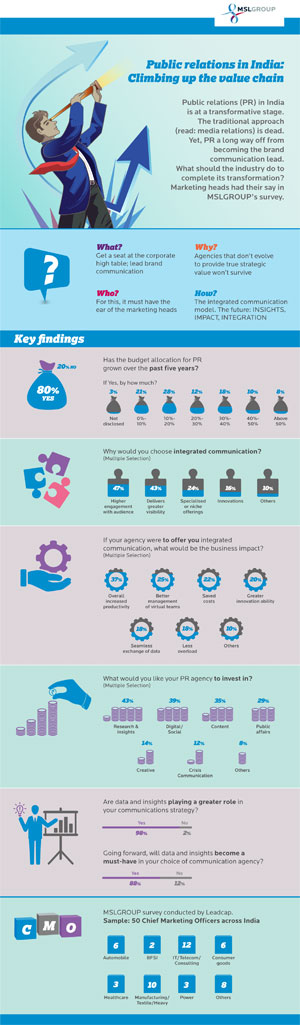
    Our survey of marketing heads across India has been a revelation. And full of hope. While advertising continues to have the biggest share of the annual marketing budget – 45% – overall marketing budgets have grown one fourth in the past five years. One of the reasons for the budgetary increase has been the adoption of integrated communication by businesses.


    With the PR industry making a decisive shift to this model, the time is right to capitalise on this trend. In fact, so important has this trend been that two thirds of the respondents said they have already adopted the integrated communication approach in order to achieve higher engagement with audiences and greater visibility. What’s a concern is that advertising agencies are being seen as the ones adapting faster to the integrated communication imperative. Marketers say they trust advertising agencies to service their needs because they’ve delivered greater return on investment in the past.


    For the PR agencies of today to become the partners of choice tomorrow, they need to demonstrate how they can add value and shift quickly to the integrated model. Marketing heads were quick to assert that agencies that did not adopt a holistic approach would fade away. Marketing heads also emphasised that data and insights would play a bigger role in campaigns and overall communications. It’s no longer a capability to be invested in for the future but a must-have now. What emerged was a picture of a new age of marketing that demands new answers. Can the PR agencies of this age provide those solutions? The opportunity exists. It’s time to seize it.


    If budgets are the acid test, then the PR industry seems to be on firm ground. While it is still way behind advertising, a majority of respondents said that their PR budgets had increased over the past five years. However, even now, respondents said PR accounts for only 15% of the marketing budget. With advertising accounting for 45%, PR has a lot of work to do if it intends to gain the lion’s share of the marketing bucks.


    The good news is that 80% of the respondents said that the budget allocation for PR is rising. The industry has evolved and companies are recognising its contribution in their growth.


    It’s now redundant to say that PR as we knew it is dead. Both, industry experts and clients, have been stressing for a while on the need for agencies to re-examine their role. Respondents are clear that they are willing to increase their budgets provided agencies can meet the dynamic needs of the market and work as a partner that understands their business goals. As many as two-thirds (67%) of the respondents have tried the integrated communication approach in their organisations.


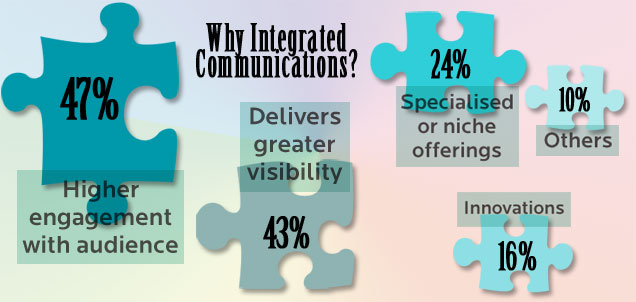
    The benefits are plenty: 47% said that integrated communication provides higher engagement with audiences and 43% said it delivers greater visibility. One respondent said that it gives consumers an opportunity to experience the brand through multiple mediums while another said that it brings together customers, employees as well as top management.


    While everyone recognises its value, it’s still early days for integrated communication in India. Some respondents said that one of the biggest challenges is adoption – it is a long process, it could get expensive and it involves getting multiple stakeholders on board.


    Also, in a situation where there are multiple businesses, multiple products, multiple consumers and multiple outcomes expected, it could get complex.


    About 37% of the respondents said that if PR agencies were to offer integrated communication, it would increase overall productivity, while 25% said it would result in better management; 22% said that it could save costs.


    When asked about the disadvantages of PR agencies offering integrated communication, 22% said that there would be difficulty in management, 18% said there would be internal conflicts and 16% believed that there would be a work overload. “PR agencies have lesser understanding of the brand. They have to prove themselves before offering integrated communication,” said a respondent


  • LGBT as TG: For pride and prosperity


    Shielding themselves from social stigma, India’s gay people lived double lives – one for the world and one in which they were true to themselves – for the longest time. Today, thanks to aggressive activism, growing awareness and an increasing number of LGBT people coming out of the closet, a new world has opened up for them. They are now carving out their space as niche consumers, giving marketers a new target group.


    Smart marketers are taking note of this newly empowered community. A report on Business.com said that gays and lesbians spend more than $600 billion every year across the world. They’re a business owner’s dream because they are:


    » Affluent: The average annual income for a gay household is $61,000, 20.4% higher than a heterosexual household’s, said the website


    » Educated: About 83% of gays and lesbians have either attended or graduated from college


    » Loyal: Approximately 89% of gays and lesbians are brand-affiliated and are highly likely to seek out brands that advertise to them


    Jaldi 5 with Ashraf Engineer: ‘LGBT community in India is making its presence felt in various ways’

    By Johnson Napier


    ‘Out of the Closet and into the Marketplace: The Birth of India’s Pink Economy’ report released by MSL Group India, has thrown up some stark realities about a community that for long has been a subject of neglect by many. That marketers chose to stay away from them for long is something that this report terms as surprising but suggests that there are opportunities galore for brands if they want to tap into this community.


    Ashraf Engineer, until recently Senior Associate Editor, The Hindustan Times – Mumbai and now Content Head, MSL India answers a few queries posed by MxMIndia on the report and the immense scope it presents to the marketers.


    01. The Pink Economy report has brought to the fore many facets concerning the LGBT community. What are some of the noteworthy observations from the report that you would like to highlight upfront?

    The biggest insight that we received is that even after the decriminalisation of consensual homosexuality I think the LGBT community is making its presence felt in various ways. Among that, one of those ways is economic manners where they are expressing their consumerist desires etc where we are seeing the first steps towards them becoming an important consumer group. I would be wary of stating that an economic boom or revolution is happening but the report takes the pains to say that is not the case. What the report makes very clear is that we are seeing the first signs of the pink economy emerging in India.


    It’s interesting to see a few businesses already taking advantage of this trend like apparels and accessories, travel and also events. These three have already recognised the opportunity and are working towards catering to this community.


    02. Why conduct a study/research towards a community towards whom the society is least concerned about?

    Through this study, we’ve looked at what is happening in the market, spoken to experts and then have come up with insights that are transpiring within this community. You could rather term it as being a business insight report. As for the need, any business-related organisation like ours where it is our job to support various businesses and communication strategies – it is our job to spot a trend early. We believed that it is going to be an important segment in the days to come and therefore felt the need to do the report.


    03. How have the marketers taken to the findings from this report? Do you see them more eager now to reach out to this section of the population?

    The response so far has been very positive. They also seem to understand that there could be an opportunity in time to come. In fact we have received a good response from the Media too. But this segment is not as evolved as it is in the West where marketers in various sectors specifically draw up business strategies and launch products centered towards this community. In fact apart from apparels and travel, even the BFSI industry abroad has been coming out with customised solutions that are aimed towards this community.


    04. Do you foresee obstacles regarding marketing or brands reaching out to this community, especially in a socially conscious market like India?

    In India, brands who are open and brash about this community may be a bit withheld for the moment but I think somewhere down the line they will understand that they need to continue drawing up plans for this community. As a consumer segment, for this community to attain full potential will take some time.


    How would you segregate this population basis their socio-economic classification? Does it throw up any interesting trend?

    The fact is that we only have international data to fall back on but in India there is no such study that tells us what the SEC standing is or for the matter even what the population base of this community is. If one were to go by the international pattern observed, the LGBT community is said to have more discretionary income. They have large incomes as they do not tend to have children; that trend is only now picking up. So as a consumer segment they are really very powerful.


    05. According to you, what are some of the learnings that Indian marketers can pick up from foreign counterparts when catering to this segment?

    Marketers first need to understand that this group does exist as a consumer segment and that there is an immense opportunity there. We already know of apparels and travel as potential segments but even lifestyle products in general need to wake up to them. Going forward, just like you have several banks abroad that offer solutions tailored towards their needs I think the BFSI industry in India needs to consider doing something similar.


    Know the market

    The LGBT market is different because it is many layered and poorly researched. It is crucial, therefore, for companies to study the market and understand which cross-section to target. This will help in getting maximum return on investments.


    Surveys conducted by various agencies indicate that gays and lesbians look at more magazines and newspapers and watch more TV than heterosexual consumers. They are also more driven by marketing campaigns to make purchases.


    One of the biggest strengths of the community is its resilience and its tendency to bond closely. When they come together for events, festivals or concerts, the energy is unparalleled. For marketers, this is a tailormade platform.


    Jerry Johnson, a marketing professional and TEDx speaker, said: “It is important for marketers to understand that the LGBT community is not just about sexual orientation. Our identities can also be identified with our interests. For any campaign to appeal to us, it should stay away from stereotypes and clichés. It would be best to keep it normal and inclusive. The Benetton ‘Unhate’ campaign was a great one as it had a simple message and yet had a strong impact. It conveyed that it is OK to be different. GAP too had a campaign that had two men wearing one shirt. These are big brands that are trying to be inclusive and we appreciate that.” Marketers have also identified that the LGBT community as an opportunity for gadget makers.


    Marketers are reaching out to them through social media, smart phones and other new media. Gay web portals are a great marketplace and have a captive audience. “Social media is the biggest tool; we are very active online. There are several online groups, websites and social forums that attract huge traffic,” said Johnson. “The internet gives customers the luxury of privacy. The best way to reach us is through our mediums.


    We become very loyal to corporations that advertise on our mediums and we also become their advocacy customers.”

    Apple, for instance, has several apps that help the community connect with a wide network. Apple’s DowneLink provides a space “for Downe (LGBT) people and their friends to exchange ideas, build friendships, and utilise local and nationwide services”. The app offers features such as social networking, blogs, e-mails, bulletins, forums, video/audio chat and instant messaging. It also has ‘365gay News’, which provides a space for LGBT people to stay abreast of current news and happenings in the world.


    The keys to success

    » Understand the segment:

    In Johnson’s estimate, there are 70 million gay people in India – many of them urban professionals with great purchasing power. “This is a huge segment and marketers are taking note of it. Mumbai, for instance, has three to four gay-related events every week. While they may not openly advertise them as so, community members spread the word and join the party,” he said.


    » Make business sustainable:

    In India, there are several challenges before pink businesses. The community is not very visible and, while there are many who are openly gay, there are millions still unwilling to come out in the open. For businesses, it is therefore best to cast the net wide than have explicit marketing campaigns. It isn’t wise to start an exclusive store as many still don’t like to be branded as gay and would shy away from visiting them.


    » Social media engagement and mobile marketing:

    Telecom and internet are two of the biggest opportunities in the LGBT space. Johnson explained that the gay people are eager to reach out and connect to others like them. “We spend a lot of time on the internet, on long-distance phone calls and BlackBerry Messenger groups. Domestic travel is another strong market. We love to travel and meet other members of the community,” he said. Since many gay couples have no children to support, their disposable income is high – something the automobile industry also recognises. Furnishings and home décor are important segments too.


    » Be sensitive and inclusive:

    Being flashy does not always grab eyeballs. It is the approach and attitude of marketers that can make or break a business when it comes to a niche market. “Gay-friendly businesses don’t need to spell that out. It is in the attitude. For instance, at hotels and restaurants, it is important that the staff are trained and sensitised. They need to treat customers with respect. Owners and managers realise that, at the end of the day, it is a business transaction and that they need to give customers the best possible service,” said Johnson. Jaideep Shergill, CEO, MSL India added: “The only tip I would give marketers is to treat them like other consumers. The more differently they are treated, the more the stigma is likely to remain.”


    Success stories

    While undoubtedly nascent, India’s pink economy has already tasted success. There is no market study, but entrepreneurs and observers have said that sectors such as tourism and apparel are catching on.


    A journey of a thousand miles…

    The pink rupee is finding its way into the bank accounts of travel companies catering to a gay clientele. Firms like Indjapink, Le Passage to India and Bangkok-based Purple Dragon are leading the race. The tours cover everything, from honeymoon packages and candle-lit dinners to wildlife safaris and spiritual retreats. Some tour companies have even conducted weddings with traditional rites for gay couples.


    The packages are mid-range to luxury and most of the clientele comes from the US and Australia. Though most agencies cater to only men, there are indications that lesbians in North America are interested in the country too.


    “India is high on the wishlist of many customers. The big attractions are history, culture, cuisine, shopping… We are happy about the Delhi High Court ruling and this might put some of our prospective India customers at ease,” Douglas Thompson, MD, Purple Dragon, told ‘The Indian Express’. Purple Dragon sends 200 to 250 customers to India every year.


    Delhi-based Indjapink specialises in gay tourism. “We create tours for the gay community, offering them outstanding personalised service and make them experience India in a discrimination-free atmosphere,” founder Sanjay Malhotra said. He felt that the reading down of Section 377 had liberated the community from discrimination and abuse.


    Malhotra told Reuters that his firm started off with 20 gay customers, but now has more than 100. “They feel they can breathe easy, live the life they want to. After the court order, we started getting more inquiries from gay men, both in India and abroad,” he added.


    Arjun Sharma, who founded Le Passage to India in Delhi, said: “It’s a $3 billion industry worldwide. Gay tourists are wealthy and have expensive hobbies like arts and fashion.”


    The Indian gay travel industry got a boost when the International Gay and Lesbian Travel Association listed the country as a destination site for gay travellers, with 11 gay-friendly or exclusively gay travel agents as partner businesses. “The gay community had so many apprehensions travelling to India,” Malhotra told Reuters. “Now, they look at the option of travelling to India without acting heterosexual.”


    India seems to be following the lead of Nepal, which became the first South Asian country to decriminalise homosexuality and legalise same-sex marriages three years ago and has since been actively courting the gay tourism market. American Thomas Roth, who runs an LGBT community market research firm in San Francisco, is among those hooked to India.


    Thirty years ago, when he first visited the country, he would evade questions about his wife and children. “Like most gays in India at the time, I was basically invisible,” he told Reuters. Today, he said, “With Gay Pride events, film festivals and parties, gay visitors can have it all.” A survey conducted by Roth’s firm last year ranked India as the second most desired cultural or adventure destination, just behind Thailand.


    When clothes set you free

    ‘The most powerful politics is the politics of economics,’ read the sign on the door of Azaad Bazaar, a clothes store that catered to the gay community in the Mumbai suburb of Bandra. Set up in 2009 in a garage, AzBaz – as it was popularly known – was the brainchild of Simran and Sabina (they both go by their first names only), strong voices in Mumbai’s gay rights movement. Their commitment to the cause was reflected in the way the store was designed – it doubled up as a coffee shop, where gay people hung out, sipped tea and chatted. It was as much a community house as a retail store.


    “A lot of people came in with their parents, and they usually come up to us with an awkward ‘hello’ but often end up in conversations ranging from the polite (‘So, how is the store doing?’) to the personal, about how they felt when their child came out to them,” Sabina told the ‘DNA’ newspaper. The store – which has now moved to Goa – also hosted book readings, film screenings and community meetings. “When we were younger, the community was not so accessible,” Sabina added.


    Sabina and Simran started AzBaz by retailing their own ‘Jailbird’ brand of T-shirts, which they marketed largely by word of mouth. It was a humble beginning, so imagine their surprise when several local shoppers started to walk in. “Once we explained the concept of the store to them, we got a variety of reactions that ranged from the evolved (‘You mean there is only one store like this in India?’) to the very excited (‘Oh, I have to tell my gay best friend about this!’),” Sabina told ‘DNA’. “This is not just about retail – it’s about understanding the concept of the store.”


    “The gay community is a targeted consumer and it’s growing now,” Simran told ‘The Indian Express’ newspaper.


    Excerpted with permission from ‘Out Of The Closet And Into The Marketplace – The birth of India’s ‘Pink Economy’ an MSLGroup India publication. If you wish to have a PDF copy of the report, write to editor@mxmindia.com with subject ‘Pink Economy Report’


    Image: LGBT community at the Bengaluru Pride and Karnataka Queer Habba 2011. Image by Fotocorp

     

  • [PR Channel] What journalists want: The 10 commandments for PR folks

    By Ashraf Engineer


    Whom do journalists love to hate? Public relations (PR) professionals probably wouldn’t top the list, but they’d come pretty close. The irony, of course, is that the journalist-PR executive relationship is deeply symbiotic – one can hardly do without the other.


    But before I say anything else, you should know that I empathize. I know journalists can’t wait to get you off their back – unless they need you. In which case, you need to respond, like, yesterday.


    How many times have you thought after an I-need-a-response-now ultimatum, ‘What do journalists really want?’


    Here are a few commandments. Live by these and, who knows, the rocky relationship might just get smoother.


    Thou shall be clear and concise

    Most journalists work to a deadline and don’t have the time for rambling, rah-rah press releases. Say what you have to without taking up too many words. You’re working to a deadline too, so this should work to your advantage. A well-written yet short press release has far more value than a tsunami of words that has at the core just one paragraph of usable information.


    Thou shall not promise what you can’t deliver

    Years ago, when I worked for one of Mumbai’s leading newspapers, Nobel-winning mathematician John Nash visited the city. The PR agency managing the visit promised us an exclusive interview, with other newspapers getting access to Nash only the next day. Turned out the agency promised every newspaper the same thing. Imagine our shock when we saw Nash’s interviews everywhere. My newspaper stopped dealing with the agency altogether. The CEO had to come over and apologize, but things were never the same again – we kept the agency at arm’s length and treated every communication from it with suspicion.


    Thou shall not peddle rubbish masquerading as news

    Journalists have had it with ‘news’ that isn’t really, well, news. And surveys that are little more than a few colleagues being asked their opinion. Good journalists are discerning; they won’t let something like that get through. The bad journalists, you should have no use for – they won’t last and will never be in a position to help you or your clients.


    Thou shall respect deadlines

    This might seem obvious, but you’d be surprised how often it is ignored. Nothing gets a journalist’s goat more than information/reactions not arriving on time. Your tardiness could slam the door shut on potential coverage. It could also destroy the goodwill that you and your firm might have with the newspaper concerned. Why risk it? Get it right.


    Thou shall make clients, facts available

    Journalists want people featured in the press release to be available, and also the facts and figures. There’s no point in pushing a story if its basic building blocks are out of reach. So, if your client has a new CEO, it’s not enough to just say it. The CEO must be on hand to articulate his vision and his plan. Unless you do that, a journalist would see no value attached to the story. Journalists aren’t carrier pigeons – they aren’t satisfied with only the information you give them. They may see a storyline you don’t, and would need support accordingly.


    Another sticking point is case studies. Wherever relevant, make sure you have good ones. Journalists love them because they make the story come alive. Make sure they support the larger story, make sure they’re well written.


    Thou shall know your target newspaper

    When I was working for a lifestyle newspaper, I was often flooded with press releases that weren’t relevant to me – from a new type of spark plug to a stent that made heart surgery cheaper.

    What were those PR executives thinking? We covered society events, fashion, cinema and television. Spark plugs? Really?

    Don’t carpet-bomb the media with releases. That’ll only result in a lot of dead trees and no stories to show for it. Read newspapers, know what they cover. Most good newspapers don’t simply run a press release; they use it to spark off an idea.


    Thou shall stay away from jargon

    Using jargon only creates an illusion that you know more than you actually do. And, like an illusion, it’ll shatter at the first challenge. Besides, it turns journalists off.

    So, the next time you’re tempted to say ‘ponzi scheme’, just say ‘a fraudulent investment operation that pays returns to investors not from any actual profit, but from money paid by subsequent investors’.


    Thou shall address releases to the right people

    Have an UPDATED list of journalists and the newspapers they’re working for. My last job involved handling news specials for a leading daily. Yet, I was bombarded with companies’ financial results. On the irritation scale, it ranked only below being addressed as ‘Mrs Ashraf Engineer’ (and that happened too!).

    A newspaper I worked for even received releases for a journalist who had passed away!

    Send your releases to the right people, make sure you address them properly and – for God’s sake – make sure they’re alive. Otherwise, guess where they end up. It’s no wonder they say ‘delete’ is the journalist’s favourite key.


    Thou shall be well informed

    I’ve lost count of the number of times the PR professional at the other end of the line didn’t have even basic information about his/her client – size, location, turnover, etc. Apart from seriously harming your own and your agency’s reputation, it creates a poor impression about your client.

    Wait, weren’t you hired to do the exact opposite?


    Thou shall know this – a newspaper is not just a print product any more

    Every newspaper now has a website. The traditional press release format was developed over 100 years ago for print journalists. But they’ve changed. Most people get their news from the web first. This has sent tremors through newsrooms and altered them forever. In the process, the PR professional’s job has been altered too.

    Help the journalists do their jobs by providing graphics – and, where required, multimedia – that are relevant and on time.

    It doesn’t end there. Journalists might require quotes from experts and client executives. Your story may never see the light of day unless you travel this extra mile. So, help journalists help you.


    Ashraf Engineer is Head – Content at Hanmer MSL. After a 16-year career in journalism, he now heads the high-value content operation of the agency. He can be contacted at ashraf.engineer@hanmermsl.com.