Tag: Arvind Kejriwal

  • Ranjona Banerji: Election of the Trivial & Telegenic


    By Ranjona Banerji


    If this general election is indeed a watershed moment for Indian polity then it is no less a groundbreaker for the Indian media. Television has dominated this election practically setting agendas and leading the battle from the frontlines when it comes to chosen candidates and parties. The battle is won by the trivial and the telegenic. The smaller India grows in terms of communication thanks to telephony and technology, the larger the disconnect from reality: or so it appears.


    If the media is going to play such a significant role from here on, then the elements within the media must come out and identify themselves by their ideological and philosophical bearings. The old argument used by journals that they are all things to all people cannot stand any longer. It is in many cases patently untrue. Further, it has reached a stage where you are taking readers for a ride.


    Television has no such argument at all and instead has created an atmosphere of rumours, allegations and gossip to thrive. Even within the media fraternity, there is a constant stream of stories about which channel has been sold to which political party or who favours which candidate. Some parties are barely being mentioned when it is evident that they will have some bearing on these elections. Thrown a few corporate houses into the mix and you have a great Indian muddle which barely resembles a delicious homemade khichdi.


    Who has financed all these opinion polls to project election results for instance? What is the consumer of news to make of them when ground reports from journalists are at odds with those surveys? In a two-month long voting schedule, a constant stream of opinion polls amounts in fact to trying to influence those who have not yet voted, even if the Election Commission has not cottoned on to it yet. The figures for conducting these polls which are going round the grapevine are astronomical.


    It is time therefore for all newspapers, news channels and websites to declare their political leanings. There is no shame in this. All over the world, the reader and viewer knows what their chosen media outlet stands for. This is not just about individual columnists to declare their leanings. This is about the organisation itself. Given the growth of the influence of the media – and these are strong words – to fool your consumer any more is tantamount to fraud.


    It is evident that it is not just a nudge from one corporate house and a wink from another that dictates media flow. We have seen epic and sudden changes of direction from left to right to centre and back. What most newspapers do to cover this up is provide a variety of columnists on their opinion pages to portray first one point of view and then another to prove that they are “neutral”. It no longer cuts it.


    TV of course is another jungle with its own rules, quite distinct in some cases from print. Editorialising and on the spot opinion-making is now par for the course. As a very senior editor who has a career in both print and television pointed out to me, if a star anchor, who is also the editor, asks a young reporter on live television, “Isn’t the political rally proving what I say?”, what is the young reporter to do? Disagreeing with the boss is not an option. And so news is created, not reported.


    For a long time in India, journalists were more left of centre than right but that was not an absolute truth. For instance Girilal Jain, a colossus in the Times of India was distinctly right of centre and the Indian Express was distinctly anti-establishment in the days when the only establishment was Congress.


    One must distinguish between the need for media outlets to declare their politics and the accusations and muck thrown at individuals on social media. Gutter language and threats will continue. But now the target will be clear and much larger. And in the interests of fairness, everyone will have a target!


  • Kejriwal and the Media: Ranjona Banerji & Pradyuman Maheshwari


    Ranjona Banerji: Kejriwal’s threat to democracy?


    By Ranjona Banerji


    The media, willy-nilly, has become part of these elections. Not as the “fourth estate” of democracy but more like a “fifth column” which is out to destroy institutions – that is, if you listen to our politicians of all colours and persuasions and try to assess the anger on social media. But why blame politicians or Twitter and trolls alone? The media itself – and here most fingers will have to point to television – has behaved in extremely irrational and even unprofessional ways when it comes to bread and butter journalism.


    Starting from the extraordinary coverage of the India Against Corruption movement in 2011, television decided to become a player rather than an observer. Even I got taken in by the exhortations of TV anchors in 2011 when they talked about millions of people taking to the streets in support of the Anna Hazare-led movement to clean up public life. Alas, when I arrived at Azad Maidan, there were less than 500 people present. Not the hundreds of thousands promised by well-positioned TV cameras.


    But once India Against Corruption transformed itself into a political party – the Aam Aadmi Party – and Anna Hazare was replaced as the movement’s leader by Arvind Kejriwal, TV started to change its tune. The tide was now against the movement. None of the surveys running up to the Delhi state elections could predict what AAP would do. The Congress would be struck down and the BJP would win is what we were told. Instead, we had the AAP forming a very close second. So much for election surveys, psephology and astrology.


    Once the AAP formed the government, the wrath of television knew no bounds. Of the English channels, Headlines Today and Times Now were the angriest. Every hand gesture of AAP members was dissected and denigrated. This is not to suggest that the AAP had a perfect month in power – far from it. Indeed, their law minister Somnath Bharti’s unconscionable midnight raid looking for sex workers in Khirki Extension deserved the strong condemnation it received. But the poor AAP did not even have the short “honeymoon” period accorded to everyone else by the media.


    Since then, some TV news channels of all languages have abandoned all objectivity and decided that the AAP has to be their primary target. The fact that some journalists have joined this party has enraged them even further. The AAP has reacted with matching bile and Kejriwal has decided that he will arrest mediapersons if he comes to power. What a wonderful circus of democracy. Enter the clowns, exit all good sense.


    Some mediapersons have now had additional tantrums about the threat to democracy promised by Kejriwal. All this is sans irony, especially of the threat to journalism as practised by them. Never mind.


    Here are some other media views:

    Senior journalists question the overreaction to Kejriwal: http://www.thehindu.com/news/ national/why-overreact-to-kejriwals-criticism-ask-journalists/article5789153.ece


    And Shekhar Gupta speaks as an “aam patrakar” in The Indian Express: http://indianexpress.com/article /opinion /columns/national-interest- main-hoon-aam-patrakar/


    **


    The upshot is that the AAP has to be treated as one more political party. Neither angel nor devil. And that ought to hold true for all of them.


    Ranjona Banerji, senior journalist and columnist, is Contributing Editor, MxMIndia. The views expressed here are her own. Twitter: @ranjona


    Mediaah!: Time media shows Kejriwal his place


    By Pradyuman Maheshwari


    Not many moons ago, Arnab Goswami could be seen screaming at anyone who didn’t agree with him that there was an Arvind Kejriwal wave sweeping the country.


    Arnab isn’t too kind with anyone who disagrees with him. His body language changes and his head shakes in denial the moment the guest with an opposing view opens his or her mouth.


    In fact, even before a guest finishes his first two or three words, Arnab opens his mouth and the two can be seen to be talking together. But that’s his style, and people love the Times Now editor-in-chief for that.


    The problem for Kejriwal is that soon after his party’s great showing at the Delhi elections, he started negating the highfalutin statements he made before the polls and after them.


    Many in the media – and this writer included – had then regarded Kejriwal as the messiah who God had sent to cleanse the country’s political system. And as it often happens, it propelled him to dizzying heights.


    Some of my friends and colleagues in the profession didn’t think too much of Anna Hazare and Arvind Kejriwal. I thought they would come around the man and his ways soon enough. After all, weren’t there many who thought a certain Mohandas Karamchand Gandhi was nuts with his satyagraha and non-violence movement?


    I was proved wrong and to my dismay – quite like the disillusionment I had with the BJP post L K Advani’s Rath Yatra and the Babri Masjid desecration in 1992 – Kejriwal made a mockery of himself and all that he stood for.


    In fact things have gotten so bad now that even though the AAP leader could well be speaking the truth, no one really trusts him.  The media at least doesn’t.


    We know the media isn’t above board. There is corruption in many newsrooms.  Paid news is rampant, and despite all of the Election Commission’s efforts, the smart ones still get away. There is paid news even for non-political content, but I don’t think Kejriwal will be too bothered about the other kind of parties.


    But is it right for him to question the integrity of news channels just because they are now treating him the way they treat all others? Just because they are questioning every act of his, which they wouldn’t just six months back?


    I have found Arnab Goswami unduly harsh on Kejriwal (see: Is Arnab being too harsh on Kejriwal, mid-day, March 13:  http://www.mid-day.com/articles/is-arnab- being-too-harsh-on-kejriwal/15156104), but that’s no reason for anyone to rubbish him (Arnab) and suggest that he and other newsroom bosses are on the take from Narendra Modi or Rahul Gandhi.


    The News Broadcasters Association acted on it a few days after the utterance and his issued a warning to the AAP leader. The message from the NBA: stop the trash, Mr Kejriwal, or our members will stop covering you.


    While Arnab Goswami was pretty scathing on his News Hour, the real blow came from Rajat Sharma on his show ‘Aaj Ki Baat’ on Times Now. Coming on air when he was down with fever and a bad throat, Mr Sharma was scathing in his criticism of Kejriwal and exposed his doublespeak in a one-hour show.


    Meanwhile, Arvind Kejriwal and AAP would’ve been taught a lesson not to subject the media to their loose talk.  Damn the media, and be ready to get damned.


    Although Pradyuman Maheshwari is Editor-in-Chief and co-founder of MxMIndia.com, the views expressed here are his own. Twitter: @pmahesh


  • Ranjona Banerji: How the media is everyone’s whipping boy

    By Ranjona Banerji


    The media is now everyone’s whipping boy and there is no need for the media to get defensive about this. As long as everyone thinks you’re doing everything wrong, it is clear that you are doing everything right. The expression “paid media” is now indiscriminately used to describe journalists who do not subscribe to your political point of view, when the term within the media is used to describe managements who sell editorial space to political parties or politicians without informing readers or viewers.


    Arvind Kejriwal of the Aam Aadmi Party has accused the media of being pro-Bharatiya Janata Party and pro-Congress and also said that some of the media is dancing to the diktats of Mukesh Ambani and Reliance. More specifically, the media he says is either pro-Narendra Modi or pro-Rahul Gandhi; the unspoken implication being that the media is anti-him. However, through 2011 the media was extremely pro-Kejriwal and the India Against Corruption movement headed by Anna Hazare. One might wager that without media support, the IAC movement would have gone nowhere. Non-stop coverage of every IAC event, gross exaggeration of public participation figures all ensured that IAC, Hazare, Kejriwal, Manish Sisodia, Kumar Vishwas, Kiran  Bedi, Prashant Bhushan and others became household names.


    India’s controversial former chief of army staff VK Singh has also jumped into the fray, calling journalists “presstitutes”. This is how urbandictionary.com describes “presstitute”: “A term coined by Gerald Celente and often used by independent journalists and writers in the alternative media in reference to journalists and talking heads in the mainstream media who give biased and predetermined views in favour of the government and corporations, thus neglecting their fundamental duty of reporting news impartially. It is a portmanteau of press and prostitute.”


    In fact, I would question Celente’s (an American “trend forecaster) wisdom and political correctness in damning commercial sex workers (the now accepted term for prostitutes) by associating them with the media and with journalists.


    Jokes aside, Singh has been angry for a number of reasons – his various dates of birth did not sit well with either the Indian Army, the GOI or the Supreme Court, his various PR efforts sometimes backfired and Indian Express published a story last year about how some troop movements during his tenure were looked at suspiciously by the Government.


    The Editors Guild has taken exception to all this media-bashing and issued a strong statement: “Ironically, leaders who built up reputations and support by engaging the public through the media are now turning on the very media when they come under critical scrutiny…


    “The media that question and criticise political leaders and indeed every section of society should of course be open to criticism, even if it is harsh, of its functioning and to its flaws being exposed. The problem arises, however, when abuse and vague, unsubstantiated accusations of corrupt motives take the place of reasoned refutation and debate. An additional danger is that some of the followers could take their cue from the statements of leaders and may not stop with verbal attacks. Both print and television journalists have been subject to physical violence as well by political party workers.”


    Physical attacks on journalists are reprehensible and have to be tackled strongly by law and order. But general criticism of the media and of journalists has to be accepted as par for the course. As we have pointed out in these columns, there are clear instances of media bias on display at times and criticism of political parties, politicians and big business is sometimes a carefully calibrated exercise.


    The spread of the tentacles of lobbyists and PR people is well-known when it comes to film and business journalism for instance. And the Niira Radia tapes exposed the susceptibility of some of India’s biggest names. These are problems which the media must discuss more stringently, or criticism from those we criticise will only get stronger.


    If we don’t guard ourselves, someone else is going to try and do it for us. And that would be the real disaster.


  • Ranjona Banerji: So why did Times make a front-page statement?

    By Ranjona Banerji


    Truth is, we have no political masters, nor do we have any hidden agenda. The only side we take is that of our readers.”

    So what compels a newspaper to make this statement, especially one that declares it is “the world’s largest circulated English newspaper”?

    The Times of India’s edition of January 23, 2014 carried this on the front page. The rather thin (leading to some very ugly hyphenation) single column headlined “To Our Readers” was a declaration that although the newspaper had been accused of first supporting and then turning against the newly formed Aam Aadmi Party, in fact it is for no one and against no one and will support whoever does the “right thing”.

    The newspaper also pointed out its philosophy, such as it is, which includes belief in “the primacy of the individual over the state, and that democracy in its truest sense is the power of one. We believe in personal liberty and in freedom of choice.” There is more in the same vein.

    As to why TOI decided to make this announcement is unclear, except for the allegations that it had switched horses mid-stream regarding the Aam Aadmi Party. But so what? As it itself declares, it has been accused supporting one or the political party in the past and has not bothered to make any front page announcements. Is it because the AAP is the new party of the middle classes, which is TOI’s core readership? Or has someone inside Bennett Coleman suddenly developed a very thin skin?

    The worst that The Times of India has been accused of is not patronage of a political party. The worst has to do with money: the introduction of Medianet where news items are sold for a hefty price and for private treaties, where certain business houses and entities can ensure good coverage for themselves.

    Obviously, there were no mentions of either in this intriguing, and if one may point out, clumsily written and punctuated, front-page editorial declaration.

    **

    However, it is also true that the media seems to be getting polarised politically in a manner last seen during the BJP’s Ram Janmabhoomi movement of the late 1980s. Journals and journalists both declared themselves to be pro-BJP and Hindutva, with an emphasis on a preference for economic reform as well as religious majoritarism. Much of this media anger was also against Congress hegemony and also showed itself in massive support for VP Singh’s breakaway movement.

    Since then, the media has been seen as supporting one or the other political direction although very often the accusations are quite wild. Right now the Indian media is clearly heading towards the Right – except for the gauntlet thrown down by the Aam Aadmi Party and its particular brand of agitation politics. And perhaps that is where TOI’s confusion begins.

    **

    The biggest current problem for the Indian media and television in particular is that it cannot see beyond Delhi. If the Gujarat chief minister was the front page hero for almost six months, he has been ousted by Arvind Kejriwal. Much as the AAP and Kejriwal have changed the game, they are certainly not the only stories in India. Yet day after day we are subjected to a series of Delhi-centric stories.

    Part of the problem is that Delhi has become the epicentre of journalism in India. As a result, once strong regional media entities have been forced to pay extra attention to the national capital. Most TV channels are headquartered in Delhi – Times Now being the notable exception amongst the top English channels. And our star TV anchors cannot see beyond their neighbourhood. Who knows what has been happening in India and the world over the past couple of weeks. All we know is that Sunanda Pushkar thought her husband was having an affair and then may or may not have killed herself and that Arvind Kejriwal slept on the streets next to his car for a few night until he was sent some hot paranthas.


    Ranjona Banerji is a senior journalist and Contributing Editor, MxMIndia. The views expressed here are her own. Ranjona Banerji can be reached at @ranjona

  • Ranjona Banerji: No ‘fine and dry’ puhleez, dear BBC!

    By Ranjona Banerji


    I have spent the last three weeks reading back issues of Time magazine. And I am amazed that their rewriting style (from what I recall, you are not really allowed to have a writing style at Time) has not changed at all. The same inverted sentences. The same twist at the end. The same short phrases to try and be current, even though some go back at least 25 years. This is testament to Time’s covenant with its principles – stick to what you started with even if your readership is shrinking and everyone around you has changed. A tip of the hat to this nostalgia-inducing standard practice: I practically went back to my childhood which was… well, it was a long time ago. You don’t want to know!


    **


    I have to confess that I have not read too many newspapers (this is a gross exaggeration: I have read precisely two) in the past 10 days. I have kept up with the news through social media and through some television. And by watching English news channels, you may forget that India is such a massive country.


    Instead: there is Arvind Kejriwal, chief minister of Delhi. Now New Delhi may be India’s national capital and it may have a state government but it cannot compare to any other state government. The chief minister of Delhi is responsible for about a quarter of the things – I am being generous here – that other chief ministers contend with. Yet, we have national news channels behaving like local cable news channels. What Kejriwal had for breakfast, what he wears to bed, the progress of his cold, how Delhi government officials may well be crooked, how to get a water connection in Delhi and on and on and on. We get it. Kejriwal and his Aam Aadmi Party achieved something miraculous in the Delhi assembly elections. Now move on. Other things are happening in the rest of India.


    The rest of TV news however is as blinkered. We are stuck in an endless spiral of Congress versus BJP fistfights. One party says blue so the other says yellow and it never ends. News channels set themselves up as pasties here as shrewd politicians play them for fools so easily. We understand that newsgathering is expensive and laborious. We know that TV has to look for instant gratification. We are aware that fighting for attention is a mug’s game. But still, it would be interesting once in a while to watch television and just get a picture of what’s happening in the world instead of a tailored picture of what might possibly create the most sensation.


    **


    This is a request to the BBC World Service’s weather department. We understand that the English are obsessed with the rain and crave the sun. But the whole world is not England. India for instance gets most of its rain from the monsoon. It rains sporadically in a few parts of India outside the monsoon – and most of this rainfall follows a very specific meteorological pattern. We in India are taught this as school children. For instance, if it rains in Mumbai consistently after the monsoon is over then it is a possible indication that the world’s climate is undergoing some immediate catastrophic crisis. Similarly, some parts of South India get the retreating monsoon. The North will be affected by westerly disturbances and it will snow in the Himalayas in winter.


    So we need some pertinent weather forecasts from the BBC World Service. Like when people are dying of the cold in North India, we don’t need to be told that the weather is “fine and dry”. We need to be told about falling temperatures. We know that it is not likely to rain in Madhya Pradesh in December. So “fine and dry” are tautological. Conversely, when there is a heat wave in summer and people are dying, “fine and dry” sounds like a slap in face. Summer is when we crave for rain, really, we pray for the monsoon. We sing those Bollywood songs your pop culture experts are so fond of.


    Also, when you run weather forecasts for the British in Britain on the BBC, you can advise them where to holiday. But for the World Service, it might be nice to concentrate on us. And tell us the weather of the world as well – there could have been more on the polar vortex, on the heat wave in Australia, on flooding in Europe. Please don’t take this badly. It’s just we’re so tired of “fine and dry”.


    Ranjona Banerji is a senior journalist and commentator based in Mumbai. She is also Contributing Editor, MxMIndia. She can be reached via Twitter at @ranjona. The views here are her own


  • Vijay Mukhi: Are Narendra Modi’s Twitter followers fake? And what about Shashi Tharoor’s?

    By Vijay Mukhi


    The best job on the planet is being a columnist on Politics and Technology, because no one in this space  talks sense or hard facts and numbers. Breaking news everyday is about Narendra Modi’s Twitter followers being fake, but no one is offering any credible evidence on either side of the debate, fake or real. So, before I throw my hat in the ring and get egg all over me (which is all in days work for me) let me tell you that I believe in the maxim Trust but Verify so before you cast the first stone, please download all the data that I have gathered from Twitter from my website www.vijaymukhis.com. We are also comparing only Narendra Modi and Shashi Tharoor as the other politicians are pygmies on Twitter compared to these two giants.


    Modi, today,  has 19,34,170 followers on Twitter compared to Tharoor who has  18,42,046,  a lead of just under a lakh. Modi and Tharoor share  447,920 followers in common which is around 25% of their followers , Modi and Kiran Bedi share 408,401 followers and Modi also shares 2,98,005 followers with Arvind Kejriwal. Thus, we can safely conclude that there are about 4 lakh people on Twitter who just like following politicians from India — why, we have no answer. This leaves Modi with a maximum of 15 lakh fake followers as fake followers would not share politicians from different groupings.


    How do we define a fake follower? Simple answer, someone who does not tweet. Modi has 6,77,296 followers who have never ever tweeted. Now imagine, why would someone join Twitter and not tweet at all! This is very extremely damning and conclusive evidence, we need no judge or jury to convict that these have to be fake followers. Thus if 35% of Modi followers have to be fake, what more evidence do you need! But, do not open the bubbly to celebrate, Tharoor has only 5,23,843 followers who also have never ever tweeted , which make up 28% of his followers. Can we thus draw a line in sand that says that if up to 28% of your followers have never ever tweeted then it is okay but any percentage above that makes these followers a fake? A more charitable explanation is that there is a silent (in terms on not liking the sound of a keyboard) majority out there on Twitter who do not tweet at all, but simply read tweets. If you take a step further, 12% of Modi and Tharoor’s followers tweeted only once and 7% only tweeted twice. A simply addition tells us that over 46% of Tharoor’s followers and 54% of Modi’s followers do not like to tweet or cannot tweet for various reasons. We need to accept that not everyone likes putting pen to paper even though we have to write less than 140 characters.


    The best evidence of popularity or influence on Twitter is how many people follow you. About 4,85,077 or 25% or a quarter of Mod’s followers have 0 people following them. Aha, this nails Modi finally and this is enough  proof that these followers are fake! The obvious answer is that if you do not tweet then obviously no one will follow you and for Tharoor the number is 2,61,883 or 14%. The percentage of the number of followers who have only 1 or 2 followers following their tweets, sort of remains the same. Thus like sending tweets , we have a whole community of users on Twitter who are so important that nobody follows what they do. Twitter Orphans can well be a new addition to the English language, what say?
    The obvious conclusion is that about half your followers would be inert or inactive or to use the TV analogy, coach potatoes who would surf from politician to politician.

    One sureshot way of finding out whether your followers are fake is to look at how many followers did you add every day of the year. During the month of July 2013, Modi added on a average around 5000 followers per month and Dr Tharoor about a 1000. For May and June, these numbers were also similar. The only conclusion we can draw here is that Modi’s team is very smart, had they added 50,000 followers on one day, they could be caught in the deserts of Rajasthan. But what if I paid an agency (millions on the web that do this for a small fee) to increase Modi’s followers count by a lakh on a certain day, the media would go ballistic and say that Modi was caught with his hand in the desert sand.


    I agree we are getting nowhere. So let’s look at another metric. When did  your Twitter followers create their account on Twitter or an ageing analysis. A whopping 1,02,385 of Modi followers were born on Twitter in April 2013, 94,874 in June 2013 or better still 502, 918 of his followers are under 180 days old on Twitter or created in the year 2103. For Tharoor, this number for 2013 is only 171,459. For 2012, the equivalent numbers are 595,656 for Modi and for Tharoor 360,540. A non-convincing explanation is that India is the youngest country in the world population wise and therefore all of your followers must represent this trend of being young. More than half of Modi’s followers have joined Twitter nearly a million , in the last 18 months only ,maybe just for him. This is why Twitter should give Modi an award for bringing so many people to Twitter!


    Where Tharoor leaves Modi biting the dust is when it when to the quality of followers, and that also by a factor of 2. We simply added up all the followers of people who follow Tharoor and the number was an astonishing 27,89,94,347 and for Modi it was half that at 10,87,44,125. We have not removed duplicate followers from this list. So theoretically when Tharoor tweets and if all his followers retweet his tweet around 27 crore people would see that tweet. Tharoor followers have tweeted over  52,26,34,885 times but Modi’s followers being newer and weaker are half that at 27,57,99,883. On a average, a Tharoor follower has 150 followers who tweets 282 times and a Modi follower would have only 56 followers and tweets much less at 143. Thus an average Tharoor follower would beat a Modi follower in a virtual fist fight as Tharoor has a long and khandhani history on Twitter.  Maybe and we have no evidence for saying this, but a Modi follower may have more pets (aka puppies) than a Tharoor follower. It a foregone conclusion that Tharoor’s followers are twice as strong as Modi’s followers and no guesses who would win a twitter slugfest, in spite of what conventional wisdom says that Modi’s followers are winning on Twitter.


    OMG, read over 5000 characters ie 35 tweets (my editor decides column length in tweets and not characters)  and yet no conclusion on whether Modi has fake followers or not! So, let’s muddy the waters even more. Go to the Twitter page of a user vijaymukhi712 by typing www.twitter.com/vijaymukhi712. This user bears my name and I have actually tweeted 86 times, a pretty active user one would have to admit, to a fake user under any yardstick. Every day my internet avatar ( not sure of the sex as you will soon see) quotes a love tweet so has his heart in the right place. But if you check further, say the 19th of every month, you will see the same love quote. This user is a creation of a computer program (which is why I cannot determine the sex)  which wakes up at 7 in the morning GMT and depending of the day of the month sends out a tweet. I did not have the time to create a database with 365 tweets. Is this a fake user or a non-human user, a word that will enter the human lexicon very soon. Twitter makes it very easy to create a user that needs no verification and we all tweet using some computer a program written by a programmer. Will there be a way to distinguish between a fake user from a machine-created one? May be and a big may be in my next life!


    Finally, all fake things must come to an end and so we come to our real conclusion.


    It is in the best (commercial ) interests of the social web to make it very easy to create fake followers as greater the number of Twitter users, the more money Twitter and the rest of its ilk charges for ads. It’s also is in the best interests of the social web that we have no way of determine a fake from a real user. It helps politicians as it make them more important in cyberspace than they really are. I seriously stopped getting women to date me when they realised that my Twitter followers was around 300. We must realise that a large majority of Twitter users will not tweet, they are readers nor writers. If politicians hired the right technology hackers, they will never ever get caught while massing millions of fake followers. Our Internet population will triple from 120 million today to at least 400 million in the next 1000 days thanks to 4G and this problem of fake followers or fake identities or fake tweets or fake anything will never ever be resolved. This emboldens all of us to say what we want about anyone or anything on Twitter and the social web as verification of any type is a miracle and we all know when the last miracle too place.


    My last two bits: Modi’s followers are as genuine or as fake as Tharoor’s followers are. Take your pick by doing the obvious, by tweeting.
     

  • Open magazine launches breakfast chat series

    By  A Correspondent


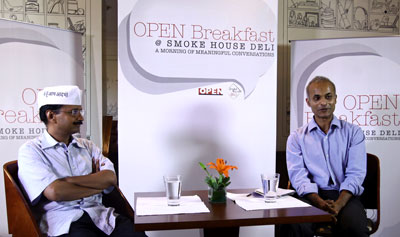
    Arvind Kejriwal with Open editor Manu Joseph Digivijay Singh with Open political editor Hartosh Singh Bal

    Open magazine has launched a breakfast chat series called Open Breakfast @ Smoke House Deli in association with restaurant chain Some House Deli. The chat series has been planned to be held every month and will host prominent public figures, in conversation with the journalists from the newsmagazine. Through the monthly conversations, the magazine desires to illuminate its readers’ understanding of politics, people and culture, notes a communique.


    The inaugural event on June 1 featured Arvind Kejriwal, activist and leader of the Aam Aadmi Party in conversation with Manu Joseph, Editor, Open magazine.


    The second edition of the series was hosted on July 6 with Congress Party General Secretary Digvijaya Singh in conversation with Hartosh Singh Bal the magazine’s Political Editor.


  • Anil Thakraney: The media is being used

    By Anil Thakraney


    During the 26/11 carnage, terrorists freely used the electronic media to their advantage, and (hopefully) some hard lessons have been learnt post that incident. Now, it’s the turn of the politicians. It is obvious that the India Against Corruption (IAC) guys are regularly using the media to build their own brand. And once again, editors and particularly the television content chiefs will need to introspect on this.


    In their mad quest for ‘Breaking News’, it isn’t occurring to news channel folks that they are being hired as a convenient ladder. What the IAC team is doing is to create scandals based on half-baked information in order to malign the big-name political leaders. This information isn’t enough to pronounce a person guilty in a court of law, but the idea is to fling some mud and, given the mood of the masses, most of it sticks. People on the streets have already pronounced Robert Vadra and Salman Khurshid guilty as charged, nothing can save these men now. All thanks to the breathless coverage on television.


    It is not my case that these people aren’t guilty. But the correct course of action would be to cross-check and verify all allegations before putting them out on air. Indeed, that’s the way journalists are supposed to operate. But in the hunger for sensationalism, and in order to beat the rivals, news channels aren’t bothering with such trivia. They are going on air the moment an accusation is hurled. I find this situation quite unfair. This means anyone can malign anyone he wants based on all sorts of wild allegations. And clearly, that can’t be the way forward.


    Much as though one would like the new political party to come to the fore, it can’t be done by smashing basic rules of ethical journalism. If, along the way, the courts dismiss these allegations, who becomes responsible for the individual’s sullied reputation? It won’t just be the accuser, it will be the media that broadcast the ‘story’.


    I really think the time has come for TV channels to ponder on this issue, and apply the brakes on such unfair coverage. No one should be allowed to use the media, however noble that individual/organization’s intentions might be.


    ***


    PS: Haha. An art director has designed a superb typeface, exclusively for doctors. Serves them right, I say. If they are going to write their prescriptions in Greek, they may as well use designer lettering.


    Link: http://stocklogos.com/topic/typeface-designed-doctors


  • Ranjona Banerji: Will Pranab Mukherjee be our next President?

    Ranjona Banerji

    By Ranjona Banerji


    Do we have a President of India at last in Pranab Mukherjee? The Union finance minister, perhaps inspired by incumbent Pratibha Patil’s wonderful lifestyle, wanted a similar retirement plan for himself. Lovely house and gardens, lots of fuss and protocol and nothing to do – perfect!


    This is hardly surprising since Mukherjee is the most hard-working man in the Universe. Not only is he the finance minister, a bad enough job, he is also the go-to man for both the government and the party. If the prime minister’s not there, Mukherjee’s in charge. If some ally is misbehaving, off goes Mukherjee to sort it out. If anything in the government is going wrong, Mukherjee to the rescue. If Parliament needs to be taught a lesson, up pops Mukherjee. Since he is 900 years old and has been part of every Parliament as long as anyone can remember, no one can contradict him. Earlier, in the 1970s, no one could contradict him because he always had a pipe in his mouth, so no one could understand him. Now he has got rid off the pipe but comprehension is still a prerequisite to contradiction. He also has a look in Parliament and if he gives you one, you quail and sit down quietly. This puts an end to the Opposition usually.


    In addition to this, he is head of some 8,000 Groups of Ministers and another 8,000 Empowered Groups of Ministers. (I really don’t know what these are but they sound important.) Effectively, this means the government will come to a standstill once Mukherjee moves to Rashtrapati Bhavan. Since we in a form of paralysis anyway, the government is hoping no one will notice.


    The main thorn in Mukherjee side is his “sister” Mamata Banerjee, also known as “I am a simple man”. The “simple man” does not want Mukherjee in the top chair. Bengali parochialism has still not recovered. This is akin to Bengalis supporting Kolkata Knight Riders instead of Pune Warriors. Oh, right, they’ve done that anyway. The TV channels are wondering how the man who everyone (except them) knew would get the job, eventually got it in spite of all their best efforts. India demands an answer here.


    The two comedy acts running on the sideline are PA Sangma and Arvind Kejriwal. The BJP is wondering whether or not to join this laughter challenge.


    The only person laughing all the way to the Mughal Gardens is Pranab Mukherjee!


  • Freaking News: How the media covered 10 years of Gujarat riots

    By Ranjona Banerji


    Interesting to see that Hindustan Times has gone for all out coverage of 10 years of the devastating riots in Gujarat, while The Times of India has played it down. This is particularly intriguing because at the time, TOI quite beat all other papers when it came to covering the Godhra train attack and the subsequent riots. Disclosure: I was deputy resident editor of the Ahmedabad edition of The Times of India at the time.


    Of course, it must also be pointed out that Hindustan Times does not have an edition in Gujarat, only a bureau and as Sujata Anandan, political editor for HT, then Mumbai bureau chief, pointed out in a related piece, she had to send people from Mumbai to cover the terrible events. It is possible however that the Delhi edition of TOI has not picked up the relevant stories, which is even odder because 10 years ago it was TOI Mumbai which shied away from riot-related stories and opinions. Apparently the resident editor at the time did not think it was relevant.


    On Tuesday, in the Hindustan Times, Harsh Mander, former IAS officer now social worker who works with Gujarat riot victims, hopes that there will be, well, hope soon. The day before Ashok Malik had asked whether it is time to forgive and forget. I wonder about that and our ability in India to behave as justice is an on and off system which we press when it suits us.


    Television, in particular CNN-IBN and NDTV, did focus on the riots and their aftermath: after all both their main faces Rajdeep Sardesai and Barkha Dutt did cover the riots extensively, perhaps for the same channel at the time, my memory fails me here. As a print journalist however, the strident hysteria of TV reporters and anchors, especially at such critical times, can often be more of a hindrance than help and so it was 10 years ago in Gujarat. Provocative people may make for good television but sometimes it can lead to irresponsible journalism.


    * * *


    Having spent a few days in Delhi, or more correctly Gurgaon, it is fascinating to see how crime dominates the papers. Is this because crime dominates events here or because local journalists look out for it?


    * * *


    On TV land on Monday night, Arvind Kejriwal’s remarks about Parliament being full of robbers, rapists and murderers got some play (see what I mean about TV promoting people just to create good television?). Karan Thapar on CNN-IBN wanted to know whether everyone agreed with Kejriwal and the Election Commission’s intent to tweak existing laws to bar people accused of severe crimes for contesting elections, within a certain time limit.


    The normally rambunctious Chandam Mitra of the BJP, normally quick to have hysterics was abnormally quiet as he hummed and hawed and said a debate was necessary and suppose the accused was later proven to be innocent? (Incidentally, this problem of later being proved innocent never bothers the BJP where Muslims accused of terrorism as concerned!).  An activist pointed out that the proposal was seven years old and surely that was enough time to debate the matter.


    Prashant Bhushan, who defended Kejriwal, said a few innocent people suffering was a small price to pay to keep criminals out.


    The Times of India, in its second editorial, slammed Kejriwal and Team Anna for swinging their “bludgeon in all directions while assuming partisan and authoritarian overtones”, which can only lead to the movement floundering.


    * * *


    On NDTV, Congress leader Renuka Chowdhury got into a made-for-TV fight with an anti-nuclear activist. This was more interesting than the issue itself – foreign-funded NGOs – which got nowhere.

  • Kejriwal’s TOI article: same old same old

    By Ranjona Banerji


    Arvind Kejriwal has reached out to fellow Indians in a plea in The Times of India today. The front page of The Times of India says ‘Team Anna confused, does not know the way forward’. It quotes from an article which Kejriwal has written for the paper. But while the front page report talks about the “apparent” confusion in Team Anna, especially after it has been attacked for going after the Congress while being soft on other parties, Kejriwal’s article is, in fact, the same old same old. He does not talk about the Mumbai debacle; he adds a throwaway line about the BJP and corruption but concentrates the article on the perfidy of the Congress.


    Anna Hazare’s ill-health, he conjectures, had more to do with the bad Lokpal bill presented by the government than anything else. If one can venture an opinion, it is this single-minded insistence on attacking only the Congress which has worked against Team Anna. If it loses media sponsorship, it might find the way forward a tad tough. Kejriwal has asked concerned citizens for ideas on how the movement should proceed. It will be interesting to see those suggestions.


    Meanwhile, Hazare’s health remains a matter of concern, with most newspapers and channels focusing on it. TV continues to target members of the anti-corruption movement. The BJP is not the flavour of the week at the moment and if you do not come out strongly against it, then TV will not forgive you – this week at least. This leaves the leaders of the anti-corruption movement floundering a bit since they have not had their core committee meeting to decide on what to do yet! Till the triumvirate speaks, all are lost!


    * * *


    The Indian traders who were detained/ tortured/ attacked in China got so much play on TV that newspapers have started giving the incident more attention. Of course, newspapers have the advantage of setting aside nationalistic outrage and looking at the larger picture. Which includes: other traders not wanting to stop going to that part of China since stuff there is cheap and China requesting Indian traders to follow their laws! This makes for a much larger and more complicated story.


    * * *


    Inflation is down the newspapers tell us and interest rates may be cut as well. Presumably, this is good news.


    * * *


    Will Friday night and Saturday morning be all about slamming the Indian cricket team for its dismal performance so far in Australia? I’m not a fortune teller but my crystal ball says that heavy weather is approaching for MS Dhoni and company!


  • Print exposes Anna’s ‘barren’ truth

    By Ranjona Banerji


    “Mumbai slow to Anna’s fast” said a front page headline in Mid-Day and that puts it succinctly. Hindustan Times, in its Mumbai edition, went with “Team Anna finds Mumbai cold, too” on page 2, nodding to both the fact that Tuesday was Mumbai’s coldest December day in 19 years as well as the reason for shifting the agitation from Delhi to Mumbai.


    But that wasn’t the news of the day, as it happened. First it seemed it might be Sachin Tendulkar’s 100th 100, but then he got out at 73. After that, it was all about the debate in the Lok Sabha over the passing of the Lokpal Bill. Of course, bolstered by the knowledge that the whole country was with the India Against Corruption agitation at the MMRDA grounds in Mumbai, the Ramlila grounds inDelhiand all over the country, TV channels promised us non-stop coverage.


    Unfortunately for all the time and money spent, not enough people showed up, either in Mumbai orDelhi. Unlike earlier times where TV cameras would concentrate on a small group and reporters would tell us that thousands had come, this time cameras ruthlessly panned empty grounds.


    So how many people showed up? The Times of India gave it a generous 10,000 to 15,000. Times Now and Newsx said about 10,000 at its peak, 4,000 through the day and 1,000 by the evening. The Hindustan Times quoted the police figures of about 5,000 as well as India Against Corruption figures of 30,000. The last is possibly wishful thinking and by the evening on TV, crestfallen youth were telling us that this agitation isn’t about numbers at all. This is somewhat at odds with Arvind Kejriwal’s earlier statement that the whole country was with them and if Aruna Roy could gather a group of 50,000, then she could push the government for her bill.


    * * *


    Of course, it is left to newspaper commentators to call Anna Hazare’s core team for their somewhat offensive language, since the cacophony on TV makes criticism very difficult. Hindustan Times has to be commended, for calling out Anna Hazare himself on his remark that “barren women cannot know the pain of childbirth”. The word “banjh” is a derogatory in most Indian languages and characterises the sort of insensitive language that is common usage in societies where sensitivity for the less unfortunate is unheard of.


    In an aside, it was amusing to observe the absolute silence of the Mumbaikars present when Hazare held forth on the importance of village politics in his speech. One can imagine the youth scratching their heads wondering what on earth he could mean.


    * * *


    The Lok Sabha debates and the confusion of whether the Constitutional amendment had been passed kept our TV anchors and studio guests busy till midnight. Luckily the Rajya Sabha was adjourned on Wednesday morning so the further passage of the bill is now delayed till tomorrow. The shortage of Constitutional experts available for TV consumption was felt very strongly on Tuesday.


    * * *


    Cricket was back in the spotlight and there is now also space for the apparent reconciliation between the two Ambani brothers.


    * * *


    For a change, the Rendezvous interviews conducted by Zainab Badawi on BBC News are quite refreshing. Guests range from Annie Lennox to Richard Dawkins to Michelle Yeoh, so the conversation is varied.