Tag: Anna Hazare

  • Nokia, Tata star in India’s most trusted brands report

    By A Correspondent

    Trust Research Advisory, the authority on the measurement of Trust among brands, is out with the Brand Trust Report 2012, the much anticipated results of India’s Most Trusted Brands.


    The Brand Trust Report, India Study, 2012 (BTR 2012), lists India’s 1,000 Most Trusted Brands even though it studied over 17,000. The report is the result of a comprehensive primary research conducted on 61 components of trust – a proprietary tool of Trust Research Advisory. The research was conducted with 2,718 ‘influencer’ respondents from 15 cities, generating more than 2 million data-points from 12,000 hours of research.


    The research was done on salaried SEC A population as they have more engagement with people and brands. Other detailed parameter of the audience chosen for the survey also exists. According to Mr. N Chandramouli, CEO of Trust Research Advisory, rigorous back checks were done to eliminate any anomalies that might appear in the survey and the parameters were set very high for the research.


    He said, that according to an AC Nielsen report, $1 trillion was spent on communication last year… Considering the huge amount of money, it is of paramount importance that the money is used correctly. Mr. Chandramauli said that even though the top positions have not drastically changed over the last year, yet the trust index pattern has changed. In 2011 report, the top two brands had the trust index equivalent to the next 65 brands. However, this figure has dropped down to the next 6 brands in 2012 report. This means that the gap between the top players is decreasing and in the upcoming years one can see a drastic turn around.


    Talking about research methodology Mr Chandramauli said “If you want to focus on trust, we can’t focus on trust but the ingredients of trust… The survey studies such 100 trust metrics in extraordinary details.” The three components of trust are the tactile, the vicarious and the imagined concepts of trust.


    Nokia and Tata retained their first and second positions as India’s top two Trusted Brands this year. Sony, the Japanese electronics leader, slipped to fifth position, outranked by the two aggressive Korean chaebols, LG at 3rd position and Samsung at 4th position. Maruti Suzuki improved its position by one notch and is India’s 6th Most Trusted Brand this year. Bajaj, ranked 7th, is a new entrant this year in the Top 10 (last year it was ranked 12th); LIC and Airtel’s positions are unchanged from last year at 8th and 9th rank respectively. Reliance slipped to 10th Most Trusted Brand this year (from sixth last year).


    Among 22 personalities listed among in BTR 2012, Anna Hazare has gained the nation’s trust ahead of Sachin Tendulkar, Salman Khan, Amitabh Bachchan and Aamir Khan, featured in that order. Most Trusted leaders in some other categories are Armani in Branded Fashion, DLF in Construction, NIIT in Education, ONGC in Energy, PVR in Entertainment, Pepsi in F&B, Dabur in Healthcare, Taj Hotels in Hospitality, Google in Internet, ACC in Manufacturing, Thomas Cook in Services, Being Human in Social Sector, Hewlett Packard in Technology, and Air India in Airlines.


    Mr Chandramouli, said: “In life, without trust, there is nothing. Each time a human engages with anything, the basis for all decisions is trust. Be it brands, other humans, or just ideas, one will react to them on the basis of the trust it generates. Last year was tumultuous for several brands, but those which focused on trust, have gained market-share, revenues and profits. On the other hand, the brands which have focused only on the latter, have invariably lost both. Focus on building trust and all else will follow automatically.”


    Anand Mahindra, Vice-Chairman and Managing Director of Mahindra & Mahindra, has elaborated on Trust is Everything concept for the Mahindra brand in the report: “No great secret lies behind the highly-trusted Mahindra brand. Consistent delivery against every promise is the single biggest driver of trust for our brand. Apart from this, factors like high quality products and services, adherence to highest standards of corporate governance, the very high integrity of the leaders who run the company and adherence to a set of values in conducting business have helped the Mahindra brand earn the trust of all its stakeholders.”


    The report, priced at Rs10,000, is available exclusively at TRA offices.


  • Newswatch: Sanjay Kapoor on Team Anna & the fast co

    By Sanjay Kapoor


    In January 2011, Anna Hazare was virtually unknown to Delhi’s self obsessed middle class. A year later, after he had unleashed a tumult against the government by sitting on a fast till the central government appointed an all powerful Jan Lokpal or ombudsman against corruption, and controlled all the headlines of the national media, Hazare is slowly slipping away from prime time news. What he and his verbose bunch of supporters have to figure out in the coming days is: what do you do when the gaze of the TV cameras shifts? How do you get them to look at you again?


    These questions must be surely gnawing at an ailing Anna Hazare as he strenuously pedals on his stationary exercise bike to regain his health and also find a way out from this dead end. He must be wondering what really went wrong at his “fast fest” at MMRDA grounds of Mumbai, where he did not get the kind of fawning and gushy support of the people as he got in Delhi. Not only were the crowds thin, even the TV news channels, unlike in the past, refused to bloat their numbers. Delhi, surely, seemed a distant memory. What really went wrong for the anti-corruption movement that seemed to threaten the stability of UPA government?


    Operating under the rubric of “India against Corruption’, Anna Hazare’s movement was crafted like the Arab Spring. The main pillars of his campaign were the media and the urban middle class. Interestingly, Team Anna seemed to follow the template put together by Belgrade-based Centre for Applied Non-violent Action and Strategies (www.canvasopedia.org), which seeks to provide consultancy to protests around the world. CANVAS takes the credit for training and supporting civil society activists in countries like Egypt, Tunisia, Myanmar, amongst many other countries, for organising protests. CANVAS recommends non-violent interventions like fasts and suggests the use of media to disseminate a message that the “people see that there is something is wrong, and they are willing to do something about it”. Funded by US-based entities, much of the advice listed on its website finds an echo in what has been witnessed in the country in the last few months.


    CANVAS suggestions are usually meant for authoritarian regimes where press is under state control and the only way to reach out to the masses is through social media like Facebook and Twitter; there is no such problem in India. In a noisy and chaotic democracy like ours with hundreds of privately owned news channels following each other’s “breaking news”, this was much easier. Team Anna and its patrons had to get one big media organisation on their side and rest was easy. Call them partners in a conspiracy hatched by patrons of Anna Hazare or a simple display of good reflexes in spotting a big story, the Bennett Coleman group showed great enthusiasm in building the narrative of how “a Gandhian left his village to save the republic from the corrupt”. In the cacophony and melee of TV news reporting there is no clarity of who ” broke the Anna Story” when he descended on Delhi to fast at Jantar Mantar last April, but it was a matter of time when all news channels went overboard in their coverage of his event. Clever camera angles plus filling up the TV screens of small snapshots of people assembling at different places helped in creating crowds when few existed. Truth was manipulated to build a feverish demand for the appointment of an unelected Lokpal to save the country from rampaging pindaris. It is quite unclear how media organisations may have benefited from wall-to-wall coverage of Anna Hazare’s fast at Jantar Mantar and later at the capital’s Ramlila Maidan, but news channel did not seem shy in expending their resources on it. Statistics show that there were 5592 pro-Anna and only 62 anti-Anna segments in the Jantar Mantar coverage. During the Ramlila ground fast it perhaps got worse. TV channels were unhesitatingly and unashamedly uncritical of the movement.


    Television coverage is an extremely expensive business and most of the news channels would not have gone overboard in hysterically reporting on Anna’s campaign if there was no promise of gains – present or in the future. Who put up the money for the coverage of the campaign? There were rumours that a colossal corpus was created in Bangalore to fund the anti-corruption campaign. Hence Team Anna showed great reluctance to campaign against the disgraced former BJP chief minister BS Yeddyurappa of Karnataka. Rumours also abound that due to the high financial stakes the Anna story was pushed more by managers and editors than by reporters. Some of the reporters covering the fast were even heard complaining that they were under pressure to make the “Gandhian’s” agitation look pretty.


    Pains were taken to make the movement look non-political, but it became clear at Ramlila Maidan and later that the spine to the movement was provided by the front organisations of the Rashtriya Swayamsevak Sangh (RSS). Crowds and news coverage is seldom spontaneous. It takes a lot of effort to get people out for protests. Contractors are used to ferry crowds for the rallies and PR companies are deployed to organise press coverage. On both counts RSS front organisations display great competence. They have enormous capacity to bring in their supporters and also organise favourable media support. Earlier anti-corruption agitations, like the one led by Jayaprakash Narayan in the ’70s and later by VP Singh in the ’80s succeeded due to the support extended by the RSS.


    At the Ramlila ground there was plenty of evidence of the presence of RSS front organisations, but most of the media outlets were reluctant to talk about it. The camera and the focus remained on a fasting Anna Hazare and his lieutenants like Arvind Kejriwal and Kiran Bedi, rather than those who were baying for Prime Minister Manmohan Singh or Sonia Gandhi’s heads. The ground was full of posters and hoardings to show how corrupt and anti-national the Congress party was. Team Anna and its supporters used the democratic space to demand an entity that was not only against the Constitution but also fascist in character. Quite evidently, such a demand met the approval of those who hate politics and want India to become a hard state.


    Anna Hazare became the darling for many of those around the country that saw politics and Parliament as a waste of time. And the way the visual media backed him and his call, it seemed only a question of time before the country got their version of Jan Lokpal, which would have been accountable to none.


    Lack of firmness and conviction displayed by Prime Minister Manmohan Singh and his ministers in handling the agitation contributed in reinforcing this impression. Besides the TV channels, newspapers too gave the impression that the Ramlila ground was India’s Tahrir moment and the government would have to give way on the Jan Lokpal bill. Times of India carried a banner headline suggesting it to be another “August Kranti”. Hindi newspapers also went hysterical. Their reporting was little different from the kind on display when the Babri Masjid was brought down by hysterical mobs in Ayodhya many years ago. There were only very few publications that did not go overboard and were critical of the undemocratic noises and demands that were being made from Ramlila ground.


    Parliament acquitted itself through reasoned debate and conveying the sense of the house on the Lokpal issue allowing Anna Hazare to end his fast.


    Subsequent media scrutiny, both by foreign and national media, showed Anna Hazare and his team members in their true colours. Hazare was really a village tyrant who believed in tying the drunk to trees if they consumed alcohol. He also believed in giving capital punishment to those who were found guilty of corruption.


    Kiran Bedi was discovered to be fudging travel bills on many of her visits. There were also allegations that were brought out by the media about short-changing the Delhi Police on the issue of providing computer education to the children of constables. Arvind Kejriwal, the brain behind the movement, too, was found to have messed up in a showdown with his previous employer, the income tax department.


    As the true picture of these crusaders came out in the open, the government, it seems got into the act and began to reach out to some media houses. It is not clear what quid pro quos were worked out, but when Hazare sat in Mumbai, there was a sea-change in the gaze of the cameras and the way his fast was reported. For a movement that drew strength from crowds and media coverage feeding on each other, Mumbai was a big dampener. Worse, Anna, who looked a champion in Delhi, fasting for almost a fortnight, could not last more than a day. All the rumours about how electrolytes sustained him in Delhi returned when his fast collapsed.


    Team Anna claims to be at the crossroad of their movement. Their cluelessness and confusion would deepen if the Congress party does well in the assembly elections. And if it does not, then they will be back on the streets claiming victory in their defeat. This time, though, there would be no ambivalence about whom Anna is hunting with.


    Sanjay Kapoor is the Editor of Delhi based Hardnews Magazine.

     

  • Can we pay attention to what’s put out?

    By Ranjona Banerji


    There was an intriguing contradiction in the way Indians abroad were carried in the news in the last week or so. While the murder of Anup Bidve of Pune in Manchester and the ill-treatment of Indian traders in China got an enormous amount of coverage, the annual government mela for our brothers and sisters who no longer live in India was not treated with the usual fanfare. Does that mean that Indians who suffer when in foreign lands are newsworthy but non-resident Indians who return to visit us are no longer so valuable? Since the India story is now located in India, is the media now yawning about NRIs? I have no answers, but I find this trend interesting.


    Meanwhile, our TV channels have taken their outrage about suffering Indians to new levels. US Republican presidential hopeful Jon Huntsman has been subjected to some racial abuse in the US for his adopted children, who are apparently Chinese and Indian. This had our morning anchors foaming at the mouth. Also, according to the on-screen updates, US Hindus were also very angry. Is this a new category of people, US Hindus? Does it include people of non-Indian origins who might be Hindus? So why would Indonesians or Nepalis (for instance) be so angry about the anti-Huntsman ads? What about followers of the Iskcon movement in the United States? Are they US Hindus? Are US Christians, Buddhists, Muslims and Sikhs (who might be of Indian origin) not bothered? What about the Chinese (regardless of religion or regionality)? Or all people concerned about racism?


    It is a futile wish, but one still does occasionally hope that Indian TV channels paid a little more attention to what they put out.


    **


    As expected, Indian cricket has been under the scanner with all the accompanying hysteria. I understand that journalists have short memory spans but still, don’t they get bored of jumping from one extreme to the other whenever things go right or wrong. Sack the team, sack the board, worship the team (to be fair, almost no one says worship the board!), are the predictable mantras depending on performance. Then it’s an inevitable battle between oldies and youngies – strangely, whenever the selectors lean towards one or the other based on media and expert advice, there’s usually a disaster on the cricket field.


    Partly of course, the new belief (most prevalent in the new media) that India has to excel at everything it touches is to blame.


    **


    The travails of Anna Hazare’s movement against corruption continue. The Times of India on Saturday had a front page story about Shanti Bhushan’s duty evasions and on the edit page, there was Shanti Bhushan lecturing us about corruption! The Indian Express on Monday tells us that Anna Hazare’s followers and friends (of the pre-Jan Lokpal variety) have been redoubling their efforts to point out that India Against Corruption is “100 per cent pro-RSS”.


    **


    Mid-Day’ Mumbai edition carries a story about how the son of a former Mumbai police commissioner (RD Tyagi) has been accused of beating up customers to his beer bar and the Mumbai police have been slow in taking action. This misuse of power by the Mumbai police needs more exposure.


  • Kejriwal’s TOI article: same old same old

    By Ranjona Banerji


    Arvind Kejriwal has reached out to fellow Indians in a plea in The Times of India today. The front page of The Times of India says ‘Team Anna confused, does not know the way forward’. It quotes from an article which Kejriwal has written for the paper. But while the front page report talks about the “apparent” confusion in Team Anna, especially after it has been attacked for going after the Congress while being soft on other parties, Kejriwal’s article is, in fact, the same old same old. He does not talk about the Mumbai debacle; he adds a throwaway line about the BJP and corruption but concentrates the article on the perfidy of the Congress.


    Anna Hazare’s ill-health, he conjectures, had more to do with the bad Lokpal bill presented by the government than anything else. If one can venture an opinion, it is this single-minded insistence on attacking only the Congress which has worked against Team Anna. If it loses media sponsorship, it might find the way forward a tad tough. Kejriwal has asked concerned citizens for ideas on how the movement should proceed. It will be interesting to see those suggestions.


    Meanwhile, Hazare’s health remains a matter of concern, with most newspapers and channels focusing on it. TV continues to target members of the anti-corruption movement. The BJP is not the flavour of the week at the moment and if you do not come out strongly against it, then TV will not forgive you – this week at least. This leaves the leaders of the anti-corruption movement floundering a bit since they have not had their core committee meeting to decide on what to do yet! Till the triumvirate speaks, all are lost!


    * * *


    The Indian traders who were detained/ tortured/ attacked in China got so much play on TV that newspapers have started giving the incident more attention. Of course, newspapers have the advantage of setting aside nationalistic outrage and looking at the larger picture. Which includes: other traders not wanting to stop going to that part of China since stuff there is cheap and China requesting Indian traders to follow their laws! This makes for a much larger and more complicated story.


    * * *


    Inflation is down the newspapers tell us and interest rates may be cut as well. Presumably, this is good news.


    * * *


    Will Friday night and Saturday morning be all about slamming the Indian cricket team for its dismal performance so far in Australia? I’m not a fortune teller but my crystal ball says that heavy weather is approaching for MS Dhoni and company!


  • The Year in the News Media


    By Ranjona Banerji


    This year started with a hangover – like all New Years should. But unlike the pleasant pain that goes with the knowledge of a party that may have meant over-indulgence but was fun just the same, the media started 2011 with one of those truly mammoth unpleasant hangovers.


    The outcome of the Radia tapes was, at best, a loss of reputation for a few well-known journalists but at worst, a loss of faith in the media as an institution. Public knowledge about the somewhat questionable dealings between journalists and publicist Niira Radia meant that the media could no longer hide in those famous ivory towers. Even more unfortunate was that the finger of suspicion was pointed at all journalists because of the transgressions of a few. It did not help matters that although Vir Sanghvi lost or surrendered his influential column Counterpoint in the Hindustan Times, Barkha Dutt did not just continue with NDTV, but went from strength to strength.


    So it was a somewhat cautious Indian media which initially tackled the phone-hacking scandal in the UK and the closure of the Rupert Murdoch-owned News of the World. Here was journalistic excess in order to get a story taken to a whole other degree – criminality. The tabloid press and the British public and celebrities have historically had an interesting and confrontational relationship. But the desire to delve into every aspect of the lives of the rich and famous – without the reverence shown in our part of the world – made for big sales and bigger profits. The readers loved the sleaze and watching the powerful cringe.


    But this scandal was something else. It was newspapers hiring investigators to pry into the private lives of ordinary citizens and using dubious methods like hacking into voicemail messages to gain information. One reporter lost his job for spying on British royals; but what was the punishment for breaking into the cell phone of a murdered teenager, deleting her messages and not only giving hope to her family that she was still alive but also materially distorting a police investigation into her disappearance?


    As it turned out, the reprisal was fierce and final: a newspaper which was over 150 years old was shut down and the British parliament had a public questioning of the owners and editor of News of the World – Rupert Murdoch and his son James and Rebekkah Brooks.


    The world’s media watched shocked as skeleton after skeleton popped out of the News of the World and NewsCorp cupboards. But surely there was no room for complacency here in India. After all, the problem was not just the Radia tapes; it was also the elephant in the room – paid news. Media houses – without or without the collusion of journalists – had been selling editorial space to political parties. The reader or viewer, of course, was left in the dark and assumed s/he was reading or watching real news stories.


    In the midst of all these depressing signs that some media introspection was required, we had all the uncomfortable revelations by Wikileaks, which turned international diplomacy on its head and exposed lies about the US role in the Iraq war and the black money held by European banks. The subsequent arrest of Wikileaks editor Julian Assange in the UK, on an old sexual assault charges filed in Sweden added to the drama. Was Assange really guilty as charged or was this an international conspiracy to get him extradited to Sweden and from there to the US to punish him for publishing secret cables and other information on the internet? The jury’s still out on that one.


    Wikileaks, though, emphasised once more how the internet was changing journalism and anyone who ignored it, did it at their own peril. Social media is playing the role of a catalyst in creating public opinion outside of the traditional media. The traditional media may not be destroyed but it will be damaged if it does not pay attention.


    Back in India, though, we still had a couple of dramas to play out. The new chairman of the Press Council of India, retired judge Markandey Katju, decided that he didn’t want to be head of a toothless body that was limited to the print media. He proceeded to write a series of articles attacking journalists, calling them frivolous, badly educated and shallow. He listed the sort of news that should be carried and slammed the choices made. He also said that the Press Council’s ambit had to be increased to include television.


    Katju may have been wrong and he may have been right in his opinions, but unfortunately for him, the Press Council remains toothless. And besides, instructing newspapers and TV channels on what aspects of news should and should not be carried impinges directly on the freedom of the press. No one spared Katju and so he quickly backtracked a little.


    Then, perhaps just to prove Katju right, media coverage of the Anna Hazare-led anti-corruption agitation proceeded on just those shallow, one-sided and breathless lines that the former judge had bemoaned. This protest was covered as if it was the only one the country had ever seen. Numbers were inflated or exaggerated. Those who questioned aspects of the Jan Lokpal Bill were shouted down as enemies of the people. As is inevitable, the print media could not sustain its adoration of this movement and started asking uncomfortable questions. TV however continued with its happy path of supporting this “national movement” at all costs until, slowly, a bit of reason leaked into the emotion.


    The doubts had crept into TV studios after the standing committee submitted its version of the bill but the Anna Hazare movement remained adamant on its own stand. But it was really the indifference shown to the movement by the people of Mumbai which ended that love affair. Rather than focus their cameras on 4,000 people pretending they were 40,000, TV cameras panned empty grounds showing us how low the turnout was.


    In journalism, as in life, there are no absolute truths. But there are facts. In 2011, the facts have shown that the people are watching the media. And there’s hardly any place to run or hide. Like we’re forcing politicians and government servants to come clean on their dealings, a little bit of spring cleaning by the media would not be amiss in 2012.


  • The Anchor: 11 noteworthy happenings of 2011

    By Tuhina Anand


    #1 The Dentsu deal. This was one of the earliest developments of 2011, creating a buzz when Sandeep Goyal made a fortune after selling his 26 percent stake in Dentsu India. Denstu Inc, the Japanese company which had a JV with Goyal’s Mogae Group became the sole owner. This development later saw some senior appointments like Rohit Ohri moving out of JWT to be the Executive Chairman of Dentsu Group India and much recently appointed Divya Gupta as the CEO of Dentsu Media.


    #2 World Cup comes home. India gave a stupendous show of its cricketing prowess when it lifted the World Cup. The series was a great opportunity for advertisers to get maximum eyeballs while ESPN Star Sports got the status of the official broadcaster of the series. Captain Cool, MSD walked away not just with the cup but also was given the title of the most influential Indian in Time’s list. Not to forget all the endorsement deals that the Indian team got post the win.


    #3 UTV-Disney deal. This was the mother of all deals when Walt Disney declared to buy stakes of UTV Software Communications. The deal is valued to be around Rs 2000 crore. Walt Disney already had a majority stake in UTV. The former will launch an offer to delist shares of the latter which will begin early next year.


    #4 Tough time for Kalaignar TV. The DMK run Kalaignar TV was in the news albeit for the wrong reasons. It got dragged in the 2G spectrum license episode and the brand took a further dip with its MD Sharad Kumar behind bars. This was one incident that Kalaignar would like to forget but its easier said than done especially because its taxpayers money that has been misused if the paper trail is proved correct.


    #5 Appointments and Dis-appointments. Ashish Bagga was elected President of The Indian Newspaper Society for the year 2011-Uday Shankar of Star India for was re-elected as the President of the Indian Broadcasting Foundation (IBF) for his second term. Also Shashi Sinha of Lodestar was elected as the President of Ad Club Bombay. After being with TV Today Network for almost 16 years, G Krishnan, the Chief Executive Officer and Executive Director quit. Haresh Chawla, the CEO of Network18 Group too decided to call it a day. Meanwhile Raj Nayak filled in the place left vacant by Rajesh Kamat when he took over as the CEO for Colors.


    #6 Justice Katju’s policing. Press Council Chairman, Justice Markandeya Katju had earned the ire of media by constantly trying to police media and gag the freedom of press. His suggestions to bring media under strict government purview and his thoughts on objectionable content had many in media being vociferous in their protest.


    #7 Rise of independents. The year marked the rise of independents in the advertising agency business who did well and earned name purely on their talent be it Taproot India with their fabulous work on Airtel and Pepsi or Creativeland Asia winning applauds at international awards arena.


    #8 AdAsia in Delhi. Delhi became the place to be for the advertising folks from around Asia who gathered for AdAsia. It was in 2003 that AdAsia was held in India in Jaipur and it came back only in 2011. The lineup of speakers was enviable and the number of delegates impressive. Thus a stimulating conference for all present.


    #9 Omnicom stake in Mudra. The Omnicom Group that has been trying to gain greater foothold in India managed to do so by taking a majority stake in Mudra. Post this Mudra also made its first structural change where it would be known as DDB Mudra and have DDB, Mudra, and Mudra Max under its umbrella.


    #10 Bobby and JWT shake hands. Bobby Pawar declared his intention to move out of Mudra soon after the Omnicom deal, thus giving enough fodder to the media to speculate on. His next destination is JWT and promptly Colvyn Harris took the opportunity to set his agency in order and went appointing three NCDs and a CCO at the helm. They sure will have their hands full in the New Year.


    #11 Anna Hazare’s magic. Who would have thought that a septuagenarian clad in Gandhi topi would become the most recognized face of 2011 and maybe even scoring more than Salman Khan in his meteoric rise to popularity? Not to mention that his fasts and LokPal Bill has taken enough of newsprint and debates on TV and has become a trending topic on the social media.

  • Anil Thakraney: The trick Anna missed

    By Anil Thakraney


    So, Anna Hazare’s Mumbai campaign suffered a serious setback. Only a few thousand ‘fans’ landed up, though expectations were of lakhs of people joining in. In fact, I was so mortally petrified of the projected traffic chaos, I made sure I did not plan any travel in the city… I stayed hidden under my bed like a coward for the period of the planned agitation.


    Quite clearly there are many reasons why the dharna flopped, and I won’t go into them out here, that’s for columnists in the mass media to worry about. But I must say this: For Mumbai, which is not a politically active city unlikeDelhi, Team Anna needed to think out of the box to get the crowds in. For one, they needed to hire a professional event management company, which would have organized entertainment and refreshments for the attendant junta. People are already fatigued of the Lokpal issue, and there have to be add-ons if Mumbaikars are tempted to give up their routine lives and spend three whole days at the MMRDA grounds. I am quite sure some event companies would have slashed their fees for the noble cause.


    Two, and no I am NOT kidding about this, Team Anna ought to have done a promo tie-up with Bollywood, without making a song and dance of it. For example, Don 2 released around the time of Anna’s Mumbai chapter. Could they not have tied up with Farhan Akhtar and Shahrukh Khan? What’s the worst that would have happened? SRK asking people to watch his flick, that’s about it. He does that everywhere, anyways. But in return, his presence would not only have pulled massive crowds in, it would have got Parliament on the edge. And the media would have shown much more interest in the event, even the Page 3 journos would have landed up.


    I am sure some of you might think I am trivializing a serious issue out here. Well,

    I am not. Because it’s quite clear to me that poor old Anna Hazare does not have the money or the means or the charisma to send Mumbai into a tizzy. He needed help. He needed to be clever. Because after the Mumbai flop show, even the Anna loyalists are having second thoughts about a solid Lokpal bill. And many fans across the nation seem to be losing faith in him.


    It would be a terrible loss for the country if Anna sahib were to fade away into oblivion. It’s time to think different.


    * * *


    PS: Since I am always cribbing and carping about the Indian media, I have decided to be nice in my last post of the year. For the entire year 2011, news channels behaved liked hysterical cheerleaders for Anna Hazare, thereby throwing all professionalism out of their studios. But as the year closed, I noticed a sense of calm and fair play across the board. The debates were more balanced and nuanced. Even Arnab Goswami was unbiased!


    Let’s hope we get to watch more of this in 2012. Happy New Year!


  • Print exposes Anna’s ‘barren’ truth

    By Ranjona Banerji


    “Mumbai slow to Anna’s fast” said a front page headline in Mid-Day and that puts it succinctly. Hindustan Times, in its Mumbai edition, went with “Team Anna finds Mumbai cold, too” on page 2, nodding to both the fact that Tuesday was Mumbai’s coldest December day in 19 years as well as the reason for shifting the agitation from Delhi to Mumbai.


    But that wasn’t the news of the day, as it happened. First it seemed it might be Sachin Tendulkar’s 100th 100, but then he got out at 73. After that, it was all about the debate in the Lok Sabha over the passing of the Lokpal Bill. Of course, bolstered by the knowledge that the whole country was with the India Against Corruption agitation at the MMRDA grounds in Mumbai, the Ramlila grounds inDelhiand all over the country, TV channels promised us non-stop coverage.


    Unfortunately for all the time and money spent, not enough people showed up, either in Mumbai orDelhi. Unlike earlier times where TV cameras would concentrate on a small group and reporters would tell us that thousands had come, this time cameras ruthlessly panned empty grounds.


    So how many people showed up? The Times of India gave it a generous 10,000 to 15,000. Times Now and Newsx said about 10,000 at its peak, 4,000 through the day and 1,000 by the evening. The Hindustan Times quoted the police figures of about 5,000 as well as India Against Corruption figures of 30,000. The last is possibly wishful thinking and by the evening on TV, crestfallen youth were telling us that this agitation isn’t about numbers at all. This is somewhat at odds with Arvind Kejriwal’s earlier statement that the whole country was with them and if Aruna Roy could gather a group of 50,000, then she could push the government for her bill.


    * * *


    Of course, it is left to newspaper commentators to call Anna Hazare’s core team for their somewhat offensive language, since the cacophony on TV makes criticism very difficult. Hindustan Times has to be commended, for calling out Anna Hazare himself on his remark that “barren women cannot know the pain of childbirth”. The word “banjh” is a derogatory in most Indian languages and characterises the sort of insensitive language that is common usage in societies where sensitivity for the less unfortunate is unheard of.


    In an aside, it was amusing to observe the absolute silence of the Mumbaikars present when Hazare held forth on the importance of village politics in his speech. One can imagine the youth scratching their heads wondering what on earth he could mean.


    * * *


    The Lok Sabha debates and the confusion of whether the Constitutional amendment had been passed kept our TV anchors and studio guests busy till midnight. Luckily the Rajya Sabha was adjourned on Wednesday morning so the further passage of the bill is now delayed till tomorrow. The shortage of Constitutional experts available for TV consumption was felt very strongly on Tuesday.


    * * *


    Cricket was back in the spotlight and there is now also space for the apparent reconciliation between the two Ambani brothers.


    * * *


    For a change, the Rendezvous interviews conducted by Zainab Badawi on BBC News are quite refreshing. Guests range from Annie Lennox to Richard Dawkins to Michelle Yeoh, so the conversation is varied.


  • [LOOKBACK 2011] The Year for News TV

    By Ritu Midha


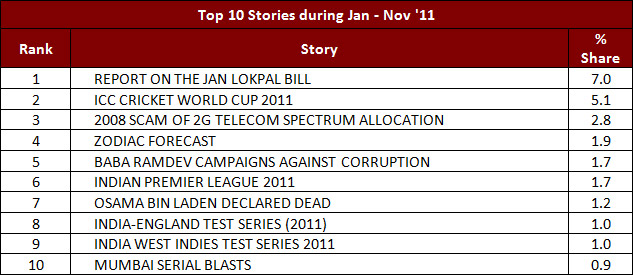
    Anna Hazare got the largest percentage share as far as the news channels go. The other top stories of the year 2011 were Cricket World Cup 2011, 2GScam. Interestingly post these comes Zodiac Forecast, which is two rungs above IPL coverage. Here is a list of top 10 new stories by percentage share:

    Source: Source: News Content Track – A service of TAM Media Research Pvt. Ltd

    Channels: Aaj Tak, CNN IBN, Headlines Today, IBN 7, India TV, NDTV 24/7, NDTV India, Star News, Times Now, News 24 & Zee News
    Period: Jan – Nov, 2011

    Note : Analysis is based on the Telecast duration


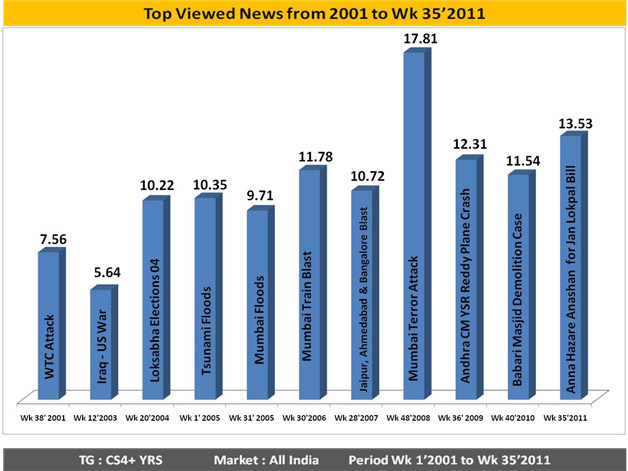
    If one looks at data from 2001, the Lokpal Bill at its peak was the second most watched news in 11 years – second only to the Mumbai Terror Attacks:


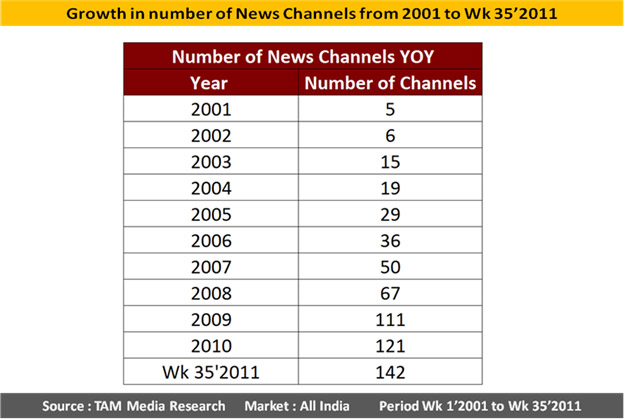
    News, interestingly is the fastest expanding genre with eight new news channels being launched (excluding regional languages) till week 50, 2011: 7 in Hindi and 1 in English.

    Even if on e looks at year on year growth – news is one of the fastest growing genres:

    With the first quarter of 2012 seeing assembly elections including heavyweights like Uttar Pradesh and Punjab – and Lokpal Bill still in the eye of the storm – the share of news channels is expected to grow.

  • Anna’s RSS links and TV’s outrage

    By Ranjona Banerji


    As was expected, the India-Australia Boxing Day Test match has started dominating TV news bulletins. This is not to suggest that Anna Hazare and the anti-corruption movement will be replaced by cricket – shame on me for even hinting at that – but it does mean that TV producers will have to do some juggling.


    However there is a chance that if anything controversial happens on the field, well… This is after all an India-Australia series and judging from a quick peek that I had this morning, the crowds are in…


    Newspapers, of course, do not have the same problems. They have the space and the wisdom gained through reflection and time to pick and choose. Cricket will find its place, as will Hazare and a whole lot of other stuff.


    * * *


    I was fascinated to see that NewsX chose to broadcast Midnight Mass on Christmas Eve live, from various services across India. Equally, to watch the Queen of England’s Christmas message on Al-Jazeera. This could be addressing niche audiences or a refusal to patronise viewers by segmenting them into tight demographic categories as determined by a marketing department.


    * * *


    Nai Duniya carried a story this weekend about Anna Hazare’s links to the RSS with proof of his association with Nanaji Deshmukh and a joint collaboration they did on village affairs. This, naturally enough, outraged TV anchors. Even the NewsX anchor – the channel is affiliated to the newspaper – found that he had to practically interrogate the editor of Nai Duniya on this ‘sacrilegious’ story. Like so many print journalists, the editor was unrepentant and unfazed. His story was not based on allegation but on fact.


    Very oddly, after that – and including in Monday’s papers – the story was presented as a Congress allegation on Hazare and was sourced to a tweet by Hazare-baiter Digvijay Singh.


    Is this journalistic laziness or a reluctance to credit Nai Duniya? After all, whoever looked for Singh’s tweet could just have easily have Googled Nai Duniya!


  • How HC took the wind out of our channels’ sails

    By Ranjona Banerji


    The Bombay High Court sort of took the wind out of the sails of not just the Anna Hazare movement, but also our excitable TV channels. Suddenly, their high-pitched pro-Hazare campaigns had to deal with a court questioning the motives of this save-India hysteria.


    The best way out was to just sidestep the issue, so Times Now went further into the reservation issue, plus an interview with Justice JS Verma who supports it, Headlines Today dwelt on the court a bit but concentrated on the now-tedious arguments between India Against Corruption activists and others, NDTV interviewed Arvind Kejriwal and so on.


    The newspapers, however, did not restrain themselves, except perhaps The Times of India, whose headline on Saturday was a staid: “Allowing agitation may be akin to meddling with House affairs: HC”. Compare this with Hindustan Times: “After HC snub, Anna blames team” or The Telegraph,Calcutta: “Team Anna gets a lesson in democracy” or Deccan Chronicle,Hyderabad: “Team Anna earns sharp rebuke from Bombay High Court”. Mid-Day, surprisingly, did not have it on the front page. It was, after all, a Mumbai story.


    The Bombay High Court indeed pointed out that it could not grant concessions to the movement as it was not convinced that this was a people’s movement and an endorsement by the court would be tantamount to the judiciary interfering with Parliamentary procedure.


    The judges said, “How is country’s interest involved? We are a democratic set up. We have elected a government. Wouldn’t your agitation interfere in the functioning of Parliament? The bill will be debated in Parliament where our elected representatives will plead our case.”


    Mani Shankar Aiyar was quick to point out that the point made by the court was too sophisticated for Anna Hazare’s followers to understand! Interestingly, Anna Hazare and his followers were sensible enough to refrain from attacking the court for being anti-people or anti-democracy.


    The flip-flop on accepting donations by Anna Hazare (first no and now that they need the money, yes) was also downplayed by The Times of India but not by others.


    Hindustan Times also carries a story about how an anti-Jan Lokpal agitation is now going on at Mumbai’s Azad Maidan, with activists, celebrities and journalists taking part. Perhaps this is democracy at work? Agitations against agitations?


    * * *

    Three edit pages pieces were well worth reading on Saturday morning. Jay Panda, MP, argued cogently for small “tweaks” in our current Parliamentary system to make it more up-to-date, while dismissing arguments for a change to the presidential system in The Times of India.


    Ramchandra Guha, historian, talked about how exasperated he has been in 2011 by Anna Hazare and his followers, the BJP and the government in Hindustan Times.


    And the piece de resistance was by Shekhar Gupta, editor of Indian Express, on the caste dynamics in corruption cases inIndia. He makes a compelling argument for the way in which the system is loaded against lower castes and religious minorities, in corruption and criminal cases – with examples. He also points out that our upper castes and classes are the most prejudiced section of society.


    Thought-provoking and definitely a must-read.


  • Turning 50 and other problems!

    By Ranjona Banerji


    I was quite happy to discover that this is my 50th update for Freaking News and am unhappy to find that I was so wrong yesterday. By the evening, it seemed that TV had decided that the shenanigans of Team Anna required as much exposure as possible and that being sensible was just a whole lot of horse feathers, while being unreasonable was so much more fun. So there were members of the core committee of the anti-corruption movement doing their normal threatening and grandstanding all over TV and this morning had an unpleasant photograph of Anna Hazare and Kiran Bedi ominously wagging their fingers at us. Bedi on Times Now was as annoying as she can be, insisting that the Cabinet and Parliament must go no further than the Jan Lokpal Bill.


    But it was later that matters got really appalling on Times Now as Mumbai-based film-maker and activist Ashok Pandit (I did not recognise him because his grey hair has turned black) accused another guest of being a terrorist because she looks like one (a Muslim, she was, of course – Hamida Naeem, a lecturer at Kashmir University). What was even worse was that although Arnab Goswami said “no personal remarks”, he did not stop Pandit and neither did the other guests, Madhu Kishwar and retired general, Shankar Prasad. The issue was the death of a young shopkeeper in Kashmir who was beaten to death because he refused to shut shop. The people who killed him are called “stone-pelters”, a special breed of humans who exist only on TV land. TV wanted to know why the Armed Forces were blamed for all kinds of things but “stone-pelters” are not condemned with the same outrage by hardline separatist groups in Kashmir. The many specious conclusions in this argument need another whole article to deal with them.


    So I was wrong again because I really believed that the deaths of 145 people from drinking adulterated illegal alcohol in West Bengal needed more prominence.


    **


    The end of the American occupation of Iraq got plenty of play on international channels but only minimal on Indian TV, not unnaturally. The newspapers as usual filled in the gaps.


    **


    The Hindu has an interesting editorial on how the BJP loved Union home minister P Chidambaram when he was tough on Naxals and Maoists but are currently gunning for him because he targeting Hindutva-inspired terror groups. Who knows, this may well be true.


    **


    After the Parliamentary debate on black money, newspapers could have given us more figures on the parallel economy in India, its size and reach. The problem is not just about money stashed abroad: it is as much about the money within India which never enters the system and so bypasses not just tax but also quality control and standards laws.


    **


    Incidentally, just for the information of our ultra-jingoistic TV-wallahs, the battle against the Armed Forces Special Protection Act is not limited to Kashmir – the act is also why Irom Sharmila has been on a hunger strike for over 10 years in Manipur. Do we as journalists have the mandate to take sides without adequate information?