Tag: Anna Hazare

  • Ranjona Banerji: How the media is everyone’s whipping boy

    By Ranjona Banerji


    The media is now everyone’s whipping boy and there is no need for the media to get defensive about this. As long as everyone thinks you’re doing everything wrong, it is clear that you are doing everything right. The expression “paid media” is now indiscriminately used to describe journalists who do not subscribe to your political point of view, when the term within the media is used to describe managements who sell editorial space to political parties or politicians without informing readers or viewers.


    Arvind Kejriwal of the Aam Aadmi Party has accused the media of being pro-Bharatiya Janata Party and pro-Congress and also said that some of the media is dancing to the diktats of Mukesh Ambani and Reliance. More specifically, the media he says is either pro-Narendra Modi or pro-Rahul Gandhi; the unspoken implication being that the media is anti-him. However, through 2011 the media was extremely pro-Kejriwal and the India Against Corruption movement headed by Anna Hazare. One might wager that without media support, the IAC movement would have gone nowhere. Non-stop coverage of every IAC event, gross exaggeration of public participation figures all ensured that IAC, Hazare, Kejriwal, Manish Sisodia, Kumar Vishwas, Kiran  Bedi, Prashant Bhushan and others became household names.


    India’s controversial former chief of army staff VK Singh has also jumped into the fray, calling journalists “presstitutes”. This is how urbandictionary.com describes “presstitute”: “A term coined by Gerald Celente and often used by independent journalists and writers in the alternative media in reference to journalists and talking heads in the mainstream media who give biased and predetermined views in favour of the government and corporations, thus neglecting their fundamental duty of reporting news impartially. It is a portmanteau of press and prostitute.”


    In fact, I would question Celente’s (an American “trend forecaster) wisdom and political correctness in damning commercial sex workers (the now accepted term for prostitutes) by associating them with the media and with journalists.


    Jokes aside, Singh has been angry for a number of reasons – his various dates of birth did not sit well with either the Indian Army, the GOI or the Supreme Court, his various PR efforts sometimes backfired and Indian Express published a story last year about how some troop movements during his tenure were looked at suspiciously by the Government.


    The Editors Guild has taken exception to all this media-bashing and issued a strong statement: “Ironically, leaders who built up reputations and support by engaging the public through the media are now turning on the very media when they come under critical scrutiny…


    “The media that question and criticise political leaders and indeed every section of society should of course be open to criticism, even if it is harsh, of its functioning and to its flaws being exposed. The problem arises, however, when abuse and vague, unsubstantiated accusations of corrupt motives take the place of reasoned refutation and debate. An additional danger is that some of the followers could take their cue from the statements of leaders and may not stop with verbal attacks. Both print and television journalists have been subject to physical violence as well by political party workers.”


    Physical attacks on journalists are reprehensible and have to be tackled strongly by law and order. But general criticism of the media and of journalists has to be accepted as par for the course. As we have pointed out in these columns, there are clear instances of media bias on display at times and criticism of political parties, politicians and big business is sometimes a carefully calibrated exercise.


    The spread of the tentacles of lobbyists and PR people is well-known when it comes to film and business journalism for instance. And the Niira Radia tapes exposed the susceptibility of some of India’s biggest names. These are problems which the media must discuss more stringently, or criticism from those we criticise will only get stronger.


    If we don’t guard ourselves, someone else is going to try and do it for us. And that would be the real disaster.

     

  • Ranjona Banerji: Anna movement reaches its predictable end

    By Ranjona Banerji


    The news was quick to jump on India’s new Union Home minister after a series of bomb blasts hit Pune the day Sushil Kumar Shinde was appointed. In a revealing interview with Rajdeep Sardesai of CNN-IBN, Shinde exposed himself as a “family” man and also attributed his political success to his Dalit caste. These are just the kinds of things a new India does not want to hear. Even worse, he then went on to say that he had been an “excellent” power minister – this on the day that North and East India reeled under power blackouts for the second consecutive day.


    Fortunately for Shinde and his possible short-comings – and also therefore for the UPA government – escape came from what has been the top news story, especially on television: the Anna Hazare-led anti-corruption movement.


    Two days ago, Times Now editor-in-chief Arnab Goswami had practically been in tears over the frail but defiant condition of Anna Hazare adviser Arvind Kejriwal. The activist, who is apparently a diabetic, was in a bad way but was refusing to break his fast until all his conditions were met – arrest half the government and so on.


    Goswami therefore got into fighting mode as there were indications that the movement was looking for a political solution. Karan Thapar also explored this on his Last Word on CNN-IBN.


    By Thursday, it was announced that the anti-corruption movement would now become a political platform. The news was welcomed by all political parties since the fight had moved away from civil society to a battle ground they were all very familiar with.


    The media’s relationship with the Anna Hazare movement has been fascinating. TV went overboard last year as it supported the movement wholeheartedly and since most TV journalists are under the age of 11, they must have felt this was bigger than the freedom movement. The print media however remained cautious and in some cases critical. The people of India also get enthusiastic and social media was buzzing with anti-corruption rage. The government helped by bumbling and fumbling in its negotiations. But nothing topped the one lakh people who supported the movement in Delhi last year. The Lokpal bill was passed in the Lok Sabha but did not get past the Rajya Sabha.


    Buoyed by its success, the movement went a little overboard in its demands and so TV also started asking difficult questions. No one showed up in Mumbai in December and TV totally turned. All the allegations against people like Kiran Bedi and Arvind Kejriwal were discussed. Hazare’s rustic ideas on politics and society became public knowledge. The group’s diverse and contradictory views on the politics, on political parties and ideologies were exposed.


    This time’s agitation saw the love coming full circle. TV tried to be supportive but the people were not. The movement’s supporters roughed up journalists for reporting the lack of popular support. The government was unmoved.


    The result is that the movement has gone political. Media support, which bolstered the movement so much in its early days, is now no longer assured. An interesting tale of how activists took on the government and enthused some people for a short while has reached a very predictable end. The media, they will have to remember from now on, will never be a pillar of support if it has to be a pillar of democracy.


  • Poonam Pandey for Anna movement?

    Ranjona Banerji

    By Ranjona Banerji


    Urgently required: new media managers for the Anna Hazare movement against corruption. Applicants must have prior experience in rebuilding lost reputations, soothing over internal fissures, creating mass hysteria and taking the Internet by storm. No bar on people who have fudged a few travel bills or Income Tax returns here and there. However, no one with any links to the Congress Party need apply. RSS and other “social organisations” are permissible. Chances of yoga gurus being admitted is at this moment ambivalent.


    Okay, they haven’t put out such an ad, but they might do sometime in the future. Because Anna Hazare, Prashant Bhushan, Arvind Kejriwal, Kiran Bedi and Baba Ramdev are back on TV screens, desperate to get back some of what they lost when the movement fizzled out in Mumbai the last time.


    Oh, all those heady weeks of being on prime time TV night after night. Imagine the fun, rushing to buy new outfits, putting all that makeup on, practising your best self-righteous pursed lips pose in front of the mirror for hours, bristling with sanctimonious rage when anyone questioned you, trying to hide your contemptuous laughter when anyone had another point of view – where had it all gone?


    Sadly, in spite of their best efforts, it doesn’t appear to be coming back in the same force. What the media giveth the media taketh away. Often without any sense or pattern. One day, you’re god’s answer to India’s problems, the next day your own problems are headline news. Instead of focusing on the wicked prime minister, the media is looking at fights between Ramdev and Kejriwal – don’t they know that Kejriwal is a diabetic and that’s why he had to leave the stage on Sunday after being rebuked by Ramdev? Diabetics, it is well-known, don’t like to be crossed. Especially if their name is Kejriwal. Or even, Arvind.


    The need for help is glaring because according to wicked media reports, Kiran Bedi even wants Poonam Pandey, the starlet (actually I don’t know if she ever “starred” in anything) who took off all her clothes after the KKR victory as she had promised, to join the movement. The mind boggles. Apparently, Pandey’s many twitter followers were Bedi’s reason, not supposedly Pandey’s shapely derriere which she revealed to the world. Barack Obama and Ashton Kutcher also have millions of followers. Bedi can approach them next. And, Sunny Leone, porn star turned Bollywood hopeful, must be feeling quite bad.


    Even more tragically, a do-gooding film star has jumped into the fray, tackling social issues plaguing our nation. (Not corruption yet). Once this film star was on the movement’s side. Now he seems to be stealing all the limelight.


    Yes, that ad is badly needed.


  • [MJR] Media has to protect freedom of expression and thought

    Ranjona Banerji

    By Ranjona Banerji


    The knee-jerk government response to the Ambedkar cartoon controversy – banning cartoons from text books – got a very strong response from Sunday’s newspapers. The need to protect freedom of speech, why cartoons frighten those in power, the personal attacks faced by cartoonists were covered by The Times of India, Indian Express and Hindustan Times in special features and detailed stories.


    Many also carried cartoons which have caused trouble in the past and tried to examine just why cartoons are seen as dangerous.


    Indian Express had a comprehensive interview with historian Mushir-ul-Hasan who has just written a book on Parsee Punch, a cartoon magazine brought out by Parsis in colonial India. The British in India at the time either had a good sense of humour or the good sense to realise that going after cartoons was hardly likely to end subversive thinking.


    The media has to come out and protect freedom of expression and thought – because in any battle against it, it will be the first casualty. The threat does not come just from those in power but also from pressure groups in civil society. Unfortunately in India, the first response by the government is to cave in to the demands of those whose “sentiments are hurt” rather than stand up for the Constitution.


    * * *


    After running through the IPL as the scourge of human civilisation, TV channels found something else to amuse themselves. Not, of course, the Indian economy, which seems perilously close to bad times ahead – there is after all little scope for a melodramatic studio-based jatra based on a falling rupee and rising inflation. Much better instead to concentrate on parties (not political ones, but the others where people gather to eat, drink and make merry and thus promote unconscionable evils), why the BCCI has insulted Kapil Dev by not giving him lots of money (and then providing the answer – because Dev hooked off to the rebel league ICL) and for all I know whether the sun will rise tomorrow or not.


    * * *


    It is always interesting to see journalists take the moral high ground when it comes to other people eating and drinking. Everyone knows that there are journalists who will do anything for a free meal and many attend press conferences only for the free drinks at the end. Even those who are not quite so greedy enjoy a drink or two at the end (or the middle) of a long and stressful working day. So why this moralistic posturing when it comes to others? Just to appeal to a puritanical audience or has alcohol dimmed their memories of their own excesses?


    In fine contrast, of course, the glamour sections of newspapers and glamour segments on news channels only serve to glorify the “having fun” lifestyle and employ almost no critical faculties at all.


    Just because the general public doesn’t know what you get up to in your spare time does not mean that you have to give in quite so much to hypocrisy.


    * * *


    Now that the Lokpal Bill has been put off till the next session, one can predict an all out publicity campaign by the Anna Hazare brigade – that’s easy. However, it is also possible to predict that while the movement may not fizzle out, the media coverage will.

  • [MJR] News TV declares IPL root of most evils

    Ranjona Banerji

    By Ranjona Banerji


    The Indian Premier League has now been declared responsible for all India’s problems. This has been unequivocally stated on our TV news channels, and is thus now the incontrovertible truth. This cricket tournament has destroyed our sense of morality, taken us down a road of sex, drugs, violence and betting, not to mention completely killed cricket. These evils, so far unknown and unseen in Indian society, will soon become widespread.


    Look at what the IPL has done:

    Item: Made a film star fight with a security guard (violence).

    Item: Made a cricketer molest a woman (sex).

    Item: Made two players go to a rave party (drugs).

    Item: Made five players work out spot-fixing deals with bookies (betting).

    Item: Made players restrict matches to 20 overs a side and then made this version popular with – shudder – cheerleaders (killing cricket).


    Against all these charges, the IPL does not stand a chance. It has been clear to the protectors of both cricket and Indian society from year one that the IPL was BAD NEWS. The very fact that so many people were interested was proof enough. And then, all those film stars, starlets, dancing girls, rich people, money, parties – my word, what is the world coming to?


    Each year, the IPL, our TV channels have found, has gotten bigger and thus by conclusion it has become worse.


    Just look, for instance, what it has done to Shah Rukh Khan: Forced him to fight with a security guard and with Mumbai Cricket Association officials. This is unacceptable behaviour and absolutely no way for film stars to behave. It is one thing to run over people, help gangsters bomb the city or beat up your wife (or even wives). For these crimes, if you’re unlucky, you will get a few newspaper editorials and maybe even go to jail but you will just be seen as a lovable rogue. But fighting with a security guard? That is the end of civilisation as we know it.


    It is hard to know what to do to save India after this. No doubt, the TV channels will tell us. A beginning has been made by former cricketers Kirti Azad and Bishen Singh Bedi, who have apparently gone on a hunger strike to save India from the IPL. The TV channels do not appear to have given this hunger strike the 24-hour coverage they granted to Anna Hazare’s hunger strike. But they do assiduously cover the cricket part of the IPL in their sports programmes. Come on, now, the whole country watches the IPL!


    * * *


    Having made it to the TIME magazine’s list of the world’s 100 most important people, West Bengal chief minister is now planning to top the list and every other list which will ever be made. This is the link to her latest dramatic act – storming out of a CNN-IBN audience meeting in Kolkata, leaving even the formidable Sagorika Ghose, TV anchor and event host, at a loss for words. The CM was furious because the students in the audience were “CPM cadre and Maoists”. That is, they asked questions she didn’t like.


    The other link is to the reply written by the erring student.


    Enjoy.


    http://ibnlive.in.com/videos/259724/question-time-didi-watch-the-show-that-mamata-walked-out-of.html


    http://www.telegraphindia.com/1120520/jsp/frontpage/story_15509625.jsp#.T7nCA1In3Vq


  • UPA tenure sees surge in attempts on media curbs

    By A Correspondent


    Last month, Congress MP Meenakshi Natarajan, reportedly close to Rahul Gandhi, the party’s general secretary, proposed a legislation that sought to regulate the media. The private member’s bill, subsequently disowned by the ruling Congress after uproar, sought to empower the government to ban coverage of an event that may pose a threat to national security. The bill also prescribes detailed ‘standards’ that the media should follow.


    Late last year, communications and IT minister Kapil Sibal famously sought to regulate the social media. The itch to regulate the media is not new but ever since the United Progressive Alliance (UPA) returned to power in 2009, attempts to do so have become alarmingly frequent.


    “The problem started when media organisations across the country began reporting on political issues aggressively,” said IBN7 managing editor Ashutosh. This was in late 2009 and 2010, when a series of scams were exposed by different sections of the media, including the alleged 2G spectrum scam in which former minister A Raja and a clutch of bureaucrats and industrialists are on trial.


    When questioned, political parties and media groups across the board agree that the government should stay away from media regulation, but that has not stopped the government from trying at various levels.


    During the time Anna Hazare’s campaign was gathering steam last year, there were reports of impending curbs on the social media, which was being used to garner support by the Anna camp. “At some stage we were told that the mainstream media was instructed not to report on the Anna Hazare campaign,” said former top-cop Kiran Bedi, who is also a member of India Against Corruption. “People voice their opinions through the media and the moment government gags that, you are abusing people’s vote,” she added. However, no such curbs were eventually imposed.


    For a country that prides itself on its status as the world’s largest democracy, the years under the UPA government, which came to power in 2004, have seen an alarming slippage in press freedom. This is ironical, political observers say, as the Congress-led UPA had benefited from the media’s aggressive exposure of scams during the NDA era. The media’s extensive, and overwhelmingly negative coverage of the Gujarat riots had also helped turn public opinion.


    The 2011-2012 Press Freedom Index compiled by Reporters Without Borders shows that India has dropped on the index from the 80th position held in 2002 to the 131st position in 2011-12 among 179 countries.


    “There is a complete absence of confidence and lot of insecurity among the elected representatives today, which is adding to the problem,” said Abraham Koshy, professor of marketing at IIM, Ahmedabad.


    In recent years, a number of politicians have invested in media businesses across the country, which some say, is another way to restrict the media.


    “The politician-corporate nexus too has grown further over the years and that is also impacting freedom of the media as some of these corporate own parts of the media. The government should not try to impose restrictions on the media,” said Nilotpal Basu, central committee member of the Communist Party of India (Marxist).


    There is a school of thought that politicians and political parties should not be allowed to own media companies under the law as that could lead to media being used as a tool for propaganda.


    “TV channels and newspapers are watchdogs of the government but if they are owned by the politicians themselves, there is a conflict of interest and that is what should be regulated,” said an editor of a news channel, who did not wish to be named. “We must sit down and discuss these issues,” said Vinod Mehta, former editor-in-chief of Outlook India. While most of those quoted in this story are also concerned about the quality of reporting in the country, which needs to be improved, most prefer self-regulation.


    Mr Ashutosh said: “Self-regulation within the media is working. Media needs to improve the same way the functioning of the Parliament, the judiciary and the executive need to improve in the country.”


    Ms Bedi said the media needs to be more independent and non-partisan but it is a fact that “media plays the roles of a visual and verbal Lokpal. Without media exposing the scams, India would have been a Banana Republic.”


    Source: The Economic Times
    Copyright © 2012, Bennett, Coleman & Co. Ltd. All Rights Reserved


  • Aditya Swamy on 6 Gen X facts brands must know

    Aditya Swamy

    By Aditya Swamy


    Youth today are coming together to bring about social and cultural change

    Besides the social change, for instance the Meter Down campaign or the Anna Hazare’s anti corruption movement. The youth are also bringing about a cultural change in terms of their influence in advertisements, films, music, television, web  and others.


    The generation gap between parents and children is breaking down

    For this generation it is the family which is first over friends. In fact, young people today see their parents as role models and know that it is their parents who will stand by them in both good and bad times.


    Warm is the new cool for this generation.

    This is the generation which is in touch with their emotions as they want to make the world a better place, and they want to be a better person. This generation is also very quick to help those that seek their help whether it’s about finding a new home, a restaurant, a job and so on.


    This is truly an empowered generation

    Because most of them believe that they can bring about a change in the society or their country. Therefore for a brand to give the youth a platform where they are able to display their empowerment becomes a very powerful tool for brands to engage with their audience.


    Technology is equal to life

    The youth today are born into a world where iPhone, iPad, tablets and other mobile platforms are just part of their life. For brands to connect with the youth they must look at how their content can evolve around the four different environment i.e. television, mobile, web and the real life screen. Therefore bringing the four together to engage with the youth.


    This generation is already inspired

    So they are not looking at brands to inspire, but they want the brands to engage them. Gone are the days when a Shahrukh Khan is seen as an inspiration, today their role models are those people that brought about a change in their surroundings or country and so on. So brands must start having a two way conversation with their audience and once a brand initiates a two way dialogue that’s when it builds a connection with their audience.


    Aditya Swamy is EVP and Business Head – MTV India


  • [MJR] In which Justice Katju tells it like it is. Again

    By Ranjona Banerji


    Press Council of Indian chairman Markandey Katju has been one of the most vocal holders of this post, losing no opportunity to stand up for the media when required and to castigate it at other times. The trivialization of news remains a key issue with him and he has questioned once again whether our obsession with Sachin Tendulkar’s 100th century was justified. Interestingly, Tendulkar himself questioned it, pointing out that in the four matches when he got his 99th 100, no one mentioned it at all!


    Katju, speaking at the convocation ceremony of the Bharatiya Vidya Bhavan in New Delhi (“over the weekend” says The Hindu in Monday’s paper) however saved his best for last, taking on Anna Hazare and his methods. While making it clear that corruption is a mega issue and that is why Hazare’s movement gained so much support, he questioned Hazare’s methods. “What is the rationale of the thinking of Anna Hazare? With due respect, I could not find any scientific ideas. These shoutings will not do anything.”


    Katju is a man who calls a spade a spade. Much as he rubbed most of the media the wrong way, there is perhaps some merit in taking some of his criticisms seriously. Is Aishwarya Rai’s pregnancy really front page news? Did the world end with Rahul Dravid’s retirement from cricket? There’s no point getting defensive here and saying, “The media has every right to choose its own stories”. Quite right it does. But does that mean that the media never makes mistakes? Or indeed, can one deny the dumbing down of the media in terms of choice of stories and understanding of news?


    **


    Talking about getting defensive, the editor in chief of this site Pradyuman Maheshwari faced some defensive posturing on the media’s role in the Norway-Bhattacharya child custody case on NDTV “over the weekend”. The anchor Sunetra Chaudhury, journalist Rashmi Saxena and former diplomat MK Bhadhrakumar staunchly held that the media had done no wrong. It was only when Maheshwari pointed out that no fact-checking had been done by the media and that the other side of the story was not presented – “a basic trait in journalism” – that the bluster of the others died down a bit and it was accepted that the media could have done more.


    Arrogance is all very well, but stupidity is just that.


    **


    This lack of perspective in the television media, especially when it comes to the armed forces, is equally appalling. It has the narrow-focused ability to only see every problem from the side of the armed forces. Yet surely we have seen, more so in recent times, highly ranked officers involved in the most reprehensible acts of corruption. In the current allegations made by chief of army staff VK Singh that he was offered a bribe by a former Lt-general, surely it would be better to get a few more facts on the case before having hissy fits in favour of every soldier ever accused of anything at prime time? At the very least it would be interesting to see if TV can seriously question what seems to be an obsession with attention as far as VK Singh is concerned. Also, at the risk of facing a firing squad at dawn, I would suggest that the media would be better served if it stopped treating the armed forces like a collection of overly-principled martyrs eschewing payment for their cause and just treat them with customary scepticism.


    **


    In an aside, how about TV channels hire some people with better spelling skills for their written portions? All morning on Monday I read about a “defemation vase” filed by Arun Jaitley against somebody. Of course, there are no bigger teasers than those little ticker tape thingies that run across the screen which promise so much and deliver so little.


    Twitter: @ranjona


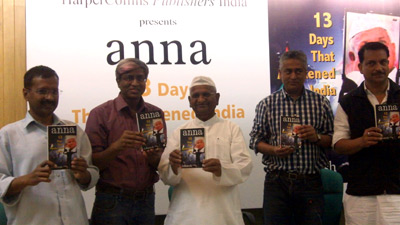
  • Ashutosh: Anna book is written in anger

    Video and Text by Shruti Pushkarna


    Launching his book titled, ‘Anna: 13 Days That Awakened India’, in New Delhi, Ashutosh, well-known Hindi journalist and Managing Editor of IBN 7 noted that the book was not about Anna Hazare but about the larger people’s movement. Addressing a gathering of journalists, social activists, politics, family and friends at the book launch, he said, “People think that the book is about Anna Hazare, it is not about Anna Hazare. It traces the movement, from where it started, the principal actors of the movement, their confrontation with the government and the politics of the day. Basically it encapsulates the entire movement from beginning to end.”


    The 74-year-old activist, Anna Hazare released the book written by TV journalist Ashutosh on the agitation in Ramlila Maidan last August, at the India Habitat Centre in New Delhi.


    In the book, Ashutosh weaves together the story of the thirteen days of Anna’s hunger strike. He had a ringside view of the developments, stationed as he was at the Ramlila grounds in New Delhi, the venue of the fast, and had intimate access to the two warring parties, the Congress government and Team Anna. Lauding the book, Mr Hazare said that it would be a great source of inspiration for the youth for whom this book will serve as a historic account of those thirteen days.


    [youtube width=”400″ height=”200″]http://www.youtube.com/watch?v=1i96hzMWcMY[/youtube]

    Ashutosh told the audiences that he’d written this book in anger at the so-called ‘elitist’ section of society who, he feels, have failed to understand the anti-corruption movement led by Anna. He also said that despite being a Hindi journalist, he chose to write the book in English because he wanted this group of people to read the book. He said, “This book is written in anger. Anger because through the movement I realized there is a section of English intelligentsia which is refusing to understand the movement and they are unnecessarily trying to find faults and trying to project it as anti-democracy. These people I thought, had no understanding of reality, they had never been to the Ram Lila Maidan, so I thought if I wrote in Hindi these people won’t read it. I wanted them to read and realize that there is a section of society which is very angry with their stand. That’s why I decided to write this book. I wanted to take my battle to their turf to understand how wrong they are. I wanted to take the battle to those who claim to be the guardians of history but actually know nothing about it.”


    The book release was followed by a panel discussion moderated by Editor-in-Chief, IBN 18 Network, Rajdeep Sardesai. The panelists included social activist Arvind Kejriwal, BJP spokesperson Rajiv Pratap Rudy, and Anna Hazare. Talking about the Anna movement, Arvind Kejriwal, member of Team Anna said that three factors had led to the success of the movement. One was Hazare’s leadership, second anger of people against corruption and third was the fact that Team Anna provided an alternative to fight the menace.


    Responding to whether the movement had lost its steam, Anna Hazare said that we will come to know by 2014 whether the movement still has the steam. He said, “There are questions about the movement. Some people doubt that the movement has lost the steam. Whether the movement still has the steam, we will know in 2014 when the country goes to general elections.” He added that he will wait till mid-May to see whether Parliament passes a strong Lokpal law during the ongoing budget session and then embark on a nation-wide tour to awaken people about the issue.


    Mr Hazare also said that one law cannot end corruption and therefore what we need is a change in the system. BJP spokesperson Rajiv Pratap Rudy said, “What we need is a change in the system. Bureaucrats are supposed to construct roads and MLAs and MPs make laws. However, in India bureaucrats make laws and lawmakers construct roads.” Mr Rudy asked how one could call India a functional democracy when a former Chief Minister, who was jailed for a multi-crore scam, gets elected to the Lok Sabha. Mr Rudy extended full support to Mr Hazare’s movement and appealed to Mr Hazare to urge good people to join politics.


    Rajdeep Sardesai expressed his reservations about the movement but he accepted that somebody has to take the lead in the fight against corruption.


  • Freaking News: It’s a dull year for TV

    By Ranjona Banerji


    The wonder that is TV news inIndiabecomes a total damp squib if there is nothing exciting happening. And this year has been particularly lacking news-wise. Or that is, news that suits TV land. Especially after the excitement of last year – not the least created by the anti-corruption movement – 2012 seems dull. The UP elections have not provided enough fodder and the best we have managed is the hullabaloo over Salman Rushdie and the Jaipur Literary Fest. The Supreme Court came down firmly on the age crisis faced by the army chief and that is now the end of that potential drama.


    It’s another matter that we have had sufficient news to keep us occupied. But when you run on a permanent cycle of “breaking news” which can be turned into hysterical studio debates, ordinary news does not suffice. Right now, the crisis within Kingfisher Airlines has the most potential.


    * * *


    Now that so many states have objected to the National Counter-Terrorism Centre, because it hurts our “federal structure”, it is perhaps time for newspapers to find commentators who can explain our “federal structure” in Constitutional terms. Are we really federal? Or is this just one more political ploy? In terms of law and order, the odd thing is that whenever something goes wrong in any state, people within and without the state clamour for a “CBI” probe. This, in spite of the fact that the CBI goes against our “federal structure” and at other times, is seen as a handmaiden of the ruling party at the Centre. It’s an odd but fascinating dichotomy of thought.


    * * *


    Yesterday’s newspapers told us that Anna Hazare is fit and raring to go. Today’s newspapers tell us that he and his team are due to meet. It would be interesting to see if television is still as accommodating to Hazare and his merry followers or whether they have fallen out of the news cycle. Newspapers, it must be admitted, have dismissed Hazare news to little single columns.


    * * *


    Having declared their “Aman Ki Asha” campaign for peace with Pakistan, the Times of India now looks east and introduces a “Bonding with Bangladesh” exercise. Since many Indians are even unaware that Bengal was partitioned (the general feeling appears to be that the only people affected were in north India), it will be interesting to see what kind of response they get. For now, it is sharing stories with the Bangladeshi paper Pratham Alo, to “deepen people-to-people” ties.


  • Journos should learn a lesson from Mumbai’s voter turnout

    By Ranjona Banerji


    So, as cynical journalists had assumed, a quarter of the way into Anna Hazare’s movement last year, this great upsurge of feeling for the country by young India was something of a hoax. When it came down to it – exercising your franchise, the biggest right and responsibility in a democracy – Mumbai has been found wanting. Hindustan Times’ headline puts it most succinctly: “Typical. Apathetic. Mumbai”.


    Newspapers also concentrated on rich and young Mumbai, both of which failed to show up. The Indian Express didn’t hold back taking about Mumbai sticking to its normal habit, “with voter disinterest in a handful of plush areas dragging down overall voter percentages”.


    As The Times of India points out, “The tony neighbourhoods of Colaba, Churchgate and Cuffe Parade repeated their past record with a measly turnout of 34 per cent, the lowest in the city.”


    The various reasons given for this voter apathy have been the chance for a long vacation, confusion over voter lists and general disorganisation. One woman is quoted about complaining that it took hour half an hour to vote – obviously too big a price to pay.


    As Mid-Day says in its editorial, “It is all very well to tweet about how this city is going to the dogs, create a Facebook page on how the roads are pathetic or organise candlelight marches to protest against terror attacks. The proof of the pudding is always in the eating. On that count, Mumbai is starving itself.”


    The Hindustan Times also went straight for the jugular – young people who are all aware and concerned in cyberspace but cannot translate that fervour into real life. (Aside to Election Commission: how about online voting for our youth who can’t be bothered to walk to a polling booth?)


    * * *


    On TV on Friday morning, the focus, for me, had to be on the Hindi and Marathi channels since the English channels were not unnaturally concerned with other news – Amitabh Bachchan’s operation, a fleeting glimpse of Aishwariya Rai carrying a baby bundle, the killing of two Indian fishermen by an Italian ship and something to do with Salma Hayek, which I didn’t bother to find out about.


    Sahara Mumbai, Sahara Samay and Star News suspended their precious stones and astrological forecast sections to provide trends, results and analysis of the elections in Maharashtra.


    * * *


    Perhaps in Mumbai’s voting pattern there is a lesson for journalists not to be too taken up with marketing hype about young India and to get carried away with what is said on social media. You have to keep track of everything but need not believe everything you hear and see on the Internet.


    Also, it is important to consider that India is not a society or a nation under threat or on the verge of civil war (whatever TV may tell you every night). We have no need for a social revolution like the Middle East for instance. Therefore, passion in cyberspace will not necessarily translate into anything at all in real life.


  • Media gets it wrong on Republic Day

    By Ranjona Banerji


    Republic Day is not about freedom from colonial rule, it’s about the Constitution and the way we rule ourselves. How did the media respond? After 63 years, maybe they feel that there’s little left to say, even though we have, in 2011, suffered a number of crises that examine or question our schedule of rights, responsibilities, freedoms and systems.


    Even the advertisers got it wrong. Bank of America, for instance, talked about some medieval version of the Panchatantra that they had helped restore. Wonderful news though that is, it has nothing whatsoever to do with India becoming a Republic. The Google doodle was some very cute cavorting elephants – but cute does not quite cover what Republic Day means.


    Anna Hazare used the opportunity to declare that “gram sabhas” are more important than the Lok Sabha. Luckily Mumbai is newspaper-free on January 27 or Hazare’s urban supporters would have been really confused. He was not, you see, talking about a sprouted moong salad or any other health food. What he means is that village assemblies are more important and should be more powerful than the elected representatives chosen by systems laid down in our very carefully constructed Constitution. As The Times of India’s Hyderabad edition put it, “Struggling to stay relevant amid signs of growing public indifference, Anna Hazare…” The Deccan Chronicle’s Hyderabad edition, it must be pointed out, did not bother to front-page Hazare archaic notions.


    But what the DC does have is an interesting story about how Nitin Gadkari, BJP party president, has changed his tune a bit about Gujarat chief minister Narendra Modi for prime minister. Now he says Sushma Swaraj and Arun Jaitley are in the race too. Perhaps the BJP, which is so enamoured of the US presidential system, now wants to internally implement the US political party system for choosing presidential candidates. It will be great fun if they do it – Modi, Swaraj and Jaitley locked in public fights with each other for the privilege of running for prime minister. Can you imagine the amount of fodder for our TV anchors?


    * * *


    Talking of TV (as I ran through the channels on Republic Day), the terrible story of a battered baby at New Delhi’s All India Institute of Medical Sciences dominated the headlines, together with the Indian cricket teams continuing travails in Australia. Virat Kohli’s century in Adelaide got some accolades but it was mainly doom and gloom. The battered baby got front page lead in the Delhi edition of the Hindustan Times, so can I forecast a more “people-friendly” 2012 in the media?


    * * *


    For the first time in several years, the Republic Day awards did not cause media hysteria. If Sachin Tendulkar had got his 100th 100th, the fact that he did not get a Bharat Ratna may have been a matter of huge melodrama. As it happens, no one got a Bharat Ratna.


    My only observation here is possibly a very visible parochialism where newspapers were happiest about awards given to local people. Now not only do you have to be jingoistic about India as a media person, you also have to fall prey to all the foibles of regional identity politics. I hope that’s not a prediction!