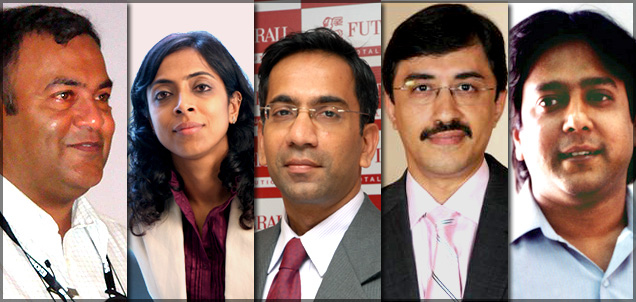
Tag: Ajay Kakar

  • From agency maverick to ‘khadoos’ client…


    By Shubhangi Mehta


    Switching jobs is an avenue for growth. But how does it work when the switch is drastic – such as going from an agency which creates a communication for a brand, to becoming a part of that brand? With increasing numbers of agency heads moving towards the client side, it looks like a trend.


    A mix of work and pleasure is what agency life promises an individual. With that also follows a pattern of sleepless nights, tight deadlines and the pressure to impress the client. What happens when one moves to the client side? How does life change, and do the switchers miss the agency days?


    We have an ample amount of such examples already in front of us. Rahul Kansal, Sunil Lulla, Ajay Kakar, Abraham Alapatt and Sheran Mehra are some such examples.


    Kamal Basu, Head of Marketing, Skoda, who was working with Saatchi & Saatchi is the most recent example of such a move.


    On his new role, Mr Basu said, “Moving to the client side is all about trying something new for me. I personally feel that advertising agency and brands work very closely and cannot do without each other hence the changeover is fairly easy as compared to moving from an agency into banking. For me right now, the most important thing is to have the mindset of a student eager to learn new aspects of the business.”


    Ajay Kakar, CMO – Financial Services, Aditya Birla Group who has worked in a creative agency environment as well, said, “The grass is always greener on the other side. Having been on both sides of the table, at the agency and client ends, I can now relate and empathize with this sentiment. Throughout my 14+ years experience at the agency side I shared the sentiment of every colleague, ie, ‘Hum kaam karte hain, while clients aish karte hain’. And during my more recent six-odd years at the client end, I can’t deny having heard or felt the sentiment, ‘Yeh agency waale kya jaane, what pressure we face’!”


    On the agency side, one is usually thought to be a lot more casual about ideation, creative, deliverables etc and the perspective is that it changes completely when one becomes a client.


    Rahul Kansal, CMO, Bennett, Coleman and Co, said, “I moved to the client’s end nine years ago. I had experienced agency life for approximately 20 years and was itching to implement my own ideas rather than just being an advisor. Though the two lives or work culture cannot be compared, yet as a client there is an ownership of the brand which leads to a personal connect.”


    Certainly an agency person enjoys agency life. But an invitation to partner a client is a thrilling mandate which might be quite enticing.


    Abraham Alapatt said, “After 10 years in the agency business, I was keen to grow into a more complete ‘marketing’ professional (as opposed to remaining a pure advertising man) and when I was offered my first head of Marketing role in 2005 with Reliance Mutual Fund, I took it most eagerly.”


    For those in the agency, the universe tends to revolve around advertising and agency imperatives. But as a as a marketer, one comes to understand that advertising and the agency are key cogs in a very large wheel.


    Sheran Mehra, Head of Marketing and Corporate Communications at Dhanlaxmi Bank, said, “I had planned my career in such a way that I wanted to move to the client side after working with an agency, since I wanted to play a larger part than just being an advisor for the brand. The agency setup is more informal, and more like a family. Not that here it isn’t like family, but it’s more formal, more of a corporate environment.”


    Alapatt further explains, “In terms of effort and pressure, being on the client side is as challenging and difficult, because the line of responsibility and accountability, especially when it comes to ROI, budget accountability etc, is a lot more definitive. If earlier at the agency, I spoke to my clients every morning and then planned my day’s priorities before catching up with my team and then breaking up jobs to meet expectations – now as a client I have to plan my day ahead (based on current business and leadership priorities) and then along with my team, chart out tasks/timelines/deliverables. I also have a lot more information available to help prepare an annual plan, review it regularly, and then make more meaningful contributions to overall marketing and business strategy then when I was on the agency side. Overall it is a lot more organised, planned, systematic, and accountable.”


    A client initiates a brief. And his job is not complete till long after the agency hands over its input and output.


    The most obvious change after moving to the client side is that one can now plan a day or a schedule and prioritize a lot more, and there are far fewer firefighting situations than when working with an agency. This is probably because ad agency teams (who work with multiple clients) need to constantly re-align their priorities in line with their clients’ changing needs.


    Mr Kakar further adds, “Today I feel like the ‘complete man’, because I now have a realistic perspective from both ends. Having been on the agency side I believe that I can be more sensitive to the agency’s needs and constraints. But on the other hand, I am more demanding on what I know is possible. But life in an agency is what I miss… the masti and the laughter in the corridors, the camaraderie, the training sessions, et al.


    “As a client we can say that one is responsible for one’s team delivery (besides your own KPIs). These are directly linked to the company’s overall performance targets and plans, and every idea, plan, activity, campaign needs to be very clearly defined and measurable as one is accountable for every rupee spent to the CEO and the board of directors.”


    Most of the people who have made a move have stuck to the client side, which seems to indicate that working as a client is more enthralling.


    “I am not sure I yet have an answer to which part I enjoy playing more. But I do believe that the agency and client are two sides of the same coin. A marketer’s success depends on his agency partner, just as an agency’s existence depends on its clients. And only when both of them come together in harmony, is there real value in the form of fun, fame and fortune, adds Mr Kakar.


    While Mr Alapatt muses, “Looking back, I am glad I made the shift for the growth, learning and opportunities it has afforded me. But I can confidently say that the first 10 years of grounding/experience that I enjoyed with ad agencies like Ogilvy and the exposure to multiple clients/categories has been invaluable to my growth, both personally and professionally.”


    The big picture seems to be that the transition from one side to another is a natural evolution and part of the growth process. And this part of the journey as a client can be said to mature one as a person and marketing professional.


     

  • The power of Public Relations: Ajay Kakar

    By Ajay Kakar


    As a marketer, we have many communication tools to capitalise on for the advantage of our brands and our business. To me, these ‘weapons’ (advertising, direct marketing, public relations et al) are very akin to a Swiss army knife; you can use any or all of these weapons, depending on the task at hand.


    But in my many years at the agency end, with stints in direct marketing, advertising and public relations, and now as a client, I have found “PR” to be the least understood, appreciated and under-leveraged communication weapon – by both the marketing and (believe it or not) agency fraternities in India. And most surprisingly, the PR fraternity too.


    As a long standing convert and staunch believer in this discipline, let me share with you my 20-year-old association with the PR discipline and the reasons why I believe that it is arguably the most powerful communications arrow in a marketer’s quiver. Also the reasons why I believe that the discipline has yet not got its full dues.


    So here’s the story of my tryst with public relations, or, if I may so say, the story of public relations in India, over the last two decades.


    PR, in fact, changed my life!


    PR is actually the exotic siren who first tempted me to leave my career in accounting and audit, to venture into the (for me) unfamiliar and untrodden path of communications.


    In 1991, I came across an interview in the Business India, with a person called Steve Lyons (I still remember the name!), who was then the head of a company called ‘Ogilvy PR’ in Singapore.  Believe it or not, until then I had never even thought of the advertising world, or even heard of “Ogilvy”.


    The article impressed me so much that I immediately searched out the agency’s address and cold-called the then-MD of Ogilvy and Mather, India, Mr. Mani Aiyer, hoping for a break in his PR unit.


    Hearing my motivation for joining PR, he tried to temper my new found passion, but having gauged me as a person who was not going to be swayed easily, he had me meet the head of Ogilvy PR in India. And that meeting shattered all my dreams and illusions.


    In 1991, PR, in India was nothing more than “Press Relations” – getting media coverage…lots of it…at any cost.


    Dejected, I decided not to pursue this temptress. And when I went back to Mr. Aiyer to thank him for his time, he actually offered me a job in advertising. Needless to say, he made a passionate pitch that swept me off my feet. And on May 2, 2001, I became an employee of Ogilvy & Mather (though not Ogilvy Public Relations).


    But fate was not going to let me off the hook, so easily.


    In 2003 I was invited to take on an additional mandate at Ogilvy, as the country head of Ogilvy Public Relations, in India. Before the end of 2004, I was the president of the industry body, Public Relations Consultants Association of India. And in 2005 I had switched over to the other side, the client side, where I became an active user of PR.


    And today, as 2011 comes to an end and 2012 draws near…


    Two decades have passed, but ‘PR’ remains mere press relations – in the minds of the practitioners – be they the PR professionals, or their user base.  Of course there may be a few exceptions. But these are far and apart. “PR = press relations” is all that we care to believe. Unless….

    In moments of need, even atheists are tempted to remember God. …. “Forgive me father, for I have sinned”. And when brands have ‘sinned’ or find themselves in a tight spot, they have reached out for public relations and found this discipline to be a saviour.


    As an example, just remember the days when colas were synonymous with pesticide and you will know what I am referring to.


    But back to any ordinary day….

    At Ogilvy, I recollect instances when I presented a Rs5 crore estimate to a client for an advertising campaign (do remember that in the mid-90s this was a princely sum) and got an instant sign off. And then when I wore my PR hat and asked for a Rs5,000 pm hike in fee from the same client (do remember that even in the mid-90s, this was a meagre sum), the client would wear a thinking hat, but refuse to lift his pen to sign on the dotted line…and finally it used to boil down to… “But you guys make so much from us on advertising. So why do you need to be paid, for PR!”


    These instances would leave indelible marks of pain on my professional pride. But looking back at all such instances, I realised that I had to ‘forgive them, for they knew not what they did’. Because they knew not what PR is and what role PR can play in their lives and the lives of their brands.


    So it was the number of clips that we were measured by. Else, the column centimetres of editorial coverage. Or the rupee value of the editorial coverage. Or the coverage we got (or did not) for the client’s son’s sports day. Media coverage. Media coverage. Media coverage.


    This was and still is a malaise that ails the PR industry inIndia. And some parts of the world.


    What is PR? What are the key deliverables one should expect? How should the impact of PR be measured? How would you like to substantiate your proposed fee or fee hike?

    Ask 5 practitioners this question and in all probability you will get atleast 6 (different) responses. So as a client, how do I value or respect a ‘good thing’ when I don’t even know what it is! Or how to measure it!


    This has been a burning need for the industry to rally around and define and ‘standardise’ expectations, industry-wide definitions and measures. But two decades later, the questions remain the same. And there is yet no answer. No understanding. No empathy.


    So while the PR industry keeps asking “why are we paid peanuts”, the user industry keeps answering “because we (think we) are getting monkeys”. This never ending coffee-toffee debate needs a closure. Soon. And I do appeal to the industry to claim their rightful place under the sun. At the earliest. By first addressing the basics. The questions that we cannot wish away. And then, of course, delivering on them.


    Until then, it is to our collective disadvantage that PR is considered a mere commodity. And we are seen as under cutting each other to win mandates. These mandates are soon lost, when the client is not in a position to evaluate or measure our success. Or the lack of it.


    The client base of the public relations industry is increasing by the day (there will never ever be a shortage of clients). But the number of satisfied clients? The number of clients making use of, and benefiting from PR in all its glory? Who is counting!  And therefore it hurts the believers, when India wins a PR Lion at Cannes. Because it has been won by an ad agency! Not a PR agency.


    So is there mere gloom and doom in the PR industry? Not at all!


    There are various case studies where PR has hit the bull’s eye and demonstrated it’s true potential and power. Let’s visit some of these and take inspiration from them.


    Today’s exceptions, tomorrow’s rule…

    It would be right to cite a few examples here that could redefine the way PR is perceived.

    We all know of John Travolta as an actor, singer, dancer but do you know that he is also a licensed pilot? So when Qantas, the airline from ‘down under’Australia, wanted to reach out to as a relevant airline for European markets, they actually got John Travolta to fly their planes to these destinations. The kind of coverage that this exercise got in local as well as world media was mind-boggling. So Qantas used this “a facet of John that you did not know”, to express “a facet of Qantas that you did not know”.


    Cadbury’s was hit by a crisis – the worm infestation case – that nearly threatened the very existence of the brand in India, as mothers questioned their generations of trust in Cadbury’s chocolates. At Ogilvy PR I had the opportunity to partner this iconic brand and their leadership team on the exercise that is now a case study for Cadbury’s, worlwide.

    Customers. Channel. Influencers. Regulators. Government. Employees…all these key stakeholders had to be reached out to, repeatedly and regularly. And the media was only one of the bridges to reach out to them. It was “public” relations at play. And not mere ‘press’ relations.

    Today Cadburys keeps scaling greater highs. It not only won back the trust of a nation. But also its loyal customer base and their sales graph. And this incident appears to be a distant dream. But in those days, every day appeared to be like a never ending nightmare.

    As an agency and team, we had the opportunity to get into the hearts and minds of the senior management team on an ‘online real time’ basis. Every day. For weeks.


    Gillette is another company that has realised and capitalised on the power of PR, year after year. You will remember their W.A.L.S (Women Against Lazy Stubble) campaign. And now the Shavesutra campaign.  Their movement has resulted in 12.2 million Indians casting their vote for a clean shave. It also led to rise in sales and popularity of the product and also bagged numerous awards…their sales going up by 500 per cent, market share up by 400 per cent, an entry in the Guinness book of records…and over $ 2.5 million worth of free media coverage.


    The Body Shop is another classic example of a brand that has enjoyed the favours of PR. No advertising. And still, it’s a global brand with very strong bondings with its consumers, as an eco friendly company.


    Or, the mother of all “PR” campaigns… Mahatma Gandhi’s freedom struggle. He influenced an entire nation to realise the power of self rule… and got ‘results’ in the form of India’s Independence.


    So, while PR is about press relations, it is also about influencing the influencer. It’s about creating credibility and about credible ways of influencing people to act. It is not only about journalists but about customers, employees, shareholders, channel partners and other key stakeholder’s perceptions management. It is a weapon that can do wonders in not only the brand’s good times, but more so in the bad times too. It can give business solutions and tangible results.


    So if you ask me, PR is about ‘Public’ and not ‘Press’ relations. It is about ideas that influence and engage my ‘public’ and something that has a multiplier effect. The credible way. And my belief is that if you capture the right essence of PR, you will not need to chase the media. The media will come chasing you.


    From a client’s perspective, if my PR agency helps me achieve my KRAs in a simpler, cheaper and faster way, then why will I not chase you? If as clients, we earn a fixed and variable salary, then why shouldn’t my PR agency also be assessed and remunerated that way? And that the variable component should be based on tangible results.  My belief is that this is one industry where the potential of an agency’s variable earnings outstripping the fixed component is very high.


    If PR can demonstrate how it can help me increase my profits, customer base and revenues, in short help me achieve  my KRAs, then forget peanuts, I weigh them in “gold”.


    Towards this destination, two points to ponder:

    • We need talent that can deliver on this potential. Talent that can claim to be a “strategic counsel”. Talent that only handles the number of clients it can give the requisite attention to.  Today, when it comes to advertising, we can even put faces to the next generation of the industry.
    • There is so much (though still inadequate) talent. But when it comes to the PR industry? I am sure that we have many unsung heroes – be they agencies, professionals or success stories. Can the PR industry do its own PR, so that we all have role models that inspire us and we aspire to emulate?


    Ajay Kakar is CMO – Financial Services, Aditya Birla Group


  • What’s more important? Creativity or Effectiveness? Or both?


    By Shubhangi Mehta


    [youtube width=”400″ height=”250″]http://www.youtube.com/watch?v=i6dEI6D_rcI[/youtube]

    Regardless of how ‘simple’ the end product may seem, creating advertisements for a brand has never been child’s play. It’s a task which only a creative mind can understand. And the complexities have grown over the years. When we spoke about campaigns 20 years ago, expectations were not as high as they are today.


    Today, it is the age of numerous and congregating media. While advertisers have many opportunities to reach to their desired audiences, the muddle can cause them to lose out. A beautifully executed campaign may not make its audience reach for their wallets, while an average one, creatively speaking, may end up garnering better results.


    What is the most important element, then, for the campaign of today? Is it creativity? Or effectiveness? Or a magic mix of both?


    MxMIndia posed the question to practitioners – people who create the campaign and people for whom the campaign is created.


    [youtube width=”400″ height=”250″]http://www.youtube.com/watch?v=odmcmnWjK10&feature=fvst[/youtube]

    Abhijit Avasthi, NCD, Ogilvy&Mather, said, “We only believe in creating effective communication. According to me people who separate the two cannot be called creative. If we look at the past 3-4 years’ trend, most of the campaigns that win at the Abbys are the ones winning at the Effies as well. A brand communication is complete only when it is an effective creative.”


    According to Ajay Kakar, Chief Marketing Officer, Aditya Birla Group – Financial Services, “What is the use of a knife that does not cut, or a gun that cannot fire? Similarly there is no use for a creative which isn’t effective. Such a creative work is only meant for Jehangir Art Gallery and not product promotion. According to me each and every creative needs to be effective and only then does it fulfil its very purpose”.


    The IPA/Gunn Report published in June 2011 examines the link between creativity and effectiveness. The original 2010 report had analyzed 257 campaigns over a period of ten years (1998-2008). The 2011 version of the report has been expanded to examine 435 campaigns over 16 years, from 1994 to 2010. The main aim of the report was to examine both effectiveness (a campaign’s ability to drive business like sales, profit and loyalty) and its efficiency for campaigns that have been awarded for their creativity and those that have not been.


    Some of the findings of the report include: creatively-awarded campaigns were seven times more efficient than non-awarded ones; between 2003 and 2010 creatively-awarded campaigns were 12 times more efficient; there is a pronounced time trend – creatively awarded campaigns are becoming more efficient over time, while non-awarded campaigns are becoming less so; the much greater ‘buzz’ effects of creatively-awarded campaigns appears to be why they are becoming more effective: in the multichannel world creativity is becoming more closely associated with buzz, leaving non-awarded campaigns struggling.


    Agnello Dias of Taproot said, “It is effectiveness that plays a key role. If the effectiveness is backed by a great creative it’s icing on the cake but if a particular campaign is effective for a brand then even mediocre creative can be accepted”.


    KV (Pops) Sridhar, NCD, Leo Burnett India, said, “One cannot really separate creativity and effectiveness in a brand communication. Both of them are two sides of the same coin. If one of these two elements is missing then it does not fulfil the purpose of an advertisement for a brand. There has to be an insight, entertainment, cut-through idea and it must break barriers. Hence it is impossible to choose between creativity and effectiveness. A creative is created for effectiveness of the brand.”


    Abraham Alapatt, Head – Brand & Corporate Communication at Future Generali India, said, “Neither the client nor the ad agency, have the luxury any longer, to choose one over the other. Given the growing media clutter, it is now more critical than ever to be creative and different to stand out and get noticed by customer prospects. I qualify ‘creative’ by using a phrase used by the Effie organizers – creative ‘work that works’ for real customers, in the marketplace. So put differently, both clients who are facing increasing competition, media clutter and tight budgets and agencies that are operating with these client constraints are now being called on to deliver marketing communication (which I don’t call advertising) that actively amplifies, complements and makes a tangible difference to the client’s pre-determined marketing efforts”.


    The debate may well rage on, but the market reality is that effective communication is the child of a creative mind. Both creativity and effectiveness are, thus, essential when creating communication for a brand.

  • It’s the Effies tonight

    By Tuhina Anand


    The stage is set for Effie Awards 2011 which will be held at Race Course, Mahalaxmi in Mumbai, tonight. The awards are much respected and coveted as they recognize effective advertising – ie, an award for advertising that has worked in the market. The client of the year and agency of the year are the Effies most watched for.


    The Effies 2011 were different even in judging as there were four sessions altogether, three in round one including one in Delhi which was for the first time and then round two. It is learnt that there were 60 judges in round one and 20 in round two and out of this number 75 per cent comprised the clients’ side who were involved in judging. The plan is now to take Effies case studies, a popular segment, toDelhinext year.


    Ajay Kakar, Chairman Effie 2011 Committee and CMO – Financial Services, Aditya Birla Group, on what the fraternity should expect from the Effies tonight, said, “The judges have cast their votes. When 60 luminaries from the advertising and marketing fraternities put their collective minds together to evaluate the work that has worked in the market place, you can expect nothing short of the ‘best among the best’ to gain its rightful recognition.”


    Work that has rightfully left its mark in the sands of 2010-11 will be unveiled at the gala awards night.


    “Effie 2011 has a host of records/firsts, to its credit be it the number of entries received (300), the number of judges (60), the number of clients in the jury, the judging in Delhi and the number of agencies (20) that contributed to the short listed entries. I am sure we can expect a few more pleasant surprises at the awards night,” concluded Mr Kakar.


    Also read:

    All set for Effies on Dec 14

    http://www.mxmindia.com/2011/11/edging-towards-effies/

  • The Anchor: 8 indications when you know it’s time to bid goodbye to your agency

    By Ajay Kakar

    These are the views of a person who has invested 15 years at the agency end. And for the last six years he has been at the client side.


    These are the views of a marketer who strongly believes that the role of an agency partner is invaluable to his success and the success of his brand.


    #1 When you have the frequent need to say all the best to exiting key members of the agency: A brand is built over years. Passion and consistency are two critical pillars in this journey. And if an agency loses/shifts your key team members frequently, that’s bad news.


    #2 When you have many people servicing your account but you do not remember the name of any: You do need mere hands and legs. To quote David Ogilvy, you need people who know more about the brand than even the client. People who leave an impression on you and make an impact on the brand. People you can’t afford to forget. Nothing less will do.


    # 3 When you have meetings only at times of a brief initiated by you: You need Brand Custodians and Brand Stewards. People who are thinking of your brand all the time. And not only when you have a felt need. Else you will always feel compromised.


    # 4 When your agency only discusses advertising or 30-seconders with you: In today’s world you need to surround and engage your fickle and distracted consumer at all times. And if your agency doesn’t help you with that they may be contributing to your losing your customer.


    # 5 When your agency does not meet you after a campaign to enquire about the results: A marketer does not need advertising. He needs advertising that sells. He is evaluated on results. If your agency is not helping you get there faster, cheaper or better, why will you value them?


    # 6 When your agency doesn’t ask for an annual hike with confidence and more so if your agency does not propose a performance-linked incentive plan: A true partnership must be a win-win for both parties. And if your agency is contributing to your success, why would they think twice before asking for your just rewards. Is it because they are not performing?


    # 7 When an agency doesn’t meet you at regular intervals to seek a structured

    feedback/evaluation: If your partner doesn’t have a road map with clearly defined milestones, there is a good chance that you are not headed in the right direction.


    # 8 When an agency does not aspire to win industry recognition/awards on your brand: In our business passion is everything. And if your partner is not excited to do pathbreaking work for your client work that gets noticed and talked about the brand is possibly not in safe hands.


    Ajay Kakar is CMO – Financial Services, Aditya Birla Group