Tag: Airtel

  • Happy mcgarrybowen designs identity for Airtel Xstream

    By A Correspondent


    Bharti Airtel has partnered with Happy mcgarrybowen to design the brand identity for Airtel Xstream, the digital entertainment platform by Airtel. As part of the exercise, Happy mcgarrybowen designed the brand identity and visual language for the brand.


    Speaking on the engagement, Shashwat Sharma, CMO, Airtel said: “The vision for the Airtel Xstream brand was to carve a voice that speaks to today’s young, technology ready consumer. We were building an India-first platform of digital entertainment services and this needed a disruptive and market-defining visual identity. Happy mcgarrybowen became our partner in bringing that vision to life. They helped create an identity that is current, aspirational and future-ready. It’s a great visual ethos of what Airtel Xstream promises to bring to the Indian consumer going forward.”


    Added Samarjit Choudhry, President, Happy mcgarrybowen: “Airtel is one of the most recognised brands in India. It has ushered in major changes in the way we use communication tools. With the launch of Xstream, they are once again on the cusp of changing our entertainment consumption habits. We have tried to capture the dynamic nature of the digital entertainment world, its confluence across platforms; obviously with the consumer at the centre of it.”


  • Motorola Mobility appoints Shivam Ranjan as Marketing Head

    By A Correspondent


    Lenovo Mobile Business Group has announced the appointment of Shivam Ranjan as the Head of Marketing for Motorola Mobility India Pvt Limited. In this role, he will be responsible for overall brand building, marketing and PR for Motorola.


    Before joining Motorola, Ranjan was heading Brand & Marketing for Airtel Payments Bank.


    Commenting on his appointment, Ranjan said: “I am honoured to Head the Marketing for Motorola Mobility, the pioneers of mobile technology in the world. With a lineup of innovative products and a strong brand legacy, I am excited and look forward to contribute to Motorola’s growth story through disruptive marketing initiatives”.


    “Shivam will be responsible for sales and marketing efforts and his experience in building brands makes him a perfect fit for Motorola. Along with experience, he brings with him new age thinking and a challenger mindset. We are positive that he will help us grow in the right direction and be a key internal stakeholder for Motorola as we move towards our goal,” said Prashanth Mani, Managing Director and Country Head, Lenovo MBG.


  • Airtel adds Leo Burnett to its roster of agencies

    By A Correspondent


    Airtel has added Leo Burnett to the roaster of agencies. Leo Burnett will handle a host of B2B and B2C services across the businesses, including the BTL work and circle marketing campaigns. The mandate was awarded after a multi-agency pitch and will be handled by the Leo Burnett Delhi office.


    Shashwat Sharma

    Said Shashwat Sharma, Chief Marketing Officer, Bharti Airtel, India and South Asia: “Since Airtel’s launch 24 years ago, the brand has evolved to cater to changing consumer needs. As we move towards the era of digital transformation, we wanted to strengthen our equity amongst youth and as an innovation thought leader. We are confident that Leo Burnett with their new age thinking and strong execution excellence would help us to create a future ready brand.”


    Dheeraj Sinha

    Speaking about the win Dheeraj Sinha, Managing Director India & Chief Strategy Officer Leo Burnett, South Asia added: “This is a spectacular win for us and I am thankful to Airtel for the confidence they have reposed in our thinking, creative prowess and ability to deliver at scale. We believe in today’s times a brand needs to have multiple conversations with people across touchpoints. We look forward to building the future narrative for Airtel across the businesses.”


    Said Samir Gangahar President-North, Leo Burnett: “This is a milestone win for us and we are beyond thrilled that Airtel has decided to bring us on board. We are looking forward to working with the teams to create some distinctive and memorable work.”


  • Tata stays as Interbrand #1


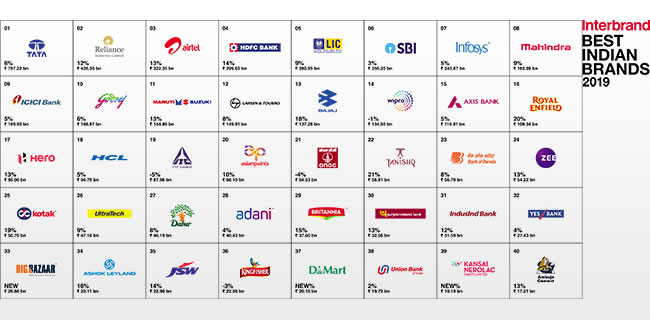
    Interbrand, the Omnicom-owned brand consultancy has named Tata, Reliance and Airtel as the three most valuable Indian brands of 2019. In its sixth year, the Best Indian Brands ranking saw retail make its presence felt in the league table, which was otherwise dominated by Automotive, Diversified Businesses & Financial Services sectors. Interbrand, it may be noted, only looks at the homegrown Indian brands, so the MNC brands are missing, even though they are popular, bestselling and trusted.


    The Auto sector shifts gears to drive top growth. Mirroring the brave global brands more than any other sector, the auto brands showed the way to the rest this year. Royal Enfield, Bajaj Auto, Ashok Leyland, Hero, Maruti Suzuki and Mahindra demonstrate growth higher than average.


    This year’s table features three new entrants. Big Bazaar joins at #33 (INR 26.86 Bn), DMart at #37 (INR 20.15 Bn) and Nerolac Paints enters the table at #39 (INR 19.19 Bn) for the first time. On the other hand, Reliance Group (R-ADAG; last on in 2017, INR 46.56 Bn) and Canara Bank (last on in 2017, INR 19.73 Bn) exited the list this year.


    The combined value of the Top 40 brands was INR 5.03 trillion, which represented a 5.2% growth in value over the previous year. Tanishq, Royal Enfield, Kotak, Bajaj Auto, Ashok Leyland and Britannia were amongst the fastest growing brands.


    Ever since its inception, Tata has continued to hold the top position in the Best Indian Brands table. However, Tata’s brand value grew by a modest 6.5% – contributed significantly by its tech services business TCS. In the same vein, Reliance, which after taking over the #2 spot from Airtel last year, consolidated itself as a strong #2 with a growth in brand value of 12%. This performance was bolstered by the phenomenal growth of JIO. HDFC Bank, LIC, State Bank of India, Infosys, Mahindra, ICICI Bank and Godrej round off the Top 10.


    Financial Services and Auto contributed the most to this year’s Top 40, at 27% and 13% of value.


    Said Ashish Mishra, Managing Director, Interbrand India: “Most Indian businesses looked at change as a big risk to their existence. But to them we would say: Risk is no longer in changing. But in not changing. And challenge is no longer just the competition or the ever-changing business environment. It’s our own inertia. Our fear of the new, of the unknown. And yet, most inevitably fight that change, trying to bend a fast-changing world to their obsolescence. What’s really encouraging is that we are now seeing the progressive few accept that the world is changing and making attempts to change. They acknowledge the new consumer preferences. They accept the new desire for experiences and respond positively. Replacing complacency with competitiveness. To reinvent themselves before they reinvent their categories. And remain unafraid of the change to drive brave growth. That, in sum, is the secret behind this year’s Top 40’s success.”


    Providing a global perspective on the Best Indian Brands 2019, Rebecca Robins, Interbrand’s global Culture and Learning Officer, added: “In a fast-changing world, brands are the only assets that companies can fall back on, to navigate the challenges. Indeed, brands are the crucial interface between technology and consumers, that channel an organisation’s efforts to engender growth. Globally, the one category that has managed this well, to constantly evolve; to lead new ecosystems; to craft highly personalised and meaningful micro-experiences while still being rooted in a larger purpose, is luxury. No wonder then, that the world’s and India’s top change drivers are taking a leaf out of the luxury playbook, to grow by adopting a “luxury mindset”


  • Tata is India’s #1 brand. Reliance & Airtel follow


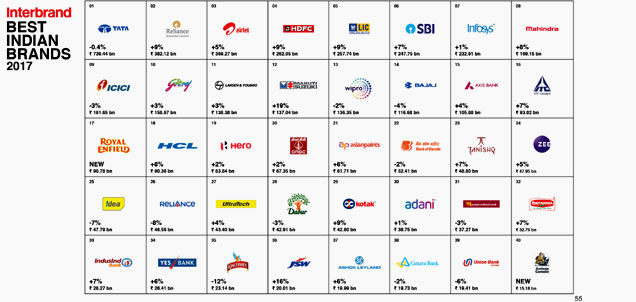
    It’s that time of the year when the Omnicom Group’s Interbrand releases its Best Indian Brands report. For five consecutive years, Tata Group has continued to hold the top position. And while Airtel continues to play strong at #3, Reliance is now a strong #2 on the back of Jio’s omnipresence amongst telecom service providers.


    Following Airtel is HDFC Bank at #4, and then Life Insurance Corporation of India (LIC),State Bank of India, Infosys, Mahindra, ICICI and Godrej round out the Top 10.The best growth performances belonged to Maruti, Reliance, HDFC, JSW and Kotak highlighting the relevance of Purpose Centricity, Technology and Brand in driving their growth.


    Interestingly more than 50 per cent of the Best Indian Brands come from five sectors: Automotive (5), Diversified (10), Financial Services (12), Telecom (2), and Technology (2). Automotive is one of the top growing sectors, leading the change is brand Maruti Suzuki, which posted a 19% increase in brand value versus 2016.


    Breaking into Best Indian Brands for the first time at #17 is Royal Enfield and Ambuja Cement at #40.


    Said Ashish Mishra, Managing Director, Interbrand India: “The Best Global Brands understand that brands are the platform for growth. A quick look at the top growing brands confirms how outgrowing the now and changing at the speed of life creates admirable value growth.  Encouragingly, the top growing Best Indian Brands too have begun to understand and demonstrate the levers that drive growth and value. Maruti Suzuki, our top growing brand for the second year in a row has done an exemplary job with Reliance, Kotak, JSW, HDFC and Ashok Leyland not far behind. Our analysis of the Best Global Brands reveals some simple truths. Truths that are useful for Indian Brands to consider while driving growth in our rapidly changing market.”


    Also present at the launch of the 2017 report was Gonzalo Brujo, Chief Executive Officer of Interbrand EMEA, Latam and India. And this is what he said: “We are living in one of the most exciting periods of change—societal, technological, industrial—that impacts every aspect of commerce and life. In this ever-shifting context, to grow, brands need to outgrow. Outgrow barriers, challenges, markets, competition, mindsets, technology and potential. Which is why businesses need brands more than ever. The Best Indian Brands understand this value  in belief systems and purposes, and hence propel this change without losing the way.”


    The Top 40 Indian Brands have a combined total value of INR 4755.7 Bn, an increase of 5% from 2016. For the complete Top 40 ranking and the report with comprehensive analysis of growth, sector and industry trends, click here


  • Taproot innovates with Airtel’s life-saving wallpapers


    Taproot Dentsu has partnered with Airtel with an innovative solution for people who become unfortunate victims of accidents.In an accident or medical emergency, one may want to help, but there is no way a stranger can reach out to the victim’s family because the phone contacts are stuck behind pass codes.


    Taproot Dentsu’snew innovation addresses this issue with much ease. The Life Saving Wallpapers help everyone make mobile wallpapers with emergency contacts and blood group, so that that information remains accessible without having to unlockthe screen. Dentsu Web Chutney, Airtel’s Digital partner, supported the execution of the idea.


    Said Titus Upputuru, Creative Head, Taproot Dentsu, Gurgaon: “At Dentsu Aegis Network, we are innovating the way brands are built in today’s world. In the unfortunate circumstance of an accident, when the victim becomes unconscious or is badly injured, there is no way people can reach out to the victim’s family and friends because the contacts are hidden behind the phone’s passcode. That’s where Airtel’s Lifesaving Wallpapers come handy. All the important data such as emergency contact numbers and blood group details are now available on the phone screen through the customized wallpapers, so that people can reach out to those who need to be contacted and help the victims. Across India, people are benefitting from this initiative. Who thought Wallpapers can save lives, but in today’s world it is possible.”


  • Airtel is India #1, World’s #22


    By A Correspondent


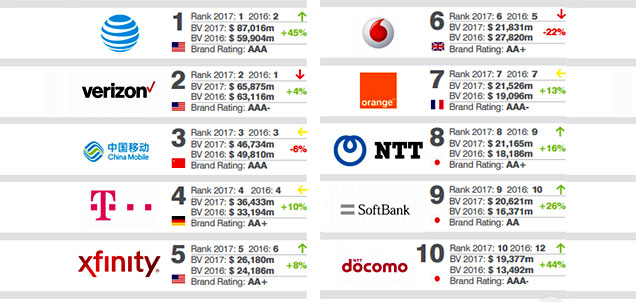
    Airtel is India’s #1 telecom brand and globally #22. It is up from 28 last year in the Brand Finance ranking of the Top 500 telecom brands. AT&T saw its brand value grow 45% this year to US$87 billion, overtaking Verizon as the most valuable telecoms brand. Its acquisitive growth in South America and Mexico follows its 2015 takeover of DirecTV, resulting in continued growth in brand value and an increase in market share.


    Verizon, though it has lost its position at the top of the table, remains strong, registering a 2 point BSI score improvement and 4% brand value growth. A spate of rumours has surrounded Verizon’s potential takeover of Charter Communications. Such a deal would create the US’ biggest internet provider and is yet another example of the consolidation affecting the industry. Verizon’s share price jumped as the speculation continued though has since cooled after the deal failed to materialise and concerns were raised at the levels of debt the new entity would be exposed to. A new Charter/Verizon combined entity would reportedly be the world’s largest debtor, with borrowings of over US$200 billion.


    In India, Idea is at #2 at Rank 64, followed by Reliance Communications (97), BSNL at 115, Aircel at 125, Tata Communications at 126. Vodafone is part of the global Top 500 at #6. There are a total of 14 Indian brands in the Top 500 list.


    T (Deutsche Telekom) is Europe’s most valuable telecoms brand, though its growth is largely being driven by its performance outside the continent. The 10% increase in brand value came largely as a result of higher revenues and increased market share in the U.S. market. In the third quarter of 2016 T-Mobile (US) added around 969,000 subscribers, dwarfing both Verizon and A&T which added only 200,000 and 450,000 respectively.


    Huawei retains the top spot in the infrastructure table with a brand value of US$25 billion after growing 28%. The Chinese giant persevered with its efforts to raise its brand profile worldwide. After successfully implementing global marketing campaigns, which include celebrity endorsements, its brand recognition subsequently increased to 81% in 2016, up from 76% in 2015.


    Qualcomm is the fastest growing telecoms infrastructure brand, rising 65% in value to US$6.8 billion. However, legal disputes with Apple regarding allegations that Qualcomm is exploiting its dominant position by charging excessive royalties raise questions about whether this growth can be sustained.


    Nokia is one of the more remarkable success stories of 2017. Its brand value peaked at US$33.1 billion in 2008, making it the world’s 9th most valuable brand across all sectors. Its slow response to the emergence of smart phone technology led to a well-documented decline at the hands of Apple and Samsung. Brand Value sunk to a low of just of US$2 billion in 2014.


    However, after a period of consolidation, Nokia is firmly on the road to recovery. After the mobile device division was sold off, the brand survived as Nokia Networks (rebranded from NSN). Nokia Networks acquired a controlling stake in Alcatel-Lucent in 2016 to create one of the largest players in the sector. Alcatel-Lucent has since been rebranded as Nokia, further reinforcing the position of the Finnish brand.


    2017 marks another turning point in the Scandinavian giant’s saga, as the Nokia brand is once again be visible on mobile devices. HMD (founded by Nokia veterans in 2016) is launching a number of handsets and a tablet, Nokia’s largest ever device at Mobile World Congress. Perhaps the greatest level of excitement is focussed on the revival of the iconic 3310.  This newfound momentum sees Nokia’s brand value climb 62% to US$4.9 billion while the fundamental brand equity measures are improving too, which sees Nokia’s brand strength rating upgraded from AA to AA+.


    Every year, leading valuation and strategy consultancy Brand Finance values the brands of thousands of the world’s biggest companies. Brands are first evaluated to determine their power/ strength (based on factors such as marketing investment, familiarity, loyalty, staff satisfaction and corporate reputation) and given a corresponding letter grade up to AAA+. Brand strength is used to determine what proportion of a business’s revenue is contributed by the brand, which is projected into perpetuity to determine the brand’s value. The world’s 500 most valuable telecoms brands are then ranked and included in the Brand Finance Telecom 500 and the Top 10ninfrastructure providers in the Telecoms Infrastructure 10.

    View the full list of the world’s 500 most valuable telecom brands here

    View the top 10 telecoms infrastructure brands here

  • Saare Jahaan Se Achhca…


    It’s Independence Day on Saturday. There are several brands which have done some splendid work in independent India, but there are some which stand out amongst these. Presenting a selection of these…


    Why Airtel wants to be everybody’s friend


    By Ravi Balakrishnan


    Airtel may want to be remembered for its snazzier, youthful advertising, but one of its definitive commercials is the barber’s shop ad from the mid-2000s. As the trademark Airtel ring tone sounds, customers and the barber hastily reach for their phones. But the call is actually for the chaiwalla, subtly establishing the brand’s ubiquity and ability to cut across classes.


    Over the last two decades – Airtel turned 20 this July – it has grown to be India’s largest mobile network. For lakhs of Indians, it’s been the first telephone connection of any sort. No mean feat in a hyperactive market that at one point in 2009, had close to 10 players and has been through supposedly giant slaying trends like mobile number portability.


    According to Srini Gopalan, lead – consumer business, Airtel owes it all too keeping its core essence intact. He explains, “Human connections are at the heart of the brand. Over the years, we’ve been able to capture this in multiple memorable ways.” For instance, Express Yourself starring AR Rahman to the more recent Har Ek Friend which acknowledged that friends were a new form of family. It’s a singleminded stance at variance with many newer entrants who initiated price wars or took potshots at other players. Says Gopalan, “While others have obsessed about specific technology or the competition, we have obsessed about customers, providing a great network and service.”


    Of course, there’s a lot more to Airtel than a few well-liked ads. It has tailored itself to various target audiences offering internet and videos at Rs 1 for the population that’s getting online for the first time. It claims to have started providing 4G to its 3G subscribers at no extra cost. Gopalan explains: “I don’t think the basic formula has changed from when Sunil Mittal started this business. We’d rather keep that intact and customise product, communication and service rather than be different things to different people.”


    How Amul, the taste of India, buttered generations of toast


    By Ravi Balakrishnan


    Few brands can stake as much of a claim to literally having fed India as Amul. Its ubiquitous butter shows up in bread baskets at fine dine restaurants and at streetside sandwich and snacking stalls that advertise their ‘made with Amul’ credentials on large chalk boards as an assurance of quality.


    Amul Butter came into its own in 1966 when its agency DaCunha Communications, perhaps unwittingly, created what would go on to be one of advertising’s longest running campaigns. The Amul Butter girl was initially a foil to a sexy milkmaid mnemonic of arch rival Polson’s. Topical ads were introduced a year after the Amul girl first appeared and continue to date.


    Along the way, the campaign has become less about butter and more about what Amul stands for. A good move since butter is no longer Amul’s flagship product, accounting for a mere 10 percent to 11 percent of its Rs 21,000 crore turnover of which 50 percent is cornered by milk. It’s arguable if the campaign flogs more product. But the ads – now also freely available via Facebook – have become an amusing, sometimes sentimental, sometimes sardonic document on life in India over the last five decades. Rahul DaCunha, director, DaCunha Communications observes, “The advertising has stayed consistent and the Amul girl has truly become the daughter of India: there’s a possessiveness people have about her. Too many advertisers let go of concepts too soon. That we’ve stayed consistent while updating the campaign every year has helped.” While hoardings are still a mainstay, on Amul’s Facebook page there are sometimes new topical ads every day that are eagerly discussed and shared.


    Amul has staved off competition, which has intensified particularly over the last decade and a half. According to managing director RS Sodhi “Our business strategy evolved 68 years back by Dr Veghese Kurien is C2C or cow to consumer. When both producers and consumers are with you, you are not afraid of competition. We do not replace expensive natural ingredients with synthetic cheap ones like other companies.”


    Which explains why Amul and its moppet are one of the few Indian brands that have survived the slog from pre to post-liberalisation India, a culling that consigned many former market leaders to history books.


    Ambassador – the first Indian car still lives


    By Delshad Irani


    In May 2014, Hindustan Motors stopped manufacturing the car with Sophia Lorenesque curves, the Ambassador, due to fast declining demand. For almost six decades, the Ambassador traversed across India, carrying multiple generations of Indian families. She’s still around, though, thanks to government and military officials, taxi drivers ferrying natives and tourists and Amby aficionados.


    The story of the first Indian car began in 1957, when BM Birla owned Hindustan Motors (established in 1942) manufactured the first Ambassador, modelled on the Morris Oxford. It was a matter of prestige to own one, especially after a five-year waitlist. She was a symbol of a liberated, new India, forging ahead in nothing less than a beautiful tank, so to speak. You couldn’t find a tougher passenger car. And still can’t. In 2013, the BBC show Top Gear put this to test – before Jeremy Clarkson famously punched his way out of favour. The Ambassador went up against Maruti Suzuki, Hyundai, Toyota and Honda, all in service as cabs around the world, in a deadly taxi shootout. While the rest emerged dismembered, the Ambassador crossed the finish-line intact and in good spirit. The irony: It was the advent of the Maruti 800 in the mid-80s and 90s that heralded the decline of Ambassador as the queen of Indian roads. Of course, changing consumer likes killed the Ambassador, too. Unchanged over the years, a car reminiscent of the bowler hat isn’t everybody’s cup of tea. And competition grew from two (Premier Padmini and later the Maruti 800) to today’s smart sedans, SUVs, MUVs, hatchbacks for every taste and type of Indian clan. Just 2,200 Ambassadors were sold in the year ended March 2014, according to reports.


    However, the Ambassador’s legacy is one adopted by others as their own. Even before Maruti pitched itself as the “people’s car” with an outpost in every cranny, it was the Ambassador that could be mended by the sides of highways with a spanner and some ingenuity. Today, however, Ambassador parts are increasingly rarer, expensive and harder to source. The Amby is also the original ancestor of supersize, utility vehicles, which can accommodate the entire family, pets and luggage for holidays through temperamental terrain. With room to spare for Ego. So, you see the Ambassador’s not quite dead. Long live the Queen.


    How Bajaj scooters gave Indian middle-class its first two-wheeler


    By Shephali Bhatt


    If you lived through the 80s and 90s without witnessing a family of four (man, wife and two kids) on a Bajaj Chetak, it’s safe to assume you weren’t living in India. Bajaj Auto gave India its first family car: only it was actually a scooter.


    The journey of bringing mobility to people in a country marred by poor transportation began in 1961. Bajaj got a licence from Italy’s Piaggio to manufacture and sell Vespa in India. Around early 70s, Piaggio went ‘No can do’ on renewing licence which led to the launch of Bajaj Chetak. In 1977, Chetak raced ahead of every other player in the two- and four-wheeler category securing sales of over 100,000 units in a year. Ten years later, this number had soared to 500,000 and by the time we hit the 90s and liberalisation set in, Bajaj Auto was selling 100,000 scooters per month. The brand had practically attained the status of ‘Chunnu Munnu de Pappa di Gaddi.’


    Bajaj scooters succeeded because they were active in a scarcity economy, says Suman Srivastava, founder of Marketing Unplugged consultancy and CSO of FCB Ulka. Incidentally, it’s the first brand he worked on. “The 70s was a rationing era which made Bajaj the undisputed king. They had a product at a reasonable price and the consumer badly needed it. You had to wait for a decade to get a Chetak,” he recounts. “When Rahul Bajaj, then MD of Bajaj Auto (now chairman) took over the reins and started focusing on scooters, his main fight was with the Bombay Club to grant him licence to expand capacity, to sell overseas. The product was always in short supply,” Srivastava adds.


    So what if Lintas’s marketing genius of ‘Buland Bharat ki Buland Tasveer -Hamara Bajaj’ was only a holding operation, acted upon when scooter sales were plummeting in the wake of 100cc bikes? It did its job. With confirmed reports of Bajaj Chetak making a comeback next year, one can be certain the scooter’s success wasn’t a flash in the pan. It is a ‘Lambi race ka ghoda’ indeed.


    How Thums Up still manages to be the king of colas


    By Amit Bapna


    There are people who won’t drink their favorite rum, Old Monk, if it’s not served with Thums Up, leaving many a barman wondering if the tippler’s loyalties lie with the rum brand or the cola? Launched in 1977, Thums Up continues to have a hold across the length and breadth of the country and remains an enigma that marketers, over the years, have tried to unravel on the success recipe of the brand. It also remains a case study for the Atlanta based Coca-Cola company that has not faced such a situation anywhere in the world – of having a homegrown brand take on the might and muscle of the big brother (Coca-Cola) and continue to be the winner. According to Debabrata Mukherjee, vice president, marketing & commercial, Coca-Cola India and South West Asia, “Thums Up has had a clear ‘masculine cola’ positioning and the brand has continuously adapted to the relevant codes of masculinity over the years that have worked very well for it.”


    The brand launched by the maverick Ramesh Chauhan was already a force to reckon with when it was acquired by the Coca-Cola Company in what was possibly the most famous deal of the early 90s. A person familiar with developments of the deal says on condition of anonymity, “Coke by buying the largest cola brand in the country was hoping to get the entire cola equity transferred to it.” That it didn’t pan out that way was something that the cola giant had not bargained for while closing the deal. Says KV Sridhar, chief creative officer, SapientNitro, “In a country like India it is not cola that is culturally rooted: what is rooted is the strong taste of Thums Up – a product made for the Indian palate.”


    Neither pulling the plug by reducing distribution strength nor scuttling advertising budgets – something that the parent Coca-Cola has known to have tried many times – worked in the case of this brand that continues to own the mind and heart space for millions in the country. Points out Sourav Ray, chief strategy officer, Havas Worldwide, “Relative to Coca-Cola, Thums Up had more freedom but less budget which worked as the perfect tonic for the marketing team to create a differentiated positioning for the brand, focus, think out of the box and freely express themselves.”


    Source:The Economic Times

    Copyright © 2015, Bennett, Coleman & Co. Ltd. All Rights Reserved

    Licensed to republish


  • GroupM to set up unit under Mausami Kar for Airtel

    By A Correspondent


    GroupM has been tasked the media investment mandate for India’s leading telecom services company, Airtel. The mandate includes traditional and digital media. The business will be handled from the Gurgaon office under Team Airtel, a unit that is being set up under the leadership of Mausumi Kar – a senior GroupM resource who has over 15 years of media experience and has been part of GroupM for the past eight years.


    CVL Srinivas

    Commenting on the win, CVL Srinivas, CEO, GroupM South Asia said, “The GroupM network has been at the forefront of creating innovative media solutions for our clients. We have taken several initiatives in the recent past to make our agency brands and units a lot more in tune with tomorrow. The biggest challenge our clients face is managing the complexity of a very disruptive media landscape. Our network is delighted to be chosen by Airtel as its media partner.”


  • GroupM bags Airtel account, to set up independent unit; Milestone Brandcom bags Airtel’s Outdoor biz

    By Pritha Mitra Dasgupta [see update at the end of this story]


    GroupM has bagged Bharti Airtel’s media account excluding outdoor, replacing Madison as the media manager of India’s largest mobile carrier by revenue and subscribers after a decade.


    The size of Airtel’s media account is upwards of Rs 400 crore, say industry sources, with estimated spends of Rs 350 crore in above-the-line (ATL) advertising and Rs 50 crore on out-of-home (OOH) media.


    Milestone Brandcom, which is the outdoor unit of Dentsu Aegis Media, has won the outdoor mandate, said a top official at Airtel. The firm’s creative mandate is split between WPP agency J Walter Thompson, Dentsu Aegis Network agency Taproot and Cartwheel. In response to an email sent to Airtel, a company spokesperson said, “No comments.”


    CVL Srinivas

    CVL Srinivas, CEO of GroupM South Asia, said, “We are delighted with the Airtel win.” He said the group will set up a separate ‘team Airtel’ to manage the account. It will be like a parallel unit within the group.


    GroupM is in the process of promoting an internal talent to head the Airtel team, who will report to Srinivas.


    Madison has been handling Airtel’s main media account since 2005 and its outdoor duties since 2010. The shift in accounts is only for India.


    Top officials in know said Madison will continue to handle Airtel account in Sri Lanka.


    Officials said the biggest reason behind this shift is because Airtel is looking for a strong partner to help it strategise through this extremely dynamic category. This was especially considering the digital space, “in which Madison has completely missed the bus”, one of them said.


    Sam Balsara

    Sam Balsara, CMD at Madison World, said: “Nothing went wrong. You win some. You lose some. Fortunately we win more than we lose.” He said, “Whilst we are sorry to part with Airtel, its impact on total revenue of Madison Media would be very marginal.


    It was one of about a dozen large accounts of Madison Media, one of over 50 accounts of Madison Media and one of over 200 of Madison World.”


    Airtel had called for two separate pitches. In November last year it put its media mandate on the block including television, print, radio, cinema and digital. This year it called for a separate pitch for the outdoor mandate.


    Source:The Economic Times

    Copyright © 2015, Bennett, Coleman & Co. Ltd.

    All Rights Reserved, Licensed to republish


    [MxMIndia Correspondent adds:

    It is learnt that GroupM will set up an independent unit to take care of the Airtel account


  • Airtel highlights parents’ role in new product campaign

    By A Correspondent


    Airtel has announced the rollout of a new campaign for mPlan Family. The launch of the product redefines the way mobile plans are used today, as it no longer will be meant only for solitary usage, but for something that is shared. Designed to be simple and delightful, it also addresses key pain points that customers encounter while managing theirs & their family’s mobile plans today.


    The campaign is based on a simple insight that while fathers’ roles as providers are critical, their contribution to the family is not as visible on a day-to-day basis as that of the mother’s. The campaign targets this relatively invisible role of fathers in our families by urging kids to be nice to them because only then will they get the chance to be on their postpaid plan and enjoy desired benefits on their mobile phones.


    The campaign brings this alive this give-and-take adjustments of relationships in every family through various 30 sec commercials. As the films start, we see a picture perfect day for a family where the kids of the house are being overtly nice to their fathers by doing chores that they aren’t otherwise expected to do. While the father is left ecstatic with this gesture, one realizes that this rosy picture is not quite as it seems. The mystery unveils as the voiceover breaks and we realize that the kids were being nice to their dad just because it is in their interest so that they can share in his postpaid plan and get maximum benefits.


    The background score for the commercials is a recreation of the famous song ‘Phoolon ka taaron ka’ from the movie ‘Hare Rama Hare Krishna’. The commercial is being supported by outdoor, radio, cinema advertising, on-ground initiatives and web media.


  • Sanjeev Kotnala: Nothing wrong if the Boss cooks

    By Sanjeev Kotnala


    Another point of view on The Innocent Simple TVC by Airtel.


    I am happy to note that the spot is still on air. It demonstrates that the client is not spooked by criticism. And I appreciate it.


    Media, creative expert and social science adventurers have not been able to see how progressive the TVC is. We must applaud   this progressiveness. Or the barbaric assault on creative will make many creative people chained to retro ideas.


    This has only increased viewing of a mediocre ad. Let’s not forget that the consumer of the brand has audience beyond metro and hence the creative expression cannot be judged by metro standards alone. Truly, the giant step of wife, as a boss, could only be accepted if the man was the boss at home, equating to wife cooking at home and waiting for him.  Let creative be analyzed for its creative and strategic intent.


    Bura Jo Dekhan Main Chala, Bura Naa Milya Koye

    Jo Munn Khoja Apnaa, To Mujhse Bura Naa Koye

    [I searched for the crooked man, met not a single one Then searched myself, “I” found the crooked one]


    It is probably the first brand in India bold enough to create WIFE-AS-THE-BOSS scenario outside the home. First to demonstrate the AMBITIOUS, NO-NONSENSE HIGHLY PROFESSIONAL SIDE of woman, if she demands performance her command must be obeyed. She in her professional avatar is away from the bonds of family and social relations and so called hierarchies. Yet she is caring.


    May be the crowd criticizing it on its myopic vision fails to appreciate. Sari in office and shorts and top at home is such a brilliant piece of costume designing.  Promoting sari as a office wear is so nationalistic and shorts and top at home show respect for the tradition and culture, but freedom in relationship. The choices being made are independent with self will and not being forced.


    Is there anything wrong in her lovingly cooking at home, seducing him with visual delights of definitely appetizing dishes and being in touch with her husband? Would the reaction been positive if after coming home, she played with the infant kid, breastfeeding the baby and showing those pictures on smartphone to her husband. Would that not still be sticking to the stereotyped images? Many would have questioned her need to work with an infant baby. Because, they need to serve; deep-fried stale creative comments with high frequency.


    May be the creative team did discuss the possibility of her ordering pizza at office and at home and eating in virtual togetherness created by the smartphone screens. May be they missed this insensitive highly progressive twist.  Why do we shy away and find fault at reflecting what is really happening in our society?


    How did they miss the macho male progressive trick of senior male boss taking load from an obviously overworked junior lady and allowing her to go home? Then from home, when the clock struck 11, the junior- who is also wife-, would have shown the dinner to him and her silently requested ab toh ghar aa jao.


    Though technically the whole premise of boss wife is weak.  Most companies do not appreciate/ allow/ employ husband wife combo and definitely not in a direct reporting structure.


    Think most of the baiters have missed the last lines of the ad. The relentless professional boss in caring wife avatar does not take the bait by an equally emotional husband.


    WIFE : Boss ko bol wife bula rahi hai

    HUSBAND :Tuh hi bolo na boss ko

    WIFE : Zaldi aana wait karoongi


    And they miss that it is just an episode of their life. How cute and loving the real relationship between these two would be. Why negate and why not look at positives.


    Maybe the next ad from Airtel must could make the Boss wife stay back for a meeting. Husband to comes back and cooks for her. End visual almost same with role reversed. Double stroke of breaking stereotypes and appreciation form this crowd.


    Hopefully that will never happen. Brands do not need to always looking at creating social revolution. Nothing wrong in being sensitive caring and easily adapting to changing role requirement.