Tag: AIM

  • Indian Magazine Congress in Mumbai on May 3

    Association of Indian Magazines (AIM), is all set to organise the 13th edition of its flagship event, the Indian Magazine Congress (IMC). This will be held in Mumbai on May 3. This year’s theme is how “Magazine Publishers in India are Innovating for Building New Revenue Streams”.

    Speaking on the congress, Anant Nath, President of AIM and Executive Publisher of Delhi Press said: “In the digital age, marred by information overload and cluttered digital spaces, the need for highly engaged and involved communities is ever more important. Magazine brands nurture spaces for readers to break away from this clutter, allowing them to find solace and comfort in a manner that is aligned with their interests and with like-minded peers. Magazines have therefore innovated new ways of monetizing their rich content and the highly engaged and invested audiences, and the IMC will throw light on these evolving paradigms.”

    The conference will have a daylong programming on following themes:

    • Subscriptions and New partner alliance
    • Leveraging e-commerce for subscription growth
    • Editorial credibility and robustness at the heart of new publishing models
    • Building new IPs on magazine content
    • New paradigms in branded content
    • Creators as collaborators for engaging content solutions
    • Product management innovations for digital age
    • Magazines nurturing and monetising niche reader communities

    Speakers at the event include:

    • Elsa Esparbe Gener, RBA
    • Kerin James O’Connor, Atlas
    • Shashi Sinha, IPG
    • Thampy Koshy, ONDC
    • Prasanth Kumar, Group M
    • Alastair David Lewis, FIPP
    • Raj Chengappa, India Today
    • Gaurav Banerjee, Disney Hotstar
    • Suagata Mukherjee, Sony Liv
    • Sameer Nair, Applause Enterntainment
    • Hormazd Sorabjee, Auto Car India
    • Naresh Fernandes, Scroll.in
    • Alex Kuruvilla, formerly Conde Nast India
    • Pradeep Gairola, The Hindu
    • Manavdeep Singh, Pub Live
    • Aditya Berlia, Apeejay Education
    • Abhishek Baxi, Independent journalist/ tech influencer
    • Vanita Kohli Khandekar, Business Journalist
    • Rati Choudhary, Decor creator (Instagram)
    • Neha Anand, Mahindra and Mahindra
    • Aditya Gurwara, Qoruz
    • Arti Raghavan, Free speech lawyer
    • B Srinivasan, Ananda Vikatan
    • Anant Nath, Delhi Press
    • Manoj Sharma, India Today
    • Dhaval Gupta, Cybermedia
    • Anurag Batra, BW BusinessWorld/ Exchange4Media
    • Riyad Mathew, Malayala Manorama
    • Girish Mallya, NextGen Publishing

    The conference agenda is available at https://aim.org.in/imc13/


  • AIM elects officebearers for 2022-24

    By Our Staff


    The Association for Indian Magazines has unanimously extended the term of the incumbent president, B Srinivasan, MD of Ananda Vikatan, for another term. Anant Nath, Executive Publisher of Delhi Press, has been elected as Vice President, Manoj Sharma, CEO of Living Media, has been elected General Secretary, and Dhaval Gupta of Cyber Media has been elected as Treasurer.


    The previous office bearers of the association were: B Srinivasan- President, Indranil Roy- Vice President, Anant Nath- General Secretary, and Manoj Sharma- Treasurer. Indranil Roy of Outlook Publishing decided to opt out of the office bearers because of personal commitments.


    At the meeting, the officebearers shared highlights of the work done by the association over the past two years:

    :: Launch of a tailor-made service called ‘Magazine Post’ by India Post, to ensure speedy and assured delivery of magazines to subscribers, along with facility of live tracking and SMS alerts

    :: Launch of content marketing studio called Dastaan Hub, to offer to marketers, branded content solutions across print and digital assets of member publishers

    :: Updates on vendor subscription booking app, to leverage the vast network of morning centre newspaper vendors, for magazines sales and delivery

    :: The roll out of the distribution agency accreditation system to strengthen the magazine delivery network

    :: Presentation by AIM at the FIPP World Media Congress 2022 in Lisbon, on collaborative approaches taken by Indian magazine publishers Initiation of work on Indian Magazine Congress 2023, to be held after a gap of four years


  • AIM collaborates with Indian Post to launch ‘Magazine Post’

    By Our Staff


    The Association of India Magazines (AIM) in collaboration with the Indian Post, the Government of India’s postal service, has launched the Magazine Post, specifically tailored to bring greater efficiencies for magazine deliveries.


    Speaking about the launch, B Srinivasan, President of AIM and MD of Vikatan Group said: “For years magazines in India have faced chronic problems in subscription deliveries as copies were either late or in many cases undelivered. We are immensely thankful to Indian Post for introducing this new tech enabled product to resolve all our delivery problems, and with a promise to ensure near 100% success rate.”


    Added Anant Nath, General Secretary of AIM and Executive publisher of Delhi Press: “In most evolved magazine markets, subscriptions account for upto 80% of magazine sales, whereas in India it has been other way round. The subscription ecosystem in India has been historically underserviced on account of lack of trust amongst readers with respect to deliveries. We feel that there is a scope of at least ten-fold increase in subscription numbers if we are able to guarantee delivery. We are confident that with the launch of this new product, publishers can realise the untapped potential of subscriptions.”


    Said Manoj Sharma, CEO of India Today and AIM treasurer: “Multiple reader surveys have highlighted that there is immense appetite for reading print copies if deliveries are guaranteed. With the launch of Magazine Post, which offers superfast deliveries at economical rate, we hope to fulfil much of this underlying reader demand.”


    Added DVS Rama Rao, General Manager of AIM and a circulation veteran: “Over the past year and half, we at AIM have put in motion multiple initiatives to improve magazine sales and to even cross pre-pandemic numbers. These include creating a WhatsApp platform for joint subscription marketing, a common accredited agency network, and a tech enabled platform for subscription sales through morning centre vendors. With the launch of Magazine Post, we have confidence that we will be able to fulfil all the subscription orders with great efficiency and thereby bring about a paradigm shift in magazine publishing.”


  • Assoc of Indian Magazines invited for pre-Budget meet

    By Our Staff


    Association of Indian Magazines (AIM) had been invited to participate in the Pre-Budget meeting for union budget 2022-23 by the Department of Revenue & Tax Research Unit, Ministry of Finance. The meeting was held on December 8, 2021, under the chairmanship of Smt. Pragya Sahay Saxena, Member (L&S), CBDT, Department of Revenue, Ministry of Finance, Government of India.


    AIM was represented by veteran mediaperson Paresh Nath from Delhi Press and Raj Mohan, Malayala Manorama, both former presidents. The AIM representatives highlighted the “debilitating impact that the pandemic has had on print media, and therefore the need for government support in lessening the tax and custom duty burden in publishing”. Further, AIM representatives requested a level playing field between magazines and newspapers in various government policies, in both expenditure and revenue, as there has been a long-standing concern that magazines are not getting the same benefits as daily papers, even though both come under definition of ‘newspapers’ under the PRB act.


    The key points of the memorandum are given below and the memorandum submitted to the ministry has been attached with the mail.


    A. Government ads in Magazines

    Given that as per IRS 2019, the total reach of magazines at 8.7 crores, is about 20% the total reach of Newspapers at 42.5 crores, DAVP should mandate that 15%–20% of the total DAVP ad spend to be spent on the magazine industry. At present it is not even 1%. This should also apply to all budgets allocated by the all-government ministries and departments, in both central and state governments.


    B. Input Tax Credit

    It was requested that for the purpose of GST, the government allows full Input Tax credit for both newspapers and magazines. Currently, publishers can only claim proportionate credit as circulation sale revenue is exempted, while advertising attracts 5%. Since newspapers and magazines are single products, it will be more equitable if the entire input tax is allowed for publishing of that single product. This will also be in line with Governments’ stated mission of minimising tax on information and knowledge.


    C. Customs Duty on Paper

    There is 5% Customs Duty on imported paper used by  newspapers and magazines. Domestic production of Standard Newsprint (SNP) is inadequate to meet the demand and Glazed Newsprint (GNP) and Light Weight Coated Paper (LWC) are not being manufactured indigenously at all. Therefore it was requested that these duties be completely withdrawn.


    D. GST of 12% on Light Weighted Coated (LWC) paper up to 70 gsm.

    At present, there is 5% GST on Standard Newsprint (SNP) and Glazed Newsprint (GNP), while 12% on Light Weight Coated paper (LWC). Magazine industry is largely using LWC while newspapers use SNP and GNP. Therefore in the interest of equity, it was requested that GST on LWC be withdrawn, or bring it at par with 5%.


    E. Exemption of GST on the Cover Paper

    Magazine covers are printed on a thicker paper so that magazines can be preserved for a longer period. AIM requests GST be exempt on thicker cover paper, on Actual User basis with RNI numbers, or at least GST be brought down to 5% on par with SNP and GNP.


    F. Clarity of Levying GST on Digital Magazines

    Newspapers, Magazines are exempted from GST under tariff item 4902. During the lockdown in Covid Pandemic when physical delivery of magazines were stopped, digital magazines were made available to readers. Therefore AIM requested that the government give a clarity on this that magazines/newspapers in print as well as on digital platforms will be exempted from GST.


    G. Tax Holiday

    Given the extremely adverse circumstances, AIM has urged the Finance Ministry to consider a general tax holiday for three years


  • Magazine publishers join hands for content marketing solutions

    By Our Staff


    The Association of Indian Magazines (AIM) has announced the launch of a content marketing studio, which will draw in the collective strengths of more than 125 magazine titles, their websites and digital media assets, to offer to marketers content marketing solutions that can reach over 150 million people. Called Dastaan Hub, the exercise seeks to expand content marketing opportunities for brand marketers.


    The studio has been put together by AIM member publishers, recognising the increasing need at marketers end to move from vanilla display advertising towards developing engaging content solutions for narrating compelling brand stories.


    Commenting on Dastaan Hub, AIM president B Srinivasan said: “Magazines by their very essence are a deeply immersive medium, and are trusted for the depth in their editorial content. Moreover, magazines cater to highly engaged communities, and each magazine publishing team has deep insights into their readers’ emotional psyches and consumer interests. This is where they have inherent strength for partnering with brands for creating compelling brand stories.”


    Some of the leading participating publishers in Dastaan Hub are India Today, Ananda Vikatan, Delhi Press, Outlook, Malayala Manorama magazines, Network 18 magazines, ABP magazines, Business World, and Diamond Publications.


    The studio is being led by industry veteran Shripad Kulkarni, who along with a team of experienced professionals, will offer full content marketing solution in appropriate multiple formats like video, shorts, podcast, articles, panel discussion, Facebook Live, contests and social media posts.


    Explaining how it will work, Kulkarni said: “Dastaan Hub team will be following a 3-step process. A classical first, studying the category and brand challenges. Second, the creative and strategy team will customise native communication led ideas, based on client brief. And then add an O2O, online to offline media delivery plan. All this will be co-created to capture the essence of the dialogue the brands want to have with their customers”


    Said Yogesh Dashrath, Country Manager, Storytel India on the launch: “Stories are a powerful means to influence and inspire. So I am sure that the Dastaan Hub plan to recreate brand stories in the regional language and cultural context will greatly help brands to connect with their customer”


    Added Pawan Sarda, Group CMO, Future Group: “Each region, each State of India is unique. So, there are so many cultural and contextual nuances one needs to keep in mind. The Dastaan hub initiative, is a good single window opportunity to connect with customers across the length and breadth of India”


    Speaking on the launch, AIM General Secretary Anant Nath said: “It is no secret that there has been an erosion of interest in magazines by marketers, and that we have been facing some serious problems in maintaining our distribution. Therefore, as a first step, we collaborated to tackle this fundamental problem. A joint distribution agency network has been put together by AIM, so that publishers can take advantage of collective bargaining and increase their footprint across geographies. Secondly, massive efforts have been put to improve the subscription ecosystem, which includes working with Indian Post to improve delivery, as well as joint subscription marketing efforts. As a result, the subscription numbers across publishers have increased during pandemic, to compensate for loss in newsstand”.


    Here’s what some leading magazine publishers have said. Manoj Sharma of India Today: “Dastaan Hub is a logical extension of our distribution efforts as we are confident that we can deliver highly engaged audiences to our advertisers. At the same time, we will be careful to ensure that this branded content will follow global ethical guidelines of content marketing, as reader trust is of utmost importance to us”.


    Indranil Roy of Outlook: “We are confident that with our collaborative working across distribution, subscription marketing, and now Dastaan Hub, our magazines will strengthen their deeply engaging relationship with readers as well as brand partners.”


  • B Srinivasan is new President of Association of Indian Magazines

    By A Correspondent


    The Association of Indian Magazines (AIM) has elected B Srinivasan, MD, Vikatan Group as its President. This happened at the AGM held on Thursday. Srinivasan, who was Vice President earlier, has taken over from R Rajmohan, who was the President since November 2016.


    Indranil Roy, CEO, Outlook Group, who was General Secretary earlier, is Vice President. Anant Nath, Executive Publisher, Delhi Press is General Secretary and Manoj Sharma, COO, India Today Group the Treasurer. Pradeep Gupta, CMD, CyberMedia is the outgoing Treasurer. The AGM has also elected the following to the governing body: Annurag Batra (Exchange4media); Amit Seth (Network 18 Publishing); Deepak Lamba (Worldwide Media); Dhaval Gupta (Cyber Media); Hoshang Billimoria (Next Gen Publishing); Mahesh Peri (Pathfinder Publishing); Maneck Davar (Spenta MulGmedia Pvt Ltd); Manan Kotak, (Chitralekha Group; Paresh Nath (Delhi Press); Pradeep Gupta (CyberMedia) and R Rajmohan (Malayala Manorama)


  • Double whammy for Print: Assoc of Indian Magazines

    By A Correspondent


    The announcement of 10% Customs Duty on paper used by newspapers and magazines, on the Union Budget, is highly unfortunate, the Association of Indian Magazine has said in a statement signed by President R Rajmohan. “This is a double whammy for Print media which is going through unprecedented crises due to declining revenues, caused by the prevailing macro economic conditions. Association of Indian Magazines (AIM) urges the Union Government to withdraw this Duty and help the print media industry, which serves millions of readers by disseminating information and knowledge.”


    R Rajmohan

    President

    Association of Indian Magazines (AIM)

    New Delhi


  • R Rajmohan is President of Assoc of Indian Magazines

    By A Correspondent


    R Rajmohan has been elected as the President of Association of Indian Magazines (AIM) at the AGM held in Mumbai. Rajmohan, Chief Marketing Officer ( North) & Head- Special Projects, Malayala Manorama Group, is a veteran in the print media having worked with The Times of India, India Today, Hindustan Times, Outlook, Open Media Network etc and has been a Governing Council member of AIM since its inception. B Srinivasan, Managing Director, Vikatan Group, is the new Vice President.


    Indranil Roy, Executive Director & Publisher, Outlook Group has been elected as the General Secretary. Pradeep Gupta, Chairman & Managing Director, CyberMedia, who is a former president of AIM, has been re-elected as Treasurer.

  • Digital is a given for Magazines


    A quick chat with Mitrajit Bhattacharya, outgoing president of AIM and Chitralekha group president & publisher on the sidelines of the Indian Magazine Congress held in Mumbai on Wednesday. Text and video by Santosh Jangid.


    The various adspend forecasts don’t paint a very good picture of the AdEx growth of magazines, in fact a recent WARC study which combines various studies puts the picture in the negative for 2016 and 2017. As President of the Association of Indian Magazines, what is your view on the magazine sector?

    There is a lot of good work that is happening by magazine brands and that is obviously moving into social media. If you see some of the legacy brands, the way they are catching up with social media, they are riding the wave. It is absolutely on par with any of the new age social media platforms. Also non-traditional format of experiential for magazines is a very weak source of revenue which if you see all major groups today activate major programmes whether they are events owned by them or they participate in major events. So if you look at Chitralekha as a group, we do a very large scale Bollywood concerts which sometimes have about 10 to 15,000 people. So they are very different kind of moneyspinners for the group. Similarly, if you look at the India Today group they have their own events which are pretty huge, similarly Outlook, Femina, Filmfare, they are doing major in the area of events. So events, digital, social media and all are coming together for magazines as a brand and I think we have to invest in this area and make the whole business profitable. Many brands have crossed the tide and started delivering profits for the investment that they have made in the past few years. I don’t see magazines in any trouble. It is as much in trouble as any other medium because it is completely unpredictable.


    Successive editions of the magazine congress in the past have been talking about digital. How effectively would you say is everyone embracing digital beyond the e-magazines and porting content online?

    I think we have crossed that stage many years ago. It is no longer the question of whether to get into digital or not because everyone is on digital platforms. A magazine like Filmfare is competing on social media with a company which is a year or two years old and covering celebrities and Bollywood. Digital is not a platform which we are discussing as magazine publishers whether to be in it or not. Different brands are on different stages of adoption on digital. Some brands have performed very well on Facebook, some people have done well on Twitter and some have adopted the newer platform like Snapchat in a better way. Each one depending on whether you are a news publications or gossip publication have adopted to different social media platforms but you cannot have the same game which is going to be played by a news magazine like India Today or a film magazine like Filmfare or a regional magazine like Chitralekha. Chitralekha is 66 years old in the print form where the age profile of readers is very mature. They are all 35+ where as if you see our social media presence, we have over 1 million active fans who are under 35 years of age. Each one is using digital to its own advantage and there is no one size fits all. Magazine industry has adopted digital fairly but having said that, are we all satisfied? Obviously not because the digital environment changes almost on a daily basis so what works today does not work tomorrow. So that is a continuous process and yes I must agree that the revenues are still not in line with customer acquisition and thats where we need to figure out how to keep the costs low and how revenues should be on par with the customer base which our digital assets have acquired.


    Are number of people visiting the online substantial enough to merit the spends on creating the content online?

    It is a chicken-and-egg story. If you don’t do it, you will not get it and if you do, you may have to wait. You may be successful, you may take time to be successful, you may not be successful. MPA (Magazine Publishers Association) results from the US quoted substantial jumps from mobile and the amount that mobile is contributing today is huge but not revenues. So the access today comes 62% from mobile but only 16-17% revenue comes from mobile. These are the gaps which need to get filled up. It is a constant challenge which is not particular to print or magazines but the same challenge is faced by television broadcasters. Your programme is not watched on a pre-appointed time which you see it on television. You may watch it when you want to watch it, in whichever format it is available. So I think, is Netflix affecting broadcasters? Yes, it is.


    What about paywalls? Some of the magazines are being sold online, but that is also being very heavily discounted

    There is no such formula. Our magazines online are equally priced if not higher than our print copies. It is not necessary that you need to have discounted prices and that’s how it sells. It’s also convenience, it is also dollar pricing. A printed copy may cost Rs 25 and the online copy may also cost the same. Highly discounted rates are for subscription models which is in print. Physical deliveries are also going through subscription of 50% – 70%  off. Digital online magazines are a highly profitable model but just the volumes need to jump.


    How effective is the monetisation happening online? Are print advertisers willing to pay extra for the digital edition?

    That is really where the problem comes. First, you need readership figures, you need measurement figures which is print plus online. Until you have the online measurement figures, it is difficult to demand a certain price for the advertisement which runs on the digital version. There are issues but digital copies and the revenues from the digital copies that you sell online if very good and that’s growing because it’s convenient. If you have a consumer who is in America who is waiting for two days to get the product delivered, he is okay about getting it online without waiting and today readability is much better. Phones are huge platforms. Currently, a lot of publishers are dumping the desktop data on mobiles and not creating content for mobiles. Mobile is very different from digital because with digital you create something and start putting in different formats but in mobile first, you create content only for mobile devices. That is where the tipping point would be, as to how big the mobile category is so that you start investing for content which is only for mobile.


    Despite the negative view on advertising spends and readership of magazines, we still have new magazines being launched, especially in the B2B arena?

    The launch of magazine is not an expensive proposition. So if you have conviction, lot of people launch magazines because the cost of launching a B2B magazine is pretty low but I don’t believe in that concept because you should not launch a product because it is cheap to launch it. If you see the spate of products coming in the market, it has really slowed down. We have had hardly any major magazine which has been launched in the last two to three years whereas a lot of them have either closed down or recalibrate. That’s the maturing up of the market. You see a lot of global licences which were given to Indian publishers they have pretty much realised there is not so much of a market here and they have gone back. I don’t think that mad rush of launching magazines is any longer there and talking about B2B, people launch because it is cheap and economical to launch. They try their hand out, if it works, it works, if it doesn’t work it’s fine. I must add that B2B magazines have a great role in building communities which they can do well beyond their printed avatars. And the success rates of these community-building B2B properties are very high.


    One last question: your view on the Magazine Congress. We’ve had two-day congresses in the past, and this year it’s been just a one-day affair?

    Everything is getting concise, our attention is getting concise. Earlier, we had a lot of international speakers, they would come, speak and they used to sell. They were all licensers of major magazines so they were very actively romancing this market. We have passed that stage. Also, people’s attention is very low nowadays and getting so many people for two days is a very difficult format. So this time, it is very tight but we have managed to get good speakers from different fields. We have got people who not just come and talk, you will hardly find publishers speaking in this congress. We are not trying to restrict knowledge from within the industry, for the industry and for the industry because we have passed those stages and this is the 10th congress.


     

  • Assoc of Indian Magazines wins 2015 FIPP Insight Award for Engagement Index

    By A Correspondent


    The Association of Indian Magazines (AIM) has won a Silver Award for its Engagement Index at the FIPP’s 2015 Insight Awards held yesterday (May 18) at Amsterdam, the Netherlands. FIPP, the worldwide magazine media association, conducts the FIPP Insight Awards (formerly known as the Research Awards) to award the best research studies published that promote the use of magazine media as an advertising medium, anywhere in the world. ‘Magazine media’ includes print, digital platforms and/or any other relevant publisher channel.


    Global media owners including Condé Nast, Immediate Media and Axel Springer were awarded in addition to the national magazine media associations of Germany, Spain, other than India’s AIM and Belgian media agency, Space. The awards were presented by FIPP’s president and CEO, Chris Llewellyn.


    The full list of FIPP Insight Award winners is:

    GOLD AWARDS

    Condé Nast Spain
    The Q Factor

    VDZ Germany
    Digital Editorial Media

    GIK Germany
    Best For Planning

    ARI Spain
    Magazine websites: usage & perception 

    SILVER AWARDS

    Association of Indian Magazines
    Engagement Index For Media

    Immediate Media UK
    Generation Wealth

    Axel Springer Germany
    Auto Bild Tablet Study

    Space Belgium
    Pulsar 2.a: Strategic Value Of Magazine Advertising


    Said Mr Llewellyn: “In a world of big data and ever more granular metrics, making the case for the effectiveness of advertising in magazine media has never been more demanding. The challenge to magazine media researchers and national magazine media associations is to come up with solutions that cut through the complexity and deliver insightful conclusions that demonstrate the unique qualities of our brands and the medium. FIPP’s Insight Awards are designed to recognise such outstanding work which we believe will benefit magazine media groups everywhere.”


    Guy Consterdine, FIPP’s insight consultant, added: “The FIPP Insight Awards, now in their sixth year, have proved an excellent showcase for some of the best research on magazine media worldwide. We are also seeing evidence that studies published in previous FIPP Insight Awards have inspired and influenced new projects conducted in other countries. We can all learn from each other.”


    Summaries of all FIPP Insight Award shortlisted entries are available to view at: http://www.fipp.com/news/fippnews/awards-entries-from-fipp-insight-forum-awards-2015


    The FIPP Research Awards followed the first day of the FIPP Insight Forum at Sanoma’s offices – a two-day event for publishers, researchers and marketing executives in the magazine media business.


  • Magazine body AIM asks MRUC to withdraw IRS report

    By A Correspondent


    The Association of Indian Magazine has also written to Media Research Users Council (MRUC) director-general Shaswati Saradar asking for the IRS 2013 to be withdrawn. “The current round of IRS has many glaring glitches when it comes to magazine readership. We urge to immediately withdraw IRS 2013,” wrote AIM General Secretary R Rajmohan in a mail to the MRUC.


    The text of the mail is as follows:


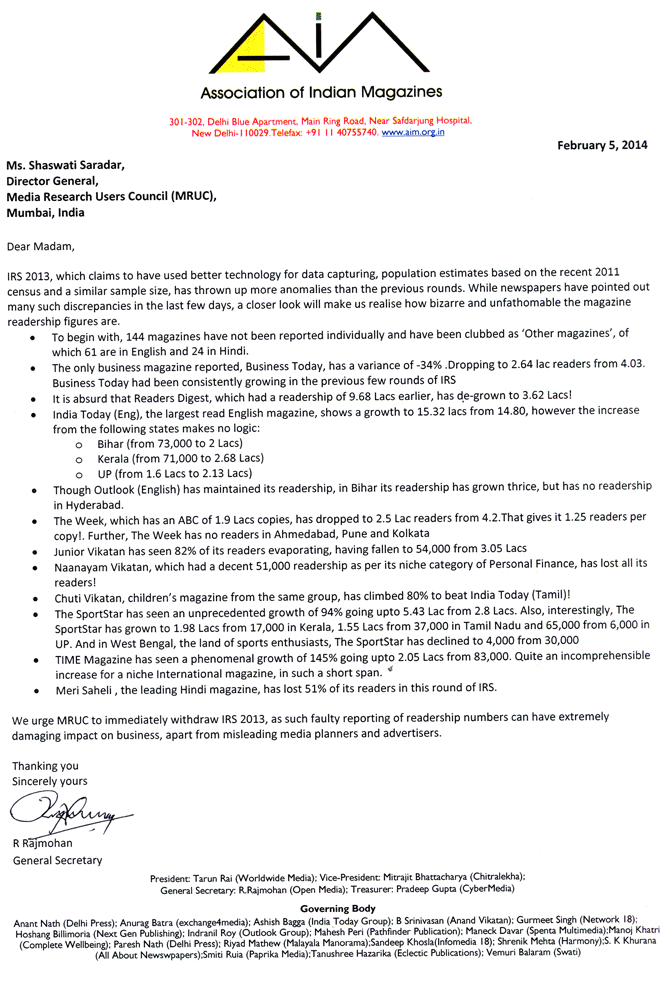
    “IRS 2013, which claims to have used better technology for data capturing, population estimates based on the recent 2011 census and a similar sample size, has thrown up more anomalies than the previous rounds. While newspapers have pointed out many such discrepancies in the last few days, a closer look will make us realise how bizarre and unfathomable the magazine readership figures are.


    To begin with, 144 magazines have not been reported individually and have been clubbed as ‘Other magazines’, of which 61 are in English and 24 in Hindi.


    > The only business magazine reported, Business Today, has a variance of -34% .Dropping to 2.64 lac readers from 4.03. Business Today had been consistently growing in the previous few rounds of IRS


    > It is absurd that Readers Digest, which had a readership of 9.68 Lacs earlier, has de-grown to 3.62 Lacs!


    > India Today (Eng), the largest read English magazine, shows a growth to 15.32 lacs from 14.80, however the increase from the following states makes no logic:


    o Bihar (from 73,000 to 2 Lacs)

    o Kerala (from 71,000 to 2.68 Lacs)

    o UP (from 1.6 Lacs to 2.13 Lacs)


    > Though Outlook (English) has maintained its readership, in Bihar its readership has grown thrice, but has no readership in Hyderabad.


    > The Week, which has an ABC of 1.9 Lacs copies, has dropped to 2.5 Lac readers from 4.2.That gives it 1.25 readers per copy!. Further, The Week has no readers in Ahmedabad, Pune and Kolkata


    > Junior Vikatan has seen 82% of its readers evaporating, having fallen to 54,000 from 3.05 Lacs


    > Naanayam Vikatan, which had a decent 51,000 readership as per its niche category of Personal Finance, has lost all its readers!


    > Chuti Vikatan, children’s magazine from the same group, has climbed 80% to beat India Today (Tamil)!


    > The SportStar has seen an unprecedented growth of 94% going upto 5.43 Lac from 2.8 Lacs. Also, interestingly, The SportStar has grown to 1.98 Lacs from 17,000 in Kerala, 1.55 Lacs from 37,000 in Tamil Nadu and 65,000 from 6,000 in UP. And in West Bengal, the land of sports enthusiasts, The SportStar has declined to 4,000 from 30,000


    > TIME Magazine has seen a phenomenal growth of 145% going upto 2.05 Lacs from 83,000. Quite an incomprehendable increase for a niche International magazine, in such a short span.


    > Meri Saheli , the leading Hindi magazine, has lost 51% of its readers in this round of IRS.


    We urge MRUC to immediately withdraw IRS 2013, as such faulty reporting of readership numbers can have extremely damaging impact on business, apart from misleading media planners and advertisers. ”


  • AIM’s Magazine Engagement Study wins big at FIPP Research Awards

    By A Correspondent


    The Engagement Study by the Association of Indian Magazines (AIM), the apex association of the Indian magazine trade, has won the Highly Commended Award for Best Research By Any National Association at the FIPP Research Awards 2012. In a ceremony that took place in London, on May 29, AIM was presented the citation by Chris Llewellyn, President and CEO of FIPP and Kathi Love, President and CEO of US market research company GfK MRI, the sponsors of the Awards dinner. The overall winner for the category was the entry by the Spanish Association.


    Commenting on why the survey received a Highly Commended Award, Mr Llewellyn said “The Research Award judges were impressed by the insights provided by the survey, and the technical excellence of its methodology. The survey has demonstrated the key underlying strengths of the magazine medium, strengths which explain why magazines are such an effective medium for advertisers. The judges felt that the survey deserved the international recognition it is receiving.”


    Meanwhile, it is learnt that information from the Engagement Study has been included in the forthcoming book ‘Proof of Performance: The Case for Magazine Media’, and an action code in the book will enable readers to play the video on their smartphones. The book is authored by Guy Consterdine, Research Consultant to FIPP.