Tag: Adspend

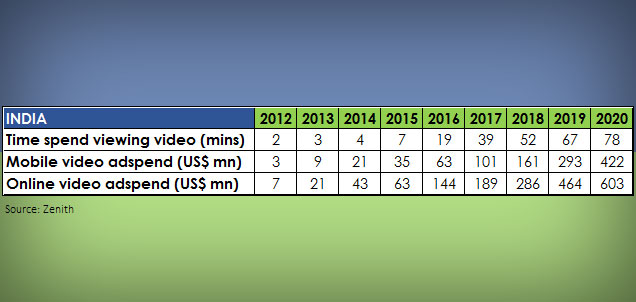
  • Online video viewing in India to leapfrog to 52mins/day in 2018


    By A Correspondent


    Online video viewing will leapfrog to 52mins a day in 2018 from a lowly 39 minutes in 2017, report media agency network Zenith.Global consumers will spend an average of 67 minutes a day watching online video this year, up from 56 minutes last year, according to Zenith’s Online Video Forecasts 2018, published today. By 2020 the average person will be spending 84 minutes a day watching videos online. In that year, China will have the keenest viewers, with the average person spending 105 minutes a day watching online video, followed by Russia (102 minutes) and the UK (101 minutes). This rapid rise in consumption is leading to a shift in the way brands plan campaigns across both television and online video. India-specific numbers are in the table above.


    This is the fourth edition of Zenith’s annual Online Video Forecasts report. It contains historical data and forecasts of online video consumption and advertising, together with commentaries on the development of individual markets by local experts. This year’s edition covers 59 key markets. By online video we mean all video content viewed over an internet connection, including broadcaster-owned platforms such as Hulu, ‘over-the-top’ subscription services like Netflix, video-sharing sites, e.g. YouTube, and videos viewed on social media.


    Global online video consumption grew by 11 minutes a day in 2017, and we expect it to grow by an average of 9 minutes a day each year to 2020. It accounts for almost all the growth in total internet use, and is growing faster than media consumption overall, so it is taking consumption time from traditional media. Although some of this extra viewing is going to non-commercial platforms such as Amazon Prime and Netflix, plenty of it is going to commercial platforms, so the supply of commercial audiences is rising rapidly.


    Zenith estimates that online video adspend grew 20% in 2017, to reach US$27bn. Growth peaked at 36% in 2014 and has fallen steadily since then, but still remains very high. “We forecast 19% growth in 2018, and an average of 17% annual growth to 2020, when online video adspend will reach US$43bn. Video’s share of online display advertising is rising steadily: it accounted for 27% of display adspend in 2017, and we expect it to account for 30% in 2020,” the report notes.


    More from the report:

    The supply of online video audiences has been growing ahead of demand in recent years: online video viewing grew 91% between 2015 and 2017, while adspend grew 52%. The cost of online video advertising has therefore come down substantially. As the growth of video consumption grows we expect prices to stabilise, with mild increases from 2019 onwards.


    Online video advertising is still only a fraction of the size of television advertising, but because television is stuck at 0% to 2% annual growth, this fraction is rising rapidly. The online video ad market was 10% of the size of the television ad market in 2015, and 14% in 2017. By 2020 we expect online video adspend to be 23% of the size of television adspend.


    Online video and television complement each other well, with most brands initially using online video to add incremental reach to their existing television campaigns. But with the rapid growth of online viewing we are now seeing more brands plan television and online video together to optimise frequency.By cutting out television spots that lead to very frequent exposure among heavy television viewers, andusing online video to target – and retarget – light television viewers, brands are using television and online video together to cut out both overexposure and underexposure within the target audience, maximising recall at a reduced price.


    Online video advertising began by emulating television advertising, with most ads appearing within other video content that the viewers were really interested in as interruptive ‘in-stream’ ads. But over the past few years ‘out-stream’ ads have become common. These are stand-alone video ads that appear within text or images, or within a social news feed. Thanks mainly to the rapid adoption of video content and advertising by social media platforms, out-stream video is rapidly becoming the dominant form of online video advertising. In the UK, for example, it overtook in-stream advertising to account for 56% of online video adspend in 2017. This is changing the structure of online video creative. Because a viewer can simply scroll past them, out-stream ads need to grab the viewer’s attention from the very first second, either with an arresting image or with a celebrity with a dedicated following. They do not have the narrative leeway available to interruptive ads.


    “Online video is driving growth in global media consumption, as smartphones with high-speed data connections make high-quality video available to people on the move, and smart TV sets give viewers unparalleled choice in the living room,” said Jonathan Barnard, Zenith’s Head of Forecasting and Director of Global Intelligence. “The rapid rise in video viewing makes online video the world fastest-growing advertising format, creating new strategic and creative opportunities. Brands that do not currently have a strategy for online video need to think about getting one.”


  • Indian adspends to increase 13.4% as global spends to slow next year: Warc


    By A Correspondent


    India is expected to see the strongest annual rise in adspend this year, up 13.3%, with a similar rate of growth anticipated next year (13.4%).  The latest Consensus Ad Forecast from Warc, the marketing intelligence service, indicates that global advertising spend will rise by 4.5% during 2016 as a whole, before the growth rate slows to 4.2% in 2017.  With the exception of newspapers and magazines, all major media channels are expected to record adspend growth this year and next. However, the two largest, TV (+1.1%) and internet (+13.0%) are forecast to see their growth rate ease during 2017. The same is true for mobile, though it is still set to be the fastest-growing ad channel over the period.


    Warc’s Consensus Ad Forecast is based on a weighted average of adspend predictions at current prices from ad agencies, media monitoring companies, analysts, Warc’s own team and other industry bodies. Current sources include Carat, eMarketer, GroupM, Magna Global, Nikkei Advertising Research Institute (NARI), Pitch-Madison, Pivotal Research Group and ZenithOptimedia.


    All 13 markets covered in the report are forecast to see the amount invested in advertising rise both this year and next, though for eight of these the growth rate will be softer in 2017.


    The world’s largest ad market, the US, is expected to post adspend growth of 5.1% this year – buoyed by the presidential election campaigns and the Rio Olympics. US adspend growth is then forecast to cool next year – rising by 2.8% – as the impact of these events is lost.


    Adspend growth by country


    2016 vs 2015 year-on-year % change 2017 vs 2016year-on-year % change
    India 13.3 13.4
    China 7.8 7.1
    Russia 5.8 6.1
    Spain 5.8 5.2
    UK 5.6 4.3
    US 5.1 2.8
    Australia 3.8 3.8
    Brazil 3.3 2.1
    Italy 2.8 1.6
    Germany 2.1 1.8
    Canada 2.0 2.4
    Japan 1.7 1.7
    France 1.3 0.8
    Global 4.5 4.2

    Source: Warc’s Consensus Ad Forecast, November 2016 (www.warc.com)


    Despite the uncertainty surrounding the “Brexit” process by which the UK will leave the European Union in 2017, the nation’s ad market is forecast to record adspend growth of 5.6% this year and 4.3% next; both above the global respective rates.


    All four BRIC markets, India (+13.4%), China (+7.1%), Russia (+6.1%) and Brazil (+2.1%), are expected to post rises in ad expenditure this year and next. France is forecast to record muted growth of +0.8% in 2017, the softest rate of the 13 markets studied.


    All media, barring newspapers and magazines, are predicted to record year-on-year growth in 2017, with mobile expected to see the greatest adspend rise, up 34.2%. Total internet (including mobile) growth is expected to be 13.0% next year, while TV, the world’s largest ad channel by spend, is forecast to post growth of 1.1%.


    Global adspend growth by medium


    2016 vs 2015 
    year-on-year % change

    2017 vs 2016
    year-on-year % change

    Mobile

    47.1

    34.2

    Internet

    14.6

    13.0

    Out of home

    3.4

    3.2

    Cinema

    3.1

    5.1

    TV

    2.8

    1.1

    Radio

    0.4

    0.3

    Magazines

    -5.9

    -4.5

    Newspapers

    -8.0

    -6.1

    Source: Warc’s Consensus Ad Forecast, November 2016 (www.warc.com)


    Said James McDonald, Senior Research Analyst at Warc: “The latest consensus results present a positive outlook for advertising investment at both a global and local level. All 13 markets studied are expected to record adspend growth in the short term, and this despite their contrasting socio-economic environments.”


    “We have identified a common trend among more mature markets whereby increasing investment in internet – particularly mobile – ad formats is driving headline growth. Applying consensus trends to Warc’s adspend data shows that mobile will grow to be the world’s third-largest ad channel by the end of 2016.”


    Indian adspend growth by medium


    2016 vs 2015
    year-on-year % change

    2017 vs 2016
    year-on-year % change

    Mobile

    62.9

    56.9

    Internet

    32.7

    32.7

    Out of home

    10.6

    10.3

    Cinema

    18.2

    15.6

    TV

    12.9

    12.2

    Radio

    12.8

    15.8

    Magazines

    -1.3

    -2.3

    Newspapers

    10.3

    9.6

    Source: Warc’s Consensus Ad Forecast, November 2016 (www.warc.com)


  • Adspend to grow 9.6% in 2015: Madison


    By Labonita Ghosh


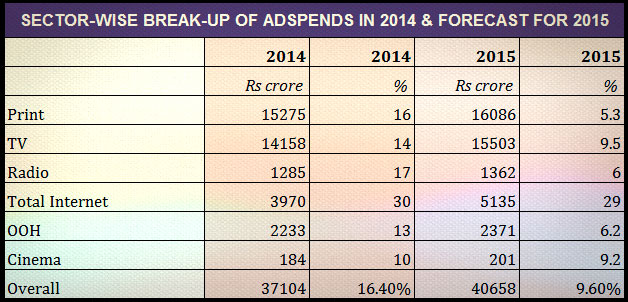
    The advertising industry is likely to grow 9.6 per cent this year, says the Pitch Madison Advertising Outlook Report 2015 released last Friday. While this looks like a tepid sequel to a blockbuster year – in 2014, the industry grew by a whopping 16.4% – the forecast is not without promises. For one, the slight uptick takes the total advertising market to Rs. 40,658 crore by end of 2015, from Rs 37,103 crore last year. Last year’s spurt was largely because of the spend on the Lok Sabha and some Assembly elections, says Sam Balsara, CMD of Madison World, which put the report together along with Pitch magazine. “The projection for 2015 is bullish, though tempered by the fact that this is not an election year,” says Mr Balsara. “There are other options, like the World Cup, the continued aggressive push by e-commerce companies, the launch of new channels and the emergence of new advertisers and new brands.”


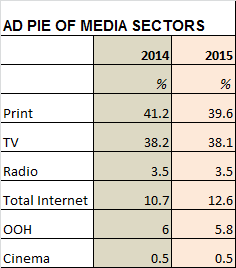
    Among the more significant findings, print media continues to be the largest sector in advertising, and is expected to grab a 40% share this year. Brand advertising in print is likely to exceed Rs 16,000 crore. TV is next in line, and expected to touch Rs 15,500 crore. Digital, which has grown phenomenally in the last five years, is now larger than Outdoor, Cinema and Radio put together, will corner 12.6% of the market.


    The report finds that the FMCG sector, which has always been a dominant player on TV (contributing over 50%) is now also the largest contributor to print media for a second successive year. Though this contribution is just 13%. “Projections for the FMCG sector appear rosy, which is heartening,” says GK Suresh, Head of Marketing (Foods Division) at ITC, adding: “If this continues, I don’t see any reason media spends should not keep increasing as well. This provides a lot of confidence to manufacturers to launch new products, and companies to invest more in existing brands. I think the report forecast is fairly accurate; perhaps even a little conservative when it comes to FMCG.” While the print market constitutes many categories, FMCG, auto, education and real estate together contribute 43% of the total. For TV, the big players are telecom, digital, e-commerce and auto.


    “I would’ve expected FMCG spends in print to grow more rapidly,” adds Mr Suresh, “mainly because it offers many more opportunities to sharp-focus your advertising, and has less wastage than TV. But we in FMCG are really struggling with digital media right now. Everybody knows it’s growing and we need to be out there, but many of us are using it as just another medium.”


    According to Piyush Mathur, President, Nielsen India, the 9.6 % projection, close to a double-digit growth, is a realistic one. “A lot is riding on e-commerce, which is at an early stage and that means a lot will happen in 2015 and 2016,” he says. “As e-commerce companies get bigger valuations, there will be more spending on advertising.”


    Still, there are a few things advertisers need to do differently, says Mr Balsara. According to him, they should focus on effectiveness, and not just on efficiency, while always keeping in mind that the reason they advertise, is to increase their brand parameters. “I have seen marketing teams to be painfully slow on certain media decisions,” he adds. “We often suffer from analysis-paralysis.” Mr Balsara says most brands fail to take full advantage of what the media has to offer by under-resourcing their campaigns. “They will be well advised to focus on fewer brands of theirs, ignore some brands and advertise those few brands heavily,” he adds. “A corollary to this is that since budgets are often limited by P/L considerations, you need to prioritise markets sharply. Spend and exposure in Priority One markets should be at least three times that of Priority Three markets. Otherwise prioritisation is meaningless, and only remains in the hands of the brand manager.” Worryingly, Mr Balsara says he also finds that as media spends get larger and larger, media decisions get taken at lower levels. “These require greater involvement of the corner-room,” he says, and more participation by senior media agency leaders.


    This story first appeared in ‘dna of brands’ issued dated Febuary 23, 2015