Tag: AdEx India

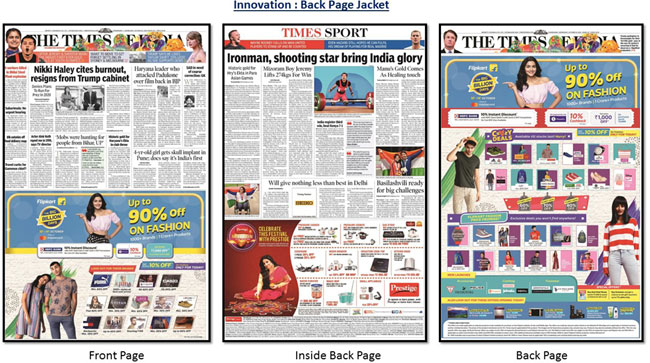
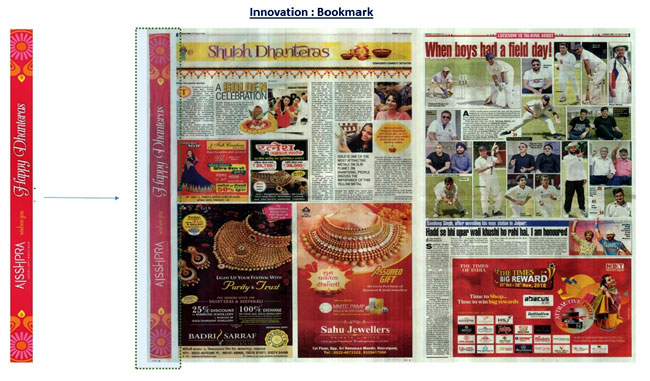
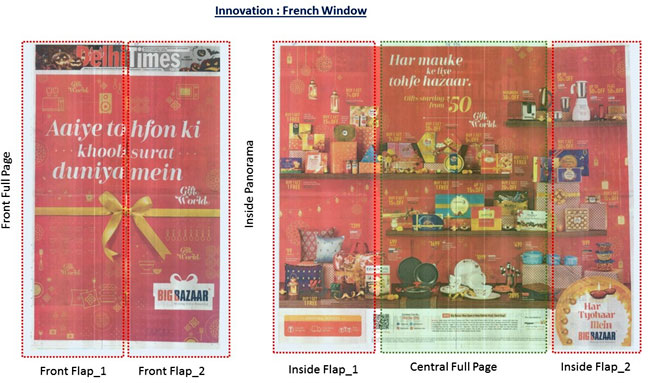
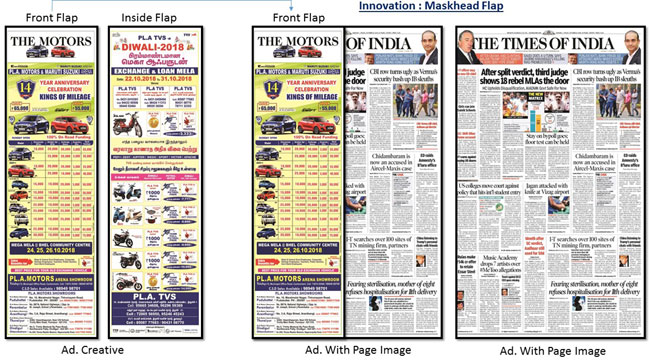
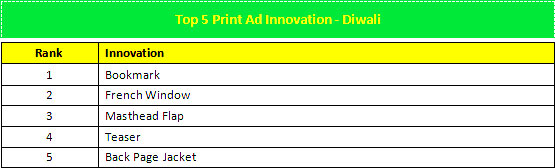
  • Top 5 Print Advertisement Layout Innovations – Diwali 2018: AdEx India

    By A Correspondent


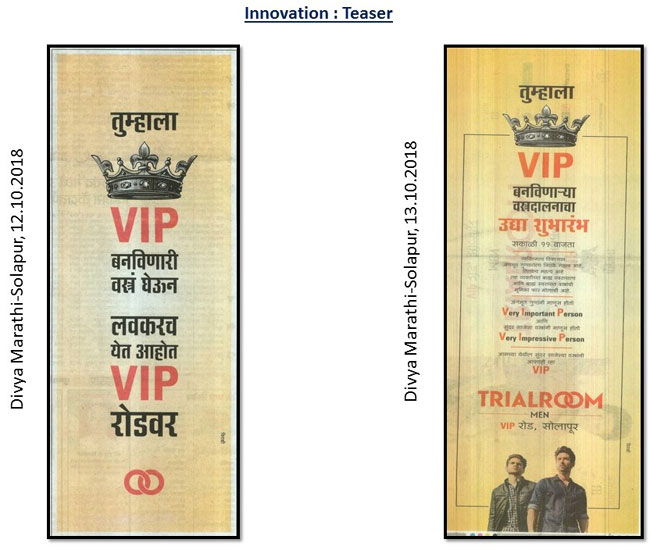
    Diwali every year offers an excellent opportunity for advertisers to innovate in newspapers for their advertisements. While front-page jackets are still very popular, there’s a lot more that was tried and tested this year.


    We got this data from AdEx India, a division of TAM Media Research. The media is print, and the period is October 1 to November 5, 2018.


    Note: the Ranking is based on percentage share.


  • Mind the TV AdEx Gap!


    By Indrani Sen


    For two consecutive years, TYNY by GroupM and PMAO by Madison were released during the same week, giving the industry lot of food for thought and facts and figures to chew and digest. TYNY or ‘This Year Next Year’ closed the estimate for total AdEx 2017 at Rs 61,263 crore with a growth rate of 10% over 2016, while PMAO or ‘Pitch Madison Advertising Outlook’ showed a growth rate of 7.4% in 2017 over 2016 and estimated the total AdEx as Rs 53,138 crore.

    After a year of stagnation and stunted growth in 2017, mostly due to the after effect of Demonetisation and Goods & Services Tax (GST),both the reports predict a better year in 2018 with a growth of total AdEx by 13% and 12% respectively.

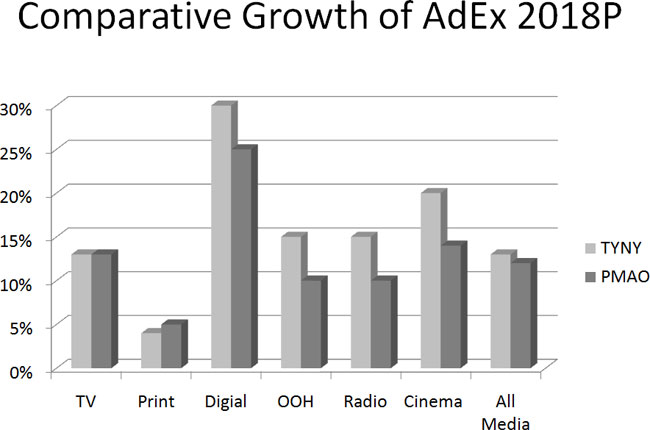
    According to both the reports, Digital is going to have the highest growth in AdEx in 2018, 30% according to TYNY and 25% according to PMAO. Both reports predict 13% growth in TV AdEx and 4% (TYNY) and 5% (PMAO)in Print AdEx. Both agree that the highest growth after Digital will be achieved by Cinema (20% TYNY & 14% PMAO) which has the smallest share of the advertising pie. Both have shown same percentile growth rates for OOH and Radio (15% TYNY & 10% PMAO).

    The chart below shows that PMAO’s estimates for growth for all media, except TV and Print, are more conservative than TYNY.


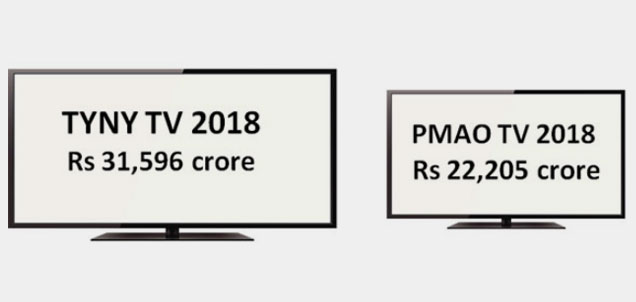
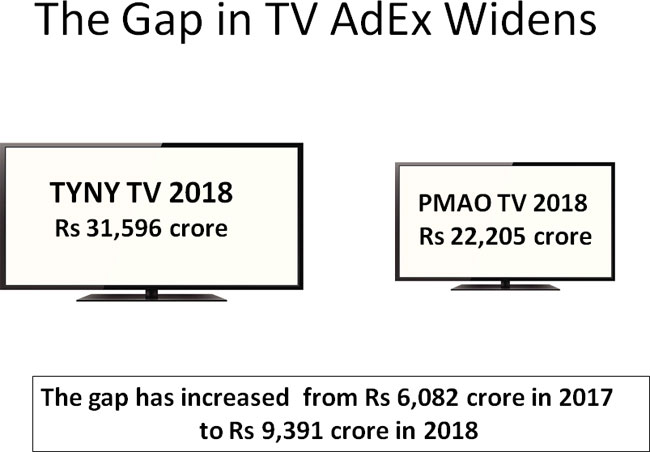
    In my analysis of the two reports last year (http://www.mxmindia.com/2017/02/what-is-the-real-size-of-indian-ad-industry/), I found a difference of around Rs 5000 crore between the two projections made by TYNY and PMAO for all media in 2017. The difference was mainly due to the disagreement between the projections for TVAdEx in the two reports with GroupM’s projection being almost Rs 6000 crorehigher than PMAO’s.

    In the projections for 2018, the gap in the all media AdEx between the two reports has widened to almost Rs10,000 crore with TYNY predicting the total industry size as Rs 69,347 crore and PMAO predicting it as Rs 59,530 crore. As seen last year, most of this difference is due to the Rs 9,391cr difference in the projections of TV AdEx shown in the two reports.


    Unless this widening gap in TV AdEx is reviewed by both the agencies and explained to the industry at large, it would become increasingly difficult for the A&M industry to assess the actual size of the TV AdEx. I think there must be a difference in the methodology followed by the two agencies for estimating TV AdEx which results in the different estimates.

    On behalf of the A&M fraternity, I appeal to both GroupM and Madison for a clarification so that we have a better perspective and understanding about growth of Indian advertising by media over the years.

    Indrani Sen is a veteran advertising professional and is now Adjunct Professor with the Symbiosis International University, Pune. The views here are her own


  • AdEx on all media drops much in Nov 2017 (vis-a-vis Oct)


    By A Correspondent


    Every week, MxMIndia in partnership with TAM AdEx brings you a scan of advertising expenditure across print, television and radio in various categories. And on a monthly basis, we bring you a view on how the adspends have been for a calendar month vis-à-vis the previous calendar month.


    October this year was particularly bad for television, though not as bad for print. But, in November, after the frenzy of the festive season, the drop is significant for print too.


    The data we bring you above and below is hence of particular interest:


  • AdEx to grow 12.1% in 2018: IPG Mediabrands


    By A Correspondent

    India ​will ​be a ​Rs ​1 t​rillion​ advertising market by 2022 India has waned through the lingering impact of currency exchange in November 2016 and pass through effect of unified tax structure in July this year​, notes IPG Mediabrands.​


    Transitory costs for introducing bold structural reforms have been paid and upswing in economic activity is strengthening. The bank recapitali​s​ation plan coupled with insolvency and bankruptcy code 2016 revives the sector and this will boost private investment. Revival in rural economy and growing middle class will boost economic growth. GDP in real terms is expected to grow +6.7% a speck slower than earlier projected +7.17%. In 2018 IMF report predicts growth of +7.4%.


    Advertising revenue will grow at CAGR of +12.1% in the next five years to touch INR 1.07 tn. Growth will be led by digital with +21.6%. Television will still rule the top as the largest media in 2022 with a market share of 41%. Digital and Print will have equal share of 25%. Mobile will displace desktop as the 3rd largest category by 2020.


    United States and China contribute close to 50% of the incremental ad dollars between 2018 and 2022 while India ranks third with a 6% contribution. The traditional categories like Print are so strong and growing YOY in India that over 60% of this incremental dollars is coming from traditional categories.


    The ​estimated Adex growth rate of +11.5% ​made ​earlier in June ​2017 ​has been revised marginally downwards to +11.1%. In 2018, ​IPG Mediabrands expect​s​ the Adspends to grow +12.1%. Categories driving up spends next year will be:-

    AUTO enjoys a strong domestic demand due to rising income, rising middleclass and a young population. Demand for commercial vehicles due to heightened infrastructure activity and government’s focus on electric vehicles to meet emission targets are some of the growth drivers.

    FMCG penetration will increase with modern trade growing faster in Tier-II and Tier-III cities. Raising disposable income among rural consumers, E-commerce strengthening their offering with daily products, evolving consumer lifestyle and government FDI policy is infusing growth.

    BANKING demand will raise thanks to increase in working population. Housing and Personal finance are key drivers. Government’s financial inclusion plan is expanding the reach of banking services and insurance coverage to rural segment.

    CONSUMER DURABLES demand will grow with rural electrification and e-commerce expansion.

    E-COMMERCE growth is propelled by increasing smartphone penetration, digital literacy combined with affordable data costs. GST will help E-commerce players to streamline supply chain and eliminate dual taxes. The sector is attracting more users from Tier-II and Tier-III cities.


    Net Advertising Revenues by category (​Rs Cr Net)


    Net Advertising Revenues: 2018-2022 (​Rs bn Net)


    Net Advertising Revenues:Top 10 markets (​USD Bn)


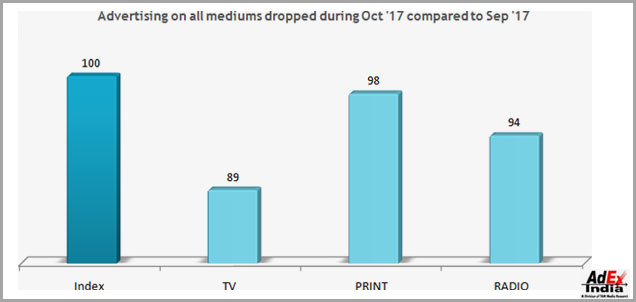
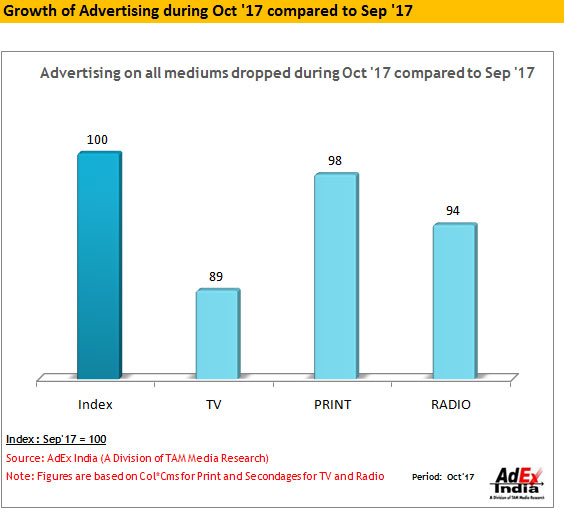
  • AdEx on all media drops in Oct 2017 (vis-à-vis Sep)

    Index : Sep’17 = 100
    Source: AdEx India (A Division of TAM Media Research)
    Note: Figures are based on Col*Cms for Print and Secondages for TV and Radio
    Period: Oct’17


    By A Correspondent


    Every week, MxMIndia in partnership with TAM AdEx brings you a scan of advertising expenditure across print, television and radio in various categories. And on a monthly basis, we bring you a view on how the adspends have been for a calendar month vis-à-vis the previous calendar month.


    October this year was all-important given that Diwali was on Oct 19, and before that we saw the frenzy towards shopping and sales.


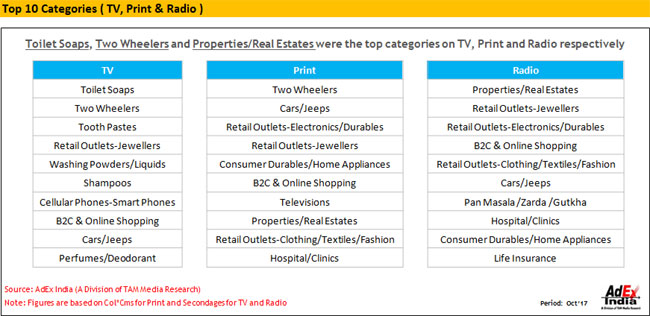
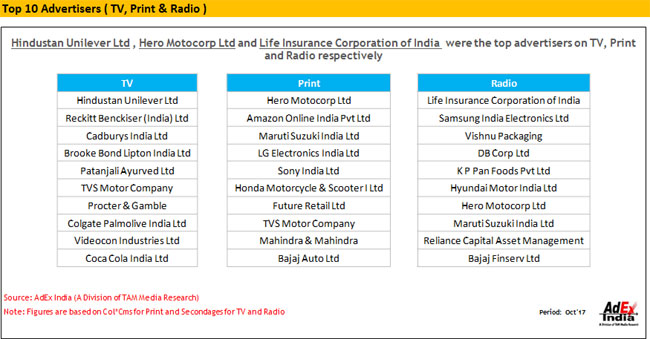
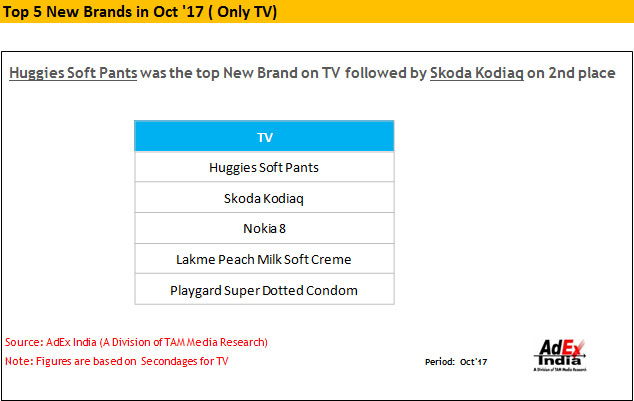
    The data we bring you below is hence of particular interest:

  • Exclusive! BARC in talks to buy TAM?


    By A Correspondent


    Entertainment television is all about twists and turn in the fictional serials. Cricket, as you would’ve heard several times over, is a game of glorious uncertainties. So why then should there be surprise over the possibility of BARC buying up TAM.

    Okay, let’s cut the tease. Broadcast Audience Research Council (BARC) has indeed been in discussions to buy the television audience measurement business of TAM, the firm jointly owned by WPP’s Kantar Media Research and Nielsen. And, yes, it’s March 12 today, not April 1.

    According to reasonably reliable sources, there have been a detailed dialogue between the joint industry body-managed BARC and TAM owners Kantar and Nielsen. The talks haven’t concluded yet and the mid-point formula that was suggested by a WPP representative has been reportedly rejected by BARC bosses.

    Both BARC and TAM were unavailable for comment, but from what one learns, BARC was seriously considering the buy.

    So why gobble up TAM when the audience research measurement activity of the measurement body was under question? Well, even as doubts were being raised, there is no denying that broadcasters, advertisers and media agency use TAM as the currency for their buying decisions. Also, as industry analyst told us, TAM comes with a ready 12,000-odd panel, established processes and teams and archival data.

    And from TAM’s point of view, why sell out to BARC? Given that all stakeholders have contributed to the BARC kitty, it’s evident that sooner or later all TAM subscribers will exit the system or want to renegotiate. Given this, it’s best to sell the existing well-oiled measurement machinery to BARC which would find it of use, said the analyst we spoke to earlier.

    TAM has already made it known to subscribers (and the media) that it will continue operations even as there is a significant number (in billings at least) of subscribers who have said they would like to unsubscribe. If TAM continues to exist, there will be several comparisons made with the new measurement system, and those subscribers who may be rated poorly by the BARC system vis-a-vis TAM may quote the latter. This could even lead to advertisers questioning the BARC data and hence cause a confusion in the marketplace.

    As reported on MxMIndia earlier, the ghost of the Indian Readership Survey has raised anxiety levels in the industry. For, MRUC and RSCI, the bodies running IRS are jointly run and owned by various stakeholders in the industry. And despite it being an industry association, print players are up in arms against the new IRS.

    BARC, meanwhile, is said to be only in the discussion with the television audience measurement business of TAM. Other divisions such as the Strategy or S Group which offers advisory service on measurement, AdEx India, RAM for radio audience measurement, Eikona for measurement of earned media and PR activity and TAM Sports, which offers special analysis of sports ROI will not be part of the deal if it goes through.

    So where do things stand now? At the time of writing, the talks have been suspended. But as the date approaches for the launch of the system, and the stakes for both BARC and TAM grow higher, the deal could well be inked. Like on television, be ready for the climax.
     

  • TAM’s AdEx to certify ad spots for Amagi

    By A Correspondent


    Amagi has announced that its ad spots will be certified by AdEx India, a division of TAM Media Research. AdEx India is the country’s most prominent advertising monitoring and information unit. This arrangement has come into effect from 1st, February, 2015.


    The certification adds a new dimension to Amagi’s offering of geo-targeted advertisements on television. An endorsement of Amagi’s ad-spot reporting mechanisms, the certification will include proof of execution and time of delivery, which will be included in the company’s post-campaign report. The certification is currently specific to Zee TV ad-inventory purchased through Amagi.


    Speaking about the development, Amagi business head, LS Krishnan said, “The TAM-AdEx certification adds value and integrity to the reporting of our ad campaigns. This partnership will add not only add credibility but also ensure transparency to the ad play-out process, a realignment which media planners have been waiting eagerly for. A first-of-its-kind certification for India’s geo-targeted TV advertising industry, this will help accelerate the adoption of geo-targeting by advertisers. This substantiates our commitment to a value-driven and effective advertising service. As a pioneer in this industry, we see it as our responsibility to grow the world of targeted advertising in India and this is a big step in that direction.”


    Amagi’s geo-targeting will help media planners, marketers and advertisers across the country plan their budgets more effectively. It also gives agencies the opportunity to offer specific, result-oriented campaigns to their clients across sectors.  Furthermore, the TAM-AdEx certification ensures that media planners can now be absolutely certain about their reporting for geo-targeted ad campaigns.


  • TV ad vol grew 12% in 2013, print up 6%


    By A Correspondent


    Various adspend numbers are already out as has the data come in from FICCI-KPMG.


    While there has been a lot of text in various studies, let the hard numbers do the talking. This is courtesy of TAM Media Research whose AdEx India division painstakingly computes data for ad volumes for the television and print sectors, amongst others.


    Note: the analysis is based on ad duration in seconds for television and CCMs for print.


    So here are the top findings in near-140 characters.


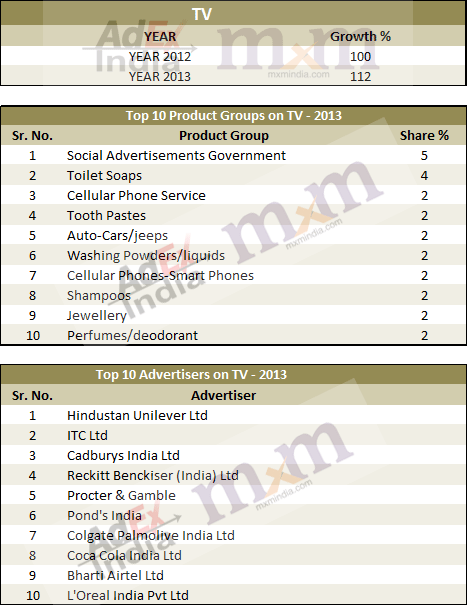
    1. The TV Ad Volume grew by 12 percent in 2013 vis-a-vis 10 percent in 2012.


    2. In TV ads, the Biscuits and Fairness creams categories are out from the Top 10. Among advertisers on TV: Samsung and Marico out, Bharti Airtel is back and L’oreal is in


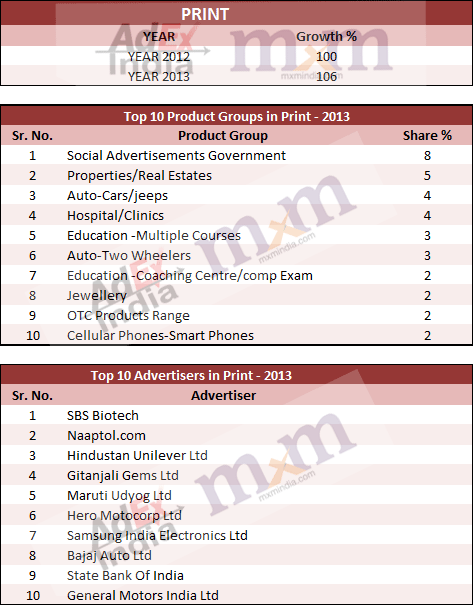
    3. The Print Ad volume grew 6 percent in 2013 vis-a-vis 9 percent in 2012.


    4. In Print ads, the B2C and online shopping category is out. OTC Products range and Cellular Phones and Smartphones are the two new product categories in the Top 10. In the list of advertisers, very interestingly, SBS Biotech the #1 was #9 last year, HUL was #8 last year… it’s #3 now.


    5. Last year’s report can be accessed at: http://www.mxmindia.com/2013/02/tam-adex-2012-tv-volumes-up-10-print-up-9/


    Source : TAM AdEx

    Medium : TV & Print

    Period : Jan – Dec 2012 & 2013

    Note: Analysis is based on Ad Volume in Seconds for TV and CCMs for Print


  • RAM releases the second Radio Listenership sweeps for 9 cities

    By A Correspondent


    RAM (Radio Audience Measurement) service, launched by TAM Media Research in 2007 for the radio industry, has released the second round of its 9 cities Listenership Sweeps. The first round was released in October 2012, along with the announcement of the news on RAM panel coverage expansion to 9 additional cities – Ahmedabad, Chennai, Hyderabad, Indore, Jaipur, Kanpur, Lucknow, Nagpur and Pune. Prior to that, RAM operated out of the four Indian metros – Bangalore, Delhi, Kolkata and Mumbai only.


    As planned and announced, the second sweeps data is for the period of February-April 2012. This sweeps, released by RAM, will help the radio industry: broadcasters & media planning agencies, to assess the impact that radio medium is having on audiences in towns other than the major metros.


    Commenting on this release, LV Krishnan, CEO said: “The second roll out is as per timelines committed by us. After the first sweeps in October last year, the second one shows interesting changes in radio consumption patterns. While in some markets, radio consumption base itself has seen an increase, in others, granular trends like Out Of Home (OOH) listenership has seen an encouraging increase.”


    RAM’s second sweeps highlights certain interesting changes in radio consumption behaviour, not only across the 9 cities, but also in comparison to the October 2011 sweeps release.


    Some highlights are:

    • Ahmedabad, Chennai & Hyderabad are the growth markets. Southern metros have seen more than 30 per cent growth in listening thresholds while Ahmedabad has witnessed 15 per cent growth
    • Pune,Kanpur,IndoreandNagpur, have remained almost the same levels as the previous round


    Ahmedabad:

    • Average audience has seen a significant increase in morning while other day parts, remained at the same level. The peak at 9am has grown by 70 per cent.
    • The increase in morning day part is due to 10 per cent growth in cume reach levels.
    • Share of Out of Home listening has grown significantly. Particularly during travel/conveyance with share of listening growing from 9 to 16 per cent
    • Cume reach levels have gone up across all the days, while Sunday has seen a significant growth
    • Time spent levels have seen a very marginal drop across the days. Sunday remains the day with highest time spent level
    • While 90 per cent of cume reach build up was achieved by afternoon earlier, now 95 per cent of the audience can be targeted by the morning day part alone at a weekly level


    Chennai:

    • While cume reach levels have dropped across all the day parts, time spent levels have significantly increased. The maximum increase in time spent being in the morning day part.
    • The audience build up has got spread through the day. It takes up to afternoon day part to cover 95 per cent of all audience.
    • Share of SEC C’s listening has grown from 37 per cent to 43 per cent
    • Share of in-home listenership grows from 76 per cent to 87 per cent
    • While Saturday had the highest listenership thresholds the previous round, Sunday has grown beyond Saturday in round 2 – both in terms of cume reach and time spent


    Nagpur:

    • The weekly listenership levels have remained at the same levels as the previous round
    • The daily cume reach has gone up, with Sunday being the maximum, but time spent levels are down across all the days.
    • Share of In-home listening grows from 82-87 per cent


    Jaipur:

    • Drop in listenership thresholds across the day
    • The same reflects in the cume reach levels across the day parts
    • Dominance of SECDE in Jaipur’s listenership contribution is normalized. Proportionate contribution from all SECs to listenership
    • Morning day part continues to be the one where listenership peaks, though at a lower threshold
    • Sunday emerges as the one with highest cume reach and time spent levels
    • The audience build up has got spread through the day. It takes up to afternoon day part to cover 95 per cent of all audience


    Indore:

    • The listenership peaks have interchanged between mid morning and morning, morning peak emerging as the highest. Other day parts are more or less are at the same threshold
    • At a weekly level, morning day part emerges as the highest in cume reach and time spent
    • Mid-morning day part saw a reduction cume reach levels.
    • TSL level growth in night day part
    • Share of In-home listening significantly drops from 94 per cent to 71 per cent. Maximum growth in Car share of listening at 22 per cent
    • Saturday loses audiences as Sunday emerges as the destination of maximum listening
    • Faster cume reach build up across the day as 95 per cent of the audiences are reached by the mid-morning day part


    Hyderabad:

    • Across the day parts TSL has almost doubled
    • Evening and night day parts have grown significantly while morning has witnessed a drop in listenership levels.
    • The drop in morning day part is primarily due to drop in cume reach levels, while TSL has grown.
    • Contribution from SEC A & B increases
    • 6 per cent drop in share of in-home listening, reflected in the growth of listening share from car/travel/conveyance
    • Equal and high threshold of listenership across weekdays and weekends
    • Evening and night day parts add significant amount of audiences to cume reach build up


    Pune:

    • Similar listenership thresholds across the day parts
    • Mid-morning to night, there is a drop in cume reach levels, but across the day parts there is a growth in TSL levels
    • Contribution from different places of listening remains the same
    • Sunday emerges as the destination of highest listenership
    • Audience addition from afternoon grows in the current year


    Lucknow:

    • Listenership thresholds drop across the day parts, while night primetime holds the thresholds
    • While there is cume reach growth in some of the day parts, there has been TSL drop across all of them
    • Share of listening from 35+ age group comes down
    • Contribution from in-home listening grows from 89 per cent to 93 per cent
    • Cumulative audience on Sunday grow from 82% to 94%
    • Weekdays and weekends have similar thresholds of TSL


    Kanpur:

    • Marginal changes in day part wise preferences
    • Growth in consumption share fromSECABand 45+ age group
    • OOH share of listening grows from 23 per cent to 29 per cent, majority of the growth coming from car/travel
    • Sunday emerges as the clear leader in listening thresholds


    TAM is a joint venture between Nielsen Company and Kantar Media Research. Besides measuring TV Viewership, TAM also monitors Advertising Expenditure of Television, Print & Radio through its division AdExIndia. Since 2004, it extended its presence in the PR Measurement & Analysis space for Corporate/Marketing Clients by setting up a separate division – Eikona PR Measurement.


    In 2007, the joint venture introduced RAM (Radio Audience Measurement) service to track Radio Listenership for the Indian Radio Broadcast Industry. In year 2009, TAM launched a division, called TAM Sports that specializes in monitoring Sports Sponsorship ROI.


  • ASCI is not a toothless tiger: Bharat Patel


    Bharat Patel

    By Robin Thomas


    The Advertising Standards Council of India (ASCI) has joined hands with TAM Media Research to introduce National Advertising Monitoring Service (NAMS) which will come into effect from May 1. The aim of the monitoring service is to reduce the number of misleading and unsubstantiated advertisements (see accompanying story: ‘Paradigm shift for self-regulation’). AdEx India, a division of TAM, will monitor around 350 televisions and 10,860 newspaper advertisements released every week.


    In conversation with MxMIndia, Mr Bharat Patel, former chairman of Procter & Gamble and Board Consultative Committee Member and also former Chairman of ASCI spoke about NAMS and its impact on consumer complaints. And that ASCI is not a toothless tiger!


    NAMS has been introduced shortly after the government asked ASCI to fast-track the decision-making process…

    Absolutely. In order to speed up decision-making, the CCC (Consumer Complaints Council) decided to meet twice every month from the earlier once a month meeting. This decision was made following the advice of Ms Ambika Soni, the Minister of Information and Broadcasting. We are open to receiving suggestions, and when the Ministry of Consumer Affairs pointed out that something needs to be done on the increasing number of consumer complaints, we decided to do monitoring and thus the introduction of National Advertising Monitoring Service (NAMS).


    And the discussion to set up NAMS?

    The discussion started over three or four months ago. We were in talks with a lot of people, including consumer organizations and we found that TAM has the best availability and resources for the service.


    There were reports of the government planning to launch its own version of advertising monitoring services to reduce consumer complaints…

    I don’t think it’s true because the Additional Secretary at the Ministry of Consumer Affairs denied any such move. So we don’t know how true this is but, the Ministry denied it at this stage. The I&B Ministry has been very supportive of the ASCI. They have, in fact, mentioned in their codes that any advertisement that violates the code of ASCI will not be allowed. The Consumer Affairs Ministry is also supportive of self regulation.


    What is your reaction on ASCI being called a toothless tiger? Will NAMS give ASCI more teeth in dealing with ads that violate ASCI code?

    Calling ASCI a toothless tiger is absolutely wrong.  Cable TV Act Rules state that no ad which violates ASCI’s code can be released on TV.  Nowhere in the world has such recognition of an advertising Self Regulatory Organisation (SRO) been granted by the Government. All the ads, against which a complaint is upheld by CCC, are modified or withdrawn voluntarily in writing by advertiser. In fact, the I&B Ministry sends all the complaints it receives to ASCI for adjudication. In print, nearly 80 per cent ads voluntarily comply with CCC rulings. So, how can ASCI be called toothless tiger? ASCI is not a toothless tiger!


    It has been 26 years since ASCI was established, what are the changes you think ASCI has brought to the minds of the consumers and the advertising industry?

    ASCI has increased awareness, atleast among its members who release 80 per cent of non-government advertising in India, on the need to have ads which are true, decent and fair to competition.  Consumers are also made more aware of ASCI as a service that can help remove ads which they find misleading or indecent or displaying unsafe practices. As a result, the total number of complaints to ASCI has increased from 770 in 2010/11 to about 2,000 in 2011/12.


    ‘Paradigm shift for self-regulation’


    I Venkat
    LV Krishnan

    According to the Advertising Standards Council of India’s agreement with TAM, AdEx India will identify ads which are potential violation of Chapter 1 of ASCI code – to ensure truthfulness and honesty of representation and claims made by advertisements against misleading advertisements. The advertisements that violate the ASCI advertising code will be forwarded to ASCI on a weekly basis, post which ASCI would process them as per its complaint redressal procedure involving its Consumer Complaints Council (CCC) for adjudication.


    AdEx India will monitor ads in the auto, banking, financial services and insurance, FMCG (including F&B), consumer durables, educational institutions, health care products and services, telecom and real estate sectors. AdEx will track more than 30 newspapers which is said to contribute over 80 per cent of national newspaper readership and all television channels across India in all languages.


    Said Mr I Venkat, Chairman, ASCI: “The National Advertising Monitoring Service or NAMS initiative is a paradigm shift for self-regulation in Indian advertising and probably a benchmark for the other countries. For such an important industry central initiative, TAM’s AdExIndiawas the obvious option to handle such a large responsibility that brought in requisite infrastructure, neutrality, integrity and quality.NAMSwill strengthen the ad self regulation redressal process manifold, as we will be able to proactively monitor wider number of ads. This will be in the best interest of the Indian consumers as it will significantly reduce release of misleading advertising in India.”


    Mr LV Krishnan, CEO, TAM Media Research said: “Apart from media measurement, for decades now, we have been playing a silent, yet central industry, role towards media (advertising) monitoring and analytics as well. Our partnership with ASCI is yet another reiteration of the neutral role we play within the Indian landscape.”