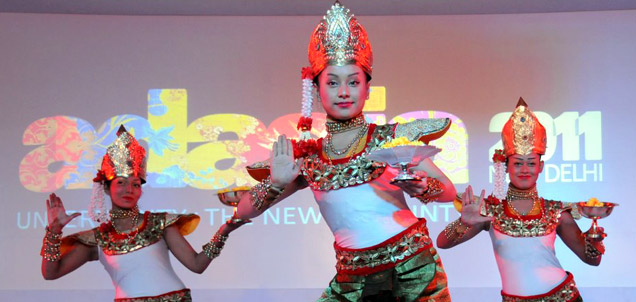
Tag: AdAsia

  • Ramesh Narayan presented AFAA Honorary Life Member Award

    By Our Staff


    Advertising agency veteran Ramesh Narayan was presented with the AFAA Honorary Life Member Award at the AdAsia Congress being currently held at Seoul Korea.


    The award was presented at the inaugural session of the AdAsia by Srinivasan Swamy, Chairman Asian Federation of Advertising Associations (AFAA) on October 25, 2023. With this Narayan becomes the only person to be presented all the three prestigious awards that AFAA presents every alternate year at the AdAsia.


    In 2015 he was presented the AFAA Special Merit Award at AdAsia Bali and in 2021, at AdAsia Macau he was inducted into the AFAA Hall of Fame.


    Said Swamy, “This award seeks to honour the enormous contribution Ramesh Narayan has made to AFAA and to the global advertising and marketing community.”


  • Sam Balsara to lead the Indian delegation to AdAsia ’23 Seoul

    By Our Staff


    Sam Balsara, head of the Indian-owned Madison World will be the Leader of the Indian Delegation to the AdAsia’23 at Seoul. The AdAsia, a property of the Asian Federation of Advertising Associations (AFAA) is scheduled from October 24th. to 26th. 2023.

    Sam Balsara is a veteran of many AdAsia’s.


    He has been honored by the Advertising Agencies Association of India (AAAI) with its Lifetime Achievement Award, and has been inducted into the International Advertising Association (IAA) India Chapter Hall of Fame as well as the Kolkata AdClub Hall of Fame.


    Said Balsara: “The AdAsia is the biggest event in Asia for the communications industry. There is considerable interest now since the last AdAsia that Indians could go for, was six years ago in Bali. The AdAsia’23 is an unmissable event for marketers, media and advertising professionals. I am confident that we will have a sizable delegation from India.”


    Adds Srinivasan K Swamy, Chairman of R K SWAMY HANSA Group, “I understand that the Korean Advertising industry and the AdAsia 2023 Seoul Organising Committee have taken special efforts to get speakers from several leading organisations across the world, in addition to leading companies in Korea like Samsung, Hyundai etc. Of course, we will also in for a treat to Korean culture and entertainment when we will get to see and hear more about K-Pop music, dance, and TV series.”


  • AdAsia 2021 Macao to be streamed on Dec 3

    By Our Staff


    The first day of the AdAsia Macao 2021 conference being held as a virtual event this year will be streamed into an event being planned for select invitees of the marcom industry on December 3.


    Srinivasan Swamy
    Srinivasan K Swamy

    Said Srinivasan Swamy, Vice Chairman Asian Federation of Advertising Associations (AFAA): “The first day at an AdAsia is eagerly looked forward to. This streaming would include the inaugural session with the awards ceremony, the keynote address by Mark Read Global CEO WPP and other interesting speeches and presentations, by leaders of industry like James Murphy Founder New Commercial Arts (previously founder of Adam&Eve DDB which was Cannes Lions Agency of the Decade), Rajeev Chaba, President and M.D. Morros Garage Motor India, Cynthia Lau Director of CruiSo Digital Solutions, Mann Lao Founder and Creative Director Chiii Design, to name a few. I am glad the Advertising Council of India has taken up this unique and useful initiative and I thank IAA India Chapter for having led this effort.”


    Locally, there will ba panel discussion featuring industry leaders like Megha Tata, MD- South Asia, Discovery Communications India & President IAA India Chapter; Pradeep Dwivedi, Group CEO & Executive Director, Eros International Media Ltd & Vice President IAA India Chapter; Sam Balsara, Chairman, Madison World; Anupriya Acharya, CEO- South Asia, Publicis Groupe & President-AAAI, who will discuss the relevance and implications of the keynote address on the Future of Marketing in a brave new world in the Indian context.”


    Megha Tata
    Megha Tata

    Adds Tata:”The AdAsia has always been known for its rich content and its great networking. Now, this hybrid effort combines the two features in a venue right here in Mumbai and we are inviting a select group of 100 marcom professionals.”


    Those interested in registering for this event can contact soumen/execseciaa@gmail.com. Entry is strictly restricted to registered invitees only.


  • What will Brahm say to this at the next AGM?


    He was more than just the Hawkins big boss. A great marketer with a keen sense of (and on) advertising. His contribution to the various industry associations has been huge, and will always be remembered by those who knew him. Brahm Vasudeva passed away late on Friday, July 10. He was Vice Chairman and Managing Director of Hawkins from 1968-84, Chairman and Managing Director from 1984 to 2006 then Non-Executive Chairman. Our ‘Namaste’ to him.


    We carry here tributes by senior industrypersons Arvind Sharma, Ramesh Narayan, Narendra Ambwani and Jayesh Ravindranath.


    Brahm Vasudeva, RIP

    By Arvind Sharma
     

    On July 10 afternoon, many industry WhatsApp groups started sharing the news of Mr Brahm Vasudeva’s passing away. He was eighty-four years old.


    This sad news got me reflecting. About Brahm and about me.


    When I joined the advertising industry in my early 20s, a handful of large consumer marketing companies wielded enormous clout in the industry. That is true to a degree even today. However, what was strikingly different in that era of nascent consumer marketing was the influence a few individual consumer marketers exerted on the industry. They punched far above the weight their revenues or their marketing budgets should have given them. The position they commanded in the industry came from their intellectual caliber.


    Brahm was one such individual.


    He used the might of his intellect to change consumers’ lives for the better. His pressure cookers liberated Indian housewives from hours of sweaty drudgery in the kitchen. He constantly innovated- in products, distribution and marketing. Pressure cookers on EMIs, I’m told, was one his category penetration driving ideas. Of course, he built a very successful business in the process. But what many of us admired him most for were his enduring contributions in moving the industry forward on a number of fronts.


    We live in an era where we get agitated about our leaders bending the truth. And that is the way it should be. But can you imagine an era where there was no way of knowing the truth! Or no agreement on how to go about discovering the truth!!


    Brahm pushed on so many industry fronts to change that.


    As a major voice at the Indian Society of Advertisers, he demanded that media should charge for exactly what it delivered based on precise measurements. Whether the measurement was in terms of column centimeters of ads actually printed or in terms of opportunities to see delivered. His sessions with his agencies with piles of newspapers to measure the exact sizes of ads seemed quirky to many. But his insightful and counter-intuitive-to-many stance that for dependable media measurement, advertisers and advertising agencies must contribute their share of measurement costs has been proven right over time. It is now the bedrock principle underlying two major media measurement institutions in the country- Media Research Users’ Council and Broadcast Audience Research Council. Among others, they provide measurement on two of the most important media in the country- Print and TV.


    While being a champion of freedom of commercial speech, Brahm understood and advocated that as industry consisting of advertisers, ad agencies, media and associated advisory firms, we must self-regulate ourselves and our content. Otherwise somebody else will. He was one of the moving spirits behind creation of the Advertising Standards Council of India. He was actually the pen that wrote ASCI’s code of conduct. In 1985, in mere 3500 words, he wrote the principles that define good advertising. Those principles hold good even today-after 50 years of rapid change.


    The four pillars of these principles are taught in every advertising class in India today


    # Truthfulness and honesty in claims

    # Non-offensiveness to the public

    # Against harmful products & situations

    # Fairness in competition


    Brahm selflessly championed these and many other ideas he believed were good for the industry while he was in office at these institutions. And for decades after that at every possible opportunity. And long after he had physically left these boardrooms, the force of his thinking has continued to guide them with a simple question, repeated often: “What will Brahm say to this at the next AGM?”


    Brahm will not be there anymore at the AGMs of these institutions. And the truth is that he has not been there at most of them for the last few years. But the question, ‘What will Brahm say to this at the next AGM?’ has become such a habit with the industry that it has continued to echo in the boardrooms. It is the industry’s way of internalising the ideas and principles of a man who shaped its past and will continue to influence its future.


    About a decade ago, Brahm started championing the use of ‘Namaste’ in place of a handshake. But then Brahm always had great foresight! He was always ahead of his times!


    Brahm, those of us who knew you personally, will miss you as a friend. As an industry, we will do well to keep your memory alive by continuing to ask ourselves: ‘What will Brahm say to this at the next AGM?’


    Arvind Sharma is a veteran adperson and former Chairman & CEO, Leo Burnett

    ~ ~


    Namaste Brahm!

    By Ramesh Narayan
     

    The Year was 1982. Delhi was hosting the AdAsia 1982.


    I was an aspiring advertising person, attending the Congress to see what advertising was all about, and whether it could offer me a career. And there, one of the things etched in my memory was the final session where Mr Brahm Vasudeva summed up the entire proceedings.


    I was so impressed with his presentation. The way he chose the right points to highlight, his impeccable delivery, the ease with which he held the attention of the audience, it was just perfect.


    And perfection is something I would grow to associate with Brahm.


    I told him about the impression he had made on me and he always chuckled that he was responsible for me getting into advertising.


    Fast forward to an IAA Congress in Cancun. As a rookie, I was using conferences as a place to learn more about my profession. Brahm, for want of any other company, was indulging me. “Nice hotel” I said, nervously. “Yes”. he replied. “Why do you say so?” he  asked me.


    “Large rooms, great view”, I said. And countered: “Why do you like it?”


    “Wooden hangars,” was his laconic reply. And then went on to add: “the little things really matter”.

    Quintessential Brahm, as I was to learn as the years rolled by.


    The IAA was a fledgling association with and managing committee meetings would be held at the Trattoria restaurant. Pradeep Guha was the Hon Secretary and I was the Hon Treasurer, and I was presenting the annual accounts to the small committee which included Brahm. At one point he raised his index finger and I paused and said “Brahm, any doubts?”


    And he replied in his even tone, “Doubts? When Ramesh presents, I have no doubts. Just some clarifications maybe?” A lesson in using the right word at the right time.


    Somehow, Brahm was slightly intimidating to most people. Yet, he was uniformly gracious and kind to me. He even confided in me one evening at the Oberoi (now Trident) that he really didn’t care much for my father (whom he knew earlier) but “you, Ramesh are different”.


    Somehow, I didn’t take offense to that statement because there was something very genuine in his tone and demeanour.


    I learned that perfection in every little thing was important to him. Preparedness for a meeting, or presentation and equally, he valued the intent of a suggestion, so I made it a point when I was President Advertising Club to talk to him before the meeting and explain my point of view. After that, he was a formidable ally.


    And of course, I was tickled pink that he made it a point to publicly announce, every time we met, that the only desk calendar that adorned his table, was the one I sent him.


    Long before Corona, he had decided that Namaste was better than shaking hands.


    Rest well, my friend. Your life was a lesson worth learning from.


    Ramesh Narayan is a veteran adperson and Founder, Canco Advertising


    ~~


    He chose every single word he spoke so patiently

    By Narendra Ambwani


    I used to love his refusal to shake hands and do namaste. So thoughtful an idea well ahead of Corona times. Also I admired the way he would think and chose every single word he spoke so patiently.


    Narendra Ambwani is a veteran corporate leader and coach, and Former Managing Director, Johnson & Johnson

     ~~


    A Man Ahead of His Time

    By Jayesh Ravindranath


    As the person who helmed and ran what was then Pressure Cookers & Appliances Ltd, now renamed as Hawkins Cookers Ltd, Brahm Vasudeva was a legend. There were people who either hated Brahm or adored him. Very few who dealt with him, were in the ‘grey’ area.


    I had the good fortune of working closely with him when I was with Everest Advertising in the 80s. While most people saw him as a difficult man to deal with, I believe I understood what made the man tick, and hence created a rapport and an equation with him.


    He had a phenomenal eye for detail and a great believer in offering high-quality products to his consumers. I learnt a lot from him, and this is what I would like to acknowledge today, about the man and his work.


    Brahm was a stickler for detail and a man who spent copious hours going through every aspect of his business, be it product design, packaging, advertising and communications, media plans, or even the recipes that went into the legendary Hawkins cookbook. The end-product that would reach his consumers was nothing but the best.


    Some examples:

    In the 80s, before the advent of the internet, all communication was through postal mail. Users of Hawkins products would regularly write in to the company, commenting on the recipes Hawkins would offer, or they would send in their own recipes. Brahm would have each and every postcard and inland letter sent to the agency for translation from the respective Indian language to English. This translation would then be reviewed by his team, an appropriate reply drafted in English and sent back to us, the agency. We then got our translators to translate the English to the relevant language on an inland letter, which then got mailed to the person who wrote in! All this clearly at a cost. This was Brahm. He wanted to ensure his customers were engaged positively, and got the best product and service from Hawkins, even though he had to expend a huge resource to do so. I cannot think of any organisation then, that would go to such lengths.


    He ran a full-fledged professional kitchen with properly experienced F&B people, at his Mahim Mumbai service centre. This kitchen was constantly preparing and testing recipes for inclusion in the cookbook. The food prepared was then trialed on housewives who hailed from that particular ethnicity or state of India, to get feedback & approval, before the recipe was published.


    His eye for detail was such that he would spend hours with his technical and engineering team on minute details of the range of cookers, to ensure that the best quality of material was used to make the final product, and that they were tested before being put out to retail. One of the results of such an eye for detail was that the Futura was the only pressure cooker in the world to have been displayed by The Metropolitan Museum of Art, New York. When I saw it there during my visit in 1997, my heart filled with pride!


    Equally, his eye for detail on all advertising that went out was legendary. We would start meetings at his corporate office in Cuffe Parade at 9.30am with an agenda of say 15 items to be covered. By 8pm we would have barely touched 5 or 7, much to the consternation of those around the table, but those 5 or 7 would have been thoroughly discussed and closed.


    I recall one instance where he had asked for a logo unit to be in a particular size on the Futura packaging, which was underway. I took back a layout and Brahm’s sharp eye felt it was not the right size. He fished out his scale and ticked me off for not following his instructions. His next comment to me was – “Young man when I ask you for something please follow my request, as I am paying for this service. If you have another view, or your creative team would like to propose another option, by all means, but do not dishonor my request”. Lesson learnt!


    The other aspect about Brahm was in spite of his reputation for being a task master, he was a fair man. He was also one of the few advertisers who back then paid his agency on time! Unheard of then in India, where clients where notorious for paying two or three months beyond the due date. One instance I would like to highlight. At Everest one day I got a call from my then Chairman Ahmed Ibrahim saying that we were short on funds and INS (Indian Newspapers Society) payments were to be made. In those days, not paying the media would get the agency on the black list. So, I trotted off to Brahm and requested for a payment of that month’s dues, one week ahead of the schedule. Brahm looked me straight in the eye and asked me with a smile though, why he should finance the agency! He made his point, and a few seconds later he called his Finance head Teckchandani to issue the cheque immediately.


    Such was the man, principled, an eye for detail and a businessman and business partner with integrity. A man way ahead of his time.


    Jayesh Ravindranath started his career in advertising in Mumbai in the 80s. After 20 years he moved over to marketing. Now he runs an independent consultancy focusing on business mentoring & strategy, out of Dubai.

  • AdAsia: Big Ideas in the Age of Now

    By Akash Raha

    Emerging from the real-timeness of the ‘anytime, anywhere’ economy, the ‘present’ has never been so dominant in the life of business / marketing professionals and consumers. There is a surfeit of ‘so-called’ ideas but there is always a short-supply of the ‘big’ idea that results in creative disruption. Robert Senior, Creative Chairman, Saatchi & Saatchi in the ‘The Pursuit of Big Ideas in the Age of Now’ showcased some of the big ideas that have made a difference and also highlighted the taxonomy of pursuing big ideas.

    The word ‘new’ has lost its significance in today’s world. For the new generation ‘new’ is disposable. New keeps changing every moment and what matters to them is ‘now’. There has been a movement of era of ‘new’ to age of ‘now’. With the change of this era changes the shift from attention to participation, inform to inspire, interruption to interaction, return of investment to return of involvement and local to global.

    It’s a volatile world we live in, and in all spheres – from political to financial. Also, the future is uncertain, complex and ambiguous. In such a scenario, it is very hard to plan for the future, because the future is so dynamic. So the question one asks is, we are uncertain about the future… what do we do next? The creeping in of fear at such a point is inevitable. The creative mind isn’t immune from fear. But the creative mind deals with fear. A creative mind loves problems and loves to solve them. With the problems, also come possibilities of creating newer things, newer ideas, and better ideas. Ideas like these can be the prism of hope. Amazing things can happen when you have ideas and are innovative. The essence is to capture the moment and be creativity.

    Creativity in a way, said Mr Senior, is like science, it’s meant to be experimented with. It has to be tried and tested in order to get to the desired result.

    One of the biggest clichés of the advertising industry, he said, was the concept of ‘Big Idea’. The question one asks is, how big is the idea, and is the idea really that big? There is no such thing as a big or small ideas, it all about having ideas in general and then nurturing them. Anyone can kill an idea, even a moron can. But the essence is to find value in a idea and then make it big. Nurturing a tiny idea into a so-called ‘big idea’ is the key.

    One of the things important in today’s world is speed. The world is moving so fast that by the time you nurture your idea, the time when the idea could be implemented is gone. Hence, speed, agility and being nimble are essential.

    He urged advertisers to believe and trust in the strength of ideas. Ideas that can create a difference, ideas that can make an impact. Talking about the current world scenario, he said it is of the essence that we try and make a difference, however small. It is okay to be a little enraged, a little angry; it is okay to dream and do something crazy. Ideas have a lot to do with emotions, and an upsurge of emotions causes action.

    Talking about the Israel and Palestine issue he gave example of how an idea (a campaign) tried to make a difference in the war-inflicted area. He went on to say that ideas are nice and creating ideas is nice, but the next step is more important. It is important to bring some action to it. It’s good to be enraged and angry with something you feel passionately about. Such anger and resentment often appeals to the heart. “Let’s give some context to the world which is fast losing its plot.” Let our heart work wonders and then we should do something that might not change our world, but do something that our children can be proud of. The speaker brought the power of ideas and connected it with emotions, and touched everyone’s heart.

  • AdAsia: Indra Nooyi’s answer to uncertainty, creative adaptability

    By Akash Raha

    In the current times of volatility managing business and brands is no easy task. Yet, we have the example of PepsiCo which has thrived in the New World Order though thick and thin. The final session of AdAsia captured Ms Indra Nooyi’s perspective Chairman and CEO, PepsiCo who stimulated the delegates with her ideas on how to manage business with de-averaged realities.

    She said that it is indeed a difficult task for CEOs to navigate an enterprise when uncertainty is the only certainty. Especially when we have not seen such volatility that one has not seen in the last few decades, what does one do?  At such a framework, prediction is very difficult, especially when it is about the future. But the question is, hasn’t the future always been as such, as unpredictable as it is right now? But no, I do believe, she said, that there is something unnerving about the uncertainty we feel today. Be it financial sphere or the political sphere, these are the times of immense upheaval and turmoil.

    At such times, it was inevitable that creativity gave way to fear and risk. There are several crises that we have faced in the recent times and from which we need to learn a lot. The first challenge she mentioned was the crisis of leadership. “One of the great tasks of leadership is to prepare when the storm comes.” And it won’t be wrong to say that several leaders of reputed companies failed to avert the tension. Hence, one of the most important things for most companies is to build strong leadership base over a long period of time. Another crisis that we faced in the recent times was the crisis of government failure. Governance of several countries around the globe failed so much so, that it has caused a crisis of expectations. Many of us don’t know or have forgotten what success looks like anymore. Financial, social and political failure all at the same time hasn’t helped the cause of anyone.

    Yet there are several positives that has emerged in recent times, one of them is that of emergence of the women force in the emerging market – more than twice the size of India and China together. There are plenty to reasons to give cause to optimism. The only certainty today is, that the world is uncertain. So the question is, how can we survive and thrive in such situation? Darwin’s theory of evolution still holds good and they key in such a scenario is that to adapt. It’s not the strongest that survive, but the fittest.  As a CEO of PepsiCo, said Ms Nooyi, I have seen so much change since I joined. “All of us have to explicitly realize that we are in a new reality… I don’t think that we can plan in the way we used to plan. Volatility is not a part of our life any more, it is our life.” Hence, when you plan, make volatility an intrinsic part of the plan. “We need to plan the next plan while the ink on our first plan is still drying out”, she added.

    Another important thing is that leaders have to lead for today. It’s important that the leaders and institution give something back to the society and stay relevant. Having a vision for the future is essential. Also, leaders should know about the element of uncertainty beforehand and keep it always as a variable in their scheme of things.

    We see how growth is elusive in many parts of the world. This is not a time for small changes; we need big changes in to big things. There must be seamless and borderless innovation to make something big happen. “Disrupt yourselves deliberately, otherwise competition will disrupt you.  The usual way of working will not work anymore.

    Lastly, it is essential to get new talent in the business and nurture them. Experience of the quality people and leaders we have in our company are invaluable. But also essential is training leaders, creating young leaders. In our company, said Ms Nooyi, we are trying to give the knowledge of East and West, about various ethnicity and cultures to all our budding upcoming leaders. Companies across boards need to rethink the whole process of leadership development.

    Leaders of today have to be super visible to the organization and to the outside world. Interaction with the outside world is absolutely necessary at times such as these. One should be transparent, truthful and open. Because, if the leader does not tell them, someone else will and then there will be speculation and rumours which is absolutely detrimental to the cause of any company. Have an open door policy. It is always a good advice always, but now it is imperative. The answer to uncertainty is simple, it is creative adaptability.

  • AdAsia: Why market to women consumers?

    By Akash Raha

    Does being a man or a woman define shopping habits? Moreover, are Asian women different from women across the globe and hence, are their buying habits different? The session ‘Marketing to Women Consumers in Asia’, discussing these and other points, examined typical traits of the Asian woman consumer. The speakers at this session were Abheek Singhi, BCG India and Yeonhee Kim, BCG Korea.

    The speakers talked about the significant political and financial changes that are happening around the globe, and women are not alienated from these changes. As a matter of fact, significant changes are happening in the behavioural aspects of women in general and women consumers per se. Research by BCG on women consumers, the speakers noted, has highlighted the necessity of marketing to women consumers. Apart from the revolution that we see around the globe, they said, a revolution is happening with women too. With the change of time, the aspirations and wants of women have changed too. According to the study, women are showing their dissatisfaction and are not happy with what they are getting.

    Women around the globe work, and share their household responsibilities with their spouses, but the case is a little different in Asia where they are entrusted with the bulk of the household chores. The chief challenge for women is Asia today therefore is the challenge of time. There is too much demand on time and too much to do. All this compounded by responsibility for the vast majority of household chores. The cultural DNA of Asian women is such that they perform a bulk of the household work far more than in western countries. On a graph, the speakers showed how the happiness and stress level follow a ‘V’ curve for women in Asia where the troughs are quite low.

    Yet, women remain a very important segment in terms of spends per year, albeit ignored by marketers. Women control US$12 trillion of annual discretionary spends which is two-thirds of the total pie. And if women are seriously dissatisfied with what is on offer, it is essential to innovate for them. But relevant significant products are more important to women consumers than mere innovation. Hence the mix should be of innovation and significance (value for money spend). Women consumers are more conscious of the price that they are paying and the value they get for it. Considering the amount of money that exchange hands from this segment, it is but ironical, pointed out the speakers, that marketers aren’t focusing on them enough.

    That said, it would be a fallacy to generalize, and moreover generalize about all Asian women. There is no one Asian woman but multitudes of them. And marketers will have to cater to them separately. A one-size-fits-all strategy will not work. But there are some of the features in Asian women that remain same upon which marketers can look into. The challenge of time is their main constraint. Yet, Asian women are optimistic about their future, community, life, family and country. In Asian countries, women are comparatively more dependent on their spouses (in terms of money) as compared to global figures. Even in Asia, there are so many countries with so many different ethnicities, motivation, per capita income, GDP etc. The one point remains, that women in general have a high quotient of influencing buy. Hence it is important that they are kept in mind while planning a marketing strategy. Moreover, the psyche of woman in each of the Asian countries have to be researched upon to truly understand how, what and when they buy and then these research data can then be leveraged upon.

  • AdAsia: Exec Summary – what a day!

    By Tuhina Anand and Akash Raha


    One of the most engaging sessions of AdAsia 2011 was the start of Day 3 of the congress, with Swami Sukhabodhananda, Founder and Chairman, Prasanna Trust. He spoke on ‘Global ethos: Managing Unpredictability across circumstances of Life and Business. The session turned out to among one of the most engaging one with Swamiji captivating the audience with his wit and mantras on managing life and business. There was a fair dose of spiritualism, but it came with practical solutions that can help an individual perform better, both in personal and professional life. The key message was to look for the solution in the problem itself, as very often one ignores this aspect and gets engrossed and bothered by the problem while overlooking the solution which is right there.

    The much-awaited session on Creative Participation with David Droga and R Balki was cancelled. The next session was on Conscious Capitalism moderated by Santosh Desai, MD and CEO, Future Brands Ltd. Duncan Goose, Founder and MD, Global Ethics Ltd and Anna Bernasek, Journalist and Speaker, addressed the audience. While the theme of the discussion might seem an oxymoron, the session looked into the idea where many capitalists have successfully straddled this and pursued business objectives with a conscience and helped in global sustainability.

    Asian women are different from women across the globe and so are their buying habits. The session ‘Marketing to Women Consumers in Asia’ emphasized the importance of marketing to women, which is often ignored. Women remain a very important segment in terms of spends per year, albeit ignored by marketers. Women control US$12 trillion of annual discretionary spends which is two-thirds of the total pie. And if women are seriously dissatisfied with what is on offer, it is essential to innovate for them. But relevant significant products are more important to women consumers than mere innovation. Hence the mix should be of innovation and significance (value for money spend). Women consumers are more conscious of the price that they are paying and the value they get for it. Considering the amount of money that exchange hands from this segment, it is but ironical, pointed out the speakers, that marketers aren’t focusing on them enough. Moreover, the psyche of women in each of the Asian countries has to be researched to truly understand how, what and when they buy, and these research data can then be leveraged upon.

    The word ‘new’ has lost its significance in today’s world. For the new generation ‘new’ is disposable. New keeps changing every moment and what matters to them is ‘now’. There has been a movement of era of ‘new’ to age of ‘now’. Robert Senior, Creative Chairman, Saatchi & Saatchi in the ‘The Pursuit of Big Ideas in the Age of Now’ showcased some of the big ideas that

    have made a difference and also highlighted the taxonomy of pursuing big ideas. He urged advertisers to believe and trust in the strength of ideas. Ideas that can create a difference, ideas that can make an impact.

    Talking about the current global scenario, he said it is of the essence that we try and make a difference, however small. It is okay to be a little enraged, a little angry; it is okay to dream and do something crazy. Ideas have a lot to do with emotions and an upsurge of emotions causes actions.

    The final session of AdAsia captured the perspective of Indra Nooyi, Chairman and CEO, PepsiCo, who stimulated the delegates with her ideas on how to manage business with de-averaged realities. She said that it is indeed a difficult task for CEOs to navigate an enterprise when uncertainty is the only certainty. The first challenge she mentioned was the crisis of leadership. She repeatedly emphasized on the creation of good leadership who would stand by when the storm comes.

    Quoting Darwins theory of evolution she said that the key in such a scenario is that to adapt. “It’s not the strongest that survive, but the fittest.” She went on to say, “All of us have to explicitly realize that we are in a new reality. I don’t think that we can plan in the way we used to plan. Volatility is not a part of our life any more, it is our life.” Hence, when you plan, make volatility an intrinsic part of the plan.

    “Leaders of today have to be super visible to the organization and to the outside world. Interaction with the outside world is absolutely necessary at times such as these. One should be transparent, truthful and open. The answer to uncertainty is simple, it is creative adaptability,” she concluded.

  • Video Report: The ‘AdAsian’ experience


    [youtube width=”320″ height=”250″]http://www.youtube.com/watch?v=iaNsKVHeQpI[/youtube]

    By Shruti Pushkarna


    Whether it was Swami Sukhabodhananda’s inspiring words of wisdom, Joseph Tripodi’s ‘engaging’ presentation or Will Sansom’s ‘Contagious’ ideas, there was something for everyone to take home from the AdAsia 2011 conference that concluded yesterday in New Delhi.


    Were expectations met? Did this AdAsia wash away the Jaipur 2003 memories? Did the Dilli chaat and the manganiyas charm the foreign delegates enough? Could it have been better? For answers to all of the above and more, MxM India caught up with some AdAsia veterans as well as first-timers on the last day of the congress.


    It was an experience to remember for quite a few, especially for the strong line-up of speakers. While first-timer Anita Nayyar, CEO-India & South Asia, Havas Media, was impressed with the creative line-up of speakers and topics, for Alok Agarwal, COO, Cheil Worldwide, India, some great content came from the non-advertising lot. He said, “…the presentations made by the non-advertising people were far fresher in their thinking…”

    Looking at the line-up, a few turned up at the congress in the hope of interacting with the industry icons. But the format of the sessions didn’t leave too much room for interaction. Coming from Pakistan, Mehwish Rafi, Chief Strategy Officer, Adcom Pvt Ltd, had a different picture in mind before she attended the sessions. But nevertheless, the sheer association with the ‘AdAsia family’ as she calls it, made it a great experience for all the 90 delegates from Pakistan.

    AdAsia loyalist, Raymond So, CEO, Mastershub, also came with huge expectations which he admitted were almost met but for the cultural experience. Recalling his grand Jaipur experience, he said, “…Jaipur had given me an excellent experience, the cultural exposure was great…and this time because of the hotel arrangement, it wasn’t as impressive as the previous AdAsia.”

    Sonal Dabral, Creative Head Asia & Chairman Bates 141 India, like most others was impressed with the content coming out of AdAsia 2011 but sharing his experience from Cannes, he gave some interesting feedback on how the content could have been showcased better. Stressing on the keyword of the trade, ‘advertising’, he said, “…I don’t think the separate seminars that happened were properly advertised… if we are in the business of building expectations, of teasing people, to creating desire about a product, I think that should have been done for each of the seminars.”

    For Chris Thomas, Chairman and CEO of BBDO in Asia, Middle East & Africa, the biggest takeaway from the conference was the vibrancy in the industry in Asia. Referring to the great work and conversations shared through the three-day congress, he said, “…there is absolutely a passion for the work, there is a sense of creativity and new techniques to be applied, and I think Asia is demonstrating its vibrancy and its importance on the world stage, and particularly in India.”

    Paresh Nath, Owner, Delhi Press, admitted to have had a great time at AdAsia 2011 as well. He said that the conversations were not just about advertising but about “communication” which happens to be an integral part of publishing.

  • Ad Asia: Acts, not Ads

    By Akash Raha

    Times have changed and with that has changed strategies of communication from brand to consumers. For much of its history, the art of advertising revolved around the creation of the ad: an expertly crafted message conveyed through traditional media and consumed by end audiences. But the audiences today have changed, they way the consume media today has changed. Audiences today consume several media forms at the same time, and to get a message across to them now is a difficult task.

    Digital and social media have upended the erstwhile models of communication. Marketing messages are now more visceral and participatory. In this era, consumers themselves can play the critical role in conveying the brand promise while energizing others to greater levels of awareness, empowerment and inspired action.

    Chris Thomas, Chairman and CEO of BBDO in Asia, Middle East and Africa & Chairman of Proximity Worldwide and Simon Bond, Chief Marketing Officer, BBDO/Proximity Worldwide in the session titles ‘Acts; Not Ads’ at AdAsia 2011 showed how ads are no longer enough. This session, deconstructed how, in today’s multidimensional media landscape, advertising messages are evolving into true social movements and acts that can affect and drive positive change. There are some old certainties which still remain certain and yet there are things that have changed forever.

    Mr Thomas said that there is a lot of uncertainty led through the forces of globalization the forces of urbanization. However, what really brings about this uncertainty is change. Giving examples from their life, both the members showed how their lives spent a decade apart had so many changes… from vinyl records to iPods, from friends on Penthouse to those on Facebook etc. These changes that we have seen in technology, has happened quicker and faster. And now, we see how information is dispensed quicker and faster in unimaginable volumes. Like a decade or two back, our values and creativity is no longer shared by two or three people but rather millions of people on digital and social media space. To emphasize this dynamic change further, Mr Bond said, “People will look back at today like they did the Industrial Revolution. It is a fundamentally changed world.”

    The panelists of the discussion gave several examples to drive home their point. The first such example was that of Yellow Pages, with an age old advertisement and with a current one. The point that they were trying to emphasize was that earlier engaging with consumers was easy as there was less interference. But today we are living in a interconnected word and customers want to interact and converse with the brand. The need is to engage with the consumers, hence, what is needed today is acts and not ads.

    A recent Yellow Pages advertisement innovated to show the efficacy of yellow pages, and an act was created, where the consumers could participate and feel one with the brand. It shows the effectiveness of advertising in the yellow pages. The implication is that the company is the same as it used to be, the customers are the same as they used to be, but the times have changed drastically. Hence, one needs to engage and innovate. Today, the consumer is in control and is in a state of absolute power. Word of mouth, trust is one of the most important things for the customers today.

    For advertisers, the essence is to create compelling content and yet, it remains important to have a clear purpose behind it. The type of communication that we are doing today is just based on the fact as how consumers react. How people buy what they buy. With modern scientific techniques one can perhaps understand this a little better now; how they buy, what they buy, but the essence to understand is why the buy. People buy not what you do, but why you do it?

    Talking about Apple as a brand and Steve Jobs the panelists stressed on how they have unleashed the power of creativity. Similarly, Starbucks too went on to say “We don’t fill bellies, we fill souls” as their campaign went from using paper cups to reusable mugs. In a new data driven world, never has creativity been more important. We know more about the consumers than ever before. But there is a danger since there is so much of information and we have to differentiate between accountability and effectiveness. We must not spend much all our attention on things that we can easily calculated and can be accounted for. The primary driver should be effectiveness… It is a little hard to predict and a little hard to account for yet it remains superior.

    Furthermore, the panel gave examples of how successful acts were created by Aviva Life Insurance and Gillette through their campaign on ‘donate books’ and ‘women against dirty stubble’ respectively. Moreover, these acts generated good content too. Similarly Volkswagen created a campaign for people car in china which became immensely successful. Through several examples, the panel showed the efficacy of acts and showed how ads are no longer as compelling. What the consumers of today need is Acts, acts which they can live and be a part of.

  • AdAsia: Brand-building in a trust deficit world

    By Akash Raha

    With a plethora of brands in the market and a cacophony of declarations from each, the result is a trust famine in the mind of the consumer.

    In such a trust deficit world, the protocols of brand-building could be a lot more complex but highly rewarding. The panel members in the session named ‘Building brands in a trust deficit world’ helped navigate through the fog of distrust and threw light on a brand becomes trustworthy.

    The panel members in this session were Robin Wight, President, Engine and WCRS; Vikram Sakhuja, GroupM, Chief Executive Officer, South Asia; Michael Boneham, President & Managing Director, Ford India; Deepa Prahalad, Author & Business Strategist and Sandeep Ghosh, CEO, Bharti AXA Life Insurance. Ms Prahalad began the discussion by asking the rhetoric question, how can a brand build trust in a trust deficit world? Trust is very important and it is not dead, but fewer brands are trusted these days. Some brands are struggling to build trust not because they are not trustworthy, but because trust is so hard to gauge and build.

    Trust is not only about what is the brand giving in terms of quality of product and services but quality of a brands conduct and the causes the brand is championing. Mr Wight went on to talk about the psyche of the consumer and said that the biological purpose of a brand is to enable the consumer to make the buying decision with little mental effort. The brain really does not want to make any buying decisions all it wants to do is pass on the genes. The brain wants to do the least work it can do and hence a trustworthy brand scores over the others. If there is decline in trust, then there is a problem and the brain has to re-think about it. For example, if the brain had to think which mobile phone to take, considering the number of phones we have in the market, it will take it years to decide. Hence today, they use the web to make their mental effort easier. Engagement that a brand creates is very important, but what we need is not only engagement but peer to peer marketing which is so successful. Peer to peer marketing depends on building trust where the consumer spread the message themselves. He gave examples of the Coca-Cola advertisement where they reached out to 80 million people with no cost to the company. The message of the World Cup was spread without the company having to spend a penny and only through peer to peer marketing.

    In recent times, we have seen a downtrend in trustworthiness of several financial service institutions after premiere banks across the globe declared themselves bankrupt. The consumer can’t help but question the bubble that the bankers create. Mr Ghosh of Bharti AXA life insurance said that there is a need for financial services structures to move away to the land of promise and begin delivering. It is essential to move from mere promises to real proof, where the spectrum of financial service provide tangible proofs and demonstrate trustworthiness.  He showed examples of two of their campaigns where they gave tangible proofs to the consumers to build trust. Such strategy of proof as opposed to shinny promises can work wonders in building trust.

    Ford is another company which stands for trustworthiness and its case is no less interesting. During recession, Ford was one of the few companies that refused bail out, and such a step only build more confidence and trust in the brand. Mr Boneham  pointed out that since then they have worked very hard around that aspect and about their independence and walking alone. “We built and rebuilt our brand for what we were standing for. Under each of these we focused on what we could do to separate ourselves from others… A few things we then focused on was quality, green, safe and smart.” The company devoted a huge amount of time with the consumers to understanding their needs and what they wanted. And it is from this that they improved on the product and built up the trust quotient. We use consumers to build experience. Even in our ads we have consumers speaking rather than celebrities. We have focused on consumers talking to consumers.

    Mr Sakhuja of Group M was the last to speak and said that the point in context is “Building trust in an attention deficit world rather than trust deficit world.” Commitment levels per se (of the consumers) are not really high rather, it is quite low. The consumers don’t give the trust away easy, but when they do, they stay with it… they are not as fickle minded as several marketers are. But there is the psychological equity to it. The question is that, are people sure about what their brand gene pool is? People are not building enough of core psychological brand equity. He gave the example of Nokia, which according to surveys still ranks high on the trust quotient even though their market share has dropped significantly. The entry barrier for phones has suddenly become low owing to the several new players that have come into the market, so people are experimenting. Yet there is the latent psychological equity to buy Nokia.

    It is also essential for brands to have consistency in the messaging over time and across all touch point to create trust. The key is to keep the old and add the new… In the urge of doing new one should not discard the old value systems for the new. Moreover, for brands to be trustworthy, they have to be modest, even when they are doing very well because one never know when the next problem is coming from. “There are no secrets anymore… Don’t talk down to the customers,” said Mr Sakhuja.

  • AdAsia | Day 2 – Exec Summary: Food for thought, and plenty

    By Tuhina Anand

    Conversation, exchange of ideas, networking and business as usual was the order of the day at AdAsia. Day 2 of Congress at AdAsia 2011 started with a session by Frederika Meijer, Representative UNPF, India and Country Director UNFPA, Bhutan. The session was on `The Female Equation: Communicating with conscience. The session was an attempt to bring to attention, provoke debate, and challenge the minds present to think of providing creative solutions to one of the critical issue on ‘The girl child’.

    The next session on Marketing 3.0-New Rules of Engagement was an interesting session where Joseph Tripodi, Executive Vice President and Chief Marketing and Commercial Officer, The Coca Cola Company discussed how marketing is dead and engagement is in. He talked about balancing the notion of Brand Love and Brand Value. As consumer engagement is rapidly changing he pointed that the challenge is to navigate in this new universe. He talked about the `Liquid and Linked’ philosophy that the company embarked on last year. It’s this philosophy which has helped in creating the FIFA World Cup campaign celebration campaign. Tripodi introduced the newly launched campaign on Arctic Home that Coca Cola has taken to give homes to polar bears. Then he gave a peek into what the company has planned for London Olympics 2012 which again is truly a Liquid and Linked philosophy. It’s basically about unlocking the social side of Olympic and dubbed it as `integrated and ambitious’ plan. Prasoon Joshi, Chairman and CEO, McCann Worldgroup India and ECD McCann Erickson was the session anchor who threw some tricky questions to Tripodi who answered them all with ease.

    There is business uncertainty, market uncertainty and media uncertainty and that’s what the next session delved on. Kelly Clark, Worldwide CEO, Maxus, Mainardo De Nardis, CEO, OMD Worldwide discussed Media Fragmentation: How to navigate through traffic? The session was moderated by Bob O’Leary, MD, Head of Global Marketing, Consumer, Citi. The panel discussed the explosion of media in the market along with changing human behaviour and the need to find a way through this. Mainardo about the changing Asian market where the role has reversed and other countries are borrowing from best practices from Asia while the scenario was completely different few years ago.

    It was a change to see finally young blood take to stage with the next session on `Ideas that are Contagious’ by Will Sansom, Writer and Consultant, Contagious Communications. HE showed works that were truly innovative uncovering new opportunities and collaborative cultures. An interesting example was that of luxury brand Burberry which used Tweetwalk to engage consumers while managing to retain the exclusivity that only front row gets during its fashion show. Through the use of social media it engaged people to follow the brand online by putting a shot of model just before the walk thus getting its fans to follow the brand online and not disturbing the dynamics offline.

    There was also a session by TED/INK-The New Age of Advertising. Lakshmi Pratury, Host, The INK and Ronda Carnegie, Head of Global Partnerships, TED talked about the movement that provokes people to think and challenge the consumer consciousness.

    Times have change and with that has changed strategies of communication from brand to consumers. For much of its history, the art of advertising revolved around the creation of the ad: an expertly crafted message conveyed through traditional media and consumed by end audiences. But the audiences today have changed, they way the consume media today has changed. The session ‘Acts. Not ads’ deconstructed how, in today’s multidimensional media landscape, advertising messages are evolving into true social movements and acts that can affect and drive positive change. The panelists gave several examples to drive home their point of how acts are much more efficacious as compared to merely advertising. Today, the consumer wants to be a part of an ad and engage with the brand, making it an act.

    There are several brands in the market and with the cacophony emanating from brand declarations, trying to out-shine other brands, results in only a ‘trust-famine’ in the mind of the consumer. Trust becomes very important and that is what the session in adasia discussed ‘Building brands in a trust deficit world’. For the panelists, the essence of building trust was to talk and engage customer and be ethical and responsible as a brand. Consumers like to associate themselves with responsible brands. The latent psychological element of how people buy things at the first place is also important. It is essential for brands to have consistency in the messaging over time and across all touch point to create trust. The key is to keep the old and add the new… In the urge of doing new one should not discard the old value systems for the new. Moreover, for brands to be trustworthy, they have to be modest, even when they are doing very well because one never knows where the next problem is coming from.