Tag: AAAI

  • AAAI announces the winners of Young Lions Competitions

    By a correspondent


    The Advertising Agencies Association of India (AAAI) has announced the winners of its Young Lions Competitions in Creative (Print), Media and Marketers categories.


    The winning teams included: Young Lions Creative Competition that was won by Gaurav Joshi & Siddharth Joglekar from Publicis India, Mumbai for “Come forward and help crime and accident victims”; Young Lions Media Competition that was won by Chinmay Kelkar & Rohan Sood from MediaCom, Mumbai for “Don’t bribe and kill the nation”; and Young Lions Marketers Competition that was won by Samyukta Iyer & Janvi Parekh from Hindustan Unilever, Mumbai for “A premium brand enters a traditional Indian category of hair oil but Indians are not willing to pay the premium. What Ad strategy should they use?”


    The jury for Creative Competition comprised Josy Paul (Chairman and National Creative Director, BBDO India), K S Chakravarthy (National Creative Director, FCB Ulka), Bobby Pawar (Director, Chief Creative Officer – South Asia, Publicis India) in Phase-I and Haresh Moorjani (Creative Director, FCB Ulka), Bobby Pawar (Director, Chief Creative Officer – South Asia, Publicis India), Nandan Srinath (Director-Response, Bennett, Coleman & Co. Ltd) and Vinod Nair (Managing Director, Network Advertising) in Phase-II.


    For Media, the jury comprised Dinesh Vyas (General Manager, India-Planning, MEC), Anand Chakravarthy (Head-West, Maxus), Sujata Dwibedy (Vice President, Starcom India), Deepak Netram (Vice President, Lodestar UM) in the Phase-I and Sam Balsara (Chairman & Managing Director, Madison Communications), Jasmin Sohrabji (Managing Director, Radeus Advertising) in the final phase.


    The jury of Marketers Competition comprised Ajay Kakar (Chief Marketing Officer-Financial Services, Aditya Birla Group), Deepali Naair (Chief Marketing Officer, Mahindra Holidays & Resorts), Rohit Srivastava (Core Consulting and National Head of Strategic Planning, Contract Advertising), Nandan Srinath (Director-Response, Bennett, Coleman & Co. Ltd), Vinod Nair (Managing Director, Network Advertising) and the Marketers competition was conducted under the leadership of Dr M G Parameswaran, Advisor, FCB Ulka.


    These competitions conducted by AAAI, supported by The Times Group, had invited participation of young creative people, under 28 years of age, from Advertising Agencies (for Creative) young media professionals, under 28 years of age, from Advertising/Media Agencies (for Media) and young marketing professionals, under 30 years of age, from client organisations/Advertisers (for Marketers). In all 250 entries were received for these competitions.


    The winning teams will be flying to France in the month of June this year to participate in the prestigious Young Lions Competitions in Cannes Lions.


  • Goafest unveils first list of speakers

    By a correspondent


    The Goafest Organizing Committee has released the first list of speakers for Goafest 2014 Knowledge Seminars. Unlike in the previous years where the focus was principally on international speakers, this year the Knowledge Seminars will have a good mix of international speakers, inspirational speakers, spiritual speakers and speakers on innovative aspects.


    The outcome is the result of a survey among the last three years’ Goafest delegates. “Based on the findings of this survey, we have put together a very special list of speakers for Goafest delegates to listen to and interact with,” said Arvind Sharma, President of Advertising Agencies Association of India.


    For the Knowledge Seminars, the initial set of names include Preethi Mariappan- Executive Creative Director at Razorfish, Germany; Melanie Varley- Chief Strategy Officer, Global at MEC; Norm Johnson- Chief Digital Officer at Mindshare; Alicia Souza- illustration designer/artist/ e-commerce entrepreneur; Shravan Kumaran and Sanjay Kumaran, the youngest app developers in India and a group known as AIB(All India Bakchod), Devdutt Pattanaik, Mythologist, Author, Leadership, DK Hema & Hema Hari, Founders, BharathGyan.


    Srinivasan Swamy

    “We are delighted that we have been able to get some very inspiring speakers on a cross section of subjects which delegates are normally not exposed to,” said Goafest Committee Chairman, Srinivasan Swamy.


  • It’s mid-Feb and no Goafest/Abby dates yet!

    By A Correspondent


    Arvind Sharma

    It’s the second week of February and no date has been announced for the 2014 edition Goafest , pointing to issues that the committee is facing on the dates. When MxMIndia called AAAI President Arvind Sharma late last month, he said he would announce them last week.


    When MxMIndia asked an officebearer about the date, he replied in the same vein: The dates will be announced soon.


    The reason for the delay is that the organizers want to avoid a clash with the general elections. But that an agency told us is not tenable as a reason because this is not the first time the elections have clashed with Goafest. “Do it in the last week of March or first week of April, and there will be no clash,” he said. “The question is do we have enough quality participants at the Creative Abby. And do we have enough sponsors coming in for the festival and the Industry Conclave.”


    What MxMIndia  has been told is that despite the absence of some of the top agencies, the event will be held.  One of the dates mooted is April 28, but that too could clash with the polls, is the worry.


    As has been reported, the London-based international not-for-profit D&AD has announced its intent to bring its awards with Kyoorius, a not-for-profit body which would conduct an annual design fest in Goa. TheKyoorius Awards are scheduled to be held around June 2014 in Mumbai, and the entries will be accepted with effect from March 20.


  • Abhijit Avasthi: As of today, Ogilvy not participating in Abby. But if Ad Club accepts its demands, it could…

    By A Correspondent


    Abhijit Avasthi

    Even as the Advertising Club, the Advertising Agencies Association of India and the Goafest committee finalise the dates of Goafest 2014, there’s no confirmation on whether Ogilvy & Mather will participate in this year’s Creative Abby.


    At its inhouse Envies awards, National Creative Director Abhijit ‘Kinu’ Avasthi , had told MxMIndia: “There are certain changes that we are looking for at the Abbys and till the time they do not happen, we definitely would not be thinking about it.” And should the changes happen? “We will think about it then.”


    So when we called Mr Avasthi for his reactions of the D&AD-backed Kyoorius Advertising Awards yesterday and asked him on the Abby participation, he said matter-of-factly: “No, not as of now. However, if they accept our conditions and change their stand, we may consider.”


    Last year, while confirming the news on not participating in the Abby, Mr Avasthi had told us: “We felt that they were not energizing our people as they used to earlier.”


    And when asked if Ogilvy will participate at the Kyoorius Awards, Mr Avasthi said: “We’ll want to hear a little more. I don’t know much about it.”


    An industry and Abby observer told us that by deciding to hold the awards in Mumbai and having very few judges, the Kyoorius hosts meet two of the main demands of Ogilvy. In addition, Mr Avasthi & Co are said to be peeved about too many unimportant categories and a skew towards domains where there is not much creative work done through the year.


    Watch this space for more.


  • We can’t be without a measurement system: Hemant Bakshi, ISA Chair & ED, HUL


    What appeared to be a quiet start of the year emerged as an action-packed one as the ghost of the TV measurement scare emerged yet again with the Union Cabinet approving guidelines on television audience measurement issued by the TRAI.  Hemant Bakshi, Executive Director – Home & Personal Care of Hindustan Unilever (HUL) and Chairman, Indian Society of Advertisers (ISA) spoke with Shobhana Nair on how no measurement system is no good for the ecosystem, and the television sector in particular. The ISA, it may be remembered, had opposed the stand of several broadcasters who had unsubscribed from TAM last year. Excerpts from an interview with Mr Bakshi


    The danger of no measurement system hangs on the industry again though the reason is different this time around. How have you thought of handling it as the ISA Chairman?

    Firstly, it has just been announced and we need to get clarification on exactly how it is going to be amended. We are trying to figure that out right now. Meanwhile, ISA’s position on this remains the same that we do need a robust measurement system and I think the guidelines will help us get that. In the short term, we can’t be without a measurement system because ratings are the currency with which we buy television and the absence of the currency will affect the industry. We want to avoid that scenario at any cost.


    Have you discussed the situation with other members of ISA and what is a possible solution that has come out?

    I think we will come to conclusions but, as I said, right now we need to understand the details of the guidelines on how things will pan out, etc. And we are working on it.


    What are your thoughts on the guidelines by TRAI for TV Rating Agencies? Do you think it is a good attempt to create a manipulation-free environment?

    I haven’t seen the guidelines fully, so I don’t want to comment on it.


    BARC has many months before it becomes operational, what is on your agenda to speed up things there?

    BARC has already been working quite well and the progress has been outstanding. We need to keep in mind that to create something of this nature takes time and can’t be done overnight. Having said that, the work on BARC is at a good pace.


    After everyone came to an agreement last year on the need for a television audience measurement, we still have many  sections in the industry against TAM…

    I think we should look ahead and not look back. Going forward, the three bodies (IBF, ISA & AAAI) are working together through BARC to create a ratings system which will be acceptable to everyone. I think we should put all our energies in that.


  • What next for TAM?


    By Pradyuman Maheshwari [updated]


    Is it a cul de sac for TAM? Was the cabinet approval for the TRAI guidelines the final nail on TAM’s 15-year-plus existence?


    Created by a decision of the Joint Industry Body way back in 1998 with stakeholders Indian Society of Advertisers (ISA), Indian Broadcasting Foundation (IBF) and the Advertising Agencies Association of India (AAAI) agreeing to back the body. For a while, there was an alternative in the form of aMap, but that fizzled out thanks to a lack of patronage.


    Had aMap existed today, one wouldn’t be sure of its future because it always quoted a consortium of unnamed investors as its primary owner.


    Policy Guidelines for Television Rating Agencies in India


    The Union Cabinet today approved the proposal of the Ministry of Information and Broadcasting for bringing out a comprehensive regulatory framework in the form of guidelines for Television Rating Agencies in India. These guidelines cover detailed procedures for registration of rating agencies, eligibility norms, terms and conditions of registration, cross-holdings, methodology for audience measurement, a complaint redressal mechanism, sale and use of ratings, audit, disclosure, reporting requirements and action on non-compliance of guidelines etc. The proposal is based on recommendations made by the Telecom Regulatory Authority of India (TRAI) on “Guidelines for Television Rating Agencies” dated 11th September, 2013.


    Based on the recommendations of TRAI, comprehensive policy guidelines for television rating agencies have been formulated.


    Salient features of these guidelines are as follows:

    • All rating agencies including the existing rating agencies shall obtain registration from the Ministry of Information and Broadcasting.


    • Detailed registration procedure, eligibility norms, terms and conditions, cross-holding norms, period of registration, security conditions and other obligations have been delineated.


    • No single company / legal entity either directly or through its associates or interconnect undertakings shall have substantial equity holding that is, 10 percent or more of paid up equity in both rating agencies and broadcasters/advertisers/advertising agencies.


    • Ratings ought to be technology neutral and shall capture data across multiple viewing platforms viz. cable TV, Direct-to- Home (DTH), Terrestrial TV etc.


    • Panel homes for audience measurement shall be drawn from the pool of households selected through an establishment survey. A minimum panel size of 20,000 to be implemented within six months of the guidelines coming into force. Thereafter the panel size shall be increased by 10,000 every year until it reaches the figure of 50,000.


    • Secrecy and privacy of the panel homes must be maintained. 25 percent of panel homes shall be rotated every year.


    • The rating agency shall submit the detailed methodology to the Government and also publish it on its website.


    • The rating agency shall set up an effective complaint redressal system with a toll free number.


    • The rating agency shall set up an internal audit mechanism to get its entire methodology/processes audited internally on quarterly basis and through an independent auditor annually. All audit reports to be put on the website of the rating agency. Government and TRAI reserve the right to audit the systems /procedures/mechanisms of the rating agency.


    • Non-compliance of guidelines on cross-holding, methodology, secrecy, privacy, audit, public disclosure and reporting requirements shall lead to forfeiture of two bank guarantees worth Rs. one crore furnished by the company in the first instance, and, in the second instance shall lead to cancellation of registration. For violation of other provisions of the guidelines, the action shall be forfeiture of bank guarantee of Rs. 25 lakh for the first instance of non-compliance, forfeiture of bank guarantee of Rs.75 lakh for the second instance of non compliance and for the third instance, cancellation of registration.


    • 30 days time would be given to the existing rating agency to comply with the guidelines.


    • The guidelines would come into effect immediately from the date of notification.


    The Guidelines for Television Rating Agencies in India are designed to address aberrations in the existing television rating system. These guidelines are aimed at making television ratings transparent, credible and accountable. The agencies operating in this field have to comply with directions relating to public disclosure, third party audit of their mechanisms and transparency in the methodologies adopted. This would help make rating agencies accountable to stakeholders such as the Government, broadcasters, advertisers, advertising agencies and above all the people.


    Background:

    Television Rating Points (TRPs) have been a much debated issue in India since the present system of TRPs is riddled with several maladies such as small sample size which is not representative, lack of transparency, lack of reliability and credibility of data etc. Shortcomings in the present rating system have been highlighted by key stakeholders that include individuals, consumer groups, government, broadcasters, advertisers, and advertising agencies etc. Members of Standing Committee on Information Technology had also expressed concern over the shortcomings.


    In 2008, the Ministry of Information & Broadcasting (MIB) had sought recommendations of TRAI on various issues relating to TRPs and policy guidelines to be adopted for rating agencies. TRAI, in its recommendations in August 2008, had amongst other things recommended the approach of self-regulation through the establishment of an industry-led body, that is the Broadcast Audience Research Council (BARC).


    The Ministry had constituted a Committee under the Chairmanship of Dr. Amit Mitra, the then Secretary General FICCI, in 2010 to review the existing TRP system In India. The committee also recommended that self-regulation of TRPs by the industry was the best way forward.


    Since, the BARC could not operationalise the TRP generating mechanism, the Ministry of Information & Broadcasting sought recommendations of TRAI in September 2013 on comprehensive guidelines/accreditation mechanism for television rating agencies in India to ensure fair competition, better standards and quality of services by television rating agencies. TRAI recommendations on Guideline for Television Rating Agencies were received in September 2013. While supporting self-regulation of television ratings through an industry-led body like BARC, TRAI recommended that television rating agencies shall be regulated through a framework in the form of guidelines to be notified by MIB. It also recommended that all rating agencies, including the existing rating agency, shall require registration with MIB in accordance with the terms and conditions prescribed under the guidelines.


    Source: Press Information Bureau website – pib.nic.in


    The problem with the TRAI guidelines for TAM is its ownership – TAM is a 50-50 jv between Nielsen and Kantar Media Research. The third point on the cabinet approved TRAI guidelines is very clear on the ownership issue. “No single company / legal entity either directly or through its associates or interconnect undertakings shall have substantial equity holding that is, 10 percent or more of paid up equity in both rating agencies and broadcasters/advertisers/advertising agencies,” it says.


    With Kantar being owned by WPP which in turns owns Group M, Ogilvy, JWT and a host of advertising and marketing services firms in India, there’s little that TAM can do.


    Perhaps not. For, as they say in India, for every law, there’s a mother-in-law, brother-in-law, and son-in-law. So Kantar can retain a 9.9 percent stake and the rest of the 40.1% can be bought by one or multiple entities, who can then have some longwinded alliance or consulting arrangement with one of the many WPP group entities.


    For instance, MxMIndia could own the 40.1 percent stake and then MxM can retain Ogilvy, or JWT or whatever for creative services. Or the 40.1 percent stake could be owned by a Trust… TAM could seek inspiration from the ownership of other similar moves made in the past.


    What’s happened though is unfortunate. By giving the government a handle to police it, the broadcast ecosystem has had it. The development also shows that the broadcasters may seem more powerful but can’t keep off the government from interfering in its affairs. It may be remembered that until last year, the print readership study was undertaken by Hansa, which is owned by the RK Swamy BBDO and Hansa group. This group also has interests in advertising and runs a media agency, but no one raised a question on the issue of ownership. Or even if people did, it wasn’t public and certainly didn’t call for a government intervention.


    Logically, the government ought to have no business to police the TV measurement business. An intervention should be necessary only if there’s a fraud and then the law enforcers – the courts and the cops can get into the picture.


    It will be interesting to see if an agency like Group M – which is owned by WPP – decides to say that it will have its own system of measuring TV audiences. It’s unlikely that it will do it as Hindustan Unilever, one of its main clients, is a key member of the ISA and a senior HUL executive is a member of the BARC technical committee for the new audience measurement system. Also, an HUL may not want to take on the government for its own business reasons.


    The clock may be ticking for TAM, but the next step in this drama is the notification of the guidelines. TAM could of course take the government to Court. In the event that the notification happens and TAM doesn’t take the government to court, it will need to do something about its ownership. And increase boxes from 9450 to 20,000 etc etc.


    There’s of course another all-important factor. From the reports we receive at MxMIndia, BARC has kind-of decided on awarding the critical tech contract to Mediametrie, the French industry body and a couple of other vendors. The deal may not have been signed, but it’s just a matter of tam, er, time. Nielsen had also made a fresh pitch at a lower cost, but the informal industry view was to think long-term and give the contract to Mediametrie.


    In that event, it may well be a cul de sac for the way TAM is today. Perhaps, like in the Hindi movies, it will need to be reborn as something else. Or wait for divine intervention.

    In the meantime, we hear of a pressure building within the industry of how the notification could impact broadcasting. The earliest the BARC-approved measurement system will come up is the second quarter of 2014. It will take a quarter or two for it to find stability and earn the confidence of the fraternity. Advertisers and broadcasters (and media agencies) can ill-afford a period of no measurement.

    That perhaps would do more harm to the industry than any other move to shore up the media ecosystem.


  • Fewer scam ads this year: the Ford-Tata Chem effect or agencies moving away from Abby?

    By A Correspondent


    We don’t know the reason for this. But from the information that we get on the street, there have been fewer scam ads released thus far. So did the JWT-Ford and Leo Burnett-Tata Chemicals episodes cause a reduction in proactive work (better known as scam ads)


    Expectedly, no one from the agency or the newspaper circuit went on record on the issue. But a senior official at a publication where many such ads appear said the dip is more than 80 percent this year. “December-end is a Diwali-like situation for scam ads. There are creative ads pleading for releases, and even though the ads aren’t priced very high, it’s significant revenue for publications,” said an industryperson requesting anonymity.


    Typically, all entries for the Creative Abby 2014 need to be released in Calendar Year 2013, hence there is a rush for releasing ads by December 31. According to an observer,  the last two days of the year may well see an increase in such releases, because many agencies haven’t yet decided on their participation at the Creative Abby at Goafest 2014. “The creatives are ready for publication, but if they don’t participate at Goafest, then the releases will happen in Jan-Feb, in time for Cannes Lions and some international fests.”


    However, when this reporter spoke to an agency head, the Ford and Tata Chemicals episodes has scared large agencies as well as clients. “No one wants to lose a job or a client because of a scam ad,” he said. Scam ads are typically proactive work done by agencies as part of ideas generated for their clients which are not released commercially or ads created only for awards, often for clients who do not advertise at all (like a cobbler or a provisions store). These are generally in the print/outdoor/poster/digital/radio categories where the creation costs are low.


    Most agency heads we have spoken with say that it’s impossible to put a check on scam ads. There could be genuine cases where advertisers may insert special ads for occasions like Diwali or their anniversary. These are generally single insert ads in the papers or on billboards… so does one rule these out?


    So what’s the solution? “None, except a self-regulation. Agencies must not encourage the creation of ‘scam’ work for awards… the problem is that these directives often come from the top.” For a few years, there has been a discussion on creating a category for unpublished work at the Abby, but that hasn’t happened till day.


    Another agency head said that if the industry is serious about putting an end to this kind of advertising, the Advertising Agencies Association of India (AAAI) must issue an advisory on this and ask its members to not send any scam ads for awards.


    Watch this space for more.


  • Is it Goodbye Abby given internal & international awards?

    By Pritha Mitra Dasgupta & Shambhavi Anand


    What happens when an industry loses its faith in its own awards? In the case of Indian advertising, agencies seem to have found a solution by launching inhouse awards.


    While Lowe and Partners launched ‘The True Show’ a few years ago, Ogilvy & Mather just held its first internal award, the Envies.


    With other agencies too planning their own inhouse celebrations, does this mean that the days of the industry awards such as the Abby are numbered? “I don’t think so,” says Arvind Sharma, president of Advertising Agencies Association of India (AAAI) that organises Goafest where the Abby awards are conferred.


    “The last 25-30 years that I have seen, big agencies tend to pull out of award shows. In ad award shows big agencies don’t count.


    It is the creatively hottest agencies that matter. People have come and gone in Goafest. While that decision should be respected, it has no bearing at all on the future of the show. The show will go on.” But the advertising industry remains divided.


    Piyush Pandey

    Piyush Pandey, executive chairman and creative director at Ogilvy & Mather India and South Asia, says that his and other agencies are sending out a message to the organisers of industry award shows by holding their own in-house awards. “If the industry comes up with an award show which is believable and credible then we will participate,” he says.


    R Balakrishnan, chairman and chief creative officer of Lowe Lintas, says that message has been going out for a while, but the ad fraternity hasn’t got it yet.


    R Balakrishnan

    “Advertising has a purpose and how creative you are is that purpose. Who better than the agency that has created it to judge it,” he says, predicting that winning an Envie will make creatives at O&M happier than winning an industry award.


    Raj Kurup, founder and creative chairman of Creativelandasia, which pulled out of Goafest this year, has been vocal about scam ads in Goafest and how the event has lost its focus. “Whether it is an internal award or an industry award, I would welcome anything that celebrates fantastic real work that has made difference to the business,” he says.


    Sajan Raj Kurup

    Leo Burnett, which has a global assessment team and a unique scoring pattern that evaluates the agency’s internal work, has planned something special for its Indian winners in 2014.


    “We have very big plans for Cannes Lion 2014 and we are planning to send 25 people including creative, account management and planners.


    Saurabh Varma

    Teams that will score high in internal assessment will be a part of this, so will be the employee of the month and the previous Cannes Lion winners,” Saurabh Varma, CEO at Leo Burnett India, says.


    While a senior official in Leo Burnett says that the agency will not participate in Goafest 2014 because it has shifted its focus to Cannes Lion 2014, Mr Varma says, “We are still making up our mind on Goafest.”


    In fact, there are many in the industry who believe that while internal award shows of Lowe and O&M make a great statement, the industry award shows will co-exist. Josy Paul, chairman and chief creative officer at BBDO India, believes the two should not be combined.


    “This is O&M seeking external input and I think it’s gonna be respected for that. If more people do things like this, it just shows the industry is more united,” he says.


    Rohit Ohri, executive chairman at Dentsu India Group, says the Goafest is a larger forum for discussing industry issues.


    “So there is nothing like loosing sheen. But yes the competitive spirit that agencies like Ogilvy bring about will be missed,” he says. Agrees Vandana Das, president at DDB Mudra Group.


    “Old forums such as Goafest are places where great minds get together to celebrate great work. But it is not necessary that there will be only one such forum. There can be more,” she says. Like all other issues, the Indian advertising industry will remain divided on this one.


    But if there is one agenda where they unite, it is that the industry bodies should introspect the reason for the plight of the agencies from the award shows and try and bring them back.


    Source:The Economic Times

    Copyright © 2013, Bennett, Coleman & Co. Ltd. All Rights Reserved

    Licensed to republish


  • Mediametrie… who, why, how?


    By A Correspondent


    If the question in our headline is what a lot of broadcast industry stakeholders have been asking this weekend, there’s reason. The US- and UK-exposed Indian media fraternity do not know much about Mediametrie, the French joint industry body for TV measurement that’s been chosen as the primary technology vendor by the Broadcast Audience Research Council (BARC).


    The BARC Board met on Saturday, November 30 and is reported to have given an in-principle clearance for awarding the measurement contract to the French measurement body. However, that’s as per the information leaked. Officially, the BARC communiqué issued doesn’t name any vendor.


    On Saturday, the BARC Board met to decide on the technology and the path ahead. “There was unanimity in deciding on a leap in technology to be used in television measurement. The Board approved the management and the technical and commercial committees to go ahead and finalize with a couple of international companies for this. The team will be completing the pilots and will start deployments soon. The Board also decided on the funding mechanism and is encouraged by the response received from banks for funding the project,” the release noted.


    As per reports earlier this year that were later denied by a BARC official, there were five vendors shortlisted for the key function of installation of set-top boxes and generate measurement viewership numbers. These included Kantar and Nielsen. Sources say Nielsen was in the final shortlist of three and was close to being selected, but the solution it offered was far more expensive than that of Mediametrie. TAM, a joint venture of Nielsen and WPP-owned Kantar, was not involved with the bid process at this stage.


    The vendor selected will not be involved with the analyzing of data, and that contract will be awarded separately by BARC. TAM is a likely contender for this, subject to the cross-ownership not being a stumbling block in its participation in the bidding process.


    So what is it that got Mediametrie to win the race? And who and what is Mediametrie?

    The reasons, in brief:

    First, the technology.

    Second, the low cost.

    Third: Mediametrie is not married to any set-top box provider

    And fourth, Mediametrie is structured like BARC and is not a solely-for-profit body


    The technology Mediametrie is likely to deploy is called ‘watermarking’ which entails inserting into programmes a ‘mark’ that is inaudible to the human ear. This ‘mark’ contains the identification of the channel which airs the content and the regular broadcast time markers. The audimeters installed in panellists’ homes can then recognise this information. According to sources, BARC officials have discussed the viability of inserting these markers with private channels as well as with Doordarshan. The technology allows for measurement of TV content on mobile phones as well as sedentary computers.


    The watermarking technology is being licensed from a Netherlands-headquartered vendor Civolution.


    The cost is indeed low for the technology and the set-top boxes and that’s the reason why BARC is bullish about achieving a 50,000 panel base in a year-and-a-half (See: http://www.mxmindia.com/2013/10/barc-eyes-50k-panel-in-1-5-years/) .


    A key irritant in the increase of the panel base of TAM was the cost of set-top boxes deployed. While TAM was willing to buy more, the costs were high and the taxes made them even more pricey. With the Mediametrie deal, the measurement technology is the key and not the set-top boxes. In fact, the boxes will need to be procured by BARC separately through one or more vendors. As per a source, Nielsen almost won contract due to this clause, as it was a tried-and-tested offering. However, buoyed by the confidence reposed by various stakeholders, the BARC technical committee is understood to have taken the decision to get into a separate contract with one or two hardware providers who can bring in the mandatory 20,000 set-top boxes required within six months of the government guidelines for TV measurement coming into force. Cisco was also rumoured to be in the running for this contract, but sources say that it may not among the chosen ones.


    As per info on its website (hence not verified by this correspondent), Médiamétrie was founded in 1985 in response to the changing demands in the French audiovisual sector. The government encouraged the creation of an independent company to ensure that audiences of the principal audiovisual media could be measured scientifically. This independence for Mediametrie is guaranteed by the presence of all professional parties, in all its decision-making processes and in its stakeholding, including the media, advertisers and agencies without any of them having a majority holding to take a decision alone. The ownership and structure of Mediametrie is hence quite like BARC and it isn’t a solely-for-profit set-up.


    Médiamétrie is now developing its range of services and extending its scope by working on new media, telephony, new multimedia practices, crossmedia, etc. It offers original products designed for specific users and launches offers on the international market that have become essential due to changes in consumers’ listening and viewing habits. Mediametrie has also created Eurodata TV Worldwide for analyzing and distributing info on over 5500 channels across over 100 countries.


    Civolution was  formed in October 2008 as a spin-off of Royal Philips Electronics.  In August 2008, Philips Content Identification, a business unit of Philips Electronics, assumed full ownership of its joint venture Teletrax. The combined entity was spun out of Philips in October giving birth to Civolution. In July 2009, Civolution took over the Software and Technology Solution from Thomson (Thomson STS), formerly NextAmp. Mediatmetrie’s technology is aided by that of Thomson (and hence Civolution).


    So, a source close to the developments, told MxMIndia that while Mediametrie is the primary tech vendor, Civolution and the set-top box vendor(s) will also play a key role in the implementation.


    When will the new BARC measurement come into force?

    BARC as we know is a Joint Industry Body (JIB) set up in 2012 with the specific purpose of designing, commissioning, supervising and owning India’s Television Audience Measurement System. IT is a joint venture bringing together the three key stakeholders – broadcasters, advertisers and advertising and media agencies. Their respective apex bodies, the Indian Broadcasting Foundation (IBF), the Indian Society of Advertisers (ISA) and the Advertising Agencies Association of India (AAAI), represent the three sectors.


    Although the public position for BARC may be that the new measurement regime will be up and about by the end of Q2 of 2014 (that’s by June 30, 2014), MxMIndia estimates as per discussions with various stakeholders in the industry, given the criticality of the data, subscribers will switch off the tap only after they are a hundred thousand percent convinced about the data.


    “Remember Q3 and Q4 are the all-important adspend seasons and we can’t afford to risk any mess-up due to the non-availability of data that has a buy-in of all parties. So even though we want the new BARC system to be a success, we need to be realistic,” said one industryperson. A broadcast sales head was more pragmatic. “Although it appears that the market will improve and we will be done with the elections, over the last few years there have been too many extraneous factors impacting broadcast sales. We can’t have one more variable in the system,” he said, indicating that the transition to the new measurement regime from TAM could well be done in a phased manner. So the new BARC data will start coming in from August 2014, as per scheduled, but subscribers may dispense with the current system only later.


    In the meantime, BARC needs to also contend with the government and a zealous Minister of Information and Broadcasting who is keen on effecting the new measurement regime in his tenure. “Minister Tewari’s intent is well-placed,” said a key BARC stakeholder, adding: “In reality, the system just can’t be executed in the UPA-2 tenure. Also, we do not a half-baked system to get operational.”


    The minister (and the ministry) is keenly keeping tabs on the progress being made on this front and it is learnt that key BARC officials are likely to meet them in Delhi this week.


     

  • Ad industry strongman Anil Kapoor felicitated with AAAI lifetime achievement

    By A Correspondent


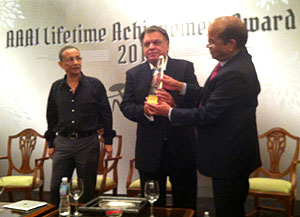
    They don’t make people like him these days. Forthright, never into any frivolous conversation, he is known as a no-nonsense man in the industry,” said Shashi Sinha, CEO, IPG Mediabrands and Lodestar UM on Anil Kapoor, Chairman Emeritus, Draftfcb+Ulka group who was felicitated with the Advertising Agencies Association of India (AAAI) Lifetime Achievement Award last evening (Friday, September 27) at an event attended by top ad industry honchos and senior advertisers.


    Accepting the award from the AAAI, Mr Kapoor said: “There is never a dull moment in advertising. For me it was simply a passion. I strongly believe advertising agencies are solution providers and not suppliers of creativity.”


    Making his opening remarks, AAAI President Arvind Sharma said Mr Kapoor is a huge influence on the industry.


    Mr Kapoor was appointed Chairman Emeritus of Draftfcb + Ulka in 2010, after a 22-year stint with the company and its associated agencies. He is a Past President of the AAAI, Chairman of the Audit Bureau of Circulation of 2007-08 and was also on the Management Board of the National Readership Survey and the Television Audience Measurement Research. In May 2002, Kapoor was also inducted into the Foote, Cone & Belding’s Worldwide Board.


    Before joining Draftfcb+Ulka, Mr Kapoor was with the Boots for 14 years, where, as Marketing Director, he launched a string of brands, all of which went on to become market leaders. Before that, he was with the legendary agency MCM. He graduated in English Literature from St. Stephen’s College, Delhi and then did his MBA from the Indian Institute of Management, Ahmedabad.


    “One thing that defines him is his ‘Never Say Die’ attitude. Anil Kapoor, who was seen as an outsider in the Industry, was soon accepted as an equal and may be as a ‘more than an equal’,” said Dr M G Parameswaran, Executive Director and CEO, Draftfcb + Ulka.


    Photographs by Fatema Rajkotwala


  • Anil Kapoor: An ‘Outsider’ who was more than an ‘Equal’


    All roads lead to the Trident at Nariman Point today (Sept 27) as the Advertising Agencies Association of India felicitates and awards Anil Kapoor, Chairman Emeritus, Draftfcb+Ulka with the Lifetime Achievement Award.


    A little about Mr Kapoor, courtesy the Draftfcb+Ulka website: His love for challenges saw him taking charge of Draftfcb+Ulka (Ulka Advertising, at the time), turning it into the fastest growing agency in India and taking its rightful place as one of the ‘Big Five’. With the formation of Draftfcb in 2006, Mr Kapoor was appointed as Draftfcb President with responsibility for Asia-Pacific region and Africa.


    He was appointed Chairman Emeritus of Draftfcb + Ulka, after a 22-year stint with the company and its other associated agencies. As one who is known to make things happen, his role expanded naturally into industry bodies. He is a Past President of the Advertising Agencies Association of India (AAAI), the Chairman of the Audit Bureau of Circulation of 2007-08 and was also on the Management Board of the National Readership Survey and the Television Audience Measurement Research. He was also on the Editorial Advisory Board of The Economic Times. In May 2002, Mr Kapoor was also inducted into the Foote, Cone & Belding’s Worldwide Board.


    Before joining Draftfcb+Ulka, Mr Kapoor was with the Boots Company, India, for 14 years, where, as the Marketing Director, he launched a string of brands, all of which went on to become No. 1 in their markets. At Boots, he also set up two field forces, one for consumer products and the other for ethical pharmaceutical products. Before that, he was with the legendary agency MCM and though not the cause, he says he had to preside over its closure – quite a learning experience! Now a confirmed Mumbaikar, Mr Kapoor grew up in Delhi and graduated with a BA in English Literature from St. Stephen’s College, Delhi and then did his MBA from the Indian Institute of Management, Ahmedabad.


    Dr M G Parameswaran

    Executive Director and CEO, Draftfcb + Ulka

    I have worked with Anil Kapoor for over two decades and I have seen him in various roles, as Head of Marketing of a large British multinational, as a CEO of a pioneering media company and as a CEO of a struggling ad agency. One thing that defines him is his ‘Never Say Die’ attitude. When he joined Ulka no one thought he had a chance of saving an agency that was fast sinking. In fact someone who is revered in advertising world even told me that I was mad to join Anil Kapoor in his mission of saving an ailing Indian agency. Anil proved all his detractors wrong though his passion, attitude and commitment to the cause. He also showed the industry how to build a strong team and keep it together for two decades. How to build an agency group entirely from within, and without the help of international experts and hand-me-down accounts. He demonstrated how to partner clients at senior levels to launch one successful brand after another,  in tough market conditions. As Ulka became FCB Ulka and later DraftFCB Ulka, his managerial and leadership skills got recognized on the global stage, many times over.


    Anil Kapoor, who was seen as an outsider in the Industry, was soon accepted as an equal and may be as a ‘more than an equal’. He went on to play leadership role in various industry bodies such as AAAI and ABC. He was instrumental in setting up the independent NRS survey in the mid-’90s.  He also played a very vital role in helping the formation of IBF as a body that could work with AAAI to create norms and processes on how agencies work with television.


    We don’t have too many people in advertising industry today who can fill his shoes.  While Anil Kapoor continues to serves as the Chairman Emeritus of Draftfcb Ulka Group and continues to play the role of an advisor to the Group which he built,  he has not been involved with industry affairs for almost a decade. I am sure it is the industry’s loss that he decided to move on. But then, all things have to change, and that is not an entirely bad thing after all.


    Shashi Sinha

    CEO, IPG Mediabrands and Lodestar UM

    They don’t make people like Anil Kapoor these days.


    I have had the good pleasure of working with Draftfcb+Ulka a few years before he joined the agency from a strong client background. In fact that possibly ensured that he was very focused on deliveries.  As someone who helmed the agency for many years and even now as Chairman Emeritus, we and our clients included have always known him to be a no-nonsense man. Forthright, never into any frivolous conversation. He was always focused on the task on hand.


    He had a keen eye on the business and would actively engage with all his clients.  Even now when some of us meet him, his observations are pertinent to the business and may I say: bang-on.


    Anil Kapoor has always been an excellent people manager considering his team has been together for so long.


    I have always had an excellent rapport with him and have found in him a Guru whom I admire and respect.


  • AAAI lifetime achievement award for Anil Kapoor, Emeritus Chairman, Draftfcb+ Ulka Group

    By A Correspondent


    Anil Kapoor

    The Advertising Agencies Association of India will present Anil Kapoor, Emeritus Chairman, Draftfcb+ Ulka Group with the AAAI Lifetime Achievement Award. This is the highest honour given to an individual in India for his/her outstanding contribution to the advertising Industry.


    The awards ceremony is scheduled for Friday, September 27, 2013 at 7:30 p.m. at Trident, Nariman Point, Mumbai. The last recipient of the AAAI lifetime achievement award was Piyush Pandey. There was no award presented for 2011 and 2012.


    Piyush Pandey

    Here’s a short note on Mr Kapoor from the Draftfcb+ Ulka’s ‘Ulka 50 years’ website:

    ” ‘Never say die’, that’s Anil’s attitude to life. His love for challenges saw him taking charge of Draftfcb+Ulka (Ulka Advertising, at the time), turning it into the fastest growing agency in India and taking its rightful place as one of the ‘Big Five’. With the formation of Draftfcb in 2006, Anil was appointed as Draftfcb President with responsibility for Asia-Pacific region and Africa.


    “Recently, he has been appointed Chairman Emeritus of Draftfcb + Ulka, after a 22-year stint with the company and its other associated agencies. As one who is known to make things happen, Anil’s role expanded naturally into industry bodies. He is a Past President of the Advertising Agencies Association of India (AAAI), the Chairman of the Audit Bureau of Circulation of 2007-08 and was also on the Management Board of the National Readership Survey and the Television Audience Measurement Research. He was also on the Editorial Advisory Board of the Economic Times, the second largest circulating business newspaper in the world. In May 2002, Anil was also inducted into the Foote, Cone & Belding’s Worldwide Board.”


    “Before joining Draftfcb+Ulka, Anil was with the Boots Company, India, for 14 years, where as the Marketing Director, he launched a string of brands, all of which went on to become No. 1 in their markets. At Boots, he also set up two field forces, one for consumer products and the other for ethical pharmaceutical products. Before that, he was with the legendary agency MCM and though not the cause, he says he had to preside over its closure – quite a learning experience! Now a confirmed Mumbaite, Anil grew up in Delhi and graduated with a BA in English Literature from St. Stephen’s College, Delhi and then did his MBA from the Indian Institute of Management, Ahmedabad.”