PVR Inox, the multiplex chain, will present the live screening of the Republic Day parade thanks to an alliance with Aaj Tak.
PVR Inox will be broadcasting this grand event live with Aaj Tak across its 30 cinemas in 16 cities. The parade will be screened live across PVR Inox’s marquee cinemas in UP, Delhi, Gujarat, Maharashtra, Rajasthan, Haryana, Chandigarh, Punjab and Kerala. The live screening of the Republic Day parade is scheduled from 9 am onwards. Tickets can be booked through the PVR Inox app or website and other platforms making it accessible to a wide audience eager to witness the historic event on the big screens.
Said Gautam Dutta, Co-CEO of PVR Inox Ltd: “The Republic Day Parade is the best possible depiction of India’s military might, diverse culture, and unity in diversity. It is therefore a matter of immense pride to be able to screen this ceremonial parade on India’s 75th Republic Day at our PVR INOX cinemas across 9 states and UTs. The marching regiments of the Indian defence forces and their equipment driving down the Kartavya Path will be a sight to behold. The visuals of the colourful tableaux of various States will add grandeur to the occasion. Our commitment to providing a memorable and immersive cinematic experience extends beyond entertainment, and we look forward to sharing this historic moment with our patrons.”
Added Dinesh Bhatia, Group CEO of India Today Group: “At Aaj Tak, our unwavering commitment to capturing the essence of India’s defining moments stands resolute. We deliver news and live events that hold significance, establishing ourselves as the choice for credibility and trust. The alliance with PVR Inox elevates our mission, uniting millions across India during national events, such as the momentous occasion of India’s 75th Republic Day.”
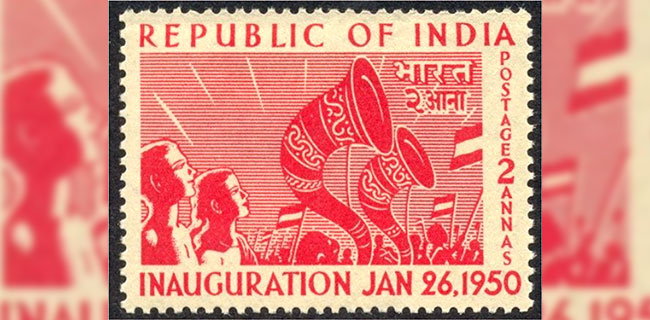
Stamp issued to commemorate the creation of the ‘republic’ – Source: Government of India Archives
By Avik Chattopadhyay
Independent India was formed on August 15, 1947.
Brand India was created on January 26, 1950.
Since the “dominion” of India was created on the day the Indian tricolour was hoisted at Red Fort, we continued to be a constitutional monarchy with George V as the head of state and Mountbatten as the Governor-General till the 26th of January 1950 when we adopted our own constitution. It was only on that date that we had our first President in the form of Babu Rajendra Prasad. Till then this newly formed nation was governed by the Government of India Act of 1935.
So, the significance of our Republic Day assumes greater importance when we realise that it was on that day, after two years, five months and 11 days of having become independent that we decided what exactly we would become in terms of a nation. The product India was rolled out as a prototype on August 15, 1947. The final production version, after all tests and validations, was finally launched for the citizens and the world at large, as a brand that said “Republic of India” on January 26, 1950. Till that day, no common citizen was aware of what exact shape and form we would take in terms of purpose, promise, values and personality. This task was entrusted to a team called the Constituent Assembly, a 308-member team made up of 21 committees headed by some of the sharpest minds like Jawaharlal Nehru, Vallabhbhai Patel, KM Munshi, HC Mookerjee, Bordoloi, BN Rau and GV Mavlankar submitting their reports to the drafting committee headed by BR Ambedkar. They met for 166 days painstakingly putting together the Constitution that was finally adopted on November 26, 1949.
In an organisational context, it is almost like all functional teams providing their inputs to the brand strategy team that finally prepares the brand book, to be presented in a townhall before all employees for their feedback and necessary modifications before the entire organisation adopts it as its credo and ethos.
The Preamble is the brand essence.
It encapsulates all the pages that follow with their numerous chapters, schedules and articles. It describes the purpose, the promise and the operating values. In fact, all organisations in India could as well study the unique structure of the Preamble to design their own, in terms of brevity of expression and clarity of purpose.
The original text of the Preamble – Source: Government of India Archives
Of the Preamble, Ambedkar said, “It was, indeed, a way of life, which recognises liberty, equality, and fraternity as the principles of life and which cannot be divorced from each other: Liberty cannot be divorced from equality; equality cannot be divorced from liberty. Nor can liberty and equality be divorced from fraternity. Without equality, liberty would produce the supremacy of the few over the many. Equality without liberty would kill individual initiative. Without fraternity, liberty and equality could not become a natural course of things.”
As a part of the debates before its final adoption, there was a proposal to call ourselves the ‘Union of Indian Socialist Republics’. Also, some had proposed that ‘God’ and ‘Gandhi’ be incorporated in the text. Thankfully, all such proposals were struck down as each would have been paradoxical to what we had aspired to nurture ourselves into as a nation.
By the 42nd amendment of the constitution during the Emergency of 1975, the words ‘socialist’ and ‘secular’ were added to describing the republic over and above being sovereign and democratic. The brand purpose was expanded in scope. However, the promises of delivering justice, liberty, equality and fraternity remained as before, except for the word “integrity” being added to unity to describe the fraternity we aspired for. Very similar to what happens when the second or third generation of the founding family wishes to ‘revisit’ the brand purpose and ‘contemporise’ it, in sync with an evolving market and customer behaviour.
These very later insertions or modifications are subjects of heated debates today. The brand purpose is being questioned by the new leadership. Like most organisations, the new CEO, especially if brought in from outside, wishes to leave a mark on the key aspects of the brand, especially the ‘vision’ and ‘mission’. That it typically the legacy the leadership wishes to create for posterity to marvel at.
Even if those ‘controversial’ words are to be removed, the essence of the Preamble does not change one bit. In its very construct it espouses the fundamental principles of socialism and secularism. The word ‘socialism’ is part of the Directive Principles of State Policy and implies social democracy and distributive justice. The word ‘secularism’ implies that there is no state religion and that the powers of the state and any religion are clearly separate. The former cannot be partial towards any particular religion or religions while the latter cannot dabble or interfere in the functioning of the state. Reminds me of the occasion when MA Jinnah in 1919 implored Gandhi not to support the Khilafat movement as “mixing politics and religion” would have disastrous outcomes.
Brand India is at the crossroads right now. The very brand purpose is being challenged by various factions and fringes by their operating principles [or lack of them] and socio-political acts. There has been no direct attempt to alter the fundamentals of the Republic but subaltern and diversionary tactics are certainly being used, citing the need to go back to our “pure past” to rediscover ourselves and reclaim our greatness as a teacher of the world. We are certainly at the crossroads as we enter the 75th year of being Brand India.
I will conclude by quoting Ambedkar once again from his last address to the Constituent Assembly on November 25, 1949:
“On the 26th of January 1950, we are going to enter into a life of contradictions. In politics we will have equality and in social and economic life we will have inequality. In politics we will be recognising the principle of one man one vote and one vote one value. In our social and economic life, we shall, by reason of our social and economic structure, continue to deny the principle of one man one value. How long shall we continue to live this life of contradictions? How long shall we continue to deny equality in our social and economic life? If we continue to deny it for long, we will do so only by putting our political democracy in peril. We must remove this contradiction at the earliest possible moment or else those who suffer from inequality will blow up the structure of political democracy which this Assembly has so laboriously built up.”
Jai Hind.
Avik Chattopadhyay is a senior business strategist and commentator based in Gurugram. He writes on MxMIndia every other Thursday. His views here are personal
Akshar Yoga, started by Grand Master Akshar, launches Healthy India campaign on this Republic Day. As part of the campaign, a number of underprivileged and specially-abled children will be carefully trained by Akshar Yoga Research and Development Centre Master level teachers.
Said master Akshar: “On a spiritual level, yoga is transformational and brings growth, positive self-development, and happiness. Its deep reach and influence can be felt in people’s lives.”
The festival will also include 100 specially abled kids and 150 children from orphanages. To achieve a healthy India, Akshar Yoga, through this campaign, wishes to spread the message about the power of yoga to the world. He will demonstrate how to enrich your life through asanas and make it beautiful. To achieve work-life balance, we need to stay in optimal health, and yoga is the perfect answer to overall well-being and good health.
Grey Group India collaborates with Axis Bank Republic Day Campaign. The campaign aims to celebrate diversity and unity in an effort to acknowledge the one language over a billion Indians speak across borders.
The communiqué states – With your support, Axis Bank and Grey Group hopes to get the Indian Sign Language officially recognised as the 23rd language in 2023.
Croma releases a film for Republic Day. It is based on the true event of a Croma customer conceptualized by the Croma in-house creative team, produced by Useful Garbage Creations and directed by Gaurav Gupta.
Croma’s digital campaign #ConstitutionOfJoy expresses Croma’s dedication to provide its customers with the best-in-class end-to-end shopping experience and understands that behind every small electronic there are countless memories.
The Government of India invoked emergency powers under Information Technology Rules 2021 to order YouTube and Twitter to take down links and certain comments on the BBC’s documentary on Prime Minister Narendra Modi, his role in the 2002 riots in Gujarat when he was chief minister and his relationship with Muslims then and now.
The Government had already instructed the BBC to take down links to the documentary in India.
Part 2 of the series is due to be released today, Tuesday January 24, 2023.
The Indian media has largely gone along with this diktat. Obviously, the Indian media feels very strongly about the Emergency provisions of 1975 imposed on the press by the then prime minister Indira Gandhi. What a travesty of democratic norms. Shocking! It is another matter that then as now media owners were quite happy that their powers were curtailed. Trains, as we were often told, ran on time.
Now in these days of an undeclared Emergency, trains do not run on time, media owners are happy when their journalists don’t perform and the journalists themselves are happiest that they no longer have to function as journalists. Being publicity mouthpieces for the Modi administration is fulfilling enough.
So a documentary which largely reiterates what the media had said in 2002 and onwards is now verboten.
Many media and public affairs commentators in their 30s have expressed dissatisfaction with older journalists who have stated on social media that the BBC documentary shows “nothing new”. I fear there is something lost in translation here.
What journalists who were old enough to be around in 2002 saw is that the riots were covered extensively and allegations made against Modi and the state administration in the documentary were also made at the time. This does not imply that the documentary is pointless or unimportant.
Rather, the BBC documentary reiterates what was said then and provides an additional input: the findings of the British government of the time. It also puts into perspective the changes in Modi from 2002 to today.
The question however is why the Modi Government is so angry. From 2014 until today, attacks on Muslims and other religious minorities, and on Dalits, has only increased. Several BJP politicians, including the prime minister, have added to the hatred against Muslims in election and other speeches. Hindutva has been paraded as an answer to India’s problems and democracy has been upbraided for not allowing superstition and arcane customs a free run.
One would have thought that the BJP and Modi would have been happy with the documentary. It underlines Modi’s role in the riots. It shows how Muslims were made to suffer. It explains 20 years later how these riots laid the ground for Modi’s later ascension to power. What’s not to like? And yet…
The media has happily gone along with all this. It has amplified the hatred and not questioned Modi or the BJP on its actions. Of course, it is not possible to question Modi in person since he does not allow it. We understand that. But the questions put to Modi by a mainstream media house are few and far between. Already, all those who questioned the Modi administration on the Covid19 deaths and the handling of the pandemic have silenced themselves.
The Indian media thus continues on its downward spiral. Gag orders on Joshimath, the invocation of emergency powers of the draconian IR Rules of 2021, the banning of a documentary about the Gujarat riots of 2002 have all washed off the media’s back like this is par for the course.
And it is. How many in the mainstream media were bothered about journalists being spied on via Pegasus? Or spyware being used to manufacture evidence against human rights activists?
The answer though is in the implied criticism in the BBC documentary. That more could and should have been done.
And thus, the response from the Modi administration, largely unquestioned by the Indian media, has been to ban and blame. Some absurdity about a “colonial mindset” from politicians who belong to a “cultural” organisation which was very subservient to our erstwhile colonial masters and did not play any role in a freedom movement, is really quite funny.
Unquestioned by the mainstream media obviously.
Radio silence from several mainstream TV anchors who brought the riots into living rooms and bedrooms.
Unfortunately, the world has noticed, even if Modi’s fans have not. I mean the newer fans, who believe he is the messiah of hope and fulfilment. The older fans after all voted for him because of the riots.
I was tempted to repeat my old story about how the state government under Modi in 2002 tried to stop The Times of India in Gujarat, where I worked at the time, from being critical of Modi’s role in the riots. The owners told us to ignore the pressure and carry on with what we were doing. In spite of immense pressure on them.
Yeah, sounds like a fairy tale today.
Like Modi’s idea of himself as a messiah.
Which as we approach Republic Day seems ironic…
Ranjona Banerji is a senior journalist and commentator. She writes on MxMIndia on Tuesdays and Fridays. Her views here are personal
Koo, the Made-in-India Twitter-like microblogging platform has launched a campaign around Republic Day. Called #TogetherWeKoo, it started on January 21.
“India is a land of diversity, with 1000s of languages, and true expression lies in being able to speak from the heart, in one’s own language,” said Aprameya Radhakrishna, CEO and Co-Founder of Koo. “True democracy lies in giving a platform to everyone, and we invite you to join us on Koo and support this campaign of equal opportunity of expression.”
Balkrishna Industries Ltd., (BKT), tire manufacturing company, has released a brand campaign. The anthem, titled ‘Muskurayega India’, which salutes the unmatchable contribution of farmers and soldiers, is produced by JJust Music, for the occasion of Republic Day.
Said Rajiv Poddar, Joint Managing Director, Balkrishna Industries: “While it is easy to get caught up in our everyday life activities, we desired to do something special this Republic Day and honor the true unsung heroes of our nation – the farmers and soldiers. ‘Muskurayega India’ is a tribute from our entire company to these individuals who are the backbone of our economy. They play an integral part in building unity in our nation and celebrate diversity in the most unique manner.”
Tata Salt has launched a nationwide Republic Day campaign called Desh Ke Liye #HarSawaalUthega. With its 360-degree approach, the campaign aims to empower children by providing them with a one-of-a-kind platform to raise questions that could spark relevant conversations and nudge a societal change.
Commenting on the launch of the campaign, Deepika Bhan, President, Packaged Foods- India, Tata Consumer Products, said: “Children can really reframe our thinking! They question what we are willing to accept as the status quo and that challenge forces change. Desh Ke Liye #HarSawalUthega is a platform that endeavours to surface these real questions. We’ve received such insightful, provocative questions already and are enthused with the awareness and change the next generation is willing to imagine. Tata Salt is one of India’s most trusted brands, and we definitely want to partner this journey of fuelling an entire generation of kids to raise their questions and contribute to a better tomorrow.”
Speaking on the idea, Sukesh Nayak, Chief Creative Officer, Ogilvy India added: “This is a very powerful platform that empowers the Children, the future of our country to ask relevant questions that will truly define the future of our country. This is an idea that not only interacts but gives voice to the children by hoisting their questions on the front page of leading national newspapers, so the whole country can see it. We believe that this idea will help children from across India voice their questions, hoist their questions and help shape a better tomorrow.”
Tata Salt has launched a nationwide Republic Day campaign called Desh Ke Liye #HarSawaalUthega. With its 360-degree approach, the campaign aims to empower children by providing them with a one-of-a-kind platform to raise questions that could spark relevant conversations and nudge a societal change.
Commenting on the launch of the campaign, Deepika Bhan, President, Packaged Foods- India, Tata Consumer Products, said: “Children can really reframe our thinking! They question what we are willing to accept as the status quo and that challenge forces change. Desh Ke Liye #HarSawalUthega is a platform that endeavours to surface these real questions. We’ve received such insightful, provocative questions already and are enthused with the awareness and change the next generation is willing to imagine. Tata Salt is one of India’s most trusted brands, and we definitely want to partner this journey of fuelling an entire generation of kids to raise their questions and contribute to a better tomorrow.”
Speaking on the idea, Sukesh Nayak, Chief Creative Officer, Ogilvy India added: “This is a very powerful platform that empowers the Children, the future of our country to ask relevant questions that will truly define the future of our country. This is an idea that not only interacts but gives voice to the children by hoisting their questions on the front page of leading national newspapers, so the whole country can see it. We believe that this idea will help children from across India voice their questions, hoist their questions and help shape a better tomorrow.”
Reminiscing the yesteryears of India’s redefining moments, Parle Products, celebrated the spirit of a sovereign India in its Republic Day film.
Conceptualized by creative agency, Please See in partnership with Reliance Entertainment, the film uses archival footage of major milestones and glorious moments to talk about the freedom movement in 1930s, 1971 war, India’s first World Cup win in 1980s, iconic Bollywood characters ‘Raj and Simran’ to the successful space mission and then India’s successful creation of Covid-19 vaccines. All of these are interspersed with perfect amalgamation of Parle-G from its launch in the 1930’s (Parle Gluco) to the pack version of today, which has been present at different intervals of history with the message ‘Years changed, but we stayed the same’, depicting its unchanged taste and popularity.
Added Mayank Shah, Senior Category Head at Parle Products: “Just as Parle Products stands for a swadeshi brand, our brand Parle-G is often referred to as ‘Desh Ka Apna Biscuit.’ We feel extremely proud and fortunate to be a part of India’s journey from pre-Independence time to present day. The film carries a degree of nostalgia as important events from the past play out in front of viewers. Just as the country crossed milestones over the years, so did Parle Products and gradually Parle-G has retained itself as the go-to product when one thinks of a biscuit. In circulation for 79 years, we have kept the taste intact with no change in the flavor of the Parle G ever since it was first sold in 1939. Parle shall continue to remain an integral part of the nation and with the coming years we hope to be a part of many such achievements – furthering our course with the country.”
 Independent India was formed on August 15, 1947.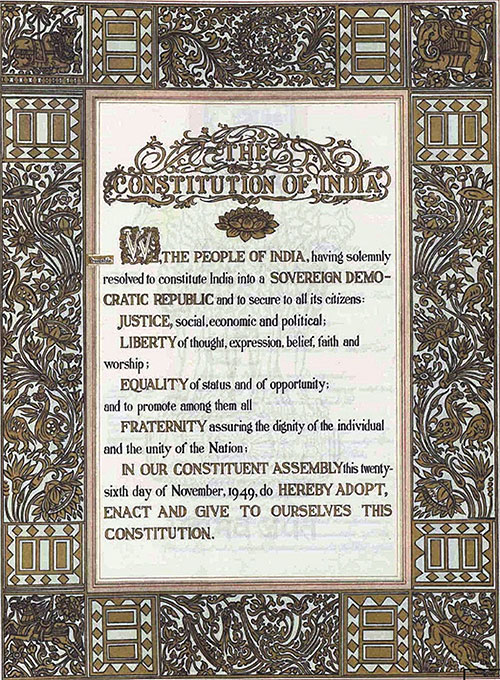
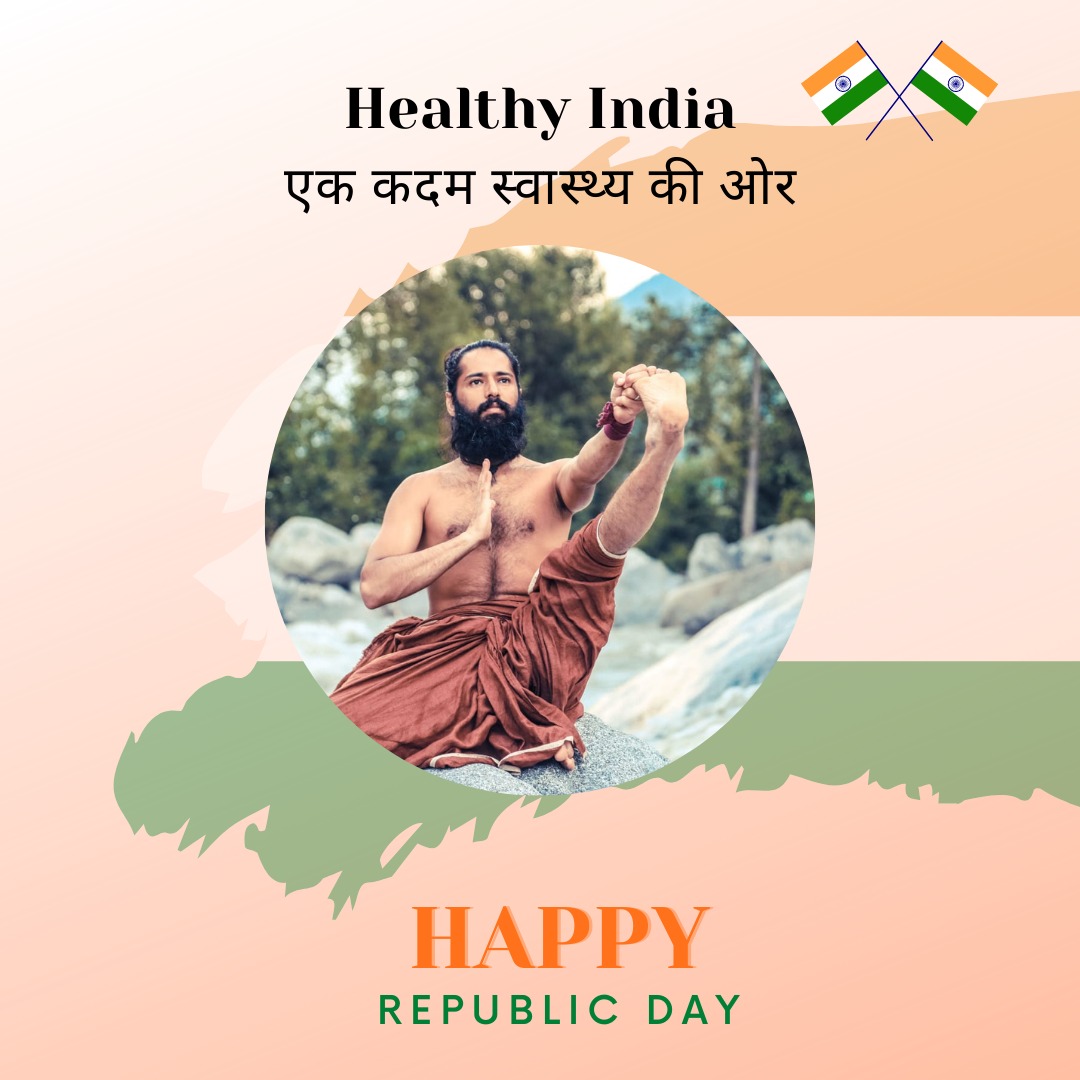 Akshar Yoga, started by Grand Master Akshar, launches Healthy India campaign on this Republic Day. As part of the campaign, a number of underprivileged and specially-abled children will be carefully trained by Akshar Yoga Research and Development Centre Master level teachers.
 The Government of India invoked emergency powers under Information Technology Rules 2021 to order YouTube and Twitter to take down links and certain comments on the BBC’s documentary on Prime Minister Narendra Modi, his role in the 2002 riots in Gujarat when he was chief minister and his relationship with Muslims then and now.