Blog

  • Radio One likely to turn English in Mumbai & Delhi

    By Robin Thomas


    FM radio network Radio One is likely to go English for its Mumbai and Delhi stations, MxMIndia has learnt from industry sources. This shift is likely to take place next month or early February 2012. MxMIndia did not receive any official confirmation from Radio One at the time of writing this, though industry sources have confirmed the development. Radio One, a joint venture between Next Mediaworks Ltd and BBC worldwide, operates in seven cities – Mumbai, Delhi, Kolkata, Chennai, Bengaluru, Pune and Ahmedabad.


    An English FM radio station in Mumbai and Delhi may add a fair deal of differentiation in music, but what remains to be seen is how advertiser-friendly it will be, given that listenership levels are lower than those playing just Hindi music.


    MxMIndia spoke to few industry players on whether Mumbai and Delhi markets will open up to an English FM station. One of them was of the view that an English FM station in Mumbai in particular will create a much needed differentiation in terms of music. There is a market for English audience, but it may take some time to get established, what remains to be seen is how the advertisers will react to this change. Another industry observer was of the view that while there is a market for English music listenership in both Mumbai and Delhi, it could still be challenging for the FM station in terms of revenue generation, as the audience size is small.


    On the other hand, Sunil Kumar, MD, Big River Radio feels the fact that there are audiences willing to pay a huge sum for rock concerts, the number of English newspapers, the popularity of serials such as Friends, are sure indications that there is a market for an English FM station. “There is a market for English music listeners, these are the people who have an international or global outlook, they travel abroad and are well attuned to English music. An English FM radio station will bring an additional audience to radio – that is, those who do not listen to radio. Just look at the number of English movie channels, English GECs, news channels, they are doing extremely well. Therefore, for a premium channel you don’t need a large audience but, you can charge huge premium for the audience they deliver to, which is often people in the higher socio-economic group,” he said.


    It may be recalled that when Fever FM was launched in Mumbai, it initially aired both Hindi and English songs after which they had to completely switch to Hindi. Radio One too has experimented for long with its English format in its earlier avatar of Go92.5 and Radio Mid-day. Market pressures and the desire to catch up with the more mass Bollywood hit music format got it to go completely in Hindi. Hit FM is the only 24×7 English FM station in Delhi, while Mumbai currently has no fulltime English FM station. The other 24×7 English FM stations in the country are Radio Indigo in Bangalore and Chennai Live in Chennai. All India Radio’s FM Rainbow station also plays English music.


  • Got an idea? Write to Times Internet to help kickstart it

    By A Correspondent


    TLabs, a mentorship-driven accelerator program developed by Times Internet Limited (TIL), is inviting bright business ideas in the field of technology, mobile and Internet to develop into world-class products. TLabs is looking for young energetic teams with a marketable idea, who have the passion and skill to execute that idea.


    Backed by Times Internet Limited (TIL), TLabs will provide funds, mentorship, and strategic and execution support to entrepreneurs in order to shape their plans into sustainable and scalable products.


    Applications are now open for the program, which commences February 2012. The 13-week programme seeks to mentor 10 start-ups. Besides an initial seed funding of up to Rs 10 lakh, it will feature interactions with experienced and eminent leaders and domain experts in India and abroad, once every week. Entrepreneurs will also benefit with rehearsal demos for the project before they ultimately present their ideas and come face to face with angel investors and venture capitalists. Entrepreneurs are free to engage with these investor communities, and execute the plan independently.


    “What sets the program apart is the access to TIL’s huge infrastructure and domain expertise. This gives entrepreneurs at TLabs the edge over other start-ups,” says Gautam Sinha, Director – e-Commerce & Technology, Times Internet Limited.


    Rishi Khiani, CEO, Times Internet Limited, said, “We want to make this a very high quality program, with very significant value addition to support entrepreneurs as well as the entire innovative ecosystem.”


    One of the companies that benefited from the TLabs program this year is DataWeave, a young start-up founded in 2011 by Karthik BR and Vikranth R from Bangalore.


    “Being chosen by TLabs strengthens our belief in our product offering. The experience of the Indiatimes network’s mentoring and the infrastructure support has already begun to show in the way we work and in the way we are perceived,” said Karthik Bettadapura, www.dataweave.in.


  • Disney Junior launches animated series for holidays

    By A Correspondent


    Disney Junior, the learning-focused block for kids aged 2-7 on Disney Channel, will usher in the holiday season beginning December 19 with the launch of two brand new short-form series – A Poem Is… and Tasty Time with Chef ZeFronk. These shorts will play out multiple times daily on Disney Channel.


    Arnab Chaudhuri, executive director content and creative, Walt Disney Television International India, said, “The launch of these new series further demonstrates Disney Junior’s dedication to programming that highlights the importance of great, heartfelt storytelling with learning components. Both A poem is… and Tasty Time with ZeFronk are wonderful additions to the already robust offerings from Disney Junior and showcase how Disney’s content strives to entertain and inspire learning while embracing positive values.”


    A Poem Is… is a short-form animated series showcasing poems for children set to scenes and imagery from classic Disney films including Dumbo, Bambi and Lady and the Tramp. Narrated by award winning actress and poetry enthusiast Shabana Azmi in Hindi, and well-known actor-director Suhasini Ratnam in Tamil and Telugu, the series is designed to bring back fond memories of Disney classics for parents and cultivate new ones for kids by introducing the young children to the beauty of poems. Featured poems include works by Robert Louis Stevenson, John Howard Payne, A.A. Milne and Henry Wadsworth Longfellow, among others.


    One of the versatile personalities of the Tamil film industry, Suhasini Ratnam said, “Children these days learn poetry only to score marks in school. This series is about making poetry interesting for them and it’s only right that somebody fond of the language does it.”


    Award winning actress and poetry enthusiast Shabana Azmi said, “Children typically respond well to reading and writing poetry, as it fuels their imagination and creativity and allows them to express themselves. Some of the poems are going to be sentimental and sweet, the kind that will warm a mom’s heart, and some of them will be silly and funny to make kids giggle and laugh.”


    Disney Junior will also feature a series of five-minute long shorts, Tasty Time with ZeFronk, encouraging kids to cook with their families and have lots of fun along the way. Well-known comic actor Omi Vaidya will lend his voice to chef ZeFronk who will host the fun-filled cooking show from his doghouse with his assistant, a songbird named Sue.


    Chef ZeFronk’s voice Omi Vaidya said, “Being an ardent fan of the channel since childhood, it feels great to voice a Disney show. The highlight of the show is that it involves a lot of fun and learning at the same time.”


    In addition to the fun-filled shows on TV, Disney Junior will soon be available as a special magazine with tons of activities and stories. This is in addition to a series of DVDs featuring select Disney Junior shows already available at retail. Parents and caregivers can also access loads of games and on-line activities of Disney Junior content online through a dedicated section on www.disney.in.


  • Online tax special programme from moneycontrol.com

    By A Correspondent


    Financial portal moneycontrol.com has unveiled Master Your Money -Tax Special, the first exclusive online event in a series of dedicated online investor camps. The month long event intends to get distinguished market experts to interact with and guide the users on their tax plans.


    The format-exclusive Master Your Money – Tax Special is designed to offer an interpersonal plane to impart information and knowledge, where participants can interact with market gurus who will decode the complexity of tax calculations and offer valuable tips.


    It is a platform where the users from different walks of life will get an opportunity to choose from a gamut of features and get their tax-related queries answered. Ranging from interactive sessions like income tax advice, FAQs and live chat with the experts to the application-based online Tax calculator, Income classifications, and a choice of tax saving instruments, Master Your Money – Tax special is all set to beat the income tax blues of all the users.


    “Master Your Money – Tax Special is our effort to reach out and provide feasible income tax solutions to the entire community of Indian investors,” said Joyson Thomas, COO, of Web 18, the company that owns moneycontrol.com.”


    He added that this is Master Your Money’s first in the series of dedicated online events and is attracting users from all over the country.


  • Mudra meets WGC’s golden rule

    By A Correspondent


    The brief that World Gold Council gave Mudra Max, which provides multi-speciality expertise to help build brands in the age of convergence, was to reinstate gold at the top of women’s wish-list by increasing desirability and making gold purchase the centre of celebration during Diwali.


    Mudra’s campaign for WGC captured audience’s attention at multiple relevant touch-points by giving higher weightage on innovations to break through an extremely cluttered media scenario.  The strategy adopted for different medias is as deatled below.


    > Television: The TV plan encashed on the festive opportunity by being present at big properties like premiere movies, awards night, reality show finales, news channels etc. A disruptive message “Somethings last, somethings don’t. This Diwali, don’t just spend. Invest” was created for the show Gadget Guru on NDTV. This helped in attracting the attention of a highly focused TG on the relevance of gold.

    > Print: A 10-year-old archival copy of TOI was used as TOI jacket, reinstating the message that ‘very little from 10 years back is worth remembering. Gold jewelry being the exception”. For the first time ever, an L-band format was used which was a combination of Masthead and Text Wrap, ensuring that the reader’s focus was drawn to the campaign message that appeared on front page of leading dailies such as Hindustan Times and Loksatta. A disruptive content ad was placed in Mint, grabbing reader’s attention on the creative message in an unconventional manner.

    > Radio:  On the day of Dhanteras, a well-known RJ from a leading radio station was ‘discovered purchasing gold jewelry from a partnering retailer’. The activity kicked off with a teaser a day before Dhanteras and continued the next day with live sound-bytes being aired from the retailer to create hype in order to drive people to purchase gold jewelry.

    > Activation: An activity was developed partnering retailers, where people walking into the store were encouraged to try out jewelry and get the moment captured in a WGC-branded framed photograph with the communication “Let this memory endure. Just like gold”.

    > Outdoor: Large format and ambient media involving tactical using innovations were used. In addition to most conventional hoardings, innovative ideas such as Roadblock on e-zone TVs, scrap TV innovation, jewel box on hoarding, LED in Gurgaon & shopping bags at airport were used.


    As a result of these innovations, the World Gold Council became one of the most visible brands during the three weeks of activity across mediums. The campaign created high recall due to nature and the scale of innovations used, creating a complete 360-degree surround (Source: MAP, TAM)·  Imports rose in October to $7.2 billion against a monthly average of $4-5 billion (Source: Economic Times). There was a 30 per cent jump in gold prices during Diwali over last year, owing to high confidence and demand (Source: Economic Times).

  • PR must look up to advertising: N S Rajan

    By Johnson Napier


    With foreign players taking a keen liking to India, the PR industry is poised for a quantum leap. Not the one to miss out on the race, Ketchum Sampark is doing everything right to stay on track and be counted as a contender worth the deal. In conversation with Johnson Napier of MxM India, N S Rajan, Managing Director of Ketchum Sampark outlines his agency’s plans to be counted amongst the best and why quality, and not numbers, will be the differentiator in the race to win and retain more clients. Excerpts:


    Q: It’s been some 7-8 months since the much-hyped tie-up with Ketchum. How would you analyze your journey post the acquisition?

    There has been no change as such at the ground level but yes, processes have changed, reporting has changed – it is now more in terms of financial and MIS reporting and not so much in operations. Also, what probably has changed and helped us is the access to information, access to best practices, access to case studies… so it is a win-win situation for us while we continue to work the way we are.


    Q: Could you elaborate on your choice of shortlisting Ketchum as your foreign partner?

    We have been working with Ketchum for more than three years now so this tie-up is actually a formalization of our relationship. We have been very comfortable with the cultural match. I think philosophically, Ketchum and Sampark have always had the same focus in terms of client deliveries, choice of clients, etc so there were a lot of similarities between us.


    Q: Come to think of it, the venture looks like Omnicom’s reply to making its presence felt in India – just the way Publicis did with Hanmer. Your thoughts?

    I think this is something like a process of evolution. We have been working with them for 3-4 years, and it just happened that the timing is now. It did take time for us to tie the knot as there had to be a comfort level on both sides. We probably got into a JV at the opportune time as the media is opening up and India remains a good market for bringing a foreign partner where we are able to service global clients in India and also open up our offices and network for Indian clients wanting to go abroad.


    Q: On the growth perspective, how would you analyse the year 2011 for your agency?

    I think we have done well. We have grown by 25 per cent and this has come on the back of 30 per cent growth that we recorded last year. Also, we signed on a lot of good clients. This apart, we just recently announced Ketchum Sampark Digital and also set up specialised verticals in healthcare and infrastructure. We believe this tie-up will take us to the next orbit in terms of skill-sets, information flow, etc. More importantly, what we have learnt from this venture is best practices. We have to understand that the market dynamics are changing and people are looking for specialised services in each of the areas. I think there is a lot of comfort at the client level if you are able to bring in value in each of the domains. That’s because clients are also looking at core focus, specialisation, skill levels, agency background, etc. So to that extent healthcare and infrastructure remains our focus areas because a huge growth is predicted in these areas. Another important area for us is crisis communications; we believe a separate vertical would be good to go with for crisis.


    As for our agency, we are divided into four verticals – brand, corporate, technology and financial services. Healthcare and infrastructure would continue to be separate verticals but could probably be clubbed under corporate. This apart, sports is another area that is huge for us. We have handled some very big marquee properties across India ranging from cricket, golf, football, etc. So that would continue to remain a focus area for us. We also engage in organising festivals like the Jaipur Literary Festival which witnessed the gathering of more than 400 authors and many media professionals from around the world.


    Q: How according to you will digital change the way PR functions, say, in a few months from now?

    According to me, the game changer in 2012 for the PR industry will be digital, as its significance and importance will be largely felt. The traditional way of communicating today will probably go direct-to-consumer with the help of digital. Also, with digital, there is a lot of opportunity for content, for social media, for gathering traffic to your site, to build conversations around content and also monitor them, etc. With Ketchum being one of the global leaders in digital I think we have a huge advantage in terms of assimilating knowledge much faster, so we will be able to scale up very quickly.


    Q: You’ve mentioned a growth rate of 25 percent plus; does that translate to occupying a fair market share as well?

    While we figure amongst the top 5-6 agencies in India, our emphasis has always been on quality. We would probably be happy if we were perceived as an agency known for its quality. I may not be the No 1 in terms of size, but I certainly will be No 1 in terms of quality. We would love to earn the respect, trust and long-term partnership from our clients. Also, we would like our employees to be happy. If in the process of doing all this we improve our ranking, we’ll be happy with that.


    Q: Despite the low-warning signs, how are you warming up to the current economic situation being tagged as ‘tough’?

    While on the slowdown, let me tell you that during the 2008-09 recession, when most agencies lost business, we were the only agency that grew that year – even if the growth was single digit. So there will always be some amount of hardship so long as clients believe that you will be able to deliver value to them. In our experience, our clients have retained us during the tough times as well. The challenge for any business is to see through the bad phase and that is possible when you are focused on quality, people and such attributes. But if you are chasing to be the No 1 player then there are chances of you losing out.


    Q: Do you plan to scale up operations across other centres in India?

    We are currently present in seven cities and we do have aspirations to roll each of the practices in each of the regions. We just hired a senior person to handle our office in the South so we are taking all steps necessary to grow all our offices. Also, we have an SBU concept where we encourage and handhold all our businesses to be profitable and contribute to the growth. So that process is happening. Finally at the end of the day, it is important for each SBU to contribute to the overall growth of the agency.


    Q: Where the industry is concerned, what can be done to make it more organised than the state it is in now?

    I think it should begin with individual agencies taking the onus and coming on a common platform to address the woes of the industry. It is important for the PR industry to look up to the advertising industry which, despite having its share of problems, is much more organised. Today, one is not even sure what is the exact size of the industry. If you put the top 10 PR agencies together I think they would be estimated to be around Rs 300-400 crore whereas the unorganised industry would be around Rs 150-200 crore. So the total industry size could be anywhere between Rs 500-600 crore. Also, the problem is compounded by the fact that compared to other markets, our fees are a little lower. Our fees are 30-40 percent lower than even that of China. There are too many players in India leading to the fees being compromised. But having said that there are clients who are willing to pay a premium if they are convinced about the quality of the service being offered.


    Q: What is the way forward then?

    I think in the long term a lot of agencies would opt for the consolidation route. What is happening is that companies here are also realising that they need networks that will lead them to get more organised, have access to better offices, skill sets, etc. All this is possible with a larger network. While pop-and-mom stores will continue to exist they too will increasingly take the consolidation route.


    Q: Any other attributes that need to be paid greater attention to?

    One attribute I think needs more attention is people. I think we don’t have too many qualified people. Also, the good PR professionals are not adept at running a business – a lacuna that needs to be bridged. This is possible with effective training programmes. We have our own in-house training programmes and we hope to train our colleagues on this front as well. Also, we plan to have a fixed number of hours for training our staff. At the end of the day, being in the services industry skills and people are important attributes that one needs to pay adequate heed to.
  • What’s more important? Creativity or Effectiveness? Or both?


    By Shubhangi Mehta


    [youtube width=”400″ height=”250″]http://www.youtube.com/watch?v=i6dEI6D_rcI[/youtube]

    Regardless of how ‘simple’ the end product may seem, creating advertisements for a brand has never been child’s play. It’s a task which only a creative mind can understand. And the complexities have grown over the years. When we spoke about campaigns 20 years ago, expectations were not as high as they are today.


    Today, it is the age of numerous and congregating media. While advertisers have many opportunities to reach to their desired audiences, the muddle can cause them to lose out. A beautifully executed campaign may not make its audience reach for their wallets, while an average one, creatively speaking, may end up garnering better results.


    What is the most important element, then, for the campaign of today? Is it creativity? Or effectiveness? Or a magic mix of both?


    MxMIndia posed the question to practitioners – people who create the campaign and people for whom the campaign is created.


    [youtube width=”400″ height=”250″]http://www.youtube.com/watch?v=odmcmnWjK10&feature=fvst[/youtube]

    Abhijit Avasthi, NCD, Ogilvy&Mather, said, “We only believe in creating effective communication. According to me people who separate the two cannot be called creative. If we look at the past 3-4 years’ trend, most of the campaigns that win at the Abbys are the ones winning at the Effies as well. A brand communication is complete only when it is an effective creative.”


    According to Ajay Kakar, Chief Marketing Officer, Aditya Birla Group – Financial Services, “What is the use of a knife that does not cut, or a gun that cannot fire? Similarly there is no use for a creative which isn’t effective. Such a creative work is only meant for Jehangir Art Gallery and not product promotion. According to me each and every creative needs to be effective and only then does it fulfil its very purpose”.


    The IPA/Gunn Report published in June 2011 examines the link between creativity and effectiveness. The original 2010 report had analyzed 257 campaigns over a period of ten years (1998-2008). The 2011 version of the report has been expanded to examine 435 campaigns over 16 years, from 1994 to 2010. The main aim of the report was to examine both effectiveness (a campaign’s ability to drive business like sales, profit and loyalty) and its efficiency for campaigns that have been awarded for their creativity and those that have not been.


    Some of the findings of the report include: creatively-awarded campaigns were seven times more efficient than non-awarded ones; between 2003 and 2010 creatively-awarded campaigns were 12 times more efficient; there is a pronounced time trend – creatively awarded campaigns are becoming more efficient over time, while non-awarded campaigns are becoming less so; the much greater ‘buzz’ effects of creatively-awarded campaigns appears to be why they are becoming more effective: in the multichannel world creativity is becoming more closely associated with buzz, leaving non-awarded campaigns struggling.


    Agnello Dias of Taproot said, “It is effectiveness that plays a key role. If the effectiveness is backed by a great creative it’s icing on the cake but if a particular campaign is effective for a brand then even mediocre creative can be accepted”.


    KV (Pops) Sridhar, NCD, Leo Burnett India, said, “One cannot really separate creativity and effectiveness in a brand communication. Both of them are two sides of the same coin. If one of these two elements is missing then it does not fulfil the purpose of an advertisement for a brand. There has to be an insight, entertainment, cut-through idea and it must break barriers. Hence it is impossible to choose between creativity and effectiveness. A creative is created for effectiveness of the brand.”


    Abraham Alapatt, Head – Brand & Corporate Communication at Future Generali India, said, “Neither the client nor the ad agency, have the luxury any longer, to choose one over the other. Given the growing media clutter, it is now more critical than ever to be creative and different to stand out and get noticed by customer prospects. I qualify ‘creative’ by using a phrase used by the Effie organizers – creative ‘work that works’ for real customers, in the marketplace. So put differently, both clients who are facing increasing competition, media clutter and tight budgets and agencies that are operating with these client constraints are now being called on to deliver marketing communication (which I don’t call advertising) that actively amplifies, complements and makes a tangible difference to the client’s pre-determined marketing efforts”.


    The debate may well rage on, but the market reality is that effective communication is the child of a creative mind. Both creativity and effectiveness are, thus, essential when creating communication for a brand.

  • The Anchor: 6 pointers for luxury advertisers when choosing a magazine

    By Mitrajit Bhattacharya


    #1 Whether the magazine caters to the right TG of the brand, not the TG that the planner/ advertiser belongs to, which may not necessarily be the same.


    #2 Most luxury brands in this country are consumed by the wealthy, so an income profiling is often better than SEC. The business community scores over the salaried class, who often simply cannot afford luxury (unless they are a rich banker). So, choose your vehicle accordingly.


    #3 Often a multi-brand distributor/ company has the same magazine list for all their brands. Decide for individual brands and not for the group; consumers finally see them individually.


    #4 Frequently check how the layout of copy/ edit pages is coordinated with that of advertisements. Many luxury magazines go to the extent of designing facing edit pages with relation to the ads and that really helps noticeability/ engagement.


    #5 Do not lose sight of sales; maintain the right balance of image-building (which is so critical for a luxe brand) without losing sight of the real impact on sales.


    #6 Be sure of the strengths of the medium and use it the best possible way, and not necessarily have the ‘same size fits all’ ad strategy across all media.


    Mitrajit Bhattacharya is the President & Publisher, Chitralekha Group & Vice President, AIM.

  • TV news = Bigg Boss?

    By Ranjona Banerji


    As has happened with newspapers, there are small signs that television will also walk along the same line – the journalistic desire to question the intransigence of Anna Hazare and his insistence on his version of the Lokpal Bill. The political classes appear to be certain that they want more time and will not be harried into passing a bill which may be inadequate. The enormous scope given to members of Anna Hazare’s movement has been considerably reduced on television as other news enters the cycle.


    On Wednesday, for instance, the black money debate in the Lok Sabha got much play on television and led, as usual, to plenty of screaming and shouting on panel discussions later. The tendency of these leaders of society to yell and brawl on TV shows remains appalling and a tremendous indictment of Indian manners. However, it is also fair to say that most people do not behave like this in real life, thankfully and perhaps neither do these habitual TV guests when the cameras are turned off.


    **


    The terrible news of the deaths of more than 100 people in West Bengal from drinking contaminated illegal alcohol dominated Thursday’s TV bulletins, which includes the international channels as well. TV of course is concentrating on the human story so we will get the bigger picture from the newspapers. West Bengal chief minister Mamata Banerjee, already getting flak from a once-enamoured media, now has to do damage control on a number of fronts and this is bound to be further debated.


    **


    James Murdoch, son of media tycoon Rupert, has now admitted that he knew about the phone-hacking practices used by journalists in his newspapers. Earlier this year, James had told a British parliamentary committee investigating phone-hacking that he knew nothing about it. More media scrutiny will – and must – ensue.


    **


    The Indian Olympic Association has decided not to boycott the Olympic Games, as demanded by the sports ministers, some activists and a few sportspersons, in spite of Dow Chemicals’ involvement in the Games. More debate is expected and more TV-inspired pyrotechnics.
    TV news in India is like the Bigg Boss for those with intellectual pretensions.


    eom

  • Tata Docomo: Old idea, fresh play

    By Anil Thakraney


    Tata Docomo has done one rather smart thingie. Instead of using Bollywood stars to connect with the whole of India (their appeal down south is always suspect), they have created two commercials specifically tailored for the Andhra Pradesh and Tamil Nadu consumers. Using the local movie stars: Ram Charan Tej and Vijay. This should help immensely in building a bond with the locals.


    [youtube width=”400″ height=”250″]http://www.youtube.com/watch?v=RNiUp0b0c4U[/youtube]

    The commercials are however not based on a new concept. It’s the same old ‘always stay connected’ idea. In the TVC, the film star, who’s the protagonist, laughs when his neighbour, a young lad, hits a girl with a water balloon. The girl in turn calls and energizes her tens of pals to seek ‘revenge’. This follows hordes of people chasing our hero till he gets hit by many balloons. Not only is the idea not fresh, it seems to have been inspired by Airtel’s ‘Har ek friend zaroori hota hai’. In short, too much deja vu out here.


    Having said that, must confess the execution is peppy and alive, and full of masti. It is also the sort of script that, I imagine, will appeal to the southern audiences, so good show on that front. Neat job done by the ad filmmaker.


    Rating: (On a scale of 1 to 5): 2.5. The marks go for good treatment

  • Cadbury & O&M top Effies 2011 honours


    By A Correspondent


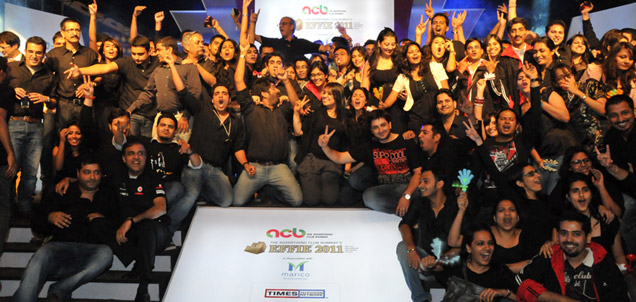
    On an exhilarating race day, at a place where horses would be galloping and competing their way for a finish to the top, yesterday it was the turn of the advertising fraternity to trot the turf and vie for their prized silverware. Mahalaxmi Racecourse in Mumbai was host to Effies 2011, the only awards show of its kind that recognizes effective advertising by creative agencies.


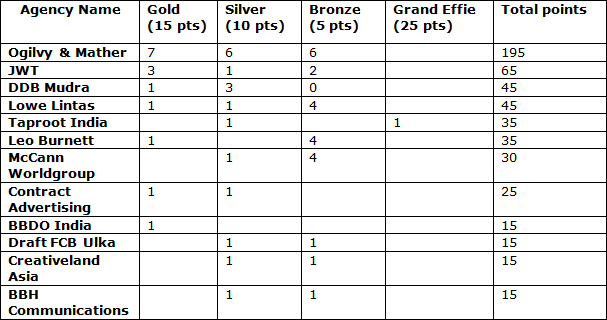
    Having finished as the agency with the highest number of shortlists, Ogilvy & Mather didn’t disappoint as it swooped a bagful of awards – 19 metals in all – leading it to be pronounced the Effie Agency of the Year for 2011. With a tally of 195 points – 7 Golds, 6 Silvers and 6 Bronzes, Ogilvy thumped its nearest rival JWT by almost thrice the number of metals, a milestone that has been a regular affair at the awards. JWT came a distant second with 65 points – 3 Golds, 1 Silver, 2 Bronzes, while DDB Mudra and Lowe Lintas were tied for the third spot with 45 points each.


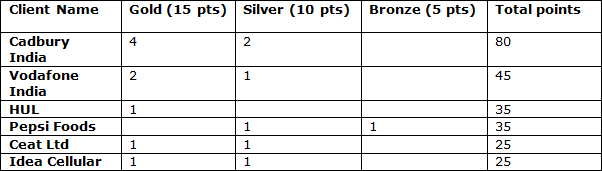
    The icing on the cake for O&M was when its coveted client Cadbury was declared the Effie Client of the Year. With 4 Golds and 2 Silvers, Cadbury edged out Vodafone India – an Ogilvy client as well – which occupied the second spot with 2 Golds, 1 Silver and 1 Bronze. HUL came third with a single Gold and 4 Bronzes.


    Flagging off the awards ceremony, Shashi Sinha, President of the Bombay Ad Club welcomed the gathering by stating that it had been a stellar an experience for the organising committee and the judges who managed to sieve and rummage through a bundle of noteworthy entries. Apart from the big number of entries and new additions the event managed to attract, Sinha said that the awards was different from the others, as it was run on international guidelines and was importantly, controversy-free.


    Lavishing praises on the event, Chairperson – Effie Committee and fellow-member, Ajay Kakar began by citing an anecdote. “During my early days as an executive in an ad agency, I used to often hear marketers say that half the money I spent on advertising is wasted and the trouble is, which half was wasted was not known. But with the instituting of the Effies, that perception has changed. In fact, it is the only awards show where both the client and the ad agency walk together to collect the awards.”


    According to Kakar, it was truly a remarkable experience for the organising committee this year as there were more categories – 12 in all, which saw around 300 entries and the 80 judges had the arduous task of shortlisting the best.


    Winning stance

    Elated with another super showing, Abhijit Avasthi, NCD, Ogilvy India remarked: “We are absolutely thrilled, given that Effies is a culmination of the year’s efforts and that it is the right balance between creativity and effectiveness in the marketplace. What’s more reassuring and satisfying is that the wins are across a lot of categories and clients.”


    When asked to comment on his client bagging the Client of the Year award Avasthi said: “Though we are happy that Cadbury has bagged the Client of the Year award, we have been supported phenomenally well by our other clients too.”


    Not disheartened by the performance of his agency, Colvyn Harris, CEO, JWT India, which came in second, said: “Every year, around this time, we review the works that we do for our clients and given our standing at the Effies this year, we hope to start 2012 with a brand new team so as to compete closely with the No 1.”


    On Effies being a great creative platform for agencies, Colvyn said: “I think Effies is a great platform for one to showcase their work, because finally, creativity may be everything but this is as important, if not more important, from a client’s point of view. If you are not successful in the marketplace, then nothing else matters. So my ambition is obviously to do well at the Effies and back that up with a good creative showing as well.”


    It was a night of thrilling proportions for Agnello Dias and Santosh Padhi from Taproot India as they bagged the envious Grand Effie award. Sharing his initial reaction on the win, Agnello Dias, co-founder, Taproot India said: “It keeps getting better. When I won for Lead India, I thought this is it; I won’t get another Grand Effie. Then Teach India happened and this year I won a Grand Effie again. So it keeps getting better. It’s even more satisfying that we are doing it outside of a large network agency and we are doing it on our own.” On the hopes for next year, Aggie said that he aimed to continue the feat with Airtel and maybe also Pepsi.


    Enumerating on their win, Santosh Padhi, co-founder of Taproot India said: “We had sent four entries, of which three were shortlisted, while two bagged awards. So I guess it was a pretty good showing. Considering the size of our agency – we have around 30 people, versus other big agencies that have 3,000 people, or more. Competing with them and coming fifth is an outstanding achievement for us. This shows that it is not numbers that matter but the power of an idea that is important.”


    Joseph George, CEO, Lowe Lintas, which tied for the third spot, said: “I think we could have done much better because Effies are the only awards that we seriously participate in. Actually, we were a bit disappointed with the shortlist itself considering we had sent more than 20 entries. But no worries, we will try harder and do better next year. What is important is that the No 1 tag is never to be taken for granted and the same goes for No 2 and 3. So we hope to be back next year, bigger and stronger.”


    The other commendable awards for the night included Marico Uncommon Sense Award that was bagged by O&M for Vodafone’s ‘Blackberry for Everyone’ and Brand Equity Bravery Award that was bagged by BBDO India for Gillette Mach3 Turbo – Shavesutra.


    Tally:


    Effie Client tally:

  • Rumour Central: N P Sathyamurthy (Sathya) to head media across Mudra

    By A Correspondent


    Veteran media analyst and planner N P Sathyamurthy is reportedly moving on from Lintas Media Group (LMG). Sathya, as he’s popularly known in the trade, has been COO with LMG and CEO with Karishma Initiative and has worked with the media agency since October 2007.


    Although an official spokesperson at LMG vehemently denied the development, MxMIndia learns that Mr Sathyamurthy may have in fact accepted an offer from the Mudra group. The role at Mudra, it is believed, is a more challenging one and will require work across media and the diverse interests of Mudra.


    Prior to his current assignment, Mr Sathyamurthy was exec director at carat and director-general with MRUC from March 2003 to September 2005. He has also worked with Euro RSCG-MPG, O&M, Mudra, Cadilla Labs and a four-year stint at Heinz.


    While he is known to be a master at dissecting numbers, Sathya (Sathyamurthy Parthasaradhy Namakkal being his full name) is educated to be a zoologist. An MSc from Annamalai Univ, he has done his bachelor’s at the University of Madras having studied at the Presidency College in Chennai.


    Although his last day at LMG is not known, sources inform that he is likely to join by Mudra next month or latest by February 2012.