Blog

  • [LOOKBACK 2011] People movements: some surprising, some not-so

    By Ritu Midha


    People movement is a way of life for any organisation, more so when it happens in the advertising and media industry.


    Here are some leading movements of 2011, a few of these even making one’s eyes pop with disbelief


    Ashvini Yardi:

    Ashvini Yardi, who seemed to be doing everything right at Colors as Head of Programming quit the channel. This made many wonder what next for Colors shows? Ms Yardi, meanwhile, continues to work with Viacom 18 and would work on film projects.


    Bharat Kapadia:

    Bharat Kapadia quit Lokmat as Director in July 2011, and started two ventures of his own. One of them a marketing consultancy firm called ideas@bharatKapadia, and the other a technology solutions company: Whatuwant Solutions.


    Bobby Pawar:

    Mother of all surprises! Mudra bagged awards by the dozen last awards season, and credit for the same, to a large extent, goes to the creative genius. He joins JWT India as Chief Creative Officer and Managing Partner India. Would the JWT awards tally increase in coming years, courtesy Mr Pawar holding the reins of creative at the agency? We vote in favour – what say you?


    CVL Srinivas:

    CVL Srinivas was the first big movement of the year 2011, moving to Starcom MediaVest as MD, LiquidThread, APAC & Chairman, Starcom MediaVest Group, India. Mr Srinivas moved from Bennett Coleman & Co Ltd, where he was the Director – Private Treaties.


    Divya Gupta:

    One had almost thought that the lady with a razor sharp mind had left advertising for good. But she proved us wrong. She joined Dentsu, as the CEO of media business. She returns to advertising and media after a gap of six years, how much a difference her presence would make to Dentsu India, we would learn shortly, as she believes in driving in top gear.


    Divya Radhakrishnan:

    Her quitting TME as President in January 2011was another big news earlier in the year. Ms Radhakrishan recently launched Helios Media Pvt Ltd which would offer outsourcing services to the broadcasting industry in the sales, marketing, research and traffic management.


    G Krishnan:

    The phones never stopped ringing the day G Krishnan quit TV Today. After 16 years with the organisation, he was the face of the organisation and rightfully so, considering his contribution to it. Future plans of the former Executive Director & CEO, TV Today Network Ltd are still under wraps.


    Haresh Chawla:

    Haresh Chawla, a name synonymous with Network18, decided to move on in November. Currently the Group CEO of the organisation, he has been with the organisation for 11 years and guided its growth from a single television channel, CNBC-TV 18 to a media conglomerate with diversified interests and revenues of Rs2,500 crore in FY 2011. All eyes are now on Mr Chawla’s next destination, while he is busy handing over the responsibilities.


    Joy Chakraborthy:

    Joy Chakraborthy quit Zee Entertainment Enterprises Limited (ZEEL) as Executive Director, Revenue & Niche Channels in October-end and had people guessing where he was headed, but not for long. He joined TV Today Network as CEO on December 1, 2011. How far Mr Chakraborthy fits into Krishnan’s boots, only 2012 will tell.


    Raj Nayak:

    This one left people gawking too! Bosses at Viacom 18, of course, remembered the magic Mr Nayak had created at Star TV, and expect him to pull a similar rabbit out of his hat yet once again. Would 2012 see Colors moving up to be the numero uno yet once again? We would have to wait and watch.


    Rajesh Jejurikar:

    Rajesh Jejurikar announced his movement from Mahindra & Mahindra to Zee Entertainment Enterprises Ltd as president in November. It will be interesting to see how he deploys his learnings as the president of automotive division, M&M at Zee.


    Rajiv Agarwal:

    One of the most acclaimed names in Indian advertising, returned to what he knows best – advertising in February 2011. After a seven years hiatus, he relaunched Nexus Equity in partnership with Arun Kale, his former partner.


    Rohit Ohri:

    He was Senior VP and Managing Partner role at JWT before he moved to Dentsu India Group as executive Chairman in June 2011. Many in the industry are of the view that Mr Ohri’s appointment was an excellent move on Dentsu’s part.


    Sameer Nair:

    When he quit Turner General Entertainment Networks in May 2011, it was, indeed, big news. However, with the organisation all set to fully integrate Imagine operations into Turner Broadcasting System Asia Pacific, many expected this to happen.


    Seema Mohapatra (November 2011):

    No one really expected Seema Mohapatra to move after a dozen-and-a-half years stint with BBC Worldwide. At the time of calling it a day at the organisation, she was the Regional Director, South Asia BBC Worldwide and headed BBC Advertising, ad sales company of BBC Worldwide for the region.


    Shreejit Mishra:

    The biggie from Hindustan Unilevel was appointed as the CEO, BCCL in May 2011. Yet another example of media companies trying to make the most of learnings in FMCGs.


    Suman Srivastava:

    The ace adman moved on from the position of CEO, Euro RSG in January 2011, to be the Founder & Innovation Artist at Marketing Unplugged.
     

  • Life OK’s gr8 start with 87 GRPs (report + analysis by Stratagem)

    By Rishi Vora


    While it may be still early days to declare Star India’s new channel Life OK as a success story in the Hindi GEC market, there is no doubt that it has delivered on the network’s goal No 1, which was to make an impact on the industry.


    The primary objective, as cited by a few industry observers, is to compete with the Sony and SAB TV combo, so that Star as a network could have a commanding position in a market which is now seen as hyper-competitive.


    So Life OK has clocked 87 GRPs in its first week, surpassing Colors’ 81 GRP launch back in July 2008. It may be recalled that Colors had left no stone unturned for the launch. The strategy was to start with the big-ticket show Khatron Ke Khiladi (with film star Akshay Kumar in a way giving a solid push to the channel), aggressive marketing, fiction shows, mythology, so on and so forth.


    One may argue that Colors was launched as the flagship channel of a joint venture company of two broadcast majors – Viacom and Network 18. Life OK in that sense is Star India’s second offering in the Hindi GEC sector. But, that has very little to do with what the channel has achieved in the first week as Star officials say that the idea is to compete with every channel in the market, it doesn’t matter if it means competing with elder sibling and No 1 channel Star Plus.


    An interesting observation: Imagine and 9x were launched in the same year (2008) and registered 55 and 21 GRPs respectively. Both the channels gradually grew in GRP terms, but as the market became competitive, the going for both channels became tough. While Imagine is still around (currently placed at No 7 with 67 GRPs), 9x may be on air, but even though it has been acquired by Zee, it has failed to create an impact . Of course there are several reasons attached to why the channel tasted early success and witnessed one of the most dramatic and talked-about downfalls.


    As for Life OK, its success at this stage can be attributed to the following: A sensible approach to launch the channel with a unique philosophy, marketing blitzkrieg (it is reported that Star India made an investment upwards of Rs 700 crore to launch the channel. The campaign, which is in full swing now, saw a three-day roadblock across Star India’s network, an outdoor plan reaching 100 towns, a week-long digital engagement programme which included an eight-hour-long concert, and of course getting Madhuri Dixit as the Sutradhar (storyteller). Plus, the fact that the channel did not bank on one particular show to deliver, and rather offered viewers a package of differentiated programming, the strategy to cut down on advertising inventory – all these factors put together have produced rich dividends.


    Official comments from the senior members of Star India and Life OK could not be obtained at the time of this report. However, industry observers believe that Life OK has what it takes to be a serious contender in the Hindi GEC market.


    Ashish Bhasin, Chairman India and CEO South East Asia, Aegis Media, observed, “Life OK as a channel has great potential.  However, the true test of a channel is after it has settled down for a few months. It is sometimes easy to get content for a short period but sustaining it on an on-going basis becomes a challenge. Ultimately, in my view, content drives the fate of any channel. If Life OK is able to sustain good quality content on an on-going basis for two or three years, it can definitely become a serious player. On the other hand, if the quality of the content starts to drop after the initial launch, then it’ll have a struggle ahead for itself.”


    Havas Media CEO – India and South Asia Anita Nayyar said, “With the kind of marketing backup and hype, the opening seems good and certainly a hike from the Star One deliveries. However, two-three weeks of sampling will continue and the actual stability will start setting in after a few weeks. Coming from the Star Network, the programming quality is very good.”


    On whether it will pose a challenge to the top players – Star Plus, Sony, Colors and Zee, she said, “It will be a strong competition in the GEC category for the No 3, 4 and 5 slots. Not sure about whether it will be another success story as big as Colors, as it had the advantage of differentiated content on the social platform when it launched. The content is interesting and should help stabilise around 60-70 GRPs from here.”


    In an earlier interview to MxM India, Star India COO Sanjay Gupta had mentioned that the No 4 position in the GEC line-up (currently held by Zee) would be a first good milestone to look at. In week 52, Zee is at 208 GRPs. Though he did not put a timeframe, going by what experts have to say, the channel will need to pick up on its early momentum and get there by bringing differentiated content – something Colors did very successfully.


    While Imagine has slipped to No 7 position and SAB is at No 5 with 122 GRPs, it looks like a serious battle from here on.


    An analysis by Stratagem Media Pvt Ltd on the launch of Life OK.Background 

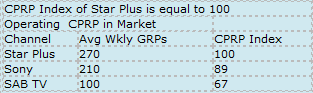
    It is a jungle out there in the media business. If you win the battle, you still have to worry about losing the war. Recently the Star Network launched another GEC called Life OK. Probably in the wake of competition from the Sony and SAB TV combo.The table 1, below depicts that the Sony and SAB combo was just about edging out Star Plus from the top GEC position, especially if it came at a more attractive rate (CPRP), as estimated in the table below.So, the not-so-hidden agenda of the Star network for Life OK would be to combine it with Star Plus and thereby fend against the Sony + SAB offensive, but without devaluing their trump card (i.e. Star Plus itself). Therefore, how would the new channel Life OK have to price itself, to overcome the Sony + SAB threat?


    Stratagem Media has undertaken a simple exercise to answer this question, for different levels of performance of Life OK.


    Objective of the exercise: To derive the CPRP Index of Life Ok @ different level of GRPs, if the CPRP of Star Plus is 100?


    Methodology: If the CPRP of Star Plus is 100, then what should the CPRP of Life OK be, if they have to match the CPRP of the Sony + SAB combo at different GRP ratios between the 2 channels.


    In the exercise below, the ratio of GRPs purchased between Life OK and Star Plus is assumed to improve in favour of Life OK, as its performance improves.


    *At these CPRPs, the Star Plus and Life OK combo will be as cost-effective as SET and SAB combo.


  • [LOOKBACK 2011] Middle India on overdrive

    By A Correspondent


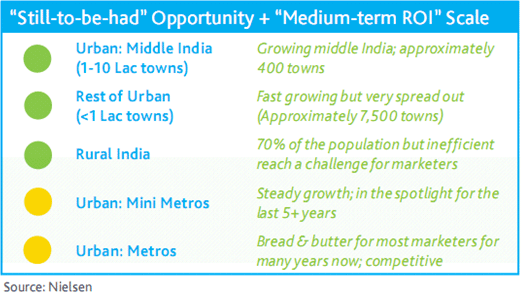
    While metros and mini metros are the flavour of the season for marketers on one side, and rural on the other, it is Middle India that is growing the fastest as far as consumerism is concerned, as per the Middle India Gold Rush, a study released by Nielsen India in December 2011.


    To define Middle India, it comprises 400 towns of population between one to 10 lakh per town. Put together these towns have an approximate populace of 100 million.


    Interestingly, the study states that Middle India would benefit disproportionately from consumerism of middle class (classified as strivers – annual household income of Rs 500,000, and seekers – annual household income of at least Rs 200,000). The reason is simple, a large percentage of the middle class resides in Middle India.


    In these towns, the markets benefit from the fact that they are easier to penetrate than metros due to sparse competition, and also easier to penetrate than rural areas due to better infrastructure.


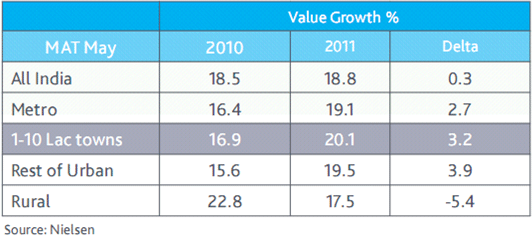
    Nielsen tracks 81 FMCG categories, and in early 2011, 49 saw faster growth in Middle India. As per the study, Middle India is showing strong value growth and as per MAT May 2011, it has moved from 16.9 per cent to 20.1 per cent growth, while for metros, the growth has moved from 16.4 per cent to 19.1 per cent, and on All India level, from 18.5 per cent to 18.8 per cent.


    Middle India is growing at a much faster pace vis-a-vis all India. From the year 2002 to 2010, Middle India saw 3.5 times growth in FMCG sector, vis-a-vis 3.2 of All India. Per Capita FMCG consumption too is much higher in Middle India as compared to All India. In the year 2010, both stood at Rs2,800 and Rs1,200 respectively.


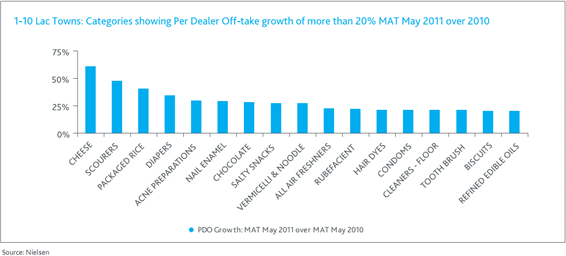
    FMCG players, obviously, are not oblivious to these growth numbers. Top FMCG players have added Rs35.8 billion from these 400 towns in the last two years. As of May 2011, FMCG per dealer off take increased to 14+ per cent in Middle India, up 2.7 points as compared to 1.5 points of metros.


    This, in turn, led to increase in number of FMCG stores in these 400 towns, at an average, 250 stores were added per town in the last three years. The total number of stores in these towns increased from 8,23,000 in June 2008 to 9,26,000 in May 2011.


    The growth story becomes even more interesting, if one looks at the subsection of 350 towns with population of 1 to 5 lakh. These towns are growing at over 20% and 56 of 81 FMCG categories outperformed All India growth rates.


    Marketers, thus, ignore Middle India at their own peril, because people residing there want to check out all the categories from potato chips to skin care and from shampoos to fragrances. They do not only want options in categories they have been using, but newer categories as well.


    Click here to download the complete report.

    http://nielsen.com/us/en/insights/reports-downloads/2011/managing-the-middle-india-gold-rush.html

  • Chris Thomas: BBDO India’s performance has been fantastic

    By Tuhina Anand, Video-Shruti Pushkarna

     

    Chris Thomas, Chairman and CEO of BBDO in Asia, Middle East and Africa and Chairman of Proximity Worldwide, has spent over 25 years in the communications industry, and the majority of his time working for BBDO. In an exclusive interview with MxM India, Mr Thomas shares his views on the network and his view on BBDO’s performance in India and the road map ahead.


    Q: Are you satisfied with the way BBDO brands are performing in India?

    I think we’ve seen tremendous developments in the BBDO brand in the last three years. Our partnership with RK Swamy BBDO has been a tremendous success and continues to grow and develop. BBDO India has been ranked as one of the most creative and the most effective networks in India.


    Chris Thomas on BBDO expansion plans

    You measure their performance at Cannes, by winning the first Indian effectiveness awards at Cannes; there has been tremendous progress.


    BBDO India’s performance has been fantastic. We’ve gone from nothing in BBDO India to an agency that punches well above its weight in terms of size, is winning on the world stage, is developing our multinational clients’ businesses and brands in a way that’s highly compelling and effective.


    Q: With the recent development of Mudra, would it in any way also affect the scheme of things for BBDO?

    Well, that is a tremendous commitment and recognition of the importance of the Indian market. For Omnicom, there’s been a long standing relationship with Mudra. Obviously from the BBDO perspective, Omnicom’s continued commitment to the Indian market is very important and supportive.


    Chris Thomas on Omnicom Mudra acquisition

    Q: Are you looking at expanding your footprint any further? If yes, where would it be?

    The only thing I’m looking at expanding is quality. What I’m always interested in, is doing great work that’s talked about and moving consumers in the Indian market. If we have specific needs to be addressed in specific geographies, then we develop those needs. But the most important thing to expand is to make sure that we are doing the best work in the market and expansion comes after that, not before.


    Q: So if you were to define BBDO, would you say it’s small, mid-sized or big?

    BBDO is a network around the world, so obviously it’s enormous. But it’s not what we focus on, what we focus on is on being good. BBDO is defined by what we call the work, the work, the work, producing the best and the most compelling commercial content on behalf of our clients.


    So in this market, we absolutely live up to and deliver on that promise, and that’s why it’s been fantastic for our clients.


    Q: In the current times, what are the two challenges that you are facing?

    The challenge… it’s true in all of the Asian markets, it’s around the world, I think. But I think particularly in India and China, the key for all of our networks is to make sure that we are attracting the best people into the industry, we are retaining them and we are developing and growing them. So for me, I spend a huge amount of my time on attracting talent, developing our talent, and making sure that we have got an unfair share of great talent.


    Chris Thomas on current challenges

    Q: So what is your formula for attracting talent?

    Well we have a phrase, ‘culture eats strategy for breakfast’, and what we mean by that is, it’s about the power of the brand and the power of the culture. The fact that we are indisputably the most creative network in the world, the fact that this year we’ve been ranked as the No. 1 effectiveness network in the world means that we have a very powerful culture, we are aligned around a set of beliefs and what we care about, and that tends to attract good people. And that’s what we preserve and protect at all cost. So culture ahead of anything else.


    Q: We’ve been hearing about a talent crunch but there’s also the issue of being paid well. Is that an issue or is it being blown out of proportion?

    I think there’s a difference between accountability and effectiveness, and I think as an industry, we are spending quite a lot of time thinking about accountability. There are things we can count, like the cost of production, cost of media and so on. And we need to be concentrating a lot more on effectiveness and the value we add as a business to our client’s business. If you do that and you can demonstrate that case and that value, then you can command a premium. But it’s for the clients to see value and that’s about generating effectiveness and effective work. And I think if you can get that right, then the remuneration conversation can follow from there.


    Chris Thomas on his formula for attracting talent

    Q: Can you tell us about Proximity in India?

    We launched Proximity about a year ago now. Obviously as a network, it’s a rapidly growing direct CRM and digital network. I think there’s been a huge amount of conversation around social media, digital CRM, and we are seeing good growth in that business and I think that will continue in India as digital media, broadband penetration, use of mobile – which is enormous in this country – continues to grow, there are tremendous opportunities ahead.


  • Kamal Basu to head marketing @ Skoda

    By Shubhangi Mehta


    Not long after quitting Saatchi & Saatchi as CEO, Kamal Basu is now said to be joining Skoda. Though no official confirmation could be attained at the time of this report, sources close to the development have confirmed the news to MxM India.


    Mr Basu was unavailable for comment. He had put in his papers in November 2011 at Saatchi & Saatchi where, as India CEO, he oversaw the agency’s Mumbai, Delhi and Bengaluru offices. Mr Basu had been with Saatchi & Saatchi India for nearly eight years after spending close to 14 years in agencies including O&M, DY&R and BBDO. He has been involved with multiple consumer categories and a rich set of global and local brands


  • The Anchor: 4 striking trends among Hindi music channels

    By Amar Tidke


    Year 2011 can be called the year of growth for the music television industry, and that has benefited not only the entire genre but also music lovers who now have varied choices for music consumption on TV.  As we all know, music knows no boundaries, it’s free from the boundaries of languages or countries and communities.


    Year 2011 saw music that cuts across all these boundaries and become the most popular hits. Four major trends that the industry witnessed are: Rise of many players in the music television space, the Digital interface, Regionalisation of media and the Innovation of content.


    #1 New channel launches

    Year 2011 saw the advent of many new channels in the music television space. We started the year with about 10 odd music channels and today we have 14 channels.  The launch of new channels has not only been a boost for the industry but also provided brands and viewers with varied choices to choose from.


    #2 Experimentation on content 

    Due to so many new entrants in the music television space, channels tried experimenting on their offerings and the audience was given assorted choices to select from. The audience demanded pure music content which was the focus of 2011. The year 2011 also proved that the audience is the final decision-maker, and channels were made to rethink their positioning to appeal to the viewers.


    #3 Regionalisation of media and innovation of content

    Another trend that was prominently seen in 2011 was concentration on regional audiences. 9X Media Group launched 9X Tashan, a Punjabi Music channel and Marathi Music channel 9X Jhakaas in the year 2011.


    #4 The digital interface

    Lastly, but very important, a trend that was seen in 2011 was the major use of Digital and Social media platforms. One of the major examples of this was the ‘Kolaveri Di’ song that was first seen on YouTube and then made its way to all popular music channels. That is the power of the digital wave and, given the interactive ability of this platform, many channels and youth brands were seen creating content for their target audiences on these platforms. We will see this platform only grow in 2012.


    Amar Tidke is Head of Programming and Senior VP, 9X Media Group.

  • Print exposes Anna’s ‘barren’ truth

    By Ranjona Banerji


    “Mumbai slow to Anna’s fast” said a front page headline in Mid-Day and that puts it succinctly. Hindustan Times, in its Mumbai edition, went with “Team Anna finds Mumbai cold, too” on page 2, nodding to both the fact that Tuesday was Mumbai’s coldest December day in 19 years as well as the reason for shifting the agitation from Delhi to Mumbai.


    But that wasn’t the news of the day, as it happened. First it seemed it might be Sachin Tendulkar’s 100th 100, but then he got out at 73. After that, it was all about the debate in the Lok Sabha over the passing of the Lokpal Bill. Of course, bolstered by the knowledge that the whole country was with the India Against Corruption agitation at the MMRDA grounds in Mumbai, the Ramlila grounds inDelhiand all over the country, TV channels promised us non-stop coverage.


    Unfortunately for all the time and money spent, not enough people showed up, either in Mumbai orDelhi. Unlike earlier times where TV cameras would concentrate on a small group and reporters would tell us that thousands had come, this time cameras ruthlessly panned empty grounds.


    So how many people showed up? The Times of India gave it a generous 10,000 to 15,000. Times Now and Newsx said about 10,000 at its peak, 4,000 through the day and 1,000 by the evening. The Hindustan Times quoted the police figures of about 5,000 as well as India Against Corruption figures of 30,000. The last is possibly wishful thinking and by the evening on TV, crestfallen youth were telling us that this agitation isn’t about numbers at all. This is somewhat at odds with Arvind Kejriwal’s earlier statement that the whole country was with them and if Aruna Roy could gather a group of 50,000, then she could push the government for her bill.


    * * *


    Of course, it is left to newspaper commentators to call Anna Hazare’s core team for their somewhat offensive language, since the cacophony on TV makes criticism very difficult. Hindustan Times has to be commended, for calling out Anna Hazare himself on his remark that “barren women cannot know the pain of childbirth”. The word “banjh” is a derogatory in most Indian languages and characterises the sort of insensitive language that is common usage in societies where sensitivity for the less unfortunate is unheard of.


    In an aside, it was amusing to observe the absolute silence of the Mumbaikars present when Hazare held forth on the importance of village politics in his speech. One can imagine the youth scratching their heads wondering what on earth he could mean.


    * * *


    The Lok Sabha debates and the confusion of whether the Constitutional amendment had been passed kept our TV anchors and studio guests busy till midnight. Luckily the Rajya Sabha was adjourned on Wednesday morning so the further passage of the bill is now delayed till tomorrow. The shortage of Constitutional experts available for TV consumption was felt very strongly on Tuesday.


    * * *


    Cricket was back in the spotlight and there is now also space for the apparent reconciliation between the two Ambani brothers.


    * * *


    For a change, the Rendezvous interviews conducted by Zainab Badawi on BBC News are quite refreshing. Guests range from Annie Lennox to Richard Dawkins to Michelle Yeoh, so the conversation is varied.


  • Skoda on lookout for creative partner

    By Shubhangi Mehta


    Six months after finalising a creative agency, Skoda has again called for a creative pitch. Industry sources close to the development have confirmed the news to MxMIndia.


    The account size for the same is pegged to be Rs 10 crore. It may be recalled that Skoda had awarded its creative mandates to Saatchi & Saatchi post a multi-agency pitch in May this year.


    Prior to Saatchi & Saatchi, the account was handled by Saints & Warriors. Before that Law & Kenneth was the sole creative custodian of the Skoda brands in India since 2007. It handled the creative duties for Fabia, Octavia, Laura and Superb.


    The creative duties for some of the Skoda brands were also handled by iB&W earlier; but these also went to Law & Kenneth.


    Skoda had entered the Indian premium car market in 2001 and set up a plant at Shendra, on the outskirts of Aurangabad.

  • [LOOKBACK 2011] Top TV & Print Advertisers


    By Ritu Midha


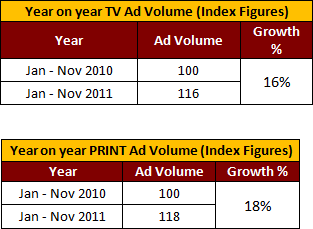
    Slowdown, as a term, might have the highest recall value for media owners in the year 2011 – more so in the case of print. Interestingly, while there would have been a dip in advertising spends in terms of value, advertising volume has in fact increased over the previous year. And even more interestingly volume growth has been higher for print media:


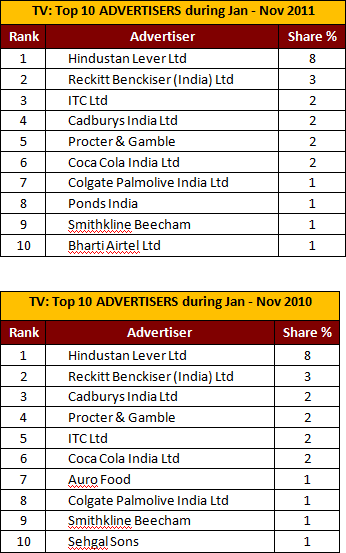
    When one moves to the top 10 advertisers for the year 2011 on television, the list seems more or less similar for 2010 and 2011, though the ranking has, of course, changed.


    Two advertisers from last year which are missing this year are Auro Foods and Sehgal Sons – both with 1 percent share.


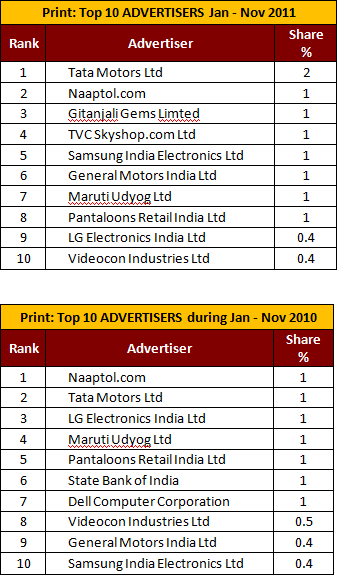
    Is the situation similar for Print? Let’s check it out: Two new entrants for 2011 are Geetanjali Gems and TVC Skyshop. The ones missing from last year are SBI and Dell Computers.


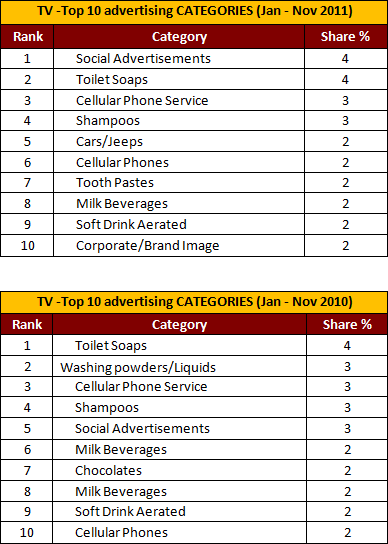
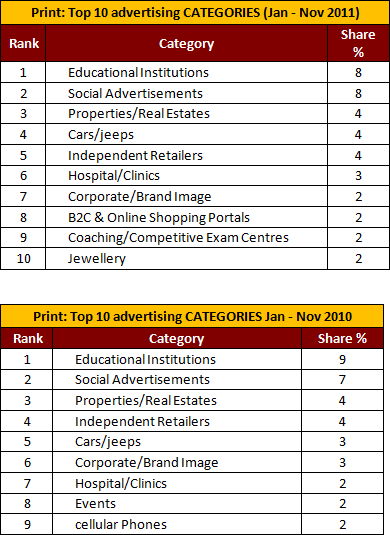
    As for the advertising categories, there are quite a few surprises when compared to the previous year, as far as television goes: Washing powders & liquids, number two category in 2010, is not in top 10 this year. Social advertisement, no 5 last, is top of the heap this year. Have a look at the tables for 2011 and 2010:


    On to print. The top five categories remain the same with just a position switch in rank in number four and five. However, there are two new entrants on eight and nine – pipping to the post the categories at those positions in 2010. Educational institutions, top category for both the years – shows a 1 percent jump in share:


    Source : TAM AdEx
    Period : Jan – Nov 2011 Vs Jan – Nov 2010
    Medium : Television & Print
    Figures for television are based on duration in seconds & are represented as index figuresFigures are based on CCMs & are represented as index figures
  • MAX introduces new film slot for movie buffs!

    By A Correspondent


    MAX, the premium Hindi movies and special events channel, is all set to bring its viewers the best of entertainment with a special movie slot titled ‘MAX Film Club’, every Saturday night after the 8pm Maha Movie.


    MAX Film Club’s Saturday night offering will offer a wide range of critically acclaimed titles like Aandhi, Ijaazat, Firaaq, Bazaar, Mere Apne and evergreen hits like Yaadon Ki Baaraat, Teesri Manzil, Aradhana, Kabhi Kabhie, Anand, Gol Maal and many more.


    Talking about MAX Film Club, Neeraj Vyas, EVP & Business Head – MAX said: “At MAX it is our constant endeavor to bring novel ways to entertain our audience. Our latest offering, MAX Film Club, is an effort to connect with the film connoisseurs, audiences who genuinely enjoy the iconic movies from across the eras. We believe there is an audience for this kind of cinema and we want to keep them glued to their seats on Saturday nights.”


    He added: “MAX Film Club is also a step to enhance our recently launched weekend campaign “Saare hafte lagey raho… weekend pe padey raho” by creating a complete entertainment package over the weekend.”


    MAX, India’s No. 1 Hindi Movie channel, provides its viewers with the biggest and best of Hindi movies and special events.

  • [LOOKBACK 2011] What creative & media agencies won

    By Ritu Midha


    A slew of international and national advertising and media awards dot the year. Agencies bag a prize, are written about, and in a few days, it is business as usual. The next set of awards comes up, another agency tops the chart, and the same cycle begins all over again.


    There are, however, agencies which garner awards consistently, across the award shows. Sometimes a few make a mark on the national awards scene, but don’t win so many accolades in international shows or it can happen the other way round.


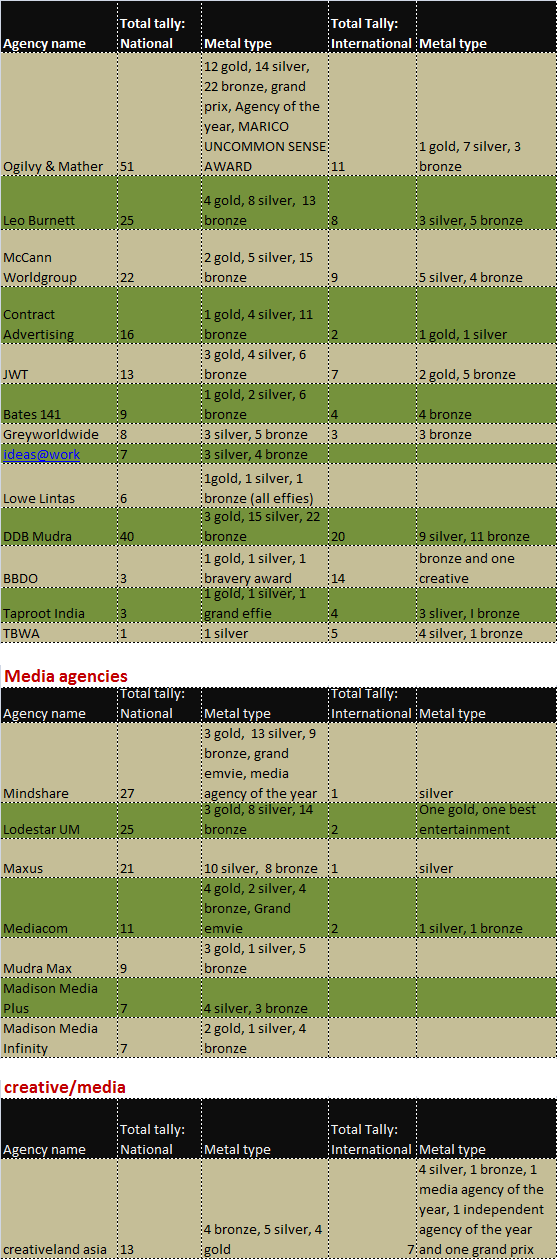
    The year 2011 had a few interesting ups and downs: BBDO which managed to bag 14 awards globally, got just three within India. Contract which got 16 within the country,  got just two globally. Mindshare won 27 awards nationally and one globally, Maxus had a score of 21 and one respectively.


    However, in the case of creative agencies, most national award winners have done well internationally too. (Perhaps the lesser number of global media awards has something to do with it!)


    Below is a quick look at how the key winners in national awards did globally, and in a few cases, how the ones which did very well globally, did in the national scene.


    Click here for a complete list of awards won by Indian agencies in the year 2011.