Blog

  • Colors launches sports reality show Ring Ka King

    By A Correspondent


    After having entertainedIndiawith their impressive bouquet of fiction shows, format shows and a number of successful reality shows, Colors, is all set to introduce a fresh format to its audiences.


    For the first time ever, the channel is launching the biggest sports entertainment reality show called ‘Ring Ka King’, which will feature 30 top Indian and international wrestling superstars including Jeff Jarrett, Matt Morgan, Scott Steiner and Monster Abyss; Indian wrestlers who have received international-level training like Jwala, Mahabali Veera, Romeo Rapta, Zoravar and Deadly Danda will also be among the participants. Indian cricket superstar Harbhajan Singh has been roped as the goodwill ambassador.


    The show will bring a mix of drama and reality by adding some Indian tadka to the good old wrestling matches that we have grown up watching. The show will go on air from January 28 at 8pm with subsequent episodes airing on Saturdays and Sundays.


    Colors CEO, Raj Nayak said: “We have always vowed audiences with some of the biggest reality shows like Bigg Boss, Khatron Ke Khiladi,India’s Got Talent and now we are proud to present yet another explosive first of its kind sports reality show – Tata Prima Trucks Ring Ka King. Coming down to participate in the show are international wrestling sensations.India, for the first time will witness the excitement of a sport and the intensity of a drama, both rolled into one.”


    He added: “We truly believe that the show will appeal to our viewers and advertisers who are constantly looking for new and innovative platforms to reach out to their audiences. We are glad to be working with Tata Prima trucks and hope that our relationship only grows hereon.”


    In what could be called a modern day clash of the Titans, some of the world’s most renowned wrestling superstars will be seen battling Indian pehelwans to capture the title of ‘Ring ka King’.


    In the first four weeks of the show, audiences will see matches that will crown a ‘Heavy Weight Champion’ and a ‘Tag Team Champion’. During the subsequent weeks, the champions will have to save their honour and title and fight against the other contenders who will challenge them to claim the belt.


    Through the show, audiences will get an insight about the intricacies of wrestling and what goes into making a show as enjoyable as this.


    Explaining the concept of the show Deepak Dhar, MD, EndemolIndiasaid: ”It’s an exciting format for us to work with. For the first time ever, we are combining sports and entertainment to create something very different and exciting. While the focus, of course, will be on the wrestling matches, it is the entertainment and the drama aspect of the show that will make the matches a lot more interesting. Endemol has entered into a partnership with TNA Entertainment, LLC to popularize professional wrestling. Endemol fulfils its commitment toIndiaby constantly bringing best-in-class entertainment toIndia. ”


    Jeff Jarret from TNA, who represents the international wrestlers participating in the show said: ”Tata Prima Trucks Ring ka King is a very exciting project for us at TNA. We know TNA has a lot of fans inIndia, especially young fans, so the enthusiasm levels are higher than ever. At the same time, the format of the show is very interesting which will allow our fans to see their favourite wrestling stars as not just wrestlers, but real people. Of course, we are looking forward to put on an adrenaline filled show that will get all our fans super excited.”


    On being title sponsors, Mr. Vinod Sahay, Head- Sales & Marketing, Medium & Heavy Commercial Vehicles, Tata Prima Trucks said: “We believe integrating our majestic Tata Prima heavy weight trucks with Ring ka King. It represents a natural fit for both our brand and the show. The Prima range of trucks, tractor trailers and tippers bring to India international standards of power, performance and endurance, which ties in very well with the Ring ka King format which aims to bring international standards of wrestling to our country incorporating the same attributes of power, performance and endurance.”

     

  • PM commends media while releasing book on Tribune

    By A Correspondent


    Prime Minister Dr Manmohan Singh released a book titled The Tribune 130 Years: A Witness to History, in New Delhi on January 19.


    In his speech on the occasion he said:

    “I am delighted to be in the midst of The Tribune family once again. The last time I was involved in your celebrations, I had the pleasure of releasing an anthology of selected writings to commemorate 125 years of this magnificent paper.


    “Today marks the release of a comprehensive history of The Tribune, on completion of 130 years of its publication. It is truly pleasant to go down the memory lane with the newspaper of my choice which has been my staple reading every morning for decades.”‘A Witness to History’ is an apt title of a book that records the 130 year old history of The Tribune. Indeed, this history stands closely intertwined with the story of our country’s journey during this turbulent period.


    “Sardar Dyal Singh Majithia, the newspaper’s founder was a man of rare foresight and a great reformist. He was inspired by high ideals and wanted The Tribune to be free of any sectarian or commercial bias, and unaligned to any dogma or political party. I am happy that the newspaper has by and large lived up to its founder’s vision. While being an effective watchdog of the interests of the people it has practiced responsible and credible journalism.


    “The Tribune has also been a wonderful example of good what trusteeship is about. Its Trustees have been men and women who have distinguished themselves in their respective professions and who embody the spirit of The Tribune very aptly.


    “The newspaper is one of the very few in the country where the editor is insulated – as much as is possible – from managerial demands and proprietorial interests. But even more importantly, the newspaper has always been blessed with Editors of impeccable credentials. My friend Raj is one of them, with many very illustrious names before him and some of them are present on this happy occasion.


    “I compliment all those who have helped shape The Tribune into the newspaper it is today-the generations before us and the current torch-bearers of this fine institution.


    “I congratulate the author of ‘A Witness to History’ Professor V N Datta for writing such a fine book. Prof Datta recounts how in the early years of the 20th century The Tribune became passionate as a patriotic and nationalist newspaper. He elaborates how from 1920 onwards, as events began moving at a fast pace and as communal tensions began building up, the newspaper’s sober and reasoned approach attempted to bridge the divide between the Hindus and the Sikhs on the one hand and the Muslims on the other. The Tribune was opposed to the dismemberment of India and made sincere efforts to prevent it, but in vain.


    “Glancing through the pages of ‘A Witness to History’ I was struck by the words of an avid Tribune reader who wrote to the newspaper on September the 25, 1947, the day The Tribune resumed publication from Shimla, after Partition had forced it to move out of Lahore. And he wrote: “The heart of Punjab has begun to beat again, though the pulse is yet faint.”


    “On May 13, 1948, to mark the Tribune’s shift to Ambala, the then Prime Minister Jawaharlal Nehru wrote in a special message to the newspaper in his inimitable style: ‘You have passed through many difficulties and have stood many tests. I trust you will not be carried away by momentary passions but will function with a vision of the future before you.’


    “We have come a long way from the early years of The Tribune. Today, while India sits at the high table of nations and is looked upon and heard with respect, a vibrant media is crucial to our needs-a media that informs and educates, a media that is inspired by public interest and not guided by sectarian or commercial considerations.


    “The Indian media of today has its inevitable highs and lows. Every day we see examples of journalism of a very high calibre. There are instances of fair and accurate reporting, free of biases. There are stories with painstaking research to back them up. Journalists often expose wrongdoings even at considerable risk to themselves. There are efforts to report constructively on subjects that are of vital national importance.


    “But we also see sensationalism, driven by a desire to sell a story at any cost. There are stories without a clear understanding of the underlined issues. There is reporting which is prejudiced. There is trivialisation of important matters. There is corruption. The prevalence of the practice of ‘paid news’ exposed recently has come as a shock to all right-thinking people.


    “It has been our government’s avowed belief that the Fourth Estate is an essential pillar of our democracy. We believe in complete independence of the media from external control. It is true that sometimes irresponsible journalism can have serious consequences for social harmony and public order, which the public authorities have an obligation to maintain, but censorship is no answer. It is for the members of the Fourth Estate themselves to collectively ensure that objectivity is promoted and sensationalism is curbed. It is for them to introspect how best they can serve our country and society and advance their well-being, and how best they can earn the respect of our common citizens. Those in the media should come together to exercise a degree of self-regulation to combat perversions like paid news.


    “It is an important responsibility of the media to expose corruption and other ills in our polity and society. It should also advise the government and even reprimand it when it goes wrong. But let me also suggest that it should not be all gloom and doom all the time. The world is looking up to us today and it would be but fair that positive news is also given its due share. The Indian development story is an exciting one and should be told through the print and visual mediums.


    “I believe that good journalism is very serious business and a very difficult work. The responsibilities that journalists carry are onerous – to inform and educate the public, to keep a watch on the government’s work and to highlight issues of critical importance. It is hard to be a good journalist – ever willing to learn, ever alert to new developments, objective, fair, sensitive, balanced and constructive in approach.


    “However, I also believe that collectively the country’s journalists have acquitted themselves reasonably well. I am convinced that the Indian media is on the balance responsible and attuned to serving national interest. I am also sure that the coming years will see even higher standards from our media.”


  • Digital Summit: Business in the time of the cloud

    By Akash Raha


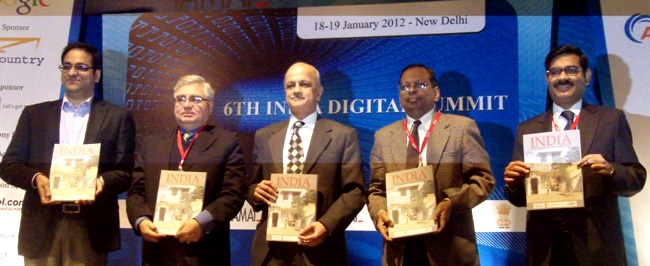
    The second day of the Sixth India Digital Summit hosted by IAMAI and Ministry of Information & Technology got underway in Delhi on January 19, 2012. The last day of the summit featured a wide array of discussions and debates between prominent members of the industry.


    Leadership Session 3: The connected home: devices and service revolution

    In the current scheme of things there is a proliferation of newer devices. Each and every day there are a plethora of newer devices coming in the market. To support all these devices a new service industry came up to support them. The session spoke about the nexus of devices, connectivity and the service sector in the back drop of the nuances of the industry, such as security.


    The session was chaired by Mr Sanjay Trehan, Head MSN India, Microsoft and the stage along with him was shared by Mr R Sivakumar, Managing Director, Intel South Asia.


    The discussion started off with Mr Sivakumar talking about the connected home. He said that the times have changed from connected homes to connected life. Earlier, Home was where the first use of technology begins. We have been using technology over the past decade without knowing about it. But some of those ideas are fast dissipating as our devices are no longer wired and we can move outside the periphery of our house and hence the idea of connective life.


    As technology has developed, the proliferation of devices too has increased. He said that the technology in the future will be dominated by three screens out of all the new devices based on convenience and ultra mobility – smart phones, netbooks and large television screens.


    He spoke about the growth of ecommerce and gave the example of the Indian Railway site irctc.co.in which does business of Rs 500 cr each month. The service provided is getting more sophisticated and more available as time goes by. With proliferation of device and connectivity, services provided online are increasing.


    When posed a question on security threats by Mr Trehan, Mr Shivakumar said that the security capabilities are still at its early stages and have to be built on. In terms of new technology, the bogey that we often ride is the talks of national security. National security and integration of security protocol is very important and yet there has to be ways to streamline the whole process and allow newer technologies to come in.


    Power Panel 7: Cloud Cluedo – Solving the mysteries surrounding the cloud

    The following session tried to unveil the mystery of cloud computing technology. Even though everyone in the technological domain are talking about this technology and its use, few people know about the intricacies of it, which the panel tried to unveil. Cloud computing gives one the ability to put business applications on the ‘cloud’ which would then make it possible for the users to access it from wherever he or she wants to.


    The following session was moderated by Manoj Chugh, President India & SAARC, EMC Corporation while the panelists were Mr Fredric Moraillon, VP – Marketing, Asia Pacific & Japan, Akamai Technologies and Rajnish Menon, director – ISV & Cloud Strategy, Microsoft.


    In his opening remark Mr Chugh explained that there are various kinds of clouds, such as Private Clouds and Public Clouds… Moreover, there is a whole mix of these clouds which gives rise to Hybrid Clouds of all shapes, sizes and colors. Cloud computing saves cost of infrastructure and will help businesses grow in the future, thereby creating new job opportunities. Moreover, while the old skill sets are going to remain important, new skill systems are needed for Cloud.


    According to sources, 50% of the cost of infrastructure can be saved when a business employs and moves their infrastructure to the Clouds. The initial cost of the infrastructure will depend on what kind of a Cloud it is. No two clouds are alike and clouds constantly grow and make newer clouds.


    Mr Menon explained to the audience that Cloud is very useful as it standardizes IT capabilities. To show the efficacy of cloud, he pointed out how all the fortune 500 companies have some sort of Cloud or the other. The point is, that Cloud is already here and is all pervasive.


    The next question that Mr Menon talked about is, is Cloud secure? The answer that he proposed was, yes, it is one of the most secure one as authority is given to only one or two who can see all the data. For those who wondered how costly cloud is, Mr Menon told that “Cloud is really cheap, but it depends on what applications you are using etc.”  In terms of regulation, currently, there is no cloud law in place in India and it is all about interpretations of the other existing laws.  Cloud computing has therefore become a new way in which one can deliver and consume IT.


    Talking about the cloud, Mr Moraillon said “From the Cloud perspective the consumer and the business are constantly merging.” He said that one can put anything on Cloud…But the question is what do you want to put on the cloud but the question is what the security level you have to secure that data is? Information is of value and it is important to keep it in the vault. But yet Cloud is useful as it is helpful and makes work and processes much easier. “You can do a campaign, a budget, file travelling expenses etc… Cloud can do all of that very easily and efficiently.” Today, one feels disconnected when ones hard disk crashes – a lot of hard work goes away, but such a thing does not happen with Cloud as the data will be present and secure on the cloud.


    The three important aspects which Cloud is efficient on is Time, Money and Labour; Wherein, it saves time and money, and allows employees to work just the way they want to work, from wherever they want. In the modern times markets are extremely fragmented and clouds helps adapt, open newer avenues to connectivity and the way work is done. The only possible concern that some businesses still have today is that of accessibility and security, however, cloud is developing and is developing fast. It is imperative that businesses move to cloud to be successful in the future.


    The panelists explained that one should move easier process on the cloud first and then go on to bigger process which have legacy and are relatively harder to move. But to start moving to the Cloud, maintained all the panelists, is essential.


    Power Panel 8: “To be or not to be an Entrepreneur”

    Being an Entrepreneur and building a business out of the scratch is never easy. In the current session the panelist discussed and talked about their difficulties in becoming successful Entrepreneurs. The talked about their experiences and shared their visions with the crowds.


    For many, starting a venture was a triggered by their situation, for some it was a choice and for the rest it was a mix of the two. The session was moderated by Manish Vij, Founder and CEO, Vun Network. The panel members for this session were Dhruv Shringi, Co-Founder & CEO, Yatra.com; Dinesh Aggarwal, Founder & CEO, IndiaMart; Rishi Khiani, CEO, Times Internet and Anisha Singh, Founder & CEO, Mydala.com.


    Mr Shringi said that currently the entry barrier is low to get into the business and it is a very good time for people to get into the business as the growth rate is good. Yet, Mr Aggarwal warns that people should not get into the business just because there is opportunity and growth. What is really required is a will to do ecommerce.


    To start off a business, funding is an important issue… Ms Singh pointed out that to garner funding and make profit eventually one has to have conviction in once business. Funding is tough and one has to have the ability to convince the investor, moreover, immense trust in once own vision is required.


    A few of the members in the panel also had a co-founder and investor… Talking about the aspect, Mr Khiani said that it not important that your partners are like you and think like you, but it is important that they have the same vision as you and believe in the product as much as you do.


  • Anil Thakraney: Dear News Channel Editors…

    By Anil Thakraney


    Er, we don’t want to hear about or watch any of the following, most of which seems to be getting prime time coverage from you guys. Either you’ve run out of news or have run out of edit judgment or both.


    Please go easy on the political turbulence in Pakistan. We really aren’t interested in their internal machinations and electoral problems. Whichever government or army chief comes to power, their India obsession will go on anyways. And Kasab’s cronies will try to slip in anyways. Tell us the ‘moti moti baat’ and cut them out. Please.


    And the army general’s age? Really, we are fed up of figuring out his date of birth, and frankly, we don’t care. We have to worry about the potholes that have sprung up on a newly built flyover. And to think the officer isn’t even a lady that we must pay so much attention to the age. Hatao, yaar!


    Please don’t overkill on the UP assembly elections. I know most of you editors are located in Delhi and therefore politics runs in your blood. And that you are obsessed with Rahul Gandhi’s shenanigans, but the rest of us in India aren’t really crazed about the battle between Maya and Mulayam. Also, whoever comes into power, the mass migration out of the state isn’t going to end. So cool down, people.


    Kindly snip out those TV shows where the usual suspect ‘experts’ dole out gyaan on why India got thrashed by Australia. There’s only so much we can take about ‘Indians should have batted, bowled and fielded better’. Yaawn! Either invite some totally fresh minds to your studios, or knock this faltu ‘analysis’ out.


    No more Kolaveri tidbits, please. The song is screaming out of our ears and lungs already. There’s only that much you guys can milk a good thing.


    Oprah’s only ticket to fame is a TV talk show. That too back in Amreeka. So okay, you told us she’s around, she’s partying and she’s shopping in Colaba. Cool. Now can we leave her alone, please? I’d rather you told us a bit more about that deadly tuberculosis bacterium. Or, you could invite Oprah to conduct a talk show on it. That would be nice.


    Thank you in advance!


    ***


    PS: The quick history of advertising. From 2000 BC to 2011 AD. With the help of cool illustrations. Enjoy!


    Link: http://mashable.com/2011/12/26/history-advertising/


  • The Anchor: 5 reasons why radio is very effective in tier 2 and 3 cities

    By Harrish Bhatia


    #1 Radio offers localised content:

    Radio speaks to consumers in their own language or dialect, and the degree of connect of the local content with people in these markets is far higher than any other medium.


    #2 People have more time for radio consumption:

    Since the level of activity in these markets is lower than in metros, people have more time to spend for themselves. This is where radio fills the gap. The increasing number of FM-enabled handsets has further increased the consumption of radio. Radio measurement survey conducted by RAM has proved that the average time spent listening to radio per day is 244 minutes inNagpurand 206 minutes in Jaipur as compared to 127 minutes in Mumbai and 124 minutes inDelhi. (Source: RAM Sweeps 1.0)


    #3 Radio serves as key source of information because of lower literacy rates:

    Literacy rates in these markets are much lower than in metros and as a result, radio serves as the primary source of information. Another critical point is that radio provides regular updates throughout the day whereas a newspaper provides news only in the morning.


    #4 Radio works even when there is no electricity:

    Since tier2 and tier3 cities have fewer electricity connections as compared to the metros and also suffer more frequent power cuts, radio serves as a main source of entertainment for people, instead of television. As a result people tune into radio using transistors and mobile phones.


    #5 Low internet penetration:

    Low internet penetration and inadequate bandwidth in these markets means that internet remains a distant dream. Thus, in the absence of internet, radio serves as a major source of engagement and personal entertainment.


    Harrish M Bhatia is the CEO, MY FM.


  • mydala.com brings battle of Agneepath to real life

    By A Correspondent


    India’s largest group buying/social commerce portal, mydala.com, has announced that it has partnered with Dharma Productions as the social commerce promotion partner for 2012’s most awaited movie, Agneepath.


    mydala.com will engage its fans, customers and merchants in ‘gang wars’ leading to Agneepath through an aggressive multimedia campaign. The real-life battle to win movie tickets, merchandise, and other prizes every day, and a chance to attend a special preview screening of the movie, has already started even before the reel-life battle begins later this month.


    Releasing worldwide on January 26, the movie revolves around Vijay Dinanath Chauhan (Hrithik Roshan) and his revenge against Kancha (Sanjay Dutt).Priyanka Chopra plays the female lead of Vijay’s aide and best friend Kaali, while Rishi Kapoor plays city gang lord Rauf Lala. Directed by Karan Malhotra, and produced by Hiroo Yash Johar and Karan Johar, the film also features Om Puri, and Katrina Kaif makes a special appearance.


    According to Mr. Apoorva Mehta, CEO, Dharma Productions: “In a networked world, traditional marketing alone is not enough to ensure success of a movie. We have partnered with mydala.com because of domain expertise and experience in creating unique and successful social commerce campaigns for Bollywood movie launches.”


    As many as 2,000 merchants across 11 Indian cities have already professed their allegiance to either Vijay’s or Kancha’s gang by sporting their gang posters for the movie at their merchant outlets, and are now enrolling thousands of customers to join their gang to emerge as winners through pamphlets bearing promo codes.


    Every customer who shops for Rs500 or more at any of these merchant locations is eligible to receive a leaflet with a unique promo code. Customers purchasing deals worth Rs500 or more onwww.mydala.com during this contest period will also receive a promo code. The campaign will runs till January 31.


    As part of its comprehensive multimedia campaign, mydala.com is promoting the movie across its entire network and beyond, including its website, Facebook, Twitter, and other partner sites. mydala.com has also roped in the movie’s leading stars Kancha (Sanjay Dutt) and Kaali (Priyanka Chopra) to lend their voices for an aggressive campaign across leading radio channels in several cities all over India.


    Elaborating on the tie-up with Dharma Productions for promoting Agneepath through social commerce marketing, mydala.com’s founder and CEO, Anisha Singh said: “Having successfully run social commerce and multimedia promotions for recent big titles such as Don2 and Ladies Vs Ricky Bahl has given us great exposure to film marketing. Agneepath is special and we’ve created a social commerce marketing plan equally special to match its calibre. To further add flavour to the war between Vijay Dinanath Chauhan and Kancha, we have also created a special Facebook app, Walk the Agneepath, where people can participate in a contest by watching a movie clip and correctly answering the questions.”


    mydala.com has also created a live scorecard on its Agneepath page on the mydala website where you can find how your gang is faring. Scoring is based on every promo code entered into the system. The gang that gets the most points at the end of the promo period will not only get to win Agneepath merchandise, movie tickets, mydala vouchers and other prizes, but also a chance to meet the star cast of Agneepath.


  • Dentsu India Group makes key senior level appointments

    By A Correspondent


    Dentsu India Group on Wednesday appointed Suprotim Day as Chief Films Officer and CP Arora as Group Chief Financial Officer.


    Mr Arora (popularly known as CP) takes on the mantle of Group Chief Financial Officer from Nobuki Sakai, who was seconded to Dentsu India early last year. A qualified Chartered Accountant and Company Secretary with nearly twenty years of experience in financial management, Mr Arora joins Dentsu from JWT, Delhi where he was the Vice President and Executive Commercial Director. As Strategic Business Partner with JWT, Delhi at both, the corporate and business unit level, he tracked financial efficiency and profitability, risk management, legal and compliance and overall financial operations for JWT Delhi Office.


    As Group Chief Financial Officer, Mr Arora will now be responsible for the financial plans, P&L management, policies, and accounting practices of the Dentsu India Group. He will also lead the accounting, budgeting, fund management, and financing functions of all the Dentsu India Group companies.


    In his last assignment, Suprotim Day (known as Tim) was Head of Stink, London’s operations in India. Stink,Londonis amongUK’s leading production houses and he was instrumental in setting up a JV between Stink and QED Films inIndia. The production house serviced agencies such as JWT, McCann Erickson, Ogilvy, Leo Burnett, Lowe, Publicis and Cheil Communications among others.


    On these key appointments, Rohit Ohri, Executive Chairman, DentsuIndiasaid: “CP and Suprotim are seasoned professionals. They will partner me in our endeavour to significantly strengthen our service quality delivery to clients.”


    With over 25 years of experience in the production and direction of commercials, Mr Day is one of the most sought after and respected Film Heads in the business. He has been in the forefront of producing large scale advertising films for clients like PepsiCo, Airtel, Sony, Nokia, ESPN, Hero Honda, Frito Lays, Samsung, Electrolux, Mitsubishi, Dabur, McDonalds and Nestle to name a few.


  • FTII Producers’ Guild fanfare over Indian cinema’s centenary

    By A Correspondent


    The Film and Television Producers Guild of India, in association with Wizcraft International entertainment and Colors television, is all set to flag off the ‘100 years of Indian Cinema’ celebrations at the 7th Apsara Awards scheduled to take place on January 25 at Yash Raj Studios.


    The sizzling event promises to get stronger on its entertainment and celebrity quotient this year reiterating what Apsara Awards stand for.  As a special segment of the celebrations, the awards night will showcase a special tribute dedicated to the legends of Indian cinema and their glorious years in Bollywood. A medley will showcase hit songs from the yesteryears and the stars that emulated the iconic onscreen characters.


    The Apsara Awards is a joint initiative by the Film & Television Producers Guild and Wizcraft International entertainment and was instituted to honour exceptional talent and breed new potential within the film and television industry.


    every year, the fraternity comes together to felicitate some of the most accomplished members of the film & television industry, and it is a continued effort to merit and recognize achievers for work done in the previous year – creative as well as technical categories.


    Speaking on the announcement, Ramesh Sippy, President, The Film and Television Producers Guild said: “The Apsara Film & Television Producers Guild Awards is an effort to mark the success of the growing Indian entertainment Industry. We are very excited to honour and felicitate that group of incredible people who have continued to make a significant contribution to this industry. This year too, we hope to inspire and empower achievers from the fraternity, especially with the entertainment industry all set to welcome the 100 years of Indian cinema.”


    “It is my honour to participate in the 7th edition of the Apsara Awards. I also look forward to welcoming the fraternity to Yash Raj studios to witness history being created as the winners are unveiled. There is no other award that matches Apsara’s stature as it is by The Film & Television Producers Guild. Along with my colleagues, we promise to make this year bigger and insurmountable,” added legendary film-maker Yash Chopra.


    Also sharing his thoughts on the celebration, Mukesh Bhatt, Sr Vice-President of the Guild said, “I am extremely delighted to be part of the celebrations marking 100 years of Indian Cinema. The celebrations have only just begun and we look forward to another great year of movies and entertainment.”


    Conceptualized, produced, marketed and promoted by Wizcraft International entertainment, the Awards will bring together the creme de la creme of Indian film & television industry on one spectacular star-studded stage! The Guild is over half a decade old and consists of more than 160 members, who constitute some of the most accomplished and influential luminaries. The nominees and awards are chosen by the Guild’s members, making it the official award for the film & television industry.


    “Wizcraft has always been the crusader for the entertainment industry inIndiaand the Guild is the most-respected body of the entertainment trade inIndia. We have always valued our partnership and we will endeavour to continue and support the Film & Cinema industry for years to come.” said Wiz. Sabbas Joseph, Director, Wizcraft International entertainment Pvt. Ltd.


  • 9 Indians among YouTube Space Mission finalists

    By A Correspondent


    YouTube, Lenovo, and Space Adventures in cooperation with space agencies, including the National Aeronautics and Space Administration (NASA), the European Space Agency (ESA), and the Japan Aerospace Exploration Agency (JAXA), on Wednesday announced the sixty finalists of YouTube Space Lab (youtube.com/spacelab), the global science competition that challenges 14-18 year-olds to design a science experiment that can be performed in space.


    YouTube Space Lab received thousands of video submissions from more than 80 countries, a remarkable number given the unique challenge of designing an experiment that could actually be carried out in space – something that has traditionally been the mission of qualified astronauts and scientists. Entrants not only described their science experiment ideas via video, but demonstrated and animated the procedures they were submitting.


    TheUS led with 10 finalists, followed byIndia with nine. Rounding out the top five countries in terms of total submissions arePoland,Canada, andSpain.


    Starting from January 18 through January 24, the YouTube community will be invited to judge these entries alongside a prestigious panel of judges, including renowned scientist, Professor Stephen Hawking, NASA’s Associate Administrator for Human Exploration and Operations William Gerstenmaier, NASA’s Associate Administrator of Education and former Astronaut Leland Melvin, ESA Astronaut Frank De Winne, JAXA Astronaut Akihiko Hoshide and Cirque du Soleil’s founder Guy Laliberté, to determine the winners.


    YouTube users and the judging panel will determine 6 regional winners (2 teams from each of the 3 regions) who will travel to Washington, DC, where the global winners (2 teams from each age group) will be announced in March.


    “We’re thrilled with the response to YouTube Space Lab,” said Zahaan Bharmal, Google’s Head of Marketing Operations, Europe, Middle East, andAfrica, and the man behind the idea for Space Lab.  “They rose to the challenge – demonstrating great imagination, creativity and passion with their ideas. Our mission was to inspire the next generation and the response shows, we’ve done just that. Today’s Space Lab entrants are tomorrow’s space explorers,” he added.


  • Debrief: Kit Kat: All about the birds and the squirrels

    By Anil Thakraney


    Recall Kit Kat’s dancing, crooning squirrels from last year? While the idea was quite insane, I did feel the approach imparted distinctiveness to the brand’s advertising. In fact, I remember social media was abuzz with the ad. Guess the positive reactions have prompted Nestle to make a sequel. And this time it’s parrots.


    The setting is a college classroom. A boring history teacher is in action, and one of the dudes can’t take it any more. He starts to record the lecture on a dictaphone, and takes a ‘Kit Kat break’. Once the choc is down, the hallucinations start. Two parrots suddenly appear out of nowhere and the couple gyrates to a romantic track. They even sit on top of the lecturer’s hair puff, much to our chap’s delight. Basically, pretty much the same stuff that happened in the squirrels commercial.


    [youtube width=”400″ height=”200″]http://www.youtube.com/watch?v=0HygFG-yvh4[/youtube]

    It’s good fun, no doubt. The key target audience, the youngsters, will connect with this situation. Also, Nestle has done a cool improvement over the previous version: they have set the new commercial inside a classroom. This allows the creative to have some irreverent fun with the boring lecturer, and it adds to the general masti. All in all, Kit Kat is on the right track. The animated creatures give the brand good recall.


    I wonder which animal/bird will feature in the next ad. Elephants? Well, if they do so, the ad must happen after the UP assembly elections are done, or the election commissioner will clamp down on it. 🙂


    Rating: (On a scale of 1 to 5): 3.5 The animal farm is buzzing!


  • I&B ministry puts up charter for media growth

    By A Correspondent


    The Ministry of Information & Broadcasting has uploaded the Citizen/Client’s Charter on its website. The vision of the Citizen/Client’s Charter is to create an enabling environment for the media and entertainment sector, with appropriate policy framework, to help it grow at a sustainable annual growth rate of above 12 per cent and, in the process, take the benefits of the emerging technologies to disseminate information on the Government’s policies, programmes and its achievement, and facilitate value based wholesome entertainment for the people of India.


    The Mission of the Charter is to effectively disseminate information on the policies, programmes and achievements of Government while ensuring free flow of information to the public and safeguarding freedom of the press and media in general.


    The charter also aims to promote, facilitate and develop the Broadcasting Industry in India and strengthen the Public Service Broadcaster. It also hopes to promote and develop good and value based content for healthy entertainment of people of all ages and create a policy framework for achieving this.


    Some other key points in the charter’s agenda are

    • Universal digitalization for broadcasting by 2017.
    • Expansion of FM Radio network to all cities with a population of one lakh and above by 2014.
    • To restore, digitalize, preserve and enhance public access to the archival wealth of films, video and audio resources.
    • Digital conversion of Indian Films by 2017.
    • Human Resource Development and setting up of the Centres if Excellence for Media and Entertainment sectors.


    The charter outlines all the major services rendered by the Ministry to the citizens along with the procedure and the stipulated timelines. Some of the subject covered are: Issue of licence for providing DTH services to prospective licensee; issue of License to Multi System Operators; setting up of teleports by TV Channels for uplinking/ downlinking; issue of permission for uplinking/ downlinking of TV channels uplinked from India.


    The Charter also highlights the evaluation criteria, performance and service standards for each of the services identified.


  • Gold opens new doors for Manappuram

    By Tuhina Anand


    The traditional arena of the gold loan as a source of quick cash has been transformed into a booming business with the advent of some major players. In redefining the way gold loan is viewed, Manappuram Finance Limited (MAFIL), based in Thrissur District in Kerala has played a key role, and in the process has turned its own fortunes around too, especially in the last two years.


    As  I Unnikrishnan, Managing Director, MAFIL says, their balance sheet has shown 100 percent growth in terms of profit in FY 2009-10 and 200 percent in FY 2010-11. There are multiple reasons for this growth, including being the first Kerala-based NBFC (Non-Banking Finance Company) to receive foreign investments which paved way for its geographical expansion. Manappuram had been restricted to Kerala till 2005 but started expanding to west, north and east. They have 2700 branches and in FY11 it has already opened some 700 branches. Also technology has played a major role in the company’s success with core banking solutions available to them, thus revolutionizing the loan against gold business.


    Other than this, communication has played a crucial role in Manappuram’s success. The company has splashed out on getting top film stars as brand ambassadors. Mr Unnikrishnan explained, “We have got not one but multiple brand ambassadors to reach out to people in various regions. When you enter a new geography, the need is to create a trust among consumers on your brand especially in our trade where we are asking them to part with their gold which is something precious to them. There is a need to build credibility in the lending business. We decided to go with the popular film actors as these are names people trust.  The idea to have so many film stars helps as each actor is trusted by people especially in their region.”


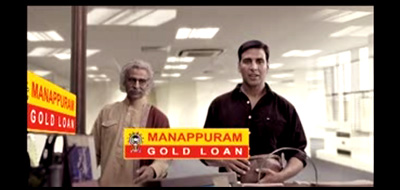
    They have roped in Mohanlal who is leading actor in Kerala, Puneet Rajkumar from Karnataka, Vikram who rules Tamil cinema, Akshay Kumar who has pan India appeal as well as actors Venkatesh and Mithun Chakraborty.


    More than anything as Mr Unnikrishnan says, they have managed to create awareness about gold loans and brought about a perceptual revolution. Earlier pawning of gold was seen in a poor light and there was a negative impression that people sell gold when they are in distress. “We have positioned gold loan as something that is handy and that is where our well crafted advertising has helped. It has required a commitment to convince the customer that gold loan is a feasible and quicker way of getting cash and not just in distress. I think this strategy has paid off and not just for Manappuram but also for the gold lending business.”


    The communication shows that gold loan can help one scale up their business or fulfill a long awaited dream. So gold which Indians have a tendency to hoard and keep in lockers can actually fetch you money to realize your dreams.


    After having a good run in the South, now Manappuram is experiencing growth from Gujarat, Maharashtra, Chhatisgarh , Orissa and West Bengal among others. In fact, Mr Unnikrishnan is bullish on the trade and estimates that the organized gold loan market is close to Rs 1 lakh crore and the unorganized as Rs 2 lakh crore. In fact, seeing the opportunity in gold loan besides the NBFCs like Manappuram and Muthoot who have gained success even banks have got into this area. He concludes, “The challenge is not the market as it is growing. The challenge is to train people who can understand and meet the need of customers.”