Blog

  • All’s well as BCCI gets back its Sahara

    By A Correspondent


    Happy days are here again for the Indian cricket board. The Board of Control for Cricket in Indian and Sahara India Pariwar have concluded their discussions and, as they say, kissed and made up. Here are the terms of endearment… specifically, the BCCI “took note” of the various requests put up by Sahara and has agreed to the following:


    1. To extend the trading window, which was due to close on Friday, February 17, until Wednesday February 29 to give Pune Warriors India the opportunity to have successful negotiations with other franchises as it looks to strengthen its squad.


    2. Reactivation of the Auction Purse of Pune Warriors India so that it can take a number of players, subject to the squad composition regulations.


    3. BCCI and Sahara have agreed to start the arbitration proceedings initiated by Sahara through appointment of an arbitrator to address Sahara’s claim for a reduction in franchise fee for 74 matches.


    4. BCCI does not have any issues with Sahara seeking a strategic partner in the Pune Warriors India franchise, subject to terms of the Franchise Agreement.


    5. In respect of their request to sign overseas players who were not included in the Auction Register, subject to the relevant player regulations, BCCI agrees to the request subject to the views of all other franchises.


    6. Sahara has requested for one of the play off matches scheduled to be played in Bengaluru to be played in Pune. The right to host the Play Off matches is awarded to the finalists from previous edition, in this case Royal Challengers Bangalore. BCCI, in principle, is agreeable to hold one of the Play Offs in the new Pune stadium, subject to the consent of RCB.


    7. Sahara has requested to furnish the Bank Guarantee against the Franchisee fee in two instalments; BCCI will consider it at the next available opportunity.


    8. Notwithstanding the recent working committee’s decision of rejecting five foreign players in the playing eleven, in consideration of the exceptional circumstance and the non-availability of Yuvraj Singh, Sahara has offered to obtain the consent of all the franchises for the submission to the BCCI.


    The joint statement signed by Messrs N Srinivasan, BCCI President and Subrata Roy Sahara, Managing Worker and Chairman of the Sahara India Pariwar adds that Sahara confirms that it will continue sponsorship of the Indian team adding Sahara may want to exercise its right to assign the sponsorship as per the agreement.


  • Networking the neighbourhood kirana @ AaramShop


    Aaramshop, a venture that makes shopping for essentials in FMCG and CPG (Consumer Packaged Goods) easy with just a click of the mouse, may be just about seven months old but has been making steady progress. As the name suggests, it is about shopping aaram se, the difference being that it has brought the local kiranas/ banias/ mom-n-pop store on its platform thus making possible for consumers to purchase their daily needs online and what better than it is delivered by your trusted neighbourhood shop that you have been visiting all this while. Aaramshop.com has partnered with1400 independent retailers across the country and plans to grow this number significantly by the end of the year.

    A concept that has not been tried before especially in the e-commerce where its largely dominated by players catering to travel, gifts and apparels and even when there are few who have ventured into selling grocery, fruits and vegetables, the AaramShop model is different as it is bringing into its fold the existing local shops into its domain. Vijay Singh, CEO & Managing Director, AaramShop, talks to MxMIndia’s Tuhina Anand in an exclusive interview and explains the concept behind his venture and the dynamics behind the ever-changing face of e-commerce in India.
     

    In the last few months that you have been running AaramShop, what has been some of the key learnings?

    It is always fantastic to see raw thoughts and ideas turning into reality – and that’s what being happening at AaramShop over the last 7 months. We launched the site in mid-June last year and it was the one of its kind of venture, anywhere in the world, so we did not really have clear benchmarks to follow.


    So far, almost all our thoughts and ideas have been reinforced and we are very positive about the future of what we have created. Every member of the brand marketing & retailing eco-system has embraced the idea of AaramShop with enthusiasm.


    How do you see the venture going further?

    Today, we are the commerce partner to over 1,400 independent retailers across the country and we will grow this number multi-fold by the end of the year to ensure that every household in the top 10 cities can order their preferred FMCG brands via their trusted independent neighbourhood retailer (AaramShops as we call them) and get it at their doorstep in a matter of a few hours. We intend to scale to approx 20,000 AaramShops.


    We are starting to see brands integrating the advantages of the AaramShop platform within their digital marketing assets. This will extend the integration to all marketing initiatives by brands, including print ads, social media, campaign sites, and so on, as it will enable to them to ensure a critical last mile connect.


    In a move to make the online shopping experience exciting, AaramShop has introduced its unique product listing option that envelops the shopper in a complete brand experience. The innovation would enable marketers across FMCG / CPG categories to take advantage of the proliferation of online videos and all other digital content and consumers’ increasing engagement with that content.


    You have said that AaramShop is just a platform and your revenue model is not dependent on it. Can you elaborate on the revenue model?

    We don’t believe that the typical e-commerce models would work for the FMCG/CPG brands, predominantly on account of absence of deep discounting by brands and the fact that FMCG brands are extremely well distributed across the country and widely available across 12 million plus stores across the country.


    At AaramShop, we believe there is no need for more shops (on-ground or online) – the opportunity, however, is in making the existing shops available on the web so that the consumers can do their shopping with added ease, without needing to trudge down to the market.


    AaramShop, therefore, has been created as a hybrid retail platform for sales and marketing of FMCG/CPG brands to busy urban consumers. The platform offers the consumers the convenience of selecting from thousands of FMCG brands and then leverages the strengths of neighbourhood retailers to ensure last mile fulfillment of the orders.


    AaramShop is a free-to-use platform, not just for the consumers, but also for the retailers and, therefore, it does not disrupt the financial arrangements that the brands have already put in place.


    We have created a number of premium opt-in services for brands to use to connect in a more meaningful manner with consumers. These premium services are predominantly built around analytics-driven marketing, advertising options online and offline, AaramShop centric opportunities, and so on. Our revenue model is centred on premium services and brands have started to use some of these services.


    Buying grocery online, what are some of the logistics nightmare that you have faced in the last few months?

    Since the last mile of our model is completely managed by independent retailer partners who undertake the warehousing and the fulfillment of orders within their stores’ normal footprint – we do not face any logistics related nightmares. This is the core strength of the retailers within their geographical footprint.


    How open have the local kiranas been of joining this platform?

    The ‘kirana’ (independent retailers) are extremely keen to join the platform. They see it as an opportunity to become more relevant to the modern consumers. AaramShop, as a free to use platform, is open not only to ‘kiranawalas’ but also to neighbourhood “pharmacies” as they tend to stock and sell a lot of personal & beauty products.


    The independent retailers realize that they are unable to ensure a great “shopper experience” within their small stores and hence tend to lose out on larger orders. However, when they merge the online convenience of AaramShop with its access to thousands of brands with the local distribution and delivery capabilities that they already have, they realize that the combo could be a possible winner.


    The digital readiness of a lot of these retailers is still low, but I believe these are quite easily addressable with some technology innovations – and that is when the number of partner retailers would shoot up.


    You have been venturing into new and innovative arenas. So what is it that an entrepreneur should keep in mind when going alone especially looking at long term sustainability solutions?

    I don’t believe there is any fun in trending a path that is well-walked.


    The environment around us has changed completely in the last five years and consumer behaviour has transformed, however we tend to keep throwing the same set of solutions for the marketing challenges that the brands face. It is important to reboot.


    My religion is still marketing; it is the rituals that have changed. This change is dictated by what I see as incredible changes that are happening all around us and, to stay relevant, one needs to change.


    We have created a solution which integrates Local + Social +Mobiletrends of the days and it enables the interlinking of the Zero Moment of Truth of brands with their First Moment of Truth.


    So long as we can continue to provide an important connect for the brands, consumers and retailers and creating value across the eco-system, we believe that our premium services would be much sort after.


    How have you been promoting AaramShop?

    We have not aggressively started to promote AaramShop yet, as the focus is still on building the channel and ensuring we get the technology right. However, in the past and also going forward, our promotion strategies are based on:

    • Extensive use of social media – for example we were the first grocery store on Facebook.
    • Micro-geographic marketing, using the excellent footprint of AaramShops.
    • High quality CRM – grocery buying is a done 20 times a year by an average household, and we want to reach out in a meaningful manner and based on past purchase behaviour to ensure repeat usage.


    What are two key goals for your venture this year?

    While we have already released our mobile apps for all platforms, our focus would stay on making AaramShop more easy to use on mobile devices. We believe that mobile is the future and we will release a number of apps that will address different needs of different users in the year ahead.


    The other big focus area is going to be the BrandEngagementCenter. The BEC (www.brandengagementcenter.com) enables brand owners and their agencies to seamlessly manage and monitor their brand/products performance on the AaramShop platform. It is also our ad & analytical centre and we would like to ensure more users to start trying their hands on it.


    Having said that, I think the list of priorities is very long and we will be fighting on a number of fronts.

     

  • Times Internet’s ‘Tweek’ hits the market

    By A Correspondent


    Tablet users can now discover a whole new world of information and entertainment at their fingertips, with the launch of India’s first tablet magazine, Tweek. Created by Times Internet Limited (TIL), Tweek can be accessed via iPad and will soon be launched for iPhone and Android devices. The application has been developed in partnership with GENWI, inventor and leader of cloud-based mobile publishing.


    The weekly magazine will offer content with an urban perspective. Keeping in mind people’s wide range of interests, Tweek will feature stories from around the world across business, entertainment, lifestyle and sport. Its interactive format will allow readers to not just instantly share stories through social networking sites, including Facebook and Twitter, but also share their feedback with the Tweek team. Tweek has also enabled the reader to not just read a story, but also to listen to and watch it and thus, experience the content.


    In a first-of-its-kind, readers will be able to actively shape a magazine. They will be able to connect directly with the writers of Tweek, and share their feedback about the stories they enjoyed, effectively ‘Tweek’ing the magazine to something they would look forward to reading every week.


    “Tweek offers its readers an unparalleled experience in terms of interactivity, customization and usability. Its content will be kept fresh and relevant by the large database of content available within the TIL network. With its launch, we intend to pioneer the tablet magazine space in India” said Rishi Khiani, CEO, Times Internet Limited.


    Mr Khiani also said that they are interested in experimenting with different ways to monetize the content beyond traditional web advertising. Taking advantage of this new medium which incorporates the rich engagement features of the web into a mobile touch experience on a larger screen they hope can deliver new advertising concepts.


    GENWI’s Cloud Publish solution enables has enabled Tweek to deliver contextual commerce, rich-media advertorials that are geo-location aware, and switch out advertisers or ad units on the fly.


    Given the flexibility of GENWI’s mobile content management system, the partnership with GENWI will allow TIL complete creative freedom and control to deliver a beautifully branded magazine-like experience on an app.


    PJ Gurumohan, Founder and CEO of GENWI said: “With the power of the cloud, Tweek will save time and production costs by reusing design layouts from week to week – all in standard web-based protocols such as HTML5, CSS, and JavaScript. But, the most groundbreaking aspect of the application is the way it surfaces existing content and takes full advantage of the tablet experience to create higher levels of reader engagement and the flexibility to explore new monetization channels.”


    Times Internet Limited, (TIL), is the internet and mobile venture of India’s largest media house – the Times Group. Indiatimes.com, TIL’s flagship brand, commands more than one billion views per month. The other key properties in the TIL portfolio are Timesofindia.com and economictimes.com.


    GENWI ( www.genwi.com ) makes mobile publishing simple – in the cloud. As the inventor and leader of cloud-based mobile publishing, GENWI enables publishers and enterprises to easily manage content across mobile platforms, deliver an excellent brand experience, and find new monetization opportunities.


    Also read
    http://www.mxmindia.com/2011/11/inma-toi-launches-tweek/

  • Anil Thakraney: Left & right brains must marry

    By Anil Thakraney


    The other day I was having a drink with a friend, an old world agency creative director. He’s one of those many old chaps who’ve been seriously challenged by the onslaught of the new media, and are at their wit’s end on how to deal with this ‘menace’. You see, not only are many clients now demanding to see creatives for the digital space AHEAD of the TV storyboards, they are putting pressure on the creative directors to make sure the videos go viral.


    I quite empathize with my old fogie pal’s predicament. Trained only in making television commercials, he’s finding it very difficult to learn new tricks. And what creative directors like him are doing is to hire net savvy kids and unleash them onto the clients. With the hope that the bachchas will take care of the digital work, while uncles, like my friend, can continue to focus on the old media.


    Personally, I don’t think this approach is going to pay dividends in the near future… in fact, it’s already showing signs of collapse. Digital marketing and advertising outfits are mushrooming by the day, and they are threatening to walk away with the digital business from clients. Clearly, this is revenue loss for the traditional ad agencies, and cannot be allowed to go on.


    I think ad agency creatives must begin operating the way movie studios work on sci-fi films, where massive technical effects are required. The movie director and the techies form a core team and each feeds off the other to produce scintillating cinema. The director makes sure the story keeps the connect with the audiences, and the tech specialists keep innovating till both are satisfied with the end result. Check out Steven Spielberg’s amazing work on the film Warhorse. The movie zaps you with special effects but the emotion runs through in every scene.


    In short, creative directors are digging their own graves if they leave the ‘headache’ of social media to youngsters in their office. They need to hire tech cats and then work ALONG with them for each brand, to make this work. Yup, the left and the right brains have to marry and produce goods that will meet the new media challenge.


    * * *


    [youtube width=”400″ height=”200″]http://www.youtube.com/watch?v=1n-9-6ULjHY[/youtube]

    PS: British Airways has released a new commercial to commemorate its sponsorship of the forthcoming Olympic Games. It involves a race between luggage bags headed for various destinations. And the ad has been executed like the TV coverage of a sports match. Funny and smart. And I must add this: Many travellers on BA complain about lost luggage. Well, now we know why. The bags lose their way in all the hurry! 🙂


  • Much needs to be done to make radio top-of-mind: Anurradha Prasad

    Anurradha Prasad is the Chairperson cum Managing Director, B.A.G Network. She is also the President of Association of Radio Operators for India (AROI). In conversation with MxM India’s Robin Thomas, Ms. Prasad spoke at length on the overall FM phase III developments, self regulation for FM radio in India, the challenges and road ahead for the radio industry in India.

     

    With positive changes such as the Union Cabinet accepting Ministry of Information and Broadcasting’s (MIB) FM phase III proposal, FDI limit being raised marginally, news to be allowed on private radio stations, and government’s nod to e-auction, as the AROI President, what are your views on the overall development in the industry?

    Phase III is an important step forward in the development of radio industry in India. However, much more needs to be done to make radio a top-of-mind media for Government and Advertisers.


    How could it have been better?

    Issues such as extension of time period and the resulting extension fees for existing radio operators have not been addressed. Phase III players will get a 15-year license, as was repeatedly demanded by AROI. However, the existing operators, who convinced the Government that the 10-year period is too less for even recuperate investments, feel let down due to this. Further content freedom allowed to all other media continues to be denied to FM radio.


    When is FM phase III expected to be rolled out? What are your expectations from it?

    The MIB has already constituted inter-ministerial committees to execute the policy. Time lines can be best advised by them.


    The government seems to be reluctant in allowing complete independence to FM radio on news and current affairs. What do you think is holding them back? 

    The issue is of setting up a monitoring system so that radio content can be monitored by the government. Once this is ready, we don’t think government will have any reason to limit news on FM radio.


    Unlike the print or the television, radio is said to be a highly regulated medium. Shouldn’t the radio industry also be self regulated rather than be regulated by the government?

    Yes, radio should be self regulated and that is why we are formulating our own codes so that national interest is kept sacrosanct in radio content.


    Can you throw some more light on the self-regulation and content code? Will the code of ethics be restricted only to AROI members?

    We will share details once the code is formulated and approved by the members. As all operators are members, there is no distinction between AROI and the industry.


    RJ Mentions is seen by some as a breach of ethics, especially because the station fails to inform the listeners that it is a plug. Do you agree?

    We cannot generalize as this can be decided only on a case to case basis. But we will formulate guidelines.


    Do you think radio stations are far too much dependent of advertising revenues? Are there any other sources of revenues that can be explored? 

    It is a fact that all forms of media are dependent on advertisements. Radio, being free to air, is slightly more dependent. However, radio will open up over 200 new markets this year to marketers. I think the immediate focus has to be in these markets. Combination of ground events, backed by radio, could be another revenue source.


    Has the music royalty issue finally laid to rest by the copyright board? What is the revenue sharing ratio between FM stations and music companies?

    Only those operators who had approached Copyright Board have got the benefit. The judgment is also under appeal from music industry. However, with statutory licensing being planned by HRD Ministry, the other operators can take immediate advantage thereafter.


    What according to you are some of the challenges before the radio industry? What steps need to be taken to overcome them?

    The main challenge is to change the mind sets, especially of advertisers, for whom radio is still at the bottom of their media plans. The industry needs to highlight the advantages of radio and showcase some marketing successes built on radio campaigns.


    Is employee retention one of the challenges facing the radio industry? Is there a talent crunch?

    There is always a talent shortage in media. However, like in television, radio, too, managed to operate over 240 stations on a non-existent talent base. AROI, on its part, is setting up a Skill Development Council for talent development, in association with Government & FICCI.


    What is the road ahead like for the radio industry?

    Right now the focus will be on closing pending issues – with BECIL, Prasar Bharti – as also the upcoming bid for 800 stations. In the longer run, radio is set to emerge as a strong competitor to both print and TV, with its uniqueness as both a local and national media, as well as the only media that is consumed even while consumers are engaged in other activities such as driving, working or playing.


  • 5 reasons why Phase III is vital for FM radio growth

    By Rana Barua


    1. More reach:

    The reach of radio will further increase with an additional 839 new FM stations in more than 200 new cities. Thus the medium will become even more effective and the opportunity will also be huge for the advertisers, especially because of radio’s reach in even the tier 2 and 3 cities.


    2. News in FM radio as a revenue stream:

    News on FM radio, in whatever form, will open up newer revenue streams if packaged well. The industry, for long, has been waiting for news to be allowed on radio. It will therefore be interesting, especially from the listeners as well as the advertisers’ point of view.


    3. Multiple Frequencies to create new genres:

    Multiple licensing, especially in larger cities, will bring new genres to radio. Larger stations, for instance, may want to create another genre of station, perhaps in a different language or a completely different programming category altogether. This will be another interesting facet for the advertisers and listeners.


    4. Networking will be allowed:

    Networking will bring down cost and thus play a critical role in radio’s growth. It will streamline a lot of cost of being in radio. Allowing networking means one will be allowed to run the FM station sitting out of a main hub; as a result the cost may come down.


    5. Create job opportunities:

    Phase III will open up a lot of job opportunities. Multiple licensing, news and networking will open up jobs. Therefore FM phase III will bring a lot more excitement as well as opportunities, thereby bringing in more talents, and genres.


    Rana Barua is veteran media professional, a former COO, Red FM and an advocate of radio

  • Associated Advertising starts the year with 6 awards at the PRCI Global Conclave

    By A Correspondent


    Building on their success at last year’s PRCI Awards for excellence in corporate communications, Associated Advertising, one of India’s largest independent advertising agencies, walked away with six awards  in 2012.


    This year Associated Advertising received a PRCI Golden Award for their television commercial for Apollo Hospital, a Silver Award for their corporate advertising campaign for Apollo Neurosciences, a Silver Award for the corporate diary designed for Andhra Pradesh Tourism, a Bronze Award for their corporate television commercial for Apollo Hospital, a Bronze award for the table calendar designed for MYK Laticrete, and the 2nd runner up award in the overall category.


    Pleased at his agency’s performance, Hemant Agarwal, Managing Director of Associated Advertising said: “We have started the new year with a bang and will stay committed to our endeavour of providing the most strategic and cutting edge solutions to our clients across the country.”


    The agency’s director Adetya Agarwal added: “At Associated, we have always approached every client communication, no matter how big or small, with complete passion and the range of categories in which we have been awarded is a testament to that commitment.”


    The agency’s National Creative Director, Manish Dodani, and the agency’s Film Head/ Director Vikram Agarwal, represented and, received the awards on behalf of Associated Advertising at the PRCI Global Conclave 2012 held at Mumbai.


  • Zzebra PR wins Gold from PRCI for their work on promoting IIFA Awards

    By A Correspondent


    Zzebra Public Relations has won the Gold in the Best Case Study from Public Relations Council of India (PRCI) for the outstanding work done in promoting the International Indian Film Academy(IIFA) Awards for its client Wizcraft International Entertainment Pvt. Ltd.


    The IIFA Case Study showcased Zzebra’s campaign which followed an umbrella messaging structure that revolved around creating strategic communication across key mainstream and regional publications, magazines, the online space, and television networks. The plan comprised of proactive and innovative PR activities to strengthen IIFA’s key attributes of being the global, glamorous and credible awards ceremony.


    Pooja Chaudhri, Joint Managing Director, Zzebra PR said: “Our understanding of the entertainment/lifestyle sector and media expertise is unmatched. Our domain knowledge on large scale events, both in entertainment and lifestyle, and our media networks across the country are our key strengths. We have successfully handled on-going communication for IP entities and large-scale events to the satisfaction of our discerning clients. Additionally, our understanding of media and their requirements when dealing with large international events and celebrity icons helps us to achieve better results for maximum client impact.”


    Zzebra PR is a leading communication company headquartered in Mumbai. Its portfolio of clients is spread across different industry sectors such as sports, entertainment, lifestyle, real estate, technology, automobile, retail and hospitality, among others. Zzebra is part of Concept Communication,India’s largest independent advertising agency.


  • Debrief: Chevrolet’s emotional route connects

    By Anil Thakraney


    Chevrolet is back with another tear jerker for its corporate campaign, ‘Sang Rishte Chalen’. This one features an emotional relationship between a father and son.


    In the TVC, the ‘puttar’ is all grown up and he’s busy packing to start a new life in another town. The father hovers over him, wondering if the son has forgotten to pack important stuff. The interaction between the two indicates an uncomfortable relationship. The dad fondly stares at an old family picture, in which his son is a little kid, and that brings back memories. Finally the son departs, but carries the same picture with him in his Chevrolet Beat. And yes, there’s a lot of rona dhona in the ad.


    I think Chevrolet is doing the right thing. While the brand ads can be more functional, it makes sense to create an umbrella corporate campaign that rides on raw emotions. This would help in building a bond with desi car buyers since we Indians are suckers for emotions.


    [youtube width=”400″ height=”200″]http://www.youtube.com/watch?v=2vFklija8XQ[/youtube]

    Must also add that the commercial is shot nicely, emotions flow easily in the treatment, it isn’t forced. And the strained father/son relationship is only hinted at, and not shouted out, which makes the film work even better. That one shot of the father trying to hug his son and the latter choosing to touch the dad’s feet is a gem.


    Good work all round.


    Rating: (On a scale of 1 to 5): 3.5 Warm play of human emotions.

  • Hay Group appoints 20:20 MSL as its strategic communications partner in India

    By A Correspondent


    20:20 MSL India, part of MSLGROUP, Publicis Groupe’s flagship specialty communications, PR and events network and the largest PR and social media network in India, has been selected by Hay Group as their strategic communications partner in India.


    Hay Group, which entered the Indian market seven years ago, is one of the leading premium management consulting companies and is the largest people consulting organization by revenue and clients inIndia. 20:20 MSL will work with Hay Group to build brand awareness and manage its reputation as a global management consulting firm that works with business leaders to develop talent, organize people to be more effective and motivate them to perform at their best.


    20:20 MSL’s seven offices acrossIndiawill work with Hay Group on a nationwide mandate, spearheaded by 20:20 MSL’s National Capital Region (NCR) Office inNew Delhi. The agency has been tasked with drawing on its integrated communications expertise to creatively engage audiences that includes CEOs and CXOs of Indian industry, across traditional as well as social media platforms.


    As a newcomer in the consulting space in a niche sector of human resources, leadership & talent, Hay Group will draw on 20:20 MSL to build brand familiarity and also sensitize Indian businesses, including family-owned businesses to the value that leadership development and talent management can add to their enterprises.


    Commenting on the appointment, Amrit Ahuja, Vice President, 20:20 MSL said: “As the Indian economy grows and Indian companies expand overseas, the focus on managerial talent and leadership has grown manifold. Indian businesses, including many family-owned businesses are on the lookout for experts and specialists who can help them achieve business objectives through development of competencies in the areas of leadership development and talent management. I am thrilled that Hay Group has chosen 20:20 MSL as its communications partner to reinforce its mindshare as the leading people consulting organization inIndia. We look forward to building the Hay Group brand inIndiaand aid the dissemination of global best practices and knowledge that it brings to Indian industry.”


    Prashanti Mikayla, Senior Manager, Brand & Talent, Hanmer MSL added: “Acquiring the right talent has become the third most important driver for organizational growth and CEOs worldwide have begun to factor this into their strategies. In the present turbulent market conditions with a dearth of the ‘right fit’, the need is to focus on attracting, engaging and retaining talent that reinforces the purpose of the company and promises a direct impact on the bottom line. With this appointment, we believe that the Hay Group can benefit from MSLGROUP’s Brand & Talent practice to fortify their Employer Brand in the Indian industry.”


    Gaurav Lahiri, Managing Director, Hay Group India of Hay Group commented: “We were interested on partnering with an agency that understands our philosophy of transforming people and organizations, realize their potential. With 20:20 MSL’s deep social media expertise, deep sector knowledge and experience, and its capability to seamlessly implement national campaigns, we hope to reach out to Indian business leaders, differentiate ourselves as a strong knowledge driven firm with proprietary insights and become the preferred partner of industry inIndia.”

  • Marico picks up Paras personal care brands from Reckitt Benckiser

    By A Correspondent


    Marico has bought the personal care business of Paras Pharmaceuticals from UK consumer goods giant Reckitt Benckiser, edging out Emami. While announcing the deal, both Marico and Reckitt Benckiser declined to disclose the financial details.


    But two industry officials familiar with the negotiations said the maker of Parachute Hair Oil has paid Rs600-650 crore for the privately-held Paras Pharma’s personal care brands such as Zatak deodorant, Set Wet hair gel and Livon hair serum. This is much lower than Reckitt Benckiser’s original demand of Rs900 crore, they said.


    Morgan Stanley was the exclusive financial advisor to Reckitt Benckiser on the deal.


    Marico CMD Harsh Mariwala said the deal will help the company target the youth who now drives demand in the country’s consumer space. “All these brands are youth-oriented, fast growing and have low penetration,” said Mr Mariwala


    The transaction will involve demerging the personal care business of Paras Pharma into a separate company, Halite Personal Care India, in which Marico will acquire 100 per cent stake. This will involve transfer of all key assets, including intellectual property rights, supply agreements and third-party manufacturing agreements.


    Marico will fund the acquisition through a mix of internal accruals, equity and debt.


    Reckitt Benckiser acquired Paras Pharma in December 2010 for Rs3,260 crore, in one of the biggest acquisitions in the Indian consumer goods sector.


    The maker of Dettol Anti-septic and Disprin pain killer was more interested in Paras’ healthcare products such as Moov pain-relief ointment and Krack heel care lotion, and decided to sell the personal care business. Financial analysts say it is a good buy for Marico.


    “The acquisition will help Marico to move from a dominant hair-care portfolio to skin-care and personal care, which is a bigger opportunity,” said Shirish Pardeshi, executive director and research co-head at Anand Rathi Securities. Marico’s key products in India include hair oil Parachute and edible oil Saffola.


    With the new deal, it will get six brands – Set Wet, Livon, Zatak, Eclipse, Recova and Dr Lips – expected to have a turnover of more than Rs 150 crore in FY12. Paras brands are among the top three in the hair gel, male deodorant and hair serum categories.


    According to industry estimates, the deodorant category is growing at a rate of 40 per cent a year, hair styling gel at 25 per cent and hair serum at 30 per cent.


    Marico CEO (consumer products business) Saugata Gupta said the integration will be easy since the company has domain knowledge in the acquired categories through its operations in Vietnam and the Middle East.


    Source:The Economic Times

    Copyright © 2012, Bennett, Coleman & Co. Ltd. All Rights Reserved

  • RAMcheck: Most popular FM stations heard out of home

    By A Correspondent


    Unlike our regular RAMcheck reports which didn’t differentiate between any places of listening, this time MxMIndia decided to concentrate exclusively on radio channels’ out of home (OOH) listenership. According to RAM (Radio Audience Measurement), the OOH listeners include listenership in cars, at work and other out of home places. TAM Media’s Radio Audience Measurement from week 40-43, 2011 to week 52- 3, 2012 reveals the most popular FM radio station out of home. RAM is currently present in four metros – Mumbai, Delhi, Bengaluru and Kolkata.


    Mumbai:

    According to the RAM data for OOH listenership, the top five FM stations for Mumbaikars are Radio Mirchi, Big FM, Radio City, Fever FM and Red FM, excluding the government-owned AIR FM2 Gold. The radio stations, from week 40- 43, 2011 to week 52 to 3, 2012, have not seen much variation in their channel shares.


    Delhi:

    In Delhi AIR FM2 Gold is the most popular FM station followed by Fever FM, a strong number two in OOH listenership share. While the number one and two slots have a clear position in OOH listenership, there is no clear winner for the number three position. There is a close fight for number three position between Radio Mirchi, Radio City and Red FM. However in Wk 52′ 2011 to Wk 3′ 2012, both Radio Mirchi and Red FM received 12.4 per cent station share whereas Radio City received a station share of 11.1 per cent. The other FM stations in the Delhi market include Big FM, Radio One, Oye!FM, Hit FM, AIR FM1 Rainbow, Vividh Bharati and Akashavani Delhi.


    Bengaluru:

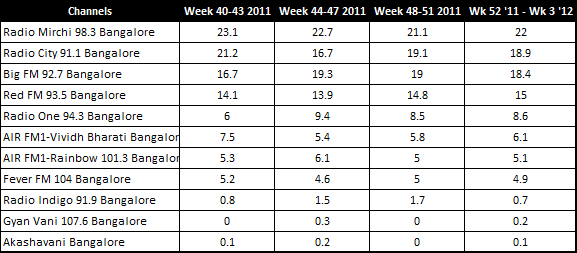
    Radio Mirchi is the number one FM station in Bengaluru followed by Radio City, Big FM, Red FM and Radio One. Between Wk 40- 43, 2011 to Wk 52, 2011-Wk 3, 2012 the radio channel share for Radio Mirchi was at its peak in Wk 40 -43, 2011 with a share of 23.1 per cent. Radio City, the second most popular FM station in OOH listenership, was also at its peak in wk 40 – 43, 2011 with 21.2 per cent share. However in week 52, 2011 – Week 3, 2012 the station share for Radio Mirchi dropped to 22 per cent whereas Radio City’s share was 18.9 per cent. The other clusters of FM stations in Bengaluru are Fever FM, Radio Indigo, AIR FM1, Vividh Bharati, AIR FM1 Rainbow, Gyan Vani and Akashavani Bengaluru.


    Kolkata:

    Kolkata has a clear number one and number two FM stations in Friends FM and Radio Mirchi. Ranked third is Red FM. The gap between the top three FM stations is significant. While Friends FM received a market share of 23.4 per cent in Wk 52, 2011 – Wk 3, 2012, the same week saw Radio Mirchi receive just 18.3 per cent market share and Red FM receive 12.4 per cent share. The other clusters of FM stations in Kolkata are Fever FM, Aamar FM, Air FM2 Gold, Oye! FM, AIR FM1, Rainbow, Radio One, Power FM, Akashavani and Vividh Bharati Kolkata.