Blog

  • Komli Media acquires Singapore-based online advertising network Admax

    By Radhika P Nair


    Online media network platform Komli Media has acquired Singapore-based online advertising network, Admax, in a cash-and-equity deal, said Komli’s CEO, Prashant Mehta. Mehta declined to reveal the deal size.


    With this buyout, Komli intends to expand its reach in South East Asia, which Mehta termed as a billion-dollar opportunity. “We will be able to leverage Admax’s team, expertise and relationships in all the South East Asian markets,” said Mr Mehta.


    Admax, launched in 2006, claims to be the largest online advertising network in the region, with a presence in Indonesia, Malaysia, Philippines, Singapore, Thailand and Vietnam. Admax will give Komli access to a publisher network of over 4,000 local and international websites.


    Komli estimates the online advertising market in the region to be worth approximately $250 – 300 million, and growing at 30-40 per cent per year. “Our target is to become the leaders in the rapidly growing Asia-Pacific market as that will add tremendous value to our global operations,” Mr Mehta revealed.


    Komli, founded in 2006, has followed the acquisition path to speed up growth in different geographies. The Admax deal is its sixth acquisition in two years and the second in the region. In mid-2011, the company had bought out Singapore-based online media sales venture Aktiv Digital. Komli had earlier acquired Australian website representation firm, Post Click, and UK-based online ethnic marketing company Indoor Media


    The company has favoured the inorganic route for acquiring technology as well. In late-2011, the company took over the India business of video advertising venture, Jivox, and in July 2011 acquired mobile advertising and publishing network, Zestadz.


    Admax will be rebranded and the 100-strong team will join the existing Komli team in the region. Komli is targeting to reach $100 million in revenue in the next 12 to 24 months, said Mehta.


    Source: The Economic Times

    Copyright © 2012, Bennett, Coleman & Co. Ltd. All Rights Reserved


  • Will Coke’s 200ml pack price cut cannibalise Thums Up?

    By Preethi Chamikutty


    Summer is still a few weeks away, but cola brands have already started feeling the heat. While most brands are closely guarding their marketing secrets for the season, Coca-Cola surprised pundits when it dropped the price for the 200 ml returnable glass bottle (RGB) by Rs2 to Rs8.


    That may not seem unusual – after all in the past, Coke has cut price. However, most of those reductions were across all brands in the portfolio, from flagship Thums Up and Sprite to Limca and Fanta. This time, however, the exercise applies only to Coca-Cola.


    Independent marketers are not convinced about the strategy as they feel that in the urge to close in on arch-rival Pepsi, Coke runs the risk of cannibalising Thums Up, its top cola brand and the country’s largest selling carbonated drink.


    So why is one of the world’s most valuable brands discounting itself in India? The official response from Coca-Cola is that the “special promotional price” will “fuel growth of the cola category. As the 200 ml pack is the entry point into the category, it will recruit new consumers into the cola segment since it is a very attractive price point,” said a company spokesperson.


    The promotional offer is being rolled out in phases across select markets; 70 per cent of markets will have the Rs8 price. Those familiar with the promotion say that this is a pilot project for three months, with an option to extend it.


    Clearly, Coke has trained its sights on Pepsi – which has yet to react to the price cut – and hopes to inch closer to it. Still, market observers wonder whether the drop in price is aimed at Pepsi or at Coke’s own brand, Thums Up, which is the leader in the cola category as well as in carbonated drinks.


    Latest market share figures are unavailable – both cola majors will not part with them – but those familiar with recent numbers point out that Thums Up has a share of roughly 42 per cent of the Rs4,000 crore pure cola market. Pepsi follows with 36 per cent, and Coca follows with a share of just under a fifth (a few regional brands account for the rest).


    An official at a beverage marketer says that Thums Up also leads the approximately Rs10,000 crore carbonated soft drinks market with a 15 per cent share. If marketers do not approve of Coke’s move, it’s with good reason. “Unless this is a global diktat, this strategy is flawed from Thums Up’s point of view,” reckoned Nobby Gupta, founder & CEO, Nobby Brand Architects.


    “In countries wherever Coke is present, it always has to be the market leader and all other brands have to follow; if that is the aim for India as well then this strategy falls in place,” he added. But he also goes on to say that this strategy will have a negative impact on the combined share of both Coke and Thums Up.


    Me Gupta’s logic is simple: Lowering the price of Coke will not put pressure on just Pepsi, it will also cannibalise the market share of Thums Up. “And if Pepsi drops price too, which is likely, there is a chance of it eating into both Coke and Thums Up,” added Mr Gupta.


    Then there are those who feel that dropping prices for short-term gain is dangerous. “Because when you go back to old prices consumers may well say: ‘Thank you very much for the discount, now I will go back to Thums Up,” said Anand Halve, co-founder of Chlorophyll Brand & Communications Consultancy. “Momentary bribing does not ensure long-term consumer loyalty,” he added.


    For a generation of Indians, Thums Up, with its relatively stronger taste, is synonymous with cola. “The preference for a strong cola continued even as new cola brands entered and are now expanding the category. Over all these years, Thums Up’s communication has remained consistent,” said Devendra Chawla, president, food & FMCG, Future Group, who is a former Coke associate.


    To be sure Thums Up has assumed almost cult brand status over the past two decades with commercials like ‘Taste The Thunder’ and ‘Toofani Thanda’ that had an international look and feel to them. Ashok Kurien, advertising guru and former chairman Publicis India, who was involved in the launch of Thums Up said: “Thums Up managed to crack the soul of Indian consumers through advertising and reached out at a deeper level. It was about struggles in life, the anxiety and determination to survive and succeed. This was probably the strongest concept in Indian advertising that connected to the young Indian male. And it still connects today.” When Coca-Cola acquired Thums Up, Kurien advised the Atlanta-headquartered company to only pit Coke against Pepsi and not touch Thums Up – as it already had an 85 per cent market share. “But Coke introduced both Coca-Cola and Thums Up in 300 ml bottle and people lapped up Thums Up, with Pepsi taking the second spot.”


    The battle between Coke and Pepsi continues, although Coke officials deny the attempt to spark off a cola war; they just want to step up per capita consumption by Indians, they say. “Indians consume only 12 200 ml bottles of beverages per year compared to 675 bottles by Mexicans – the highest consumers of Coca-Cola globally,” pointed out a Coke official.


    Source: The Economic Times

    Copyright © 2012, Bennett, Coleman & Co. Ltd. All Rights Reserved

     

  • 5 reasons why March is an unforgettable month

    By A N Chorrea


    It’s March 1. In the good old days on Radio Ceylon or Sri Lanka Broadcasting Corporation, we would hear the song ‘Din Hai Suhana Aaj Pehli Tareekh Hai’. I am not much of a radio person now (especially after Radio One turned Hindi and knocked out all its star RJs), but I think I do see an ad with that playing somewhere.


    So here are my five reasons why March is an unforgettable month.


    1. It’s 30 days and some hours for the year-end. Targets aren’t complete this year. The newspapers say the market’s looking up. But where the sugar are the monies?

    2. It’s the month, when the appraisal process starts in most organisations… chances are it’s already done in the boss’s mind

    3. It’s the month where one needs to make all the tax-saving investments… but where’s the money in the bank?

    4. It’s the month where the kids have their exams. And even if your kids are too small or big or you have none, there are several all around.

    5. It’s the month this year where the Union Budget is going to be announced which is a huge distraction for many big spenders… there are just 31 days in the month and we are losing a few thanks to the holidays (and, yes, Holi too!) and now the Budget too.


    Here’s wishing you a happy March. Enjoy


  • [MJR] Litfests: Boon or bane for Indian book market?

    By Yogi Aggarwal


    Literary events do not, as a rule, make news and are normally assigned just a paragraph or so in the inside pages of newspapers. Not the Jaipur literary festival (JLF), now in its sixth year.


    Its organisers have an eye for easy publicity, and the knack of drawing record crowds. It’s fast approaching the bustle and energy of a mela, with an attendance of over one lakh visitors during the five day jamboree last month.


    Either there has been a sudden spurt of interest in books, or the people just come to have some fun, as they do at the largely low-brow Kala Ghoda festival in Mumbai. Though literary events such as those recently started in Mumbai,KarachiandHyderabaddo help to sell some books, none has the drawing power or the induced magic of the JLF.


    Is the JLF in the envious position of attracting certain top writers, which then bring it to the attention of the media, or is it the media hype than brings in the writers? The latter is unlikely to be the case since the Indian market for books is still a small one. And despite the presence of several distinguished mix of writers, only one person has the reputation to generate a large crowd-pulling controversy – Salman Rushdie.


    It was his attendance at JLF in 2007 which led to vastly increased numbers at the fest in the following years, and it was the motivated opposition to his presence in Jaipur or even to a video conference that took the JLF to the top league in such events around the world.


    William Dalrymple, the impresario who runs the show, maintains that literary fests like the one in Jaipur have the effect of “putting literature back at the centre” and that such fests are part of the exponentially expanding book market inSouth Asia.


    Both are questionable statements. Literary fests do lead to some interaction between writers and readers, and this may even help the writers understand their audience, but at the signing that accompany the sales of books at the venue at most a few score copies are sold, hardly putting literature back at the centre.


    It is also debatable whether the book market is expanding exponentially in our region. There are certainly a larger number of fiction titles being published. But most of them sink without going into a second print.


    The reason for the proliferation of these literary melas is twofold. First, they provide yet another celebrity event to fill the pages of our newspapers, most of whom have abandoned their role of informing and educating their readers, to pandering to their prejudices and serving salacious stories. Second, they are a tonic for our increasingly jaded elite.


    For this reason the controversy surrounding Salman Rushdie was the perfect marketing gimmick. While Rushdie himself thrives on the opportunity to be in the public eye, this occasion was the more central since it highlighted the conflict between “diehard mullahs” and “freedom of expression”.


    The media helped fuel the dichotomy by only giving space to a fundamentalist fringe, ignoring the large number of Muslim liberals. The heat and the large public interest & debate this generated will surely make the next JLF even bigger than before.

    All this does not leave the author any better off. Nor does it generate a genuine interest in the ideas that books are meant to foment.


    Just before the JLF, there was a similar event in Mumbai. Organised by a large media conglomerate, it was a successful mela with all the attendant frills of book signings, meet the author events, food courts and milling crowds. Surely it is another JLF in the making, and a bigger one too at that, considering the influential and well-funded backing, and its location in Mumbai.


    It is ironic that the media conglomerate has no space or time for books. It stopped reviewing them years ago since “our readers aren’t interested”. Intelligent and fair reviews by a dedicated lot of critics, complete with author interviews on a weekly books page or even section are necessary for the growth of an informed readership.

    Melas can be useful but cannot replace this essential perquisite of a literate, book-reading culture.


    Yogi Aggarwal is a veteran journalist.


  • [MJR] Famous Grouse: High-pitched hysteria on the box

    By Ranjona Banerji


    Day after day, as I watch television news, I am in a state of constant frustration and rage – so many journalistic mistakes made day after day and not a sign that anyone is going to correct them. Wholesale editorializing by reporters, daft theories for every event conjured up by editors, complete lack of coordination between a reporter at a “live” event and the newsroom, high-pitched hysteria in TV studios at prime time when the debates and discussions happen. Heck, they can’t even get the grammar or the facts right on the little bit of text they put up on their screens.


    Then, circumstances and real life conspired against me and I haven’t managed to watch much TV news this week. And shock and horror, it’s been traumatic. I have severe withdrawal symptoms. My melodrama gene has been severely denied and it is protesting.


    My chief grouse in this first of a list of grouse is against newspapers. I propose that they start a TV section. Not a review – which so many of them do so well and I do enjoy reading Shailja Baipai and Poonam Saxena and Mihir Sharma’s columns for Indian Express when he was still there and Sevanti Ninan and all the rest of my esteemed colleagues whom I may have left out.


    No, I’m talking about a page, at least, dedicated to the TV style. We can have wild accusations, absolutely no subbing of any copy, every impossible theory treated seriously, a studious attempt to avoid objectivity and a debate where two people who know the least about any subject are asked to write 500 words about it with no punctuation and plenty of highlighted words and CAPS SO THAT YOU KNOW WHEN THE CONTESTANTS (sorry participants) ARE SHOUTING.


    Is there a print equivalent of interrupting? If so, stick that in the mix as well.


    Aaaah, bliss!


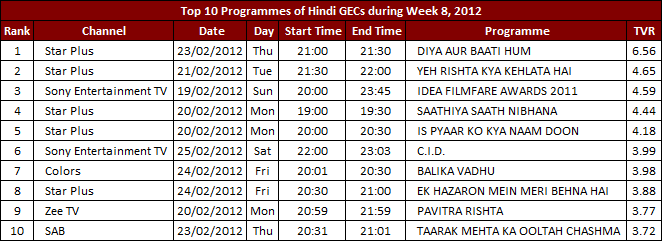
  • TAM data Top 10 programmes on HGEC – Wk 8 ’12


    Source: TAM Peoplemeter System
    TG: CS 4+ yrs
    Market: Hindi Speaking Market
    Period: Wk 8 (Feb 19 to Feb 25), 2012


    About TAM Media Research


    TAM is a joint venture between Nielsen Company & Kantar Media Research. Besides measuring TV Viewership, TAM also monitors Advertising Expenditure of Television, Print & Radio through its division AdEx India. Since 2004, it extended its presence in the PR Measurement & Analysis space for Corporate/Marketing Clients by setting up a separate division Eikona PR Measurement.


    In 2007, the joint venture introduced RAM (Radio Audio Measurement) service to track Radio Listenership for the Indian Radio Broadcast Industry. In year 2009, TAM launched a division, called TAM Sports that specializes in monitoring Sports Sponsorship ROI.


    TAM Media Research’s objective is to fuel media insights that will drive the growth of the Indian Media Industry.

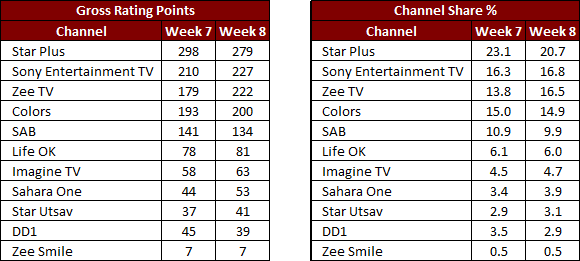
  • TAM Data (GRPs Channel shares of HGECs)- Wk 8 ’12


    Source: TAM Peoplemeter System

    TG: CS 4+ yrs

    Market: HSM

    Period: Wk 7: Feb 12 to Feb 18, 2012

    Period: Wk 8: Feb 19 to Feb 25, 2012


    About TAM Media Research


    TAM is a joint venture between Nielsen Company & Kantar Media Research. Besides measuring TV Viewership, TAM also monitors Advertising Expenditure of Television, Print & Radio through its division AdEx India. Since 2004, it extended its presence in the PR Measurement & Analysis space for Corporate/Marketing Clients by setting up a separate division Eikona PR Measurement.


    In 2007, the joint venture introduced RAM (Radio Audio Measurement) service to track Radio Listenership for the Indian Radio Broadcast Industry. In year 2009, TAM launched a division, called TAM Sports that specializes in monitoring Sports Sponsorship ROI.


    TAM Media Research’s objective is to fuel media insights that will drive the growth of the Indian Media Industry.

  • Swad of Success: Regional FMCG firms like Panjon, Bisk Farm, Mapro, raising funds to expand operations

    By Sagar Malviya


    After a gap of almost four years, TV commercial of the once popular Swad digestive candy hit the screens early this month. Swad, which is making a come back, is one of the brands owned by 48-year old Panjon, an Indore-based firm that sells candies to balm and toothpaste endorsed by Shammi Kapoor and Sonali Bendre in its glory days. The plan is to reach out to more states, expand product portfolio and grow sales ten-fold in two years.


    Panjon isn’t alone. Almost half a dozen smaller regional firms such as Bisk Farm, Mapro, Wagh Bakri and V-John, among others, are entering newer states, some advertising for the first time, while others planning to raise funds to survive a fresh salvo by large consumer goods companies that expanded into the turf of smaller rivals last year.


    “While our products are doing well in MP and UP, competition is also getting intense in these home markets,” admitted Atul Kothari, managing director at Panjon, which is in talks with a clutch of private investors to raise funds for expansion. “We are looking to enter Gujarat, Punjab, Haryana and Bihar this year,” he said. The company plans to add more than 1,400 distributors to its existing network of 600.


    So what exactly was the trigger? Well, for one, large FMCG firms have been aggressively reaching out to rural consumers through expanded distribution, which led to smaller regional players losing market share across segments in their core markets.


    Over the past couple of years, P&G has almost doubled its distribution reach and now has a direct reach of 1.3 million outlets, against HUL’s direct reach of 1.60 million outlets. Emami expanded reach by as much as 30 per cent primarily in rural areas, while HUL added more than 50,000 villages to its network just last year. Ditto, in the case of Dabur, which rolled out special rural focused sales initiatives across eight key states and widened reach in 71 high potential districts.


    However, the regional players are now plotting a counter attack, not just in their existing markets but also in newer states. The Rs 500-crore SAJ Food Products that dominatesEastern Indiawith its biscuit Bisk Farm is a case in point.


    “Last year, we entered Karnataka and are planning to reach Andhra Pradesh next month. We aim to have a national footprint by 2013,” saidVijay Singh,MDof Kolkata-based SAJ Food Products. He added that the firm has even discussed internally about coming with a public issue in the next two years.


    But it won’t be easy. And smaller rivals are aware of the fact that price competitiveness with national players would rather be futile with the latter having economies of scale. Hence, they are looking to cash on through their quality proposition rather than being price warriors.


    Maharashtra-based processed food firm Mapro Foods andGujarat’s tea company Wagh Bakri feel that they are better in terms of quality compared with rivals such as Hindustan Unilever. “Large players are very aggressive in terms of schemes and offers. But we believe that consumers want quality and not price-offs,” said Parag Desai, executive director of Wagh Bakri, that is looking to enterPunjaband Haryana.


    Some firms that already have an indirect reach nationally are also keen to distribute products directly and cut costs on intermediaries. Delhi-based Vi-John is reworking its distribution strategy by eliminating super-stockist and instead having selling agents in each state.


    “We are planning to add over 1,500 distributors and 70 stockists to have direct reach in western and southern markets,” said Vimal Pande, CEO of Vi-John Group, which has 30 stockists and 2,500 distributors.


    Modern trade is doing its bit too. “Regional brands need to build stronger consumer connect to keep their consumer franchise or they could expand distribution to add new consumers and grow base,” said Devendra Chawla, president – food and FMCG at Future Group.


    Source: The Economic Times

    Copyright © 2012, Bennett, Coleman & Co. Ltd. All Rights Reserved


  • Realigned DDB Mudra ups ante for APAC push

    By A Correspondent


    After a realigning and restructuring exercise that stretched through to 100 days plus and with several key appointments and a few exits later, the DDB-Mudra alliance presented itself in a new avatar as the DDB Mudra Group at an event in Mumbai yesterday. The event was made interesting by having the APAC, Japan and India Chairman & CEO of DDB, John Zeigler announce the key milestones to the gathering.


    While the top-level realigning at the group was made known earlier to one and all, the event also witnessed a couple of other key announcements from the group. These included the entry of TracyLocke, one of the world’s most awarded shopper marketing agencies into India and the decision to make Water, the strategic branding and design consultancy to join the Interbrand network and represent Interbrand in India.


    With a client roster that boasts the likes of HP, T-Mobile, Starbucks, Johnson & Johnson, Gatorade, Tropicana, PepsiCo, Sony and Unilever’s Lipton, TracyLocke will be managed in India by Pratap Bose, Chief Operating Officer of DDB Mudra Group. According to Jim Sexton, Global Chief Marketing Officer of TracyLocke, “Once we saw the level of retail expertise and comprehensive knowledge of the India consumer and shopper at DDB MudraMax, we knew we had the perfect fit. We look forward to delivering to our clients a unique brand of shopper marketing relevant to each segment of the Indian market. Additionally, we hope to share proprietary marketing tools that we can take from India to the rest of the world.”


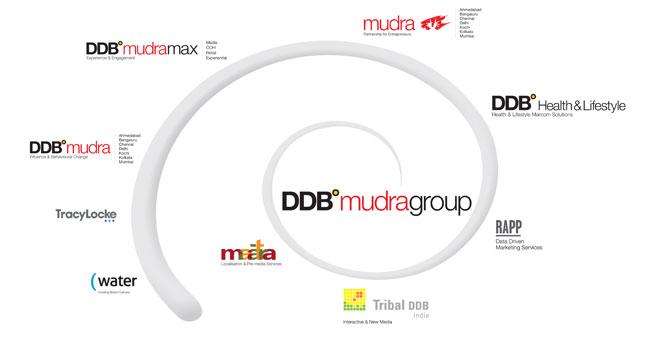
    As for the revitalised DDB Mudra Group, the network in India will be split as DDB Mudra, Mudra and DDB MudraMax. Accordingly the group has adopted a new structure, brand identity, colours and architecture that will drive forward the change. The new structure will comprise eight branded agencies as follows: DDB Mudra – the Influence & behavioural change agency with a pan India presence across Ahmedabad, Bengaluru, Chennai, Delhi, Kochi, Kolkata and Mumbai; DDB MudraMax – the Experience & Engagement agency which offers Media, Out-Of-Home, Retail and Experiential; Mudra – the partnership for entrepreneurs agency with a pan India presence across Ahmedabad, Bengaluru, Chennai, Delhi, Kochi, Kolkata and Mumbai; DDB Health & Lifestyle – Health & Lifestyle Solutions practice; RAPP – data driven marketing services agency; Tribal DDB India – interactive & new media agency; Water – Brand & Design consultancy and Maatra – localisation & pre-media services agency.


    Elaborating on the proposed management structure, Madhukar Kamath, Group CEO and MD, DDB Mudra Group said that while he was proud of Mudra’s past, he is equally excited about the future. According to Kamath, the executive board committee will comprise of Sonal Dabral, Chairman & CCO, DDB Mudra Group, Pratap Bose, COO – DDB Mudra Group, Madhukar Kamath, Group CEO & MD, DDB Mudra Group, Dilipkumar Upadhyaya, CFO and Ajit Menon, EVP – DDB Mudra Group. Excited about the largescale realigning, Kamath said that the new venture would see DDB Mudra emerging amongst the fastest and topmost agency in a few months from now. He was also in praise of his clients of whom he said that about 40 per cent of them access more than one business service of the Group, which speaks volumes of the solutions and services that the group has to offer.


    Earlier, John Zeigler began by highlighting the growth of DDB Worldwide and how it is looking at Asia Pacific, led especially by India, to drive its expansion into the region. “Current figures suggest our growth split as 44 per cent from Europe, 38 per cent from North America, 6 per cent from Latin America and 11 per cent from Asia Pacific. Our core focus would be to increase the pie of Asia Pacific to a large sum going forward and this would be driven by India which is being seen as a leading market in marketing communications by most agencies.” In a one-on-one conversation with MxMIndia, Mr Zeigler was hopeful of deriving a modest growth across APAC as he said, “With the kind of businesses we have in India we should be able to achieve a growth rate of 25 per cent plus. As for our other agencies across Asia Pacific, we had a compounded growth rate in excess of 30 per cent year on year.”


    Mr Zeigler further highlighted how DDB’s model was unique in the sense that it captured both local and global sentiments of its clients and offered services that were unmatched in nature. The idea, according to Zeigler, was to be seen as an agency offering local solutions to international clients who wanted to tap outside markets as well as offering international solutions to local clients who wanted outside exposure to derive local growth.


    On getting TracyLocke to India, Mr Ziegler said, “As one of the leading shopper marketing agencies in US andEurope, TracyLocke brings vital shopper insight and great creativity into our future. The launch in India is its entry intoAsiaand will be providing vast opportunities for the entire DDB Asia Pacific group.” The summit is to be conducted next month and will showcase the experience, skill sets, global practices and learning of the entire DDB Asia Pacific region which has distinguished itself in 2011 with several impressive wins including Spikes Asia’s Network Agency of the Year 2010 and 2011, and AdFest Network Agency of the Year. The summit will be attended by Chuck Brymer, President and CEO of DDB Group Worldwide; John Zeigler, Chairman & CEO, DDB Asia Pacific, India & Japan; and Patrick Rona, Tribal DDB Asia Pacific’s President and Chief Digital Officer for DDB Group Asia Pacific, as well as an overseas contingent of senior agency personnel from across the Asia Pacific region.


  • With Moradabad launch, Hindustan now pan UP and Uttarakhand

    By A Correspondent


    Hindustan Media Ventures Limited (HMVL) recently launched its 10th edition in the state of UP from Moradabad. With this, Hindustan completes its footprint across the two states of Uttar Pradesh and Uttrakhand. It is now printed from 18 centres across the states of UP, Uttarakhand, Bihar, Jharkhand and Delhi.


    Commenting on the launch, Benoy Roychowdhury, ED, HMVL said: “Moradabad is a unique region of Uttar Pradesh that has placed India on the global map through its exports of over Rs2,200 crore of brass artifacts annually. Through the launch of our Moradabad edition, Hindustan now serves the entire footprint of Uttar Pradesh and Uttarakhand – two progressive and prosperous states with a rich, cultural heritage.”


    Sharing his views on the launch, Amit Chopra, CEO, HMVL said: “With our launch in Moradabad, we mark the completion of our journey of expansion that began in 2005. We now serve this economically powerful and culturally rich zone. As in our other markets, Hindustan will work to create reader delight through a high-quality newspaper and continuous engagement. We will become partners in progress for the citizens of the region. I am confident that Hindustan will emerge as the preferred newspaper for the people in this region.”


    Rajan Bhalla, (Head-Marketing, Strategic Businesses – HT Media) said: “The core proposition of Hindustan is ‘Tarakki ko chahiye naya nazariya’ – central to our brand and activation campaigns. We approached Moradabad with this very distinct perspective. Our Election Campaign “Aao Rajneeti Karein” reflects our commitment towards the state of UP and creating positive social impact.”


    Hindustan’s Moradabad edition has started with a strong 1.1 lakh circulation, a number that is unsurpassed in that zone. Moradabad launch comes on the back of the recent Aligarh edition launch which continues to progress by leaps and bounds; setting new benchmarks of journalism and reader connect.


    Hindustan Media Ventures Limited (HMVL) is the publisher of the leading Hindi newspaper – Hindustan, Hindi magazines Nandan and Kadambini and the news website livehindustan.com. Hindustan, which is the fastest growing daily in the country has presence in the states of UP, Uttarakhand, Bihar, Jharkhand & Delhi, with a Total Readership of 3.75 crore.


    The company is a subsidiary of the HT Media Group – a diversified media group with interests in Radio, print & online media.


  • [MJR] Gouri Dange: Why this silence over the noise?

    By Gouri Dange


    Since the feeding frenzy over the Saif tidbit that fell into the media shark tank is over, one is loathe to bring it up again and create more sites where the moronic incident will pop up on search engines. But there’s one thing that no one asked or discussed anywhere in any medium, earth, fire, water, or air – meaning print, Hindi news channels, English news channels and on the internet: Is it not at all legitimate and reasonable for a person to ask for quiet and decorum in a public space?


    As backward and foolish and boorish as the punching out of a diner in the Taj by Saif, is the attitude that he (and crores of his fellow Indians) display when he airily said to the man who asked him and his women and men pals repeatedly to keep it down: ‘If you want silence, go to a library’. (Fortunately he thought of ‘library’ and not ‘graveyard’).


    Ha! Is that the only place where one can expect and demand some quiet in this sub-continent, is what SOMEONE should have asked this Nawabling, when the story was being followed so closely. But, typically, all we had by way of coverage is ‘who started it’ and ‘what did the Taj have to say’ and ‘was there CCTV footage or not’, and ‘was Saif’s phone on or off’ and other such nitty-gritty matters delivered to us with such round-the-clock efficiency by every media that there is. But about the fact that he was making enough noise for fellow diners (who are not all gosh-golly about Bollywood) to find him and everyone at his table galling and bad for the digestion, no one said a thing. At least someone could have asked him that prim but significant question that our teachers asked us often: “Is this what your mummy-daddy taught you to do?”


    However, it looks like the media too (who thrive on noise of their own kind) has accepted that every Indian famous and otherwise, has an inalienable, constitutional right to make as much noise whenever and wherever he/she pleases. No one asked the Princelet whether he felt free to talk, shout, laugh and horse around in any country outside the sub-continent. I’m trying to think of him and his gang in some toney restaurant in the western world behaving this way in the first place (forget punching out a fellow-patron) and I can’t see it happening. On top of it, the media reports that 48 hours later, when he had come down off his uncha-ghoda, he admitted that he had done something wrong (as opposed to the previous day’s “mummy-tell-him-no…he-beat-me-first” stance) he said something about “We (the royal We) should set a good example as we are constantly watched…etc”. My point is, you should behave well not because you are watched but because your mummy-daddy spent good money getting you an education and some polish. And because other people have a right to be in a pleasant dining situation (outside of a library).


    It was only some voices of Facebook et al that were all a-twitter with the right questions on this ‘silence is only in libraries’ school of Indian philosophy.  And about how the same minor-Mughals behave impeccably in public places outside of this great land, where silence and not shoving people is kind of expected of everyone.


    One last point that any responsible media person must kindly caution these Beautiful People (various Khans, Aroras, and suchlike) about after such a fracas, is this: don’t get into physical brawls, because you never know, those hair weaves, that botox, the silicon, and the stitches, can all come undone right there in public, and then what a mess there will be to clean up. (And can the media possibly NOT quote a bunch of puranay-paapi ‘vouching’ for each other’s decency and honesty? I mean come on, do we really want to hear about solidarity for Saif coming from sundry blackbuck shooters and hit-and-run-drivers with infamous anger-management issues of their own?)


  • 5 things that agencies must do to attract top talent

    By Rohit Ohri

    The advertising industry is guilty of ‘criminal neglect’ in its approach to recruiting talent. For an industry that sells original thinking, this is surely creative suicide.


    The good news is that no matter what the size of the company, attracting and retaining talent has more to do with one’s commitment to building a sustainable organisation, rather than how much one pays.


    My core belief on talent management revolves around proactive engagement. If organisations proactively think about how they should keep their employees engaged over a period of time, attraction rates go up and attrition rates fall.


    That said, here are five things advertising agencies must do to attract the best talent: I call it the REACH principle.


    1. Reach wallets

    It’s true that it takes more than just money. But it does take money. Beating the market is neither an attractive nor a sustainable practice when it comes to compensation.


    Many companies ignore this truth and apply a famine and feast mentality when it comes to compensating creative talent. First under-paying, when the company has the leverage and then over-paying later, in order to attract or keep that talent from being snapped up by eager competition. This breeds suspicion and kills loyalty.


    Instead, be relentlessly pro-active in maintaining market parity at every position, with bonuses and incentives for extraordinary results. This creates an environment in which financial resentment is not a motivation for your talent to look for new opportunities.


    Desperate competitors may still over-pay. But when talent feels valued, the premium required to convince them to leave gives you an immediate competitive advantage.


    2. Reach clarity

    Clearly articulate your vision and then build around it. As a species, we are united by our instinct to create. We want to make things… especially, a difference.


    Google’s success is driven by a simple premise – to organize the world’s information and make it universally accessible and useful. A goal that attracts informs and unifies some of the most original thinking of the last ten years.


    Define the change your company wants to make in the world. No matter how local. Nothing attracts like a clearly defined vision of a better future. Being made to feel that one plays a significant role in helping the company achieve its goals enhances performance and builds loyalty.


    3. Reach goals

    Measuring progress is one of the keys to harnessing creativity. A study in the Harvard Business Review showed that a sense of progress is the attribute which people value most in their day. Progress can only be measured on a continuum that has a beginning and an end.


    Defining the difference you want your business to make provides the latter. The former comes from individual reviews – a subject worthy of its own post. Annual reminders of how far the organization has come are also imperative.


    Celebrating the company’s anniversary with a retrospective comparison of where you were a year ago and now stand, is simple and powerful. It helps to reiterate goals and review the course…


    4. Reach out

    Be Open. Be Honest. Transparency is the most over-worked word in the English language at the moment. However, this does not make it less essential to attracting and retaining great people. Don’t build walls around you…break barriers and allow others to do too. If you want your people to respect your view points, respect their’s too.


    5. Reach hearts

    Say Thank You. The artist in all of us needs to be recognized. So does the human being. And yet most companies are slow to praise. Or even to thank. Thanking your people as often as possible is a small acknowledgement that you take neither their talent nor their choice for granted. Respect their choice to stay with you and chances are that they won’t go anywhere else in a hurry.


    These steps require investment – of time – and a little money. Practice them collectively and your company will be irresistible – and invaluable…


    Rohit Ohri is the Executive Chairman at Dentsu India Group