Blog

  • Lifestyle retail chains post weak same-store sales in January-March quarter

    By Sarah Jacob & Sagar Malviya


    Sluggish demand has led lifestyle retail chains to post weak same-store sales in January-March 2012 and lower growth estimates for this fiscal.


    Driven by new stores, most retailers clocked 20-30 per cent sales growth in January-March. But same-store sales, or sales from stores that were operational last year, grew in single digits. Same-store sales are an important indicator of consumer demand and the health of the retail industry. Retailers don’t expect things to improve this fiscal as demand is subdued.


    The downturn began after Diwali, and the increase in the prices of essential commodities, lower salary increments, adverse macro-economic conditions and government inaction dented consumer confidence.


    “We would have targeted double-digit like-to-like growth if the year looked better,” said Govind Shrikhande, MD of department store Shoppers Stop.


    Shoppers Stop’s revenues grew 27 per cent to Rs 621.35 crore in the January-March quarter, but same-store sales grew 10 per cent. Volume growth contributed just 1 per cent to the increase in same-store sales while price hikes made up the rest. “Prices have risen and imports are getting costlier. These developments start impacting consumer demand after a point,” said Mr Shrikhande.


    Rival Lifestyle International, which operates stores under the Lifestyle and Max brands, said it clocked sales of over Rs2,500 crore last fiscal and has targeted revenues of Rs4,500 crore by 2013-14.


    “The second half of last year was not good and it’s apparent in our bottom line,” said Lifestyle International MD Kabir Lumba. He refused to divulge figures as the company is unlisted. “Given the current market conditions, we have lowered our growth estimates by around 10 per cent,” Mr Lumba added.


    Pantaloon Retail posted an increase of 7.6 Pantaloon Retail in sales for the three-month period ended March 2012, but same-store sales rose just 3.6 per cent – the lowest in 13 quarters. Retailers say demand is subdued in the first two months of the current fiscal as well. “The overall sentiment has been poor and it is reflecting even in May,” said J Suresh, CEO of Arvind Lifestyle Brands and Retail. The 10 per cent excise duty on branded garments last fiscal has impacted Arvind’s value format Megamart, which posted a growth of 11 per cent in same-store sales during the quarter against an 18 per cent increase in the year-ago period. However, its lifestyle brands business – which includes Arrow, US Polo and Flying Machine brands – grew 27 per cent in the fourth quarter in terms of same-store sales.”


    Same-store sales have slowed down despite retail chains extending end-of-season discounts and advancing them by up to three weeks to liquidate inventory. “This helped them post higher sales on a sequential basis. However, margins of most retailers took a hit,” said Sangeeta Tripathi, a senior analyst with Sharekhan. Margins were further squeezed by higher interest rates, fuel and real estate costs.


    The slowdown in like-to-like sales has forced retailers to explore new strategies to drive sales. Shoppers Stop, for instance, is focusing on store events as well as new loyalty card schemes and has recently lowered prices of private label brands by 5 per cent.


    Experts say stores can boost sales by improving shelf displays and promoting private labels. “Significant work can be done to make the product on the shelf more compelling for the buyer, both in terms of merchandising and placement. Retailers can also differentiate by looking at their private labels, not just as additional margins but as brands that fill a gap,” said Devangshu Dutta, chief executive of retail consultancy Third Eyesight.


    Source: The Economic Times
    Copyright © 2012, Bennett, Coleman & Co. Ltd. All Rights Reserved

  • Can Facebook, the marketer’s online best friend ever become its ace salesman?

    By Delshad Irani & Ravi Balakrishnan


    In 2009, Facebook terminated the ‘Whopper Sacrifice’, Burger King’s social experiment cum marketing activation. Created by Crispin Porter Bogusky, the campaign’s premise was the more ties you sever the closer you get to your BK Whopper. The application as it turned out was a whopping success.


    Within a week 200,000 ‘friends’ were virtually burned out of existence from various lists. Facebook couldn’t handle the loss of those hard-earned friendships. Burger King, on the other hand, proved the point it set out to make – Americans sure do love their burgers. That same year, Swedish furniture giant Ikea spent practically nothing to create a campaign to promote its newest store.


    The agency Forsman & Bodenfors created a new Facebook account for the manager at the store in the city of Malmo and posted catalogue pictures of furnished rooms.


    Users could win furniture and other items in the photos if they beat their friends to the punch. All they needed to do was tag the pieces with their names first. Needless to say the prospect of first-to-tag-wins drove Facebookians crazy. The campaign was hassle-free, cheap and effective, just like the Scandinavian furniture it was advertising.


    Fast-forward to a few weeks ago. General Motors, the world’s fourth-largest advertiser and spender of $3.9 billion globally on advertising in 2010, haunted by questions related to effectiveness and ROI, pulled out its pretty penny, all $10 million of it, from Facebook’s paid-ad kitty just days before the social network’s stock went public.


    In addition to that sum, the automaker spends a reported $30 million on content creation for social media. These examples make Baccarat-crystal clear what we know already – you don’t have to pay big to make an impact via social media.


    In India, most marketers love talking about the worth of a campaign by the number of fans, or likes received on the most recent post. But even they are starting to ask a tricky question: what’s the real worth of their campaigns on Facebook? Worth more than a burger, eh?


    The site itself has been trying to tell advertisers that no longer will mere presence and innovative social media campaigns cut it. If they want scale, they’ll have to shell out the hard cash for offerings like “sponsored stories”, not to be confused with “sponsored ads”.


    For instance, products like Reach Generator guarantee that posts by a brand stand to be seen by 75 per cent of its fans every month or an estimated 50 per cent every week. Non users of the tool will have to settle for an average of only 16 per cent of fans viewing posts on a weekly basis. Not everyone’s buying though, believing that compelling content will win any day of the week.


    Anuradha Aggarwal, senior VP, brand communication and insights, Vodafone India said: “Since having high engagement scores is our goal, we focus on creating content on our Facebook page rather than on advertising. We focus on creating posts and apps to enable our 3.2 million fans to create conversations and experiences around the brand.”


    PepsiCo’s approach is to use a combination of both, posts/promotions on brand pages and display advertising. One of the cola maker’s prominent campaigns on the site was ‘Meet Messi in Miami’ where fans had to complete a series of tasks to win a chance to meet The Atomic Flea.


    During the 2011 ICC Cricket World Cup, Pepsi launched an online progamme as part of the ‘Change the Game’ campaign where fans could win a dream trip across the country for all India matches. The latter initiative was listed as one of the 19 best campaigns in the world by Facebook on their success stories blog, the only Indian effort to feature on the page.


    According to Homi Battiwalla, category director – colas, hydration and mango based beverages, PepsiCo India, it is too early to give a conclusive opinion on new advertising properties like sponsored stories and other offers. So the bottom line when it comes to the marketing on the social network is the game hasn’t quite changed. “The primary focus remains on organic content as we believe it results in better consumer connect,” said Mr Battiwalla.


    For automakers like Mahindra & Mahindra, Facebook is good for what it was born to do in the first place. Well, that and to spy on “old acquaintances”. According to Vivek Nayer, senior VP, marketing, automotive division, Mahindra & Mahindra: “Rather than looking at Facebook for advertising reach, we’ve leveraged it for what the platform is inherently good at; building communities. Today at 5 million, we are the largest automotive community on Facebook in India”


    In the case of Unilever, the company moved from almost accidentally stumbling on the power of the site – after noting a lot of action on its first Cornetto Luv Reels page long after the promotion was over – to it being a key pillar to the launch of Fruttare, its new range for the summer. Sapan Sharma, general manager – ice creams, Hindustan Unilever, said: “There’s an advertiser login where you get all the details. In the first 10 days of launch, 1.2 lakh fans signed up and there were 1.2 to 1.5 lakh conversations.”


    Arch-rival P&G is not lagging either. According to a company spokesperson: “In just less than two months, we have over 690,000 fans for our Thank You, Mom campaign. This makes it the largest, most engaged-with Thank You, Mom community globally.” For the launch of Olay’s premium skin care range, Olay Regenerist, a Facebook waiting list was created, with both fashion journalists and consumers signing up for an exclusive trial on the site; in less than three weeks, over 11,400 people had registered.


    But as the eight-year-old Facebook enters a new league as a listed company, it needs to, and rather urgently, scale its revenues to sync with its audience. Minute, often ineffective, right-rail ads aren’t exactly a juicy bone to dangle in front of existing and potential advertisers; thus the introduction of premium ads and better placement.


    According to Siddhart Rao, CEO of digital agency Webchutney, the sweet spot between organic and paid promotion is the one that will yield maximum benefit to brands looking to extract value from social media marketing platforms like Facebook. “One cannot work without the other,” he said.


    S Yesudas, managing director – Indian subcontinent, Vizeum, said: “I do not think all marketers know what to expect from the medium. The hurry to be on to the bandwagon gets them there. The fact that Facebook offers free advertising inventory for brands to test the medium gets overlooked. In my opinion, the medium can be successfully used to build relationships with the consumers.


    Targeting can be done based on profile information, relationship status, interest or based on certain words in profiles or status messages. But the truth is the brand communication will always compete with the updates, videos, etc from friends.”


    Indeed, it’s complicated; the relationship between advertisers and Facebook. Especially when one moves from the fluffy world of engagement to hard sales. Many retailers in the West like JC Penney, Gamestop and Gap pulled the shutters on their stores on Facebook this February.


    Chhaya Balachandran Aiyer – founder – MD, BC Web Wise said: “Ironically Wade

    Gerten, the founder of 8thBridge – the flower store that was responsible for the coinage of the term F-commerce as it was the first to open shop on Facebook for 1,800 Flowers – has admitted that sales never really materialised for their first or other F-outlets, adding that F-commerce deserved an F. Given the fact that F-commerce (Facebook commerce) has failed in the west for retailers, it appears that Facebook would be an engagement vehicle. Peer recommendation and product ratings are not integrated. Should it launch a brand intelligence tool which can be used by consumers – which exposes peer comments and recommendations that can be accessed by the FB community – then the ball game will change.”


    Venkat Mallik – president, Tribal DDB & Rapp India says Facebook’s ability to deliver sales impact has been a bit of a mixed bag: “There need to be more strong case studies demonstrating the sales or brand impact from the use of Facebook led engagement.”


    However while Facebook may not itself be a platform to sell it can impact sales according to some of its satisfied customers. Unilever’s Mr Sharma for instance believes there’s a definite co-relation between high levels of engagement and products sold.


    According to Carlton D’Silva, chief creative officer, Hungama Digital Media, “Opinions of family and friends matter when making purchase decisions decisions and Facebook activity will provide a lot of data to consumers, which can be leveraged in places where they make these decisions, causing a significant, if not direct impact on purchase behaviour.”


    “GM is slashing its advertising budgets by $ 2 billion, of this only $10 million or 0.5 per cent was on Facebook. They have also announced they won’t advertise on Super Bowl, either. Further, what should be noted is that GM has 8 million fans already. I am sure that they are going to continue with the engagement plans for acquired fans. It would be foolish to assume anything beyond, or assume Facebook has failed for GM, it would be just that advertising further is currently not the best bet in its media plan,” said Ms Aiyer


    The users of Facebook both on the agency and the marketer side each have their wishlist ready.


    “The analytics are available at a lag of 7 to 15 days; I’m sure it can come earlier. I’m sure there will be a time when we can talk to people from a specific city or market,” said Mr Sharma


    “They are hugely data rich. If in some way they get to using some of the data millions of people put in their hands on a minute to minute basis, sky will be the limit for them.This will surely come in with resistance from the users, unless they persuade them. They have to walk this path very carefully,” added Mr Yesudas.


    Most brands have a clear agenda from marketing spends on social media platforms like Facebook – greater outreach among target audiences through personalised interaction and engagement, leading to higher impact on conversions and sales.


    “It’s a perfectly reasonable expectation from a social communication platform with 900 million members,” said Mr Rao of Webchutney, “but whether brands invest enough thought, time, resources and action to engage audiences meaningfully is another question.” And one helluva question it is. Because for every whopper of a Scandinavian success story, there are at least a dozen marketing campaigns that have fallen flat on their face. So, ask not what you can do on Facebook but what Facebook can do for you.


    Source: The Economic Times
    Copyright © 2012, Bennett, Coleman & Co. Ltd. All Rights Reserved

  • Contract creates a cliche-free TVC for FirstPost

    By A Correspondent


    Firstpost.com, a digital newsroom and an advocate of ‘participation’ accompanying the breaking news process has debuted a new campaign with a television commercial which is set to change the way the world perceives news, or rather newspapers.


    While habits suggest people are moving to the internet more often to seek news, the perception of reading news is still dominated by ‘the morning newspaper’, which does provide news, but effectively a day late.


    The new campaign for Firstpost.com, devised by Contract Advertising, depicts what Firstpost is set out to achieve was simply to reach out to a larger audience. In the one year of its existence, digital natives had already taken a liking to this newsroom on the web and spurred the level of participation by actively engaging with Firstpost on a regular basis. However, the challenge was to take Firstpost to internet users who still thought of the ‘morning newspaper’, whenever they thought of ‘news’. The objective was to get people turn to Firstpost.com for their dose of news and opinion on the web or any mobile medium for that matter.


    Explaining Firstpost’s commitment to digital journalism, Durga Raghunath, VP Products and Exec News Producer, Firstpost said: “The news has moved beyond a static newspaper. The idea was to make readers entirely rethink their view of news as-it-happens. Therefore, the lines around reading news a day late. Contract, of course, has taken this spirit and made a stunning ad, whose concept is adorable.”


    While Firstpost.com has its dedicated following, the task was to migrate newspaper readers to Firstpost, explained Ravi Deshpande, Chief Creative Officer, Contract Advertising: “We wanted to get regular newspaper readers interested in the Firstpost. And we needed to do that in the most persuasive and effective way since reading a newspaper first thing in the morning is a hard habit to beat.We also wanted to avoid cliches such as our reporting is better or unbiased etc when we planned the communication. We focus on the fact that you not only help protect our only planet  when you consume news in digital platform but you also help yourself get the news as it happens. You don’t really have to wait for 24 hours to learn about the news”.


    Mapping out the approach, he said: “We were pretty sure that once they were there, the product itself would hook them. After all, Firstpost is a truly international news product from Indiathat has not been an offshoot of a traditional newspaper attempting to replicate itself online.


    Right from the word go, it has been designed to cater to the needs of people on the move. It enables a dialogue, not a monologue. Challenging newspapers would have to be done at a poetic level. Thus, the direction we’ve taken in the film is to display the terrible loss of trees that the planet goes through. We wanted to cue how people could read news fast on Firstpost.com without hurting the planet. While personally I feel reading a newspaper in the morning is rather romantic, the shift to digital is inevitable.”


    On aspects of execution he added “We wanted the execution of the film to serve up total honesty, total reality… that’s why we showed nothing fictional when it came to the process of deforestation, whereby trees get cut, transformed into pulp and ultimately into newspapers that serve up news that’s already a day old. The music we chose was an authentic country/folk song, that helped us present irony in an entertaining way, it kept the drama going till the commercial makes its statement about exhorting you to move to the digital platform.”


    TVC Credits
    Chief Creative Officer: Ravi Deshpande
    Creative Director: Ravi Deshpande
    Copywriter: Ravi Deshpande & Sahar
    Art Director: Ravi Deshpande & Salil Sojwal
    Account Management: Arjun Sengupta ,Anish and Namrata
    Production House: Day Dreamers
    Director: Bosco
    Producer: Deepti & Kautul
    Agency producer: Ketaki Guhagarkar


  • Anil Thakraney: The IPL diary

    By Anil Thakraney


    The two month long drama is done and dusted. (I use the word ‘dusted’ hesitatingly… goodness knows if there are more skeletons waiting to tumble out.) It’s a good time to take stock of the IPL and make some suggestions for the next season.


    Since the overall television ratings were on the lower side this year, it indicates a strong possibility of audience fatigue having set in. My hunch is there are just too many matches in the tournament… the numbers must be scaled down. I think the IPL should be a one-month event, this would make sure audience attention doesn’t flag. And the tournament doesn’t lose its appeal.


    There have to be very powerful and effective mechanisms put in place to rid the tournament of all the scandals it’s associated with. Match/spot fixing, black money transactions with players, rowdy behaviour of some franchise owners, drunk players going berserk at the IPL parties, cheerleaders being hit on, crowd mismanagement at the venues, etc, etc. I don’t know if the BCCI is aware of this, but the IPL carries very little respect and credibility across the world. I was stunned by the constant allegations of match fixing on the social media right through the two months. Clearly that’s not good for the IPL brand.


    The auctioning process needs to be made transparent. And the fee paid to all players made public. (We still don’t know how much Sachin and Dhoni get paid.) Since the IPL is not a private party, its financial records must be made public. This will only help the tournament gain some much needed brownie points.


    There have to be clear guidelines laid out for all members who get free passes at the venues. On how they must conduct themselves, and the exact benefits allowed to them. The reason Shah Rukh Khan got into a skirmish at the Wankhede stadium is because no one told him he’s not allowed to take children onto the cricket ground.


    Navjot Sidhu, Ravi Shastri, Laxman Sivaramakrishnan, Danny Morrison and a few others should be given a break from commentary duty for a few seasons. And instead, some old boys and T20 misfits like Ganguly and Dravid must be removed from the field and brought into the commentary box.


    Lastly and most importantly, a separate contract needs to be signed between the BCCI and the Royal Challengers team owner, Dr Vijay Mallya. This contract should make it clear that throughout the duration of the tournament, his very bigda hua beta, Sid, shall be barred from tweeting.


    * * *


    PS: Speaking of the IPL, in case you missed it, here’s SRK’s fantastic speech at Yale. Full of beans and full of humour. This is not the SRK who landed up at Wankhede that night, and indulged in deeply vulgar behaviour. I guess basically he’s a cool guy. But is unable to exorcise theDelhimawaali who still lurks inside of him.


  • Dial ‘M’ for Mobile & Money!


    By Tuhina Anand


    Bharti Airtel’s foray into mobile advertising or m-advertising opens up immense possibility in this space for a country likeIndiawhere mobile penetration is much higher than internet. Also the hand held device is something personal which many have the habit of checking frequently, hence the assurance that if a message is sent, the chances of it getting noticed is much higher.


    There are players who have been trying to explore this territory for a while but the limitation has been that they are all third party players and would need support of a telco. With Airtel’s entry, this space will get the much needed fillip and advertisers a better medium of targeted advertising.


    Airtel, being a leading telecom player, has the advantage of huge database and they can facilitate a targeted and customized communication for potential consumers. Mohit Beotra, Head, Emerging Business, Bharti Airtel Ltd, said: “Our perspective on mobile advertising is straight forward. We can help in targeting the right kind of customers based on the analytics. We have access to data that can help in increasing the effectiveness of a campaign. There is an opportunity for the marketers and our customers and we can help in facilitating that dialogue to reach to the right kind of people.”


    He added: “While we would like to open eyes to the kind of opportunity that m-advertising has for the marketers, we would also like to help them in constructing effective campaigns for them on this platform.”


    Airtel has a three-year deal with Mogae Digital, a company owned co-owned by Sandeep and Tanya Goyal, to be its sole and exclusive monetization partner. They will sell advertising solutions on behalf of Airtel and also drive marketing reach for the telecom giant. While it is estimated that mobile advertising will grow by more than 40 per cent in the next few years inIndia, Mr Beotra stated that these are merely figures floating around and one can’t surely put a number to it. However, he is sure that Airtel’s revenue from this venture would be significant in the coming years.


    A recent example of m-advertising is the launch of Life OK channel by Star which allowed the channel to target the viewers just hours before the launch as the message flashed on their screens when one finished their call thus helping in targeting the right consumers in the right place.


    Giving his take on Airtel’s move, V Balasubramanium, Chief Knowledge Officer & Director, Rainman Consulting, said: “It will be a catalyst for growth rather than re-defining m-advertising. It will help the m-advertising category to grow as telco companies can use the rich consumer behaviour insights they possess for an effective connect. As the effectiveness grow through their ablility to target the right consumer with the right message, then naturally more brands would flock in to this medium. This, I see, is a good start and I am sure the same will be explored by more companies. But the secret of success is how well you use your consumer intelligence from the existing data. Innovative analytics will thus play a big role for its success and that will be heart to success! As companies latch on to that then success is near the corner.”


    Sharon Aneja, Director, Earned Innovation & Business Head West, SMG Digital pointed out that for any one who is into the business of brand building, the real handicap is lack of information. If one has data, then half the battle is already won. She said: “Today, there is a need to get people interested at various points of purchase funnel and the communication should not stop once he or she reaches the shop floor. M-advertising can help in getting people more interested in the product even before the purchase decision is made. By taking a lead, Airtel has taken the industry leader position and set a precedent for others to follow in quality messaging and point advertising.”


    Ms Aneja feels that the move will open new doors, however the challenge is how one finds interesting ways to use that data. Having worked in theUKusing mobile advertising, she pointed that while the data protection rules are stringent there, the brands have used m-advertising to explore personalized messaging and targeted reach. She added: “I think in India, since it’s still the beginning of mobile advertising, one has seen a limitation in terms of offering which usually revolves around the WAP service. This however will change as technology comes into play. Also as the purchase funnel has changed, brands need to have several touch points to let the consumer experience and know more on the product. Something like location advertising would help on the mobile platform.”


    “The real opportunity also lies with the untapped reach which m-advertising can open up. This will give brands and marketers unprecedented reach to communicate to rural consumers which hitherto has been a challenge,” concluded Ms Aneja.


    Airtel’s m-advertising will be in compliance with TRAI regulation and would not reach those who have opted for DND. As Mr Beotra pointed that their customer base is huge and those on DND is not such a big number, hence in no way would those numbers affect the reach of Airtel’s m-advertising. However, the move has definitely opened up a new channel for advertisers who are pressed in today’s time to grab the attention of their consumers, both existing and potential in the cluttered market.

    Imaging: Rafiq (images: Microsoft Clipart)


  • [MJR] TV gets boring after IPL

    Ranjona Banerji

    By Ranjona Banerji


    The end of the IPL has seen a flurry of articles, analyses and edits – as well as some television breast-beating. Tuesday’s must-read is Ayaz Memon in The Times of India as he dissects the IPL and people’s reaction to it. TOI also carries an edit on the IPL – a day after everyone else.


    On TV, Rahul Kanwal of Headlines Today, wearing far too much make-up – almost like those pictures of stars like Rajendra Kumar and Biswajit with orange lipstick that movie halls used to carry – was in “hot pursuit” with BCCI chief TV spokesperson (if that’s not a designation it should be) Rajiv Shukla trying to solve all the problems with the IPL.


    The upheaval in the Uttar Pradesh Assembly also bothered our TVwallahs and led to one more verbal fisticuffs on Times Now. This followed another one on the Andhra High Court striking down a quota for minorities. One feels that TV channels need to stop inviting people like Ravi Shankar Prasad and Mohammed Owaisi on the same show as it only leads to acrimonious yelling rather than informed debate. Arnab Goswami did not even bother to control them. TV debates appear to have run through their usefulness. They provide little information or food for thought and now that the actors are the same on every channel night after night, there is no variety or novelty either.


    * * *


    The big news for newspapers in Mumbai was the horrific road accident on the Mumbai-Pune expressway where 27 members of a marriage party were crushed to death by a speeding truck. Several heart-wrenching details about the accident were in all the newspapers and were in fact almost too much to bear.


    The problems of no proper ambulance or paramedical services or the dangers of Indian roads and our lack of disaster preparedness were all covered. None of this makes the spectacle of accidental death any easier of course.


    The drought in Maharashtra is also now making almost a daily appearance in newspapers but I haven’t noticed it on TV yet. That is hardly surprising because unless there is mass-scale devastation, even 24 hour TV news channels struggling to fill in the gaps will not be interested. There is limited scope for engineered outrage and explosive TV debates when it comes to drought or even malnutrition.


    * * *


    The biggest media-related news was former British prime minister Tony Blair telling the Leveson inquiry into media ethics that politicians have to hobnob with the media in today’s world. He admitted to flying to Australia to convince Rupert Murdoch to support the Labour Party in the general elections. Interesting… Now how many Indian politicians would be so courteous to the Indian media?


    * * *


    On a personal note, was quite pleased to see the French Open get so much coverage in the newspapers. Of course, the IPL is over so there’s plenty of space… Hindustan Times gets top marks – but it has increasingly established itself as a newspaper which covers all sports not just cricket. Even the Times of India deigned to provide a little space to tennis and the Grand Slam which has just started in Paris. That is high honour indeed.


  • IPL’s new champions- Kolkata Knight Riders

    By Sudarshan S


    April 18, 2008 to May 27, 2012 is a long wait, but as the owner and the mercurial Shahrukh Khan said: “This is something youngsters should believe in – resilience, patience, perseverance.  If you believe, you can win.”  Manoj Tiwary swings a delivery of Dwayne Bravo to the boundary on the 19.4 over, and the fireworks lit up the sky to usher in a new champion. Kolkata Knight Riders dethroned Chennai Super Kings led by Mahendra Singh Dhoni with a record of having qualified for semi-final of all the editions, and the fourth final.


    The match was not over, at 19.4th over, as the next KKR player walked in without helmets, pads, and no guards and took off from where Brendon Mcullum had left off on April 18, 2008 – the first game of IPL versus Royal Challengers Bangalore, where he scored 155, while KKR, then favourites even before the tournament started, posted 258 – the highest total in all IPLs.  Shahrukh Khan, the next player, walked in and seized the moment like a true showman.


    Every opportunity provided by the media was like a free hit that Shahrukh Khan lapped up, and displayed his candor by playing to the gallery. He wore his mask of modesty in the celebrations, and was humble enough in first congratulating his team, captain, coach and support staff, and in the same breath, he also thanked the hosts, their captain, crowds for the wonderful hospitality.  He hugged each and every player to now openly display his glee over the patient wait of the prophetic words on April 18, 2008 that had come true after ‘Four years One month and Nine Days’.  Jiving to ‘Will You be My Chhammak Chhallo’ along with the close knit family of cheer girls, and asking Navjot Singh Sidhu to comment something about the performance.


    This was KKR’s 75th game in IPL – a major milestone for a movie if it ran that many weeks, but Shahrukh would have spent 40 weeks over five years with the team by just his presence to achieve a brand valuation of about 50 odd million dollars (say about Rs250 crores), behind Chennai Super Kings ($75 million) and Mumbai Indians ($60 odd million).


    Just trying to imagine the glamour quotient of other teams, be it Shilpa Shetty for Rajasthan Royals, Preity Zinta, for Kings XI Punjab, Deepika Padukone for Royal Challengers Bangalore, and Akshay Kumar for Delhi Dare Devils.

    KKR was the only team to have a dream combination with John Buchanan as the coach, Sourav Ganguly as the captain, and a cheer BOY in Shahrukh Khan.  What changed were the coach and the captain, and this was akin to a brain and heart transplant, but the soul remained intact, and resurrected the team.  Fourth in the fourth edition, sixth in the first and third edition, eighth in the second edition – that also witnessed the Fake IPL player controversy.


    Now who remembers all that – for this was all a PR stunt – not Public Relations, but Performance and Response.  “This is something youngsters should believe in – resilience, patience, perseverance.  If you believe, you can win.”  You did.  Congratulations, Kolkata Knight Riders, Congrats Shahrukh — the Showman!


    Sudarshan S teaches public relations at various business and media schools. He also head the Mumbai-based Prognosys Marcom Services

  • Ormax launches brand track tool for TV & radio

    By A Correspondent


    The India n television and radio industries now have their own brand health & equity tool, called Ormax Brand Matrix (OBM).


    Launched by Ormax Media, OBM is the first brand-tracking tool customized to address the needs of broadcasters (both television and radio) in India. The product design is based on a mix of qualitative and quantitative consumer research.


    Speaking about OBM, Shailesh Kapoor, CEO, Ormax Media said: “There are various conventional models for brand health and equity measurement available in the research industry. However, none of these catered well to broadcaster requirements. Unlike FMCGs, television and radio consumption is very different. There is no monetary consideration, but there is time cost instead. Also, the viewer or listener consumes multiple brands everyday. The broadcasting industry deserves its own brand-tracking model. We are finally ready with OBM, after extensive research and testing over the last two years.” OBM is not only customized to television and radio, it also has custom-made variants for various television genres, such as GECs, movie channels, youth channels, kids, niche channels, and others.


    Mr Kapoor added: “More than a research product, we have conceptualized OBM as a strategic framework. If used well, it can enable brands to take sound business decisions based on statistically robust and qualitatively layered consumer evidence.”


  • Grand finale for Radio City’s Gully Premier League

    By A Correspondent


    Following the phenomenal start, the second season of Radio City 91.1 FM’s Gully Premier League (GPL) reached its peak during the grand finale. The second season of GPL witnessed a record number of 14,000 team registrations across the country.  The finale saw Ghatkopar ke Super 11 win the tournament. Young cheerleaders as well as celebrities such as Shaan, Babul Supriyo, Meet Brothers Karan Wahi and Vikas Kalantri added to the glitz.


    Season 2 of GPL was held across 14 cities – Mumbai, Bangalore, Chennai, Delhi, Hyderabad, Jaipur, Lucknow, Nagpur, Surat, Baroda, Ahmedabad, Vizag, Coimbatore and Pune.


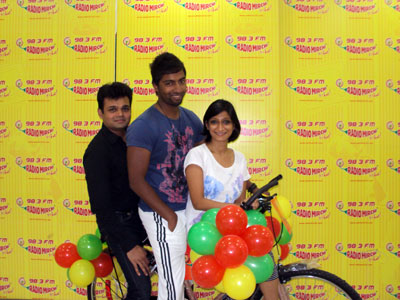
  • Radio Mirchi tackles petrol price hike!

    By A Correspondent


    The continuous price hike in petrol has left everyone in a fix and in a unique initiative, Radio Mirchi gave away bicycles to lucky listeners for an easier, better and eco-friendly commute.


    Radio Mirchi invited listeners to give a vent to their angst in a enjoyable and memorable way. RJ Jeeturaaj asked Mirchi fans to compose fun, peppy poems on the constant increase of fuel prices on ‘Hi Mumbai’.On popular evening show ‘Sunset Samosa’, RJs Suren & Meera ran a musical contest where listeners had to sing and complete songs they had created on a cycle.


    The innovative initiative by Mirchi registered huge participation from the listeners as they spoke about the troubling state of affairs caused by the ever rising price hike on the airwaves.


  • Competition Commission approves RIL Trust’s stake buy in Network 18, TV18

    By A Correspondent


    India’s competition watchdog has approved Reliance Industries’ acquisition of stake in Raghav Bahl’s media companies Network 18 and TV18 Broadcast.


    The Independent Media Trust, a trust set up for the benefit of Reliance Industries Limited, acquired the stake by subscribing to the optionally convertible debentures of companies controlled by Mr Bahl.


    The deal, expected to be around Rs2,700 crore, is touted to be one of the biggest in the media industry.


    The Competition Commission of India states in its order that the assessment of competitive impact of the proposal was carried out to ascertain whether both groups are engaged in production, supply, distribution, storage, sale or trade of similar or identical or substitutable goods or services.


    However, CCI noted that new channels can be started with ease in the country given the scope of innovation and technology. “The commission is of the opinion that the proposed combination is not likely to have any appreciable adverse effect on competition in the business of supply of television channels in India… specific determination of relevant product and geographic market in respect of supply of television channels in India is not necessary,” the CCI said in an order put up on the commission’s website.


    The TV18 group operates CNN-IBN and CNBC TV18 channels, among others.


    Source: The Economic Times
    Copyright © 2012, Bennett, Coleman & Co. Ltd. All Rights Reserved